



Abstract
Background:
Nurse managers are responsible for solving work-related ethical problems to promote a positive ethical culture in healthcare organizations.
Objectives:
The aim of this study was to describe the activities that nurse managers use to solve work-related ethical problems. The ultimate aim was to enhance the ethical awareness of all nurse managers.
Research Design:
The data for this descriptive cross-sectional survey were analyzed through inductive content analysis and quantification.
Participants and research context:
The data were collected in 2011 using a questionnaire that included an open-ended question and background factors. Participants were nurse managers working in Finnish healthcare organizations (n = 122).
Ethical considerations:
Permission for the study was given by the Finnish Association of Academic Managers and Experts of Health Sciences.
Findings:
Nurse managers identified a variety of activities they use to solve work-related ethical problems: discussion (30%), cooperation (25%), work organization (17%), intervention (10%), personal values (9%), operational models (4%), statistics and feedback (4%), and personal examples (1%). However, these activities did not follow any common or systematic model.
Discussion and conclusion:
In the future, nurse managers need a more systematic approach to solve ethical problems. It is important to establish new kinds of ethics structures in organizations, such as a common, systematic ethical decision-making model and an ethics club for nurse manager problems, to support nurse managers in solving work-related ethical problems.
Keywords
Introduction
Nurse managers have a responsibility to solve work-related ethical problems, 1,2 undertake ethical decision-making, 3 and support nurses in solving ethical problems. 4 The ethical problems that are properly resolved promote greater ethical reasoning among nurse managers and improve the ethical culture of organizations. 5 Stronger ethical culture is associated with a lower prevalence of ethical problems as well as higher work engagement. 6 Furthermore, the ethical decisions made and any activities taken as a result of those decisions become critical because of their direct impact on the overall quality of care. 7 Good quality of care is widely accepted as an overarching value at European Union (EU) level and is shared across the Europe. 8 There is a growing concern for how well nurse managers are able to solve work-related ethical problems when they are facing fast, ongoing procedure changes, restructuring, budget restrictions, reforms to improve productivity, 9,10 and the growing demands and expectations in terms of both quality of care and value for money. 3 Solving ethical problems should not be ignored due to these pressures. In this study, the term nurse manager refers to nurse leaders and managers at different levels in healthcare organizations. Although the ethical problems may vary at different levels of management, similar activities can be used to solve these problems.
Ethical problems are understood as difficult issues that require moral solutions, and the solutions must be based on moral principles or values and what is fundamentally good or right. Ethical problems may be new and unfamiliar, or they can be recurring day-to-day issues. The term ethical dilemma is used when a choice has to be made between two equally unsatisfactory alternatives and there is a clear conflict between competing moral principles and values. The situation becomes irresolvable and often leads to endless disputes and disagreement. If it is possible to reframe the dilemma as a problem, however, it may be possible to apply problem-solving methods and find a viable solution. 11 In this study, work-related ethical dilemmas are thus seen as ethical problems, occurring in work and relating to work tasks.
Nurse managers occupy key leadership roles in health organizations worldwide, 3 and they make ethical decisions regularly. 7,12 There are several ethical decision-making models that can support nurse managers in their actual ethical decision-making, 5,7,13 –15 understanding different perspectives of a problem, organizing and prioritizing thinking, and appreciating the implications of the various options. 7 All follow a quite similar process: clarify and define the nature of the problem; identify key facts, values, and stakeholders; list a course of action; identify the results of each action on each stakeholder now and in the future; decide on the specific action; and evaluate its outcome. 5,7,13 –15
However, all ethically competent nurse managers who make routine decisions may traverse these steps so quickly that they are not consciously aware of them. For less common challenges, managers need to dedicate conscious time and effort when seeking ethical decisions. Nurse managers and organizations should have already determined their own guidelines for identifying and solving their ethical problems, 16 ethical decision-making rules, clear models, 14 and their own systematic approach to ethics. 12 It cannot be assumed that leaders “of good conscience” will automatically figure out the most ethical action to take, as even they are not immune from making decisions that have not been thoroughly examined for their ethical content. 14
According to earlier studies, nurse managers use their personal values 1,17 –20 and their colleagues to solve ethical problems. 1,17 –21 They also use discussions, 21,22 ethics committees, 1,18 professional meetings, organization policies, 20 the Patient’s Bill of Rights, 1,17 –19 and codes of ethics. 1,17,18,20,23 The proto-codes of the European Nurse Directors Association 24 and the codes of ethics of both the International Council of Nurses 25 and the Association of Academic Managers and Experts of Health Sciences in Finland 26 offer ethical guidance and inform managers about how they should act. 24 The usefulness of such codes of ethics has been shown to be positive for many kinds of problems, 23 although the usefulness of codes of ethics for actual decision-making has also been criticized. 27 For these codes to be meaningful, they have to be clearly known, understood, and, of course, usable. 28
An essential component for the best ethical decision-making is also an absence of undue pressure that would compromise one’s own ethical standards. Furthermore, it is important to ensure that nurse managers are well equipped and educated in terms of how to deal with their own and their staff’s problems. Ethics training, 20 ethics committees, 29 ethics clubs, 30 and different kinds of ethics meetings should be easily available. Ethics rounds and educational experiences help to identify and analyze ethical problems, stimulate critical reflection, and support ethical decision-making. 31 Support from senior leaders and organizations is also needed. 4,32 Supportive surrounding of the organization is seen as prerequisite for ethical competence. 30 Furthermore, ethics conversations or rounds led by ethics experts can act as forums for processing and discussing ethical issues, 33 offering broadened thinking and strengthened confidence to act. 34
Although there are a few studies on nurse managers’ problem-solving activities, there is a need to study the process of their ethical decision-making. 35 Particularly, more ethical problem-solving descriptions are needed as well as more knowledge on specific activities that nurse managers use to solve work-related ethical problems and the process these managers consciously adopt to make their own ethical decisions. Earlier studies have mainly looked at nurse managers’ own activities. The activities supported by the organizational structures are seldom studied. 20
Aim of the study
The aim of this study was to describe the activities that nurse managers use to solve work-related ethical problems. This knowledge can provide supportive resources for nurse managers in solving future ethical problems. The ultimate aim of the study is to enhance nurse managers’ awareness of the importance of ethics and their ethical activities. The study’s main question was the following: “What activities do nurse managers use to solve their work-related ethical problems?”
Methods
Study design, sample, and data collection
The data for this descriptive, cross-sectional survey were collected in 2011 from nurse managers working in Finnish healthcare organizations. There are nearly 5800 nurse managers in Finland working at the ward or the middle level of organizations. 36 To achieve a broad and diverse description of the nurse managers’ activities in solving work-related ethical problems, data were collected from the approximately 1170-member Association of Academic Managers and Experts of Health Sciences. The union is a national interest group for managers and advanced consultants/specialists in the social and healthcare sector. Members hold a master’s degree in nursing science or a related discipline. The target group included all nurse managers registered with the union who hold ward-, middle-, and strategic-level posts (N = 326). Excluded (N = 1170 − 326 = 844) were different kinds of experts who do not work in management roles. The sample was a large group of nurse managers countrywide from different management positions and with a corresponding mean age (50 years) and gender (female 94%) in terms of the whole population of nurse managers in Finland. 36
The data were collected using a questionnaire that included an open-ended question and background factors. First, there was one open-ended question where respondents were asked to describe, without any limitations, at least one activity they used to solve work-related ethical problems at work: describe how you solve ethical problems that you face at work, relating to your work. Second, there were structured questions that included background factors (gender, age, education, current work, and length of work experience). The questionnaire was pilot tested in a sample of nine nurse managers to test the feasibility of the study and the clarity of the questions. The Association of Academic Managers and Experts of Health Sciences provided the address labels, and the questionnaires were sent to the nurse managers’ home addresses with prepaid envelopes for returning the completed questionnaires. During the 2-week response time, 122 responses were received (response rate of 37%), and the majority of the respondents (n = 104) also answered the open-ended question.
Ethical considerations
Permission for the study was given by the Association of Academic Managers and Experts of Health Sciences in 2011. Because the study did not involve patients or intervention in the integrity of a person, institutional ethics committee approvals were not needed. 37 However, careful consideration of research ethics was done. Potential participants were informed via a cover letter about the aim of the study, the principle of voluntariness, and the anonymity of the respondents, as well as the opportunity to get additional information or withdraw from the study. 38 The completed questionnaire was considered to be consent to participate in the study.
Data analysis
Inductive content analysis 39 and quantification were used to analyze the open-ended question. The transcribed version of the source material (A4) was typed in 1.5 line spacing to produce 79 A4 pages. The focus of the analysis was on the manifest content to nullify any chances of falsely interpreting the material. The units of analysis were the responses to the study task. For the scope of this research, a suitable meaning unit was used, namely, a constellation of words. Meaning units were condensed, abstracted, and labeled with a code. Then, these various codes were compared and sorted into eight categories, named according to their main content.
After the content analysis, the number of activities used to solve work-related ethical problems (n1 = the sum total of activities used to solve ethical problems) and the number of respondents (n2 = the number of people who brought forth activities to solve ethical problems of a particular category) were counted. Each respondent described at least one activity to solve a work-related ethical problem.
Microsoft Excel was used to analyze the structured questions. Frequencies, percentages, and means were used to describe the respondents’ backgrounds.
Findings
Respondents
The majority (98%, n = 120) of respondents were female with a master’s degree (83%, n = 102) and a mean age of 51 years. Most of the respondents were nurse managers working at either the middle or the strategic level (73%, n = 89), and most (86%) had 5 or more years of experience in healthcare management.
Activities to solve work-related ethical problems
The nurse managers described a variety of activities to solve work-related ethical problems (n1 = 193 solutions). During the content analysis, these ethical problem-solving activities were divided into eight categories (see Figure 1). Ethical problems were solved by using discussion (30%), cooperation (25%), work organization (17%), intervention (10%), personal values (9%), an operational model (4%), statistics and feedback (4%), and personal examples (1%). In the following paragraphs, the main ethical problem-solving activities for each category are described with support from original respondent quotations.

Activities of nurse managers to solve work-related ethical problems.
Using discussion
In most cases, ethical problems were solved through discussion (30%, n1 = 59). Nurse managers had discussions with the different participants involved in the issue and on the justifications and the values related to the situation (see Table 1).
Solutions to ethical problems using discussion.

Using cooperation
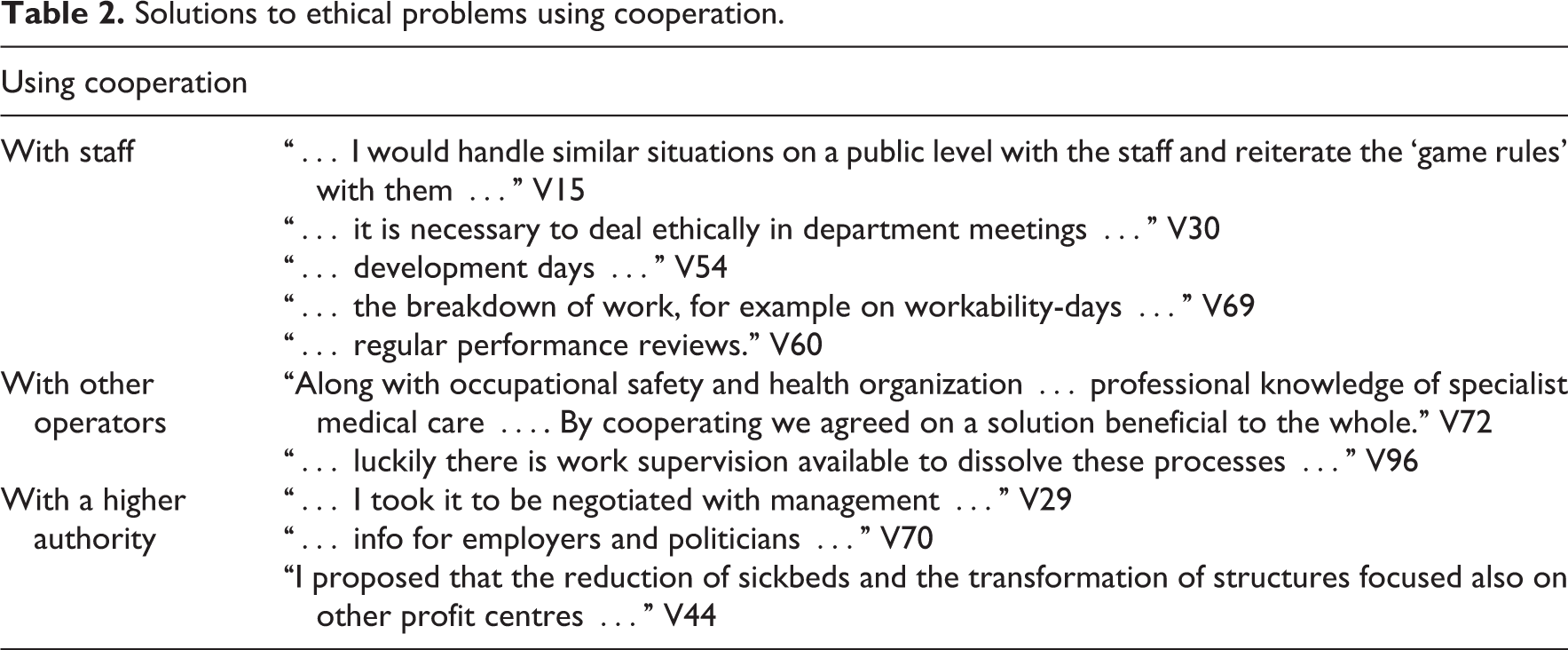
Nurse managers also worked to solve ethical problems using cooperation with others (25% of solutions, n1 = 49). They cooperated with staff, other operators, and higher authorities (see Table 2).
Solutions to ethical problems using cooperation.
Using work organization
Ethical problems were also solved using work organization (17%, n1 = 32). Work was organized by arranging work tasks, resourcing the staff, agreeing on work-related matters, dividing and changing the workload, using an additional workforce, and directing the flow of patients (see Table 3).
Solutions to ethical problems using work organization.

Using intervention
Ethical problems were also solved using interventions (10%, n1 = 19). Nurse managers were taking up matters, giving warnings, breaking situations, and directing staff to the occupational health center (see Table 4).
Solutions to ethical problems using intervention.

Using personal values
Nurse managers solved ethical problems by using their own personal values (9%, n1 = 18). They strive to work according to their values with righteousness, equality, transparency, respectful, humane behavior, and good care. They also try to use their values to direct them to their own best solutions (see Table 5).
Solutions to ethical problems using personal values.

Using an operational model
Nurse managers solved ethical problems using operational models (4%, n1 = 7) with the use of shared operational models, rules, and instructions (see Table 6).
Solutions to ethical problems using an operational model.

Using statistics and feedback
Ethical problems were also solved using statistics and feedback (4%, n1 = 7). Feedback came from clients, staff, or students. The utilization of statistics meant the use of different clinical monitoring forms and statistics to help solve these ethical problems (see Table 7).
Solutions to ethical problems using statistics and feedback.

Using personal examples
Ethical problems were also solved using personal examples (1%, n1 = 2). Nurse managers were considered to act as examples for other staff (see Table 8).
Solutions to ethical problems using personal examples.

Discussion
Ethical problems are diverse, complicated, and unique, and when solving them, there is a need to have multiform solution methods. In this study, nurse managers described various activities that they use to solve work-related ethical problems. Activities were their own (using work organization, personal values, intervention, and personal examples), realized together with someone else (using discussion, cooperation) and with the support of the organizational structures (using operational model, statistics, and feedback). Nurse managers solved work-related ethical problems most often by discussing them. It is an important part of nurse managers’ work to discuss the ethical premises, aspects, and solutions on which they build their practice at different levels of their organizations. Based on these data, nurse managers worked to solve ethical problems, made conscious ethical decisions, and worked together at different levels to solve problems guided by their own values and operational models. Nurse managers also sought support for situations and found different ways to take ways to deal with these problems into shared meetings, theme-days, and performance reviews.
However, the actual used activities seemed to be quite unstable and uncertain as precise guidelines when solving work-related ethical problems. Nurse managers’ activities to solve ethical problems did not follow any common or systematic model. Meslin et al. 40 found that different organizations manage the same ethical issues differently. In this study, there was a described use of operational models. No one described ethical decision-making models, although the use of models was recommended decades ago. 2 Furthermore, ethics committees were not described as solving ethical problems at all. In the1980s, Sietsema and Spradley 17 found that nurse managers working in hospitals without ethics committees reported ethical conflict more often than managers in hospitals with ethics committees did. A formalized ethical problem solution mechanism, however, did decrease the level of ethical conflict for nurse managers. It is important for nurse managers to have closely argued, clear, and transparent solutions because these managers should be professional role models, 41 modeling ethical decision-making to nurses 3 and thus overall ensuring that nursing remains ethically at the highest level. 25
It is also noteworthy that nurse managers used their own values for solving ethical problems. However, none indicated that organizational or professional values supported them in problem-solving, not codes of ethics. It is possible that nurse managers had adopted certain organizational and professional values so deeply that they did not mention those separately although we expected that a code of ethics would be mentioned. Codes of ethics should serve, support, and guide nurse managers 32 in ethical decision-making. The fact that none of the nurse managers indicated the use of ethics experts may describe the situation in Finland. Ethics experts are not employed in clinical settings, although there are examples of their valuable use in other countries. 33,34
Strengths and limitations
Certain limitations need to be taken into account when interpreting the results of this study. First, the goal of the study was to collect representative descriptions about the activities of nurse managers when they were solving work-related ethical problems. The response rate of 37% was relatively low and weakened the trustworthiness of the study overall. A reminder letter might have increased the response rate, but because the survey was anonymous, sending one was not possible. However, that trustworthiness was strengthened by broad and positive material in the study: Written answers to the open-ended question were rich and diverse and were organized into categories according to similarities. The resulting categories from the content analysis were also quantified to highlight the commonness of the ethical problem-solving activities being used. A focus group interview may have produced even more multidimensional data; however, collecting nurse managers from different parts of the nation for a focus group would have been too challenging. The questionnaire was also considered to be easier for nurse managers to respond to challenging and even sensitive ethical issues in private and peace at work or at home. Second, to improve the trustworthiness of the research, the analysis was described in such minute detail that another researcher could easily follow the exact steps used in the analysis of this research material. 42 Furthermore, there were direct quotations from the nurse managers included, so readers will be able to evaluate the findings easily. 39
Conclusion and recommendations
The ethical problems that nurse managers face are diverse and will continue to be so in the future. Problems will stay the same to a certain degree, but new types of problems will also surface. It is important to establish, support, and use new kinds of ethics structures in organizations and to better support nurse managers in their ethical problem-solving. These ethics structures can include implementing a common, systematic, ethical decision-making model, based on the results of this study, as such tools seem currently to be missing from most nurse manager activities. A systematic ethical decision-making model would support nurse managers and help them deal with immediate problems 11 and likely will improve the process and the outcomes of ethical decisions. 15 It would also better equip nurse managers to deal more effectively with new problems in the future. 11 Furthermore, essential nurse leader competency in 2020 is predicted to require expert decision-making that is clearly rooted in empirical science. Using systematic, scientific approaches in ethical decision-making will increase the likelihood of making quality decisions that work well for all concerned. 43
It also appears that nurse managers are not aware of ethics committees or, at the very least, are not using those that do exist. Two dominant types of ethics committees exists in organizations: (1) research ethics committees (RECs), which focus on a review of research practices involving human subjects and (2) clinical ethics committees (CECs), which focus on moral issues related to patient care. 44,45 In Finland, there are nine RECs, and they are centralized in university hospital regions 46 and regulated by the Medical Research Act. 37 REC regulatory structures have been developed at both international and national levels, while CECs have remained much less regulated. 44,45 In Europe, a number of countries have established CECs to provide support to health professionals when they solve ethical problems, 45,47 whereas in Finland CECs have developed more slowly. For example, in Norway, in every hospital trust, there is at least one CEC that uses a structured ethical decision-making model to ensure a good decision-making process and the best possible foundation for any decisions its healthcare personnel must make. These CECs arrange seminars for hospital employees, elaborate and develop ethical guidelines, discuss general and individual patient cases, and encourage multi-professional cooperation to view and address ethical problems from different points of view. 48
The ethics structures of each organization must include a CEC. It is also important to consider using an ethics committee or an ethics club for nurse manager problems. In such nurse manager clubs, nurse managers can discuss not only ethics but also their work-related ethical problems and can analyze or solve these problems with the support of a common ethical decision-making model. Nurse managers have several other ethical responsibilities in addition to solving individual ethical problems. These responsibilities include developing their own ethics knowledge and conducting and/or implementing ethics research. Nurse manager ethics clubs can also offer support to help nurse managers meet any of these responsibilities. If it is correct that value consciousness and an increased ability to solve ethical problems can save resources without reducing quality of treatment and care 49 and that the ethical management of nursing can have a positive impact on the commitment and well-being of staff and consequently on the care of patients 50,51 and higher patient satisfaction, 52 then there is no reason to leave these ethical structures without effective organizational support.
This study offers an overview of nurse manager activities to solve work-related ethical problems. More detailed information is still needed. In the future, it would be interesting to test different systematic ways to solve ethical problems and to identify which can best enhance the quality of ethical decisions and advance the overall ethical culture of each organization.
Footnotes
Acknowledgements
The authors would like to thank all the nurse managers who kindly participated in the study and reflected on the aspect of ethical problem-solving activities that they have encountered in nursing management.
Conflict of interest
The authors declare that there is no conflict of interest.
Funding
This study received no specific grant from any funding agency in the public, commercial, or not-for-profit sectors.
Research Ethics Board Approvals
Permission for the study was given by the Association of Academic Managers and Experts of Health Sciences (2011-05-02). The completed questionnaire was considered to be consent and a willingness to participate in the study.