



Abstract
Background:
Nursing students, during their study, experience significant changes on their journey to become nurses. A major change that they experience is the development of their moral competency.
Objective:
The purpose of this study is to explore the process of moral development in Iranian nursing students.
Research design:
A constructivist grounded theory method was adopted. Twenty-five in-depth, semi-structured, face-to-face intensive interviews with 22 participants were conducted from September 2013 to October 2014. All interviews were audio-taped, transcribed, and analyzed using writing memos and the constant comparative method.
Participants and research context:
The setting was three major nursing schools within Tehran, the capital of Iran. Nineteen nursing students and three lecturers participated in the study.
Ethical considerations:
The study was approved by the Tehran University of Medical Sciences Committee for Medical Research Ethics (92/D/130/1781). It was explained to all participants that their responses would be treated with confidentiality and that they would not be identified in any way in the research and any publication ensuing from the research. All participants agreed to be interviewed and signed written consent forms agreeing to the recording and analyses of the interview data gathered.
Findings:
Findings indicated three levels of moral development along with the formation of professional identity. The three levels of moral development, getting to know the identity of nursing (moral transition), accepting nursing identity (moral reconstruction), and professional identity internalization (professional morality), were connected to the levels of professional identity formation.
Discussion:
The proposed model added a new insight to professionalism in nursing.
Conclusion:
From the findings, it was concluded that to enhance higher moral practice, nursing instructors should promote the professional identity of nursing students. Reinforcement of moral characteristics and professional identity within registered nurses occurs over a series of phases and, once fully integrated into the identity of nursing students, the moral characteristics that they acquire become part of their both professional and personal identities.
Introduction
Nursing is regarded to be one of the most ethical and trustworthy professions in the world with the profession attracting individuals that are considered to have a high level of moral standards. However, the reasons as to why nurses are prepossessed of such of high level of moral standards remains in question. To answer this question, scholars have raised two major possibilities. The first possibility may be that those attracted to pursuing a career in nursing are individuals who already have a highly developed sense of morality. The second possibility may be that through the process of undergoing nursing education, the morality of students is enhanced. In this regard, there are some findings that have indicated that nursing students do morally evolve during their college education. 1 – 6
Moral development is defined as the development of an individual’s understanding of the rules and principles that distinguish right from wrong. 7 Furthermore, it has been suggested that the level of moral development can play a role in decision-making processes. 8 In this regard, Kohlberg 9 notes that moral competence is “the capacity to make decisions and judgments which are moral (i.e. based on internal principles) and to act in accordance with such judgments.”
Moral development within nursing students
Numerous studies have been conducted examining the moral development of nursing students. Duckett et al. 10 showed that moral development in nursing students was significantly different between entry and graduation. Students with lower scores at entry had higher scores at graduation, indicating benefits derived from the program. The study of moral development of nursing students in Finland also showed that nursing education may exert a beneficial effect upon students’ moral development. 11 Furthermore, the results of two studies on Korean nursing students showed that the level of moral development was higher at graduation. 12,13
There is thus a plethora of studies that indicate that nursing education has a positive effect on moral development of nursing students during college years, culminating in a high level of moral development at graduation. However, the influential factors within nursing education that students are exposed to and how this relates to an unfolding evolvement of higher moral development have not been specifically identified. Consequently, nursing scholars have been compelled to utilize general theories of moral development to inform educational programs. For example, Baxter and Boblin 5 proposed a foundation based on the works of Kohlberg, Gilligan, and Restas as tools to reduce unethical behaviors among nursing students.
Nursing education in Iran
Iran’s Bachelor’s degree in Nursing Education is a 4-year program. Entering into the program is gained through participating in a national entrance exam. Students are primarily selected based on their exam scores with less weighting being accorded to their interest in pursuing a career in nursing. As greater weighting is placed on scores obtained in the entrance examination and not simply on individual’s natural desire and inclination to become nurses. It thus seems that assessing the first possibility, that is, that the high degree of moral development among nurses is attributable to the nature of individuals interested in and attracted to the degree may not be able to be fully tested. However, an examination of the unfolding of moral development during the educational process could be examined, and it was this possibility that the study focused upon. Pursuing this possibility was also supported by previous studies of moral development in Iranian nursing students which had suggested that positive changes in moral development do occur during students’ college years. 14 –16
The study of morality within nursing education has been a field of specific interest in Iran during the past years with a number of Iranian studies having been conducted. For example, in a grounded theory study by Borhani et al. 14 which explored moral competence in Iranian nursing students, findings indicated that effective professional role models and the facilitation of creative learning are two main factors in the development of moral competence in nursing education. Vanaki and Memarian 15 also conducted a grounded theory study to investigate the process of moral competence development in nursing students. Their findings indicated that personal factors and useful work experiences played a significant role in moral competence development. They also observed that high moral competence had a strong effect on clinical competency. They concluded that moral individuals were more responsible and had greater commitment to their work.
A review of the literature showed that nursing students morally evolve during college years. Also, most of studies in this field have been carried out utilizing a positivist paradigm. Few naturalistic studies did not answer the question of how morality develops in nursing students. Despite the useful results of these studies, the underlying process of moral development still remains unclear. There is a knowledge gap regarding the process of moral development and the specific factors influencing this development. Far more research is required in this area in order to enable nursing researchers and educators to identify how moral development is influenced, nurtured, and developed. Such knowledge is required in order to enable educators to positively influence the moral development of nursing students and new practitioners. The purpose of this study is therefore to explore the process of moral development in Iranian nursing students.
Methods
This research was a grounded theory study utilizing a constructivist approach. Constructivist grounded theory was chosen in order to inform strategies and procedures for exploring participants’ meaning-making of their experiences through qualitative inquiry. 17,18
Participants, procedure, and data collection
The study was conducted in three major nursing schools in Tehran, the capital of Iran. Initial sampling criteria were being a nursing student in Bachelor’s degree and having experience of decision-making in morally involved situations. The researchers constructed tentative ideas after the first interviews. Thereafter, ideas were examined through empirical inquiry. New participants were selected through theoretical sampling to elaborate and refine theoretical categories.
The first author, who was also a nursing instructor, interviewed participants in diverse clinical settings. The first author visited schools and educational hospitals and asked students whether they have encountered experiences of moral decision-making. He asked students whether they had the experience of feeling compromised between doing what is right or choosing their own interests which was not necessarily aligned with doing what would be considered to be right. Students who had experienced these kinds of dilemmas were then asked to participate in the study. After obtaining their consent, participants were provided with a definition of moral decision-making. They were then each asked to describe their experience of situations in which they were required to make “moral decisions.” Participants were selected across all 4 years of program. In addition, three nursing educators were interviewed.
Because following the same student during college years was not a feasible method for doing this study, the method used by Piaget and Kohlberg in their studies was used. Piaget observed and interviewed children in different ages and compared their reasoning. 19 Kohlberg also used the same method. In his doctoral thesis, Kohlberg interviewed 10- to 16-year-old boys living in the suburban areas of Chicago. Then he followed them in his next study. 19,20 We also asked the students to explain their experiences from moral decision-making from their first year of study. Then we asked them to compare their reasons and feelings about the decisions during college years.
Data were collected through intensive interviews which facilitate gathering rich data within constructivist grounded theory. The researchers developed an interview guide according to constructivist grounded theory approach which consisted of three parts: initial open-ended questions, intermediate questions, and ending questions.
In the initial open-ended questions, the interviewer asked about lived experiences of participants with questions such as “Have you ever experienced being stuck between doing right or wrong?” The interviewer followed up with intermediate questions such as “Did you ever think about your decision? “What was your reason for the decision that you made?” and “How do you manage situations like this? You learned … from who?” The main part of interview guide was intermediate questions. Finally, ending questions such as “Is there something else you think I should know to understand … better?” were used to close the interviews.
The researchers also utilized memo writing as an analytic tool as well as the data collection method. Memo writing keeps researcher involved in the analysis process and helps them to increase the level of abstraction of their ideas. 17 Theoretical saturation was achieved when no new properties of the theoretical category were emerging from the data. 17,18
Data collection (recruitment and interviews) and data analysis occurred iteratively. Interview guides were revised according to memos after analyzing each interview. Twenty-five in-depth, semi-structured, face-to-face intensive interviews with 22 participants were conducted from September 2013 to October 2014. The duration of interviews ranged between 25 and 60 min. The first author transcribed interviews after listening to each one several times. The researchers continued interviewing until redundancy of data was apparent and theoretical saturation was achieved. The age of students participating in the study was between 18 and 30 years with the mean ± standard deviation (SD) of 21.68 ± 3.00 years. Eleven students (57%) were male. All three instructors were female and they were 35, 45, and 46 years old.
Data analysis
Constructivist grounded theory approach was adopted for data analysis. Data analysis began with coding. The first three interviews were coded by research team. Coding was conducted in two phases: initial and focused coding. Initial coding was begun after the first interview. The researchers were mindful of remaining open and staying close to the data. Through this phase, we kept our code simple and compared data with data. We selected focused codes according to their frequency and significance. We constantly compared data with data, codes with data, codes with codes, codes with categories, and categories with each other. We especially compared incidents of moral decision-making in the first and last years of nursing program.
We used our focused codes as the title of our successive memos. Memos were used to shape concepts and their properties. We tried to theoretically develop our memos during the study and make them progressively more analytical. Sorting memos according to their importance in the process of theorizing was made during several meetings with the research team. The relationship between concepts was made clear by the utilization of diagrams. The researchers explored how and why nursing students construct meanings and actions in morally involved situations. The process of data analysis is presented in Figure 1.
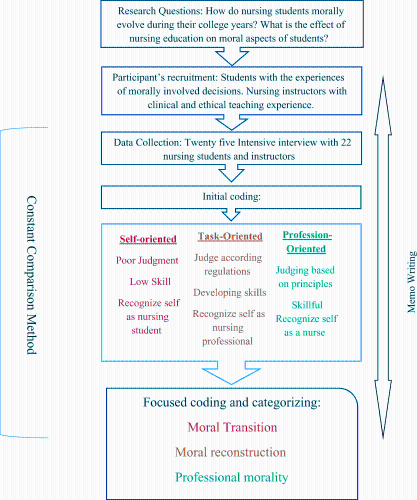
Analysis process showing coding and category development.
The criteria outlined by Charmaz 17 including credibility, originality, resonance, and usefulness guided this work to assure that the final product was genuine.
Ethics
The study was approved by Tehran University of Medical Sciences Committee for Medical Research Ethics (92/D/130/1781). All participants signed written letters of informed consent agreeing to be interviewed. Participants were assured that their identity would remain completely anonymous. The identities of the participants were only known to the interviewer.
Results
An examination of the data indicated that becoming a nurse and developing moral competence can be likened to the unfolding of a journey. Based on the emerged themes, we constructed a model to show the moral changes that students experience in the journey to become a nurse. According to our interpretation, moral development happens along with the formation of professional identity. From the point of origin within this journey to its final destination, nursing students undergo significant changes. One of the major changes is the evolution of their moral competence. All nursing students who participated in the study had experienced changes in their moral competence. These changes are the result of being confronted with moral issues and which require morally based decisions.
The most important feature of the journey was its gradual nature. Phases appeared to be successive and irreversible, and students would have to pass through earlier phases in order to reach phases of higher development. Each phase had its own characteristics and each student, depending on their particular circumstances, experienced these changes in their own unique way. However, the results did indicate that depending on the individual’s unique circumstances, not all students reached the latter stages.
Moral development model
The constructed model showed developmental process to occur within the context of an input and an output decision-making system. Decision-making systems are named self-oriented and social/professional-oriented. The decisions among the first years are mostly self-oriented and in the final year are more based on a social/professional-oriented system. The developmental process consists of three levels of formation of professional identity which are related to moral development steps illustrated in Figure 2.
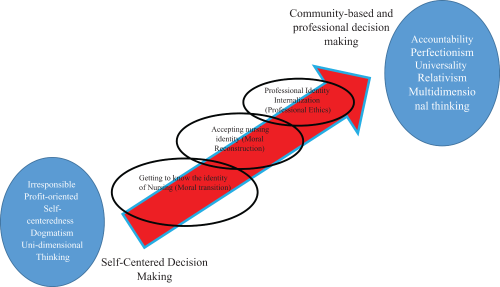
Moral and professional identity development model in nursing students.
Moral transition (getting to know the identity of nursing)
Becoming a nurse, just like any other journey, begins even before departure. The beginning of this journey occurs as the individual makes a decision to enter the discipline. At this stage, prospective students usually know very little about nursing and the burden of ethical decisions that are entailed in being part of the profession. This phase, in which the student becomes familiar with the identity of nursing, has two steps. The first step is indirect recognition. During this step, an understanding of the meaning of nursing is acquired indirectly through the descriptions and explanations of others. Nursing course instructors are the first source of such knowledge for first-year students. A fourth-year student described within her memoirs the reporting a medication error: Our clinical instructor had told us we should report it. I could not believe it (had) happened to me … it was very hard. It is a nurse’s duty to report (such an error). I was a student. I thought more about myself. (Participant 3)
In this regard, Participant 10 noted that “When you dress (in) your white coat, people look at you differently, then you think I should be more responsible.”
In this phase, although the students’ knowledge about nursing is superficial, the fact that they recognize themselves as “a nursing student” does seem to effect the decisions that they make. One of the participants described encountering a car accident victim in the street when she was in her first year of college. The effect of self-recognition as a nursing student was obvious in her social act: When I decided to help him I had this feeling that I am a nurse now, I am responsible for his health. (Participant 8) The family say(s) look “be smart, consider your benefits.” But when I entered into nursing I saw here is the opposite. I should report my mistakes. “I” was not the matter at the moment. In the first semester doing such a thing was unbelievable for me. (Participant 15)
Moral reconstruction (accepting nursing identity)
The second phase of moral development unfolds with an acceptance of one’s nursing professional identity. This is the second station in the journey of becoming a nurse. The student, having chosen nursing as a career, begins to engage more with “becoming” a nurse. Thus, at this phase, they begin the formation of their professional identity. Acceptance and the formation of professional identity are the results of nursing students’ direct experience of the clinical environment. The students construct a meaning of nursing in this phase. The meaning is also a result of their interaction with the education system. This interaction happens within all components of the system, especially through their interactions with their instructors, registered nurses, and most importantly with their peers, that is, their cohort of nursing students.
Acceptance of nursing identity and the adoption of its moral values are based on the particular meaning which they construed as a result of their own personal direct experiences within the clinical setting. The following excerpt illustrates the more professional change in the meaning that is attributed to “being” a nurse and is suggestive of moral reconstruction:
Interviewer: what changes happened in your idea about being a nurse: By entering into medical-surgical courses, we start to look at nursing as a scientific profession instead of some basic techniques. (Participant18)
The conscious acceptance of professional identity and how this evolved from the earlier transition phase is illustrated in the following excerpt offered by a student who was in her last year of study. Once again there is evidence of moral reconstruction within this excerpt: When you enter into a profession you try to be like them. I was not very kind to people at the time, but after I identified myself as a nurse I began to be nicer and I developed tolerance within myself. (Participant 7) Several times I was in situations that I couldn’t decide about what I should do. Like when I injected the wrong dose of insulin. It was impossible to delay, the life of patient was in danger. Other professions are not like this. (Participant 12)
Within this phase, there is also evidence of the role that peer-supported learning plays in moral reconstruction. One of nursing education’s characteristics is training within small groups. Peers play a significant role in the development of each other because they are bound by common experiences and the learning that they engage in within their groups, which is participatory. In each group and within each situation that they are exposed to, a level of synergy occurs between peers as they analyze and make decisions together. The impact of this participatory learning is so significant that over time they begin to adopt a shared form of decision-making that they will enact even in the absence of one another. Thus, it appears that over time and through group participation, a code of similar conduct is developed and adopted.
The development of peer-supported learning and developing a shared code of conduct is apparent in the following excerpt: Even registered nurses did not pay enough attention to him, but my friend and I went to help him and changed the bandage. Maybe, if I was alone, I would not have enough courage to do that. (Participant 10) When I thought about that (situation) later, I told to myself maybe I could (have) solve (d) the problem better. If I had the same experience before or if someone had told us what we should do (then) in … (Such) situations it (would) not (have) take (n) that long (to resolve). (Participant 19) Since we learned about the importance of confidentiality of patients, I tried to keep other peoples secrets confidential. (Participant 19)
During this phase, the old decision-making value system, which has been evidenced to be lacking with regard to professionalism, evolves and reconstructs itself to a higher moral level. The new system is based on values that the students have perceived of as being critical within the professional nursing setting. Students begin to acknowledge that they must place the interests of others above their own self-interest, reconstructing their moral value system to one that is more professional and one that operates considerably above the level of utilitarian self-interest that was still evident when they first entered into their nursing education. The students thus take strong heed of professional values in decision-making, considering higher moral values and the benefits of others rather than their own benefits only. This experience of the students within the clinical setting, their interaction with their lecturers, students, and their peers thus plays a considerable role in their derived and learnt “meaning” of nursing and in their moral reconstruction.
Moral internalizing (professional identity internalization)
The last station of the journey is moral internalizing. In this phase, nursing students fully internalize the professional characteristics of nursing into their identity. The greater the duration of their exposure to working within the professional climate, the greater the likelihood that they will fully internalize these professional characteristics into their professional identity. The imbibing of these professional characteristics into their professional identity reflects within their personal traits as their professional identity, that is, their sense of being fully engaged with being a nurse becomes part and parcel of their personal identity. One participant notes how the characteristics that she acquired during nursing have become part of her personal daily life: I practiced to only speak about the disease and the questions that our trainer asked us. Now, I see people tell me their secrets, not just patients, but my relatives, I consider myself a nurse there too. I think confidentiality has grown in me as a trait. (Participant 20)
Another participant also notes that she had undergone a change in her manifestation of particular traits since entering into her nursing education. In this regard, she identifies characteristics of kindness, honesty, and caring for others, which she notes are far more evident within her as compared to before she entered her nursing training: I compare myself with before I come to nursing, I have changed a lot. Other people are now more important to me. When I meet someone, I consider a lot of things. I try to be honest and kind with people. (Participant 9)
It becomes apparent that with the multidimensional development of nursing students in college years, many changes may likely occur in the degree of their morality. As their sensitivity to moral aspects grows within their professional training, students gain greater insight into the moral issues that may arise in their daily lives. Alongside their development of cognitive competencies, in which they exhibit enhanced critical thinking, there is a distinct growth in moral emotions of empathy, compassion, honesty, and confidentiality. In this regard, nursing students become gradually transformed during their training evolving into “moral agents.”
Part of the first author’s observation in the open-heart intensive care unit, with seventh-semester students, indicated the degree to which a student had become a moral agent. In this regard, the student was extremely upset by the fact that patients in critical care units were being attended to by nursing assistants who he felt were lacking in expertise: This student drew my attention. He was older than others and he had experience in clinical settings and was therefore a suitable participant. Because of personnel shortages, some of nursing work was being done by nursing assistants. The student was very upset about the situation.
Discussion
Nursing is one of the most influential healthcare professions that requires high level of moral skills and competencies. Several studies have shown that Iranian nurses have high levels of moral development and that nursing education has played a considerable role in this development. 1 –3,14 –16,21 Within this study, the changes in moral development were associated with the formation of professional identity. The developmental process of moral evolution in nursing students was constructed with three levels. This model specifically focused on exploring the association between the three levels of professional identity and the unfolding moral development of nursing students.
What the findings did seem to illustrate was that nursing students’ moral development was significantly influenced by their interaction with their instructors and educators, interaction with registered nurses in clinical practice, and interaction with their peers. Similarly, a qualitative research study on American nurses which sought to explore how nurses professional identity was established indicated that nurses need to find a place where their values and skills successfully fit with their colleagues and the environment within which they practice, and that this fit was molded by the interaction with and influence of one’s peers, in this instance, colleagues. 22 The importance of environment and role models has also been highlighted in other studies. For example, Borhani et al. 21 argued that nursing instructors should provide a creative learning environment and supportive learning conditions in order to enhance the learning experience and the development of professional competencies within nurses. Within this study, the researchers also propose that the “whole learning system,” with all its components and embedded values, is of critical importance in the development process. Furthermore, this research notes that the development of moral competencies is not simply a function of educational instruction by lecturers/educators but is also, to a great degree, a function of the participatory learning that occurs through engagement with peers. This research has utilized as an analogy for the formation of nursing identity as that of a “journey travelled.” The unfolding of becoming a more moral person is perceived as a journey in which nursing students are the travelers, sojourning to their final destination of a fully integrated professional identity with the highest degree of moral competence attainable for the individual concerned. The point of departure, at the “first station” which is aligned to stage 1 of the model, is getting familiar with nursing and commencing with the most basic understanding of the complexities of the field. Nursing students, at the beginning of the journey, have an extremely superficial understanding of nursing, and this level of understanding is supported by other studies which have noted similar superficiality of knowledge within the early stages. For example, in a recent study in Iran, knowledge of nursing was very low within the first-year students. 23 Similarly, the results of two studies conducted on nursing students within the United Kingdom illustrated that nursing students have a relatively simple knowledge of nursing in their first year, but their perceptions begin to undergo changes in the first year and thereafter. 24,25
Generally, the theoretical courses that students are exposed to within first semester do not have a considerable effect on their nursing students’ knowledge and their understanding of the profession. It is when they move on to their clinical practice that a far greater understanding is obtained. In this regard, the learning that takes place within clinical practice could be argued to be the “second station” that the student arrives at as part of his or her educational and moral journey in becoming a nurse with an integrated professional identity and moral competencies. Other studies also indicate that clinical education has a far more significant effect on the development of professional identity in nursing students as opposed to the theoretical components that students are exposed to. 26 Thus, it is one’s clinical education and exposure to practice that takes students far further into their experience of and introduction to nursing, and thereby their moral and professional development.
At this point, as they arrive at the “second station,” that is, stage 2 of the model, although they “know” themselves as students in this stage, their moral competencies are not significantly higher than they were upon first entrance into nursing education. This is supported by many other studies that illustrate consistent findings regarding the relatively low levels of moral competency of nursing students as they enter clinical practice. 1 –3,6,10 –12,27,28 At this point, that is at their arrival at the second station of clinical practice, the moral skills and learned values and their lack of efficacy become apparent. During this stage, as they gain exposure to real-life contingencies and situations, new skills are shaped and new values are adopted, with these new skills and values being reflected in an enhanced level of moral decision-making. As students become more and more familiar with nursing and the exigencies of daily practice, their moral competency develops and they start to accept nursing as a part of their identity. Professional identity is hereby forged by the experience of being a nurse and actually “doing it.” 29 More specifically, it is forged by practice and socialization, clinical engagement, and observation of professional roles and functions. 30
A further critical part of the journey is “acceptance.” Acceptance of nursing as a career is a crucial phase of professional identity development. Students who cannot “accept” nursing and integrate it into their identity will not sustain their studies and will be more likely to drop out. Even for those who continue and complete their education despite a lack of acceptance and interest, they are more likely to ultimately leave the profession. 31,32 By accepting nursing as a career, the students, while sojourning at the second station, have begun to learn and integrate new values and skills into their repertoire. At this stage or at this station, the students “reconstruct their morality.” Their personal values are replaced with or assimilated with their newly acquired professional values and new moral skills and competencies are also developed in response to an ever-increasing exposure to new and repeated challenges in the field.
The last stage in our model, utilizing the journey analogy, is the “third station,” that is, the internalizing of professional identity. When students recognize themselves as nurses, it effects all aspects of their life. It is a stage or station at which there is the fullest possible integration of professional identity and the greatest enhancement of moral competencies and is arrived at when students are in their final year of study. 1 –3,6,10 –12,27,28
To reach this level, the students need to have “bonded” with nursing. In a study of Japanese nursing students, “bonding into nursing” was defined as the process by which each nurse fully established her or his professional identity as a nurse. The researchers within the Japanese study utilized a substantive theory that was very similar to the one used in this research. The steps that they described were learning from working experiences, recognizing the value of nursing, establishing one’s own philosophy of nursing, gaining influence from education, having a commitment to nursing, and integrating the nurse into the self. 33
In a study by Vanaki and Memarian, 15 they also noted that personal factors and useful work experience were significant in moral competence development. Based on their findings, ethical individuals were more responsible and had more commitment to their work. They argued that being more moral is the reason that one has more job commitment. In contrast, we deduced simultaneous development of professional morality and identity from our model.
As Rest and Narvaez 34 illustrated that every profession has its effect on moral development, so do the present researchers believe that nursing has its own route of and effect on moral development. Furthermore, we argue that the development of morality occurs in conjunction with the formation of professional identity.
Within our conceptualization, professional identity is defined as attitudes, values, knowledge, beliefs, motives, and skills which are shared within a professional group. These features shaped along with one’s personal identity are ultimately developed into one’s professional identity and role. 30,35 The formation of one’s professional identity is also influenced by the relationship of the individual within their immediate professional community. 36,37
As such, professional identity is an integral part of the personal identity of nurses, which forms in a step-by-step process. 38 Formation of professional identity is a process which transforms a layperson into a professional. It is a result of work experiences and the facing of new challenges within the work environment. Through this process, professional values and competencies are developed within the individual and are ultimately integrated with his or her personality. 39
We argue that moral development is a result of engagement with moral situations. The results of this study and a study on Finnish nursing students show that exposure to difficult and morally burdensome situations increases the moral competency of students. Baxter and Boblin 5 similarly argue that being in difficult situations and struggling to resolve them causes moral development and acceptance of responsibility.
Conclusion and implications
This study explored, through the collection of qualitative data, the stages that nursing students go through in their development of their professional identity and moral competencies. The findings of the research have led to the proposal of a three-stage model which outlines three levels of moral development and identity formation and can be utilized to explain the differences among graduates in their moral competencies.
From a practical perspective, these findings have important implications for the planning of nurses’ moral education.
Nurses work in a dynamic environment and they are required to make tough decisions every day. They need to have proper skills and competencies in relation to ethical issues. It is nursing education’s duty to prepare students in this regard. Nursing education administrators can benefit from the results of this study in developing nursing curriculum that considers the moral development of their students. Educators should consider the level of nursing students’ moral development and professional identity as well as contributing factors in their training.
We believe that nursing students should shape their professional identity in the real work environment and by dealing with challenging situations. Formation of professional identity by positive experiences and participatory learning can develop required moral competencies.
Based on our findings, we recommend that nursing educators use proper methods and content. The unsuitable choice of method and content does not promote effective education. The complicated content that is suitable for a professional nurse can confuse a fresher student. In contrast, the simple content and methods can bore a registered nurse.
Study limitations
Development of morality is influenced by various factors. In addition to natural cognitive development during college years, many environmental factors can affect the process. We connected the development of morality to the formation of professional identity. However, we did not overlook the role of other factors. We connected the development of morality to the formation of professional identity and while we did see this occurring as a function of the educative process across three different levels, given that our study was exploratory, we did not take into account the variations in the individual circumstance and the personalities of participants. While personality variables and demographic variables such as gender and socio-economic status can affect the process, these are variables that we recommend should be explored in future research on the development of moral competencies and professional identity within nursing students.
Footnotes
Acknowledgements
We would like to gratefully acknowledge the research participants for their generous contributions. We would also like to acknowledge all those who cooperated in the research project; also, our thanks go to the Tehran University of Medical Sciences for their coordination and financial support. We confirm that the article has been read and approved by all named authors and that there are no other persons who satisfied the criteria for authorship but are not listed. We further confirm that the order of authors listed in the article has been approved by all of us. We confirm that we have given due consideration to the protection of intellectual property associated with this work and that there are no impediments to publication, including the timing of publication, with respect to intellectual property. In so doing, we confirm that we have followed the regulations of our institutions concerning intellectual property.
Conflict of interests
The author(s) declared no potential conflicts of interest with respect to the research, authorship, and/or publication of this article.
Funding
The author(s) disclosed receipt of the following financial support for the research, authorship, and/or publication of this article: This study is funded by a research grant from the Tehran University of Medical Sciences.