



Abstract
Background:
The concept of professional commitment is being widely studied at present. However, although it is considered an indicator for the most human part of nursing care, there is no clear definition for it, and different descriptors are being used indiscriminately to reference it.
Objective:
The aim of this study is to clarify the concept of professional commitment in nursing through the Rodgers’ evolutionary concept analysis process.
Design:
Systematic search using English and Spanish descriptors and concept analysis. Studies published between 2009 and June 2015, front-to-back analysis of the Nursing Ethics journal and manual check of articles cited in studies related to the Nijmegen Professionalism Scale.
Research design:
The procedure of concept analysis developed by Rodgers was used.
Ethical considerations:
Although the topic was not labeled as sensitive and subject to ethical approval, its realization was approved by the Ethical Committee of Clinical Research of Aragon (CEICA) approved the study on 18 March 2015 and also careful procedures have been followed according to ethics expressed in the Declaration of Helsinki.
Findings and discussion:
A total of 17 published studies. A clear definition of the concept was made, and surrogate terms, concept dimension, differential factors related to the concept, sociocultural variations and consequences for nursing practice were identified.
Conclusion:
There is a need for continuous advancement in the development of the concept, specific actions to encourage this and the improvement of evaluation methods for its study.
Keywords
Introduction
Healthcare is in constant change and transformation, due to factors such as increasing the demand for high-quality standards, advances in training, improvement in the practice of health professions, increasing ageing, demand for care, autonomy, expectations and recognition of patients’ rights. All this influences the nature of the health organization that should, in theory, translate into a greater professional commitment. However, it must be borne in mind that hospitals and other places where health services are provided are complex environments, combining different professional groups that, due to the current economic changes, have limited templates, of work and diminished resources, which causes that the health professions are suffering constant symptoms of exhaustion and discontent: it increases the number of conflicts, the stress, the professional wear and dissatisfaction. 1 –3 In particular, the nursing group is considered one of the great risk groups to suffer the so-called burnout syndrome, due to its high degree of relationship with the patient. These situations, generated by a series of factors that are difficult to modify that are sufficiently conditioned by the lack of resources, provoke the search for motivational resources of low cost, that promote of individual way, the professional commitment that has been identified as a factor relevant in the studies that address these problems. 4 This broad and difficult concept is the key to understanding the difference between care as a professional nurse activity and spontaneous care activity. 5
In summary, due to the world shortage of nurses, turnover, the decision to leave the profession and consequences such as stress, anxiety, lack of autonomy and excess workload, the nursing be growing concern with the definition and evaluation of professional commitment; however, the apparent ease with which it is recognized, changes in healthcare policy, cultural differences, the evolution of the characteristics of work and the profession, educational methods and other personal factors hinder its definition. 6
Many attempts have been made to define the ‘professional commitment in nursing construct’. These studies aim to increase the performance of professionals, the quality and safety of healthcare provision, and financial returns, and to study the ethical and moral realm of professional responsibility.
Given the ambiguity that exists and the numerous surrogate terms used to encompass the same construct, detailed study of its definition and characteristics is needed. Evidence that supports its relevance and work on its evolution and quantification are required.
Background
Due to this recent professionalization, nursing has been considered a semi-profession. Nonetheless, through the present implementation of study programmes, research and theory, 7 nursing possesses a scientific corpus of knowledge and skills that confer professional autonomy. In recent years, research in the field of nursing has generally focused more on technical and clinical advances than on the less tangible aspects of the profession, which appear to be being more studied and valued at this time.
Reflection on professional commitment emerged to improve on the idea that job satisfaction affected behaviours such as absenteeism and staff turnover. 8
Eagerness to improve the service provided to users of healthcare systems had led research of professional commitment in nursing to become focused on negative factors or consequences for those who practise it, such as burnout syndrome, stress and job dissatisfaction that are directly related to the occupational characteristics of the places where it is practised, and which hinder suitable action to be taken. However, different authors have concluded that professional behaviour depends on other factors. 9
The studies that deal with the concept are few and ambiguous. Despite the existence of different constructs for the concept and lines of research, no consensus has been reached as to its definition. There are diverse instruments that aim to quantify it; however, these focus on behaviours of daily practice, driven by concerns regarding increased healthcare costs, the shortage of nurses and quality of care, among others, and not on concerns for encouraging the human side of healthcare.
The analysis of concept is necessary to eliminate the ambiguities about it, clarify the dimensions of the construct and above all, study the ethical and moral sphere of professional responsibility that differentiates the spontaneous activity of care from the professional activity of caring. All this will allow the development of initiatives that increase the professional commitment and thus the human quality of the care provided by the nursing professionals.
Design and search methods
It was decided that the method proposed by Rodgers 10 (Figure 1) would be used. This methodology has been used in similar works. 6,11,12

Rodgers’ 10 evolutionary concept analysis process.
In addition to the study of the essence of concepts, the proposed method provides the vision of a changing and dynamic reality, leaving aside the literal or semantic meaning. Due to the objective of the present investigation, this method proves to be very adequate because the concept under study is a changing concept in context, culture and time. This methodology, unlike others, is a cyclical process which facilitates analysis in complex concepts such as the one studied, allows to clarify the current use of concepts and clearly defines their attributes as a basis for the later development of the concept. 11,12 In general, this type of methodology is used when the concept is poorly defined, its characteristics or attributes are not clear or the evolution of this is constant.
The starting point in order to include all uses of the concept was the documents extracted from the work Systematic Review of Professional Commitment summarized in Figure 2 and Table 1.

Summary of systematic review strategy nursing professional commitment.
Literature review.

This included 106 works (primary articles) cited in three articles dealing with the construction of the Nijmegen Professionalism Scale. 13 –15
A search was made of the Medline, PubMed, IME, IBECS, Cuiden, SciELO, Enfispo, Cochrane Plus, Web of Science, MEDES and TESEO databases. The literature review was in both English and Spanish languages. It was decided to include the Spanish language since Spain is the country where the study has been carried out and it was also wanted to corroborate that in this language, little has gone into the meaning and relevance of the professional commitment in the nursing profession. The following search concepts were included: ‘Commitment’, ‘Compromise’, ‘Concept analysis’, ‘Engagement’, ‘Professionalism’, ‘Professionalization’, ‘Professional Practice’, ‘Nijmegen’, ‘Responsibility’, ‘Compromiso’, ‘Análisis concepto’, ‘Profesionalismo’, ‘Profesionalización’, ‘Práctica Profesional’ and ‘Responsabilidad’, combining the descriptors/key words with the words ‘Nursing/Enfermería’, ‘Nurse/Enfermera’ and ‘Nurses/Enfermeras’ (operator ‘and’), that were included in the title. Were taken into account the publication date of the originals had to be within the previous 5 years (November 2009–November 2015), since in the preliminary investigation, it was clear that the study of the concept was recent and it was intended to know its current meaning. However, documents were retrieved from the main references, completing the understanding of the evolution of the concept over the last two decades (1994–2007).
To complete the search, due to the ambiguity of the terms used and the definition of the concept, a manual review was carried out and a front-to-back analysis was made of Nursing Ethics (November 2009-November 2014), although this magazine was included in the PubMed repertoire, to analyse one by one the originals published in the last 5 years. Due to which the duration of the process was updated again, according to the same methodology, until June 2015.
Search outcome
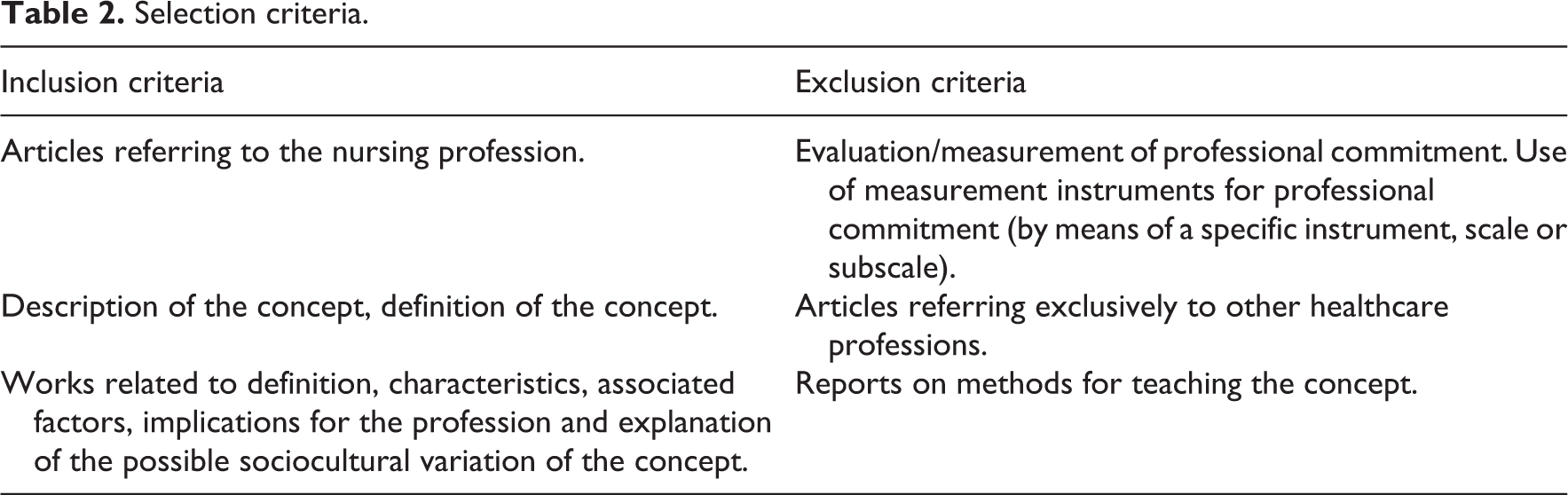
After analysing the content of 99 original works, it was decided that the analysis should only include works of a qualitative nature, understanding those documents that did not intend to quantify the professional commitment, that is to say, they did not use instruments of measurement or evaluation, that is to say works whose objective was to describe characteristics, associated factors, implications for the profession or explanation of possible sociocultural variations of the concept. The works of a quantitative nature focused on measuring specific behaviours and did not provide abstract definitions or broad attributes. An exception was made with the inclusion of the original by Jenaro et al. 9 Despite the use of quantitative methodology, its aim was to analyse the association between the individual characteristics of nurses’ work and the professional commitment. The other selection criteria can be found in Table 2.
Selection criteria.
A total of 17 works were analysed (Figure 3 and Table 3). The most relevant themes were identified by means if thematic content analysis through provisional categories were created based on the questions: How can professional commitment in nursing be defined?; What are the characteristics or attributes that define it?; What factors are associated with professional commitment in nursing?; What are the implications of achieving optimum levels of professional commitment in nursing?; and Are there sociocultural or temporal variations in the clarification of the concept? (Table 3).

Strategy selection studies concept analysis nursing professional commitment.
Characteristics analysed studies.

Results
Surrogate terms and relevant uses of the concept
As explained by Ghadirian et al., 6 ‘The term “surrogate” is used for the concepts that express the same meaning of the desired concepts. In other words, the term explains the meaning of a concept’. Akhtar-Danesh et al. 16 affirm there is no consensus on the definition of professional commitment in nursing. This may be due to the different terms of substitution that appear in the literature.
The substitutive terms used by the works analysed, which do not necessarily have similar characteristics, (Table 3) are set out below. It also explains the meaning of the term commitment to value differences.
Commitment
This is the commitment of offering service to society, belief in respect and the values of every individual; the commitment to education and autonomy, and the intention to continue to work as a nurse. It is the way people think about the profession and show their loyalty to it. 21
Professionalism
The concept of professionalism has been studied since the 1960s by healthcare professions. A number of authors provide a general and abstract definition for this concept, while others are more specific through their description of behaviours.
Letelier-Valdivia and Velandia-Mora 27 consider it to be ‘a moral ideal of nursing care whose aim is the protection, enhancement and preservation of human dignity’. Akhtar-Danesh et al. 16 include specialization, intellectual and individual responsibility, and group consciousness in their view.
There are authors who consider the concept to mean its practical expression. Zibrik et al. 29 define it as the conduct, goals and qualities that designate someone as a professional. Arnold 30 considers it to be a set of behaviours put into service of the good of others through vocation, with a body of knowledge and skills. Keeling and Templeman 7 consider that such behaviours are shaped by autonomy and self-regulation, to which they add the belief in public service that prevails in the United Kingdom. Ghadirian et al. 6 also highlights the importance of acquiring a professional ideology, measured by the best standards, as does Dehghani et al., 18 who consider it relevant to take into account personal and professional characteristics. In relation to the latter, Hutchings et al. 20 have been focusing on patient-centred professional work. They consider professionalism to be attention and work centred on interest for patients’ characteristics, preferences and desires.
Engagement
There is apparently more consensus in relation to this term, essentially considered an attitude towards work. According to Gokenbach and Drenkard, 19 it refers to an attitude that allows one to be physically, mentally and emotionally connected to work. In keeping with the line previously established by Jenaro et al. 9 and Keyko, 24 they define it as fulfilment and a positive state of mind characterized by drive, dedication and absorption in work. In the research carried out by Beattie and Crossan, 17 which aimed to determine the characteristics of the concept, it is defined as a positive attitude held by an employee towards the organization and its values.
Meaning in work
According to Lees, 26 this is the discovery of meaning in the experience of work, the actual job and its purpose.
Attributes of the concept
Attributes are the characteristics of the concept that you set apart from the rest. This step tries to discover the essence of the concept, leaving aside other non-defining characteristics of the concept of professional commitment in nursing. Through the analysed bibliography, this study proposes the following attributes.
Learning the knowledge and skills inherent to the profession
Constant and specialized learning forms a part of the commitment that is acquired through the practice of any profession. However, this aspect takes on great relevance in nursing due to the constant changes that take place. Jafaragaee et al. 21 firmly believe that the development of knowledge and experience is a defining characteristic of the commitment to offer the best care.
Nevertheless, there is obvious concern regarding the connection between theory and clinical practice. An example of this is the results obtained by Keeling and Templeman 7 who discovered this concern about the concept of professionalism in nursing students. Knowledge of theory should therefore be understood as an ideal which should be incorporated in daily practice. Thus, this attribute not only includes formal and permanent knowledge in clinical competences, described by authors such as Letelier-Valdivia and Velandia-Mora 27 and Walker et al., 28 but also encompasses other aspects, such as the obligation of being informed, learning interpersonal skills, collaboration and communication, and even the ability to adapt. 16,18,20
Acquisition of values
Values are philosophical constructs. While they are general, they are not found in the same way in all people, and hence the importance of their acquisition in professional life. By way of example, Alfred et al. 31 found significant differences between the values held by nurses in Taiwan and the United States. Professional ethics, however, are rules that should govern the conduct of a group and are ‘imposed’ by the profession as a whole and not by individual commitment.
All the analysed works refer to the importance of personal values in professional practice. An example of this is the work by Akhtar-Danesh et al., 16 which although differentiating between four profiles when defining professionalism, stressed the importance of values being placed at the service of professional tasks, including the respect for human dignity, personal integrity, protection of privacy and protection of patients from any harm. Other authors point to accessibility and flexibility; empathy and altruism; vocation, personal commitment integrity, compassion and the defence of moral, legal and social values; trust, honesty, positive attitude, kindness, patience and respect for confidentiality, among others. 20,22,27,28
The importance of the acquisition of values is also reflected in the opinion held by Lees, 26 who described engagement as a set of five core values. The same importance is seen in the work by Dehghani et al., 18 which proposed that emphasis should be given to human values and in the work by Jafaragaee et al., 21 who insist on the development of these values and the fostering of high-level human virtues.
The development of this aspect, according to the literature analysed, should be brought about by means of a hidden curriculum that tacitly conveys appropriate values.
Acknowledgement of professional responsibility
The acquisition of knowledge, skills and values necessarily involves the acknowledgement of the responsibility that arises in the decision-making process. These also include, as explained by Hutchings et al., 20 the duty of care and attention to high quality.
This does not only entail the ability to reflect over such aspects but also encompasses personal responsibility to the nursing profession; in other words, the constant evaluation of daily practice, and even judgements on the practice of others; adherence to codes of professional ethics; participation in the advancement of the profession, whether through research, teaching or participation in organizations and actions; and the feeling of belonging that hinders abandonment.
This aspect appears explicitly in the consulted literature. Akhtar-Danesh et al. 16 point out that all of their sources included accountability, responsibility and adherence to professional codes of conduct as essential elements that define professionalism. The nursing students interviewed by Keeling and Templeman 7 revealed their concern for the imminence of responsibility, showing their understanding of nursing as a ‘way of life’, including the importance of the ability to judge others. Jafaragaee et al. 21 considered promotion of the profession as indicative of commitment; in other words, pride in being a nurse, being responsible and negative about abandonment. Walker et al. 28 referred to adherence to a code of conduct, the ability to recognize mistakes, work ethic, awareness, time management, commitment to profound reflection on practice, and evaluating colleagues and accepting evaluation from them. With regard to participation in the advancement of the profession, the opinion given by Natan et al. 32 includes as an element of professional commitment the functions of nursing preceptors, whose workload is increased and who take responsibility of the errors of their students.
Professional behaviours
This concept encompasses all types of behaviours that take place in work or in relation to the profession. These include the integral care that aims to prioritize the interests and well-being of patients; 18 the importance of personal appearance, inter-disciplinary collaboration, leadership and attitude; 16 accessibility, flexibility, adaptability, autonomy and working relationships; 20 support for other nurses and respect for cultures among others. 28 They can also be classified into subdimensions: behaviour towards the patient, behaviour towards other professionals, behaviour towards society and behaviour towards oneself, which would largely depend on the other described attributes.
Individual motivation is therefore an essential condition that characterizes the components of professional commitment. Concurring with Jenaro et al., 9 other external factors that are difficult for the professional to change or control are considered predictors and not definitory attributes of professional commitment.
Implications, consequences and hypotheses of the concept
The analysed literature shows the growing interest in the study of the concept. It is considered that the study of professional commitment will increase the quality of care and patient safety, personal satisfaction and that of users, professional authority and the ability to make decisions; will lead to the development of proficiency programmes to improve the effectiveness of education, reduce accidents and errors; will promote risk management, the creation of employment regulations, socialization, professional development, promotion of the profession and development of the concept itself. 9,18,21,25,27,29
All of these aspects are crucial for the development of nursing as a profession and for patients seeking quality care. In the same way, it is considered that staff with high levels of professional commitment strive to promote integral care, prioritizing patients without neglecting their responsibility towards themselves and their professions, which is a priority in current healthcare. 9,18,27 Moreover, in the long term, these professionals will increase their participation and satisfaction, fostering creativity and innovation. 22,25,27
Nonetheless, it is interesting to reflect on the opinion given by Ghadirian et al., 6 who despite pointing out the positive aspects derived from fostering professional commitment, sustain that in situations of uncertainty, blind spots may be created in the organization and the flow of vital information may be stopped as the result of professional groups forming their own subculture, particularly in their habits of language and communication. Therefore, they tend to be separated, even if they are working with other groups within an organization. If we include this possibility, there should be insistence on the importance of supporting other professionals and teamwork.
Concepts that are related, factors and elements
The analysed literature contains a number of factors of a general, multidimensional and dynamic nature which, while not being definitory items, be the concepts that are related to professional commitment and vice versa.
Examples of this are the studies by Beattie and Crossan, 17 who describe elements of employee engagement such as feeling valued and having a voice, satisfaction in the workplace, significant work, support culture and support for management, among others; by Hutchings et al., 20 who point out aspects related to the workplace: limited access to information, equipment and sufficient resources; suitability of facilities and so on; those related to users: lack of compliance with treatment, erroneous perceptions of the role of nurses, lack of involvement by carers and so on; and by Akhtar-Danesh et al., 16 who highlight the communication of beliefs and appropriate regulations by institutions. Other significant elements found in the consulted literature are given in Table 4.
Concepts that are related.

Sociocultural and temporal variations
Due to the previously described factors, Dehghani et al. 18 consider that the concept can vary between countries depending on the culture and context.
For instance, the work by Jafaraghaee et al. 22 concludes that Iranian nurses assume professional commitment as the result of their religious beliefs, a circumstance that does not occur in other environments. Another study conducted by Zibrik et al. 29 showed that a rural environment inevitably affected the ways in which nurses experienced and fulfilled their professional functions. Moreover, as described by De Araujo-Sartorio and Pavone-Zoboli, 34 the image of the nurse also depends on the specific context and culture of each work setting.
With regard to temporality, the development of new technologies, new care roles, changing expectations in patients and young nurses mean that the factors of the concept are in constant evolution. 28,35
A number of authors even suggest that the concept varies on an individual and personal basis. Lees 26 believes that employees perceive the importance of work in relation to other areas of their lives, and define it according to the context of personal life. Hutchings et al. 20 also include the specific relationship between nurse and user.
An exemplar or model case of the concept
As discussed in the article by Ghadirian et al., 6 of a similar nature to this work, it is difficult to describe a specific case that explains the true meaning of professional commitment due to the very nature of the concept.
Nevertheless, a number of works can be found that may explain the essence of the concept by means of the actual words of participants (semi-structured interviews). 7,16,22,28,29 A recent work can also be consulted in which Dehghani et al. 18 propose a specific case in the Iranian context.
Discussion
From the results extracted by this research, the professional commitment in nursing could be defined as the acquisition of knowledge and skills that allow a moral idea to be formed, through values, about the provision of good service of care, acknowledging the autonomy, self-regulation and responsibility inherent to the nursing profession, which creates a feeling of belonging to the profession. It is an attitude that provides a physical, mental and emotional connection to work and professional behaviours, measured by quality standards and placed at the service of others, and in which the offering of the best services should prevail, taking into account the professional and personal characteristics of patients according to the situation.
The proposed definition, together with the attributes identified could reflect a theory that is highly valid for nursing as it describes the essential components that should govern the profession. The concepts that are related, which cannot be considered definitory because they are beyond the control of the professionals themselves, should be studied in relation to the concept. Therefore, echoing Jenaro et al., 9 research into this concept should be encouraged in different contexts and circumstances in order to confirm the universal elements of the concept and their sociocultural and temporal variations, including the different roles in the profession (nurse practitioner, educator, researcher, administrative or management functions).
It is important to highlight the positive consequences of research into and work on fostering professional commitment for the profession from a positive perspective. The high rates of psychiatric morbidity among nurse administrators lead to the conclusion that models of commitment must be fostered that advocate increasing the personal motivation professionals from a positive perspective, instead of focusing efforts on rewards, which are not good methods for resolving the nursing shortage, for example. 9,36
Therefore, it is necessary to study alternatives that do not depend so much on material resources, but on the actual professional. More studies to date have focused on burnout and stress, 37 particularly with regard to prevention 24 and not on more positive alternatives for job promotion. Consequently, there are difficulties to identify situations where professionals with low professional commitment offer low-quality care, without suffering from identifiable conditions such as stress or burnout syndrome.
Limitations
Data sources searched were limited to those published during November 2009–June 2015, with the exception of landmark articles; however, it was intended to know the meaning of the concept at present.
The limitation caused by the subjectivity of the surrogate terms used in the initial search should be recognized. In order to reduce this subjectivity, the terms were extracted from the existing literature and a sufficient number of descriptors were used in order to leave no gaps in the search.
The heterogeneity of the selected documents, understood as the differences in type, origin and so on, can be considered as another limitation. For example, the work of Jenaro et al. 9 analyses the association between nurses’ individual characteristics, job features and work engagement, not professional commitment. However, this characteristic has helped to more clearly define the concept by means of the different points of view and different terms used found in the existing literature.
As has been explained, Rodger’s evolutionary method is considered the most adequate to perform the analysis of concept, therefore, it is necessary to consider as a limitation the possibility of finding variations if alternative methods are used.
Finally, the use of the concept has only been analysed from qualitative works. This restricted the number of works in the literature and may have left a number of uses unstudied. However, it was considered that the qualitative approach would more appropriately cover both the abstract and the practical realms of the concept and can therefore be considered as strength of this study.
Conclusion
The identified terms are used indistinctly to encompass one concept. It is necessary to unify all of them in a concept that includes all the described elements.
The concept of professional commitment has been clearly defined, encompassing both the abstract and practical realms, and its attributes identified as encompassed by four dimensions. This analysis proposes a definition that can be considered universally valid, and does away with certain ambiguities.
It is necessary to continue research into the variations that the concept may have depending on the sociocultural and temporal context. 35 Only in this way can specific actions be adequately focused on fostering it and effective methods found to evaluate it in every context. Nursing is a universal profession, regardless of the fact that its practice is regulated in every country, and therefore, the proposed definition can be considered a starting point for the in-depth study of each context. 38
Major technological developments, amendments by health organizations to the controls limiting the autonomy and development of the profession, and the current economic situation and lack of resources compel the nursing profession to improve the attention given to its human side. This can only be achieved through the fostering of individual and collective professional commitment, which seems to be the only reason for remaining in the profession and improvements to levels of quality and services provided. 4,24,39
It is necessary to advance the development of the concept, perhaps specific actions to promote it and, consequently, to improve the methods for evaluating it in order to study it, without losing sight of the difficulty involved in achieving accurate tools. 40 –42 In fact, a number of authors warn against the idea of taking this concept to be an ideal, which would give rise to exhaustion, 43 and it is believed that it should be monitored rather than measured. 41
Footnotes
Acknowledgement
The authors thank Visitación Ortega Riba for her professionalism and assistance provided in obtaining the documents for analysis.
Conflict of interest
The author(s) declared no potential conflicts of interest with respect to the research, authorship and/or publication of this article.
Funding
The author(s) disclosed receipt of the following financial support for the research, authorship, and/or publication of this article: This research was funded by a grant awarded through the competition held by Víctor Grífols i Lucas Foundation, Spain.