



Abstract
Background and significance of research:
Nurses’ awareness of professional values and how those values affect their behaviors is an integral part of nursing care. There is a large body of research on nursing professional values, however, a careful survey of the available literature did not yield any studies investigating the status of professional values in operating rooms.
Objective:
This study aims to investigate the perception of operating room nurses of university hospitals toward professional values.
Research plan:
In this cross-sectional study, data were collected using Schank and Weis’s Nurses Professional Values Scale–Revised. The collected data were analyzed in SPSS version 16.
Participants and settings:
The 513 participants of the study consisted of operating room nurses and nurse anesthetists from six university hospitals.
Ethical considerations:
This study has been approved by the ethics committee of the university.
Findings:
The mean total professional values score of the operating room staff was found to be 100.84 ± 15.685, which indicates that the participants had a positive perception toward observance of nursing professional values in practice. The results showed that the participants considered the domains of justice and activism as, respectively, the most and the least important. The operating room staff’s overall professional values scores were not found to correlate significantly with their ages, professional experience, university majors, or attendance at ethics workshops. However, a significant difference was found between the professional values scores of the female and male staff. The professional values scores of the operating room nurses and the nurse anesthetists were not significantly different (p value = 0.494).
Conclusion:
Operating room staff’s awareness of professional values is essential to providing care to patients based on professional principles. Accordingly, there is need for programs to raise operating room nurses’ awareness of their professional duties and improve their professional performance.
Keywords
Introduction
Nursing is science and skill combined to provide effective professional care. 1 As the providers of physical, social, and psychological care to patients, nurses need to act according to a set of professional and ethical standards. In addition, at work, nurses face complex professional and ethical matters which can prove highly challenging in their interactions with patients and organizations. 2
Values are defined as goals and beliefs which shape one’s behaviors and provide a framework for decision-making and action. 3 Values include beliefs about what is right, good, or desirable and motivate social and professional behaviors. 4 Therefore, values affect one’s social behaviors and perception. 5
Professional values act as standards for action and are accepted by professional groups and specialists as a framework for evaluation of values and beliefs which influence professional behaviors. Professional values constitute the foundation of the nursing profession and enable nurses to cope with conflicts and prioritize measures. 6 Professional values are a framework for professional decision-making and action and contribute to one’s professional commitment. 7 Acceptance of such values is essential as they shape the identity of a profession and provide guidelines on professional performance. 8,9 Rooted in individuals’ personal values, professional values are influenced by family, culture, environment, religion, and ethnicity. The acquisition of personal values is a gradual, evolutionary process which occurs over the course of one’s life. 9 Likewise, development of professional values is a long-term process which begins with professional training and continues over the years of a nurse’s practice. 5 Due to differences in education, culture, personal values, marital status, experience, and specialty between individuals, perception of professional values can vary from person to person. 7
Nursing is a science and profession which stresses certain human values and the importance of ethical values. 10 As the largest group of healthcare providers, nurses should take care of patients according to ethical matters. 12 Variety in nursing roles increases the need for consistency and homogeneity in nurses’ values, knowledge, and personal skills. 5
Being at the core of the nursing profession, professional values provide nurses with guidelines on how to interact with patients, colleagues, other members of the medical profession, and people in general. They also provide nurses with a framework for ethical behaviors which result in safety and humane care. 12 Professional values play a key role in nursing and can help it thrive and guarantee high-quality care. The quality of nursing care can be enhanced through professional values, critical thinking, effective communication, cooperation, professional socialization, attention to the quality of healthcare, raising patients’ awareness, nurses’ job satisfaction, promoting clinical health, and patients’ confirmation of the quality of care. 6,12 Nurses with positive professional values, as a result of their great commitment to their organization, are more inclined to work responsibly and achieve better results than their peers. 13 Acquisition of professional values influences nurses’ skills in resolving conflicts and prioritizing measures. 8
The moral dilemmas in today’s clinical environments are becoming increasingly complex as a result of rapid technological advances and the increase in conflicts across personal, professional, and organizational values. Most of the ethical issues reported in nursing literature concern insufficient resources, unethical or poor performance of doctors or nurses, disregard for patients’ rights, and national or organizational policies which undermine the quality of healthcare. 7 Nurses encounter challenges not only in providing care but also in interacting with members of other medical professions, their work environment, and their peers. If nurses cannot actively cope with everyday ethical issues, they will not be able to meet the standards of care. 1
While professional and ethical values are very important in nursing, they are sometimes forgotten for various reasons. Development and implementation of strategies to enhance nurses’ capability of providing ethical care requires an identification of their perception of professional values in nursing. Therefore, this study set out to evaluate nurses’ professional values in the operating room staff of university hospitals in 2017.
Background
In Iranian universities, operating room work and anesthesiology for nurses are treated completely separately from nursing. Thus, students accepted for the former majors start with basic courses in their respective fields of study.
A bachelor’s degree program in operating room work is one of the subcategories of medical sciences and introduces students to the new principles of operating rooms, modern advances in specialized surgeries, and how to care for patients before, during, and after an operation. The graduates can become members of medical teams and help improve the outcome of surgeries in operating rooms, diagnostic–clinical intervention wards, or mobile care centers.
In 1957, the Operating Room Nurses Association started as an independent international organization (in the Ministry of Health and Medical Education, Iran) to pave the way for the progress of operating room nurses as specialized individuals in medical teams. In Iran, associate degree programs in operating room work were available between 1988 and 2002, and as of 2008, universities have offered consecutive and non-consecutive bachelor’s degree programs in the field. Recently, a few universities in Iran have begun to train master’s students in operating room work. This major is offered in paramedical and nursing schools where operating room departments are in charge of training students in operating room work.
A subcategory of paramedicine, nurse anesthesiology introduces students to the new principles, methods, and equipment used to care for patients under anesthesia in general and specialized surgeries in operating rooms, as well as in intensive care units and emergency rooms; students learn to care for patients during the various stages of anesthesia through theory and practice. In Iran, consecutive bachelor’s degree programs in anesthesiology have been available since 2009; previously, only associate degree and non-consecutive bachelor’s degree programs were available.
Objective
This study aims to evaluate nurses’ professional values in the operating room staff of university hospitals.
Research plan
This is a cross-sectional study where data were collected using a two-part questionnaire: part 1 addressed the respondents’ demographic characteristics, and part 2 was Schank and Weis’s Nurses Professional Values Scale–Revised (NPVS-R) which addresses the five dimensions of caring, activism, professionalism, trust, and justice. The collected data were analyzed using descriptive tests (mean and standard deviation), t-test, analysis of variance (ANOVA), Pearson’s correlation coefficient, Friedman test, and SPSS v. 16; p values under 0.05 were considered as significant. Before the statistical tests were conducted, one-sample Kolmogorov–Smirnov test was used to ascertain the normal distribution of the data, which was confirmed by the results (p value > 0.05). Furthermore, Levene’s test was used to evaluate the homogeneity of the variances for the various groups, which was confirmed by the results (p value > 0.05).
Research questions
Is there a relationship between operating room staff’s demographics and their perception of professional values? What is the mean total professional values score of operating room staff in university hospitals? How does operating room staff rank the dimensions of professional values? Is there a significant difference between operating room nurses and nurse anesthetists in mean professional values score? Are there any significant differences across the participants’ mean scores for the various dimensions of professional values (caring, activism, trust, professionalism, and justice) in relation to their majors (operating room work, anesthesiology, and nursing)?
Method
Data collection instruments
The operating room staff’s perception of professional values was evaluated using a two-part questionnaire. The first part addressed the participants’ demographic characteristics, including age, gender, academic major, length of employment, and participation in ethics workshops. The second part of the questionnaire consisted of Schank and Weis’s NPVS-R. NPVS-R was developed and standardized by Schank and Weis to measure professional values in nurses; the instrument has been found to have satisfactory validity and reliability. NPVS-R consists of 26 items extracted from American Nurses Association Code of Ethics and covers the five domains of caring (9 items), activism (5 items), trust (5 items), professionalism (4 items), and justice (3 items). Scoring is based on a 5-point Likert-type scale. The score range is between 26 and 130, and higher scores indicate a better familiarity with professional values.
The validity of the instrument has been confirmed by five experts in the area of nursing professional values; and an evaluation of the reliability of the instrument yielded a Cronbach’s alpha of 0.92. 14 In a pilot study conducted at Tabriz University of Medical Sciences, the Cronbach’s alpha of the instrument was reported to be 0.91. The accuracy of the translation of the questionnaire from English into Farsi was verified by three faculty members of the Nursing and Midwifery Department of the university and two English teachers. For an evaluation of the face and content validity of the instrument, seven faculty members—four members with a master’s degree and three members with a PhD in nursing—from the Nursing and Midwifery Department of Tabriz University of Medical Sciences were asked to assess the items. 14 In their study of observance of professional values by American students in associate’s degree and bachelor’s degree nursing programs in 2003, Martin et al. studied 1366 subjects and reported the Cronbach’s alpha of NPVS-R to be 0.95. The content validity of the instrument was confirmed by an expert in ethics. 1,15 In this study, data were collected using pen and paper and on a self-report basis.
Sampling was conducted according to the random stratified sampling method and based on the size of each stratum: the hospitals were taken as the strata and at least 60% of the nursing staff of the operating rooms of each hospital was selected through random sampling for participation in the study. After making arrangements with the head nurses of the operating rooms of the hospitals in the morning, afternoon, and evening shifts, the researcher asked all the practicing nurses in the operating rooms to participate in the study. Subsequently, the nurses who were willing to participate were asked to fill out an informed consent form before completing the demographics questionnaire—developed by the researcher—and the NPVS-R.
Participants
The participants consisted of the nursing staff of six university hospitals affiliated with the university of medical sciences. The inclusion criteria were being willing to participate in the study, having an associate’s or a bachelor’s degree in operating room work and anesthesiology or a bachelor’s degree in nursing, and being the permanent staff of the operating rooms. The personnel who had recently been transferred to the operating rooms from other wards were excluded. Eventually, 513 nurses who met the criteria were selected for study. Using the formula for calculation of two means and considering the total sample loss, the researcher set the sample size at one and a half times the size yielded by the formula to increase the accuracy of the findings (type I error = 0.01, 90% power, sample size = 513).
Ethical considerations
This study has been approved by the ethics committee of the university. All the participants of the study were informed of the objectives of the study and filled out the informed consent form. The participants were assured that they were free to withdraw from the study at any point, that the questionnaires were anonymous, and that their responses would remain strictly confidential.
Findings
The operating room staff’s overall professional values scores were not found to correlate significantly with their ages, professional experience, university majors, or attendance at ethics workshops. However, there was a significant difference between the professional values scores of the female and male staff. The results of the independent t-test showed that the difference between the professional values scores of the operating room nurses and the nurse anesthetists was not significant (p value = 0.494; Table 1).
Descriptive statistics of the nurses’ demographics and how they correlate with their NPVS-R mean scores.

ANOVA: analysis of variance; SD: standard deviation; NPVS-R: Nurses Professional Values Scale–Revised.
a ANOVA test.
b Independent t-test.
* Significant (p < 0.05).
The mean total professional values score of the operating room staff of the university hospitals was found to be 100.84 ± 15.685, which indicates that the participants had a positive perception toward observance of professional values in practice.
The results of the Friedman test showed that the participants regarded the domains of justice (with a mean score of 3.75) and activism (with a mean score of 1.85) as the most and the least important, respectively. The mean scores obtained for the other dimensions of professional values were as follows: 3.68 for caring, 3.01 for trust, and 2.70 for professionalism. Based on the mean scores, the dimensions can be ranked thus in order of importance: justice, caring, trust, professionalism, and activism (Table 2).
The results of Friedman’s ranking to prioritize the dimensions of professional nursing values.

Regarding the fourth research question about how the mean professional values scores of operating room nurses compare with those of nurse anesthetists, the results of the independent t-test showed that the difference was not significant (p value = 0.494, t = 0.684; Table 3).
Comparison between operating room nurses’ and nurse anesthetists’ means and standard deviations for professional values.

O: operating room nurses; N: nurse anesthetist.
* Related to Levene’s test for equality of variances.
To answer the fifth research question concerning whether there are any significant differences across the participants’ means scores for the various dimensions of professional values (caring, activism, trust, professionalism, and justice) in relation to their college majors (operating room work, anesthesiology, and nursing), the researchers used the ANOVA test. Table 4 shows that considering the significance level for the dimensions of professional values (caring, activism, trust, professionalism, and justice), that is, 0.05, the mean scores of the participants who had majored in operating room work, anesthesiology, and nursing were not statistically significant. As the results were not significant, complementary analysis following the ANOVA was not required (Table 4).
Comparison across the mean total scores of the operating room staff, nurse anesthetists, and nurses for the different domains of professional values.
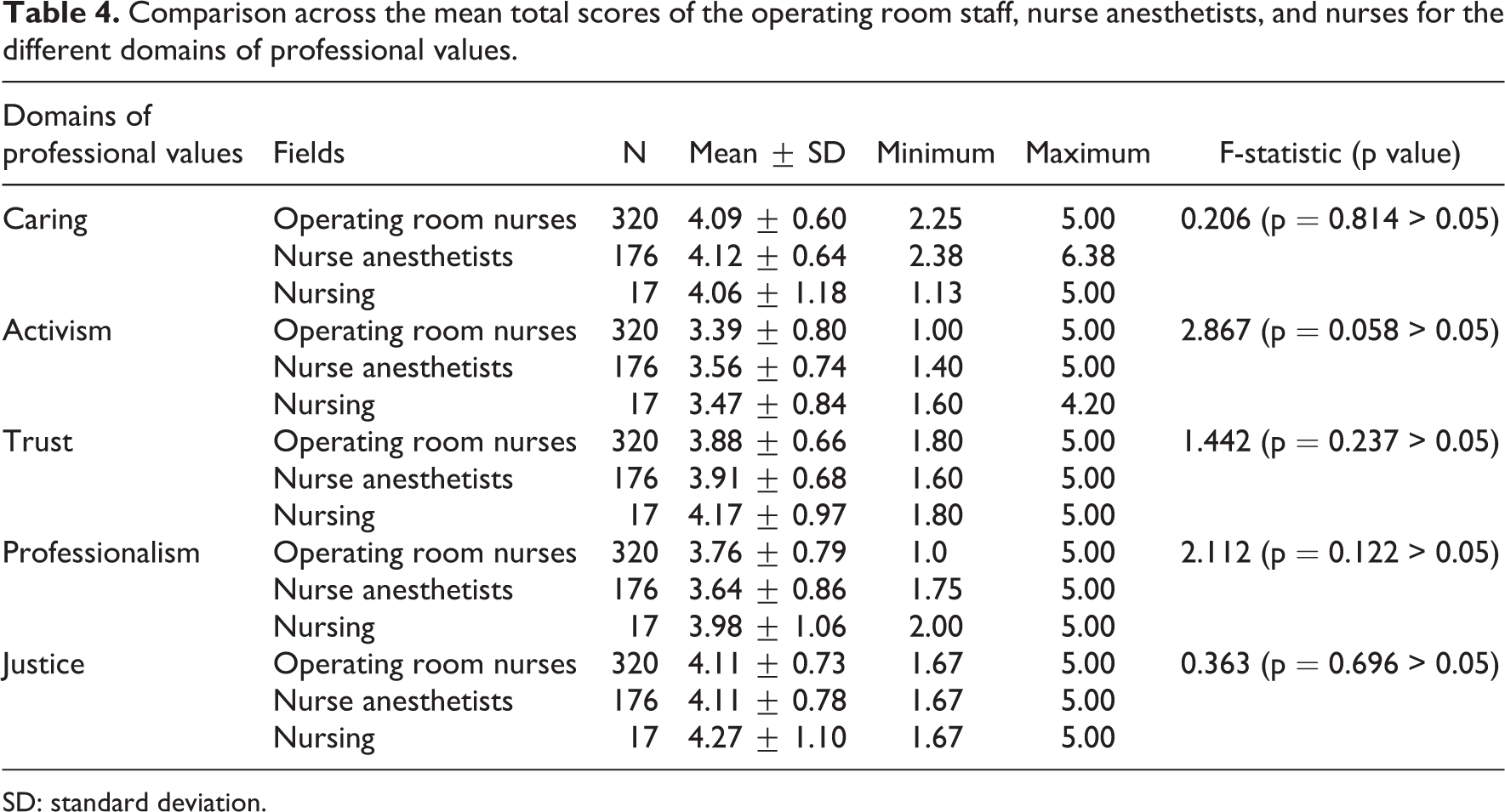
SD: standard deviation.
Discussion
This study aimed to explore operating room nurses’ perception of professional values. With regard to the first research question concerning whether there is a relationship between operating room staff’s professional values scores and the demographic variables of age, gender, work experience, university major, and attendance at ethics workshops, the researcher used one-way ANOVA or the independent t-test depending on the type of the variable. In each case, initially, the compatibility of the findings with the basic assumptions of each test was verified. The results showed that the nurses’ demographic characteristics, including age, professional experience, major, and attendance at ethics workshops, did not correlate with their perception toward observance of professional values. However, a significant correlation was found between the participants’ professional values scores and their gender.
Several studies report absence of a significant correlation between nurses’ age and their observance of professional values, which is consistent with the findings of this study. 15,16 However, the studies of Poorchangizi et al. 9 and Kubsch et al. 17 report a significant, positive correlation between professional values and age. It can be argued that increase in age leads to greater personal stability, better adaptive skills, and more experience, all of which reinforce professional values in nurses. 9 Yet, some studies report that older nurses achieve lower professional values scores, which indicates that nurses’ respect for professional values decreases as they get older. 1,14
The results of the study of Parvan et al. 14 show that male students’ mean total professional values score is lower than that of female students, which is consistent with the findings of this study. The study of Martin et al. 15 reports similar results. However, other studies do not confirm the existence of a significant, positive correlation between the variable of age and respect for professional values. 1,9,14
Since observance of professional values in clinical environments is of utmost importance, it was assumed that the male and female staff of the operating rooms would have similar perception toward the status of professional values. The existing discrepancies between the results of different studies can be attributed to differences between their methods, limited sample size, or differences in the numbers of hospitals surveyed.
The results of this study show that there is not a significant, positive correlation between the participants’ professional experience and their perception of professional values, which is consistent with the findings of several other studies. 1,14,18 Other studies, however, report a significant, positive correlation between nurses’ professional experience and their professional values scores. 9,12,19 Such contradictions can be attributed to differences in the age range of the participants, clinical environments, or working conditions. 9
According to the study of Shahriari and Baloochestani, 1 there is not a significant, positive correlation between nurses’ observance of professional values and their college majors. It can be assumed that despite differences in their fields of study and majors, nurses’ perception toward professional values are mostly similar.
The results of this study show that attendance at ethics workshops or courses does not have a significant impact on operating room nurses’ perception of professional values. Yet, the studies of Parandeh et al. 12 and Bang et al. 20 report that education can result in better observance of professional values. It appears that education can influence nurses’ adoption of professional values, and educators can play a part in instilling professional values required for professional development. Weis and Schank 21 believe that professional values can be developed through education and instructors’ role modeling behaviors. In order to enhance nurses’ awareness of and respect for professional values, more effective teaching methods with more accurate content on professional values seem to be necessary. 12
Regarding the correlation between nurses’ demographics and their perception of professional values, different studies report different results for professional ethics, which can be attributed to differences across societies in dominant values as determined by their cultural, social, economic, and religious conditions. It is necessary that nurses’ professional values and factors which discourage nurses from observing professional ethics and standards in providing care be identified.
Regarding the second research question of the study concerning the mean total professional values score of the operating room staff in university hospitals, the results showed the mean to be 100.84 ± 15.685. As the acceptable mean score for the instrument employed in this study is 78, the participants had a positive perception toward observance of professional values in nursing practice. Similarly, Shahriari and Baloochestani 1 and Poorchangizi et al. 9 report nurses’ mean professional values scores to be 101.53 and 102.57 ± 11.94, respectively. Moreover, Brown et al., 16 Clark, 19 Gallegos and Sortedahl, 22 and Schank and Weis 23 report high mean professional values scores for nurses.
According to the American Nurses Association, the majority of the individuals who enter into the nursing profession believe that professional values are very important in nursing, though they may not observe all the values in practice to the same extent. 9 In their study of nursing students’ perception of professional values in Turkey, Donmez et al. 11 report a mean professional values score of 99.45—they conclude that overall nursing students have the same amount of interest in the nursing profession. The mean score obtained in this study is greater than the one reported by Donmez. The discrepancy between the results can be attributed to the facts that operating room nurses are more experienced than students and the atmosphere and conditions of operating rooms are different from the environments in which students are taking their clinical courses. Parandeh et al. 12 note that culture plays a major role in the development of professional values.
Regarding the third research question of the study concerning how operating room nurses rank the different dimensions of professional values, the results of the Friedman test showed that the dimensions of “justice” and “activism” were regarded, respectively, as the most and the least important by the participants (Table 2). The participants’ mean scores showed that the importance they attached to each dimension was thus in descending order: justice, caring, trust, professionalism, and activism. The items related to the domain of justice were considered as the most important, while the items related to activism were perceived to be the least important.
Similarly, the study of Bijani et al. 5 reports that nurses regard the dimensions of justice and activism as the most and the least important, respectively. In the study of Parvan and Zamanzadeh, 14 the nursing students from three type 1 universities in the cities of Isfahan, Shiraz, and Tabriz were found to regard justice as the second most important dimension of professional values, while the studies of Pourama et al., 24 Allahyari Bayatiani, 25 and Rassin 4 report justice to be regarded as the least important dimension. These differences can be explained thus: today, nurses’ understanding of the importance of each of the dimensions of professional values is influenced by the current considerations and trends in their societies (economic, professional, and administrative (activism) considerations). Rassin 4 and Hendel et al. 26 also refer to the role of nurses’ social perception.
The fact that the participants of this study regarded justice as the most important dimension of professional values may indicate that nurses believe patients from various social classes should be treated equally and be given care without any personal prejudices on the part of nurses. 27
As with this study, many studies report the dimension of activism and its items to be perceived to be the least important by operating room nurses. 5,14,19,23,28 Allahyari Bayatiani et al. 25 report activism to be the third most important dimension from nurses’ point of view. Research shows that nurses tend to consider professional values which are directly related to their practice as more important. 5 Other values that may require attention beyond working hours are perceived to be less important. Research also shows that proper educational programs can improve nurses, nursing students, and nursing instructors’ perception of the dimension of activism. Better familiarity with professional values and encouragement on the part of instructors or colleagues can motivate nurses to participate in activities which go under the category of activism. 28 The fact that nurses do not regard all nursing professional values as equally important can be attributed to a variety of factors, including personal beliefs, working conditions, pressure in the workplace, organizational culture, level of organizational support awareness, workshops, and level of professional interest. Another factor which may account for nurses’ negligence of certain professional values is nursing professors and instructors’ insufficient attention to the emotional aspects of learning when students are developing professional values. If observance of professional values is not encouraged in academic programs, they may not be fully embraced. 9,19,29
In this study, the operating room nurses’ mean total score for the dimension of caring showed that they regarded caring as the second most important dimension. In other studies, however, values related to caring are reported to be perceived as the most important. 19,22,24,25,28,30 Providing care according to the principles of professional behaviors is central to nurses’ code of ethics. 14 Nurses are expected to provide patients with respectful, effective, and unprejudiced care. 24 One reason why caring is nurses’ top priority can be people’s expectations of nurses, as Leners et al. 31 report in their study—it is also a popular belief that caring-related values may be intrinsic in individuals who are inclined to the nursing profession. Thus, the fact that in many studies nurses are found to regard caring as the most important dimension of professional values is predictable. However, the mean score of the participants in this study showed that caring was their second priority, which may be an indication of the need for a careful evaluation of the recruiting procedure for nurses (examination of the compatibility of candidates’ personality traits with the nursing profession) and nurse education programs in Iran.
In this study, trust was found to be perceived as the third priority. However, in the studies of Parvan and Zamanzadeh 14 and Bijani et al., 5 trust is reported to be nurses’ first priority among the dimensions of professional values. Considering the rapid advances in healthcare, it is necessary that nurses observe the principles of professional performance, do regular self-assessments, upgrade their knowledge and skills, and seek help from other professionals in order to meet patients’ needs as effectively as possible. 5
In this study, the participants’ mean scores showed the dimension of professionalism to be fourth in order of priority. Nurses’ negative perception of monitoring and evaluating each other’s professional performance and fear of making the atmosphere at work or school tense can explain their regarding the items of professionalism as less important. 14 As patients should be the primary concern of medical teams in healthcare and monitoring the performance of one’s colleagues can improve individual and collective performance in medical teams, there is need for programs to raise awareness in this regard. 5
Regarding the fourth research question of the study about whether or not there is a significant difference between operating room nurses and nurse anesthetists in their mean professional values scores, the results of the independent t-test showed that the difference was not significant (p value = 0.494). Thus, it can be concluded that operating room nurses and nurse anesthetists have similar perception of the observance of professional values in practice.
The strengths and limitations of the study
Regarding the fact that this study is the first attempt at evaluation of the perception of operating room personnel of professional values, the findings of the study can be employed to reinforce and encourage respect for professional values in the operating room. Furthermore, as the sample of the study was selected from six major university hospitals based on the stratified random sampling method, the collected data on operating room personnel’s perception of professional values are quite reliable. The results of this study can help nursing policy-makers and administrators develop more effective educational programs toward the personnel’s better familiarization with and internalization of professional values and providing care according to such values.
A tendency toward selecting answers with higher values on the Likert-type scale could make the respondents’ answers inaccurate—the researchers tried to minimize the impact of that limitation by informing the participants about the objectives of the study, assuring them of the confidentiality and anonymity of their information, and increasing the sample size.
Conclusion
The results of this study show that the mean total professional values score of operating room nurses is relatively high. Overall, there is a need for more research on nurses’ perception of certain dimensions of professional values which are related to nurses’ professional duties. Activism was found to be the operating room nurses’ last consideration in order of priority. Activism refers to those professional duties of nurses which are non-clinical in nature, for example, participating in the activities of professional associations or nursing research. Therefore, it appears that more effective programs should be developed to raise the awareness of operating room nurses and enhance their participation in professional, non-clinical activities.
“All data are provided in full in the results section of this article.”
Footnotes
Acknowledgements
This article has been extracted from the second author’s master’s thesis registered at Shiraz University of Medical Sciences (No. 14166). The authors would like to thank all the nurses who participated in the study.
Conflict of interest
The author(s) declared no potential conflicts of interest with respect to the research, authorship, and/or publication of this article.
Funding
The author(s) received no financial support for the research, authorship, and/or publication of this article.
