



Abstract
Background:
Discrimination in nursing has led to the formation of some taboos that often impact the individual’s professional development. Nurses use strategies to overcome discrimination that can lead to consequences.
Research objective:
This study assessed nurses’ experiences to explore the consequences of Iranian nurses’ strategies to overcome intra-professional discrimination.
Research design:
This qualitative content analysis study employed purposive sampling to reach 25 nurses working at educational hospitals in Tehran, Tabriz, and Ilam, Iran. The data were collected using deep and unstructured interviews along with notes in a period of time between April 2016 and May 2017. Interviews were simultaneously analyzed using inductive and conventional content analysis method after being transcribed.
Ethical consideration:
This study was approved by the Regional Committee of Medical Research Ethics. Also, voluntary participation, anonymity, and confidentiality were considered.
Findings:
Two themes emerged from our analysis due to consequences of nurses’ efforts to overcome intra-professional discrimination: “seeking justice” and “passivity.”
Discussion:
Nurses’ efforts to overcome professional discrimination have led to outcomes. These outcomes can be affect on their individual effort to achieve organizational goals, provide better care or feel disabling or nurses turnover.
Conclusion:
Strategies adopted by nurses to overcome intra-professional discrimination have led to consequences which vary from negative to positive and impact their performance.
Introduction
Discrimination is a situation in which individuals enjoy unequal rewards in return for the equal roles they play. 1 Discrimination is observed in different aspects of service provision where members of a social group suffer from stigmas attached to them and limit their business and social life. 2 Under discriminatory conditions, there is no opportunity for equal social mobility for different individuals, and they have unequal situation in education or employment. 1
All organizations and groups including agencies that offer healthcare and nursing services traditionally face discrimination. In the nursing profession, discrimination has led to the formation of some taboos that impact the professional development of individuals. 3 Enjoying equal opportunities in the working environment and fair non-discriminatory behavior by applying suitable procedures and policies is part of the rules recognized and approved by the nursing federation. 4
Justice in the organization represents employees’ perceptions of fair treatments in workplace. 5 Justice is one of the requirements for any kind of social participation. Continued presence of people in groups depends on their perception of the way fairness is observed. 6
Justice is the first virtue of social institutions and social justice is a concept of fair and just relations between the individual and society. 7 Social injustice can be described as a situation in which the dominant population is made known of the inequity of others due to their relative position in the structure of power and discrimination. 8
Discrimination is an issue that might cause undesirable consequences such as psychological stress, feeling of exhaustion, and suppression in individuals, which are reported repeatedly. These negative feelings prevent individuals from achieving their desired goals. 9,10
Nurses experience psychological or moral distress when they do not feel competent or when their colleagues assume their nursing activities are at a lower level than the desired state. 11 Groups of individuals, who have traditionally faced discrimination, try to fight against it and create justice in social systems. 3 The stressful nature of injustice makes individuals become inclined to revengeful behavior in terms of emotion and excitement and leads them to turn to behaviors such as negligence, working less, aggression, reducing the quality or the quantity of work, reducing the level of commitment, creating tension or conflict, and leaving an organization. 12
Experiencing organizational injustice puts employees under serious stress and pressure from different aspects. 7 Individuals react to unfair behavior differently. A significant part of these reactions is harmful to an organization and leads to negative consequences. 10,13
Understanding how people judge justice in their organizations and how they react to perceived justice or injustice is a critical topic to understand organizational behavior. Collaboration and team work are among vital elements of nursing. 9 Increasing collaboration among nurses is essential to maintain a secure and safe therapeutic environment. 14 However, discrimination prevents relationships, cooperation, and exchange of data and has negative consequences for patients such as the occurrence of adverse conditions, medical errors, endangering patents’ safety, and low-quality care. 11,15
Few studies have been conducted in the area of organizational justice in the nursing population. 16 Consideration of the issue of discrimination as an influential factor and the responses of individuals to confront them in the intra-professional collaboration is of particular importance. Research results note discrimination as one of the main concerns of nurses in their intra-professional collaboration process, 17 and nurses have used strategies to overcome it. 18 Strategies lead to outcomes. This study assessed nurses’ experiences to explore the consequences of Iranian nurses’ strategies to overcome intra-professional discrimination.
Methods
Design
In this study, to achieve a condensed and broad description of the study phenomenon and the product of the analysis, themes, or categories that describe the phenomenon, content analysis method as described by Hsieh and Shannon 19 was applied. This method is a subjective interpretation of the content of textual data by the systematic process of coding and identifying categories or themes. 20
Sampling and study settings
Purposive sampling was used in this study. The process of sampling and data analysis simultaneously continued until the manifest content was clarified and the themes, categories, and subcategories were determined. The study setting included emergency, internist, surgery, hemodialysis, post–coronary care unit (CCU) wards, and intensive care units (ICUs) (pulmonary, general, and surgery) in the teaching and nongovernmental hospitals in the cities of Tabriz, Tehran, and Ilam between April 2016 and May 2017. Study inclusion criteria were holding a BSc degree or above, a clinical work experience of at least 1 year, interest in sharing one’s experience and talking about the topic of collaboration, proficiency in the Persian language, and having consent to participate in the study.
Participants
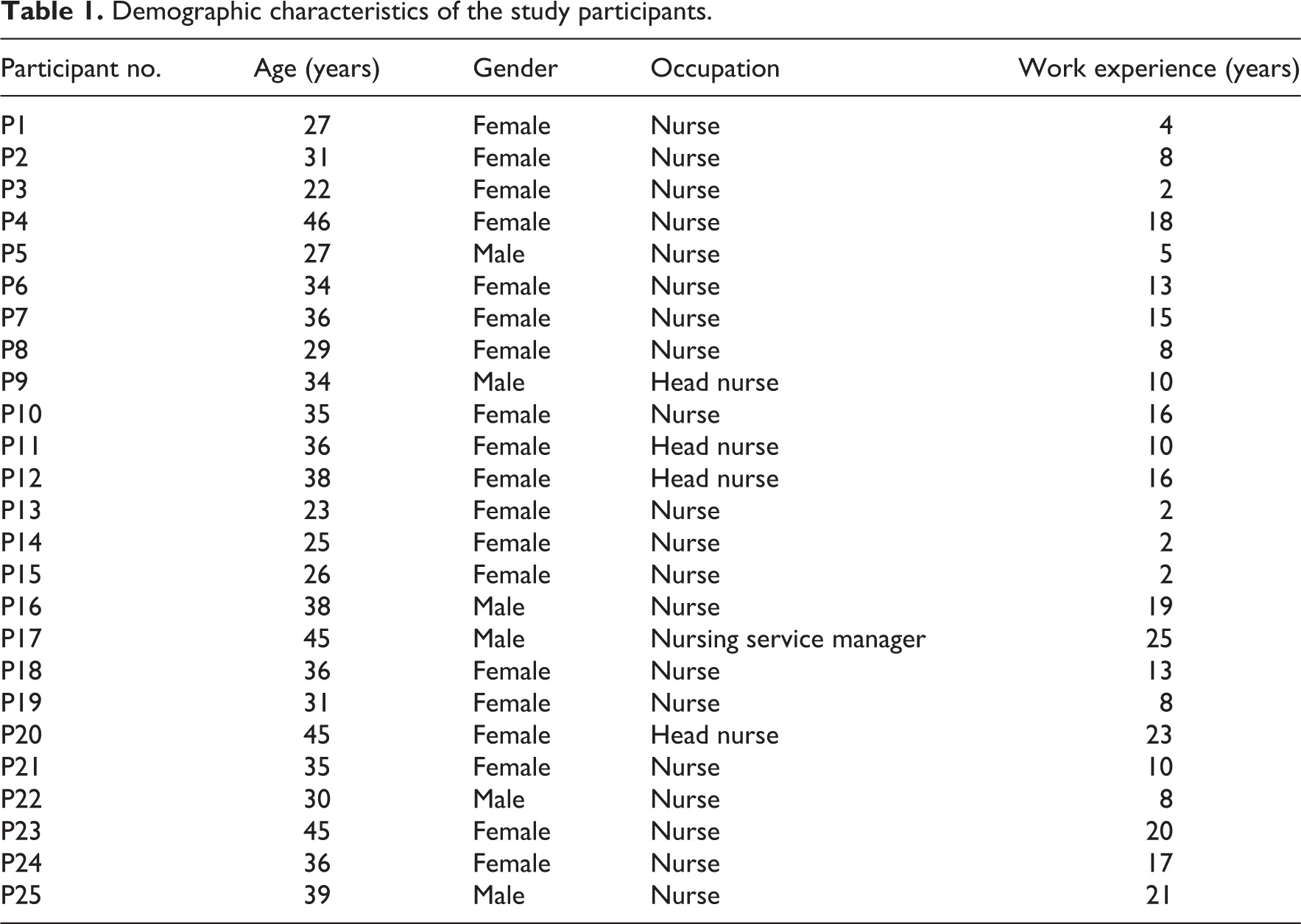
In this study, considering the nature of collaboration and to reach a comprehensive perception of applied strategies, participants were selected from among nurses currently employed at hospitals. In all, 25 (19 females and 6 males) participants participated in the study, including 20 nurses, 4 head nurses, and 1 nursing service manager, with a mean work experience of 11.8 ± 6.9 years and an age range of 22–46 years, with a mean age of 34.8 ± 7.1 years (see Table 1).
Demographic characteristics of the study participants.
Data collection and procedures
After obtaining the informed consent, data were collected through unstructured in-depth interviews with the participants. The first part of the interview consisted of some open-ended questions to enable the participants talk freely about their experiences. For instance, one item asked the nurses to describe their last work shift from the time they entered the hospital till the time they exited. Another question was, “How does collaboration between you and your colleagues take place?” The next items were follow-up questions that were based on the responses given by the participants asking for more clarification. For example, one follow-up question was, “How was your reaction to discriminations?” Or has your reaction led to a change?
Interviews were digitally recorded and later transcribed word by word on the same day to be used as the main data of the study. Interview with each participant was carried out in one to two sessions and in a private room at the healthcare providers’ workplace. Each interview took between 30 and 90 min, and the average length of an interview was 45 min.
Ethical considerations
Ethical considerations in this study were observed by gaining the participants’ informed consent, arranging appointments to interview the participants, giving the participants total freedom to enter the study and to exit at any stage of research, gaining the participants’ consent to record the interviews, keeping the participants’ responses confidential, and avoiding revealing participants’ identities. This study was approved by the Regional Committee of Medical Research Ethics (ir.medilam.rec.1396.31), and for presence in the field, introduction letters were given to the hospitals.
Data analysis
Data were analyzed using conventional content analysis.
21
This process included six steps: Transcribing data, reading and re-reading documents, and perceiving initial ideas; Creating original codes: Coding verbatim and line by line; Searching for themes: Contracting the codes into potential themes; Reviewing themes: Relating themes with each other, with extracted codes and the entire data set; Defining and naming themes: Ongoing analysis, distillation of themes, and creating apparent definitions and names for each theme; Producing the report: Final analysis, moving between transcripts and themes, selection of vivid stories for each theme, and conducting the report.
Overall, in this study, each interview was typed immediately after interview session. They were then transcribed, read, and reviewed several times. Next, the transcripts were divided into meaning units in sentence and paragraph frame within which the related main meaning occurred. The meaning unit identification was repeated several times and the appropriate codes were then written for each of them. The codes were then categorized according to conceptual and meaning similarity criteria. The declining trend in data reduction was present in all analysis units, main categories, and subcategories. Finally, the data were placed in the main categories which were more general, and the main theme was abstracted at the end.
Trustworthiness of the study
To make sure of the usefulness of data, the variables of validity, verifiability, reliability, and transferability were taken into account according to Guba and Lincoln. 22 Moreover, member check was used in addition to prolonged involvement of the researcher to increase the credibility of the data. Also, after encoding, the interview transcripts were returned to the participants to ensure the accuracy of the codes and the relevant interpretations. Peer check approach was used to control data confirm ability; for this purpose, the data were coded and categorized, which were later evaluated by the expert professors familiar with nursing and qualitative research. When there was no consensus between codes and categories, discussion was continued to clarify the issue and to reach a consensus. To control for the dependability of the data, an audit trail was used. In implementation of this method, the researcher maintains the preliminary data, categories, and themes until the end of the research process. Moreover, the review and analysis of the data of the experienced individuals in the research by two qualitative researchers outside the study increased the reliability of the study. The transferability of the study also depended on the evaluation and approval of findings of the individuals in the same environment. Sampling with a maximum variance also helped in the transferability and stability of the results as well as credibility of the data. Allocation of sufficient time to the study and face-to-face communication with the participants were other factors that increased the data credibility. Results were also confirmed by some nonparticipant nurses.
Results
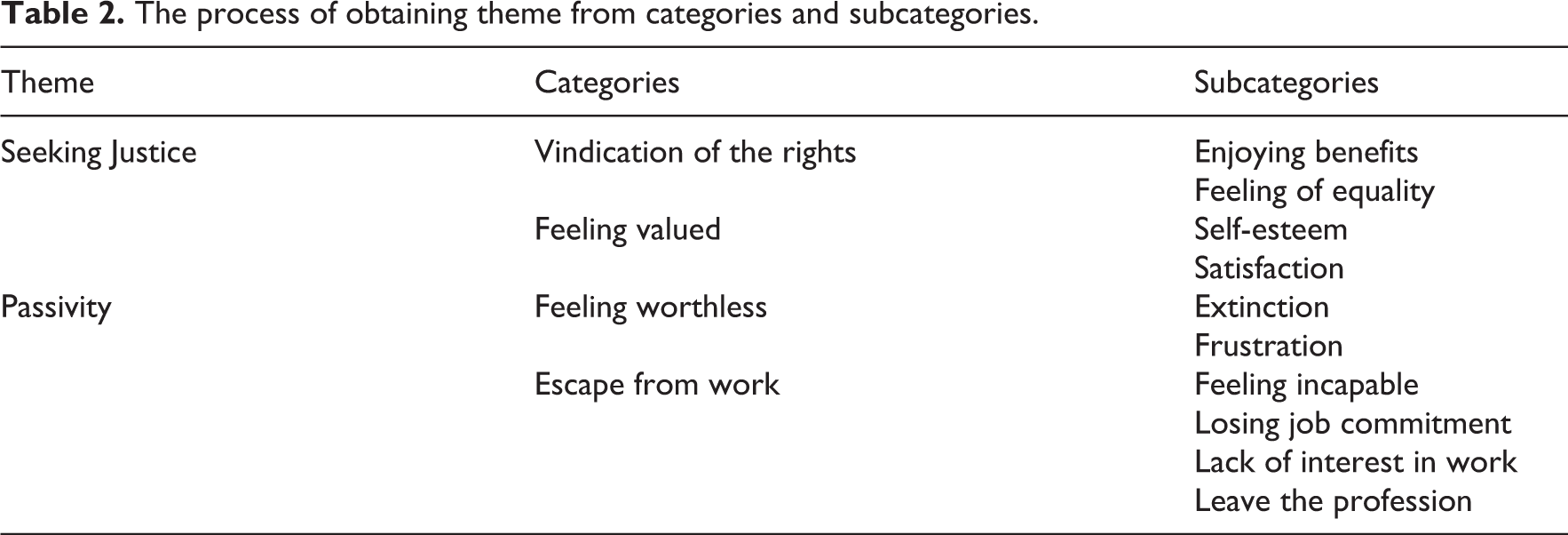
The classification of results based on data analysis showed that the strategies employed by nurses to overcome inter-professional discrimination lead to the consequences ranging from “seeking justice,” with the features of “vindication of the rights” and “feeling valued,” to “passivity,” with the characteristics of “feeling worthless” and “escape from work” (Table 2).
The process of obtaining theme from categories and subcategories.
The consequences result from practical, interactive, or emotional responses to events and answer the question, “What happens in case of practical, interactive, or emotional responses?”
Seeking justice
Organizational justice is one of the key processes for positive communication between individuals and desirable outcomes and is one of the concepts associated with the employees’ behavior while they have motivation and job satisfaction. Groups that face discrimination try to fight against it and establish justice in social systems. The results indicate the achievement of justice. Seeking justice is a category that is characterized by two features: “vindication of the rights” and “feeling valued.”
Vindication of the rights
In this subcategory, participants have mentioned, in their statements, some indications of the positive outcomes of their efforts and the achievement of their desired goals. This subcategory is defined by two features: “enjoying benefits” and “feeling of equality.”
Enjoying benefits
Enjoying the desired benefits in the workplace according to the performance of individuals has been an important feature of vindication of the rights in line with understanding “seeking justice.” Findings show that the benefits received and desired by individuals are also different. Some of the participants find different modes of incentives as being seen by superiors, and others believe that promotion and obtaining a suitable job position mean enjoying the benefits in return for the performed activities and define it as vindication of the rights. An administrative participant expresses his experience of seeing individuals and giving them their rights as follows: The individual is seen in different situations. When seen, they can be accepted and their ability will be seen. When it was seen and confirmed, they will receive what they longed. You may, for example, give a verbal or written appreciation, you may be financially rewarded, your annual evaluation may be influenced, or you may be placed in a higher position in terms of management. (P17) When they increase our salary, they increase the work difficulty as well, they know that we are here. (P19) Those who are intimate with the head nurse are writing their program well, if they have a problem in their program, they will take leave. They will also receive more salary for their extra work. (P8) For example, they need a vacation, they sometimes have a problem or need a leave, we try to cooperate with them. (P17)
Feeling of equality
Feeling of equality between individuals and consequently the efforts of individuals mean that the differences of individuals have been seen and everyone has their rights. Observance of justice, in other words, the relative establishment of justice, is what the participants refer to in the study. In this regard, a participant states that The staff find out and they say that yes, justice is observed; that is, everyone has come to their right, there is a relative justice for them, which is also a motive. (P17) There was encouragement and punishment. The person who worked was different from who did not work in terms of assessment. There was a difference between the individuals. (P16)
Feeling valued
The second subcategory of “seeking justice” is “feeling valued” in individuals who experience it because they have been seen and their rights have been recognized. “Self-esteem” and “satisfaction” are descriptive features of this subcategory.
Self-esteem
It refers to identifying and reinforcing the abilities that are directly related to self-confidence. So the more the individuals can develop their abilities, the more their self-esteem increases. The findings of this study indicate the efforts of individuals to empower themselves and achieve its consequent result. A participant (P16) expresses the result of his work and his team as follows: For example, when the supervisor entered the sector and wanted to cause a challenge, he failed. I carefully delivered all the patients, and this proved that I was doing my job well. Our hospital has been among the top hospitals in the last two years, our manager has been great and the minister visited our hospital twice.
Satisfaction
Satisfaction is another feature that leads to “feeling valued” in a person. Satisfaction with the provision of proper healthcare leads to nurse and client satisfaction with relief of conscience. Participants have mentioned this feature frequently. Regarding the satisfaction of work done by the patients, a participant states that The work is done better and sooner; I also get the result sooner. When the work is done faster, the patients are satisfied; when nothing is left for the next shift, the colleagues are satisfied as well. (P22) Regarding conscience, we were satisfied with ourselves in our unconscious mind that we were doing the right thing and we would be appreciated. (P16)
Passivity
The consequence of passivity is the opposite point of seeking justice. As the title of the class implies, it means becoming passive in work, which can be seen in different ways in people. While seeking justice is a positive consequence of the strategies and efforts of participants, passivity is the result of uselessness of strategies. The features of “feeling worthless” and “escape from work” describe this class.
Feeling worthless
While seeking justice is associated with feeling valued in individuals, passivity leads to a sense of worthlessness in individuals. In this study, this feeling is described by two features of “extinction” and “frustration” based on the participants’ experiences.
Extinction
Not being seen despite all the efforts made in the work environment leads to a kind of extinction and in fact stopping the positive efforts due to the loss of motivation. In this regard, a participant says, There might be some people who lose their motivation because they were not supported. (P6) Unfortunately, not differentiating the staff makes them lose their motivation. They say that when it makes no difference, why do I bother myself? They get angry and lose their motivation consequently. (P11)
Frustration
Another feature of losing self-esteem is the feeling of frustration that is the result of “not being seen” and futility of efforts to overcome discrimination. The findings of the study in describing frustration indicate that in fact it is a kind of negligence by superiors and its consequent unsettled problems. In this regard, a participant says, No matter how much you repeat, nobody listens. I even think that the head of the university has also understood because he had come and seen, he had felt what is going on; everyone has lost their motivation. Our cooperation was great, but now challenges have overcome.(P19) Those who do not work are fortunately placed in sections with easy job. They do nothing. Those who are skilled suffer more; they do most of the work. Nothing makes difference to those who are carefree. It really impacts individuals’ morale. (P4)
Escape from work
The second feature of passivity is “escape from work.” Feeling worthless and a decrease in self-esteem in a person lead to a kind of disability and escape from work. “Feeling incapable,” “loss of job commitment,” “lack of interest in work,” and “leaving service” are descriptive features of this subcategory.
Feeling incapable
The participants acknowledged their inability to do the work in their statements. As previously stated, the feeling of worthlessness negatively influences the person’s morale and leads to physical inability. In this regard, a participant states, When the system does not value them, they suffer from weakness and disability; mental disability affects the physical disability. So, such persons cannot afford doing what they have to and their work should be done by their colleagues. Many physical deficiencies are due to the fact that the person is not spiritually satisfied. The system must satisfy the individuals spiritually. This disability usually prevents the patient from doing the work or from doing the work carefully. However, the personnel are also mentally damaged. (P17) The system can have the most significant effect on the patient. (P16)
Losing job commitment
This feature means becoming like other people and it is the result of futility of efforts. People are trying to be seen by superiors and they are also taking steps to empower themselves and provide proper healthcare; however, when they do not get their desired result, they desist from the work and become like individuals who have experienced this case before. We refer to the experiences of a number of participants in this regard.
Losing job commitment and going with the stream do not take place at once, but, as it is mentioned, it appears gradually overtime. A participant says, Someone who says that if the system is like this, let it be! I am good and let the others be bad. This person considers his conscience because the work of an individual in a working environment is his identity card; that is, the person has accepted to play his role well, that individual has nurtured this belief as goal, as a wish and longs to be always good. However, certainly he will, one day, say that why should I be good? The person will finally go with the stream and becomes like others; like that eagle who lived with the crows. (P16) The individual has seen that nobody has valued him and no attention has been paid to him, so he has reached a dead end. Such a person will give up someday. When individuals do not get promoted they will be certainly discouraged. (P17) That is, I did not have the same enthusiasm that I had before, and I was somewhat like the rest and only the shift was passed. I read books behind the desk; for example, if I had two free hours during a shift, I did not talk to my patients, train them or take them to a walk! I did none of them anymore, because I lost my motivation. The patients were not important to me anymore. I did not care for the patients, the ones who were important to me one day! I was like the rest. It was exactly going the opposite way of the organization and the organization was not important to me. (P21)
Lack of interest in work
The findings reveal another feature in relation to passivity, that is, lack of interest in work. A participant states that I don’t like to work here or in hospital anymore. One of the reason for my decision of not working in clinic is that I have really lost my interest. (P15) I don’t like this system anymore. (P10) Initially I loved my field, but I don’t anymore. (P15)
Leave the profession
Temporary or permanent leave and even thinking about it may be the choice of participants in dealing with discrimination. A participant says, I went to decide on what should I do, I was about to resign; a friend of mine resigned and left the organization. There are also a lot of individuals who take a leave without pay. (P19) I decided to leave the organization that did not consider me. In fact, I left the organization. When they did not consider my ability, I volunteered for my patients from the very beginning. It did not matter at all that my supervisor reckoned it in the evaluation or not. I just worked for the sake of God. I stopped doing this when I saw that I am worthless and I would not get promoted whatever I do; then I tried to leave. (P21)
Discussion
Actually the participants use different active and inactive strategies to overcome the perceived psychosocial issue which have led to some consequences. The consequences are ranging from seeking justice to passivity.
In this study, justice is based on the vindication of the rights and feeling valued. In vindication of the rights, if the efforts lead to the intended benefits such as the promotion of a job, receiving rewards, or having the feeling of equality, in other words, noticing differences in them, it can be said that they have achieved what they deserve. Parallel to vindication of the rights, a person feels valued, which is followed by self-esteem for scientific and practical empowerment and increase in confidence to provide superior healthcare that results in self-satisfaction. Thus, it can be said that a person feels valued through receiving his own rights. Obviously, achieving justice will be an incentive for more individual effort in achieving organizational goals, including communicating with team members and providing more careful attention.
The feeling of individual success and mastery in doing tasks create a positive attitude in nurses; these individuals will also feel stronger and more dominant in performing their tasks and will have better insights into their jobs while gaining a sense of self-esteem. As stated by Zahednezhad et al., 5 understanding the organizational justice among the health workers is associated with well-being, attitude, and performance of the staff. If employees’ services are not fairly compensated, it is likely that their confidence and feelings of capability would weaken.
In this study, passivity is the opposite point of seeking justice and is the other consequence of the strategies used by the participants in the study, which indicates a failure to achieve the desired outcome. Its characteristics imply a reduction in self-esteem in the form of extinction, meaning loss of motivation, and the avoidance of effort and frustration caused by the lack of noticing and non-settlement of problems that lead to escape from work; it is felt as a feeling of incapability of performing work that results from mental disability, loss of job commitment, lack of interest in work, and ultimately abandonment of service. In other words, observing organizational justice, the way nurses behave and treating them regarding the distribution of rewards and fair procedures lead to an increase in the level of psychological empowerment of nurses, 5 and the perception of injustice in workplace affects various behaviors of employees, including destructive, anti-production, and retaliatory behaviors. 13
Psychological stresses and feelings of helplessness and frustration in individuals have been repeatedly reported as undesirable consequences of discrimination, and these negative emotions impede the achievement of desirable goals in individuals. 4
In fact, discrimination is among hypocritical behaviors (any inappropriate behavior, exposure, or conflict in a range from verbal abuse to physical abuse); hypocritical behaviors are among the barriers of professional communication and collaboration such that the effect of the hypocritical behavior between nurses, doctors, and other members of the care team has prevented communication, collaboration, and information exchange and has had reverse effects on the patient’s dynamics and outcomes, including the occurrence of adverse events, medical errors, compromising patient safety, and low-quality cares. 11,23 In other words, justice leads to the integrity of people and injustice causes division between people. 6
Nurses also experience psychological or moral distress when they do not feel competent or when their colleagues presume their nursing activities below the desired level. 11 All these issues cause the loss of one’s motivation to strive for presenting the right and fair service; it can become intolerable at a specific time and might lead to leaving the service. This is when collaboration has been considered as the most important factor in preserving and maintaining nurses.
Disappointment, lack of motivation, lack of strength and unwillingness to try, and feeling frustrated from lack of participation in organizational affairs are reported as consequences of discrimination in other studies, 9 which reduces the commitment of individuals to organizational values and goals. In fact, loss of motivation to stay good and continue to try and work can be seen in the participants of this study.
The findings of this study regarding the failure to meet the expectations of nurses and the lack of access to justice that leads to their service abandonment resemble the results of a study by Atashzadeh Shouride et al. regarding nurses leaving the profession. In their grounded theory qualitative study, they have referred to issues such as professional/managerial challenges that include dissatisfaction with the nursing profession, management weakness and inappropriate social status of the profession, failure to meet financial needs, lack of access to welfare facilities, non-commitment to profession, nursing heavy workload, inappropriate managerial feedback, uncertainty, inaccurate evaluation of nurses’ performance, lack of clarity in the rules and regulations of the nursing profession, discriminatory implementation of the rules for nurses, disproportionate rewards with nurses ‘performance, authoritarian management practices in nursing, and lack of nurses’ job promotion conditions. They also referred to occupational stress and burnout. 24
In fact, workplace justice is a protective factor of nurses leaving their current profession, and poor workplace justice could negatively affect workers’ psychosocial perception and is the primary motivating factor of nurses’ intention to leave. 10
In total, it can be said that the fair treatment of individuals, in other words, establishment of organizational justice, is a vital principle for working in social systems in today’s civilized world. 6 The concept of justice in organization implies equality and ethical behavior, and organizational justice implies the perception of employees regarding the correctness or incorrectness of the company’s governance and employees’ behavior. 25 This concept is known as a code of ethics in nursing, and nurses are required to observe ethical codes such as not doing harm, kindness, independence, justice, and care ethics in patient care. These issues are essential not only in relationships of nurses with patients but also in their relationships with other nurses and other members of the care team. 3,11
Studies on factors affecting motivation, performance, survival, and maintenance of the staff within healthcare systems show that these staff have lost their motivation due to poor job development, development prospects, lack of positive monitoring and guidance, feedback, and recognition, which have led to a feeling of lack of support and a lack of value in them. 10 The concern is that if they are not adequately protected or motivated, it will affect the quality of care. 12,15 Justice is a basic human need and only nurses who have themselves experienced equity can provide their patients the experience of equity. 11
The findings of this study, based on the participants’ statements, confirm the results of the mentioned studies, so they perceive the experience and perception of discrimination in the organization as an effective factor in how they collaborate with others; thus, they have stated that discrimination leads to loss of motivation for cooperation, work in the clinic, and even the intention to leave service. While observance of justice is one of the most important factors affecting the survival of the organization and maintaining its health in the long run, it is one of the basic requirements of organizational behavior that increases the sense of belonging, loyalty, and trust of individuals to the organization, on human and social capital of the organization. 5,6 Empirical evidence also confirms that fairness perception is directly related to important organizational attitudes and behaviors, such as the intention to leave a job, 10 and it is also related to a better understanding of organizational justice, with higher satisfaction, more commitment to the work location, and behaviors beyond duty. 6,9 This is what managers and practitioners should take into consideration at all levels of management.
Footnotes
Acknowledgements
The authors thank all participants for providing their experiences in this study and also Ilam University of Medical Sciences for its funding to conduct this study.
Conflict of interest
The author(s) declared no potential conflicts of interest with respect to the research, authorship, and/or publication of this article.
Funding
The author(s) disclosed receipt of the following financial support for the research, authorship, and/or publication of this article: This study was funded by Ilam University of Medical Sciences.
