



Abstract
Background:
Compassion has long been advocated as a fundamental element in nursing practice and education. However, defining and translating compassion into caring practice by nursing students who are new to the clinical practice environment as part of their educational journey remain unclear.
Objectives:
The aim of this study was to explore how Chinese baccalaureate nursing students define and characterize compassionate care as they participate in their clinical practice.
Methods:
A descriptive qualitative study design was used involving a semi-structured in-depth interview method and qualitative content analysis. Twenty senior year baccalaureate nursing students were interviewed during their clinical practicum experience at four teaching hospitals.
Ethical considerations:
Permission to conduct the study was received from the Institutional Review Boards and the participating hospitals.
Results:
Baccalaureate nursing students defined and characterized compassionate care as a union of “empathy” related to a nurse’s desire to “alleviate patients’ suffering,” “address individualized care needs,” “use therapeutic communication,” and “promote mutual benefits with patients.” Students recognized that the “practice environment” was characterized by nurse leaders’ interpersonal relations, role modeling by nurses and workloads which influenced the practice of compassionate care by nursing personnel.
Conclusion:
Compassionate care is crucial for patients, nurses, and students in their professional development as well as the development of the nursing profession. In order to provide compassionate care, a positive practice environment promoted by hospital administrators is needed. This also includes having an adequate workforce of nurses who can role model compassionate care to students in their preceptor role while meeting the needs of their patients.
Introduction
Compassionate care is defined as a set of four attributes: wisdom, humanity, love, and empathy, where these attributes may be expressed as awareness of a situation when a person is vulnerable and suffering. 1 It is the inner feeling of another person’s suffering with the motivation to help and alleviate the suffering. 2,3 Compassionate care is one of the core values of the nursing profession since its founding by Florence Nightingale. 4 Today, it is evident in codes of ethics, 3 standards of care, 5 and health policy documents 5,6 which guide nursing practice. Nevertheless, a lack of compassion during patient care by students and nurses new to the profession is increasingly reported in the literature. 1,4,7 –9
Evidence has shown that compassionate care addresses a patient’s innate need for connection and relationship, and is said to improve health outcomes as well as the patient experience in the health care setting. 9 A lack of compassion in the care of patients has been associated with substandard care characterized by poor adherence to recommended standards, a lack of dignity, deprivation of patients’ basic rights to quality care and, leads to patients’ dissatisfaction with care, unintentional or intentional harm and increased morbidity and mortality. 5
Compassionate care as a core value of the nursing profession assures a measure of integrity in the professional conduct of nurses. 10 Evidence has shown that compassionate care and other professional values are learned through the influence of professional experts, colleagues, patient care situations, reflective learning and organizational values. 10 –13
Baccalaureate nursing students are expected to join the team of skilled and professional nurses to meet the growing health care needs of patients. 14,15 At the end of their final year, baccalaureate nursing students should be ready for graduation and nursing professional registration. They are therefore expected to have gained adequate cognitive, psychomotor and affective nursing competencies in classroom, and skills laboratory learning, as well as clinical experiences, to be ready to practice as registered nurses. 16 –18 Didactic and laboratory learning offers students most of the cognitive and some of the psychomotor competencies of the profession that are transferred to clinical settings in the care of patients. 19 But affective skills that encompass compassionate care are largely dependent on students’ exposure to the clinical settings where they practice and experience care of patients in the real world. Clinical instructors/preceptors play major roles in facilitating the realization of this process. 20 –22
Few researchers have explored nursing students’ perceptions and understanding of compassionate care. For example, an ethnographic analysis of students’ narrations by Burton found that students viewed compassion as applying emotions/feelings or empathy and its sense of need in caring. A student’s personal family attachments and upbringing, as well as their ability to manage emotional labor (healing personal emotional distress when a patient’s suffering is alleviated) were influencing factors to consider in addition to the pedagogical approaches to teaching compassionate care. 23 Similarly, an interview project on exploring students’ perceptions and understanding of life-altering suffering found that students perceived compassion as offering themselves to another by a deeper connection, helping the patient to voice their suffering and building confidence to support those who suffer. 24
In China, understanding the definition of and perspectives about compassionate care of baccalaureate nursing students remains unclear. Documents that are supposedly responsible for providing directions on the core values of nursing practice (National Nursing Career Development Plan) do not provide a clear description of compassionate care. 25 Moreover, there are reports that teaching in nursing schools and clinical training on the domain of compassionate care is under-addressed. 26 In 2016, China had 216 colleges and/or universities offering baccalaureate nursing programs. 27 The majority of clinical nursing preceptors in China possess associate degrees without standardized qualifications. This does not provide these nurse preceptors with an adequate background for in-depth indoctrination of core nursing values leading to inadequate provision of compassionate care and/or translation of such values to clinical students. 28 This situation may complement factors at different levels of hospitals in China which leads to a lack of compassionate care among nurses. These factors include severe nurse shortages where one nurse provides care to more than 10 patients, 28 patients’ concerns about economic costs, frequent disputes in first rank hospitals, 29 frequent patients’ concerns about inappropriate medical care, and frequent conflicts related to quality needs and limited resources in secondary hospitals. 29,30 While baccalaureate nursing students learn and practice in these environments as a necessary part of their preparation for the future nursing workforce in China, it is important to understand their view of compassionate care in order to develop student-centered programs that build students’ core values as future nurses.
Aim
The aim of this study was to explore how Chinese baccalaureate nursing students define and characterize compassionate care as they participate in their clinical practice.
Methodology
Research design
Using a descriptive qualitative design, semi-structured in-depth interviews were conducted. This methodology was chosen based on its ability to allow in-depth exploration of the “lived” and “constructed” experiences of each individual participant. 31
Setting and population
Baccalaureate nursing students from one university during their senior year (fourth year) who were in clinical practicums at two first rank tertiary general hospitals, one first rank tertiary cancer hospital and one secondary hospital in Guangdong province were recruited from June to September 2017. Inclusion criteria were as follows: nursing student from a baccalaureate program, having practiced for at least 6 months in clinical settings and planning to seek employment as a nurse upon graduation. Students who planned to work in other areas after graduation, as is common in China 32 were excluded.
Ethical considerations
Ethics approval was obtained from Sun Yat-sen University Nanfang College (Ref: 2017620). Participants signed the informed consent forms, were given details of the study and told that they could withdraw at any time without prejudice.
Recruitment procedure
Participants were recruited through purposive sampling, which allows for conscious selection of a few participants with rich information about the research question at hand for in-depth interview. 33 After obtaining permission from nursing faculty, the final year baccalaureate nursing were approached to explain the study. Students were given written information about the study and asked to contact the researcher if they were interested in participating. Twenty-two females volunteered and two were excluded because they planned to work in other fields after graduation. To maximize participants' variability, the author actively invited male students to participate. However, due to the limited number of male students, only one showed interest, but did not meet the inclusion criteria.
Data collection
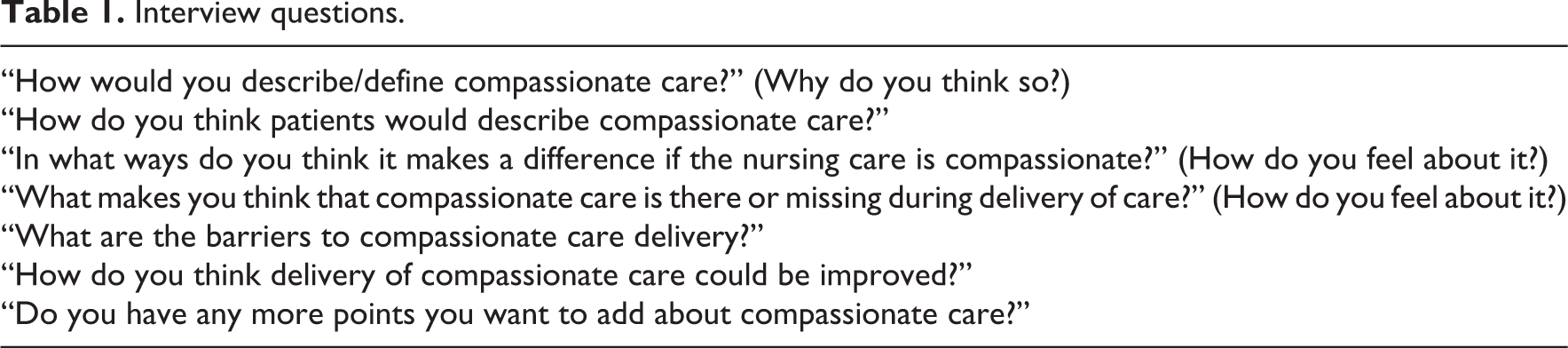
A demographic questionnaire was used to collect data regarding participant’s age, sex, months of clinical experience, and the average number of patients cared for during the practicum period. Twenty semi-structured in-depth interviews, using an interview guide with probes (Table 1) were conducted and audio recorded. The interviews were conducted in a location preferred by the participants, such as a quiet room or a garden. This approach was used to systematically arrange a relaxed atmosphere and gain more detailed and in-depth data from the participant. 34 The first author who had experience working with students as an educator (not including any of the participants) and in using qualitative interview techniques conducted all the interviews in Mandarin. Each interview lasted for 30–60 min and was terminated when the participant was satisfied with her responses. During two of the interviews, participants were overwhelmed by emotional reactions with one shedding tears and the other faltering while reporting the painful experiences of witnessing care without compassion of suffering patients. The researcher used comforting mechanisms by offering a tissue, showing understanding and reassuring the student that “it is ok” and then asking the students to continue if they felt comfortable. During and immediately after the interview, field notes were taken describing the environment, physical setting, and body language of participants during the interview as a method of data triangulation and transferability. Within 7 days after the interviews, transcripts were sent to the participants for validation before coding began, 35 and 17 participants provided feedback to confirm content validity. Each student’s audio record and questionnaire were assigned code numbers to maintain anonymity, secured in a locked location on a password protected computer which was accessible only by the researchers.
Interview questions.
Data analysis
Descriptive statistics were used to describe participants’ demographic characteristics. The audio recordings were transcribed verbatim and translated into English by the first author who is fluent in both Mandarin and English. Data were analyzed using qualitative content analysis. 36 The transcribed texts were read in full by the first author, with frequent reference to the audio recording to obtain an overall picture. 36 NVivo 11 software was used to aid in making notes in the margins, identifying and extracting codes. Each transcript was read line by line and key words and concepts as used by participants were extracted to make codes. 37,38 Data saturation was reached after the 17th interview, and no new themes emerged. The co-authors also read the transcripts and revised each generated code for accuracy and consensus. Similar codes were then grouped together into subthemes and later, themes were generated through discussion by all authors. 37
Scientific criteria were used to ensure validity and reliability of data such as credibility which was achieved through participants’ confirmation of transcripts before coding and use of both audio records and field notes to verify accuracy of the data; trustworthiness which was achieved through secured keeping of both audio records and field notes, engaging multiple authors for coding and use of participants verbatim quotes to present the findings; and researchers’ reflexivity. Reflexivity is defined as the critical reflection of the researchers’ theoretical orientation, preferences and influence to the research process and therefore, results. This is an important process to evaluate possible biases and establish validity of the findings. 39 The first author (female) who was a nurse educator in a baccalaureate nursing program in China and is currently a PhD candidate, initially conceived the idea for this study after realizing that students’ clinical training had minimal emphasis on core nursing values such as compassion. This author consulted with a doctoral-prepared nurse educator/researcher to conceptualize further about this study. Two other researchers who have experience teaching in baccalaureate nursing programs and are currently PhD candidates, later joined the research study and contributed to critical evaluation of the process and data analysis. Reflective discussions among the researchers with reference to field notes, audio recordings and study procedures were used as a way to further evaluate if credibility, dependability, transferability, and confirmability were achieved per Guba’s constructs 40 to evaluate the research findings.
Results
Twenty baccalaureate nursing students who practiced in four teaching hospitals: nine from two first rank tertiary general hospitals, six from a first rank tertiary cancer hospital and five from a secondary hospital, participated in the study. Their median age was 22 years, ranging from 21 to 24 years, they were female, and had practiced in the clinical settings for an average of 10 months. Participants from the secondary hospital reported an experience of having cared for an average of 12 patients under guidance of their preceptors while participants from the first rank hospitals reported assisting their preceptors as well as providing care to an average of four patients independently per shift.
Six themes emerged which summarize the students’ definitions and characterizations of compassionate care as illustrated in Figure 1. Students defined and characterized compassionate care as a phenomenon not standing on its own, but closely related to and connected to other concepts which represent key values in nursing practice. Students described compassionate care as a phenomenon centered in empathy which forms the moral drive for the nurse to exercise his or her humane caring behavior. It is directly connected with and operationalized along with other components including desire for alleviation of patients’ suffering, addressing individualized care needs, using therapeutic communication, and recognizing and promoting mutual benefits. Students further described compassionate care as a phenomenon that occurs within the clinical practice environment where a therapeutic relationship between a nurse and a patient can be initiated. Factors such as role modeling by staff nurses, the leadership of administrative nurses, and the workload of the unit can influence this relationship and shape the compassionate caring behavior of a nurse.

Conceptual framework of compassionate care as defined and characterized by baccalaureate nursing students in clinical practice.
Theme 1: empathy
Throughout the interviews, most participants used empathy as a core unifying descriptor of compassionate care. They described empathy as “being in patients’ shoes.” Some linked empathy to different challenges patients go through such as physical dysfunction, hospitalization and financial stress as aspects which need to be understood by nurses. They ascribed that empathy helps nurses to recognize the variety of negative feelings of patients and fosters an attitude of patience and gentleness: It refers to empathy and an understanding of their [patients’] feelings. People do not feel happy being admitted to the hospital, especially people with chronic illness. The symptoms, examinations and treatment can make them feel exhausted. If we stand in their shoes, we can show better attitude, like patients more and be nice. (P6 secondary hospital) It [compassion] is empathy. I have been ill too, so I know how it feels to wish someone cared for me in a warm manner. I would talk to them gently using a soft voice. (P8 cancer hospital)
Theme 2: desire for alleviation of patients’ suffering
Participants described patients with different suffering experiences as a motivator for practicing compassionate care. Some participants became emotional during the interviews when talking about how appreciative patients became when nurses used personal touch and a caring attitude or behavior at a time of intense suffering: Compassion is a feeling of care. One of our patients was so upset because of a schedule delay in surgery that she refused to eat. My teacher spent the whole morning helping her understand the reason for the delay, explaining the measures to be taken and helping her with breakfast. She did not leave her [the patient] alone with sadness (stated in a soft, emotional tone of voice). (P6 Secondary hospital) A family member rushed to the nurses’ station and shouted “nurse, my dad’s machine keeps alarming, help!” Two minutes had passed; the nurse said “that’s normal” without removing her eyes from the computer. I think it’s too mechanized, there is no such feeling [of compassion]. Unworthy of the mission nurses have been given (stated in sorrow). (P15 first rank general hospital) For example, you just go to the ward to remove an IV catheter, and then you see the patient get out of bed to do something. You help him, he is very happy. (P9 cancer hospital)
Theme 3: using therapeutic communication
Participants expressed that compassionate care is also portrayed by the way nurses communicate with patients. Many stated that therapeutic communication is crucial for patients to feel that they are being cared for with compassion as they receive treatment and interact with nurses. Participants further described the attributes of therapeutic communication that nurses need to demonstrate to patients as part of compassionate care as: (a) Pleasant manner: A nice introduction and a warm greeting at the beginning of relationship building and ongoing course of care: Usually, we [students] will call patients ‘uncle’ or ‘aunt’ and greet our patients each day. They remember you better after you’ve introduced yourself. They would tell you how they feel every day. (P11 general first rank hospital) They evaluate (nurses) based on communication manner, whether you are smiling, talking friendly, and patients generally like that kind of a nurse. (P3 secondary hospital) (b) Comprehensibility of information: Patients have limited knowledge about their disease, including the type of diagnosis, examinations being conducted, treatments, surgery and rehabilitation. Thus, responding to patients’ questions and providing information in a clear manner is crucial in reducing their anxiety. Mastering the patients’ local dialects was strongly recommended by participants as a key communication strategy: I try to use words he [the patient] understands in his dialect when I explain about his disease. He felt comfortable. Medical terminology can make him feel confused and upset. (P3 secondary hospital) (c) Utility of information: Linking the information delivered with the daily life of the patients so they can transfer this knowledge into health behaviors: There is one nurse who is very good at providing education to breast cancer patients. She focuses on different aspects of daily life, like what kind of soup is good for the patient and how to prepare it. Patients enjoyed education that is related to their life. (P7 general first rank hospital) (d) Explaining the procedure: Explanation of the procedure, obtaining patient’s consent and continuous communication during the procedure helps the patient to be psychologically prepared and tolerate the painful experiences of the procedure especially if it is invasive: You talk to patients while performing the nursing procedure. You ask about their feelings and explain what’s happening. So that they feel they are prepared and won’t be scared. (P13 cancer)
Theme 4: addressing individualized care needs
Participants expressed that compassionate care is recognition that patients have different diagnoses, educational and socio-economic backgrounds, life experiences and personalities. And that each patient therefore has different care needs that must be met in an individualized approach. They also expressed how addressing individualized patient care needs help them to develop a holistic view: (Nurses should) care for patients according to their psychological needs. For instance, I had a patient who frequently complained to nurses about pain while rejecting any interventions. After I accompanied her a lot I realized she just wanted attention. Understanding her helped me form a holistic view of patients. (P4 Secondary hospital) Patients diagnosed with cancer have different expressions. Denial, crying or anger (pause with empathetic facial expression). We provide support and comforting accordingly. (P13 Cancer hospital)
Theme 5: recognizing mutual benefits of compassion
Participants expressed that compassion facilitates successful therapeutic relationship building. They expressed that patients do not understand the concept of self-care as beneficial for them, or that their family members may need to participate in caregiving activities even though they have paid for their hospitalized care. Patients therefore expect nurses to demonstrate a high level of technical skills as well as completion of all physical care because they (patients) are vulnerable. Students were concerned about the gap between patients’ high expectations and the limited care capacity and health resources. They acknowledged that compassion can mediate relationship building and help patients to understand the role of nurses. It helps patients take responsibility for their health and collaborate with the nurses in compliance with treatments. This collaboration and compliance yields better patient outcomes, which motivates nurses to continue providing compassionate care: Some patients said they were ill, and they paid for hospitalization, so they should claim the services. (P4 Secondary hospital) I think it [compassion] conveys the information that nurses want to help. They would listen to our health education and receive treatment more positively. (P18 general first rank hospital) Patients’ collaboration, recovery, and appreciation motivates us in our career journey. We feel suitable for and proud of this career. We will enrich our knowledge and improve our skills. (P2 general first rank hospital)
Theme 6: role of practice environment in compassionate care
When mentioning the methods of improving compassionate care, some participants would hesitate on whether compassion is an innate individual trait or a skill that is cultivated through educational experiences. Regardless, they acknowledged the importance of educational curriculum as a factor for cultivating compassionate behavior of nurses: I think some nurses naturally have a feeling to help others. Maybe inherited from family…or maybe by furthering their nursing education. I think that staff nurses with a bachelor’s degree have more compassion. (P5 secondary hospital) You see a majority of nurses in the hospital are from diploma and associate degree. They do not recognize how problematic it is if compassion was missing. (P16 general first rank hospital) (a) Role modeling by clinical preceptors: Observing moments when preceptors delivered compassionate care, helped students to learn how compassionate care could lead to positive patient outcomes and therefore transfer it to their patients during practice: I appreciate the way she did skin care for the child so carefully. It is important to protect the child’s skin during ventilator intubation to prevent infection. I always keep that in mind later on when infection protection is ignored by other nurses. (P11 first rank) (b) Leadership: The way head nurses used their position in interacting with junior nurses or students either promoted or destroyed an atmosphere for participants to transfer compassionate care to patients. The motivation of nurses using compassionate caring behavior can help sustain the practice in hospitals: She (preceptor) only talks to me when she wanted me to do this and that. I felt like I was only free labor (frown and air of sadness). If we are not treated with compassion by the preceptor or head nurse, how can we be compassionate with our patients?” (P9 cancer hospital) It [compassion] is so hard to cultivate and maintain, especially in nurses who have worked for many years. It would be nice if compassionate nurses were well-paid and acknowledged that their behavior would be spread. (P14 first rank hospital) Hospitals should advocate for nurses who work hard to help patients who are suffering, such as those with cancer. We (nurses and patients) work together. Trust by the public would help in providing compassionate care. (P12 first rank hospital) (c) Heavy workload: All students’ shared sentiments on how a typical shift in a unit beyond its maximum capacity and the unpredictable care demands of patients compromised time for compassionate care: A hospital’s nurse-patient ratio should be reasonable. Because, honestly speaking, if nurses are too overloaded with endless work then they have no time to care. It takes time to ensure we feel the pain of others and help them. (P15 first rank general)
Discussion
To the best of our knowledge, this is the first reported qualitative research in China exploring the perspectives of baccalaureate nursing students on compassionate care during their clinical practicum. In the six themes that emerged, participants demonstrated a broader perspective in defining and characterizing compassionate care, and recognized the centrality of compassion as a core value that should govern nursing practice. 4
Findings of this study demonstrate that student nurses viewed compassion as a core nursing value. Compassionate care is composed of interconnected components unified by empathy. Frequently students used empathy interchangeably with compassion, which is based on their understanding of patients’ suffering and being ready to use their professional power and ethos to offer the best for their patients. Emerging literature discusses an interrelationship between empathy and compassion where empathy can be seen as being learned in a cognitive and affective manner. Affective empathy implies emotional resonance where understanding of a person’s suffering experience intersects with a person-centered response in an act of compassion. Affective empathy which comprises emotional resonance, affective understanding of persons suffering experiences and person-centered response defines and intersects with the actions of compassion. 24,41 However, the concepts of empathy and compassion as well as their relationships and intersections require further decoding by the historical literature. As ascribed in the thesis of Edith Stein (1989) “The Problem of Empathy” referenced by Kris McDaniel, 42 empathy refers to “an irreducible intentional state in which both other persons and the mental states of other persons are given to us.” Furthermore, she states “In an empathetic experience, we are presented with not mere bodies in motion, but rather with persons—and they are presented to us as persons who are angry, or who are grieving, or who are filled with joy.” 42 Stein describes key concepts of empathy include “intentions” of the helping person to “experience” the state of another person bearing the “physical body” and “feelings/emotions.” Similar discussions in contemporary literature related to caring have referred to empathy as: putting oneself in the patient’s (the suffering) shoes 41 or a sense of knowing and sharing the experience of another person. 43,44 Compassion is centered on the “quality of an individual’s character” 45 as defined by wisdom, humanity and love. 1 This definition, when viewed from a caring perspective, extends to “experiencing inner feelings for another person’s suffering accompanied by cues to alleviate the suffering.” 1 –3 As a result, this relates to affective empathy 41 as found in many nurses in caring environments and the nursing student participants in the current study. 46 As noted, they used the terms empathy and compassion interchangeably.
The current study also found that students recognized the uniqueness of each patient, and that compassionate care requires the ability of a nurse to comprehend this and to be able to respond to each patient’s needs uniquely. This was closely connected with a nurse’s ability to communicate therapeutically by showing warmth, listening to the patient, communicating effectively by talking in the patient’s dialect and making information understandable and useful for each patient. This is supported particularly by the findings of Bramley and Matiti who explored the definition of compassion from patients’ perspectives as “knowing me and giving me your time” which emphasized the unique nature and needs of each patients, and the need to offer personal time, listen to the patient and meet those needs. 46 Results in the current study are also supported by the concept of “connection” as described by Braband et al. 24 who studied nursing students and that of Sinclair et al. where compassion was defined from the client’s view as offering oneself to another to gain a deeper understanding of the suffering person. 47
The current findings demonstrated that nursing students were obliged to understand their patients’ perspectives and strived to satisfy their care needs as a way of establishing their role as care providers. Providing compassionate care to patients comes from a student’s own moral drive and beyond what is taught by a clinical instructor/preceptor and is mirrored by the findings of Zamanzadeh et al. 48 The participants in the current study had a broad view of compassionate care as they expressed their appreciation for thorough performance of nursing procedures by the preceptors which led to positive patient outcomes. Lown et al. 9 found that compassionate care improved patients’ health outcomes as well as the patients’ experiences during hospitalization.
Students recognized that compassionate care can be an advantage in relationship building and promoting mutual benefits for both patients and nurses and was more frequently reported by those practicing at the first rank hospitals. This same group of students practicing at the first rank hospitals were possibly influenced by observing nurses in these settings who manage much suffering and are at high risk for compassion fatigue. 28,49 Findings in the current study related to relationship building and promoting mutual benefit mirror those findings of an ethnographic analysis by Barton 23 who found that compassion created trust among student nurses and their patients which consequently was the factor for mutually beneficial relationships. Relationship building as an important aspect of compassion could therefore help nurses to promote the concept of patient self-care and collaboration, better treatment compliance and satisfaction which could also reduce nurses’ workloads and risk for fatigue.
This study demonstrated that participants recognized the significant influence that nurse leaders and role models have in promoting the practice of compassion among nurses. It becomes more important for nursing schools and teaching hospitals to utilize the expertise of these nurses in promoting the value of compassion in care-giving because the future generation of nurses will be influenced by this learning environment. The increasing complexity of interpersonal relationships between nurse leaders and nurses working under their direction, as noted by participants in this study, could also hinder the development and/or promotion of compassion among this same generation of future nurses. 50 Positive role models who demonstrated desirable caring behaviors to students during their clinical experience as found in this study, were responsible for influencing students’ attitude and compassionate behaviors. 51,52
Participants in this study did not use the term “love” in connection with compassion. Despite students’ extensive verbal comments and non-verbal behaviors when talking about their compassionate care-giving actions, none used the word “love” as a synonym for compassion. The researchers believe that this is influenced by Chinese culture where the expression of the word “love” is most frequently used in terms of romantic relationships. 53 Other studies have found that the words “wisdom” and “humanity” were repeatedly used by compassionate care-givers. 1,23,45
Implications
This study has described the perspectives of baccalaureate nursing students on compassion and compassionate care. Knowledge about its integration in nursing education programs has been limited. It is clear from this study that students understood compassionate care from a broad perspective and acknowledged its importance in the provision of patient care. Students recognize factors that influence its development and sustainability as well as deterrents to its promotion. It is crucial for nurse educators to elaborate on compassionate care in the nursing education curriculum. Similarly, it is critical that teaching hospitals promote and integrate compassionate care as a nursing competency. In doing so, learning experiences are provided that allow students to practice and hone their skills in the provision of compassionate care. Additional, empirical studies are recommended to validate these findings and explore the differences and similarities in the provision of compassionate care in diverse cultural settings.
Despite the fact that this study is qualitative in nature, from a pragmatic viewpoint its generalizability could be challenged. 54 However, the current findings have the potential for multicultural applicability and can be referenced in the nursing discipline in different contexts world-wide. The identified themes depict the perceptions of nursing students regarding compassion as a core value of nursing and mirror the findings of many studies done in different areas of the world that this value explains the universality of the human character and emotions as central to understanding suffering. 55,56
Limitations
One limitation of this study is that students were recruited from baccalaureate nursing programs where the concept of compassionate care may be more fully integrated in the curriculum as opposed to the experience of students in diploma or associate degree programs. This limits the generalizability of the findings to other nursing programs. Another limitation may be the level of the hospital where the participants were obtaining clinical experience. Factors such as the philosophy of care, staff workload, diversity of patient services and the cultural setting in China could influence these findings.
The use of focus group discussions (FGDs) might have generated more diverse findings based on the interactive nature of participants in FGDs. 57 However, based on the sensitivity of the topic, in-depth interviewing in a calm, friendly setting elicits personal perspectives about compassion without due pressure from colleagues. 34
Conclusion
Baccalaureate nursing students defined and characterized compassionate care as a union of empathy related to and interacting with a nurse’s desire for alleviation of patients’ suffering, addressing individualized care needs, using therapeutic communication, and promoting mutual benefits with their patients. Students recognized that the practice environment is characterized by nurse leaders’ and instructors’ interpersonal behaviors, and role modeling and that workload influences the practice of compassionate care by nurses. Further empirical research in other contexts may be needed to validate these findings and/or explore similarities and differences in other cultural settings.
