



Abstract
Background:
Plagiarism is an ethical and academic issue, which is affected by several factors.
Objectives:
This study is an attempt to introduce a model for elaborating on the causes of plagiarism in Iran.
Research design:
The study was carried out as a grounded theory study.
Participants and research context:
Data were collected through in-depth semi-structured interviews with 32 university professors and postgraduate students at Iranian universities of medical sciences. The participants were selected through purposeful and theoretical sampling. Data analysis was done following Strauss et al.’s work. To ensure study rigor, Lincoln and Guba’s measures were used.
Ethical considerations:
All procedures performed in studies involving human participants were in accordance with the ethical standards of the institutional and/or national research committee and with the 1964 Helsinki declaration and its later amendments or comparable ethical standards.
Results:
A conceptual model of the causes of plagiarism was developed based on analyzing and coding the data. The main core of the model was the emergence of plagiarism, and other cores were (1) causal condition: lack of skills, pressure by education system, and lack of awareness; (2) intervening factors: technological advances, legal gaps, and lack of efficient supervision; (3) ground factors: personal traits and attitudes of the academic community; (4) strategy and interventions: role model, supervision, national/international coordination, and higher awareness; (5) outcomes: regeneration of plagiarism and negative attitudes toward Iranian authors in the world academic communities.
Conclusion:
Several factors affect plagiarism. Among the approaches to attenuate plagiarism in Iranian academic communities are improving self-esteem and self-efficacy in Iranian researchers, emphasizing on quality rather than quantity of published works, discouraging boasting attitudes in the practitioners, denouncing intense competition among researchers, and introducing clear laws and severe punishments for plagiarism.
Introduction
The term “plagiarism” refers to different ways of copying of ideas, methods, results, and words without mentioning the source and the original author. 1 It covers a wide range of behaviors like intentional or unintentional self-plagiarism or copying diagrams, figures, and tables. 2 –4
Plagiarism is an unethical phenomenon 5 with a long history and deep roots in the history of science. It has become a more common issue in the modern age of information. 6 Plagiarism has become more common for reasons such as technological development and increasing access to various scientific sites and articles around the world, and to prevent this, various universities have developed anti-plagiarism sites and programs and have also offered more supervision. 7 –10 Currently, plagiarism is recognized as an unacceptable and most destructive academic behavior. 11 It is actually a major challenge today to universities, 12,13 and many research institutes and universities have introduced principles and standards based on a clear definition of plagiarism. Several guidelines and educational initiatives have been introduced to prevent plagiarism and promote responsible research behavior. 8,14
Over the past years, plagiarism has become a main area of interest for researchers so that a large body of literature has been created to examine different aspects of the phenomenon like individuals’ awareness and attitude, 15,16 and the causes of plagiarism. 10,17,18
Like many other countries, Iran is faced with the issue of plagiarism in its academic communities. 19 Recent years have witnessed a surge in the number of higher education institutes and postgraduate students in Iran. 20 Consequently, the number of scientific and research work has increased notably in Iran. 19 However, plagiarism has become a ubiquitous phenomenon in Iran so that according to Scimago, 1.5 out of every 1000 papers by Iranian authors have been rejected due to plagiarism between 2013 and 2015. 21 In addition, copying materials from the Internet has become a normal way of doing assignments and writing essays and dissertations in Iran. 22
There are several factors causing plagiarism. Fatima et al. surveyed the internal and external factors causing plagiarism in 176 students from five state universities in China. They reported that behavior control and educational factors had a positive effect on plagiarism, and information technology (IT) did not have a notable effect on plagiarism. Among the external factors, plagiarism and pride had a positive and significant relationship, whereas there was no significant relationship between academic skills and plagiarism. 23 In another study by Smith et al. on plagiarism in students, contrary to the results of the study by Fatima et al., poor skills and Internet expansion were the reasons for plagiarism, which may be due to the method of study and its location. Also, the lack of sufficient knowledge and personal views were mentioned as other factors affecting plagiarism in this research. 24 Zamani et al. 13 studied 370 university students in Iran and showed that elements such as attitude, ease of access to the Internet, lack of self-efficacy in doing a research work, mental and psychological pressure, and the unique role of the online world were the causes of plagiarism in students. A qualitative study by Amiri and Razmjoo 22 in Iran revealed that the lack of awareness in university professors about plagiarism, lack of writing and research skills, peer pressure, pressure on submitting a quality work, and ease of plagiarism were the main factors causing plagiarism.
Plagiarism is a complicated phenomenon that happens within an academic community, although its reasons might be beyond the community and extend to the whole society. Depending on the society, environment, and culture, the reasons for plagiarism differ. To fight this, we need to find its roots and see the phenomenon as a process that has emerged over time in the society. Given the fact that the majority of studies on plagiarism have been of quantitative nature 15,25 and there have been a few studies on this topic based on a grounded theory approach in Iran and other countries, this study is a grounded theory work to examine plagiarism qualitatively.
Aim
Therefore, the objective of the study is to propose a model to elaborate on the causes of plagiarism in Iran based on a grounded theory approach.
Methods
Study design
Since plagiarism is a multifaceted and complicated phenomenon, we needed a grounded theory and a qualitative approach to elaborate on it. Qualitative method is recommended as the best method to comprehend complicated phenomena. 26 In addition, the reason for adopting a grounded theory approach was its potential to model the hidden layers of social structures using continuous comparison. This approach is also suitable for gathering and analyzing the data needed to develop a theory. 27
Participants
The study population consisted of university professors and postgraduate students from four medical sciences universities in Tehran, Iran, who had a history of research work. Sampling was started with purposeful sampling and then continued with theoretical sampling. 28 That is, after finding the primary categories, the next participants would be selected based on their ability to contribute more light on the emerging categories. 29 When 16 individuals were selected through purposeful sampling, the researchers interviewed people who were more familiar with the phenomenon of plagiarism and the reasons for it to enrich their findings. During the sampling process, the samples were selected to be the most varied and representative of all different groups to obtain richer information. Due to the fact that the researchers had already informed the participants, no one refused to participate in the research, but three of the participants interrupted the interview due to work problems and postponed it to another time. Inclusion criteria were postgraduate students or faculty board members in medical sciences universities, having a published paper, being an active researcher, and desire to participate.
Ethical concerns observed in the study were making the required arrangements before entering the research environment, briefing the participants about the objectives and method of interviews, ensuring the participants about confidentiality of their personal information like their identity, securing their informed written consent for participation and voice recording the interviews, and informing the participants of their right to leave the study at whatever stage.
Data gathering
The data gathering process consisted of in-depth, semi-structured, private, and face-to-face interviews at the faculties and research and educational centers at different occasions. The interviews were conducted by the second author of the article, who is a PhD student in health promotion having work experience in research centers, as well as the corresponding author who has a long history of research and teaching master and doctoral students. Both researchers have extensive experience in qualitative research and interviews. The interviews were started by asking demographic questions, followed by asking their opinions about the nature of plagiarism, the way it happens, what they think about plagiarism in Iran, the condition that leads to plagiarism, reasons for plagiarism, and how it happens in Iran. The data gathering process continued until theoretical saturation. Totally, 32 participants took part in the study. Theoretical saturation was achieved when the codes obtained from the interviews were repeated and no new codes emerged in the last five interviews, by which the researchers concluded that continuing the interviews will not add a new finding to the research and hence ended the interviews. The interviews lasted between 35 and 60 min, and the time and place of interviews were selected to the convenience of the participants (mostly in the university and educational and treatment facilities). Because MA students had less information and experience of plagiarism, their interviews were shorter.
Data analysis
In this research, the software MAXQDA 12 was used for management of data. Data analyses were conducted following Strauss et al.’s 30 approach. After completion of the first interview, it was transcribed verbatim as soon as possible and the analysis process was continued along with the interviews. The findings of data analyses would constitute the basis for the following interviews, and this process was continued until the last interview. Three coding stages including open coding, axial coding, and selective coding were performed. The open coding stage was in fact a microscopic data analysis process where all possible meanings were extracted. The interview texts were reviewed several times at this stage and the research team concentrated on developing concepts based on the data. At the open coding stage, the researchers began to divide, analyze, compare, and label the data so that the text of the interviews turned into smaller pieces, and for the ideas that were inside each of the pieces, a specific concept name was assigned. The axial coding stage used the codes and categories obtained throughout the open coding, and similar categories were combined based on common axes. The codes were continuously compared at this stage, and then each category was compared with other categories to make sure that the categories are distinguishable. Afterward and based on the conditions that lead to plagiarism, the grounds of plagiarism and strategies to control it were determined based on selective coding. In fact, this stage was about integrating and refining the findings and achieving the main pattern to elaborate on plagiarism. In the selective coding step, the researchers connected the various categories formed in the previous steps by a diagram (Figure 1).
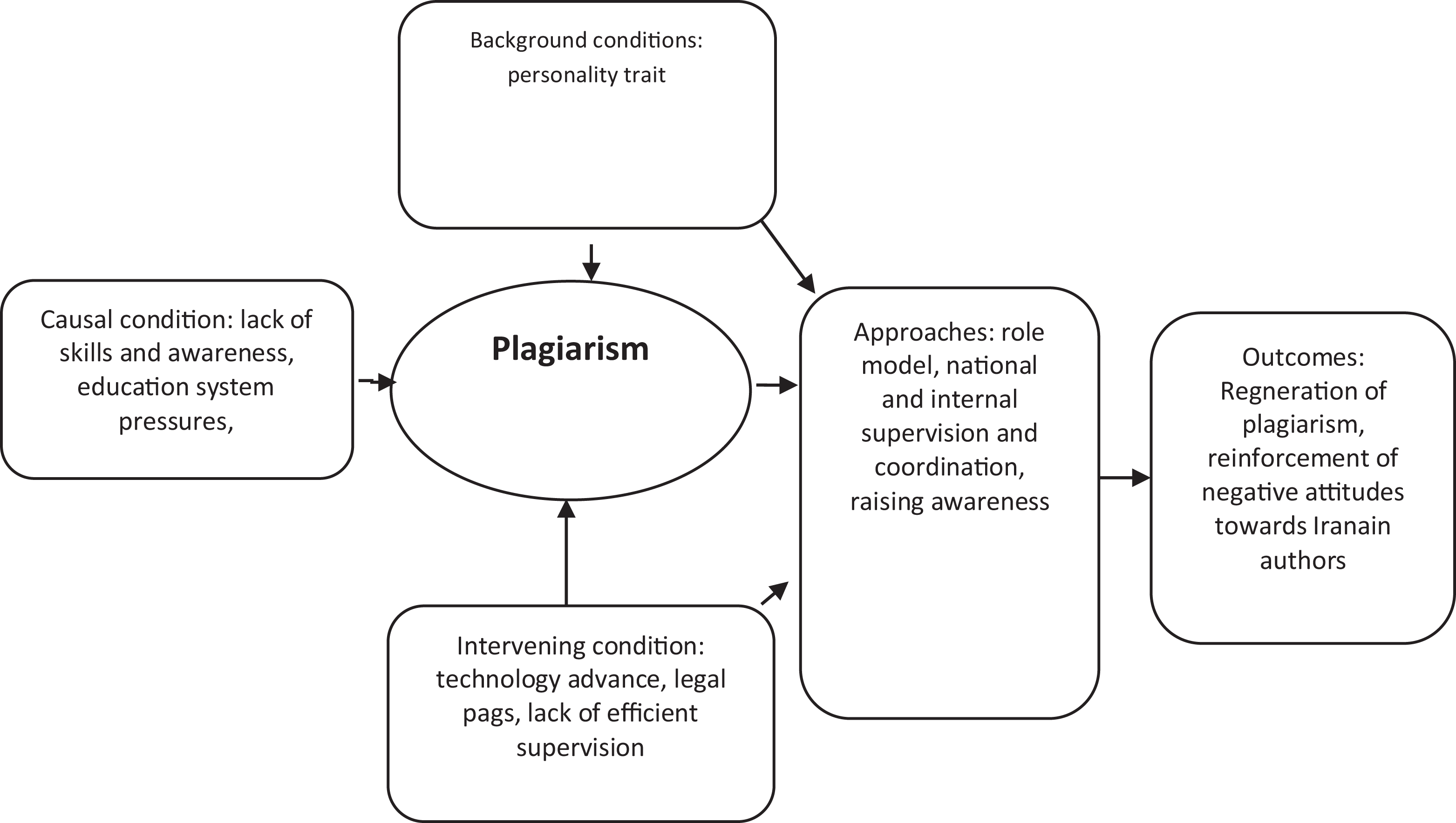
Emergence pattern of plagiarism in Iran.
Rigor
To ensure reliability and validity of the study, Lincoln and Guba’s 31 measures were used. As to the credibility of the data, the author had a prolonged engagement with the participants to win their trust and have a better perception of their experiences. Since the researchers had been researching scientific environments for many years, and some of the authors were university professors, they were greatly aware of the phenomenon under study and could also build a good relationship with the participants. In addition, the coding and analysis results were forwarded to some of the participants to check whether the results reflect their opinions and viewpoints (member check). Moreover, the widest diversity of participants added to the authenticity of the data. Confirmability was ensured by observing neutrality; asking experts in plagiarism and qualitative research to check the codes and themes; and reviewing the interview texts, codes, and categories through peer check. Specialists who checked the data analysis process and findings included two university professors familiar with qualitative research, two university professors who worked in research centers, and three researchers who previously had research experience in plagiarism. To ensure stability of the findings, the interviews were transcribed as soon as possible and experts were asked to check the data (external check). Transferability was ensured by selecting diverse participants and using direct quotes.
Ethical consideration
All procedures performed in the study involving human participants were in accordance with the ethical standards of the institutional research committee and with the 1964 Helsinki Declaration and its later amendments or comparable ethical standards. The ethical committee of Kermanshah University of Medical Sciences approved this study (KUMS.REC.1398.661).
Results
The study was conducted on 32 medical sciences university students and professors in Iran. The majority of participants was in the age range of 30–40 years, male, PhD student, and had an h-index range of 1–5 (Table 1). In addition, the paradigm structure of themes and subthemes was formed after data analyses (Table 2).
Demographics of the participants.
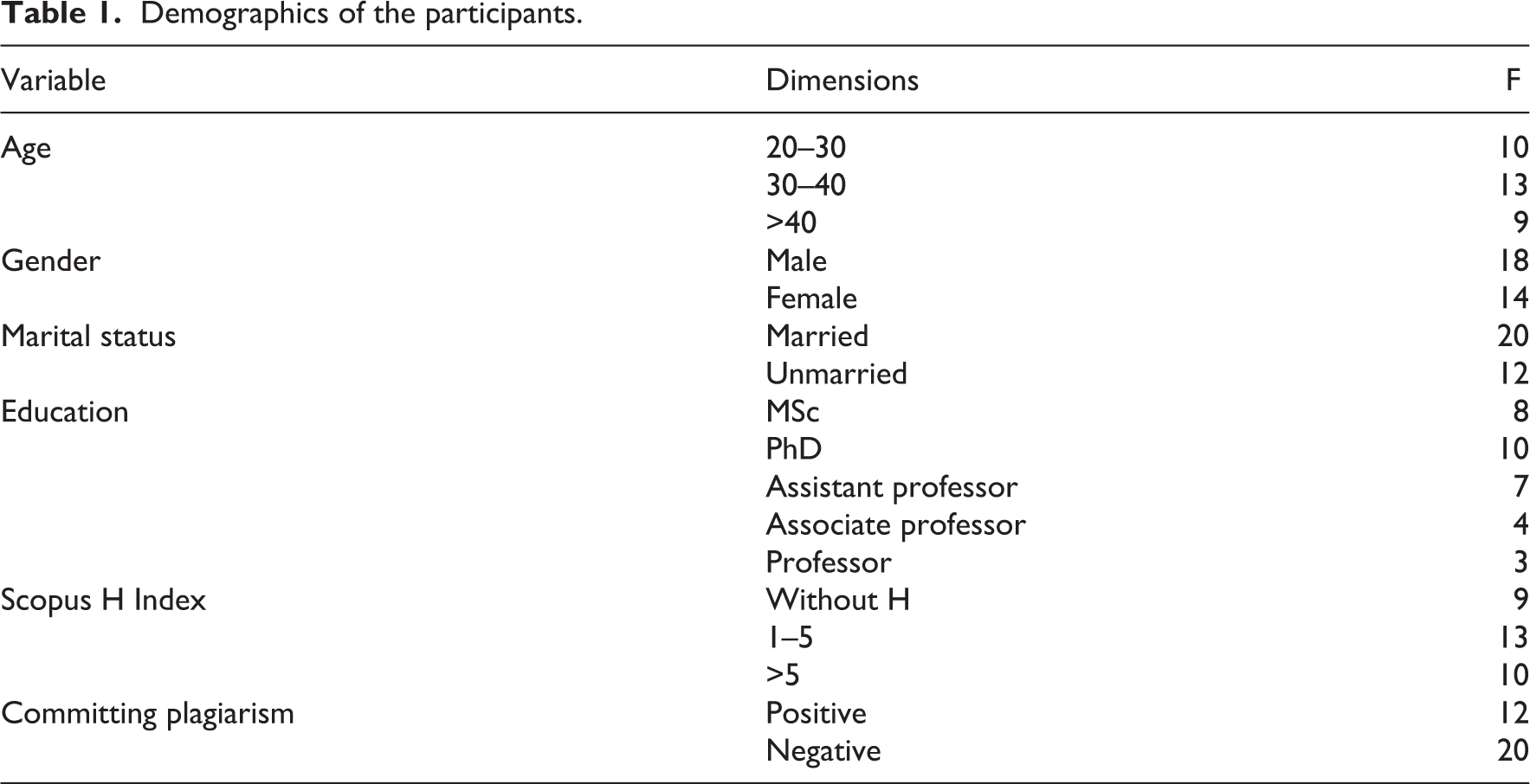
Categories and subcategories that emerged from interviews.
Causal condition
The causal condition of plagiarism in Iran contained three categories of lack of skills and awareness and pressure by education structure.
Lack of skills and awareness
This category comprised subcategories such as lack of article writing skills, lack of English writing skills, lack of skills to search for articles in scientific databases, lack of skills to use referencing software, lack of awareness about different plagiarism techniques, and lack of awareness about plagiarism software.
An associate professor, 30–40 years old, commented, Many students and even professors have a very poor English language skill. Therefore, they tend to use the clauses used in other papers, which are easier for them to understand. We students do not know how to write a paper and there is nothing in the courses about it. That is why many try to do the job through plagiarism. (MSc student, 20–30 years old) Many of the students do not know how to do a search on the Internet for they dissertation. They do not even know how to make a reference in their paper. (Assistant professor, 30–40 years old) Every year, several workshops are held for different things but there is nothing about plagiarism. That is way many do not know much or at all about plagiarism or if they have done it. (PhD student, 30–40 years old) It happened to my friends and I. One of our papers was rejected due to plagiarism. The fact is I myself knew nothing about plagiarism check software two months ago. (PhD student, 20–30 years old) I extracted two papers out of a research work and naturally, the both papers had identical methodology. I did not know that is a plagiarism at that time. (MSc student, 20–30 years old)
Education system pressure
This category comprised subcategories, namely, work pressure, emphasis on educational degree, inconsistency between courses and expectations, paying attention to high h-index, and valuing the number of published papers: We are under pressure to promote ourselves and it needs publishing papers. Some of the professors who are too busy for this, use plagiarism for writing dissertation. (Full professor, >40 years old) What matters in Iran is the educational degree and competency and capability do not matter. That is why everyone is chasing an educational degree no matter how it is achieved. (Assistant professor, 30–40 years old) They do not teach us that much, but they expect a lot by heavy assignments that we cannot handle them. Therefore, we pay others to do those assignments or copy others’ papers. (MSc student, 20–30 years old) Here, we only care about quantity and number of papers published by an individual. Quality of paper does not matter and therefore to increase the number of papers, many students and professors turn to plagiarism. (Associate professor, >40 years old) Iranian academic community values h-index too much while the quality of teaching and other aspects are neglected. That is why everyone is obsessed with h-index. (PhD student, 30–40 years old)
Background factors
The background factors in plagiarism were personal traits and attitudes of the academic community.
Personal traits
This category consisted of boasting, seeking fame, laziness, lack of self-confidence, poor ethical beliefs, and competitiveness: Today, many of the professors tend to boast about their h-index and having a higher h-index, they try to publish as many papers as they could no matter how. (Assistant professor, 30–40 years old) To become famous, many of the colleagues try to improve their h-index. Therefore, the quality of papers is not important for them. What matters for them is to publish more paper and even they publish one paper in more than one journal. (PhD student, 20–30 years old) Some of the students and professors do not have the confidence to write and publish a quality paper in creditable journals. Therefore, they turn to copying and plagiarism. (Professor, >40 years old) Unfortunately, unethical behaviors are very common in Iran academic community. Some do not feel a bit of guilt whey they turn to plagiarism; they might even be proud of themselves. (Professor, >40 years old) Unfortunately, there is an intense competition among faculty board members so that they do anything to publish more papers. Sometimes, they even turn to plagiarism. (Assistant professor, 30–40 years old)
Intervening factors
Technological advances, legal gap, and lack of strict supervision constituted the categories of intervening factors.
Technological advances
Subcategories in the category were expansion of the Internet and easy and inexpensive access to information: Today, everyone can access the whole online information all around the world. Therefore, it is very easy to use others’ works without giving reference. (PhD student, 20–30 years old) Technology advances have given us easy access to a great volume of resources and it is easy to copy small pieces from several papers and create a new paper without leaving a trace behind. (MSc student, 20–30 years old)
Legal gap
Lack of clear and strict laws about plagiarism constitutes the subcategories of this category: There is almost no penalty for plagiarism in our educational system. (Associate professor, 30–40 years old) There are no clear laws to punish plagiarism in Iran. That is why it is spreading. (Associate professor, >40 years old) I have not heard anyone being punished by being fired from university for plagiarism. Even a PhD dissertation that is copied is punished only by giving a low score. (PhD student, 20–30 years old)
Lack of efficient supervision
This category contains the subcategory lack of adequate supervision about plagiarism: Most of the dissertations are copied and nobody cares. It is an irony that genuine dissertations receive lower scores. (MSc student, 20–30 years old)
Strategies
Role model, supervision, national and internal arrangements, and improved awareness constituted the categories of this theme.
Role model
This category comprised following faculty board members, following friends and colleagues, and widespread plagiarism in Iranian academic communities: When the majority of professors do it, you cannot expect students to avoid plagiarism. (Associate professor, >40 years old) Many professors motivate students to do plagiarism, intentionally or unintentionally. In some cases they make the student do so. My own advising professor made me to divide a research work into several parts and publish each part in different journals under different titles, while the papers overlapped by 80%. (PhD student, 30–40 years old) Nowadays, rather than being considered as a wrong action, plagiarism is considered as good thing and those doing it brag about it and how smart they are. Some of my colleagues have told me and others stories about their plagiarism. (Assistant professor, 30–40 years old) Out of eight students in the class, three purchased dissertations available on the market, and their professors did nothing about it; although they knew. (MSc student, 20–30 years old)
Supervision and coordination at national and international levels
The subcategories were stricter supervision on dissertations, introducing stricter laws and penalties, and using plagiarism check software by Iranian and foreign journals: Recently, advising professors are required to have stricter supervision on dissertations to control plagiarism. (Assistant professor, 30–40 years old) New laws are going to be ratified to introduce harsh punishments for plagiarism by students and professor including getting fired. (Professor, >40 years old) Before the plagiarism check software, plagiarism was very common in Iran. However, journals are now checking every paper for plagiarism and reject them when the similarity is above a specific threshold. (Associate professor, >40 years old)
Raising awareness
This category contained subcategories, namely, holding article writing and plagiarism workshops at universities: Following the recent spread of plagiarism, many universities are holding plagiarism workshops to raise awareness in students and professors about the problem. (PhD student, 30–40 years old) Recently one of the universities held workshops to raise awareness about plagiarism and improve writing skills in students and prevent plagiarism in students. (Assistant professor, 30–40 years old)
Outcomes
This theme contained two categories, including regeneration of plagiarism and reinforcement of negative attitudes toward Iranian researchers.
Regeneration of plagiarism
Copied papers and emergence of a black market for dissertation outside universities were the two subcategories: It is easy to find dissertations in any major and at any level in Enghelab Square market, Tehran. (PhD student, 30–40 years old) Many create a resume by spending money and buying one or two papers in Enghelab Square market, which are then published. (MSc student, 20–30 years old) One of the professors publishes more than 40 papers every year and in fact he contributes in a few of them. What they do is that they add their colleagues’ names in their own papers and those colleagues return the favor by adding their name in their own papers. In this way, they can publish this many papers every year. (Assistant professor, 30–40 years old)
Development of negative attitudes
One of the outcomes of the spread of plagiarism among Iranian authors is that journals follow a stricter review process for Iranian papers: Recently, we see that creditable journals do not trust the data provided by Iranian authors and reject our papers easily. (PhD student, 30–40 years old) It appears that creditable journals have become more sensitive about Iranian papers so that they have stricter review process for Iranian papers. (PhD student, 20–30 years old) Recently, foreign creditable journals reject Iranian papers without reviewing them. Because of this, Iranian authors try to add a foreign author’s name to the paper to avoid this. (Associate professor, 30–40 years old)
The phenomenon of plagiarism in Iran is affected by several factors. The background factors that lead to plagiarism are personality traits like competitiveness and boasting about the number of published papers. In this regard, the causal factors that affect this phenomenon are lack of skills and awareness and the pressure induced by the education system, which are intensified by intervening factors like technological advance and lack of efficient regulation and supervision. In addition, expansion of plagiarism triggers strategies and approaches like role model, national and internal supervision and coordination, and higher awareness. Since the adopted approaches to this phenomenon have not been effective so far, we see regeneration of plagiarism and reinforcement of negative attitudes toward Iranian authors.
Discussion
A model to elaborate on the causes of plagiarism in medical sciences universities in Iran was introduced. Among the main causes of plagiarism in Iran were the lack of research and article writing skills and lack of awareness. Many of the students and even professors do not have the skills to write a quality research paper, and therefore, they turn to plagiarism. In some cases, they do plagiarism without knowing that. This finding is consistent with other studies in this field. 32 –34 In the study by Smith et al., 24 lack of knowledge and lack of skills have been mentioned as the main causes of plagiarism. In the study by Ryan et al., 35 lack of awareness about plagiarism in students has been mentioned as the main cause of plagiarism. One key finding was that many of the students and even professors did not have a clear and right understanding of plagiarism, and even many of them had committed plagiarism without knowing so. It is essential, therefore, to familiarize researchers with plagiarism and its instances.
The pressures caused by the educational system were another casual condition of plagiarism. In the study by Koh et al., 36 the authors showed that educational and environmental pressures like tight schedule to submit assignments and keeping pressure on students to graduate as soon as possible lure students toward plagiarism. Recent decades in Iran have witnessed more emphasis on educational degrees so that degrees have become a measure of one’s value. Therefore, the society is full of students who only seek a diploma without having slightest interest in learning the material. Many enter postgraduate programs only to receive a diploma, and since many of them have a job at the same time, it is not easy for them to find the time to learn research methods. As a result, many of them turn to plagiarism. In addition, the public policy to improve the scientific ranking of the country in the region has put more emphasis on the quantity of published papers. Students and professors need to publish papers to enjoy promotion, and since many of them do not have the time to do research work, they turn to plagiarism to keep their jobs.
Among the background conditions of plagiarism, personality traits were notable. Individuals with personality traits like boasting, seeking fame, laziness, lack of confidence, competitiveness, and poor ethical beliefs had more tendency to commit plagiarism. Other studies have also highlighted personality traits as a reason for plagiarism. 37,38 In fact, major personality traits that motivated plagiarism in Iran were seeking fame and competitiveness. Since the Iranian education system puts more emphasis on quantity, some of the students and professors are tempted to publish as many papers as possible to improve their prestige and to overtake their competitors, for which they choose plagiarism. On the other hand, some of the students and professors copy others’ works due to laziness and poor ethical beliefs. In the study by Batane, 39 laziness was highlighted as the main reason for plagiarism in students.
The results showed that one of the intervening factors of plagiarism in Iran was technological advance. This is consistent with other studies in this field, 10,24,40 so ease of access to the Internet facilitates plagiarism. 7 In the study by Scanlon and Neumann, 9 IT development and spread of websites were named as the reasons for the expansion of plagiarism. In fact, the technological advances of the past decade and ease of access to the Internet have made scientific resources more accessible. People can easily access a wide range of scientific resources nowadays and copy the content without giving reference to the source. However, by using the technology in the right way, we can fight plagiarism.
The most notable findings here, which have been barely covered by previous works, were legal gaps and lack of supervision. These factors were categorized as intervening factors in the growth of plagiarism. There is no efficient supervision on research activities in Iran, and even when a clear case of plagiarism is found, there are no clear laws about how to deal with the offender. Therefore, many find it easy to commit plagiarism without any fear of the consequence. In the study by Ryan et al., 35 penalty was noted as one of the main organs of plagiarism management; hence, without an effective punishment, no plagiarism management initiative will be effective. In fact, researchers should be convinced that plagiarism brings serious consequences to them. However, in the absence of clear laws, researchers find plagiarism a safe path to take.
As to the strategies and concerns, three categories, namely, role model, national and international supervision and coordination, and raising awareness about plagiarism, are notable.
Plagiarism in Iran has become a norm, and many professors and students follow their friends and colleagues and do plagiarism. The prevalence of the problem is growing day by day, which is supported by other studies as well. 13,18,20
One of the interesting results was that despite other countries where plagiarism is considered a bad and wrong action, 16,24 there is no serious negative attitude toward it in Iran. In some cases, the participants did not find it as an unethical action. One reason for this can be the spread of plagiarism, such that it has become a norm in the society and individuals in that society find it a normal phenomenon.
Another strategy was the emergence of initiatives to fight plagiarism. The past 1 or 2 years in Iranian universities have witnessed a rise of reactions to plagiarism so that the highest legislative bodies have expressed their concerns. The Islamic parliament has examined the issue and called for introducing regulations to punish plagiarism. There have been a series of regulations enacted by the parliament to force the universities to introduce stricter supervision on research works and dissertation done by students and fight plagiarism. In addition, another initiative by universities is to hold plagiarism workshops to introduce students and professors to plagiarism and prevent unintentional plagiarism.
The results showed that one of the outcomes of plagiarism in Iran is its regeneration. In fact, we observe a growing trend of plagiarism as confirmed by other studies in this field. 22 The number of papers that are copies of other papers and dissertations is growing in Iran, and even large black markets have emerged where students can buy dissertation and articles with different quality levels, and even some have merits to be published in journals with high impact factors.
Reinforcement of negative attitudes toward Iranian authors is another negative consequence of plagiarism. Following plagiarism scandals of Iranian authors, journals have become more sensitive to Iranian papers and employ a stricter review process on them. In some cases, they do not even examine the papers from Iran and reject them without reviewing them. There have been cases where plagiarism of a submitted paper was revealed after the publication and the journal was forced to withdraw the article and reject it. 21
Conclusion
Plagiarism in Iran is affected by different and complicated factors like lack of skills, pressure by the education system, personality traits, technological advances, legal gaps, and lack of supervision. The outspread of plagiarism in society has triggered reactions like role model, national and international supervision and coordination, and rise of awareness. Plagiarism has negative consequences like regeneration of plagiarism and reinforcement of negative attitudes toward Iranian authors in academic communities all around the world. Therefore, increasing students’ awareness and skills as to article writing and research work, improving confidence and self-efficacy in researchers, alleviating boasting and competitiveness traits in researchers, and introducing the concepts and instances of plagiarism can help researchers to avoid plagiarism. In addition, emphasizing on the quality of papers rather than the quantity, promoting the use of plagiarism check software, and introducing clear laws and penalties for plagiarism can prevent the spread of plagiarism.
Strengths and limitations
This research is one of the few studies in Iran that investigates plagiarism using a grounded approach. The results are comprehensive and valuable information for policy makers and activists in academic communities to introduce effective programs and regulations to fight plagiarism. Diversity of the participants including university students and professors who took part in the interviews in different situations was another advantage of the study. However, the study was not free of limitations as some of the participants had concerns about voice recording the interviews. To solve their concerns, they were informed about the objectives and necessity of the study and that the recorded content will be used only for research purposes and remain confidential. In addition, the authors ensured the participants that their identity will not be divulged to any institute or organization.
Footnotes
Acknowledgements
We hereby appreciate sincere cooperation by participants as well as Vice Chancellor’s Office for Research and Technology at Kermanshah University of Medical Sciences, which was a crucial and important factor in this study. We also express our gratitude to all the participants as well as other individuals and organizations for their contributions to this study.
Availability of data and materials
Authors report that the data supporting their findings can be publicly shared.
Conflict of interest
The author(s) declared no potential conflicts of interest with respect to the research, authorship, and/or publication of this article.
Funding
The author(s) disclosed receipt of the following financial support for the research, authorship, and/or publication of this article: This study was supported by a grant from the Deputy for Research and Technology, Kermanshah University of Medical Sciences, University Research Committee (Grant No. 980601). The cost of the payment is spent on the design and implementation of the study.
