



Abstract
Evidence-based nursing practice is based on three pillars: the available research, known preferences of the patient or patient group and the professional experience of the nurse. For all pillars, research is the tool to expand the evidence we have, but when implementing evidence-based practice in paediatric nursing two of the pillars demand that children are included as respondents: practice research on the nursing interventions in paediatrics and the preferences of patients, something recognized by scholars and practitioners. But including a vulnerable group as children in nursing research raises specific ethical issues that need to be considered by researchers. What are ethical considerations that are currently raised about doing research with children and what do we learn by synthesizing the narrative of these studies of why the issues are raised and which solutions can be offered for these issues? In this article, considerations on three ethical principles according to the Belmont report are described by examining recent research. Twenty-one studies were found addressing relevant ethical aspects including vulnerability, gaining consent, designing quantitative or qualitative research methods and considerations regarding the execution of the study. Ethical considerations should be much more a case of continuous awareness and attitude, then box-ticking exercise, although there are sufficient international guidelines available specifically for research that includes children to aid researchers.
Keywords
Introduction
There is growing support and demand in healthcare for evidence-based practices. Evidence-based practice originated from the medical discipline 1 and is defined by Sackett et al. 2 as ‘the conscientious and judicious use of current best evidence from clinical care research in the management of individual patients’ but was soon adopted in other healthcare-related disciplines, including the nursing discipline. 3 Evidence-based nursing practice is based on three pillars: the available research, known preferences of the patient or patient group and the professional experience of the nurse. Only when all three are included in decision-making is nursing practise truly evidence-based. This is true for the whole of nursing practice, and paediatric nursing is no exception. For all pillars, research is the tool to expand the evidence we have, but when implementing evidence-based practice in paediatric nursing, two of the pillars demand that children are included as respondents: practice research on the nursing interventions in paediatrics and the preferences of patients, as the third pillar focuses more on the experience and expertise of the paediatric nurse in this case. This includes the need to investigate the preferences and needs of children as a specific category of patients, something that is recognized by scholars and practitioners. 4,5 Research regarding the care for children thus should at the very least include children as respondents. Though qualitative research is most adept as gathers in-depth data to find answers on complex phenomena or exploring experiences, the point of view of children can also be obtained through quantitative research with children.
Aim and question
Ethical issues regarding research have surfaced as scientists intensified the use of research to develop knowledge following the age of enlightenment, although written ethical codes only started appearing in the 19th century with the Nuremberg Code as one of the first in 1947, as a result of numerous morally abdominal research incidents. Throughout the years inevitably there is a lot written on this topic, therefore this narrative synthesis 6 aims to give a state of the art on issues raised in the most recent literature, focusing on literature concerning research with children. The question central in this narrative is: What are ethical considerations that are currently raised about doing research with children and what do we learn of the narrative on why these issues are raised and of solutions offered to these issues?
Method
Search strategy
A comprehensive literature search was done in EBSCO searching for keywords in abstracts ‘child* OR youth OR teenager’ in combination with ‘ethic*’ and MeSH terms ‘nursing research’ OR ‘evidence based nursing’ OR ‘CHILDREN – Research’ OR ‘NURSING research’ OR ‘NURSING research methodology’ OR ‘NURSING research – Moral & ethical aspects’ OR ‘EVIDENCE-based nursing’ ‘EVIDENCE-based pediatrics’. Articles needed to be published between 2000 and 2019.
Inclusion and selection
The original search rendered a total of 120 articles. To be included, the article needed to be in English and published in academic or scientific journals. The articles did not have to be peer-reviewed. Book reviews, editorials and articles focussing on the ethical side of medical treatment or genetic research were excluded. After this selection, 73 articles remained. For these articles, the abstract was retrieved to screen on general content. Articles that were not available or without an available abstract were excluded. Also, articles that according to the abstract did not focus on the ethical issues regarding research with children were excluded. In the search, but also in this article, we define a child as a person between 0 and 18 years old. After this selection, 25 articles remained. During the study, some articles appeared in references; two of them were included as they conformed to the search terms above and the inclusion criteria, and they are listed in the findings as ‘snowballing’ papers. For two other articles, only an abstract was available for review, and this is noted in the findings.
Analysis
The articles were first open-coded on their main theme or issue raised in it, then a summary of the main lesson or take away was drafted. These themes and summaries were then used to cluster the articles according to the principles of the Belmont Report, which is used to teach nursing science students on ethics 3 articulating three primary ethical principles: beneficence, respect for human dignity and justice.
Results
In 27 articles, addressing various ethical aspects of research with children was included. Among the selected articles were two reviews, one on Internet use and one on well-being.
The articles were clustered based on the three primary ethical principles: beneficence (five articles), respect for human dignity (nine articles) and justice (13 articles).
For each principle or issue within a principle, a theoretical background with commonly used concepts or theories is offered first, followed by a summary in the form of a narrative synthesis, described as a way to synthesize multiple sources only with words that tell the story of what is found 6 in the recent literature originating from the search of this study, which is presented in a table at the end of the findings on each principle.
Principle of beneficence
This principle can be summarized by the phrase: ‘above all, do no harm’. 3 The main concern with this principle is to minimize risks and optimize benefits. This principle should, according to Beauchamp and Childress, 7 also include not only management of the possible risks but also active protection against maleficence. When preparing a study, the first ethical consideration is the possible benefit of the study. Few studies expect a direct benefit for the participating children or the patient group they are part of, but even if a study provides no direct benefits to participating children, from other studies, it is known that it is important to consider other benefits besides the direct effect of the study.
The literature from our search, presented in Table 1, suggests that making a positive contribution to other’s lives is a profit of participating in studies, mainly discovered by reflection on this participation later in life, and according to Litton, 8 it seems that participation also improves overall well-being. It is noticeable that Crane et al. 9 report in a review that little is known of the actual perceived well-being of children during studies. They rightfully advise to include monitoring well-being as a part of the methodology of a study.
Besides this benefit principle, it is only logical that even if there is little benefit for the participating children, it is increasingly important to hear children in complex health situation as well, even though these situations usually involve more risks, in order to investigate their perspective as only they can provide this through research. The flipside of the benefits is what the costs then are for the child to participate, physically and emotionally as researchers have a moral obligation to protect the interests of the children involved. In the studies found in the search for this overview regarding the benefits, costs and risks, they all stated that the benefits almost always outweigh the risks, 10 –12 although the field should direct its focus and prioritize which evidence is most needed in paediatric nursing care. 13
Included studies on risks and benefits.

Principle of respect for human dignity
This principle elucidates several rights, intertwined with human dignity, including the right for self-determination and full disclosure. 3 Issues regarding vulnerability of children as a specific group of respondents and informed consent will be discussed. The difficulty in doing research with children is that they are commonly considered a vulnerable group of patients. 3,5 This is not surprising, seeing that children are also not considered legally capable of giving consent when they are younger than a certain age, depending on the laws and guidelines in the country of origin. In healthcare, there is a second age threshold: namely, the legal age from which a child has a say in his or her medical treatment, this also varies per country. Therefore, instead of considering age, can researchers use Gillick’s competence, 14 named after a British activist who sought ruling for young girls who insisted to be competent to decide on contraceptive advice or treatment regardless their age (below 16 years). Rather than enforcing the parental right, the judges ruled that minors were competent under certain conditions to bypass their parents based on cognitive competence.
Recent studies in our search as presented in Table 2, describe ethical issues concerning the respect for dignity by an awareness of the power differences in the relationship between researcher and participant, 15,16 in the duty to protect their safety 17 and awareness of the right for children be treated with respect within the research relationship. 18 –20
Included studies on dignity and rights.

One related issue for all researchers regarding self-determination is the acquiring of consent. Regarding the process of consent when children are involved, it is common practice to adhere to the right of self-determination by not only gaining parental permission but also ascertain the children’s assent. Both types of consent were specified by Lambert and Glacken, 21 as shown in Figure 1, in order to guarantee that consent giving beforehand was also retained during the study, although a study found in this review found these concepts not yet adequately defined. 22 When working with children, the subtle signs and ‘no-pressure-rule’ demand constant ethical awareness of the researcher towards his or her own behaviour and non-verbal communication. This awareness shows a respectful attitude towards children with their own abilities and limits as respondents.

Elements of child assent according to Lambert and Glacken. 21
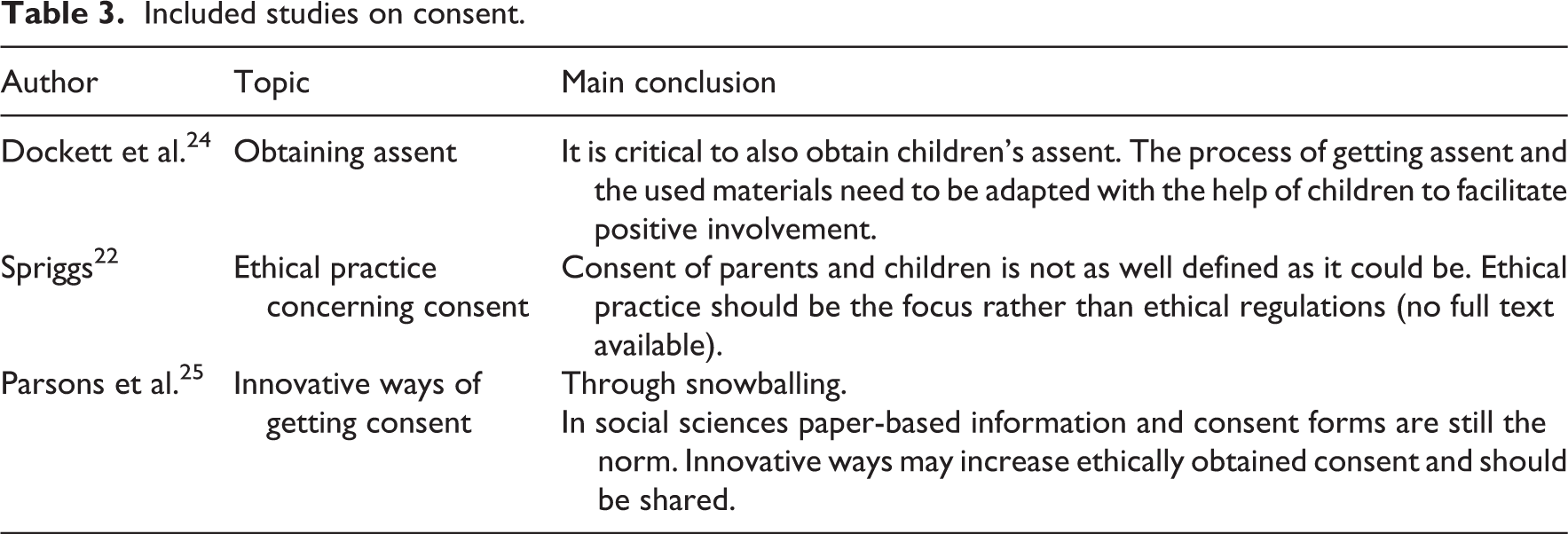
Recent studies presented in Table 3 show that to obtain this assent the information provided on the study is of great importance. Only when the information of the study is really understood by the child, is it able to weigh the consequences for themselves. 23 The studies show that researchers are developing diverse ways to disperse the information to children, they use verbal, and non-verbal methods like texts, pictures, a video clip or even a comic book about the study. 24,25 The provided information is not only important to empower the child to make an informed decision but it is also closely related to determining a child’s competence to provide assent or consent.
Included studies on consent.
Principle of justice
This principle is concerned with all rights related to just and fair treatment, including a right to privacy. 3 This principle thus dictates how a study should be performed to be fair towards respondents. Fairness is often described as ‘people who are equal, get treated equally’.
To do so, based on the articles in this review, one should when designing ethical research involving children first and foremost be aware of their own perception, or philosophical outlook into research involving children in general. Punch 26 discerns three different perspectives:
A perspective in which one considers children as the same as adults and uses the same methods as they do with adults.
A perspective in which one perceives children as completely different from adults and uses ethnography (mainly observation) to analyse the child’s world.
A perspective in which one sees children as being similar to adults, although with different competencies, therefore employing multiple innovative and adapted methods.
As with many ethical issues, like age thresholds, this perspective can differ between countries and continents. Graham et al. 27 wrote a comprehensive global guideline called ERIC (Ethical Research Involving Children) requested by UNICEF to provide some sort of baseline for researchers worldwide. ERIC supports this reflective attitude starting by acknowledging that mainly the researchers’ own knowledge, beliefs, assumptions, values, attitudes and experience intersect with ethical decision-making.
When examining the recent literature in this review presented in Table 4, it is noticeable that cultural contexts 28 –30 and professional/scientific integrity 31,32 are the main aspects of discussion. They show the need for ethical rules and regulations to be interpreted, adapted and practised by reflexive and ethical responsible researchers who are aware of their own moral, ethical, cultural and philosophical perspectives. It is encouraging to see that also a more multidisciplinary approach, the borrowing of perspectives and knowledge from other disciplines, is prevalent. 33,34
Included studies on treatment.
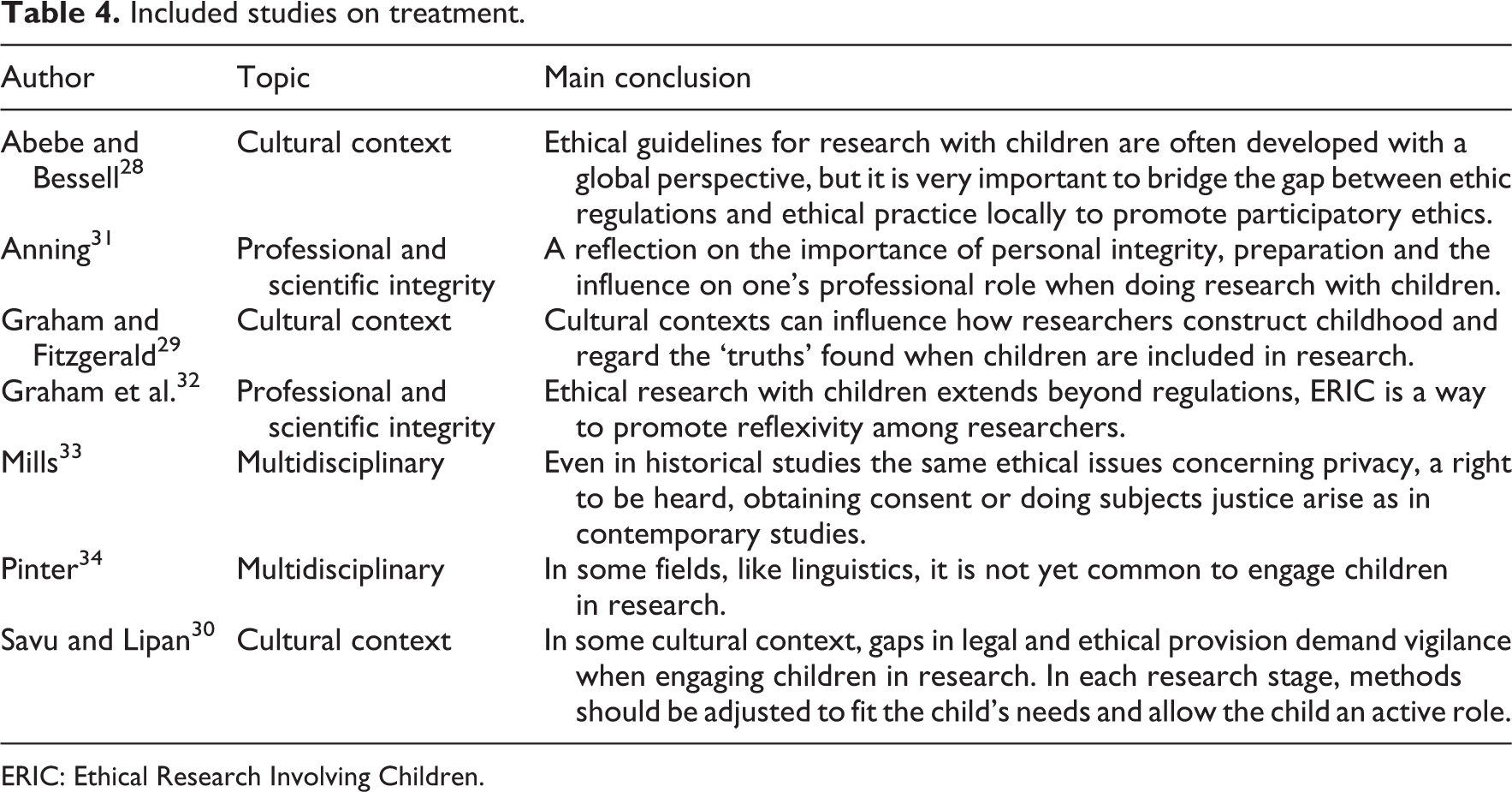
ERIC: Ethical Research Involving Children.
To treat children fair during the research process, one should also adapt the used measurement instruments in a way that they fit the intelligence, competency and capabilities of children. There is an increasing amount of measurement instruments adapted or created, especially for children. This search found one article to aid quantitative inquiry, using the digital opportunities which are available. 35 But it can be argued that qualitative methods eminently can render a broad scope on phenomena, which are especially valuable for nursing research as a relatively young science. 3,4 For qualitative studies, it was concluded by Docherty and Sandelowsky 36 that children even as young as 6 years were capable of reporting experiences truthfully according to their parents. Kirk 37 did a review in 2007 stating that researchers could learn from the debates in social sciences and should use, as well as evaluate the use of creative methods.
Recent studies presented in Table 5, show that mainly the ‘how’ of creative methods needs developing: multiple articles advocate the adoption of a more narrative way of thinking and recalling with children like storytelling, 38 using drawings 38,40 or photographs 38,40,41 as well as other creative methods to accompany stories. For example, when working with children with limited vocabulary, relational observation of play and behaviour can be adapted as a research method. 40,42 The data of more innovative and creative method require vigilance in handling the data not as just products (a drawing of a photograph) but as a process, in which context, relationship, meaning-making and perspective must be included in the analysis.
The studies found in this search made it paramount that also in the analysis of the data, children should be able to participate and join the analysis. 38,40
Included studies on treatment and privacy in methodology.

Discussion
It is striking that authors of included studies are aware of the risks and the importance of safeguarding the well-being of children during a study, but it is not yet common to address this issue methodologically in studies with children. Risks regarding the well-being of involved children were studied by Staphorst et al. 43 who showed that children give different names to the negative impact on their well-being, or discomfort, as a result of participating in (medical) research like worries, boredom or unpleasantness. Discomfort for children is clearly more than physical stressors like pain. Researchers could consider including a measurement instrument for this discomfort like the DISCO-RC from Staphorst et al. 43 to gain insight into the level of discomfort, after children assent to participating to ensure that the costs do not outweigh the benefits for the children involved.
Regarding the information and consent/assent process of a study, it is common practice to assess a child’s competence informally, but competence can be formally measured with tools like the MacArthur Competence Assessment Tool for Clinical research or treatment. Hein et al. 44 found in a validation study of this tool that age was the most predicting variable for competency in children followed by intelligence. These two variables should always be included in the process of establishing competency. The narrative synthesis in this review shows that the legal and cultural restrictions in age and assumed competence, or lack thereof, can also be methodically reviewed.
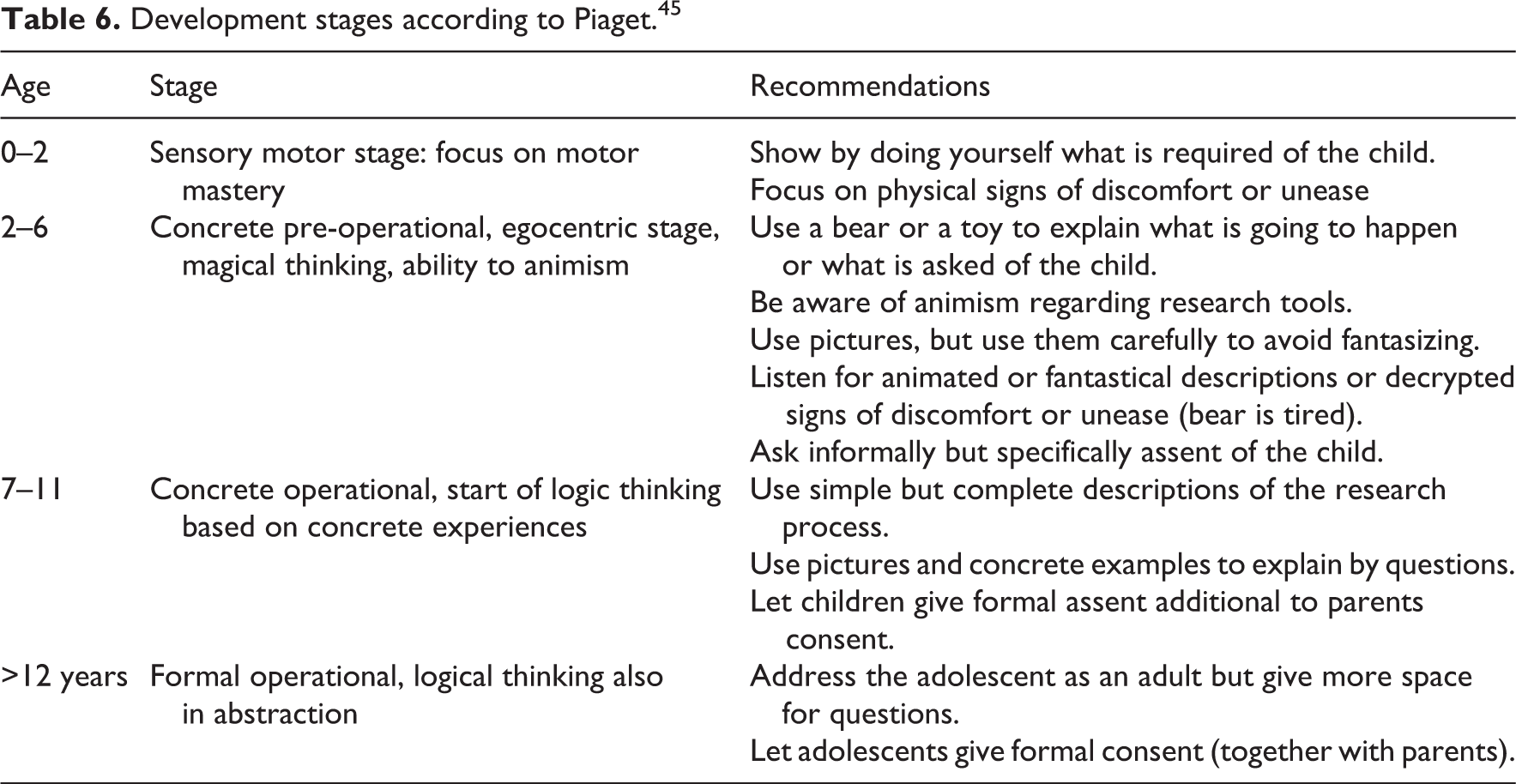
We addressed Gillick competence earlier, and the first condition of Gillick’s competence is that the minor really understand the professional advice or information. Therefore, any information should ideally consider the developmental stage children that are included are likely to be in, usually this developmental stage is determined according to Piaget’s theory 45 based on age groups. This is not just a cognitive consideration; it is ethical in the sense that researchers have a moral obligation to make sure that children understand the study and the consequences of their participation at their own level. In Table 6, different stages are described and illuminated by a few examples. As it is becoming more common to test measurement instruments on a pilot population, so should the information for children also be tested out on children in the same age or developmental stage before execution of the study.
Development stages according to Piaget. 45
The third perspective described by Punch 26 seems the best fit for research with children. On the one hand, children should receive the same ethical courtesy as adults, but simultaneously be considered in their unique and specific competencies. Although, for example, it was stressed in the articles regarding the methods that qualitative methods are indeed suitable for studies to explore phenomena, one should be aware of certain implications of the specific characteristics of children as the influence of scripting experiences when interviewing children. Children have a way of bundling alike experiences into one coherent narrative, 36 and they also show the tendency to unconsciously select experiences or feelings mainly when it is not clear for them what the interviewer wants to know or the experience is emotionally loaded for the child. 37 These specific tendencies demand a consistent ethical awareness of the researcher, both in designing interview questions, the execution of the study and in analysing the results. One of the aspects of being scientific integer of a researcher is to try operating as neutral and objective as possible. With qualitative research, this is done by determining beforehand what to ask and how/when to prompt. But a conversation with children also needs to be a bit playful for them to trust and open up to the researcher. This playfulness may lead to direct questions from the children as they do not understand ‘research-rules’ or do not realize that the researcher is not supposed to give their own input or opinion. It probably will be a thin line to find the balance between answering the child’s questions as honest and authentic as possible to forge a trusting relationship without influencing the response of the child. Of course, this is not only important in doing research with children, and one can improve the trustworthiness 46 of the data by using available methods from general qualitative research. For example, it can increase the credibility to record a reflective interview log or organize supervision meetings to stay aware of the course of the interviews and the role of a researcher; regarding conformability, researchers could include children in the analysis of peer review suitable for children; regarding authenticity, researchers should describe and disseminate the results from drawings or quotes in a respectful way.
To assist nurse scientists, the literature in this review was clustered according to the three main principles they are educated with. However, by doing so, new elements may have been missed in the process, perhaps those related to specific paediatric ethical issues as the principles are not specific for paediatrics. ERIC 27 is the first initiative to translate and support implementation of the Right of the Child formulated by the United Nations. Also in this international endeavour, three main principles are used: benefit, justice and respect. Maybe this initiative could lead to more child-specific principles of ethical considerations in the future.
Although the guidelines in ERIC and the others mentioned in this synthesis exist, they do beg the question how to avoid a box-ticking ethical attitude, when there are so many boxes to tick. It would be interesting to examine if these guidelines are frequently used and what they offer in practice. As this narrative shows a need for a more morally ethical awareness, it is less tangible to measure or control. The question is of this is necessary. What do we expect of a researcher who includes children in their studies, even if these children are not submitted to medical procedures? What is mandatory, and what is up to the researcher or ethical committee?
Conclusion
Therefore, what story do the issues that are currently raised tell us? What can researcher learn from the solutions offered?
First, that every nursing study aiming to include children as subject, respondents or even as fellow researchers should start with an ethical discussion on the realization of the principles respect, benefit and justice throughout a study. 4 This synthesis shows that these principles still raise issues in the current literature and are not a matter of simple box-ticking; researchers should assess and develop their own ethical morals 31 ,34 regarding the inclusion of children 9,22,26,27 and the ethical ways of keeping them included in the study as the main objective from the design of the study 32 through the data collection and analysis 41,42 until the dissemination of the results. 38 Every study involving children should be scrutinized on possible risks, consequences, impact as well as the benefits, methods and expected results of the study. This scrutiny should be used to discover the fruits of the ethical decision-making and the ethical appropriateness of the methods and tools considered. But as recent literature shows ample opportunities and possibilities to address the ethical issues regarding vulnerability, costs, obtaining assent, participatory research and innovative data collection methods, there is no reason why the necessary evidence to underpin nursing paediatric practice could not be discovered through any form of research with children.
