



Abstract
Background:
The parent of a child with profound cognitive disability will have complex decisions to consider throughout the life of their child. An especially complex decision is whether to place a tracheotomy to support the child’s airway. The decision may involve the parent wanting a tracheotomy and the clinician advising against this intervention or the clinician recommending a tracheotomy while the parent is opposed to the intervention. This conflict over what is best for the child may lead to a bioethics consult.
Objective:
The study explores the conflicts that may arise around tracheotomy placements.
Research design:
This study is a retrospective cohort study of pediatric patients for whom a tracheotomy decision required a bioethics consult.
Participants and research context:
Pediatric patients aged birth to 18 years old with a bioethics consult for a tracheotomy decision conflict between April 2010 and December 2016. A standardized data collection tool was used to review notes entered by the palliative care team, social workers, primary clinical team interim summaries, and the bioethics consult service.
Ethical considerations:
The study was reviewed and approved by the medical center’s institutional review board.
Results:
There were 248 clinical bioethics consults during the identified study period. There were 31 consults involving 21 children where the word tracheotomy was mentioned in the consult, and 13 of the 21 consults were for children with profound cognitive disability.
Discussion and conclusion:
Clinicians need to be aware of their own biases when discussing a child’s prognosis and treatment options while also understanding the parents’ values and what the parent might consider to be burdensome in the care of their child and the acceptable burden for the child to experience.
Keywords
Introduction
Advances in medical technology have extended the lifespan of children with profound cognitive disability (PCD). The parents of children with PCD will be faced with many complex decisions throughout the life of their child. One of the more complex decisions may be whether to support the child’s airway with a tracheotomy, which may include long-term ventilation. The ability to support a child at home with medical technology, such as tracheotomy and ventilator, is increasing, which may add to the complexity of decisions regarding goals of care.1,2 The complex decision point of whether to place a tracheotomy may result in conflict between members of the healthcare team and the child’s parents. The decision to place a tracheotomy in a child with PCD may involve the parent wanting a tracheotomy and the clinician advising against this intervention or the clinician recommending a tracheotomy while the parent is opposed to the intervention. The parent’s decisions will generally reflect what they consider to be in the best interest of their child. The physicians and nurses caring for the child may also believe that, given their experience with similarly situated children, know what is best for the child. For example, a parent may believe that placing a tracheotomy in their child who has PCD will improve the child’s “quality of life” (QOL), while the healthcare team may believe it will only prolong “suffering.” In a different scenario, the physician may believe that a child needs a tracheotomy to progress to care outside the intensive care unit (ICU), while the parent disagrees with the recommendation, believing that with more time in the ICU, their child will improve and the tracheotomy will not be necessary.
For children with PCD underlying, this difficult decision is often a consideration for the burden of the tracheotomy and related life-sustaining treatment on the child against the predicted capabilities of the child, and the burden that may arise in caring for the child over a lifetime. A family may decide that the severity of the child’s disability and the related burden of care is not in the child’s best interest, while another family may believe differently and perceive the burden and QOL for the child is acceptable. This can be difficult for healthcare team members whose values and what they believe to be in the best interest of the child may differ from the values and considerations of the parents.3,4
The best interest standard has been used in pediatric bioethics to guide medical decisions and to consider ethical obligations. 5 However, this standard has limited ability to resolve disagreements between clinicians and parents, because of the varied interpretation of what is “best” and the view that parental decisions should be prioritized over clinicians when there is uncertainty on the impact of the decision.6,7 In the case of tracheotomy, such decisions fall within a zone of parental discretion. The clinician’s focus is on the health and wellbeing of the child, relying on experience and knowledge of cure rates and the long-term impact of an illness or injury. The parent, as the surrogate decision-maker, is also focused on the child’s wellbeing, but in addition, they consider relationships and values when making decisions.1,5,8 For children with PCD, it can be even harder to assess interests, leading to an alternative approach based on relational potential in support of parental discretion. 9
However, despite the ethical rationale for deferring to parental decisions, some clinicians make recommendations based on their own perspective. A study using case examples and a preference survey found a correlation between a physician’s personal preference for life-sustaining treatment for themselves and the recommendations made to families. 10 The physicians were given a patient scenario about a child with spinal and head injuries and asked to rate (acceptable to not acceptable) their recommendations for a tracheotomy and/or reintubation for the child in the scenario. Physicians who preferred less life-sustaining treatment for themselves were less likely to recommend a tracheotomy to the family in the scenario. Care team members often base the QOL concerns for a child with disabilities on their experiences only of the child in the hospital without the benefit of knowing the child outside the hospital setting. It is important for the healthcare team to understand that for some families their child’s life has value and brings joy even if it is only through the child’s brief smile and the occasional giggle. Other families may view the brief eye contact or occasional smile as holding little meaning and question what QOL the child has when they seem unable to interact or experience the world around them.
Disagreements between caregivers and the healthcare team may result in clinicians or parents requesting a bioethics consult. This article describes bioethics consults over 6 years in 21 children involving the decision to place a tracheotomy. Many of these consults involved children with neurological impairment or progressive degenerative diseases. Consults included cases where the parent did not agree with the recommendation for a tracheotomy and consults where the healthcare team felt the family request for a tracheotomy would only prolong the child’s suffering The objective of this article is to better understand these conflicts and identify improvements in the approach to tracheotomy discussions.
Methods
This study is a retrospective cohort study of pediatric patients aged birth to 18 years old cared for at a 400-bed pediatric academic medical center in the Northwest about whom a tracheotomy decision required a bioethics consult between April 2010 and December 2016. A database of clinical bioethics consults was reviewed using the search terms: trach, tracheotomy, and tracheostomy. Consults of patients who had a tracheotomy placed during the admission that led to the consult were included. Consults that were unrelated to tracheotomy decisions were excluded. A standardized data collection tool was used to review notes entered by the palliative care team, social workers, primary clinical team interim summaries, and the bioethics consult service. Demographics collected included date of birth, gender, and diagnosis. The language preferred for care was collected to evaluate how low English proficiency might impact the tracheotomy discussion. The date of admission and date of consult were collected to determine length of hospital stay at the time the consult was made. This information seemed important to see if the conflict over decisions was associated with the length of hospital stay. The notes were reviewed for diagnosis, discussions regarding treatment options, prognosis, recommendations for treatment, and discussion around parent and patient preferences. Cases where a bioethics consult for children who had a tracheotomy placement during a previous hospitalization were excluded.
The medical center’s institutional review board approved the study.
Results
Child and consult characteristics
There were 248 clinical bioethics consults between April 2010 and December 2016.
Of those consults, 31 involved 21 children where the word tracheotomy was mentioned in the consult (see Figure 1). The consults were requested by 3 clinical nurses (10%), 25 physicians (80%), and 3 social workers (10%) with 55% of the consults originating in the intensive care area. One child had five consults and six children had two consults. The multiple consults were requested as the child’s illness continued to progress or multiple attempts at extubation had failed, and there was continued disagreement about the placement of a tracheotomy. The median age of the children at the time of the bioethics consult was 5 months old. The median length of hospital stay (LOHS) at the time of the first bioethics consult was 54 days. The LOHS and timing of the bioethics consult correlated with the child’s illness or disease progression leading to the tracheotomy decision point. Language preferred for care was identified as non-English in 43% of the families. More than half (62%) of the children had PCD. All but one child was in the hospital at the time of the bioethics consult (see Tables 1 and 2).
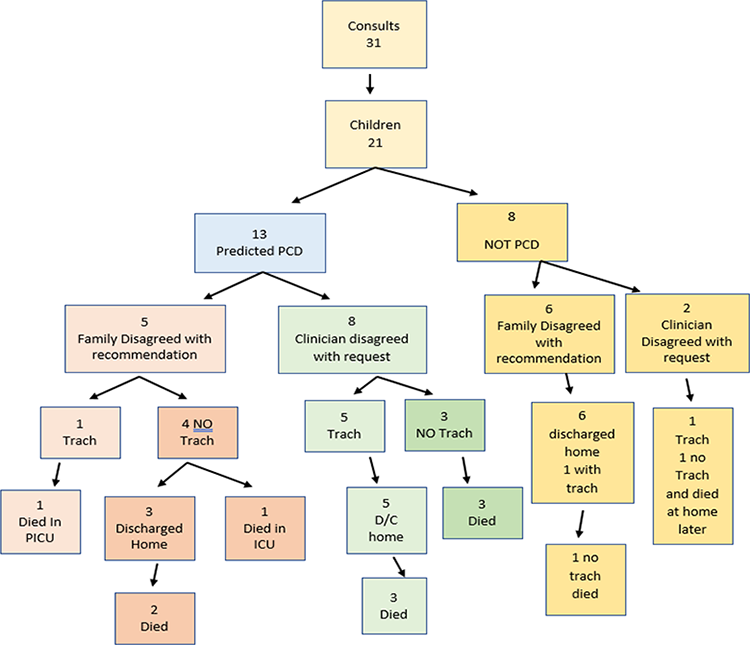
Outcomes tracheostomy decision.
Summary table (N = 11) parents disagree with Trach recommendation.
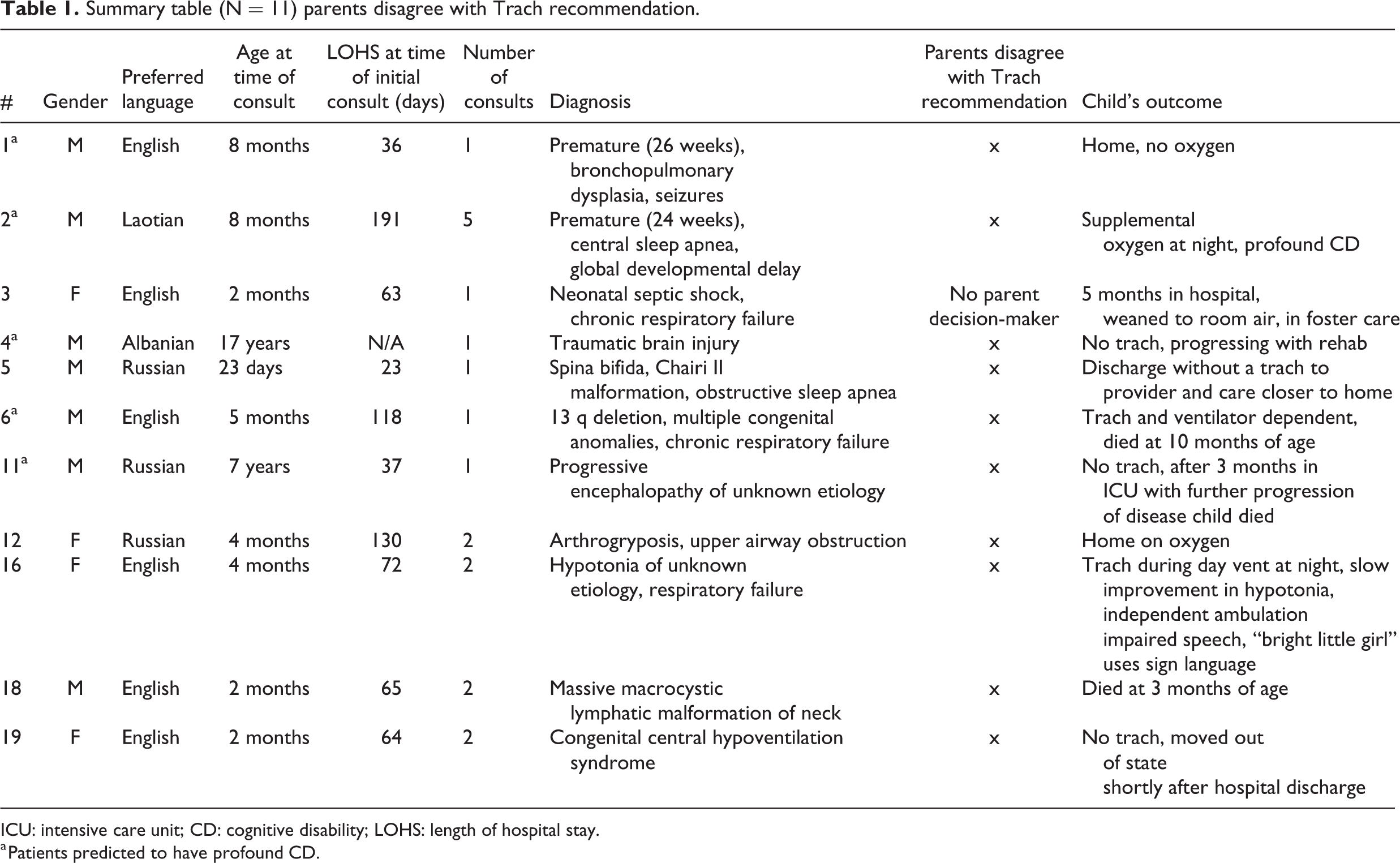
ICU: intensive care unit; CD: cognitive disability; LOHS: length of hospital stay.
a Patients predicted to have profound CD.
Summary table (N = 10) providers disagree with Trach request.

LOHS: length of hospital stay; CPAP: continuous positive airway pressure.
a Patients predicted to have profound cognitive disability.
In this cohort of 21 children, 11 families disagreed with the recommendation by the provider that a tracheotomy was necessary, and 10 families wanted a tracheotomy and the provider disagreed. The family often wanted the child to have more time to determine whether a tracheotomy was truly needed. “She just needs more time to grow, wait until her 3 months birthday and then try one more time (to extubate).” In the 10 children where the provider recommended against the tracheotomy, this was most frequently due to believing the intervention would not improve the child’s outcome and may only prolong dying.
In the 13 children with PCD, 5 parents disagreed with the provider’s recommendation for a tracheotomy and 3 of these children were discharged home without a tracheotomy. There were eight children where the parent requested a tracheotomy and the provider recommended that a tracheotomy was not in the child’s best interest. Five of these children eventually received a tracheotomy and were discharged home (see Figure 1 and Tables 1 and 2).
Family and provider perspectives
To learn about family preferences, a review of the palliative care notes was most informative. The palliative care team was consulted with 90% (n = 18) of the children. Some families did not want a tracheotomy, wanting more time to see if their child would improve without this intervention. One family described wanting more time for the child to grow and were concerned at the added complexities of a tracheotomy, “it is best to see if he will outgrow these events (airway instability), it would be very difficult to add a tracheotomy to all his other care.” In other situations, the provider felt a tracheotomy would not change the trajectory of the child’s illness and would prolong dying: “there will not be developmental progress, he will have limited neurological function, and may never breathe on his own.” In a consult for a 7-day-old infant with hypoxic-ischemic encephalopathy (HIE), the infant was predicted to have “profound developmental disabilities and will likely never walk or talk and will always require full-time care,” an outcome predicted based on medical knowledge. Whereas the parent’s decision was noted to be guided by their hearts, “being a parent and trying to discern what is best, coping with the uncertainty, focusing on loving her son and being a mom. She feels strongly he will recover to some extent.” Both the parent and the provider are considering QOL, each with their own viewpoint, wanting what is best for the infant. A number of the palliative care notes discussed some loss of trust parents felt in the provider being able to predict the child’s outcome: we have been told our child was going to die in utero, then would not make it through the first day, and told our child would die many times during our 5 months in the hospital. They cannot predict what will happen, my child continues to surprise the doctors and nurses. to continue to provide ventilator support with a very slow wean to extubation (with a plan to not re-intubate if respiratory failure occurred) in hopes of arranging for home high flow nasal cannula to allow the child to eventually spend time at home with family.
In the second child with trisomy 18, the bioethics consult was requested by the intensive care unit providers to assist with determining ethically sound goals of care for this infant in the setting of a serious cardiac defect in addition to the child’s respiratory failure from hypotonia. Parents were told, “due to the child’s poor prognosis, and the severe cardiac defect, that even without the underlying genetic disorder cardiac surgery would be complicated and risky.” Providers recommended slowly weaning the child off the ventilator and not reintubating her for future respiratory concerns as “it would not be appropriate to reintubate her due to her poor overall prognosis.” Parents wanted “everything done to keep their baby alive and requested a second opinion” concerning the feasibility of cardiac surgery, and “a tracheotomy if she could not be weaned from the ventilator.” The second opinion from an outside pediatric cardiology group concluded “even with a less severe congenital heart defect such a patient would not undergo palliative cardiothoracic surgery at their institution; given the severity of the defects, surgery would be prohibitively high risk.” Comfort care was recommended, but the parents declined: “parents do not want to stop searching for a curative option” and feel “it is God’s will that she be sustained until a curative option is found” and to do less felt like “discrimination because the infant has trisomy 18.” In this case, the providers were recommending comfort care as the severe cardiac defect was “unlikely to be amenable to repair” and the diagnosis of trisomy 18 “makes her ineligible for cardiac transplant.” In addition, her hypotonia was causing respiratory failure making it unlikely she would be able to extubate, requiring a tracheotomy and long-term ventilation. The healthcare team was recommending against long-term ventilation as they believed the child was “suffering due to medical interventions with no chance of a meaningful outcome.” Parents wanted “a miracle” and “heart surgery.” They did not understand how the diagnosis of trisomy 18 and the prognosis of poor neurologic function impacted medical decisions. The bioethics consult noted the divide between parents and the care team and the breakdown in communication. Recommendations included engaging palliative care in conversations with the family around common goals of care, responding to why cardiac interventions were not possible, and discussions about why further escalation of care was not recommended. The consultant recommended “collaborative communication, using a step-by-step process as opposed to one that offers all or nothing.” To improve communication the consultant suggested the best approach with this family might be to discuss why treating specific symptoms was not beneficial rather than continuing to discuss discontinuing life-sustaining care.
Discussion
The healthcare team provides recommendations based on what they believe to be in the best interest of the child using their knowledge of the medical diagnosis and predicted outcomes based on medical experience, and their values. Parents evaluate the recommendations based on the information they receive, their past experiences and often their decisions are guided by their heart and their values. 11 Parents may request aggressive therapy because they consider the quality of the child’s life to be good, and a tracheotomy will extend that life. Providers may believe the burden of a tracheotomy outweighs the benefit; the child will not have a good QOL regardless of treatment interventions. The parent may believe the child holds a special relationship within the family and that constitutes a good life despite the burden of care. Sometimes, the parent just wants to prolong the time they have with their child which outweighs their concern about the burden of care. For some parents, there is not a real choice. A decision for life-sustaining treatment is one in which the parent is hoping to save the child’s life or just prolong time with their child. For the parent, no intervention means the child will die, and to many families, this is really not a choice.12,13
In the bioethics consult for the infant with HIE (#6, Table 2) who is predicted to be neurologically devastated, there is decisional conflict between the parent and the provider. The parents desire a tracheotomy for their infant and the provider is concerned for QOL based on the low possibility of neurological recovery. The bioethics consultant noted that there are often differences in viewpoints when considering a child’s QOL. Parents and providers may have conflicting assessments of QOL based on values and different understandings of the situation. The parent may feel “the child contributes to meaningful family relationships despite limited interactions” and providers may be concerned with the limitations the child will have with the diagnosis of profound cognitive disability. In an article looking at end-of-life decisions, the authors noted the duty healthcare providers have to involve parents in complex decisions because the parents represent their child’s interest which includes the family’s values and beliefs. 6 Ultimately, the parents will assume the practical and emotional outcome of the decision made. Most of the parents in this study did not speak about concerns for QOL but rather the relationship with their child, the hope for an intervention that would allow their child to survive. The additional time provided by any intervention is immeasurable and the family values “the gift of time.”
The issues within the two consults for the infants with trisomy 18 are not unusual. Medical interventions for infants with trisomy 18 that include complex cardiac surgeries and/or tracheotomy often lead to a debate around what is best for the child. The conversation includes neurologic prognosis and QOL. In a qualitative research study, parents of children with trisomy 18 and 13 were surveyed to understand their perspectives on having a child with trisomy 13 or 18.11,14 In this study, 25% of the children received the same intervention that a typically developing child with similar medical conditions would receive and half received comfort care. In the children who died, 88% of parents described their child’s life as positive, 68% had no regrets, and 31% regretted not considering more interventions. Of the surviving children in this study, 98% lived at home, 1 child required a tracheotomy and long-term ventilation, 11% used supplemental oxygen, and 59% had a gastrostomy tube. Of the infants who received comfort care only, one-third died in the hospital, one-half were discharged home and died within 3 months, and one-third lived beyond the first year. Of the infants who received full intervention, one-third died in the hospital, 36% died by 3 months of age, and two lived beyond 1 year. Of the 25 children who received heart surgery, all went home and 10 lived for 5 years.
The children had significant developmental delays but did gain some milestones slowly over time; 95% of parents reported that they were able to communicate with their child and 99% described their child as happy. The article did not elaborate on how the parents made this conclusion but did describe how parents were able to understand what their child needed. The family gave meaning to the child’s vocalizations and body movements, and the family celebrated small achievements in development.
Conversations with healthcare providers were helpful in 63% of families, but 37% of parents felt judged for pursuing clinical interventions. Language used in conversations that families perceived negatively included “the child’s diagnosis was incompatible with life,” “would live a life of suffering,” would be “a vegetable,” “would live a meaningless life,” and will “ruin the marriage” and/or “the family.” Parents also noted positive interactions with providers who mentioned that the child may “enrich their lives,” might have a “short meaningful life,” or “survive for many years.” In this qualitative study, parents reported a positive view of family life, and viewed the child’s life as having good quality. Parents accepted the physical and cognitive limitations experienced by their child and celebrated each small physical or cognitive achievement.
The desire to do what was needed for the child to survive is supported in a study that explored 15 the family experience with a child on home ventilation. The families describe being asked to choose between a life-support decision and the alternative, the death of their child. This is a similar finding in the studied cohort, “parents hope their child will come off the ventilator on their own, but if a tracheotomy is necessary then it would be considered.” The choice presented to families, found in bioethics consultant notes and palliative care notes, was to consider supportive palliation (no tracheotomy) or prolong life (tracheotomy). For the parents, only one option was really possible, the choice to do whatever was needed for the child to live.
Practice implications
Parents may be asked to make complex and emotional decisions about the life of their child with cognitive disability. In the study by Sharman et al. 16 looking at parents’ decisions to limit or withdraw life support, they found that for complex decisions related to continuation or limitation of treatment, parents want to be involved but the level of participation in the decision-making may range from having the knowledge to having the final say. Some parents described feeling rushed to make the decision, while others wanted to avoid the decision all together. Some parents believed it was their right to accept or reject life-sustaining treatment, feeling they were able to perceive their child’s will to survive, regardless of the child’s cognitive ability, often based on the child’s behavior, body language, and eye contact. For parents of children with serious disabilities, there was a strong desire to protect and advocate for their child during the decision-making process while at the same time struggling with being the decision-maker.
When conflict occurs, communication often stops, and in the clinical setting, this may lead to mistrust and conflict around goals of care. 17 In this cohort of consults, the median length of time in the hospital prior to a bioethics consult was 54 days. The exploration of notes did not include the time leading up to the bioethics consult, making it difficult to determine whether the goals of care were discussed early in the hospital stay or what the family might have understood about the trajectory of their child’s condition. Providers and nurses verbally discuss the child’s condition and support families through complex decisions, but the emotions involved in the decision may make it difficult for parents to retain or understand information. Providers and nurses may perceive this as the parent being unable to make a decision or really not understanding the child’s condition.
In an effort to address this concern, 8 a handbook for parents, The Caring Decisions Handbook, was developed to provide information and answer questions about making end-of-life decisions using parent narratives. Topics in the handbook included how to think about end-of-life decisions, comfort treatment, QOL, disagreement, and taboo questions. The handbook was piloted with 12 families who found the resource helpful, specifically the parent narratives and knowing what to expect; further research and refinement of the book were recommended. Would resources such as this handbook augment communication and provide a shared language between families and providers? Further research is needed to better understand how to support families and avoid conflict during difficult decisions.
Limitations
This study evaluated the documentation related to conflict around tracheotomy decisions that led to a bioethics consult. This does not account for those conversations where conflict was resolved without the need for a bioethics consult. This study provides insight into those conversations that did lead to conflict. This will enable improvement in collaboration with families starting with considering goals of care and values of the family while also being aware of how biases and values within the healthcare team can impact the family’s perception of the conversation.
Conclusion
The physician makes recommendations based on the medical facts and anticipated outcomes based on the best available evidence. The goal of the healthcare team is to provide a realistic view of the potential QOL, related burden of care on the family, and the severity of disability for the family to make informed decisions about ongoing care. Parents may consider their child’s “will to survive” and “they are still fighting” when considering recommendations. The conflict may occur when the care team perceives “the child is suffering” and “we are prolonging death,” while the parent may be looking at how to have as much time as possible with their child.
In this study, only written notes were reviewed, conversations were not observed, so a full understanding of how biases may have been reflected in conversations with the family is unknown. In the bioethics consultant notes, provider concern for the child’s QOL was revealed in statements such as “there will be limited developmental capabilities,” “subjecting child to harm without the possibility of benefit,” and “low possibility of neurologic recovery.” Providers may not have the experience of seeing the functioning of a child with congenital disability outside the hospital setting which may limit their understanding of a parent’s advocacy to continue treatment. This lens through which the provider discusses complex decisions with the parents may understandably lead to biases that the provider needs to be aware of when discussing the child’s prognosis. A few of the families requested continued intervention for their child because they just wanted more time which may be difficult for the care team who views this continuation as unnecessary suffering for the child. It seems bridging this gap will require the healthcare team to (1) inquire about family values and experience with cognitive disability; (2) hear the family point of view when discussing QOL; (3) start the conversation early; and (4) provide a way for families to process information, which may require written materials.
