



Abstract
Background:
As caring in times of pandemics becomes extremely stressful, the volume and intensity of nursing work witness significant increase. Ethical practices are therefore even more important for nurses and nurse leaders during this special period.
Research aim:
The aim was to explore the relationship between ethical nurse leaders and nurses’ task mastery and ostracism, and to examine the mediating role of relational identification in this relationship during pandemics.
Research design:
Based on social exchange theory, this study tests a theoretical model proposing that ethical nurse leaders can increase nurses’ task mastery and reduce their ostracism by improving their relational identification with leaders during pandemics.
Participants and research context:
A multilevel and multi-wave field study using data from 172 nurses from 45 departments of two comprehensive hospitals was performed from April to August 2020 to test proposed hypotheses.
Ethical considerations:
We received formal approvals from the ethical committee of the hospital where we conducted this study before the data collection.
Results:
Ethical nurse leaders can indeed increase nurses’ task mastery and reduce their ostracism during the pandemic period; furthermore, nurses’ identification with their leaders mediates these relationships. We find that ethical leadership plays an even more important role in improving nurses’ task mastery and reducing their ostracism that may be facilitated by pandemics this special time. Nurses will become more identified with their leaders when they are treated by ethical ways.
Discussion:
The study tries to advance our understanding of the important role of ethical leadership in nurse management literature and provide useful suggestions for healthcare institutions, nurse leaders, and nurses during pandemics.
Conclusion:
Theoretical contributions and practical implications of our findings are discussed. Specifically, we suggest that healthcare institutions cultivate ethical nurse leaders to facilitate nurses’ relational identification, which in turn will positively influence work outcomes.
Introduction
The spread of Covid-19 all over the world has affected billions of people across almost all nations. The rapid and serious outbreak of this pandemic has challenged all healthcare providers (e.g. nurses) and thoroughly increased their job demands, leading to many physical and psychological problems. Recent studies reveal that the exhausted caring in this special time may induce high stress, 1 increase perceived risk, and reduce motivations to provide healthcare. 2 At this hard time, nurse leaders should play a more important role in providing abundant support for nurses since generally, leaders have more experiences and power than subordinates. 3 Encountering the most complex ethical dilemma, nurse leaders need to carefully choose the way to supervise their subordinate nurses and maintain a close relationship with them, increasing their psychological acceptance of patients and tasks.
According to the literature, although nurses’ appropriate understanding of the ethical components of their everyday practices becomes more important for all healthcare institutions, 3 few previous studies have identified positive influences of ethical nurse leaders on their subordinate nurses’ critical workplace outcomes.4,5 Moreover, investigating theoretical mechanisms through which ethical nurse leaders affect their subordinates will also have critical implications for healthcare institutions and nurse leaders to understand how to ethically influence their subordinates. 6 Thus, a comprehensive theoretical model describing relationships between ethical nurse leaders and critical workplace outcomes, and potential theoretical mechanism is proposed in this study.
Background
Ethical practice has been identified as one of the most important job characteristics for nurses, and researchers have investigated several important managerial implications of nurses’ ethical practices in different healthcare institutions. For example, ethical healthcare practices of nurses have been reported to play an important role in improving task performance and other critical outcomes.5,7–9 Other researchers have highlighted the importance of ethical nurse leaders.10,11 For instance, Storch et al. 12 found that ethical nurse leaders can help to improve ethical practices of their nurses. Salmela et al. 6 found that, as managers, nurse leaders are responsible for realizing and passing on ethically sustainable cultures for the growth and development of staff. However, few previous studies have formally tested whether and how ethical nurse leaders provide ethical role models for nurses to assimilate ethical codes and conduct appropriate treatments toward both leaders and patients. 12
Ethical leadership can be formally defined as “the demonstration of normatively appropriate conduct through personal actions and interpersonal relationships, and the promotion of such conduct can also be achieved through a two-way communication, reinforcement, and decision-making.” 13 Many prior studies have suggested that ethical leaders tend to maintain high moral characteristics, such as honesty, integrity, and being principled,13–15 and treat their subordinates morally, such as treating their followers fairly and in such a way as to empower them. Furthermore, they use managerial tools such as rewards and punishment to encourage more ethical behaviors in the workplace.16,17 However, few studies have investigated the attitudes and reactions of nurses when they are supervised by ethical nurse leaders and how ethical nurse leaders facilitate their acceptance of their leaders, which, in turn, effectively affect the transmission of task-related information. Therefore, in this study, we tested the theoretical mechanism by which ethical nurse leaders affect subordinate nurses’ acceptance of their leader and their task mastery.
Theoretically, we suggest that ethical nurse leaders enhance subordinate nurses’ identification with them, which in turn reduces subordinate nurses’ ostracism, especially toward their leaders. Identification with leaders is a kind of relational identification by which nurses tend to incorporate their relationship with their leader into their own self-concept.18,19 Unlike collective identification, through which individuals identify with collective entities such as an organization,
20
relational identification focuses on the quality of the dyadic relationship between two individuals or entities. Relational identification theory
19
has suggested that when individuals have a positive experience from one relationship, they will be more likely to identify with such a relationship, thus increasing their motivation to maintain it. Ethical nurse leaders can help to improve their subordinates’ positive experience throughout all leader–subordinate interactions. For example, ethical nurse leaders can treat nurses fairly by, for example, equally distributing valuable department resources, such as monetary rewards,
16
and incorporating nurses’ concerns when making critical decisions.
21
Moreover, ethical leadership can also provide an empowered environment within which nurses have the freedom to carry out their work according to their own intuition and skill.
22
Therefore, we suggest that ethical nurse leaders can increase nurses’ positive experiences during pandemics, which facilitates these nurses’ identification with their leader. Therefore, we proposed the following hypothesis: H1. Ethical nurse leaders can improve nurses’ identification with leaders during pandemics.
Few previous studies have investigated nurses’ reactions toward their leaders. 23 In this study, we tested nurses’ most important reaction toward their leader, ostracism, which is defined as an individual’s or group’s omission to engage another organizational member when it is socially appropriate to do so. 24 Prior studies have revealed that workplace ostracism can lead to many negative outcomes, such as withdrawal or workplace deviance, 25 or aggressive reactions that negatively impact job performance. 26 For nurses, proactive ostracism toward their leader can be extremely destructive during pandemics because it can lead to worse treatment toward patients since leaders have been reported to be the most important sources of employees’ work-related suggestions, 26 especially during the most complex period such as the pandemic since more demanding treatments are required in addition to traditional healthcare processes.
Social exchange theory and the norm of reciprocity27–30 indicate that individuals will reciprocate positive treatments from other people or parties by exchanging their own valuable resources and attitudes. Based on this perspective and given that ethical nurse leaders can provide nurses with positive experiences that increase identification with leaders and reduce ostracism, we suggest that when nurses identify with their leader, they are more likely to engage in frequent interactions and maintain a positive relationship with their leader to maintain or even increase the positive experiences of this dyadic relationship. Therefore, we suggest that ethical nurse leaders can increase nurses’ identification with them to reduce nurses’ ostracism during pandemics. Thus, we proposed the two following hypotheses: H2. Nurses’ identification with leaders will reduce their ostracism during pandemics. H3. Nurses’ identification with leaders mediates the impact of ethical nurse leaders on nurses’ ostracism.
Moreover, identification with the nurse leaders can also facilitate nurses’ task mastery. Prior studies have generally indicated that leaders are one of the most important sources of employees’ task-related information.31–33 In this study, we suggest that when nurses strongly identify with their leader, they will maintain a relatively close relationship with them, follow their directions to engage in healthcare work, and acquire more job-relevant information from them, given that they are more likely to consider their leader as an ideal role model from whom to learn especially when emergence happens. Taken together, we suggest that relational identification with leaders has a positive effect on nurses’ task mastery, and thus mediates the positive relationship between ethical nurse leaders and nurses’ task mastery. Figure 1 provides an overview of the conceptual framework for this study.
H4. Nurses’ identification with leaders will increase their task mastery during pandemics.
H5. Nurses’ identification with leaders mediates the impact of ethical nurse leaders on nurses’ task mastery.
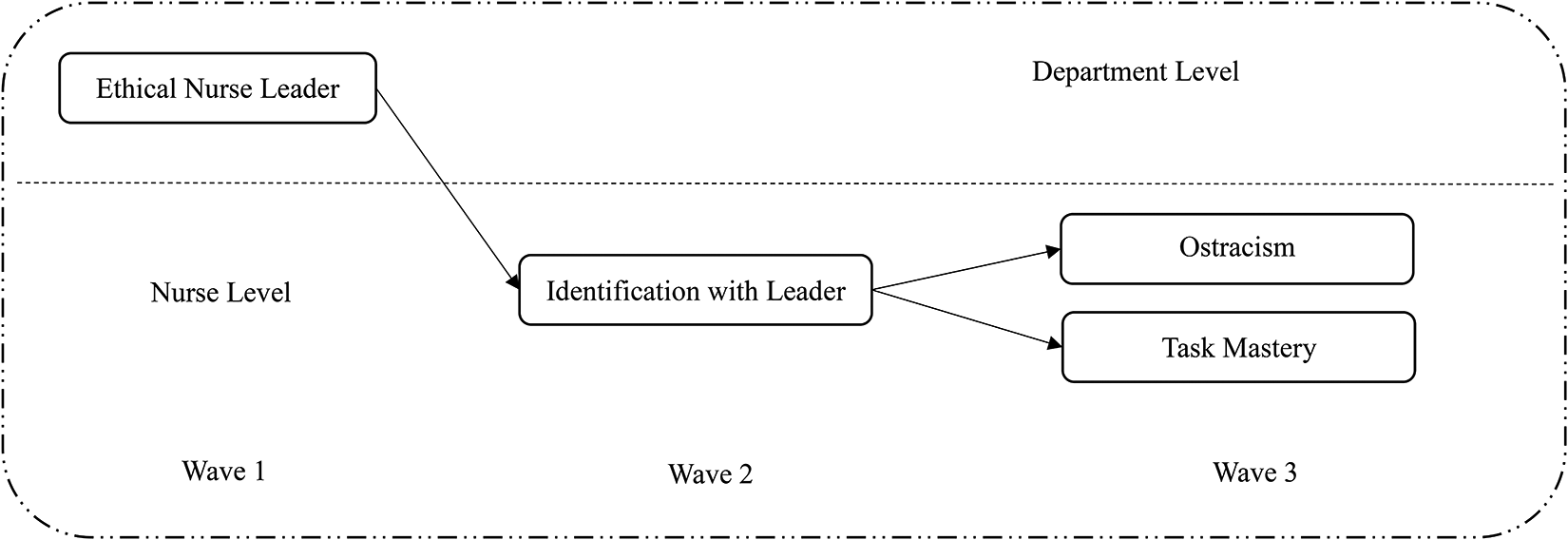
Multilevel and multi-wave theoretical model.
Aims
This study was designed to test the influences of ethical nurse leaders on nurses’ task mastery and ostracism and the mediating effects of the relational identification on main relationships.
Methods
Participants and data collection
This quantitative field survey study adopted a random and convenience sampling method. The random sampling indicates the random selection of population members while each population has a known and typically equal probability of being selected. The convenience sampling involves selecting population members because it is convenient and easily accessible. 34 We combined these two sampling methods by selecting two comprehensive hospitals accessible and then randomly selecting 45 departments from these two hospitals. Two comprehensive hospitals were considered since they include almost all inpatient wards and thus can provide the most high-quality service, education, and research functions across different healthcare regions. From these two hospitals in two major cities in China, unit-level nurse leaders and subordinated nurses were randomly selected from different departments and in three shifts (i.e. morning, evening, and night). We employed only unit-level leaders to make them comparable. Therefore, a multilevel and multi-wave (i.e. three waves) field survey with 172 nurses (114 female and 58 male) was conducted during the pandemic period from April to August 2020.
According to previous studies, 10 precise results can be obtained from surveys using a relatively large sample. Gorsuch 33 recommended that the minimum necessary sample size is 100, or the minimum ratio of the sample size to the number of items being analyzed is 5. In this study, 31 items were used to measure the main variables, which were ethical nurse leaders, identification, ostracism, and task mastery. Therefore, the minimum sample size was 155. Moreover, hypotheses also need to be taken into consideration in sample size justification. For example, the minimum sample size needed to test hypotheses with two independent samples t test at .95 level is 174. 35 Given that we used the non-proportionate quota sampling method, a sample of 172 registered nurses was considered adequate, and the inclusion criteria were as follows: participants held a secondary diploma or further educational qualifications in nursing and participants provided bed-side patient healthcare in hospitals. Nurses from 45 departments participated in the three waves of data collection, and a mean of 3.82 nurses was supervised by one nurse leader.
Ethical considerations
We received formal approval from the ethical committee of the hospital where we conducted this study before the data collection. Data privacy and confidentiality were assured by obtaining subjects’ both oral and paper informed consents to participate in the research before data collection and ensuring that findings were only reported in aggregate.
Measures
We employed a multi-wave data collection to reduce the common method bias that may be a serious concern if we collect data at one time. Moreover, a multi-wave data collection strategy can also help ensure causalities of main variables because of the time sequence of main variables in our theoretical model.36,37 Therefore, ethical leadership and control variables were collected during the first wave. Identification with leaders was measured at Wave 2 (2 months after the first wave), while ostracism and task mastery were measured at Wave 3 (2 months after the second wave). A translation and back-translation method was rigorously conducted by two doctoral experts from relevant majors to create Chinese versions of the scales. 38 We also adapted items to field settings to make them easier to understand (please find them in Supplemental Appendix A). The reliability index—Cronbach’s α—was calculated based on the data we collected. We formulated the variables by calculating the mean values of all items from the same scale.
Ethical nurse leaders
Considering that ethical nurse leaders were measured at the department level (Level 2), we used the aggregated score of all nurses from the specific department. It was measured using 10 items adapted from Brown et al. 13 Two sample items are as follows: My direct nurse leader “sets an example of how to do things the right way in terms of ethics” and “disciplines nurses who violate ethical standards.” Each item was scored on a 5-point Likert-type scale ranging from 1 = totally disagree to 5 = totally agree. Cronbach’s α was .94.
Identification with leaders
Identification with leaders was reported by all nurses at Wave 2 and measured by six items taken from Mael and Ashforth. 39 Two sample items are as follows: “When someone criticizes my direct nurse leader, it feels like a personal insult” and “My direct nurse leader’s successes are my successes.” Each item was scored on a 5-point Likert-type scale ranging from 1 = totally disagree to 5 = totally agree. Cronbach’s α was .95.
Ostracism
Ostracism was reported by all nurses at Wave 3 and measured using 10 items adapted from Ferris et al. 40 Two sample items are as follows: “I want to leave the area when my nurse leader enters” and “I want to avoid my nurse leader at work.” Each item was scored on a 5-point Likert-type scale ranging from 1 = totally disagree to 5 = totally agree. Cronbach’s α was .95.
Task mastery
Task mastery was also reported by nurses at Wave 3 and measured using five items adapted from Chao et al. 41 Two sample items are as follows: “I have mastered the required tasks of my job” and “I understand what all the duties of my job entail.” Each item was scored on a 5-point Likert-type scale ranging from 1 = totally disagree to 5 = totally agree. Cronbach’s α was .88.
Control variables
Several variables, including the demographic variables of nurses and leader’s age, sex, education, and organizational tenure, were controlled in this study to rule out their potential influences. However, removing these variables did not significantly change the results.
Programs, descriptive statistics, and inferential statistics
Although all constructs were measured at the same level, the nested structure of our research design meant that hierarchical linear modeling was used. Since the ethical nurse leaders were a department-level construct, two-level models were used wherein all nurses constituted Level 1 cases, which were nested within Level 2 departments. Furthermore, to ensure multilevel reliability of our measurements, we calculated the intraclass correlations and descriptive statistics when measurements could be organized into groups. Intraclass correlations generally describe whether between-group variance is sufficient for an analysis and how strongly individuals in the same group resemble each other (intraclass correlation coefficient (ICCs)).42,43 We found that the ICC [1] for ethical nurse leaders, which indicates the extent of between-group variance, was .34 and the ICC [2] which indicates the absolute agreement between ratings was .32. These results suggested that the Level 2 variance and reliability were sufficient to warrant estimates of the predictive effects of ethical nurse leaders on other variables.
Moreover, we conducted several confirmatory factor analyses (CFAs) to examine the distinctiveness of main variables: ethical nurse leader, identification with leaders, ostracism, and task mastery. A four-factor model with distinct factors of ethical nurse leaders, identification with leaders, ostracism, and task mastery was compared with several alternative models, including a three-factor model in which ethical nurse leaders and identification with leaders were loaded onto a common factor; another three-factor model in which identification with leaders and ostracism were loaded onto a common factor; a third three-factor model in which ostracism and task mastery were loaded onto a common factor; a fourth three-factor model in which ethical nurse leaders and task mastery were loaded onto a single factor; a two-factor model in which ethical nurse leaders and task mastery or ostracism and identification with leaders were loaded onto two factors, respectively; and a one-factor model in which all variables were loaded onto a single factor. The results are presented in Table 1. Several fitness indexes were calculated, such as root mean square error of approximation (RMSEA), which is a measure of the differences between values predicted by a model and the values observed; comparative fit index (CFI), which examines the discrepancy between the data and the hypothesized model; and Tucker–Lewis index (TLI), which generally captures the model of interest and improves the fit by 95% relative to the null model. We found that the four-factor model generated the best fit with the data (χ2(589) = 1980.25; RMSEA = .11; CFI = .80; TLI = .78). These results supported the distinctiveness of these measured constructs.
Results of confirmatory factor analyses (CFAs).
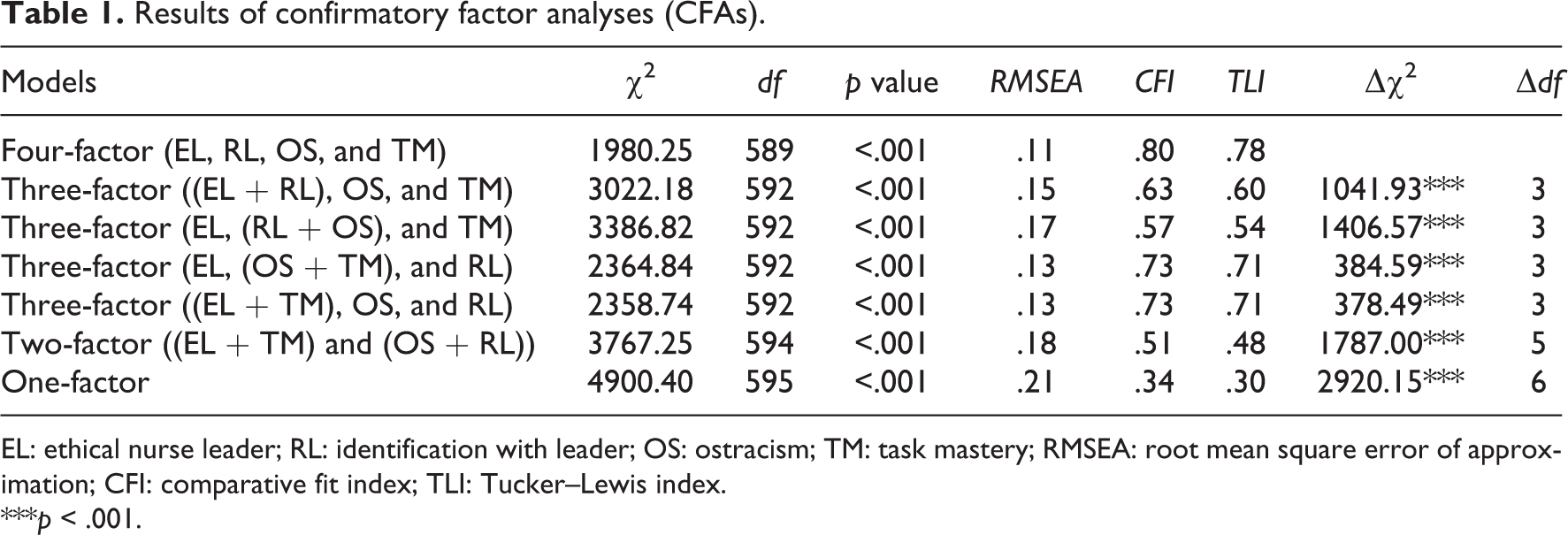
EL: ethical nurse leader; RL: identification with leader; OS: ostracism; TM: task mastery; RMSEA: root mean square error of approximation; CFI: comparative fit index; TLI: Tucker–Lewis index.
***p < .001.
The average age of nurses was 30.3 years (SD = 4.93). The average education level of nurses was 3.99 years (i.e. college level; SD = 0.67), and about 97.66% of participants had at least a college-level degree. The average age of leaders in the 45 departments was 36.2 years (SD = 4.27), 97.77% of whom had at least a college-level degree (please see Table 2 for more details). Correlations (i.e. Pearson correlation coefficient) between each of the main variables and the measurement reliability (Cronbach’s α) are shown in Table 3. We found that correlations between each pair of main variables were moderate or low, meaning that there was no serious multi-collinearity problem. Moreover, we found that the Cronbach’s α of each variable was high, which indicates that the measures had a high reliability. We also investigated the collinearity statistics of the models; for all variables, all variance inflation factors were less than 1.14 and were thus below the recommended value of 10.
Descriptive statistics of the sample.

Correlations of main variables at two levels.
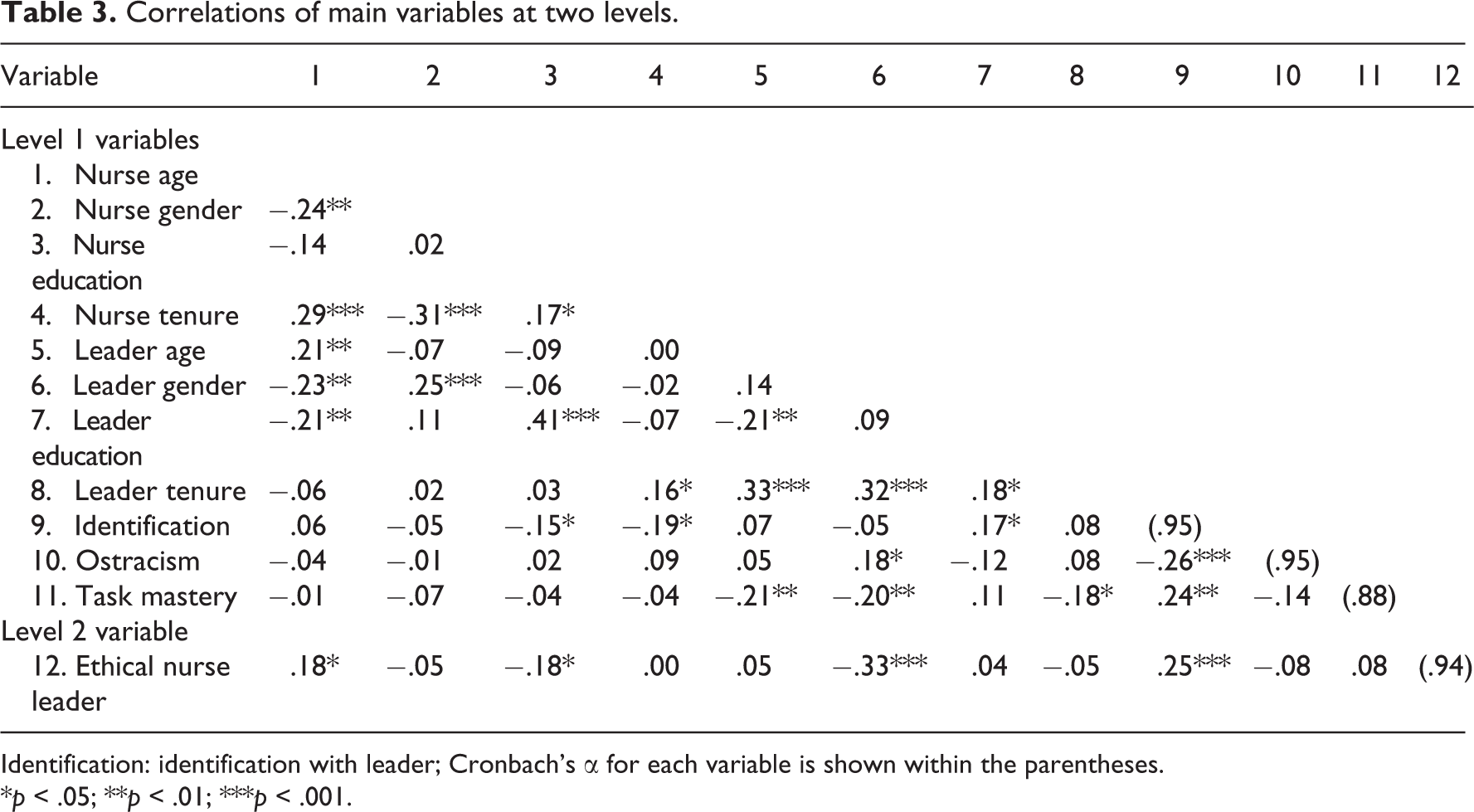
Identification: identification with leader; Cronbach’s α for each variable is shown within the parentheses.
*p < .05; **p < .01; ***p < .001.
Hierarchical linear modeling was used in Stata 14.0 to test all hypotheses. Nonstandard regression coefficients are reported in Table 4. Hypothesis 1 focuses on the relationship between ethical nurse leaders and identification with leaders. Model 2 from Table 4 revealed that the ethical nurse leaders have a significantly positive relationship with identification with leaders (β = .52; p < .05), thus supporting Hypothesis 1. Moreover, Hypotheses 2 and 4 concern the relationships between identification with leaders and ostracism or task mastery. As shown in Table 4, Models 5 and 9 revealed that identification with leaders had significant relationships with ostracism (β = −.19; p < .01) and task mastery (β = .11; p < .01), thus supporting Hypotheses 2 and 4.
Results of hierarchical regressions.
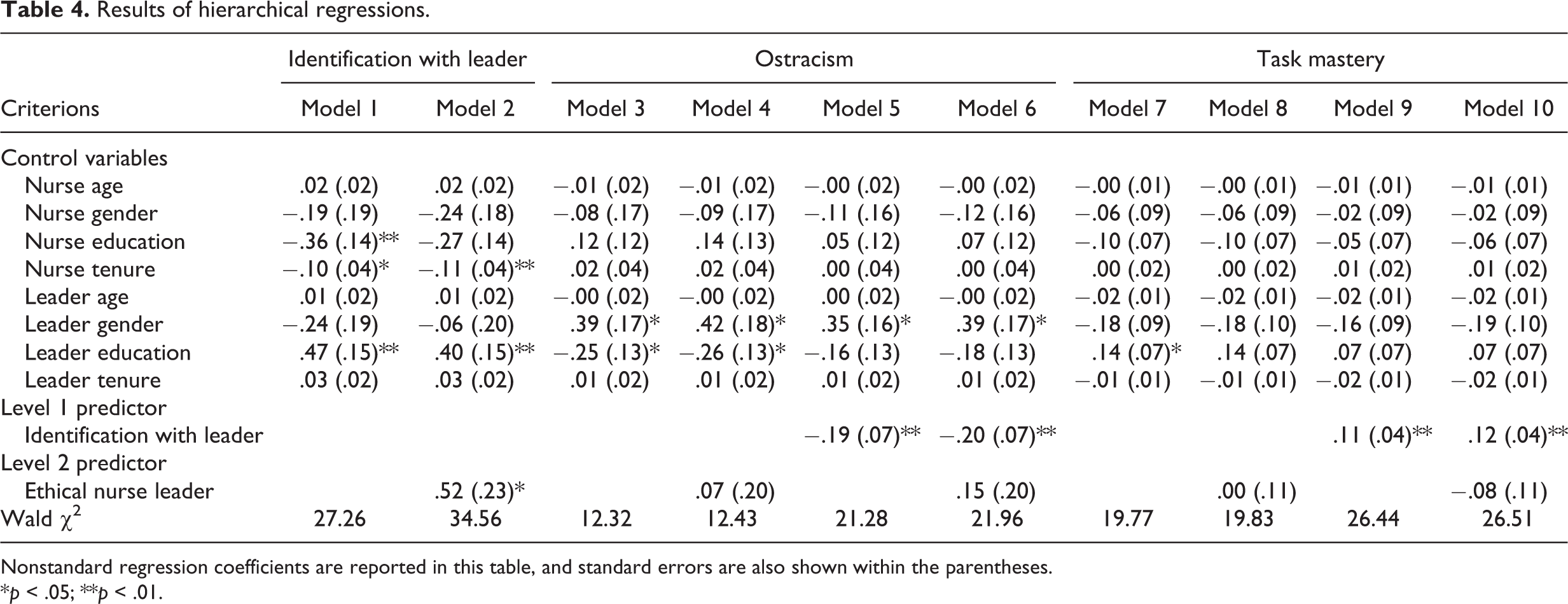
Nonstandard regression coefficients are reported in this table, and standard errors are also shown within the parentheses.
*p < .05; **p < .01.
Regarding the two mediating effects proposed in Hypotheses 3 and 5, Baron and Kenny’s method 44 was used. This method included the following four steps: (1) testing the relationship between the independent variable and dependent variable; (2) testing the relationship between the independent variable and the mediator; (3) testing the relationship between the mediator and dependent variable; and (4) examining whether the relationship between the independent variable and dependent variable becomes non-significant or less significant when controlling for the effect of the mediator to estimate the full and partial mediating effect. In the first step of our analyses, we regressed the dependent variables of ostracism and task mastery onto ethical nurse leaders but found no significant relationship (ostracism: β = .70, not significant; task mastery: β = .00, not significant). However, some researchers have suggested that a significant direct relationship between an independent variable and dependent variable is not fundamental to establishing a mediating effect40,41 and believed that Steps 2 and 3 of Baron and Kenny’s method were more essential for establishing a mediation effect. Therefore, we relaxed this condition of establishing a complete mediation and continued with the subsequent steps. Then, we tested the relationship between ethical nurse leaders and identification with leaders and found a significant positive relationship (β = .52; p < .05) from Model 2 (Table 4). Identification with leaders also had a significant negative relationship with ostracism (β = −.19; p < .01) and a significant positive relationship with task mastery (β = .11; p < .01). Therefore, the results generally supported Hypotheses 3 and 5, in that identification with leaders mediated the negative relationship between ethical nurse leaders and ostracism and the positive relationship between ethical nurse leaders and task mastery.
Bootstrapping methods were also used to test the two mediating effects. First, we ran the bootstrap process in Stata 14.0 with 3000 resamples45,46 to test the mediating effect of ethical nurse leaders on ostracism through identification with leaders. The indirect effect was significantly negative (b = −1.93; p = .05). Then, we tested the mediating effect of ethical nurse leaders on task mastery through identification; the indirect effect was only marginally significant (b = 1.77; p = .08). Thus, both Hypotheses 4 and 5 were generally confirmed.
Discussion
Although prior studies declared the hard situation of healthcare providers during the pandemic period, few of them have indicated how to positively solve their difficulties. Drawing upon social exchange theory, this study tested the relationship between ethical nurse leaders and nurses’ relational identification, and whether this in turn influences their task mastery and ostracism. Based on results from a multi-wave and multilevel study, we found that during this pandemic period, when nurse leaders are ethical, nurses’ identification with leaders is greater, and their ostracism, especially toward their leader, is lower. Moreover, nurses’ task mastery is also improved by their identification with leaders. Therefore, ethical leadership could be an effective tool for nurse leaders during pandemics to improve their own social inclusion engaged by subordinate nurses and nurses’ task-related information and skills, which may further increase their performance.
This study makes some important theoretical contributions. First, prior studies have seldom investigated nurses’ task mastery from an ethical perspective. Generally, researchers believe that ethical leadership increases followers’ moral awareness, in terms of a social learning perspective. However, our results suggest that being an ethical leader can also increase followers’ task-related skills and performance from a social exchange perspective. This is because leaders, as main sources of knowledge and valuable resources, strong identification with them, can facilitate communications between leaders and subordinates. From a relational identification perspective and according to the social exchange framework, we believe that this positive influence exists primarily because nurses will strive to maintain a strong identification with leaders that are considered to be ethical role models. This strong relational identification can further improve nurses’ acceptance of their leader, who is generally deemed to be the richest source of knowledge and skills that are beneficial for work fulfillment. Therefore, acceptance of nurse leaders can ensure the efficient transmission of knowledge and information.
Moreover, we found that a strong relational identification with leaders can also reduce nurses’ ostracism, especially toward their leader. As a nurse, the teamwork is essential for completing necessary healthcare practices. When nurses engage in proactive ostracism toward their leaders, they are less likely to cooperate with others to complete their tasks as a team. As indicated by previous studies, 23 attitudinal acceptance toward their leaders is particularly valuable for nurses than for those in jobs that do not demand team collaborations. From the perspective of relational identification, we found that ethical nurse leader can increase nurses’ relational identification with leaders and reduce hostile attitudes and behaviors, such as the ostracism. These results also confirm that ethical leadership is important for nurse leaders to supervise their teams and create harmonious workplace environments.
Finally, combining these two findings, we suggested that ethical nurse leaders can also help nurses deal with the physical and psychological burdens during pandemics since they improved their subordinates’ task mastery and reduced their ostracism that will significantly increase their resource exhaustion. Since we highlighted the important influences of nurse leaders on their subordinates, resources provided by them may be especially valuable for subordinate nurses to complete their tasks while maintaining a good working condition.
Practical implications
This study has many important practical implications. Especially, we suggest nurse leaders could use our results to improve their subordinate nurses’ social acceptance and task performance when nurses are threatened by the widespread of the virus. For example, nurse leaders could employ ethical leadership practices to win over their subordinates and improve their relational identification. Thus, if healthcare institutions want to improve nurses’ task mastery after pandemics, they could cultivate ethical nurse leader to promote caregiving from nurses that goes beyond existing role expectations. Providing educational efforts such as ethical training programs may also be critical for institutions and nurse leaders to ensure a moral climate within the workplace. Moreover, healthcare institutions could encourage nurses to incorporate ethical principles into their daily practices to ensure more patient-orientated caregiving. Furthermore, from the nurses’ perspective, through improving identification with their leader, nurses could also improve their task mastery and reduce ostracism, specifically toward their leader. Considering the importance of teamwork when fighting the pandemic, workplace ostracism is extremely deleterious for nurses. However, identification with leaders could reduce this proactive social exclusion. Thus, healthcare institutions could organize team-building activities that involve both the leader and subordinates to facilitate their relational identification.
Limitations
This study has some limitations. For example, since we conducted the field study in China, Chinese culture may have influenced the results. Therefore, more studies should be conducted in countries with different cultural backgrounds to test our hypotheses. Furthermore, our sample size was relatively small, and so future studies should use larger samples to substantiate the external validity of our results. Moreover, although all hypotheses were generally supported, causality cannot be inferred from field surveys. Thus, experimental designs should be employed to substantiate our results. Moreover, the data analyzed were reported by nurses. While the multilevel design helped us to remedy this problem to some extent, future studies could use a multisource sample collection strategy to reduce the common method biases. Finally, some boundary conditions could be proposed and tested in the future. For example, the organizational culture or climate of the department may also influence the relationship between ethical nurse leader and its effects. Therefore, future studies could consider testing the boundary conditions of the proposed relationships.
Conclusion
Based on social exchange theory, this study proposed and tested a theoretical model of ethical nurse leader and nurses’ relational identification, and whether this would, in turn, influence their task mastery and ostracism during the pandemic. A multilevel and multi-wave field survey was used to test the hypotheses. We found that ethical nurse leader can indeed improve nurses’ relational identification and task mastery and reduce their ostracism, especially toward the leader. Future studies can further test the impacts of ethical leadership on nurse communities.
Supplemental material
Supplemental Material, sj-pdf-1-nej-10.1177_09697330211030673 - Effect of ethical nurse leaders on subordinates during pandemics
Supplemental Material, sj-pdf-1-nej-10.1177_09697330211030673 for Effect of ethical nurse leaders on subordinates during pandemics by Jinyi Zhou and Ke-fu Zhang in Nursing Ethics
Footnotes
Acknowledgements
The authors thank participating hospitals and nurse participants. We express our gratitude toward hospital administrators and nursing managers for their assistance.
Conflict of interest
The author(s) declared no potential conflicts of interest with respect to the research, authorship, and/or publication of this article.
Funding
The authors disclosed the receipt of the following financial support for the research, authorship, and/or publication of this article: This study is supported by China Postdoctoral Science Foundation and Fundamental Research Funds for the Central Universities.

Supplemental material
Supplemental material for this article is available online.
References
Supplementary Material
Please find the following supplemental material available below.
For Open Access articles published under a Creative Commons License, all supplemental material carries the same license as the article it is associated with.
For non-Open Access articles published, all supplemental material carries a non-exclusive license, and permission requests for re-use of supplemental material or any part of supplemental material shall be sent directly to the copyright owner as specified in the copyright notice associated with the article.
