



Abstract
Background:
A large number of nurse researchers do not adhere to ethical standards while performing the research. Moreover, there is far less data on knowledge of existing national ethical guidelines. This study was, therefore, done to assess awareness and adherence to current national ethical guidelines among nursing students and faculty members.
Methods:
A cross-sectional descriptive study was done among nursing faculty members and theses carried out by postgraduate nursing students between 2012 and 2017. Using the convenience sampling technique, seven states of North India were selected. In each of the selected seven states, one government and one private nursing college was selected. Thus, a sample of 14 nursing colleges was selected. Then, using simple random sampling, a total of 140 nursing faculty members and 280 postgraduate nursing theses were selected from all the chosen institutes to be part of the study. Data analysis was done using descriptive statistics.
Ethical considerations:
The study has been approved by the institutional ethical committee (ECR/737/Inst/UK/2018/RR-18). In addition, written permission from the head of each nursing institute was obtained before conducting the study. After participants read the Participation Information Sheet, they were asked for written informed consent before data collection. Confidentiality of the information and anonymity of the participants were maintained throughout the study.
Results:
The majority (81.8%) of the participants were females. It was found that compared to private nurses, government college nurses were more adhered to the research guidelines on research project approval (68.6% vs 22.1%), informed consent guidelines (74.3% vs 25%), providing patient information sheets (55.7% vs 10%), maintaining information confidentiality (82.9% vs 72.1%), maintaining anonymity (76.4% vs 22.9%) and obtaining custodian permission (97.8 vs 89.3%). It was also shown that nurses were more aware of the informed consent process domain (4.3 ± 0.3) followed by the general ethical principles domain (3.8 ± 0.8).
Conclusion:
Government college nurses adhered more to the research guidelines as compared to those employed in private settings. Most of the faculty members were not part of any clinical trials and had no research ethics training at all. Therefore, it is needed to provide an instructional programme to raise awareness of the research ethical standards.
Introduction
Essentially, human subjects research pertains to a broad range of scientific inquiry aimed at gaining generalizable knowledge that improves health, enhances understanding of the disease, and is morally justified by its social significance. However, every research incurs some inherent risks and probabilities of harm or inconvenience to participants/communities. The protection of participants should, therefore, be built into the design of the study. While conducting biomedical and health research, the four basic ethical principles, namely autonomy (respecting individual’s decisions), beneficence (doing good), non-maleficence (non-harming) and justice (treating equally) have been pronounced for protecting the dignity, rights, safety and well-being of research participants, and are to be applied to all biomedical, social and behavioural science research for health involving human participants, their biological material and data. 1 International norms require the Research Ethics Committees (RECs) to evaluate the research. In India, the Indian Council of Medical Research (ICMR) establishes the guidelines for the ethical conduct required to follow in biomedical research. 2 In series with developments in medical research, the ICMR revised the Ethical Guidelines in 2000 and 2006, respectively. On 12 October 2017, the ICMR published the latest National Ethical Guidelines for Biomedical and Health Research involving Human Participants. It is anticipated to protect the human participants as well as enhance the outcome quality of the research. 3
The researcher and the team are responsible for protecting the dignity, rights, safety and well-being of the participants enrolled in the study. They should have the appropriate qualifications and competence in research methodology and should be aware of and comply with the scientific, medical, ethical, legal and social requirements of the research proposal. Also, the organization’s ethical committee ensures that the conducted research follows the formulated principles/guidelines. 4 Unethical behaviour in scientific research can destroy the public trust in science and impact the research team negatively. Without trust between scientists and the public, or within research teams, meaningful research is compromised. 5 In recent decades, significant progress has been made in transforming the research culture to integrate this ethical responsibility more deeply in the development and implementation of protocols. 6 In this country, research involving human participants has become a vast academic and commercial operation, but the human participants’ protection system has not kept pace with that development. In addition, ethics is not yet part of the existing teaching curriculum in both medical and non-medical disciplines in India. 3 The federal government and professional societies are undergoing some reforms; however, to create a streamlined, effective, responsive and comprehensive system that protects all humans, both the executive and legislative branches will need to come together. 7 However, to promote involvement in worldwide study initiatives, adherence to and awareness of research ethics and ongoing training on ethical standards are crucial for medical scientists. 8 Several government and private nursing colleges in India currently offer education in nursing research at the undergraduate, postgraduate and doctoral level. The Indian Nursing Council (INC) has developed a uniform nursing research course for these colleges. On qualifying, nurses are expected to know about ethical guidelines for participating in human research. 9
Also, research involvement should no longer be limited to completing a project for postgraduate research students to fulfil academic/programme requirements or research supervision. With the existing research efficiency in terms of the number of qualified postgraduate and doctoral nurses in India, research has moved forward and continues to expand as an active component of the profession. It not only provides contextually relevant knowledge but also makes nursing more visible in India as an academic discipline within the global community. 10 However, the question still remains. Do we adhere to the ethical guidelines established for clinical research? The answer is a resounding ‘No’. This is because the ethical guidelines in India are just recommendations, not laws 11 . Literature review on nursing studies 12 suggests that ethical challenges are one of the recurrently emerging issues. Because of the lack of continuity and clarity in ethical practices, nurses need to develop an awareness of these concerns, as well as an effective framework to deal with human rights issues. 12 Furthermore, there are few data in India on awareness of the current national ethical guidelines for biomedical and health research among nurses and their adherence to these recommended guidelines. Concerning the significance of this topic, this study aimed to assess awareness and adherence to current national ethical guidelines among nursing students and faculty members. Also, to compare the adherence with current national ethical guidelines for biomedical and health research by nurse researchers at government and private nursing colleges.
Methods
A cross-sectional descriptive study was carried out among nursing faculty members and theses carried out by postgraduate nursing students between 2012 and 2017. The study included nursing faculty members if they possessed the postgraduate nursing qualifications, and were involved in teaching and guiding postgraduate nursing students for more than 3 years. Also, theses were selected if carried out in between 2012 and 2017 and a copy of the thesis was available in the respective library. The sample size was estimated by using the online available software, 13 considering 77% of total knowledge levels, 14 0.05 desired precision and 95% confidence intervals. We used a finite population (238 faculty members, and 2100 postgraduate theses) to account for sampling from populations. Thus, the minimum sample size was found to be 128 faculties and 242 postgraduate theses. Considering 10% dropout, the sample size was 141 faculties and 266 postgraduate theses.
Sampling and data collection procedure
Using a convenience sampling technique, seven states of Northern India were chosen. Rajasthan, Punjab, Haryana, Himachal Pradesh, Delhi/NCR, Uttarakhand and Uttar Pradesh were selected. In each of the selected seven states, one government and one private nursing college was selected. Thus, a sample of 14 nursing colleges was selected. Ten nursing faculty members were selected from each nursing institute by using simple random sampling. Thus, a total of 140 nursing faculty members were selected for the study. In addition, a list of theses carried out by postgraduate nursing students between 2012 and 2017 was prepared. Of these, 20 theses were chosen from each nursing institute by random sampling. Thus, a total of 280 postgraduate nursing theses were selected to be part of the study. The written informed consent was obtained from participants after they had been provided with the Participation Information Sheet. Then the ‘Structured knowledge questionnaire’ was handed over to each participant in person and requested to fill them out and return them to the researcher. In addition to the questionnaire, the researcher employed a ‘Structured Observation Checklist’ to evaluate postgraduate nursing student theses to identify the adherence with current national ethical guidelines for biomedical and health research.
Research instruments
Data collection was done by using the following tools:
Socio-demographic profile: Eight items for collecting baseline information were included, such as age, gender, habitat, nursing institute type, the position of the nursing faculty member, number of publications, prior training about International Conference on Harmonization–Good Clinical Practices (ICH-GCP) and clinical trial participation.
Structured knowledge questionnaire: A structured self-administered questionnaire has been developed to assess the awareness of current national ethical guidelines for biomedical and health research among nurses involved in research activities. It was divided into 12 domains with five multiple-choice questions in each domain. This resulted in a total of 60 questions. One mark was given for each correct answer. Accordingly, each of the five domains received five marks with a minimum of zero and a maximum of five for all correct answers, resulting in a total of 60 marks.
Structured observation checklist: In addition to the above-mentioned questionnaire; a checklist consisting of six items was developed to identify the adherence with current national ethical guidelines for biomedical and health research among nurses involved in research activities.
Validity and reliability of the instruments
The research instruments were validated by five experts in the field of nursing, biomedical ethics, epidemiology and biostatistics. The reliability of the questionnaire was assessed through test–retest methods, which were found to be highly reliable (Cronbach’s alpha = 0.92). The reliability of the observation checklist was assessed by the interrater reliability method, which was found to be reliable (r = 0.88).
Ethical considerations
The study has been approved by the institutional ethical committee (ECR/737/Inst/UK/2018/RR-18). In addition, written permission from the head of each nursing institute was obtained before conducting the study. After the Participant Information Sheet was provided, the written informed consent was obtained from the participants. Confidentiality of the information and anonymity of the participants was maintained throughout the study.
Data analysis
Data were analysed using Statistical Package for Social Sciences (SPSS) version 20.0. Data analysis was done using descriptive statistics. Continuous variables are expressed as Mean ± standard deviation; categorical variables are expressed as frequency and percentage.
Results
Out of the total 140 nursing faculty members, 7 nursing faculty members were on leave and 3 refused to participate in the study. Thus, a total of 130 nursing faculty members were provided questionnaires. Of the total 130 questionnaires, 121 were returned, out of which 6 questionnaires were incompletely filled and were excluded from the analysis. As a result, the study population consisted of 115 nursing faculty members with a response rate of 82% and 280 postgraduate nursing theses. The majority of the participants were females (81.8%), between the age of 31 and 40 years (58.3%) and working in private (53.9%) and government hospitals (46.1%). The majority of faculties (93.9%) were not part of any clinical trials and 83.4% of participants did not have any ethical training, that is, ICH-GCP (Table 1). It was found that, compared to private college nurses, government college nurses more adhered to the research guidelines on research project approval (68.6% vs 22.1%), informed consent guidelines (74.3% vs 25%) providing patient information sheets (55.7% vs 10%), maintaining information confidentiality (82.9% vs 72.1%), maintaining anonymity (76.4% vs 22.9%) and obtaining custodian permission (97.8 vs 89.3%; Table 2). It has been found that nurses were more aware of the informed consent process domain (4.3 ± 0.3) followed by the general ethical principles domain (3.8 ± 0.8; Table 3).
Sociodemographic characteristics of nursing faculties/nurse researchers.

ICH-GCP: International Conference on Harmonization–Good Clinical Practice.
Nursing faculty’s awareness on current ICMR ethical guidelines for health research.
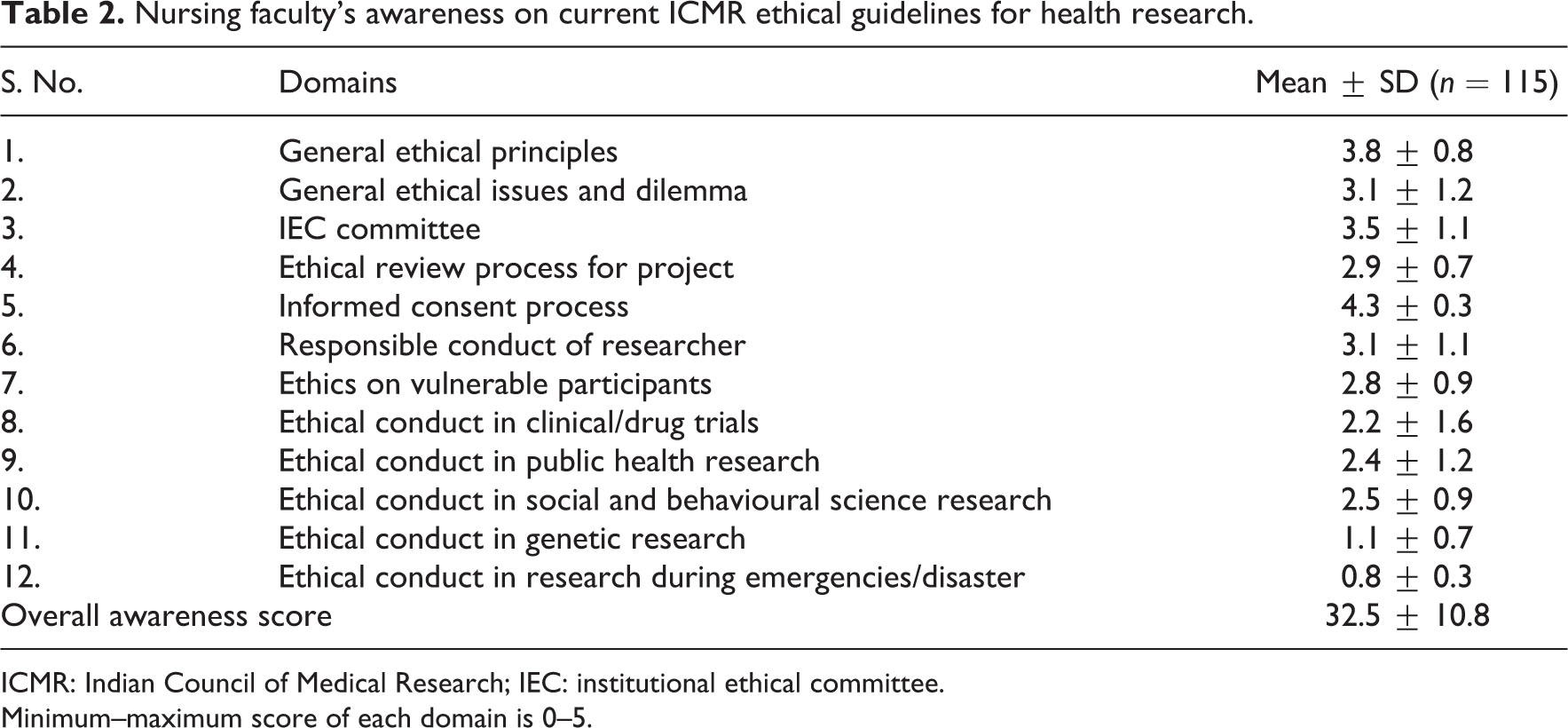
ICMR: Indian Council of Medical Research; IEC: institutional ethical committee.
Minimum–maximum score of each domain is 0–5.
Nurses’ adherence with ethical guidelines in research.
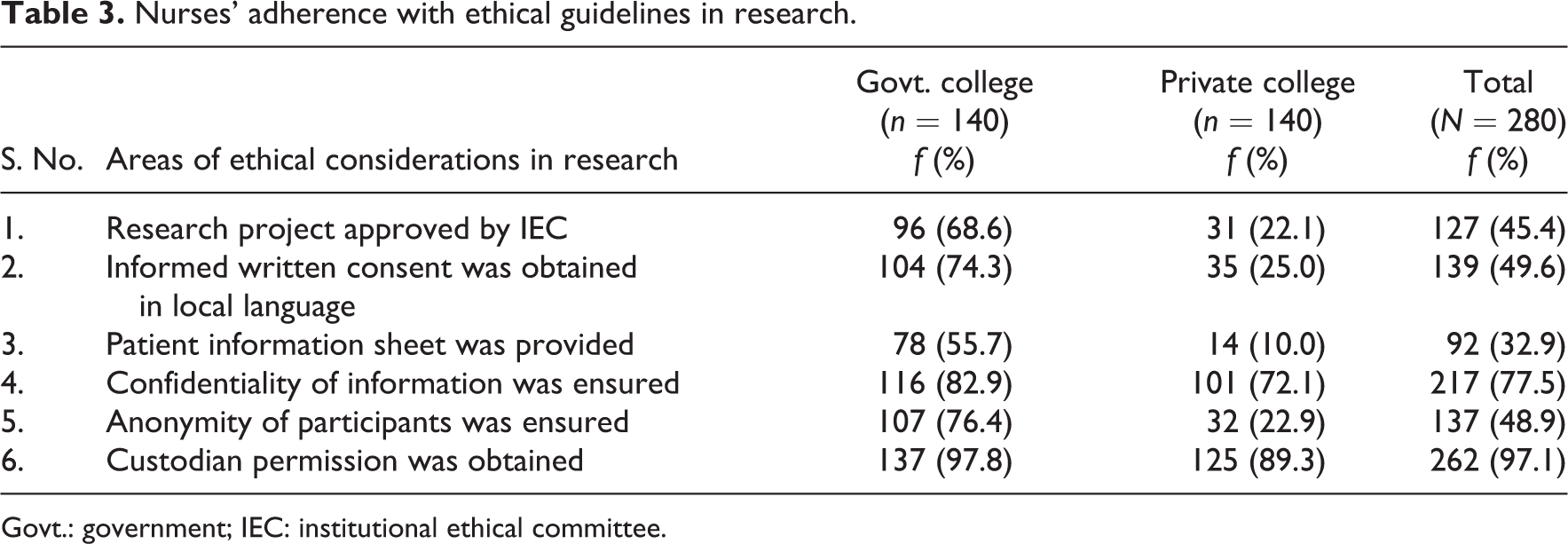
Govt.: government; IEC: institutional ethical committee.
Discussion
In this study, most faculties were females and more than 80% of the participants were assistant professors or lecturers. This study reported that compared to private colleges, nursing faculty members at government colleges adhered more strictly to ethical guidelines such as taking informed consent, providing information sheets, maintaining confidentiality and so on during their research activities. Less compliance could be due to the absence of access to any ICH-GCP ethics training as more than 90% of the faculty members did not participate in any clinical trials and 83.4% of the respondents did not have any ICH-GCP training. This training is essentially required as it strongly reaffirms the principles of the Belmont Report, which summarizes ethical principles and guidelines and highlights its adequacy in the conduct of informed consent 15 . In this study, participants were more aware of the informed consent process (4.3 ± 0.3) compared to other domains of ethical research guidelines, but unfortunately, 75% of private college faculties and 25.7% of government college faculties did not comply with the informed consent process when conducting research. Similarly, El-Dessouky et al. 16 found that more than 50% of participants provided correct answers to the informed consent process and very fewer participants (12%) were familiar with the research ethics guidelines.
In this study, 72.1% of private and 82.9% of government college nurses maintained information confidentiality while participants’ anonymity was maintained by only 22.9% and 76.4%, of private and government college faculty members, respectively. Leila Hosseini Ghavam Abad et al., who conducted a study among medical students in 2019, also found a low level of confidentiality awareness as there was a lack of knowledge and a positive attitude towards it 17 . In this study, only a few participants were aware of ethical conduct in clinical/drug trials, which may be related to the less participation in clinical trials, since only 6.1% of participants were part of it and 16.5% of participants had ethics training. Similarly, Bulut Aksoy et al. 18 found that there were fewer nurses (8.6%) involved in clinical research, and only 3.8% of nurses had relevant training. A recent focus has been put on monitoring the health of participants when performing research during clinical trials. 19 This study found a medium level of awareness while evaluating the ethical conduct domain for vulnerable participants. The result shows that many participants used the vulnerability concept, but very few people define it. 17
The Helsinki Declaration outlines the need for the patient Information Sheet and signature form throughout the world and emphasizes, in particular, the patient’s understanding of the information and his or her liberty to make choices regarding participation in the study. 20 In this study, adherence to the provision of patient information sheets by both the private and government college faculty members was very low, that is, 10% and 55.7%, respectively. This could be related to the less number of participants who had prior research training, which was 16.5% only, or there was no stringent review of their projects by their supervisors, that is, some of them may have used it, but have neglected to write in their theses, which were not assessed by the research supervisors or faculties.
Public health research differs from general health research that necessitates additional ethical considerations. This study reported that participants had a medium level of awareness about ethical conduct in public health research. Research involving public health interventions or research conducted during public emergencies, such as natural disasters and disease outbreaks, has unique ethical challenges. 21 Furthermore, this study showed that participants had less awareness regarding ethical behaviour in an emergency/disaster as little is known about the nurses’ direct experiences in ethical preparedness to cope with traumatic crises and public health adversities. These findings underline the need for ethical considerations to be given more focused attention in emergency planning, preparedness and response by nurses to better inform the ethical basis for emergency disaster management.
In our study, participants were less aware of ethical conduct in genetic research, it could be because clinical genetic research is often regarded as more ethically problematic than other forms of research, and in some countries like India, it is subject to specific regulation. Problems include whether and how to disclose findings, especially where their significance is uncertain; potential risks (including potential work or insurance discrimination due to genetic testing); how to properly inform participants of such risks; and the possible implications of genetic information. Given these potential ethical concerns, finding an ethically appropriate way of doing genetic studies is extremely necessary. 22 Therefore, researchers should be given ample training to do so.
Strength and limitations of the study
The strength of this study was the collection of the data in different institutions of North India, including private and public institutions. This study had certain limitations. The information is self-reported and the participants may have answered in a socially acceptable way. The data were collected using self-structured questionnaires. This study was restricted to North India; further research can be carried out to explore other parts of the nation.
Study implications
This will help to sensitize the researchers about an important issue that is usually overlooked during the study. This study provides a base for the development of a training programme to provide a better vision for ethics that prevent participants from any harmful effects or being overused in the research by the researcher. It also helps to create awareness among faculty members regarding bioethical guidelines so that they can propagate them to their students more appropriately and accurately.
Conclusion
The majority of the nursing faculties have not been part of any clinical trials and did not have any training about ethics ICH-GCP. Government college nurses adhered more to the research guidelines as compared to those working in private settings. Nursing faculty members were more aware of the informed consent process, while less aware of the ethical review process for the project, and least aware of the ethical conduct in research during emergencies/disasters and genetic research. This is, therefore, needed to provide an instructional programme to increase awareness of the research ethical guidelines that include informed consent, the confidentiality of the participants’ information and anonymity, ethical basis for emergency and genetic studies, and to be ensured by the researcher during their research activities.
Footnotes
Acknowledgements
The author would like to sincerely thank all the faculties of the selected nursing colleges for their extensive support and participation in this study and The Nursing Research Society of India (NRSI) for the opportunity to carry out this project during my Post-Doctoral Fellowship of Nursing Research Society i.e. FNRS.
Conflict of interest
The author(s) declared no potential conflicts of interest with respect to the research, authorship, and/or publication of this article.
Funding
The author(s) disclosed receipt of the following financial support for the research, authorship, and/or publication of this article: A seeding amount of about $600 was received from Nursing Research Society of India (NRSI) to conduct this project.