



Abstract
Background:
Critical care nurses have risked their lives and in some cases their families through hazardous duty during the COVID-19 pandemic and have faced multiple ethical challenges.
Research/aim:
The purpose of our study was to examine how critical care nurses coped with the sustained multi-faceted pressures of the critical care environment during the unchartered waters of the COVID-19 pandemic. It was anticipated that our study might reveal numerous ethical challenges and decision points.
Research design:
A qualitative descriptive study, utilizing an interpretivist paradigm.
Participants and research setting:
Critical care nurses, working in either intensive care units or emergency departments (N = 11) who were primarily from Northern California hospitals. Individual in-depth ZOOM® session interviews, guided by semi-structured questions, were used to collect data. Interviews lasted between 18 and 59 min, with an average length of 33 min. Session interviews were transcribed and analyzed.
Ethical considerations:
This study was approved by the researchers’ university Institutional Review Board.
Findings:
Five main themes emerged: Fear of the Unknown, Adapting to Practice Changes and Challenges, Patient Advocacy and Moral Distress, Isolation and the Depersonalization of Care, and Professionalism and a Call to Duty.
Discussion and conclusion:
Fear of becoming ill or bringing COVID-19 home to their families was a constant source of anxiety for nurses. There were numerous changes in policy and challenges to standard practice protocols, including most notably shortages in personal protective equipment, which nurses navigated resourcefully. Most nurses interviewed were motivated by a sense of professional duty. The nurses experienced some moral distress in their inability to advocate as they might like for their patients, especially at end of life. Infection control requirements for isolation.
Keywords
From day one of the COVID-19 pandemic critical care nurses risked their lives and those of their families through their everyday work of caring for patients. They served as the frontline of care during COVID-19 pandemic—in emergency departments (ED) triaging and receiving patients, in critical care units, maintaining patients on life support, as well as in designated COVID-19 units. Nurses across the globe navigated conflicting guidelines regarding the use of personal protective equipment (PPE) and the means of transmission of COVID-19,1,2 and were forced to work with shortages of PPE 3 as their workload increased. As researchers, we sought to explore the experiences of critical care nurses in intensive care units (ICUs) and EDs from April 2020 through June 2020, prior to the second surge of high infection rates in California.
Background
A brief review of nurses’ experience of past US public health emergencies and disasters indicates there are cautionary lessons to be applied to the current pandemic. Twenty percent of ED nurses who worked in an emergency department of a New Orleans metropolitan hospital during and immediately after the 2005 Hurricane Katrina disaster suffered from post-traumatic stress syndrome. 4 As well, US nurses lack adequate ethical preparedness for public health emergencies and the ethical dilemmas they will inevitably face.5,6 Furthermore, moral distress in nursing, in essence, the psychological distress of not being able to do what one knows is right in clinical setting, 6 has been shown to contribute to high burnout rates among critical care providers. 7
Among other findings, novice emergency department nurses in Spain experienced anxiety provoked by uncertainty over whether or not they would have a proper training period, guilt about not being as expert as seasoned nursed, and fear of infected family and others. 8
Early in the pandemic, there was a lack of US research studies exploring the experiences of critical care nurses caring for patients with COVID-19. We were able to review a growing body of international research literature that began to emerge from Europe, Asia and the Middle East. Care erosion, caused by factors such as the sense of being a prisoner in PPE coupled with the toll of an exhausting workload, were some of the findings of researchers in Iran. 9 Frontline nurses in China caring for COVID-19 patients faced new challenges early in the pandemic and felt pressure because of fear of infection, a sense of duty as nurses. They held onto the belief that the epidemic would soon be overcome. 10 Chinese nurses also faced multiple ethical challenges including a lack of emotional support for patients, being unequally exposed to the virus, and feeling powerless. 11 Turkish nurses faced numerous adverse effects, both social and psychological, including stigmatizing attitudes and burnout and demonstrated resiliency by using short-term coping strategies. 12
Research exploring the experiences and ethical challenges of caring for patients COVID-19 pandemic in the United States is lacking, and it is hoped that this study helps to begin to fill that research gap. And, while the aforementioned experiences of nurses globally reflect the unique cultural conditions in the countries studied, our research enables further consideration of the universal experiences of nurses during the COVID-19 pandemic.
Purpose
The purpose of our study was to provide insight into how nurses function under the sustained multi-faceted pressures of the critical care environment during the unchartered waters of the COVID-19 pandemic. It was anticipated that our interviews might uncover numerous ethical challenges encountered by these nurses and thus provide a better understanding of their solutions to questions of resource shortage, end-of-life care, and the decision to come to work when faced with the uncertainty of a novel virus.
Research design
This study utilized a qualitative descriptive design to explore the experiences of US critical care nurses caring for patients with COVID-19. Qualitative inquiry aims to describe and interpret human phenomena. 13 Given the research aims and objectives, we utilized an interpretivist paradigm. In our study we sought to understand the experiences of critical care nurses working on the frontlines during the COVID-19 pandemic. What practices, meanings, and concerns did they articulate in describing their workday?
Sampling and recruitment
After obtaining university human subject’s approval, participants were recruited via purposive convenience sampling through postings on social media, such as the university’s nursing department Facebook® page, the Emergency Nurses Association’s research opportunities web page, as well as by nurses networking with each other (chain-referral sampling). Participants were encouraged to share recruitment posts with other nurses. Recruitment continued until no new themes emerged from the interviews. 14
Nurses wishing to take part in the study contacted the primary investigator via email. In order to meet study criteria, participants had to be 18 years of age or older, currently working as critical care nurses (ED or a critical care specialty unit, such as an ICU), and be willing to answer demographic data questions and take part in an online audio recorded interview lasting up to 60 min. We used the term critical care nurse to apply to any nurse who on a regular basis provides direct care for critically ill patients.
A copy of the informed consent statement was sent to participants meeting study criteria for review and an appointment was arranged at a mutually convenient time via Zoom.® Data analysis and recruitment occurred concurrently. Participant recruitment continued until no new themes emerged, indicating data saturation had been reached.
Demographic data
Participants were asked to provide their age, gender, race, educational level, years a registered nurse (RN) state and county where there their hospital was located, whether the hospital was urban, suburban or rural; unit setting (ICU, ED, etc.), number of persons at home and their ages, whether or not the hospital was unionized, and years as an RN. Table 1 displays the participant demographic data.
Participant demographics.
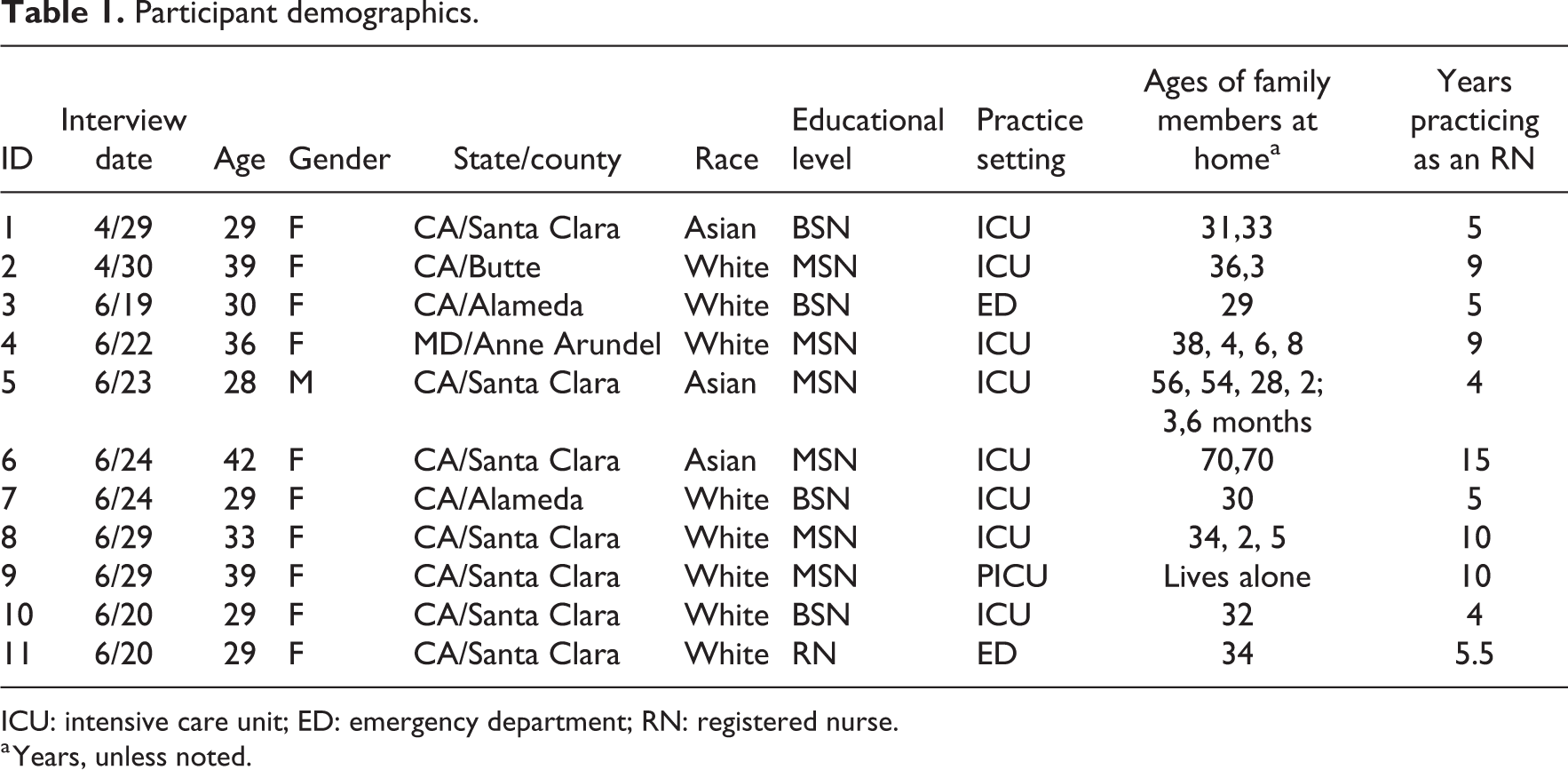
ICU: intensive care unit; ED: emergency department; RN: registered nurse.
a Years, unless noted.
Qualitative interview guide
Questions for the semi-structured interview guide were developed by the researchers’ personal experiences as ICU and ED nurses, as well as a review of the moral obligations outlined in the American Nurses Association (ANA) Code of Ethics for Nurses. 15 Questions were used as a guide for the interviews and followed-up with probing questions to further our understanding of participants’ experiences of working in critical care areas with COVID-19 patients. The overall interview guide consisted of 16 questions covering the following broad areas: (1) challenges at home and in the community, (2) resource allocation, (3) inter and intra professional experiences, and (4) care experiences with patients and their families.
Data collection
After obtaining verbal consent from the participant at the time of the interview and collecting demographic data, individual semi-structured interviews were conducted via Zoom.® The same researcher, who is a retired ICU/ED nurse, conducted interviews. In order to protect patient confidentiality and minimize bias, participants had the option to turn off the video camera during the interview. New informants were recruited until no new information emerged. 16
Data analysis
Zoom® conferencing software provided verbatim interview transcriptions which were reviewed by all members of the team for errors and discrepancies. Conventional content analysis was used to describe and interpret the collective experiences of the nurses caring for patients during the Covid-19 pandemic. Data analysis began with each member of our research team reading the whole set of interviews in order to immerse themselves in the data. We then reread the texts in sets of four highlighting words and phrases into meaning units, and writing summary codes of the text in the margins. We used the same process iteratively to analyze each four-interview set, constantly comparing the new data with the existing whole of reviewed interviews, and coding meaning units into categories and linked themes.
Subsequent group analytic discussions allowed us to reorganize, link, and collapse initial categories into subthemes under fewer main themes. We used LucidSpark®, a collaborative interactive whiteboard with virtual color-coded note cards that could be renamed and rearranged through group consensus to form a holistic understanding of the experience of the critical care nurses interviewed. Credibility in content analysis was enhanced by group dialog and consensus, as well as inclusion of verbatim quotes by the participants. 17 Trustworthiness was ensured by keeping an audit trail of our analysis sessions as well as by having an experienced qualitative nurse researcher on the analysis team.
Results
Participant characteristics
Eleven critical care nurses were recruited. Participants were between 29 and 42 years of age. Six had masters degrees, 3 had young children at home, 2 lived with elderly parents, 10 were female, 1 male, 2 worked in ED, 1 was a pediatric intensive care unit (PICU) manager, the remainder were ICU nurses; all but one nurse worked in Northern California. One, serendipitously, worked in Maryland, the result of networked recruitment. We decided to retain her transcript, both because of its rich content and because it provided an independent data point against which to read the California interviews. Seven of the 11 interviewed nurses worked in Santa Clara County, California, the location of the first COVID-19 related death in the United States. 18 Online interviews lasted between 18 and 59 min, with an average length of 33 min.
Themes
Interpretive content analysis revealed five overall themes and associated subthemes. The five main themes were as follows: (1) Fear of the Unknown, (2) Adapting to Practice Changes and Challenges, (3) Patient Advocacy and Moral Distress, (4) Isolation and the Depersonalization of Care, and (5) Professionalism and a Call to Duty. Overall themes, subthemes, along with examples of participant quotes are discussed in the following paragraphs.
Theme 1. Fear of the unknown
In the first few weeks of the pandemic, nursing staff most feared lateral transmission. As one ICU nurse said, “Nobody knew if the N95s were enough.” These fears were exacerbated by PPE shortages, limited knowledge of how COVID-19 is transmitted, as well as shifting infection control policies. Over time, nurses adapted to treating COVID-19 patients, and for most it became business as usual as their fear diminished. Despite the fact that nurses at her facility had adequate PPE, an assistant nurse manager felt she was placing her staff in harm’s way: Every time I made assignments for my nurses…I feel like I was sentencing them to some sort of death. Or, you know, sacrifice. There were people that would become emotional. We had to rotate our staffing (in and out of COVID assignments). I am kind of resigned to the fact that I will (get sick). It’s kind of like it’s just part of our job at this point. I don’t know if it’s gonna be benign or not, but I do have a feeling, I’ll probably pull it through, given my age. I don’t have any co-morbidities. So I’ll probably survive. Yeah, so when I’m leaving work. I actually bleach the bottom of my shoes down…I take my shoes off outside and I come in through the garage door. I strip and throw my scrubs into the washing machine right away and then I go take a shower.
Anxiety eased with time and testing
One participant recounted that in the beginning of the pandemic she was afraid to come to work but then became confident the hospital was taking care of her. She began to feel that essential workers in grocery stores were at greater risk of exposure than ICU nurses, because she had PPE. Another nursed said: “I would get a mounting tension before going to work like in the early days, pretty much all the time.” While still feeling vulnerable, her anxiety was alleviated when the hospital began paying for free antibody testing. She felt antibody testing validated the fact that PPE was working to protect her.
The ICU is safer than the ED
A subtheme that emerged was that most nurses felt the ICU to be safer than the ED, even though the sickest patients were in the critical care units. The ICU represented a controlled, known environment. In the ICU, for the most part, COVID patients had been identified and proper infection control precautions were being taken. Whereas, the ED presented greater risk since COVID patients were often not isolated from the main department due to a high patient census and a limited number of negative pressure rooms, as well as emergent situations such as rapid sequence intubations. And, as a whole, nurses believed ICUs were better equipped with more abundant supplies of PPE and other protective gear.
Theme 2. Adapting to practice changes and challenges
Challenges to practice centered on infection control, driven by shifting policies as knowledge about the virus evolved, as well as constant shortages of PPE. Several nurses maintained there were no PPE shortages at their hospitals, but then went on to describe elaborate rituals for preservation of N95 masks that might be used for several days in a row. N95 masks were sterilized with ultraviolet lights, wiped down with bleach wipes, or stored in various ways for reuse in brown paper bags, plastic food storage containers, or cardboard food containers like those used for fast food. Nurses described to us the detailed and often confounding steps they took to preserve their one allotted N95 mask: Placing the mask in the brown paper bag contaminates the brown paper bag and then you place your hand in it the next day to place the mask back on your face. Maybe the brown paper bag keeps the germs from spreading around a bit. It just gives you a place to keep it. The food container works a bit better. When you place the mask in the food container you keep the straps out. So, any contamination is at bottom of food container.
Unclear and changing directives from management, and the Centers for Disease Control (CDC), and other authorities regarding infection control practices led to confusion, as well as creative adaptive strategies, that were not evidence-based, but felt protective to the nurse. Some nurses, concerned about become infected, doubled up with a surgical mask with as N95 mask, or a Powered Air-Purifying Respirator (PAPR) with a surgical mask. The layering of masks was used to ensure a good seal. One nurse determined if an N95 mask seal was poor by her ability to “smell someone’s Jolly Rancher (candy)” while wearing a mask, or if her glasses fogged up.
As a response to limited PPE supplies, nurses developed techniques for minimizing incursions into patient rooms, such as clustering care and using extension tubing and placing IV pumps outside of patient rooms. Even in instances where PPE was not in short supply, nurses found it difficult to stop and don PPE on each occasion before entering a patient room, particularly in emergent situations like a code, “because it goes against everything not to rush in.” One nurse reported signs in her hospital’s bathroom directed at staff that read, “there is no emergency in a pandemic,” meaning nurses should not be in such a hurry that they don’t take time to gown up with PPE.
Theme 3. Patient advocacy and moral distress
Critical care nurse participants described several end of life care and decision making dilemmas that produced a degree of moral distress. The distress was the result of the disruption of the nursing role in patient in terms of family communication and advocacy. The nurses were in the position to grant or deny access to family visitors of dying patients based upon the visitors vulnerability to COVID-19, often resulting in elderly spouses who were unable to provide comfort in their loved one’s final moments: The patient’s wife is elderly. She’s…very old and frail and we couldn’t even let her in to see her husband…[A] son who was able to go in…wasn’t really even able to go in…so he was just looking from a window and [it] just broke my heart. She was in her 80s. She was done. She didn’t want it anymore. She kept…writing [it] down, “Pull it out. Pull it out. Pull it out…” and…she finally…used her foot, reached up, and grabbed the suction catheter, and self-extubated. We ran in there and she said, ‘Don’t you dare, put that back…’…her son’s just hysterical…begging his mom not to do this…she ended up dying that night and it was awful. …you’re not having those conversations face to face anymore. And you’re having those conversations with family who haven’t seen their father and mother…for days and all they receive is an update over the phone. So they don’t see how bad things really are…it lacks that personal touch. You’re not there, you can’t offer them a hug. The shared decision-making process between the patient and the spouse or whoever, that’s definitely changed. It does make it a little harder, because as a nurse, you feel a little left out. Usually you’re able to partake with a doctor at the bedside. You become the go-between. The family’s asking for things and you have to go in and advocate.
Theme 4. Isolation and the depersonalization of care
Our interviews revealed that caring for COVID patients created multiple layers and meanings of isolation, both for the patients and for the nurses who cared for them. We found that isolation could be both a physical reality created by PPE and isolation rooms, as well as a psychological construct for nurses created by fear of contagion. Most respondents experienced a depersonalization of care and a siloing of care.
Some nurses perceived a shunning by neighbors, friends and family members in the early days of the pandemic. An ICU nurse told us she kept to herself and did not advertise where she worked. One nurse told us she was not allowed in her grandfather’s backyard; another said parents called their children to them when hers walked by, another felt her brother’s landlord was treating her differently because of her place of employment. Many nurses felt the intense experience of their work lives was so separate from the general public that their main socialization was online with other nurses.
Nurses spoke of the challenge of working alone in an isolation room with a patient who required multiple interventions, including turning. Because a need to reduce staff exposure to the virus and to save PPE, activities that previously were team based became solo and care became siloed. One ICU nurse stated, You don’t realize how important to you that is until you lose it (the team). To not have that is has become the norm; because why would you want to expose you know a patient care technician or another nurse just for the sake of, you know, doing the job faster? It has become common practice to go in there on your own as an RN, and that has been incredibly difficult I do feel like I have to talk out loud more with my patients who are conscious, just because they can’t see my facial expressions as well anymore. They can’t read my lips, if they’re hard of hearing. They can’t see me smiling at them…it’s just kind of different now how I make that therapeutic connection with my patients who are awake and alert. Yeah, they’re, they’re not allowed to go in and hold their loved ones’ hands one last time when they’re saying goodbye. Oh, it’s so hard.
Theme 5: Professionalism and a call to duty
The nurses we interviewed were motivated by two factors—serving their patients and being present at work to support their co-workers. In both instances, they largely put the interests of patients, the public, and their co-workers before themselves, a phenomena one nurse called, “the Nurse Drive.”
Many of the nurses said that “this I what I signed up for,” meaning that on some level, they understood the risks they had assumed as nurses and that they were bound by a sense of professional duty. Nurses said that working was their decision, a choice they had made when they trained to become a nurse. However, they drew a line between professional obligation and bringing the illness home to family or the community: I’m fine getting it (COVID-19), just because I know that’s the nature of my job. That’s what I signed up for. But that’s not what my family signed up for. They didn’t choose to be a nurse, so I feel super worried I’m going to end up bringing this virus home and getting other people sick. If nurses had the proper equipment and the proper PPE we would not be complaining at all. We would take care of these patients, no problem without a single peep out of us. Besides the paycheck has been, I think, there is the idea of serving the community in the best possible way that I know how. I mean it’s random, like we’re kind of forced to show up, but, also, it’s knowing that we’re caring for patients that are on rotor prone beds that are very, very sick.
Limitations
This study represents one of the first qualitative studies in the United States during the pandemic. As with any qualitative study, the participants were self-selecting. During the time of study recruitment, nurses were asked by their employers not to speak to the press, so there was apprehension among the nurses who spoke to us nurses spoke to us, and hence, likely some self-censoring.
The nurses who did elect to participate represent a range of nurses ages 29–42, with 4–15 years of experience, and with a range of educational backgrounds. It should be noted that the majority of registered nurses in California (65%) are over the age of 40, 19 and therefore our interview pool does not represent the majority demographic of California nurses. As well, it is imagined that younger nurses might not have the perspective or ethical frame of reference that older, more seasoned nurses would.
During the interview process, we made every effort to assure participants their data would remain anonymous by not asking participant’s names or the names of the hospitals where they worked, and by assigning each participant a coded reference identifier. For further protection, we offered them the option to have the video camera off during the interview. Three of the participants elected to do so. Nonetheless, the participants may have felt reluctance to share personal information with us, thus limiting the data available to us.
Discussion
The majority of our respondents worked at hospitals in Santa Clara County, California, where the first known death in the United States from COVID-19 occurred in February 2020. Our interviews were conducted relatively early on in the pandemic before the so-called second wave of infection. Because these nurses were working in hospitals heavily affected by COVID cases, we came to see them as “canaries in the coal mine,” in the sense that their insights and commentary were prophetic in terms of what critical care nurses across the globe would face in the following months.20,21
Our research revealed that critical care nurses met a number of compelling ethical issues each day they worked with COVID-19 patients. These included rationing of scarce resources and creating new improvised strategies for dealing with infection control; the inability to have true human presence at death; duty to patients, their colleagues, and to their community versus jeopardizing their own health and that of their families.
The lack of PPE and fear of contagion were topics that dominated the interviews, especially those conducted in the earlier months of the pandemic. These findings correspond with two major themes identified in a cross-sectional study of Michigan nurses 22 —fear of infection, and work-related problems, particular around PPE.
In a systematic review of nurses working in acute care hospitals during pre-COVID-19 respiratory pandemics, researchers found a heightening of nursing sense of duty, dedication to patient care and personal sacrifice. They also found nurses feared for their own safety, as well as their families, but that nurses are willing to accept occupational risk in order to care for patients. 23
We found that the nurses showed resilience. Ironically, none of the respondents saw their behavior as altruistic or saw altruism in the actions of their co-workers. They identified community members who brought them food as altruistic, or physicians who worked extra hours as altruistic, but not themselves. They did acknowledge that the experience of working during the pandemic was a defining event for their careers.
Other research echoes these findings. Danish researchers found that frontline nurses during the pandemic explicitly rejected the hero narrative and that being labeled as such inhibits important discussions of rights and boundaries. 24 Further, the media’s description of healthcare workers as “heroic” during the COVID-19 pandemic can have potentially negative consequences by limiting the discussion of safe and reasonable limits to duty and the potential psychological hazards of being labeled a hero. 25
COVID-19 researchers examining experiences of nurses working during the pandemic offer caution for the long-term emotional costs of such long-term exposure to stress.26,27 Moral distress, the psychological distress that is experienced as a reaction to a morally challenging situation, is one that researchers have begun to parse in terms of frontline health care workers’ response to the pandemic, 28 and it is one that will have repercussions well into the future.
Moral courage in nursing, the courage to act for moral reasons in spite of possible adverse consequences, is a topic often is overshadowed by discussions of moral distress and nurse burnout. Finnish researchers 29 identified seven core attributes of moral courage: true presence, moral integrity, responsibility, honesty, advocacy, commitment and perseverance, and personal risk. In our view, while our nurses did not see their behavior as courageous, brave or extraordinary, all of the nurses we interviewed displayed a high level of moral courage in terms of these traits. Working without adequate PPE; coming to work while fearing infection or bringing the virus home to their families; and grappling with ever-shifting policies around infection control, finding ways to be present for patients, despite isolation protocols, are a few examples.
Conclusion
Many of the dilemmas faced by nurses were directly related to a scarcity of resources, particularly PPE. We believe nurses should continue to advocate through their professional organizations, such as the Emergency Nurses Association and the American Association of Critical Care nurses, as well as through their elected representatives to better manage production and supply chain issues around PPE. Nurses should advocate for legislation that would require hospitals to maintain a three-month stockpile of N95 respirators, gown and other protective equipment, such that which became law 1 April 2021 in California. 30
Finally, hospitals should recognize the toll caring for patients who are in isolation takes on nurses and increase opportunities for debriefing and counseling in response to this psychic burden. Working while garbed in full body PPE and not being able to offer family presence to dying patients causes moral distress because it runs counter to several provisions of the American Nurses Associations Code of Ethics 15 including, Provision 2, the nurse’s primary commitment is to the patient.
