



Abstract
Background:
Nursing documentation is an essential aspect of ethical nursing care. Lack of awareness of ethical dilemmas in nursing documentation may increase the risk of patient harm. Considering this, ethical dilemmas within nursing documentation need to be explored.
Aim:
To explore ethical dilemmas in nurses’ conversations about nursing documentation.
Research design, participants and context:
The study used a qualitative design. Participants were registered nurses from a Patient Hotel at a Danish University Hospital. Data were collected in three focus groups with a total of 12 participants. Data analysis consisted of qualitative content analysis inspired by Graneheim and Lundman.
Ethical consideration:
This study was conducted in accordance with the ethical principles of research and regulations in terms of confidentiality, anonymity and provision of informed consent.
Findings:
Ethical dilemmas were strongly present in nurses’ conversations about nursing documentation. These dilemmas were demonstrated in two themes: (1) a dilemma between respecting patients’ autonomy and not causing harm, which was visible in nurses’ navigation between written documentation and oral tradition, and (2) a dilemma concerning justice and fair distribution of goods, which was visible in nurses’ balancing between documenting deviations and proof of nursing practice.
Discussion:
Ethical dilemmas in nursing documentation regarding respecting patients’ autonomy and not causing harm accentuated discussions on professional responsibility and patient participation in clinical decisions. Dilemmas in justice and fair distribution of goods emphasised discussions on trust in relationships versus trust in electronic health records.
Conclusion:
Actual tendencies in the healthcare system may increase ethical dilemmas in nursing documentation. Sharing otherwise invisible and individual experiences of ethical dilemmas in nursing documentation among nurses, nurse leaders and decision-makers will enable addressing these in reflections and discussions as well as in considering adjustments of conditions for nursing documentation.
Introduction
Nursing documentation is a written or electronically generated record that reflects the activities of nursing care and can range from nurse’s assessment of subjective and objective data, analysis of the situation, care planning, implementation and evaluation. 1 Documentation is essential for identifying the nursing interventions provided to patients, showing their progress during hospitalisation.2,3 It also contributes to patient safety, continuity in care and legal protection for nurses. 4 Optimal nursing documentation clearly and concisely communicates the observations, actions and outcomes of care in a timely and accurate manner.2,5 An association between optimal documentation and mortality for cardiac arrest patients has been observed, 6 demonstrating that insufficient nursing documentation may cause patient harm. However, nurses constantly struggle to optimally and effectively document due to time and workload constraints and attitudes towards documentation.5,7 Attitudes may encompass nurses’ perceptions and opinions about the effect of documentation and will affect their documentation practices, as the choice of documentation strategy depends on each nurse’s opinion and perception. 4 A link between documentation time pressure and burnout syndrome among healthcare professionals is documented 8 ; hence, it is tempting to search for a common understanding of the exact nature of optimal nursing documentation. However, a review shows the need for further research in factors that influence nursing documentation. 4 One factor might be ethical dilemmas, which are defined as situations with competing values, where a choice of action has to be made – a choice that will have consequences for the patient, no matter what choice is made. 9 As nursing documentation is an action taken to address patients’ needs in accordance with the professions’ goals and perspectives, 10 it is an essential aspect of ethical nursing care.5,11 In the delivery of ethical care, awareness of the inherently ethical dilemmas related to documentation is critical. The absence of ethical awareness may result either in inaction or in routine-based care with the risk of causing the patient harm. 12 Avoiding harm (maleficence) is one of four common ethical principles. 13 The other principles are respect for autonomy, doing good (beneficence) and justice. These principles represent a culturally neutral approach and provide a basic and accessible moral analytical framework, which can be helpful in discussions and decision-making in relation to ethical dilemmas in healthcare. However, the ethical principles do not provide rules and guidance for specific actions. 14 As such, the content in optimal and effective nursing documentation in each situation may be discussed related to these principles. For example, the patients’ autonomy in decision-making about care is missing in nursing records. 15 This points at the need for enhancing patient participation in nursing documentation, which is found to be challenging although important, 16 and further document the need for increased understanding of ethical dilemmas in nursing documentation. By adding to the visibility and evidence on ethical dilemmas in nursing documentation, this study will assist nurses, leaders and decision-makers in acknowledging and addressing potential ethical dilemmas and adjusting conditions for nursing documentation.
Aim
To explore ethical dilemmas in nurses’ conversations about nursing documentation.
Research design
Methodology
A qualitative research design was applied to explore and understand ethical dilemmas in nursing documentation from an emic perspective. In the phenomenological hermeneutical approach, knowledge is created in the interaction between the interviewer and the participants and between the transcribed interview text and the researcher.17,18 A text can be interpreted in more than one way because it can encompass more than one meaning, depending on the interpretive flexibility of data. 18 To increase rigour and add transparency, the research process is reported according to the Consolidated Criteria for Reporting Qualitative Research checklist. 19
Context
This study was conducted at a Patient Hotel at a Danish university hospital, where patients from different specialities are admitted, covering surgical and medical areas such as urology, radiotherapy and some neurological diseases. The speciality ward is responsible for the treatment, while the patient physically stays at the Patient Hotel, where the nurses are responsible for their care. When necessary, the patients go on ward rounds and treatments at the speciality departments.
Participants
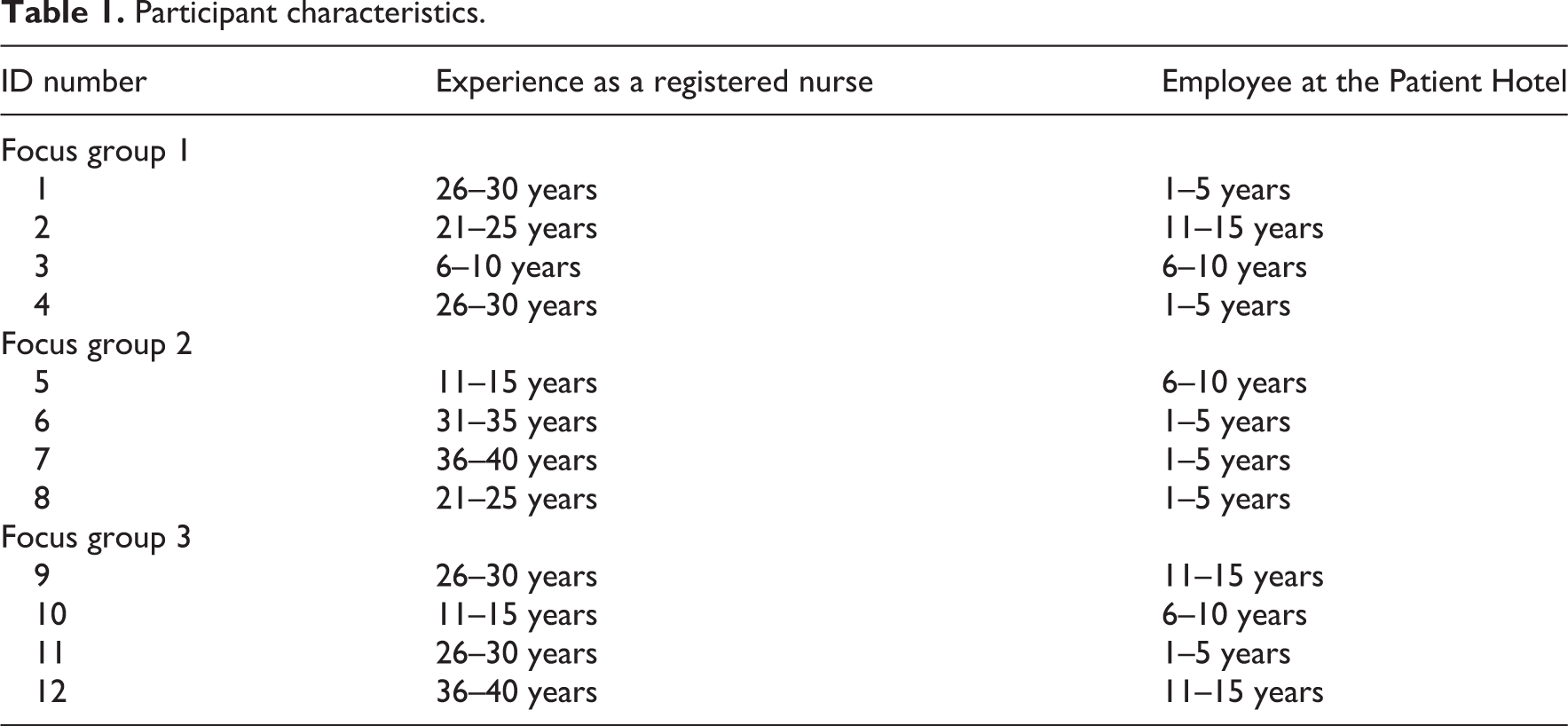
The participants were registered nurses employed at the Patient Hotel. They were recruited through the nurse leader at the Patient Hotel. All nurses employed at the Patient Hotel accepted the invitation to participate if it did not conflict with their work schedule. Inviting all the nurses at the Patient Hotel was intended to capture a range of diverse perspectives. In total, we conducted three focus groups with four participants in each group (Table 1). We used focus groups due to the advantages of the synergy that evolves between participants during interactive discussions. Such interactions contribute with valuable data on the extent of consensus and diversity among participants. 20
Participant characteristics.
Focus group discussion
The focus groups took place in August and September 2019 in the nurses’ common room in the Patient Hotel with no one else present. The participants sat around a table, with the moderator (first author) facilitating the discussions. The moderator was an experienced researcher with some experience in focus groups. She had no daily contact or relation with the participants, although a few of the participants had met the moderator randomly due to her job as a researcher affiliated with the Patient Hotel. An observer (last author) who was experienced in qualitative research and focus group discussions and was unknown to the participants was sitting in the corner taking notes on interaction and nonverbal communication and asking supplementary questions. The moderator and observer are experienced female registered nurses with a PhD. Their pre-understanding is constituted by clinical experience with nursing documentation, by previous research on nursing documentation and by teaching ethical theory to nursing students in the bachelor’s programme. The focus group discussion was based on a thematic guide with the opening question, ‘Please, tell us about your documentation practice’. 21 During the focus groups, the moderator encouraged participants to elaborate on each other’s statements and clarify their viewpoints. The focus groups lasted 52, 43 and 47 min, respectively, and were recorded on a digital audio recorder. After the focus groups, recordings were transcribed verbatim. In accordance with Morgan, 22 three to five focus groups are adequate for data saturation. After three focus groups, data were assessed to provide a detailed understanding of ethical dilemmas in nursing documentation of why no repeat interviews were conducted.
Data analysis
Data analysis was inspired by Graneheim and Lundman and encompassed an inductive qualitative content analysis to organise data systematically and generate knowledge based on the participants’ perspectives.17,18 Initially, the authors read the interviews to gain a sense of the whole meaning. Next, the interview texts were divided into meaning units, which represented parts of the text concerning the aim of the study. The meaning units were condensed to articulate the manifest content – staying close to the text (what was in the data). The condensed meaning units were interpreted to articulate the latent content (what the data were about). Next, sub-themes were created by exploration of similarities and differences among the interpreted meaning units. Finally, the sub-themes were formulated into themes at a higher interpretation level to clearly address the aim and communicate the findings (Table 2).17,18 To support credibility, the authors extracted and interpreted meaning units in the texts independently and discussed these until consensus was reached. During this iterative analytical process, the authors continuously returned to the texts to secure the core meaning, and discussions continually challenged the authors’ pre-understanding to minimise researcher bias 23 and avoid premature closure of the analysis. Member checking was not performed as the analysis involved a synthesis of all data and it was unlikely that the participants would recognise their own story. 23 Finally, themes were discussed in relation to theory and other research findings in the ‘Discussion’ section.
Examples of the process of content analysis.

Ethical considerations
The study followed the ethical guidelines for research. 24 The individuals participated voluntarily and signed an informed consent form after receiving written and oral information. 24 Anonymity and confidentiality were ensured by coding data and exchanging ID numbers for names. 24 Finally, the data were stored in a safe computer requiring passwords and only accessible to the authors.
Findings
The findings illustrated that nursing documentation is not straightforward but rather complex. This complexity generates ethical dilemmas that appeared in two themes: (1) a dilemma between respecting patients’ autonomy and not causing harm, which was visible in nurses’ navigation between written documentation and oral tradition, and (2) a dilemma concerning justice and fair distribution of goods, which was visible in nurses’ balancing between documenting deviations and proof of nursing practice.
Dilemma between respecting patients’ autonomy and not causing harm
Respecting patients’ autonomy and not causing harm are core values in nursing practice. However, they may contradict each other in nurses’ documentation practice and lead to a choice of oral communication instead of written documentation, which is illustrated in the following quote: One patient asked me not to document discontinuation of parenteral nutrition. I called the department (to which the patient belonged) and told them verbally. We must respect when the patients do not want us to document something, but in relation to her safety, I needed to tell the department about it. I needed my colleagues to know in case she felt bad later. This placed me in an ethical dilemma, because I wanted to do the best for the patient, but I also needed to respect what she tells me and therefore I did it verbally. (FG 3, ID 11) It is her life and her illness. If she doesn’t want us to document it, then we can’t press her. However, we would very much like to provide the information (to other healthcare professionals). (FG 1, ID 2) You can’t follow up on the situation if you don’t know about it. You don’t need to labour the point, but you can write down that the patient seems to be worried about her discharge. (FG 3, ID 9)
Whether nurses are documenting or handing over important information orally may affect the relationship between the persons concerned. If nurses document information that patients have asked them not to document, this may contribute to patients choosing to withhold information: They could withhold something that they do not want to share (if they know what we are documenting or telling). (FG 1, ID 4) What would you say if I document this (our conversation) in our record, because I think that this is important for your care trajectory and important for others to know. Then the patient can give her permission. (FG 3, ID 10) There is something that we must document because others need this information. If the patient does not want us to document it, then we are not allowed to hand over this information because we are then betraying the patient’s trust…Then you are alone with that knowledge. (FG 2, ID 7) I was concerned about dissemination of the cancer in a very ill patient with cancer. We (the nurses) needed to observe the patient carefully to assess if the illness was worsening, but there was no need to worry the patient at that time. I talked to a colleague about my concerns and asked her to check it up. As such, a lot of our basic knowledge and clinical analyses are lost because we don’t write it down. (FG 3, ID 12)
Dilemma concerning justice and fair distribution of goods
The core ethical value of justice also concerns fair distribution of goods, which could be nurses’ resources. Nurses’ documentation practices might be time-consuming and nurses tend to balance between documenting deviations in patients’ health condition and providing proof of their performed nursing practice. Proof of nursing practice includes describing matter of course activities, such as ingested fluid or food or that a wound dressing is all right, as described in this conversation: I think that people sometimes have doubts about how much to document. (FG 3, ID 9) How much you need to elaborate. (FG 3 ID 11) Exactly. If the dressing is dry and good-looking – do I then have to write what I see or do I only need to write when something deviates from normal. How much time do I need to spend on documenting that nothing is wrong but still ensure that my colleagues can see it (that the dressing is all right and proof that I have observed the wound dressing). (FG 3, ID 12) I don’t write in every single record every day that patients have had something to eat and drink. I write when they don’t eat. (FG 3, ID 10) It is different when it’s about an observation of a dressing. If I don’t write anything, then they (other nurses) think that I have not inspected the dressing. You can just write that it is all right. You don’t need to write more than that. Whether they have eaten is only if it deviates. (FG 3, ID 12) Sometimes I miss some information from the department. Sometimes there is information that could have been good to know. (FG 2, ID 8) On the other hand, it can be the opposite – I think, why do I need this information? It is not always an advantage to know a lot about the patient. (FG 2, ID 6) Everything is a little bit superficial. (FG 2, ID 5) However, when we look into the documentation system, we discover something that we need to be aware of. (FG 2, ID 7) It depends on why the patient is admitted to the hospital. (FG 1, ID 1) If the patient has just had surgery, then you ask about pain, whether they have had something to eat or drink, toileting, painkillers, and things like that. It appears when you talk to the patient, but of course you don’t need to document such things. On the other hand, we need to know something to be able to know what to observe. (FG 1, ID 3) We spend a lot of time documenting; couldn’t we just document the deviations and spend more time with the patient. I also tend to write too much, because you are afraid of legal problems if something happens (an adverse event or a patient complaint). (FG 2, ID 6)
Discussion
Nurses’ documentation practice encompasses ethical dilemmas regarding respecting patients’ autonomy and not causing harm, and regarding justice and fair distribution of goods. These findings are discussed with literature on nursing documentation and ethics.
Respecting patients’ autonomy and not causing harm are basic ethical values that may contradict each other in nurses’ documentation practice and constitute an ethical dilemma. This could lead the nurses to choose handing over information orally instead of writing in the documentation system, which could cause patient harm due to the lack of shared knowledge among nurses. This contradicts that patients’ autonomy must uncritically guide care to minimise harmful outcomes. 12 In addition, it is confirmed that incomplete oral handovers may increase the risk of maleficence in forms of medical errors and inadequate care.25,26 Haahr et al. 27 confirm that nurses experience ethical dilemmas when patients and relatives have preferences for care that conflict with the nurses’ professional responsibilities. In such a case, the nurse could choose to respect the patient’s autonomy and not document (inaction) or the nurse could ensure not causing harm and document (routine-based care). Both decisions – inaction and routine-based care – might represent misuse of power in patient–nurse relationships through either sentimental or authoritarian care, and both extremes of care relations are morally irresponsible exertions of power relations in nursing care. 28 The nurses’ choice of handing over information orally can be perceived as soft paternalism according to Beauchamp and Childress. 29 Nurses’ autonomous practice implies accountability, which entails both personal and professional responsibility, that is, a personal responsibility to support ethical acts in accordance with professional practice and a professional responsibility to exercise discretionary power to the benefit of the patient. 30 In our study, discretionary responsibility was expressed as nurses handed over oral information about lack of nutrition to refrain from harming the patient. On the contrary, favouring patients’ autonomy is essential in nursing, that is, to provide care and comfort to the patients while treating them as unique persons, respecting their autonomy and integrity, and ensuring the safety of vulnerable human beings.31,32 The dilemma occurs between respecting patients’ autonomy and the professional autonomy of having the authority to make decisions with the freedom to act in accordance with professional knowledge. Verkerk 33 elaborates on choice of action in such an ethical dilemma by emphasising that, instead of seeing the ideal of autonomy as being self-sufficient and independent, having a relationship and commitment are more important, where the moral question is presented in terms of responsibilities rather than of rights. In developing a more relational model of autonomy, handing over or documenting important information could be seen as an interest in the patient instead of as disrespecting the patient’s autonomy. However, handing over personal information despite the patient’s wish might affect the relationship negatively and lead the patient to withhold important information for clinical decisions as discussed among the participants in our study. Inherent in ethical dilemmas is the absence of obvious answers to the choice of action. The question ‘What is the best way to care for this patient currently?’ could be used to understand the patient’s preferences and perspectives and to consider how to act. 34 The answer to the above question might be supported by ideas of person-centred care, in which the patient as a person is emphasised, and efforts are made to perceive the person as a whole rather than as a patient with a condition. 35 A means to enhance person-centred care is to emphasise patient participation, for example, by advocating for nursing documentation carried out together with the patient.36,37 However, this is shown to be difficult due to challenges in meeting the patients’ expected needs and nurses’ needs 16 because it may be impossible to respect the patient’s autonomy and concurrently be professionally responsible as these actions sometimes are mutually exclusive. As such, organisational intentions, such as patient participation, may accentuate nurses’ experiences of ethical dilemmas in nursing documentation.
Justice includes fair distribution of goods, such as nurses’ time resources. In our study, some nurses found it particularly important to document patients’ deviations, while others aimed to describe matters of course to demonstrate their activities, that is, proving their nursing practice. Others found that different documentation practices among nurses might result in omitted communication of information, 38 which might jeopardise clinical decision-making, compromise continuity of care, and even risk causing the patient harm, eventually in forms of increased mortality. 39 However, the findings in our study demonstrate that it can be challenging to find a common way of communicating information, as nurses struggle with what information it is important to convey. In addition, what each nurse finds important to know about patients to care adequately for them is subject to individual judgements and preferences. Therefore, our findings underpin and contribute to the evidence regarding the different views on nursing documentation and the uncertainty about which criteria have to be met to achieve optimal documentation. 40 Contrary to these findings, standardised criteria are raised. For example, a meta-study suggested that nursing documentation should be patient-centred, contain the actual work of nurses, be presented in a logical and sequential manner, be written as events occur, record variances in care, and fulfil legal requirements. 2 These criteria may, however, risk embracing a degree of detail that could contribute to depriving patients of time with nurses. Hence, the individual nurse with the responsibility for several patients is left with the demand of prioritising goods. The basic ethical principle of justice demands the nurse commit to a fair distribution of resources among the patients, which means that fulfilling documentation requirements at a detailed level to all patients might be impossible. This signifies how challenging it might be for nurses to live up to an ideal world regarding documentation when they are facing real dilemmas, as demonstrated in our study. This is supported by Haahr et al., 27 who found that nurses experienced a dilemma with the desire to produce high-quality care, but that this was often affected by a lack of balance between patient care and administrative duties.
Although time-consuming and resource-demanding, some nurses argued for documenting course of matters to secure justice if accidental events happened or in case of complaint cases despite time constraints and demands of fair distribution of goods. A study by Allen 41 supports this by finding that formal documentation has become important evidence of organisational and professional performance, implying that trust in healthcare professionals has been replaced by trust in auditable systems. Nevertheless, such documentation patterns create multiple fragmented representations of the patient and make it difficult to get an overview of the patient’s situation. 41 As such, the argumentation for documenting matters of course might be influenced by electronic documentation systems, by a rising number of complaint cases in healthcare 42 or by patients’ rights to access their electronic records. Despite the uncertainty of the reason for diverse opinions on the content in nursing documentation, it is worth acknowledging that an ethical dilemma exists regarding how to execute fair distribution of goods in nursing documentation within the actual healthcare system.
Limitations
The credibility of the study may be questioned in terms of whether participants from a single unit can adequately address the intended focus of the study and in terms of how the researchers’ pre-understanding influenced the research process. 18 While both researchers were experienced clinical nurses, their experiences with nursing documentation and teaching might have influenced their choices in data collection and analysis. More authors taking part in the analysis may have minimised the impact of the authors’ pre-understanding and may have contributed with a more varied interpretive repertoire. 43 However, the interpretation of findings based on four basic ethical values enabled a clear communication of findings related to the aim of the study. Inclusion of participants from a single unit also affected the transferability. In addition, the relationship between participants from a single unit may improve the depth and nuances in conversations in focus groups. Nevertheless, other ethical dilemmas in nursing documentation could have been detected in other contexts.
Conclusion
While regulations regarding nursing documentation list normative rules and requirements, the demand of doing good in each situation is a continuous question for nurses. Nursing documentation encompasses ethical dilemmas regarding patients’ autonomy, not causing harm, and fair distribution of goods, which may have consequences for continuity of care, care relationships, trust, time distribution and nurses’ feeling of security. Ethical dilemmas in nursing documentation may be accentuated by actual tendencies in the healthcare system, such as patient participation, patients’ access to healthcare records and increased trust in auditable systems, such as electronic health records. Adding detailed and nuanced knowledge on inherent dilemmas in nursing documentation makes it possible to share otherwise individual and invisible dilemmas among nurses, nurse leaders and decision-makers. Bolstering awareness of ethical dilemmas in nursing documentation might support reflections and discussions among nurses as well as enable nurse leaders and decision-makers in considering adjustments of the conditions for nursing documentation.
Footnotes
Acknowledgements
The authors would like to thank the participants and their nursing leader for their valuable contributions that provided knowledge of their documentation practice.
Authorship
The study is designed by Lone Jørgensen and Mette Geil Kollerup. Both authors participated in the focus groups and analysed the data and drafted the paper. Both authors contributed to revise and approve the paper that presents the original results of the research.
Conflict of interest
The author(s) declared no potential conflicts of interest with respect to the research, authorship and/or publication of this article.
Funding
The author(s) received no financial support for the research, authorship and/or publication of this article.
