



Abstract
Background
Head nurses have duties in providing nursing care and ethical supervision to the nurses in the unit. Compliance with the ethical competence framework for head nurses is essential in fostering an ethical climate in the organization.
Objective
The objective of this research is to study the head nurses’ compliance with the ethical competence framework by the Thailand Nursing and Midwifery Council (TNMC).
Methods
The study is a qualitative research, using in-depth interviews conducted among 20 head nurses practicing in a super tertiary hospital in Bangkok, Thailand. The sample was selected using a criterion sampling method. The head nurses’ ethical experience relating to work practice was analyzed by thematic analysis.
Ethical considerations
The ethical approval of this study was obtained from the Committee for Research Ethics (Social Sciences), Mahidol University, and from the Institutional Review Board of the hospital in which the study was conducted.
Results
From the thematic analysis of the ethical experience practiced by the head nurses, 8 themes and 16 sub-themes were categorized across 5 ethical competencies based on the ethical competence framework by the TNMC. It was found that all the identified themes and sub-themes conformed to the ethical competence framework, and demonstrated the head nurses’ compliance with the framework.
Discussion
Head nurses’ ethical experience in practice conforms to the ethical competence framework by the TNMC. The framework that is based on the Code of conduct and the nursing culture that places the importance of the seniority system may facilitate the compliance with the ethical competence framework.
Conclusion
Head nurses demonstrated compliance with the ethical competence framework by the TNMC. Nevertheless, improvements could be done to the framework by adding details such as more examples of ethical decision-making scenarios, personnel’s rights, and social media usage guidelines.
Introduction
Ethical problems in healthcare have been a long-established issue since the dawn of medicine and even more so these days owing to the advanced technology and changes in the relationships between patients and healthcare providers.1,2 Nursing ethics emphasizes caring for the patients based on values while fulfilling the patients’ expectations of recovery from their illness.3,4 The nursing competency ensures that patients receive the care that is meeting the professional’s standard and ethical competency is an important aspect of the nursing competency. 5
Head nurses have dual roles as a nurse, being clinical experts and complying with nursing ethical guidelines, and as a manager, having to comply with managerial ethics while implementing organization policies and managing the subordinate’s ethical conducts. 6 Provision of support to help registered nurses solve ethical problems and establishment of a moral community are also the responsibility of head nurses. 7 Through ethics-centered behavior, sympathetic interactions, and exalted manners, head nurses can motivate the nurses’ ethical behavior, stimulate an ethical environment and atmosphere in the organization thus providing better care for the patient. 8 Therefore, the ethical competency of head nurses has a pivotal role in the practice of nursing ethics in the organization.
Background
The guideline for nursing ethics is generally included in the nursing manual or code of ethics/conduct9,10 also, ethical competencies specific to nurse leaders are available in the various standards of conduct.11,12,13 In Thailand, the ethical competency of head nurses in practice is guided by the head nurses’ competence framework by the Thailand Nursing and Midwifery Council (TNMC) which includes a subsection regarding ethical competency.
14
Five ethical competencies are listed without further details. Nevertheless, the “Handbook of Ethics for Nursing Organizations: Mechanisms and Practices”
15
contains operational details of the ethical conduct to facilitate the head nurses in their practice according to the ethical competence framework. The Five ethical competencies are listed as follows: 1. Demonstrate knowledge and an understanding of moral principles, ethical theories, culture, human rights, patients’ rights, the Nursing and Midwifery Profession Act, general principles of law, the National Health Act, the Health Security Act, and other relevant acts. The important moral principles the TNMC have cited are respect for autonomy, beneficence, non-maleficence, justice, veracity or truth-telling, and fidelity. The patients’ rights used as the reference is from the “Declaration of Patient Rights” in Thailand.
16
2. Be capable of making ethical decisions in practical and administrative nursing by following the ethical decision-making process which consists of information gathering, determination of ethical dilemmas, determination and analysis of options for decision-making, decision-making and implementation, and evaluation of the decision-making process and the results from the decision. 3. Assist patients in becoming informed of their rights and to understand them and act as the patient’s representative (Advocate) by guiding patients in protecting their own rights, helping find a solution that benefits both the patients and the families, facilitating their patients’ own decision-making, and interpret findings for their patients, provide information to be considered. 4. Possess administrator morals and ethics, regarding good governance: altruism, justice, respect for others, and moral courage. Also, the followings are listed as administrator ethics: respect for autonomy, beneficence, non-maleficence, justice, veracity or truth-telling, fidelity, accountability, advocacy, cooperation; recognizing the importance of the organization’s mission, teamwork-building culture, and caring. 5. Act as a role model in the unit/division by possessing the following attributes: ethical behavior at work and in personal life, management with good governance, work assignment aligned with the performance of subordinates, providing a safe environment for work, and listen to others.
While the code of ethics/ethical competence frameworks are established to help health care workers practice ethically, it is known that compliance is not always followed especially if, in practice, the context for the ethical competence framework was not brought into consideration. 17 Many health care workers have a critical attitude towards ethical guidelines and felt that ethical competency should be learned through good examples, role models, and practical experiences. 18 Studying of the compliance with the ethical competence framework is important for the TNMC to understand the practical aspects of the framework, facilitate the improvements on the following versions of the framework, and may assist the nursing organizations in implementing the framework to assure head nurses’ ethical competency.
From the literature review, researches on the competency of head nurses are mostly focused on the general competency of nurse leaders/head nurses and there are few studies that examine the ethical competency of head nurses.19,20 Furthermore, there is a lack of study regarding the head nurses’ compliance with the ethical competence framework established by the nursing organizations. Even though in Thailand, there was a previous study conducted on the head nurses’ competency, the study did not focus on the ethical component of the competency in particular. 21 Therefore, this research aims to study the compliance with the ethical competence framework by head nurses practicing in Thailand.
Objectives
To study the head nurses’ compliance with the ethical competence framework by the TNMC.
Methods
Design
The study is a qualitative research. The head nurses’ ethical experience was obtained by an in-depth semi-structured interview. The data was then analyzed by using thematic analysis. The resulting themes and sub-themes of the head nurses’ ethical competency were compared with the ethical competence framework for head nurses by the TNMC 14 to study the head nurses’ compliance with the framework.
Participants and research context
The sample group consisted of 20 head nurses practicing in a super tertiary hospital in Bangkok, Thailand, and selected by criteria purposive sampling with the following criteria: the head nurses practicing in a super tertiary hospital in Bangkok as a ward chief or head of the unit with at least 1 year of experience in nursing administration. The head nurse should voluntarily participate in the study. The duration of data collection was from 1 February 2020 to 29 February 2020. Head nurses are defined as the head/chief nurse of the ward/unit and are categorized as first-level nurse managers in the nursing hierarchy. 22 The researchers believe that the participants selected are representative of the various fields of medicine and should appropriately reflect the practice of the ethical competence framework by head nurses in Thailand. Super tertiary hospital in the Thai healthcare context is defined as a medical school/university-level hospital with technologically advanced diagnostic tools and up-to-date treatment options, comprises of various specialty and subspecialty physicians capable of treating complex medical conditions, and serving as a referral center. The super tertiary hospital was chosen as the research site due to the diversity of services and personnel, the complexity of the organization, and the affiliation with academic programs. A variety of ethical issues are expected to be found in such a large and specialized hospital.
Data collection
After the ethical competence framework for head nurses by the TNMC 14 is examined, the framework is used as a guide for the data collection by using an in-depth semi-structured interview. The semi-structured interview tool used has the benefit of obtaining comprehensive and important information from the participants which shares their experiences, thoughts, and knowledge in a narrative format and conveyed through the researchers’ interpretation. The qualitative tool is constructed and developed by reviewing relevant documents and literature. A themed framework is created for the questions to cover the ideas and theories. An in-depth, semi-structured interview guideline is used and the interview forms are reviewed by three experts. Validity, appropriateness, and comprehensiveness are checked. After adjustment and rectification by the researcher, the forms are used in a trial interview with three head nurses that have similar characteristics to the participants to test for question comprehension. The interview forms are then adjusted for appropriateness and intelligibility before actual use. Open-ended questions are used, as the participants describe their experiences and opinions in a narrative fashion. Before the interview, documents containing detailed information regarding the in-depth interview were given to each participant and the consent forms were signed. Permission for audio recording during the interview was requested. The interview was conducted in a quiet and private area within the workplace, at a convenient time for the participant. The interview session usually lasted 45–60 min. Semi-structured interview forms contain themes that are prepared in advance. General questions regarding sociodemographic and professional experience were used to obtain the participants’ background information. The ethical competence framework for head nurses by the TNMC 14 was then shown to the participants, along with the contents of the “Handbook of Ethics for Nursing Organizations: Mechanisms and Practices” 15 to ensure that the participants could recall, and are familiarized with the framework. Next, open-ended questions are used, as the participant describe their experiences and opinions on their ethical conduct in relation to the framework. The questions are designed to assure that the answers of each participant cover all the five ethical competencies listed by TNMC. The example questions were, “How does the ethical competence framework for head nurses by the TNMC affect your practice?”, “Do you think the framework is easily applicable in practice?”, “Please tell your experience of having to perform ethical decision-making”, “In your opinion, what are the attributes an ethical leader should possess?”, and “How do you view role modeling of head nurses?” The interviews were recorded with handwritten note taking and also with an audio recorder. Transcription of the audio recordings from the interviews into text format was performed and data verification was done together with the participants to ensure the accuracy of the data.
Data analysis
To comprehend the essence of the compliance with the ethical competence framework by head nurses, data analysis was done using thematic analysis to acquire head nurses’ views and opinions on ethical experience relating to work practice. Following the thematic analysis method described by Braun, 23 the data from the transcription was repeatedly reviewed and carefully searched for patterns. Codes were then assigned to the repeating, relevant data that reflects the ethical conduct of head nurses. The coded data were analyzed and sorted to identify potential themes and sub-themes. Each theme and sub-theme were reviewed and refined to assure they were representative of the head nurses’ ethical competency, emphasizing on the majority of the responses which contain similar ethical experiences. Defining and naming themes was done, followed by an analysis of the themes. Final refinement and analysis were performed with a conclusion by descriptive presentation. The resulting themes and sub-themes are then compared with the five ethical competencies listed in the ethical competence framework for head nurses by the TNMC 14 to study the head nurses’ compliance with the framework.
Ethical considerations
The ethical approval of this study was obtained from the Committee for Research Ethics (Social Sciences), Mahidol University. MUSSIRB no. 2019/327 (B2) on 28 January 2020, and from the Institutional Review Board of the hospital in which the study was conducted. The informed written consent was obtained from each participant. The purpose and method of data collection were explained, including the rights of the participants to withdraw from the study, allow or decline to give answers, and the ability to cease providing information if desired. Participants are allowed to make inquiries throughout the interview and confidentiality is emphasized in every process of the study.
Results
All of the 20 participants in the study are female. Their age range was 43–60 years with a mean experience in the managerial position of 4.55 years. Of the 20 participants, 11 held a BS in nursing, and nine held an MSc in nursing. All were in the position of head nurse at the time of the interview. Regarding the area of services, 12 work in inpatient wards, three work in outpatient departments, and five work in intensive care units. The specialty area of the head nurses are OB-GYN, Surgery, Internal Medicine, Pediatrics, ENT, Ophthalmology, and Orthopedics.
List of themes and sub-themes of the practice of the ethical competence framework by head nurses.
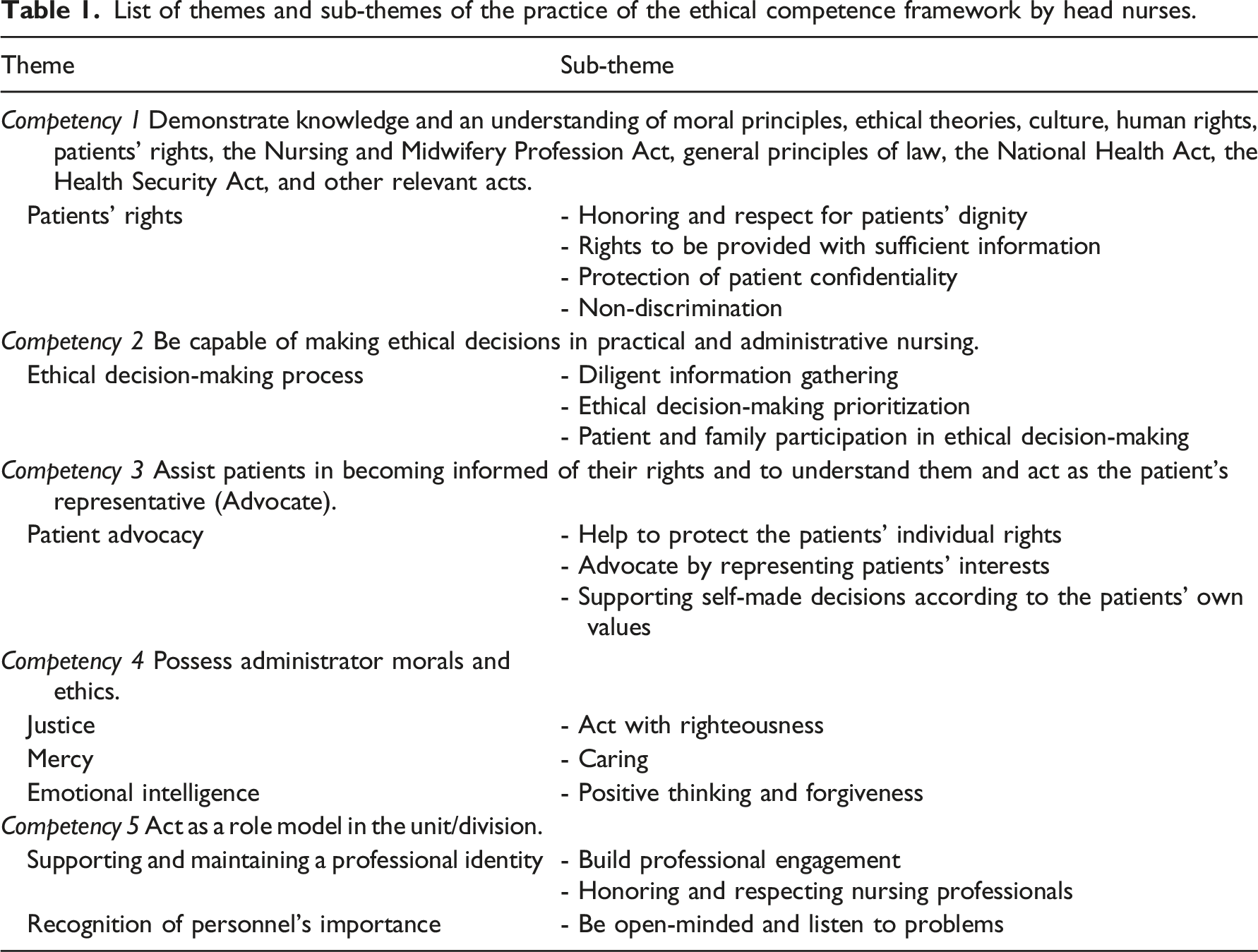
It was also found that all of the individual participants each described their ethical experience that conforms to all the five main components of the ethical competence framework, demonstrating their compliance to the framework.
Competency 1
Demonstrate knowledge and an understanding of moral principles, ethical theories, culture, human rights, patients’ rights, the Nursing and Midwifery Profession Act, general principles of law, the National Health Act, the Health Security Act, and other relevant acts.
Patients’ rights
Honoring and respect for patients’ dignity are regarded as fundamental principles in human rights and also in healthcare ethics. Most of the head nurses emphasized this aspect. For example, one head nurse explained: “Honoring and respect for patient dignity are always practiced with the same standard whether the patient is Thai or foreign national. We introduce ourselves and explain the process in detail. If the patient does not understand Thai, we will reach out to a translator from another department to help in communication.”
Many head nurses also feel that patients have the right to be provided with sufficient information regarding their illness condition and plans for treatment so that they can make their own decision on the treatment choices. A head nurse described that: “Information is provided to the patients about their diseases, what procedure is planned, financial aspects, their choices, etc. The patients should be aware of their illness, what had been done, and how to take care of themselves to prevent complications.”
Protection of patients’ confidentiality is also one of the topics that most head nurses pointed out. As one head nurse mentioned: “A patient had HIV infection and he doesn’t want his family members to know. We have to be cautious when discussing the patient’s illness especially in the wards where the adjacent patient is nearby, we have to communicate this issue in our team.”
Non-discrimination is emphasized by head nurses as a basic principle in nursing care and was described as follows: “HIV patients should still be taken care of with the same standards as other patients even though some of them may have a poorer prognosis. They should receive the same nursing care as other patients.”
Competency 2
Be capable of making ethical decisions in practical and administrative nursing.
Ethical decision-making process
The majority of head nurses felt that diligent information gathering for the ethical decision-making is considered an important step which a head nurse described in detail: “First, we must gather the information, we cannot make a decision instantly. We may consider severity, intention, ask the person involved, find facts, and then analyze and find possible solutions. If we cannot do it, we will consult with our seniors.”
In ethical decision-making, prioritization of the ethical problem severity facilitates the decision on the timing of the intervention. One head nurse explained: “It depends on the severity of the incident. If it is not very severe, we would discuss it with the people involved first but if it is severe e.g. at the multidisciplinary level, we would call the physician right away.”
Ethical decision-making should consist of patient and family participation. It is important that all parties involved in the care of the patient are able to express their opinions to provide the best solution to the patient’s problem. A head nurse explained: “An HIV patient does not want to tell his family, at the same time he cannot take care of himself. It is the patient’s right to keep it confidential, but we have to give him the right information for his decision-making and provide the facts to the caregiver.”
Competency 3
Assist patients in becoming informed of their rights and to understand them and act as the patient's representative (Advocate).
Patient advocacy
Some patients do not know their rights or are vulnerable patients that cannot protect their own rights. All of the head nurses in the study mentioned that head nurses should help protect the patients’ individual rights. A head nurse explained: “In an abused child situation, we put extra caution on the relationship between the child and his/her family. We contacted the social development department, coordinated with the mother and family. We received good cooperation from everyone. This is to ensure that we can be certain that the mother could continue to give good care to the child.”
Head nurses also advocate by representing patients’ interests especially access to healthcare and financial support. A head nurse described this in detail: “Sometimes the patient cannot afford the treatment costs on the spot, they had health insurance but did not know that they can claim the expenses through the direct billing with the insurer. We helped them check if they have any insurance and advice on possible solutions and options.”
Several head nurses felt that the patients should receive sufficient information about their conditions and have a right to make their own decision according to their own values. A head nurse described this in detail: “A patient wanted to be transferred back to his home in another province and willing to die peacefully there. But it’s complicated as the family cannot take care of the patient at home, in the meantime, he does not want to stay at the hospital. So, we helped coordinate the situation until we found an appropriate place to transfer the patient to.”
Competency 4
Possess administrator morals and ethics.
Justice
A leader must act with righteousness and show their staff that there is no bias. All of the head nurses in the study cited justice as very important. As a head nurse expressed: “Our unit had to send nurses to attend a 4-month specialized training course every year. Some nurses complained that they were not chosen. But they did not know that other nurses never went for the training either. We have training records of every nurse so we can explain the reason, we can disclose the information if necessary, to prove that we did not do something out of hate or love.”
Mercy
Head nurses care for their team’s practice, work environments, feelings, and well-being. “I told my subordinates to see my work and apply it to their usage, they don't have to do everything from scratch. Nurses usually work hard with continuing long hours, anything that I can help to relieve their stresses, I would be happy to do.”
Emotional intelligence
Positive thinking and forgiveness are attributes that head nurses believe will make colleagues happier and work in unity. As a head nurse asserted: “Positive thinking enables people to work together happily. We try to understand our colleagues to make work more enjoyable and we can be happy as a team.”
Competency 5
Act as a role model in the unit/division.
Supporting and maintaining a professional identity
Head nurses build professional engagement by acting as role models. When nurses see their leaders working hard and being compassionate, they get inspired and have a sense of belonging to the organization. A head nurse put it this way: “I will look at my nurse leader as an example. I feel that nurse leaders in each generation serve as a role model. My nurse leader always mentions that, as we are registered nurses, we have to love and be honest to our profession.”
Head nurses have to respect other people and honor them when circumstances arise. A head nurse asserts in this regard: “My former leader is a role model and I follow what she does. For example, I respect my team members. When they make a mistake, I discuss with them privately, not in front of the patient, or else the patient will lose trust in them.”
Recognition of personnel’s importance
Many head nurses felt that a role model should also be open-minded and listen to problems. A head nurse explained: “When there’s a problem, we will discuss openly, not worrying about being blamed. We try to help as best as we can.”
Although most of the head nurses in the study felt that the ethical competence framework is not difficult to comply with, some head nurses had the opinion that the “Handbook of Ethics for Nursing Organizations: Mechanisms and Practices” 15 could be further improved by citing more ethical decision-making examples, mentioning of the personnel’s rights, and adding guidelines for proper social media usage to facilitate the head nurses’ ethical practice.
Discussions
The head nurses’ compliance with the ethical competence framework for head nurses by the TNMC has never been studied before. From the interview of the head nurses, the themes and sub-themes from thematic analysis regarding the head nurses’ ethical experiences were categorized according to the five competencies of the ethical competence framework by TNMC. 14
In the first competency which consists mainly of the theoretical knowledge and understanding of ethics and relevant laws, patients’ rights are the aspect that head nurses describe as very important. From our study, the patients’ rights components that the head nurses mentioned are: honoring and respecting patients’ dignity, rights to be provided with sufficient information, protection of the patients’ confidentiality, and non-discrimination. These sub-themes demonstrated the head nurses’ compliance with the ethical competence framework. All of these components are emphasized in most of the nursing code of conduct,9,10,24 and also in the declaration of patients’ rights. 16 Since patients’ rights are one of the most frequent ethical issues that nurses had to encounter on a daily basis, nursing organizations tend to emphasize the nurses’ knowledge of patients’ rights. 25 Moreover, in the present time the subject of human rights is under scrutiny all over the world, violation of human rights and patients’ rights are considered as serious ethical issues. Consequently, head nurses’ compliance with the ethical competence framework regarding patients’ rights is expected.
The second competency focuses on the head nurses’ capability of making ethical decisions in practical and administrative nursing. Head nurses mentioned diligent information gathering as a step in the ethical decision-making process. Park 26 emphasized that gathering information is necessary for clarifying problems regarding ethical decision-making. Ethical decision-making prioritization is another step in the decision-making process since limited resources of healthcare facility and personnel requires prioritization of resource utilization. Poor priority setting may lead to nurses’ moral distress, impact patient outcomes and the quality of nursing care. 27 Patient and family participation in the ethical decision-making is encouraged by head nurses in our study. Patient participation in the ethical decision-making process supports the moral principle of autonomy, and the burden of patient care especially nonmedical burdens usually has a considerable impact on the family. Therefore, the patients’ families should participate in the decision-making process. 28 According to the “Handbook of Ethics for Nursing Organizations: Mechanisms and Practices”, 15 the framework for the ethical decision-making process was outlined and several examples were given to guide the head nurses through the process. Head nurses also gain experience on ethical issues over time and develop their skills in ethical decision-making both in clinical and administrative practice. 29 In our study, head nurses demonstrated their capability of making ethical decisions in practical and administrative nursing according to the ethical competence framework.
The third competency, assisting patients in becoming informed of their rights and to understand them and act as the patient’s representative (Advocacy) is also a competency that head nurses described. Head nurses advocate by helping to protect the patients’ individual rights. As many patients have a lack of knowledge of their rights, do not understand their rights, or are unable to protect their rights due to their underlying conditions or capacities, head nurses could help the patients by defending and informing them of their rights. 30 Advocacy by representing patients’ interests is another role that head nurses mentioned. Nurses could represent patients’ interests in the aspects of personal needs and values, treatment choices, or financial and health resources. Head nurses also advocate by supporting self-made decisions according to the patients’ own values. The patient’s participation in decision-making also supports autonomy which is a fundamental principle in ethics. 31 From our study, head nurses demonstrated their compliance with the ethical competence framework in relation to advocacy. Advocacy is listed in the code of conduct as a responsibility of registered nurses to help ensure that the patients receive optimal care based on their rights.9,10,24 Also, personal values and professional skills which are essential to advocacy develop with experience and could facilitate the head nurses’ competency in this regard. 32
In the fourth competency, apart from conforming to the nursing ethics, head nurses as leaders of the units must possess leadership ethics. From our study, head nurses had the opinion that an ethical leader should demonstrate justice and fairness by acting with righteousness. Also caring, as an aspect of mercy, represents the deep understanding a leader has of the subordinates’ stress and hard work and it could be demonstrated by showing kindness, taking care, and helping subordinates at work and in personal life.33,34 Head nurses also view that emotional intelligence which includes positive thinking and forgiveness is a basic trait that every ethical leader should possess. From our study, the head nurses’ practice demonstrated their compliance with the ethical competence framework regarding possession of administrator morals and ethics. The practice with care is a basic principle in nursing that is listed in every nursing code of conduct and is embedded in every nurse’s practice. Furthermore, prior to working at an administrative level, head nurses must receive training in leadership and nursing administration. Head nurses also learn and inherit ethical leadership attributes by experience during their practice under former head nurses and this supports the head nurses’ compliance to the ethical competence framework in this aspect.
The fifth competency, acting as a role model in the unit/division, is viewed by the head nurses as a practice that affects the behaviors of other nurses, especially the younger generations. From our study, head nurses view that supporting and maintaining a professional identity is a competency that a role model should practice. Head nurses act as a role model by building professional engagement, making their colleagues feel like a member of the team, forging integrity in the process. Nurse engagement with the organization and the profession reduces fatigue, improves the work environment, and produces favorable outcomes. 35 Honoring and respecting nursing professionals reflect integrity, relationship-focused, optimism, and generosity traits of a role model. 36 A respectful relationship with colleagues is mentioned in the nursing code of conduct9,10,24 and is embedded in the culture of the nursing profession. 37 Head nurses listen to their subordinates’ problems with an open-minded attitude, showing that they recognize the importance of the personnel. The head nurses’ compliance with the ethical competence framework regarding role modeling reflects the nursing culture in Thailand, whereas the nursing practice is hierarchical and seniority-focused. Junior nurses learn from senior colleagues and view them and head nurses as role models.
The themes and sub-themes of the head nurses’ ethical competency from our study are found to be similar to the study of Tongmuangtunyatep and colleagues 21 which also used the competence framework for nurse administrators by the TNMC 14 and identified “Professional Ethics” as one of the five factors in developing the Competency Assessment Scale for Head Nurses (CASHN) in Community Hospitals. The items that were categorized into the professional ethics factor include leadership ethics (honesty, transparency, and role model), responsibility, taking actions related to the code/standards, decision-making with justice, morality, and ethics, advocacy, commitment to the units and organizations, patients’ rights, regulation of guidelines consistent with organizational policy, and take action as an ethical consultant.
Compliance with the guidelines or the competence framework set by the organization ensures that the personnel practices according to the professional standards. Multiple factors from both the practitioners themselves and from the organization play important roles. Fischer et al., 38 categorized the factors affecting the compliance to medical guidelines into three groups; group 1, personal factors such as lack of awareness, lack of familiarity, lack of agreement, lack of self-efficacy, lack of skills, lack of learning culture, lack of outcome expectancy, and lack of motivation. Second group, guideline-related factors such as lack of evidence, complexity, poor layout, lack of applicability, and lack of clear intervention goals. Third group, external factors such as organizational constraints, lack of resources, lack of collaboration, and social and clinical norms. Carthey et al. 39 also analyzed the factors that prevent the following with guidelines such as information overload, redundancy of guidelines, accessibility difficulty, the length and complexity of the guideline, and personal factors/Human factors.
From our study, the head nurses demonstrated good compliance with the ethical competence framework in all categories listed by the TNMC, 14 which reflects the overall quality of the framework, the regulatory process, and the head nurses’ willingness to comply with the framework. Head nurses develop their ethical competencies since the beginning of nursing practice. By encountering ethical problems regularly in the daily nursing practice, head nurses assimilate ethical experiences while using the ethical competence framework and Code of conduct as their guide for practice. As the nursing culture in Thailand emphasizes hierarchy and seniority system, junior nurses usually learn from their senior colleagues and view them and head nurses as role models. In the process, leadership skills and ethics are embedded in most of the nurses and facilitate the compliance with the ethical competence framework. Moreover, the advent of quality control by the hospital accreditation process in recent years may have a positive impact on the regulatory process of ethical practice in the organization.
Nevertheless, the head nurses’ opinions on the ethical competence framework reflected that in practice, some aspects of ethical conduct may benefit from further improvements of the ethical competence framework. Although in the “Handbook of Ethics for Nursing Organizations: Mechanisms and Practices” 15 there were six examples of ethical decision-making scenarios, more examples could facilitate the head nurses’ practice in a variety of situations. The inclusion of personnel’s rights and social media usage guideline in the framework could also assist in the head nurses’ ethical practice.
Limitations
The study was conducted by interviewing head nurses practicing in a super tertiary hospital in Bangkok with the expectation that the ethical problems would be diverse from the multitude of services such as academic, research, or healthcare provision, and the diversity of multi-level/multi-specialty healthcare personnel. However, variations in personnel backgrounds, the organization culture, regulation systems, and social norms may result in a different compliance outcome in other contexts. The small sample size may also affect the generalization of the results. Finally, the limitation of the thematic analysis that is subjected to bias or inconsistencies may affect the result of the study.
Conclusions
From the thematic analysis of the ethical experience practiced by the head nurses in a super tertiary hospital in Bangkok, Thailand, 8 themes and 16 sub-themes were categorized across five ethical competencies based on the ethical competence framework by the TNMC. It was found that all the identified themes and sub-themes conformed to the ethical competence framework, and demonstrated the head nurses’ compliance to the framework.
Nevertheless, to facilitate compliance with the ethical competence framework, head nurses felt that improvements could be done in several aspects. The framework itself could be benefited from adding certain details such as citing more ethical decision-making examples, mentioning of the personnel’s rights, and adding guidelines for proper social media usage. Also, the role of the organization in enhancing the head nurses’ compliance to the ethical competence framework through motivation, and regulation should be emphasized.
Footnotes
Acknowledgements
The author would like to thank all participants for providing their experiences and involvement in this study and would also like to thank Prof. Dr Wariya Chinwanno and Mrs Krissana Kindree for their valuable suggestions.
Ethical approval
Ethical approval for this study was obtained from the Committee for Research Ethics (Social Sciences), Mahidol University. MUSSIRB no. 2019/327 (B2) on 28 January2020 and from the Institutional Review Board of the hospital which the study was conducted. The study was performed in accordance with the ethical standards as laid down in the 1964 Declaration of Helsinki and its later amendments.
Declaration of conflicting interests
The author(s) declared no potential conflicts of interest with respect to the research, authorship, and/or publication of this article.
Funding
The author(s) received no financial support for the research, authorship, and/or publication of this article.
Informed consent
Informed written consent was obtained from each participant.
