




Abstract
Background
Dignity is a central human value supported by nurses’ professional ethics. In previous studies, nurses in clinical practice have experienced that dignity increased their work well-being and pride of work. Dignity is also strictly interweaved to professional identity in the different nursing’ roles, but little is known about dignity among public health nurses and primary care settings.
Purpose
This study aimed to describe the perceptions of nursing's professional dignity of public health nurses in primary care in Finland.
Research design
An inductive qualitative descriptive approach with semi-structured focus group interviews was utilised.
Participants and research context
Twenty-seven Finnish public health nurses were interviewed via eight semi-structured focus group interviews in primary health care settings.
Ethical considerations
Before data collection, research permissions were obtained from participating health care centres. This type of research in Finland, with competent adult participants, does not require ethical pre-assessment but written and oral informed consent obtained before the interviews.
Findings
Based on our findings, public health nurses perceived that professional dignity was (1) part of their self-respect, an observed daily value based on their acknowledged competence. Besides, they perceived that (2) service users’ trust in public health nurses was a strong expression of professional dignity, and it could be uncovered when recipients of care utilised their services. In addition, public health nurses experienced that (3) professional dignity was an expression of different intertwined interprofessional and social factors.
Discussion and conclusion
Professional dignity is simultaneously an essential prerequisite and an outcome of public health nurses’ work. In future, more information would be needed to implement strategies in primary health care to foster nurses’ professional dignity also in international public health arenas.
Keywords
Introduction
To give and receive dignity and respect is vital for all human beings. It is crucial to understand the elements that can encourage, devalue or violate human dignity and respect in the health professional context. Professional dignity constitutes an in-depth approach to the meaning of dignity linked to professionalism. The respect or disregard of professional dignity influences health professionals’ satisfaction and organisational well-being.1,2
In the last decade, professional dignity for health professionals, particularly nurses, has gained momentum in clinical practice. In the literature, it has often been used to promote nurses’ motivation and combat job abandonment and dissatisfaction.3,4 Public health nurses are among the oldest professionals involved in prevention and education in many countries5–7 Globally, public health nurses make a crucial contribution to meeting the population’s needs and primary health care.8,9
In Finland, public health nurses’ education began in 1924, 10 and current public health nursing is part of a government-financed health system that was introduced in the 1940s. Their education is incorporated into a 4-year bachelor’s degree in universities of applied sciences. Public health nurses in Finland are registered nurses at the bachelor level (180 ECTS), and they achieve a further specialisation in public health (60 ECTS). They focus their activities on the prevention of illness and the advancement of the population’s health. 11 Their scope of practice ranges over the lifespan of families with children in early childhood, adolescence and increasingly to health promotion of the ageing population. Public health nurses work in social and health centres dealing with maternity and child health care, school health, occupational health and adult health.12,13 They have a fundamental role in detecting health problems, and their interventions focus on health education, behavioural changes and primary health care. They are autonomously responsible for their health care plans and work in multi-professional teams. Understanding their professional identity and dignity at work is pivotal as it also influences their work performance. 12
However, public health nurses in different countries have suffered over the years for their scarce recognition, and little is known about their perceived dignity.14,15 In this framework, it is essential to have an in-depth knowledge of public health nurses’ perceptions of professional dignity and discover strategies to help them achieve their individual and public health promotion targets. This study sheds light on this concept in community settings in Finland. This research constitutes an important contribution to professional dignity in the nursing discourse.
Background
Dignity as an intrinsic value
Human dignity is recognised as a central human value and the ground of human rights. However, the concept is not only a synonym for rights. 16 It is the central construct of integrity and respect for the person. Human dignity refers to the inner nature of human beings, and the uniqueness of persons who are considered persons in themselves. 17 From that perspective, human dignity cannot be subordinate to any other value; it refers to the unity of the human being in its completeness. 18 Human dignity underlines the persons’ unitary structure, founded on integrating their somatic, psychic and spiritual dimensions. Dignity is beyond a legal set of rules, political systems and moral doctrines. Instead, these terms draw their supreme argument from the concept of dignity. 19
Hence, according to the theoretical perspective that has informed many investigations,17,20 dignity is embedded in every individual, and is the essence of human beings as the ontological substance of the subject. 17 In this perspective, all human beings possess and deserve dignity because they belong to humanity. For this reason, dignity is a universal norm. This was stated by Immanuel Kant (1724–1804) when he argued that all humans had to be inherently persons in their dignity and humanity and had not to be treated merely as means to an end, but always at the same time as ends in themselves. 21 In this sense, dignity acquires the most extraordinary worth and can be used as an ontological truth where the person’s dignity is rooted in the person’s body. Kant used the expression ‘Kingdom of ends’ as the social agreement that obliges everyone to promote the common good. 21 Dignity, therefore, is considered a common promise of recognition and does not allow humiliation for human beings.
This position is slightly different from Arendt, who particularly stressed dignity as the right to have rights, or the right of every human being to belong to humanity, a right that should be guaranteed from humanity in itself. 22 In this sense, dignity is the ground of rights and duties in the nursing profession. 16 This would point to an unspecified term generated by moral choices, social mechanisms and historical constantly evolving. In this manuscript, we are not examining the concept of dignity, but rather its experienced aspects, that is, what is ‘contingent, comparable, and contextual […] experienced, bestowed, or earned through interaction in social settings’. 23 (p. 294),24 This type of dignity is also called an earned dignity25,26 or social dignity23,24 and is linked to the social appreciation and recognition persons experience in their interactions with other persons. Dignity is therefore recognised as an essential aspect of workplace environments where people spend a good part of their day-time in organisational institutions.27–31 Dignity grows through social relationships, and this connectedness also influences a person’s integral dignity. 32 As a specific concept, nursing’s professional dignity was in-depth analysed and discussed by Sabatino et al. 33 (p. 9), who tentatively defined for the first time the construct as a ‘multidimensional intertwined concept composed of the characteristics of human beings: intrinsic human dignity, subjective perception of one’s own dignity, the professional identity of nurses and their professional ethical values and workplace elements, including inter- and intra-professional relationships, communications with patients and their significant others and the organisational characteristics of work environments. In addition, it is important to establish the scenario of these macro- and micro-dimensions, as a variable context, culturally and historically situated, which influences the perception of the concept itself’. Crucial studies accomplished on this issue were also carried out in 2012, 20 where mapping of the concept was first proposed in 2016, 34 where the concept was studied in hospital setting in Italy and in 2018 34 where the construct was analysed in hospitals and community settings in England. Furthermore, two qualitative investigations accomplished in South Africa35,36 stressed the significance of the contradictory experiences of nurses to have their professional dignity respected in private health care structures. The two investigations underlined that the professional dignity of nurses is both a non-negotiable value and a value connected to the fluctuating social experiences of nurses’ embedded societal and cultural milieu. Instead, Froneman et al. 37 explored midwives’ professional dignity and found that other health care professionals and the management influence its social construction in clinics.
Professional dignity and nursing codes of ethics
With this theoretical basis,26,38 we believe that with dignity and therefore professional dignity, nurses can also positively influence how professional identity is understood, especially in hierarchical settings.6,39,40
Therefore, recognising dignity represents a well-established value in developing codes of ethics to ethically inform health professionals. In the last 20 years, nurses’ codes of ethics have begun to emphasise the importance of respecting nurses’ professional dignity and not only patients’ dignity. The first code to introduce this aspect was the American Nurses Association Code of Ethics of 2001, where nurses were expected to owe the same duties to others as to self. That was then expanded to include the responsibility to preserve integrity and safety, maintain competence and continue personal and professional growth. In the updated Code by the American Nurses Association,41,42 dignity was mentioned explicitly: ‘Moral respect accords moral worth and dignity to all human beings regardless of their personal attributes or life situations’. 41 Dignity has also been highlighted in the Australian Code of Ethics for Nurses 43 and the 2021 version of the International Council of Nurses Code of Ethics. 44 Element 2.4, ‘Nurses and practice’ reads ‘Nurses value their own dignity, well-being and health. To achieve this requires positive practice environments, characterised by professional recognition, education, reflection, support structures, adequate resourcing, sound management practices and occupational health and safety’. These Codes indicate that nurses’ well-being is crucial because nurses are human beings in their whole essence and integrity as persons and maintain quality clinical care.
Dignity is the core value of professional identity and collaboration, but little is known about how public health nurses perceive their professional dignity in their daily practice. Therefore, achieving a clearer understanding of professional dignity in practice is pivotal to advancing respect for the nursing profession.
Methods
Aim
The study aimed to describe the perceptions of professional dignity of public health nurses in primary health care in Finland. This could be further used to develop strategies to support public health nurses’ daily practice.
Methods
A qualitative descriptive approach was used to gain new understanding of a subject that began to be investigated in the first decade of this century. The method used allowed increased insights about individual human experiences in professional dignity.45,46
Participants
The target group were Finnish public health nurses. The investigation was conducted in two health care organisations, one in a mid-range town in eastern Finland and one in a large town in southern Finland in 2015. After receiving organisational approval, the researchers informed nurse executives about the study, and they handed out information letters regarding the study to the public health nurses in their organisations.
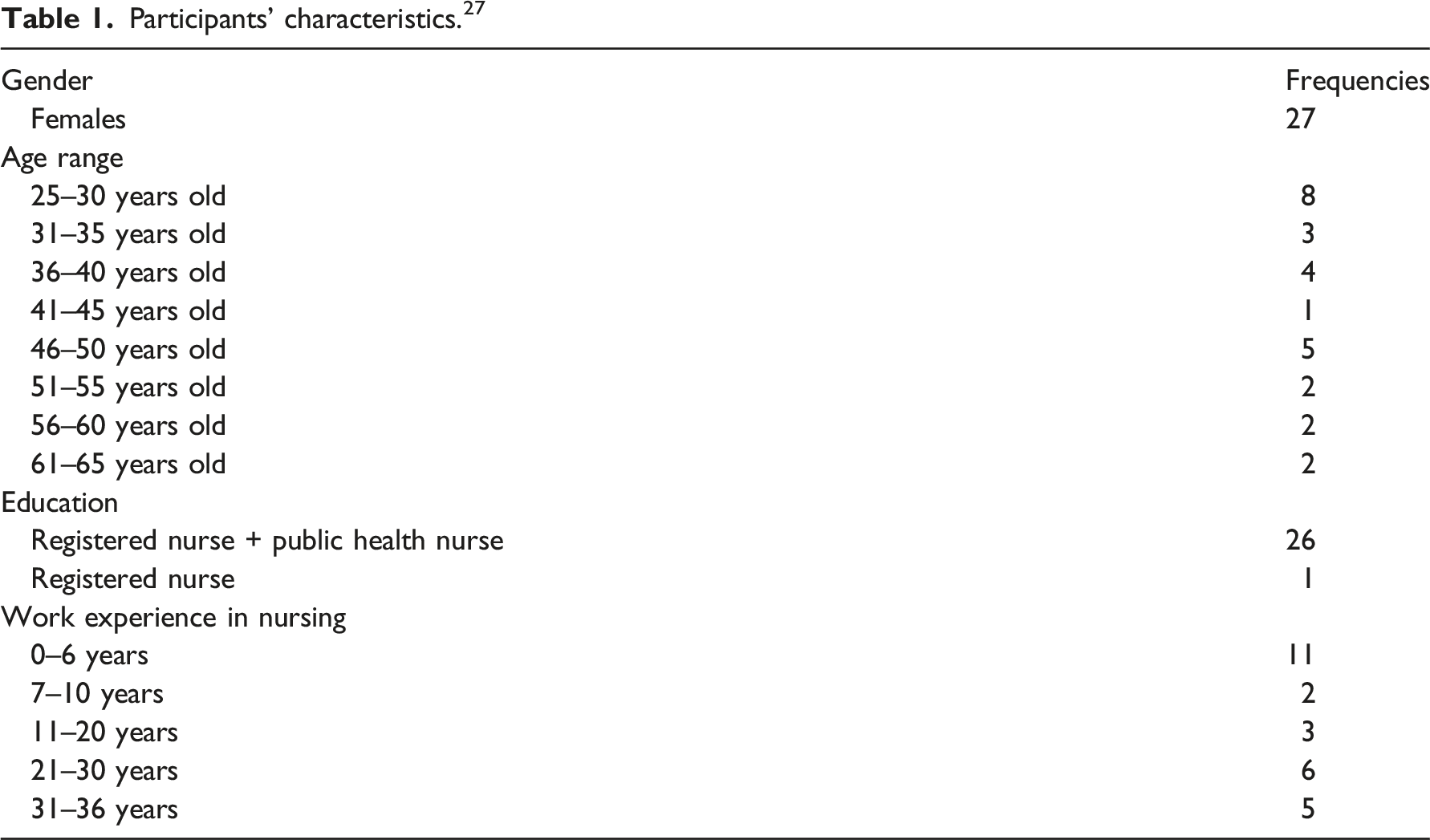
Participants’ characteristics. 27
Data collection
An interview technique with a semi-structured method for gathering data was used.47,48 The focus group interview method was suitable because professional dignity is social by nature. We developed a semi-structured interview guide with four themes, based on previous knowledge: (1) the meaning of professional dignity for public health nurses, (2) the experiences of professional dignity in public health nurses’ work, (3) the factors influencing professional dignity and (4) the future perspectives of professional dignity in the public health nurses’ view. All interviews were conducted and recorded by three researchers. Altogether 27 nurses with at least one year of experience in public health nursing were interviewed in eight groups. Two nurses made up two interview groups because of the cancelled participation of invited nurses at the last moment. Two groups comprised three nurses; three groups included four nurses, and one group comprised five nurses. The interviews were carried out at the health care centres’ meeting rooms during the nurses’ working days. All interviews were audiotaped and lasted between 47 min and 1 h and 34 min. At the end of every focus group, the two researchers involved in data collection took notes regarding public health nurses’ sentiments and non-verbal communication to reach an overall structure of the social nuances found in this social setting.
Data analysis
The data were analysed using inductive content analysis.49,50 First, the data were transcribed verbatim and consisted of 184 pages. The researchers read the data several times to get an overview of the entire content and then inductively analysed the manifest meaning of the transcriptions. Subsequently, the researchers selected units of analysis (a word, a sequence of words or sentences) that responded to the research questions thus developing an initial coding framework. After this, through a process of iterative synthesis, the units of analysis were reduced into further codes and grouped based on their similarities and differences. Subsequently, the research team connected them to categories and themes through a theoretical abduction process to gain logical inferences about the social phenomenon under scrutiny. 51 Altogether, 10 categories and three main themes were found. The themes were named inductively, based on the content analysed.
Trustworthiness
To assure trustworthiness 52 in the descriptions about the perception of nursing’s professional dignity in public health nursing in Finland, the research team used the principles of credibility, transferability, dependability and confirmability as the suggested criteria. 53 Credibility was established by precise purposive sampling of nurses and extended engagement in the field with public health nurses, but was also assured as part of the collection of rich data that were analysed in detail from the transcripts of the focus groups. The meeting of the dependability criterion is controversial in qualitative studies, although researchers should at least try hard to enable potential examiners to replicate the analysis. Dependability also addresses the reliability of the research findings. In this framework, the research group tried to connect credibility with dependability, considering that an in-depth verbatim analysis line-by-line of the data could assure this criterion. Confirmability, which refers to the potential congruence that data accurately represent the participants’ information, was accomplished by in-depth discussions among the research team, and potential disagreements were solved in discussions. A member of the investigation consortium who had neither participated in the group interviews nor in previous analysis read the original un-coded transcripts to corroborate the results. Collecting data from public health nurses working in various municipalities secured data transferability.
Ethical consideration
Before data collection, research permissions were obtained from both participating health care centres. According to Finnish national legislation (Ministry of Social Affairs and Health 488/1999), this type of research with competent adult participants without questioning their integrity does not require ethical pre-assessment. However, written and oral informed consent was obtained before the interviews. Participants were informed about the study’s voluntary and confidential nature and their rights to withdraw participation without any consequences. The information of names, regions or places of work was blinded during the study’s transcription phase to guarantee anonymity.
Findings
Based on our findings, public health nurses described their professional dignity in relation to (1) Public health nurses’ self-respect, (2) Patients’ trust in public health nurses and (3) Public health nurses’ professional dignity as an expression of interprofessional and social factors (Figure 1) Public health nurses’ perceptions of nursing’s professional dignity in primary care in Finland.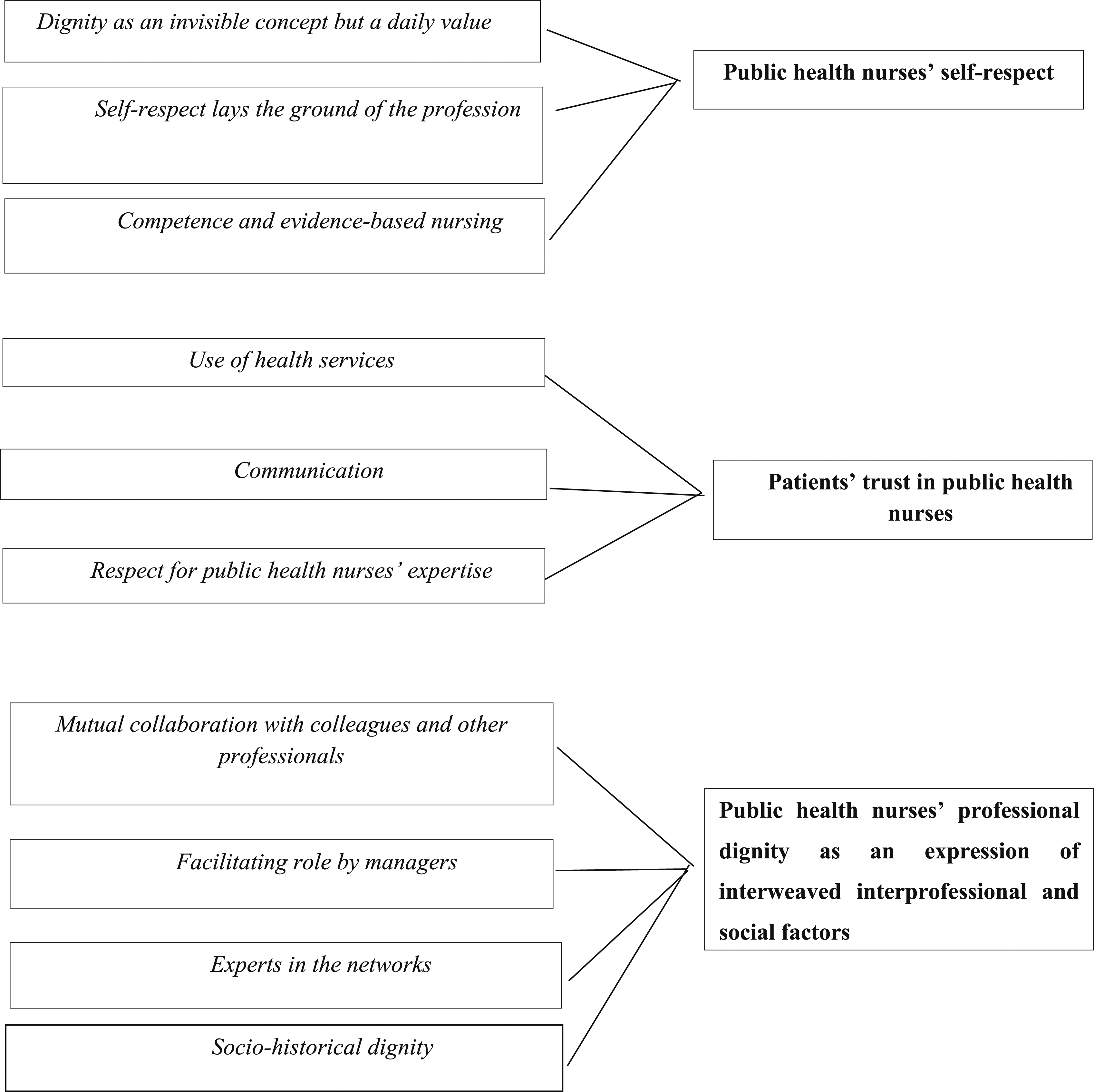
Public health nurses’ self-respect
According to the interviewees, one of the critical issues for public health nurses' professional dignity is self-respect. This included their self-respect for their profession and their attitude to seek education to improve competencies and develop public health nurses’ work capacities.
Professional dignity as an invisible concept, but a daily value
Public health nurses described professional dignity as a concept they were not thinking of during their everyday practice but was evident when it was lacking. They described professional dignity as a health care value of work and as something that could be expressed in words, ways to behave, communication and rewards. Professional dignity was described as appreciation, respect, trust in the profession, polite behaviour and fair and equal encounters. Self-respect referred to patients, civic society and other professions. This meant that public health nurses act in a way they were worthy of public trust. Participants were proud of their profession because it was Finland’s oldest speciality in nursing education. In addition, they experienced that the core of professional dignity was to share respect with colleagues. There are midwives and public health nurses in every district, and they are highly respected. (FG 3) Yes, I remember when I was studying in my first year, relatives looked to me to explain their health issues, and I used to say that I could only give them this information because I was training to be a public health nurse. (FG 6)
Self-respect is the basis of the profession
Public health nurses stated that if they were not respecting their own profession, they did not expect the public to do so. Significantly, they perceived that if they valued their profession, other people would be able to recognise its professional dignity. Participants dignified their work because it was preventive, close to human beings and promoting health. Participants experienced that professional dignity influenced their organisational environments and their work well-being. We (as nurses) are proud to work for health; our aim is to strengthen the right health choices of the public. (FG3)
Competence and evidence-based nursing
As an expression of nursing’s professional dignity, public health nurses emphasised their responsibility to seek and update their competencies. They recognised that they had to revise their skills constantly because the surrounding society was changing continuously, and they had to respond to patients’ multidimensional needs. They highlighted that public health care was also part of the demographic changes and immigrants’ specific health needs. They felt that all these issues constantly challenge public health nurses’ skills. For example, their new responsibility was to support persons’ integration into the receiving society. (As a sign of professional dignity) … Our profession has to change as well; we have to respond to new societal needs, especially of immigrants. (FG 4) We have to make visible what we know… in the workplace and society. (FG 6)
Patients’ trust in public health nurses
Patients’ trust assumed a crucial role in public health nurses' experiences of professional dignity. Professional dignity emerged through patients' use of services and communication between patients and nurses.
Use of health services
Public health nurses described that a significant expression of professional dignity was represented by how patients used public health nurses’ services. Participants pointed out that almost all pregnant women attended their regular, but voluntary, health appointments before and after delivery. Families were also very committed to bringing their children to the regular consultations with them. School health nurses had similar experiences: children and adolescents visited them voluntarily and regularly. Despite their socioeconomic social status, persons were looking forward to being assisted by public health nurses. Yes, they really use our services (as a sign of professional dignity), very seldom they (patients) don’t attend, or they have forgotten an appointment or something… (FG1) They are wealthy and poor, all walks of life; however, they come to visit us, even those (patients) who have money to afford a private visit. (FG 3) We are a default value for all Finns – it is a sign of professional dignity. (FG 5)
As an expression of professional dignity, some interviewees brought out examples of patients’ rights to choose their own health care district. Some families were moved to other districts in town, but they decided to be taken care of by the same public health nurses. In addition, in a more prominent health care centre with many public health nurses, some families chose the same nurse for all their babies’ deliveries. According to the participants, the continuity of care was experienced as an incredible expression of professional dignity. “… if families have an appointment with a physician, they will be saying: ‘Oh, I was expected to meet my own public health nurse’ – this is really an appreciation of our work. (FG 1)
Communication
Participants described that an expression of professional dignity was also the patients’ way to communicate with them. Families expressed their willingness to discuss their personal concerns with public health nurses. Interviewees often described being the first persons for parents or adolescents to be acquainted with their concerns and painful life experiences. Patients would discuss with public health nurses also other than health-related problems. Nurses experienced that those care recipients enhanced their role as professionals with these conversations. We talk about healthy lifestyles but also smoking, alcohol and domestic violence (FG4)
Respect for public health nurses’ expertise
Participants experienced that the patients’ commitment to their health advice was an expression of professional dignity. Nurses understood that families respected them as authorities. They usually asked for public health nurses’ guidance and followed care instructions. Patients looked for face-to-face opinions despite all available information. For example, delivery training for the families was available through the internet, but mothers and fathers wanted to hear what the public health nurses thought about their specific situation. One participant described that families considered public health nurses ‘a relative’. They (families) are alone, they lack everyday basic health skills, and I feel they are dependent on us. (FG 4) They (families) don’t have family networks, and they come with lists of questions. (FG 1)
Public health nurses’ professional dignity as an expression of interprofessional and social factors
Participants described that the professional dignity of public health nurses could be recognised in their different interprofessional networks. This was shown by respectful collaboration with colleagues and other professionals in their workplaces.
Mutual collaboration with colleagues and other professionals
Interviewees found that their colleagues and other professionals showed respect for public health nurses by consulting them and involving them in their multi-professional networks. Collegiality… it is so important… when you have an almost retired colleague who teaches you things as a mother. (FG 6) One mother told me she asked a physician to advise her about breastfeeding, but the physician affirmed that she didn’t know it because she was a doctor and invited her to ask a public health nurse. (FG 6)
Facilitating role by managers
Participants said that professional dignity also meant a well-organised job environment. This referred particularly to managers, who needed to be more aware of public health nurses’ professional skills and use their lifelong learning. Participants experienced professional dignity when they had suitable and sufficient equipment in their daily work. This also included necessary human resources to tackle busy times with an increased number of patients. Interviewees experienced that their relatively autonomous working schedule and flexible working times were an expression of managers bestowing professional dignity to their work. So, at long last! But it took a long time before we got individual mobile phones. We were not convinced that we could get them… we had to use our private phones during home visits. (FG 3) Yes, they (managers) say that we are doing great work and dignify our work, but, in reality, analysing the workload or the human resources is sometimes difficult to notice. (FG 1)
Experts in the networks
Participants considered themselves dignified if they were used as experts in different organisations and third sector activities. Usually, they were encouraged by family associations to give presentations or advise them. Some nurses met with networks of social workers, and they were also present in social work teams. Participants appreciated that social workers had a good awareness of public health nurses’ work and competencies. Collaboration with nursery schoolteachers in rural kindergartens provided them with a feeling of professional dignity. Public health nurses described that their national professional meetings were central to upgrading and exchanging professional opinions with their colleagues. If I say something about sleeping or nutrition… physicians are not very expert, and they look at it from the medical point of view, and this emerged in our professional meetings (FG 1)
Socio-historical professional dignity
Participants sensed that their profession was dignified in society, but the economic benefits were not reflecting this. Generally, the interviewees described that their reputation was positive in the media: the retired nurses were highly appreciated in the villages as they represented the wise persons, together with midwives and doctors. Public health nurses also had a pivotal role in instructing people concerning vaccination and public health. One participant described an exhibition about public health nurses in a health care centre, which was seen as a sign of appreciation of the profession.
Over the decades, the work of public health nurses had changed and included many new duties that midwives or physicians previously covered. However, the salaries had not kept pace; in addition to their basic salary, physicians received rewards based on the procedures or treatments carried out. Neither rewards, lifelong learning nor new titles were available benefits for nurses. Our work is preventive by nature, and diseases are decreasing due to us. (FG 4) We are expected to take care from the cradle to the grave in a high-quality way, but…this is difficult with these scarce extras. (FG 1)
Discussion
The study aimed to illustrate public health nurses’ perceptions about professional dignity in primary health care in Finland. Three themes elicited the professional part of dignity connected to the perceptions of oneself as a person and the professional part of dignity linked to practice working environments.
The first theme regarding public health nurses’ self-respect sheds light on the concept of nurses’ self-worth, notably, to be a moral agent and to be morally responsible for one’s actions. Nurses’ self-awareness of their worth and self-fulfilment are directly connected to the intrinsic value of persons who have dignity embedded in their humanity with an ingrained moral law. The worth of human beings is deeply ingrained in their humanity, and their value is absolute, irreplaceable and unique and is the ontological core of human beings. 54 The dignity of human beings is also the grounding value of human rights and the right to have rights as expressed by Hannah Arendt, 55 and it is intertwined with the embedded worth and value of persons.
It is not always easy to demonstrate self-respect and self-esteem56–59 as a person and professional. These views mainly depend on different subjective, socio-contextual factors linked to the culture, the beliefs of individual workers in a particular milieu and the psychological dimensions and personality traits of that person.60,61 As an intrinsic value, self-respect is connected to a person’s inherent and implicit worth and implies a particular grade of self-esteem, mainly recognised by social relationships of mutual dependency. Self-esteem is strongly connected to social recognition, and this implies a strict connection with social esteem. 62 For primary health nurses, self-respect meant to be responsible for achieving evidence-based nursing based on lifelong learning. To improve competencies and skills constantly was seen as fundamental in an ever-changing society that presents enormous challenges associated with major globalised transformations such as large migration flows and relevant and sudden shifts in economics due to major confrontations at a global level. 63
The second theme regarding patients’ trust in public health nurses involved the nurses’ relational dignity in their interactions with patients and their significant others. This creates a relationship of mutual dependency that fosters empathy. Public health nurses acknowledge their professional dignity in mutual relationships with patients. This relational part of dignity, well emphasised in an ethics of care64–66 and by various scholars,67,68 deals with the social part of dignity. This describes dignity as the essence of relationships and human encounters. Dignity is mainly the relational manner of care ethics and moves from individualistic behaviour to interdependence. Relationality (or connectedness) describes the full meaningfulness of individuals69,70,71 and is mentioned as a critical tenet for nurses in codes of ethics.41,44 Care ethicists consider interactions with others vital to foster dignity in all persons. In our study, public health nurses felt appreciated by the recipients of care they were assisting, and some of them wanted to be taken care of by the same nurses even when they moved to different geographical areas. Nurses were seen as trustful professionals, and patients treated them with confidence. 72 Broadly speaking, nurses felt greatly rewarded by this social recognition. In a dignified working environment, public health nurses felt it was meaningful to be committed to their profession. As a sign of professional dignity, participants pointed out public health nurses’ education attractiveness. The rates of new student nurses in Finland have been stable during the past decades, and for participants, this mirrored the respect for the nursing profession. 71
The third theme, regarding dignity as an expression of interprofessional and societal factors, revealed the respect that other workers had for the prevention and promotion of health achieved by public health nurses. The interviewed nurses believed that the inner nature of public health nurses’ work highlighted their dignity. Participants experienced that respectful communication with other professionals increased their well-being. However, nurses also pointed out that respect between colleagues had to be mutual. Public health nurses work independently and plan their own appointments and care. 6 Autonomous working encouraged but also forced them, to have steady and regular interactions with their co-workers. Participants experienced that physicians also dignified their long-lasting care relationships with care recipients.
Public health nurses described that their dignity was widely recognised in society, and they were acknowledged socially in their specific context. They believed that their reputation had always been positive, given that retired public health nurses were well appreciated in their villages. These nurses were considered some of the most educated people, along with midwives and doctors, because of their crucial role in educating people, promoting vaccination and practising preventive health measures for the community.10,11 However, during the last decades, public health nurses’ work profile has changed and included many new responsibilities that midwives or physicians previously fulfilled. Notwithstanding this, their salaries had not substantially changed over the years, and compared to physicians, who earned a basic salary and bonuses for specific routine treatments, were considered unfair. It also emerged that managers advocated for nurses in senior roles. However, the interviewed nurses wished the executives would be closer and listen more regularly to their viewpoints on organisational aspects of care. This is a well-known concern in the international nursing management literature.73–75 In fact, transformational and lean leadership styles, 76 enhanced affective commitment and more vital empathy 77 and human-centredness 78 can positively influence the retention and the satisfaction of the staff employed.
Limitations and directions for future studies
Our study has several limitations that should be identified. First, in the analysis process, it was occasionally difficult to distinguish whether the concept of nursing’s professional dignity could be clearly ascertained compared with the integral dignity of persons in general. This is a limit found in all the studies on this topic. However, we see this as a finding, and the two concepts of the inherent dignity of persons and the nursing profession’s dignity can be evaluated as two sides of the same coin. Second, the data were collected exclusively in some primary health care districts in Finland. Had more districts been included, other construct aspects could have been determined. Third, due to the study’s design, the results cannot be generalised, but we do believe they have a particular grade of transferability to other similar contexts. Despite these limitations, the results may help examine the significance of the relational and organisational aspects of the work of public health nurses to deliver quality care services based on respect for themselves as human beings and as representatives of their profession.
Conclusions
Professional dignity is an aspect of humanity and the health care professions and is a tenet based on ethics, particularly in acts that concern social behaviours. The ability to confer dignity is the prerequisite of ethical nursing practice in various caring settings. In addition, it is a requirement necessary to be applied to nurses themselves when they have to take care of others in mutual relationships of quality. We hope that the authors’ efforts in outlining the role of public health nurses in Finland will foster greater recognition of their professional dignity. Nurses should seek to ensure their well-being and other health care workers’ prosperity as far as possible in all circumstances. All workers in health systems must strive to work collaboratively and supportively towards this goal.
Footnotes
Acknowledgements
Thanks to Centre of Excellence for Nursing Scholarship OPI of Rome for supporting the research.
Declaration of conflicting interests
The author(s) declared no potential conflicts of interest with respect to the research, authorship and/or publication of this article.
Funding
The author(s) received no financial support for the research, authorship and/or publication of this article.
