



Abstract
The unique role of the nurse ethicist in the clinical setting is one meant to enhance the ethical capacity of nurses, and front-line healthcare providers. As a nurse ethicist, it is also my goal to enhance the ethical climate of each individual work area, patient care unit, and the broader institution by encouraging ethical conversations, navigating ethical dilemmas, and seeking creative solutions to minimize moral distress and burnout. To provide preventive ethics support and education, I began regularly visiting patient care areas for ethics rounds, which I affectionately named “E-walks” (for Ethics Walks). I will discuss and reflect upon the lessons that have emerged as three key components of “E-Walks”: Recognition, Solidarity and Dialogue. These themes will speak to the unique presence and availability of a nurse ethicist as a valuable resource to front-line healthcare providers who face ethical dilemmas and morally concerning cases. I will go on to argue and demonstrate that my role as the nurse ethicist lies at the intersection of bioethics and the theoretical framework of the “ethic of care,” which is focused on building, creating, and sustaining caring interprofessional relationships through the work of ethics, nursing, and education.
Introduction
In the start of 2021, I was offered the opportunity to become the inaugural clinical nurse ethicist to work alongside the director of ethics, in the newly created Center for Bioethics, in a major pediatric quaternary care facility. As a skilled clinician, with over 26 years in Neonatal Intensive Care Unit (NICU) nursing experience, as well as an ethicist, I was tasked to assist with ethics consultations, provide ethics education, and collaborate in ethics scholarship. One of the main goals as a nurse ethicist is to enhance the ethical capacity of nurses, and front-line healthcare providers. I hope to work to empower them to act as advocates and change agents at the bedside. My ultimate goal is to enhance the ethical climate of each patient care area, and the broader institution by “improving the capacity of nurses to manage the ethical issues inherent in the care of patients in a contemporary, technologically-driven healthcare system.” 1 I have worked to operationalize these goals by facilitating ethics conversations, providing ethics education, assisting in navigating ethical dilemmas, and seeking creative solutions to minimize moral distress and burnout, like facilitating debriefing sessions for staff to share their struggles. In order to provide preventive ethics support and education in my role, I began regularly visiting patient care areas for ethics rounds, which I affectionately named “E-walks” (for Ethics Walks), a child-friendly nod to the beloved Star-Wars creatures. Epstein 2 explains a concept referred to as preventive ethics, which allows for early case discussion, care planning that may reduce ethical dilemmas, intractable disputes, and even moral distress among the healthcare team.
As I speak with staff as a trusted colleague, I hear about concerning cases and the moral distress they might be experiencing. As the details of these situations unfold, I can provide “real-time” ethics education, discuss ways that staff can be supported and empowered, and facilitate formal ethics consultation when needed. More importantly, E-Walks allow me to meet the staff where they are, caring for patients, on the units, in the halls, in their workrooms and they allow me to acknowledge, in the moment, the challenges they are facing. Margaret Urban Walker 3 declared the “institutionalization of the ethics consulting role is probably the only way reliably and authoritatively to mark and open moral-reflective spaces. These will be actual spaces – places and times – where there are regular discussions, consultations, conferences, lectures, meetings, rounds, and so on, that animate and propel the moral life of that institution.” Out of the over 24 E-Walks performed in the first year in the role, nearly a third of those cases that were discussed led to formal ethics consults.
Background: The unique perspective of the nurse ethicist
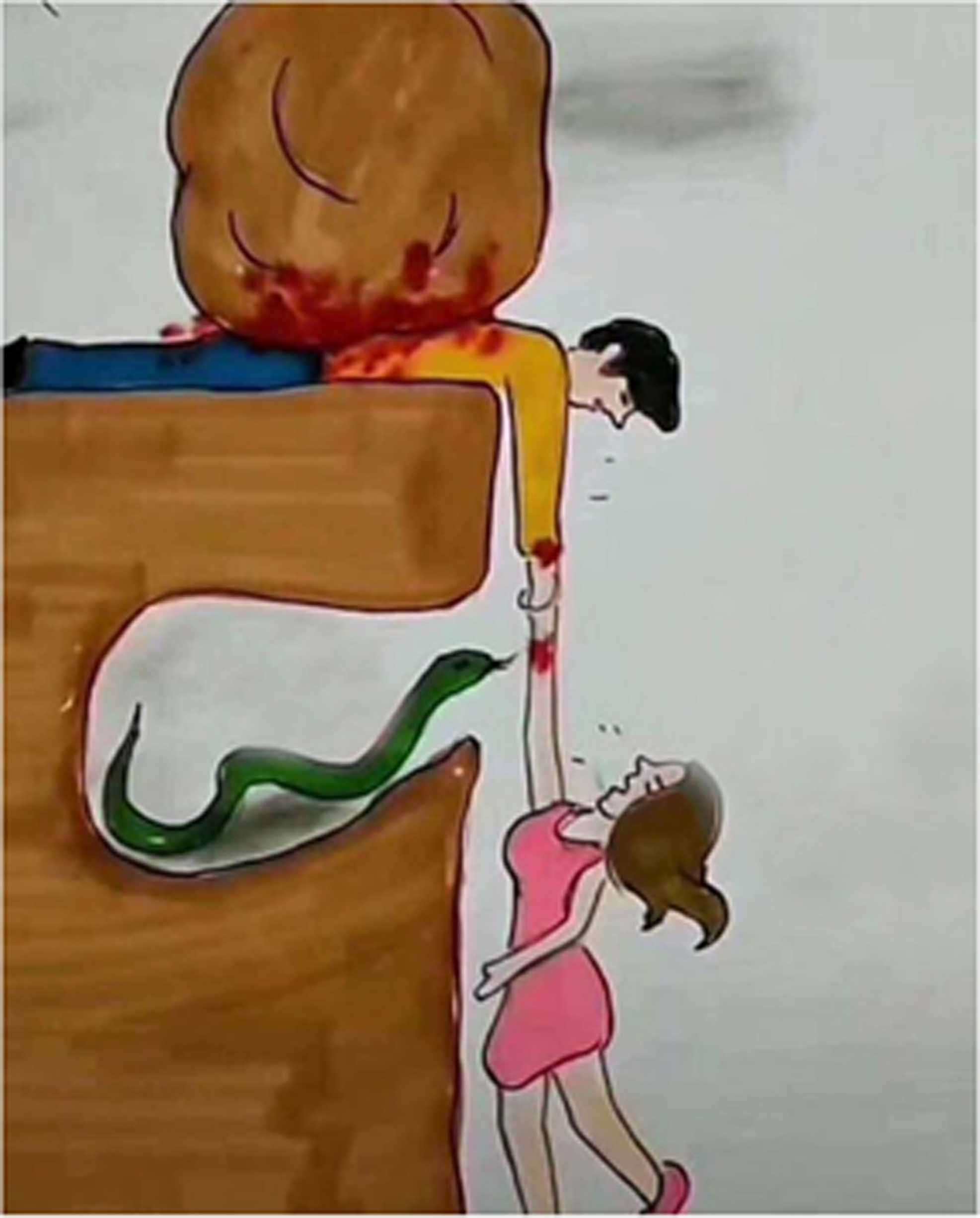
A recent image (source unknown) posted on a social media site, shows a man laying atop a cliff, with a large bolder crushing his back. While he is laying there, he is reaching down to hold onto the arms of a woman who has fallen over that cliff. The woman is holding on tightly to the man’s arms, trying to climb up, however, a large snake, hidden in a crevasse, is about to bite her arms. The man wonders why the woman cannot see that he is being crushed by the bolder and doing all he can to hold on to her. The woman wonders why the man cannot see that the fear of the snake biting her has left her paralyzed and is preventing her from moving at all, let alone from trying to climb up to safety. In full acknowledgement, this picture analogy perpetuates stereotypical gender roles and is not an inclusive image. In fact, it is a stark reminder that bias, inequity, and prejudice must be recognized and called out whenever it is present. Please consider this analogy as simply two individuals, who are unable to understand one another’s pain and one another’s perspectives. Their viewpoints are mutually exclusive, and neither can perceive the barriers to achieving her rescue.
This metaphor represents differing and perhaps even conflicting perspectives and demonstrates that one may not realize what the other is experiencing, even when they are tightly clinging to one another, entangled in mutually dependent desperation. What seems so obvious to one can often be unthinkable to the other, leading to misunderstandings, distress, and a sense of intractable dilemma. This is similar to the complex circumstances around patient care and navigating different perspectives, especially when there are ethical dilemmas. It can often be challenging for members of the healthcare team, to see the “bigger picture” in the case and they are sometimes unable to appreciate the perspectives and values of the patient, their loved ones, and even other colleagues. This pictorial metaphor reminded me of my work and vital role as a clinical nurse ethicist, where I am often involved in cases to help find clarity in misunderstandings, in analyzing ethical dilemmas, and in assisting all stakeholders in the case to better understand one another’s perspective.
“Ethicists are not merely finding facts or illuminating different perspectives when engaging patients, caregivers, physicians and treating teams in a very privileged context, i.e., the therapeutic space.” 4 This is especially true for me as a nurse ethicist, who comes to the table with formal bioethics education, a specialty skill set, married with my nursing education and extensive clinical experience. “The ubiquitous presence of nurses in close proximity to patients and families gives nurses a unique and privileged perspective on issues of importance to bioethics.” 5 In examining the key components of E-Walks, it illustrates those nuanced abilities and functionality that can be expected of a nurse ethicist that often goes beyond a practical or applied bioethics approach. It is something more than assisting others to navigate ethical dilemmas and search for morally and ethically sound decision-making when seeking resolutions to hard cases. Farroni (2019) 4 suggests that it is this “‘something else’ that is worthy of exploration in the discourse regarding the role and expertise of the clinical ethicist to consider the direct therapeutic benefits of our practice.” I believe that the role of nurse ethicist lays at the intersectionality of traditional bioethics education, largely based off the bioethical principles of respect for autonomy, beneficence, non-maleficence, and justice and the theoretical framework of an ethic of care. 6 Blending the foundational tenants of bioethics to guide ethical decision-making, with the foundational clinical practice of nursing and the art of caring is at the heart of the nurse ethicist’s role. Nurses are educated and obligated to incorporate the entirety of a patient in caring for that individual, attending to not just physical needs, but all biopsychosocial, cultural, and spiritual needs. This wholistic approach to care can be a great asset in the role as a nurse ethicist, as this role requires clinical, ethical, dialogical, and relational discernment that often seeks to consider the “bigger picture” or wholistic context to the dilemma at hand, all the while building and maintaining relationships in an ethic of care.
Nurses are uniquely situated in the provision of care to maintain complex relationships through the caring process, which is at the heart of an ethics of care. An ethics of care framework generally looks at the moral importance of connections and relationships with others. Bowden 7 explains that the “ethic of care” is often used by nurse ethicists in support of the “ethical nature and possibilities” of their roles and practice, “making those connections between the ethical ideals of caring relationships and the ethical ideals of nursing.” 7 DeMoissac and Warnock 8 explore the concept of caring that is rooted in the works of feminist theorist, Carol Gilligan, “emphasizing the importance of decision-making within a specific context and views individuals in relationships…that the goals of caring is not necessarily to come to an agreement, but rather, to come to a shared understanding.” 8 This notion of focusing on shared understanding is a powerful one, and can be seen as a consistent theme in the various vignettes that will be shared in the discussion of E-Walks and their key components. There is more emphasis on humanity and relating to one another in the adaptation of an ethic of care that directly correlates to caring and to the role of nurses. “A caring approach acknowledges the significance of relationship and provides the means by which the particular human context can be explored. Bioethical issues are more fully understood within the context of a caring approach.” 8 This caring approach is also considered by Bowden 7 to be one of “the most important dimensions of ethical encounters – the significance of caring relationships and the development of moral integrity and autonomy in relational contexts of vulnerability.” 7 Van Heijst 9 also supports this requirement that adopting an ethic of care perspective better orients bioethics to vulnerability and therefore offers a more relations-based approach to ethics which is more in alignment with what nursing and healthcare are all about.
In this paper, I will discuss and reflect upon the lessons that have emerged as three key components of “E-Walks”: Recognition, Solidarity, and Dialogue. Here is a brief overview and introduction to these key components and their relevance to the role of nurse ethicist. A more detailed discussion of these themes will then be presented through case scenarios. It can also be noted that these meta themes or components both stand alone as key concepts and weave together in synergy, one concept informing and overlapping into the other. Recognition centers around seeing others’ perspectives, for me as the ethicist to see the perspective of others and as part of my role to encourage staff and families to see the perspectives of others. The concept of recognition will even be further examined by introducing the concept of mattering, where recognition is based on seeing others, and mattering centers around being seen and valued for who you are and for the meaningful work you perform. The concept of solidarity in its origins has evolved over time to also be used in the context of healthcare and biomedicine. In this environment, solidarity includes supporting ethical relationships and interactions between patients, families, and health care providers. 10 Solidarity is also listed as one of the six elements of Slow Ethics, that nurse ethicist, Ann Gallagher 11 (pg. 50) so poignantly describes as the value that reminds us of our common humanity. She relates it to moral repair and forgiveness and sees that the power of solidarity lies in promoting togetherness in relation to the art of care, which is fundamental to the nursing profession. Arthur Frank 12 , medical sociologist, writes that dialogue acknowledges that the world is co-experienced by two or more people. Through dialogue, we share our perspectives and feelings. Dialogue allows us to examine ethical dilemmas and to explore how these issues can have meaning both for our patients and for ourselves as providers. Offering tangible bioethics support and accessibility in patient care areas creates opportunities for dialogue that may not occur otherwise. This dialogue then also becomes an expression of solidarity, where I can discuss and journey along with providers, in recognition of the dilemmas they encounter and remind staff that they and their work, matter.
E-walks also create open moral spaces for staff to share and explore their concerns. 3 Urban Walker writes that “ethicists are architects of moral space within the healthcare setting, as well as the mediators in the conversations taking place within that space.” 3 I will go on to argue that preventative ethics “E-Walks” demonstrate my role as the nurse ethicist at the intersection of bioethics and the theoretical framework of the ethic of care, which is focused on building, creating, and sustaining caring relationships which I propose can be achieved through recognition, solidarity, dialogue and through the work of ethics, consultation, and education.
Recognition
A recent E-walk conversation with a medical resident illuminated the value of creating open moral space and recognizing what others are experiencing with a more empathetic lens. He told me that he was troubled and morally distressed by a particular case in which the mother was in what he perceived as, deep denial, that her child was not going to survive his disease. He shared that it was extremely difficult to maintain a therapeutic relationship with this mother because her deep denial was driving her to be controlling, demanding of treatments (not deemed by the medical team as beneficial or necessary) and unreasonable in working with the medical team to find shared goals. He was concerned that this child would die and that his mother would either feel as though the medical team did not do enough to prepare her for his death, or that they did not take time to explain things to her in a way she could understand. I asked him if it could be possible that she was not in denial, but rather keenly aware that her child was going to die, which was shaping her need to control and to delay the inevitable, out of sheer desperation? He looked at me perplexed and stated that he never thought of it that way, from that perspective. The pictorial analogy, described earlier in the paper, flashed in my head. I encouraged him to shift his perspective and approach to perhaps acknowledge along with her how difficult this stage of their journey together will be in caring for her son. Recognizing and acknowledging her anticipatory grief in an honest way, sharing with her his own anticipatory grief that this child, also his patient, will die. Both the medical resident and the mother are deserving of grace and time to process their emotions as they simultaneously face losing this little boy. Recognizing that the mother is grieving rather than being in denial might be a perspective shift that can bring some clarity and shared decisions in this case.
“Clinical ethics teaches us to seek another account, to insist on a more nuanced explanation of tragedy and circumstance. Along with empathy, it asks us to adopt a posture of generosity and grace.” 13 The first key component of E-walks is recognition and actively acknowledging the moral and emotional challenges that staff face. Through anecdotal experiences, there are times when I will go beyond applied ethical resolutions and look more at the nuances of the interactions in which I respond, which can perhaps expand the definition and functionality of the role of nurse ethicist. As bedside nurses, we often learn about ethics through lived experiences with patients and the kind of cases that might “keep you up at night”—those patients that you never forget. However, often on E-walks, I hear about collective frustrations, where providers express feeling overwhelmed and distressed over the cases where they admittedly do not understand the parent’s values and choices, or they question the goals of care and whether they are truly in the best interest of the child. They talk of trying to do all that they can to help these patients and families by exercising their moral agency. They even work to try to help themselves come to a place of understanding, to extend themselves grace, however, they often find themselves resigned to the paradox, that even when they feel that they have done all that they can, it is still not enough. 12
Some cases have such complicated social issues that they are perceived as an ethical dilemma by staff because of heightened emotions. One such case was a mother who became unhoused during her daughter’s hospitalization and the staff were left uncertain on how to discharge this little girl. Where would this mother and child go with complex medical needs? Were there shelters or temporary housing to take this mother and child? The staff were emotionally distressed in trying to prepare them for discharge in the face of so many uncertainties. We provided in time ethics education that while the case was truly emotionally distressing, no ethical dilemma was present. It was a complex case that would require careful planning and resources through ancillary services and the social work team to assist the family. However, it is often these socially complex cases that carry heavy moral weight and that are emotionally troubling for the staff. The frequency of these kind of cases often causes a buildup of unresolved emotional and moral distress over time, which leads to what is called moral residue. Over time, this layering of moral distress and moral residue builds from one case to the next, creating a crescendo effect. 14 It is imperative to decrease moral distress and this crescendo effect by making efforts to process and discuss cases as well as find ways to minimize the burdens of moral distress. “The common thread that binds these cases together tends to be the requestor’s view of a very challenging, emotional, and possibly high stakes situation for which they need assistance. It becomes imperative that the clinical ethicist be mindful of not just the requisite knowledge competency or adherence to process but also the manner by which they interact with each stakeholder to navigate these complex situations.” 4 These acts of recognition, in recognizing staff perspectives, demonstrate that my role as the nurse ethicist is to assist the staff in working through both their emotional and moral distress, all while maintaining their professional identities and the importance of their work “mattering.” Haizlip 15 et al., speak to the concept of recognition in a more nuanced way, using the term Mattering. These authors have adapted this psychosocial concept of mattering to apply to healthcare providers and their professional work and looked at how this concept can potentially decrease moral distress and burnout. “Mattering at work may be particularly important for healthcare professionals because this desire to positively influence others’ lives is at the heart of our professional identities.” 15 It offers staff a moment, in a philosophical sense, to “be seen” and that their presence, their work, and their needs as providers are valued. Sawubona, is an African Zulu greeting that means “I see you.” It has a long oral history, and it means more than our American traditional “hello.” It says, “I see your personality. I see your humanity. I see your dignity and respect.” 16 In the African village context, where everyone knows one another, it is an exceedingly powerful representation of understanding. 16 It is in this definition and context that I contend the power of recognition holds as a key component of E-walks—it is about recognizing and respecting the perspectives of others and acknowledging that these providers and the care they provide, matters. “Mattering is a construct from social psychology that describes the feeling that one makes a difference in the lives of others and has significance in one’s community.” 17 Reconnecting staff with their “why” and purpose of their work and its meaning cuts through the moral distress by reframing and reconnecting them to their value and work as clinicians. It is in those times of suffering that we need the help of others to hold us in our identities, as often when in distress our professional identities are threatened.18,19 I am in the unique position, while rounding on E-walks, to recognize and address these concerns at the point of care delivery. Serving as a mentor for nurses and others, I provide them an opportunity to work through challenging situations which potentially ameliorates their moral distress by recognizing it and addressing it, in real time conversations.20,21
Solidarity
The lesson for the concept of solidarity as a key component came from an extensive ethics consult that was identified during an E-walk. This was a case of a medically fragile, complex, chronically ill child, who was cared for primarily at home by his dedicated mother. Whenever the patient faced a health crisis, usually for a suspected infection, where he required work up and treatment, he would come into the hospital for admission. Often, due to his medical complexity, he would remain inpatient for weeks to clear the infection and fine tune other medical needs. As part of the requested ethics consultation to address concerns around potential over-medicalization, our ethics team reached out to hear from his mother on her perspectives and values. We spoke to the mother on the phone about her wishes and goals for her son during this admission. It became clear that she was aware of how difficult her son’s case was for the medical team to treat. She understood and acknowledged that there might be times when there were no clear beneficial medical treatments or answers for them. She asked that the medical team acknowledge her as an expert in her son’s care needs and to be honest with her about the limitations inherent in medicine. She understood that the medical team may not have all the answers, and that she may not have ideas or answers as well. She was asking for the team to walk alongside her and her son in their care journey, she wanted the team to involve her in mutually thinking through unclear situations and she welcomed the medical team’s willingness to admit uncertainty, as she too faced the same uncertainties. She was seeking solidarity.
Gallagher 11 writes that “solidarity” is the value that reminds us of our common humanity and can relate to moral repair and forgiveness when dealing with both troubling cases and moving forward in caring relationships. Prainsack and Buyx 10 ask that we understand solidarity in the context of biomedical ethics, as “something that is enacted, rather than as a value, feeling or obligation.” 13 Merging these two definitions of solidarity best meets the purpose and intentionality to providing solidarity in the context of E-walks and ethics support. Solidarity, as an action verb, becomes the literal act of journeying alongside others when they are facing conflict, dilemma, heightened emotions, or moral distress, whether that be patients and families or our healthcare colleagues. It applies to all those that I interact with as the nurse ethicist, whether that is a mother who is uncertain about treatment options, if any, to help her son, or if it is a medical resident struggling to find a way to understand the anticipatory grief of a mother. We should not offer solidarity; we should engage in solidarity as we seek to find that common humanity and shared perspectives. Solidarity is actively choosing to be present in the moment, committing to the other person that you value their humanity and their personhood. Recognizing that we have more in common than we realize, as we are encountering a similar, shared experience, with unique perspectives.
One E-walk proved challenging when a nurse shared with me how angry she was at a family because they had not been in to visit their child in over three days. This child had a tracheostomy and was ventilator dependent, with gastrostomy tube feedings and required complex twenty-four seven total care. The mother provided nearly all his care with very limited home health nursing support. The father worked twelve-to-fourteen-hour days to provide for the family and was unable to take off work to visit, but occasionally came in very late at night. They also had two other children that they cared for, they were not fluent in the English language, and they shared one car for transportation. I listened intently to the nurses’ frustrations around the fact that major medical decisions needed to be made for this child and that there was no clear plan for him, that his plan was stalled between choosing palliative/hospice care versus continued aggressive treatments and frequent re-hospitalizations. The nurse was certain that the family was avoiding decision-making. I understood her frustrations (recognition), and then reminded her of the family’s full situation. I asked her, if we could just “zoom out” for a moment to look at this family’s “bigger picture.” I asked her if it was possible that the mom (and the family) was simply needing some respite care. Perhaps, mom was using this time, knowing that her child was being well cared for in the hospital, to rest herself…to spend some quality time with her other children, to talk to other family members about the major medical decisions they were looking to have to make? Perhaps they were grieving, scared of what they were facing, which was the potential loss of this little boy? The nurse listened and then softened and realized she had not been able to “zoom out” from a narrowly focused perspective and her own complex feelings. We sat next to one another for a while in silence, thinking about the “bigger picture” for this case and this family, and how many other cases and families might have similar stories. She finally looked over at me and thanked me for sitting with her (solidarity), for talking with her, and for helping her to see that often there might be another perspective that helps us to empathize with families and with one another. This was me, as the nurse ethicist, being present in the moment with this nurse and is an example of solidarity in action, as well as recognition and dialogue.
Lazenby 22 (p.69) refers to this kind of solidarity in action, as “nursing presence” and takes it one step further to a more primitive and profound meaning that this presence is simply being a person with our patients and families, or our colleagues, who are simply people themselves. I try to extend that same presence to our colleagues and engage with them in the same solidarity that we seek to engage in with patients and families through ethics support and the consultation process. This presence builds trust and relationships, using the framework of ethic of caring, that have the potential to improve the clinicians’ sense of value, their feeling of being supported in their work, their willingness to call for ethics support or consultation in the future, and ultimately impacting the overall ethical climate of the institution, one interaction at a time. This idea aligns succinctly with Provision 6 in the American Nurses Association (ANA) Code of Ethics for Nurses which states, “The nurse, through individual and collective effort, establishes, maintains, and improves the ethical environment of the work setting and conditions of employment that are conducive to safe, quality health care.” 23
Dialogue
The value of the key component of dialogue in E-walks has presented itself time and again and is seen woven into the previous vignettes shared. Dialoguing and discussing cases and stories allow for reflection. In one such case, I ran into two fellow nursing clinical supervisors in the hallway on my way to do an E-walk on their unit. We stopped, then stepped into their office for privacy, and began to talk. They were excited to hear I was on my way to talk to their staff and they both began to share a story with me about a case that was still troubling them, about a young patient that had recently died a couple of weeks previous. They wanted to prepare me that some of the staff were likely to still be affected and might bring it up on my walk. We talked about concepts around values conflicts, moral distress, and the complicated social issues with the young patient’s family. We discussed the potential of medical racism and bias in how the family felt they were being treated by staff. We also discussed the concept of a “good death” and what that look might look like, and who gets to define “a good death”, the patient’s family or the providers? We talked about how difficult it is when we find that what we value may be very different from what the patient or the family values. I encouraged them to consider calling for ethics support from the consultation service when these kinds of issues arise potentially in the future. I offered that these kinds of issues we were discussing would be helpful for staff to also be involved in discussing and we began to look for times that I could hold a debriefing session for the staff to discuss this case. We also acknowledged that looming paradox of staff feeling as though they did everything they could to help this mother during the death of her child, but somehow, they were left feeling that it wasn’t enough. This was an opportunity to talk through this case, which is part of the inherent value that E-walks provides.
Frank 12 writes about the importance of aligning people in the common bond of suffering (both as patients and as caregivers) and their shared vulnerability. He encourages health care providers to not over analyze stories and narratives, and encourages them to think along with the stories, in a process closer to letting the stories analyze us as caregivers, helping us to see our shared experiences with our patients and our colleagues. He believes that by engaging in the narrative and the power of storytelling, health care professionals have an opportunity to affirm both their own humanity, as well as the humanity of those we care for and work alongside. 12 This becomes what Lazenby (p.89) refers to as a “dialogue-centered approach” where he too describes the need for healthcare providers to deepen their understanding of how dialogue has great impact on our relationships and on our interconnectedness, as it shows respect for the other and a willingness to engage. 22
Verghese discusses how in many ways technology is pulling us away from our patients. He describes this phenomenon as “loneliness in proximity,” where in the medical setting we often find staff, physicians, nurses, and patients all isolated from one another as they work, and even as they suffer, right alongside one another. 24 We are so close to one another and yet so far apart. Verghese also believes strongly in the value of dialogue and narrative as valuable necessities when interacting with patients. He mentions in his talk that there are really two patients, the patient in the bed, and the patient in the computerized chart. He is amazed that we spend so much of our time as practitioners in the computer with the “virtual” patient, while the real patient is laying in their bed wondering where everyone is, and when anyone is going to come and talk to them. In current healthcare settings, we often miss opportunities to engage, to have dialogue, and to physically be present with our patients and their families. 19 Our communications have become limited to emails, text messages, clinical notes, and virtual meetings. In the rush of the shift and all the tasks that are required of providers, we are also missing opportunities to have reflective and meaningful dialogue with our colleagues which can lead to a lower quality of care and job dissatisfaction. 19
The concept for E-walks is not new and is much like that of the creation of unit-based ethics conversations by Wocial et al. where they developed a program that sought to “create an environment with morally open space where reflective dialogue and experiential narratives are encouraged and increase participants’ abilities and confidence in dealing with ethically challenging situations.” 25 This is the kind of dialogue and sharing of stories that E-walks make possible. It is these valuable meetings with colleagues that provide unique opportunities to engage in dialogue and provide ethics education and support.
Conclusion
Nurses are uniquely positioned in their roles and profession, especially with patients, to provide an ethic of care in the face of vulnerabilities and the nurse ethicist role is distinctively positioned to provide that same ethic of care blended into the context of broader bioethics support, consultation, and education. “Care ethics in these terms articulates a focus that sees ethics everywhere and the need for ethical caring as pervasive and ongoing in all our relationships, not only between nurses and patients, but between nurses and nurses, doctors and nurses, hospital administrators and nurses, as well.” 7 DeWolf Bosek identified that the primary desire of staff nurses was ethics support and education when facing an ethical dilemma or moral distress. They also appreciated the accessibility of assistance in decision-making around the appropriateness of seeking ethical consultation and how to maintain strong interprofessional relationships in that process. 26 E-walks have become a valuable tool in operationalizing the facilitation of ethics conversations, ethics consults, providing ethics education, navigating ethical dilemmas, and seeking creative solutions to minimize moral distress and burnout. The accessibility of the nurse ethicist, through supportive ethics activities like E-walks, can demonstrate their unique role and valuable contribution to the ethical environment of their institutions.
Footnotes
Declaration of conflicting interests
The author(s) declared no potential conflicts of interest with respect to the research, authorship, and/or publication of this article.
Funding
The author(s) received no financial support for the research, authorship, and/or publication of this article.
