




Abstract
Background
Ethics positions, consisting of the two fundamental dimensions of idealism and relativism, influence individuals’ decision-making significantly. Particularly in an applied field such as nursing, the ethics positions of nurses can play a significant role in clinical decisions. Therefore, it is important to know the factors affecting the ethics positions of nurses in clinical decision-making.
Aim
The aim of the study is to examine the factors affecting the ethics positions of nursing students in clinical decision-making.
Research design
This is a two-phase sequential explanatory mixed methods study designed in accordance with the COREQ criteria. A participant Information Form and the Ethics Position Questionnaire were used to collect quantitative data. Qualitative data were obtained through focus group interviews.
Ethical considerations
This study was conducted after receiving written permission from X University Ethics Board. Additionally, permission was obtained from the participating nursing faculty.
Participants
Among the fourth-year nursing students, 180 students participated in the quantitative phase and 30 students in the qualitative phase of the study.
Results
The quantitative data analysis showed that the idealism sub-dimension mean scores of the participants were higher than the relativism sub-dimension mean scores. The analysis of the qualitative data resulted in four main themes that influence participants’ ethics positions in clinical decision-making: (1) attitudes of role models in clinical practice (staff nurses/mentors/lecturers), (2) resources related to clinical practice (labs, hospitals/classrooms), (3) health system (hospital policies/school policies), and (4) personal differences (act with emotion/act with logic).
Conclusion
The results showed that the health system, role models in the clinic, personal differences, and skill-related resources affect the ethics positions of nursing students in clinical decision-making. In this regard, awareness can be raised by providing training to nursing students by academic instructors on ethics positions and the factors that are determined to affect ethics positions in clinical decision-making.
Introduction
Clinical decision-making in nursing is a process that includes planning, implementing, and evaluating the results of appropriate interventions to solve the problems encountered in the clinic. 1 The decisions made by nurses in this process affect patient care outcomes, treatment processes, and patient safety.2-4 Additionally, correct and timely decision-making by nurses in clinics increases the quality of care, patient satisfaction, and the motivation of nurses, as well as helping to reduce care-treatment costs and medical errors and use resources effectively. Therefore, it is very important to help nurses develop their clinical decision-making skills and doing so has been identified as one of the key educational objectives.5-8
When the theoretical and practical aspects of nursing education are considered, nursing students frequently experience self-confidence and anxiety problems when applying their theoretical knowledge in practice.9-10 The anxiety experienced by the students in the clinics leads to a decrease in their motivation in clinical practice, causes medical errors, and, as a result, negatively affects their clinical decision-making skills because they perceive 11 themselves as incompetent.9,12 Considering that nursing students will have an important position among other health professionals, much like registered nurses, learning about the factors affecting clinical decision-making in the education process is thought to be important. It has been reported in previous studies that various factors are effective in the clinical decision-making of nursing students, and ethics positions also affect their individual decisions or decisions regarding patient care. In this study, we examined the issue, which was addressed separately as clinical decision-making and ethics position in previous studies, as factors affecting ethics positions in clinical decision-making, and we evaluated it holistically with previous literature information.
Background
Although nurses do not have the final say on decisions about whether any medical intervention should be carried out, they are responsible for providing the prescribed medical care. They play an advocacy role in this direction, fulfilling duties that include safeguarding against the side effects/complications of the medical intervention. 13 However, it has been pointed out that this process is affected by several variables, including individual differences, acquired skills, knowledge, personality traits, education, values, old habits and experiences, one’s line of work, etc.2,14 The “moral philosophy” or “ethics position” of individuals, which is considered a way of determining how individuals make decisions, has been stated as an important variable in the decision-making process.15,16
It is necessary to know moral philosophy to understand the moral judgments and behaviors of an individual in a situation where the individual encounters an ethical dilemma and needs to make a decision. 17 An individual’s moral philosophy has an impact on his/her views and attitudes toward various moral issues, including moral judgments about other people’s behaviors, ways of attributing responsibility for the effects of such behaviors, and how an individual decides what behavior he/she considers unethical. Therefore, the position of making the most ethical decision forces the individual to choose the guiding principles on which the final decision is made indirectly, if not explicitly, and the ethics position of the individual is important in this process.18,19 In this context, idealism and relativism are seen as also being effective in the ethical decision-making of nursing students20,21 and it is emphasized that academic nurse educators should focus primarily on activities that increase their knowledge of ethics positions and moral judgments and support them. 22
An ethics position means that actions that cause harm or are inconsistent with commonly accepted standards of morality trigger moral scrutiny. 18 But individuals differ significantly in moral outlook. The ethical ideology model showed two main dimensions (idealism and relativism) that play a significant role in ethical evaluation and behavior. Accordingly, some people are idealistic, and they think that “if an action is going to hurt an innocent person, then it shouldn’t be done.” Some people are also moral relativists, and they believe “what is ethical changes from one situation and society to another.”16,18
According to ethics position, idealistic individuals insist that the individual should avoid harming others at all times and under all circumstances. On the other hand, individuals with a relativist position believe that individual moral views are above universal ethical rules. These individuals assume that there are no “exceptional” moral codes. 16 Compared to idealists, relativists rely on their own feelings rather than ethical standards. 23 In summary, each person has their own set of personal ethics positions. But ethics position is very important for health professionals, as they must recognize health dilemmas and make the right decisions. 24
In the literature, it is seen that idealism and relativism are effective in ethical decision-making in cross-cultural studies. However, it is argued that ethical decision-making does not always depend on one’s moral philosophy.16,22 Within this scope, this study aimed to investigate the factors affecting the ethics positions of nursing students in clinical decision-making because nursing students will face nursing interventions that require many clinical decisions in their professional lives. Accordingly, answers to the following questions were sought: “What are the ethics positions of nursing students?” and “What are the factors affecting the ethics positions of nursing students in clinical decision-making?”
Method
Design
This is a two-phase sequential descriptive mixed methods study that aligns with the COREQ criteria (Consolidated Criteria for Reporting Qualitative Research). 25 The first phase was cross-sectional, and the data were collected using the survey method. This phase of the study sought answers to the question, “What are the ethics positions of nursing students?”. In the second phase of the study, qualitative data were collected through focus group interviewing performed with nursing students. The second phase of the study sought answers to the question, “What are the factors affecting the ethics positions of nursing students in clinical decision-making?”
Sample group
Fourth-year nursing students were included in the sample group as they had gained certain clinical experience and were more likely to have encountered clinical decision-making. Therefore, an announcement was made to 189 students in the last semester of their senior year. Quantitative data were collected from 180 students who agreed to participate in the study, and 30 students who accepted the focus group interview and an audio recording of the interview constituted the sample group for the qualitative phase.
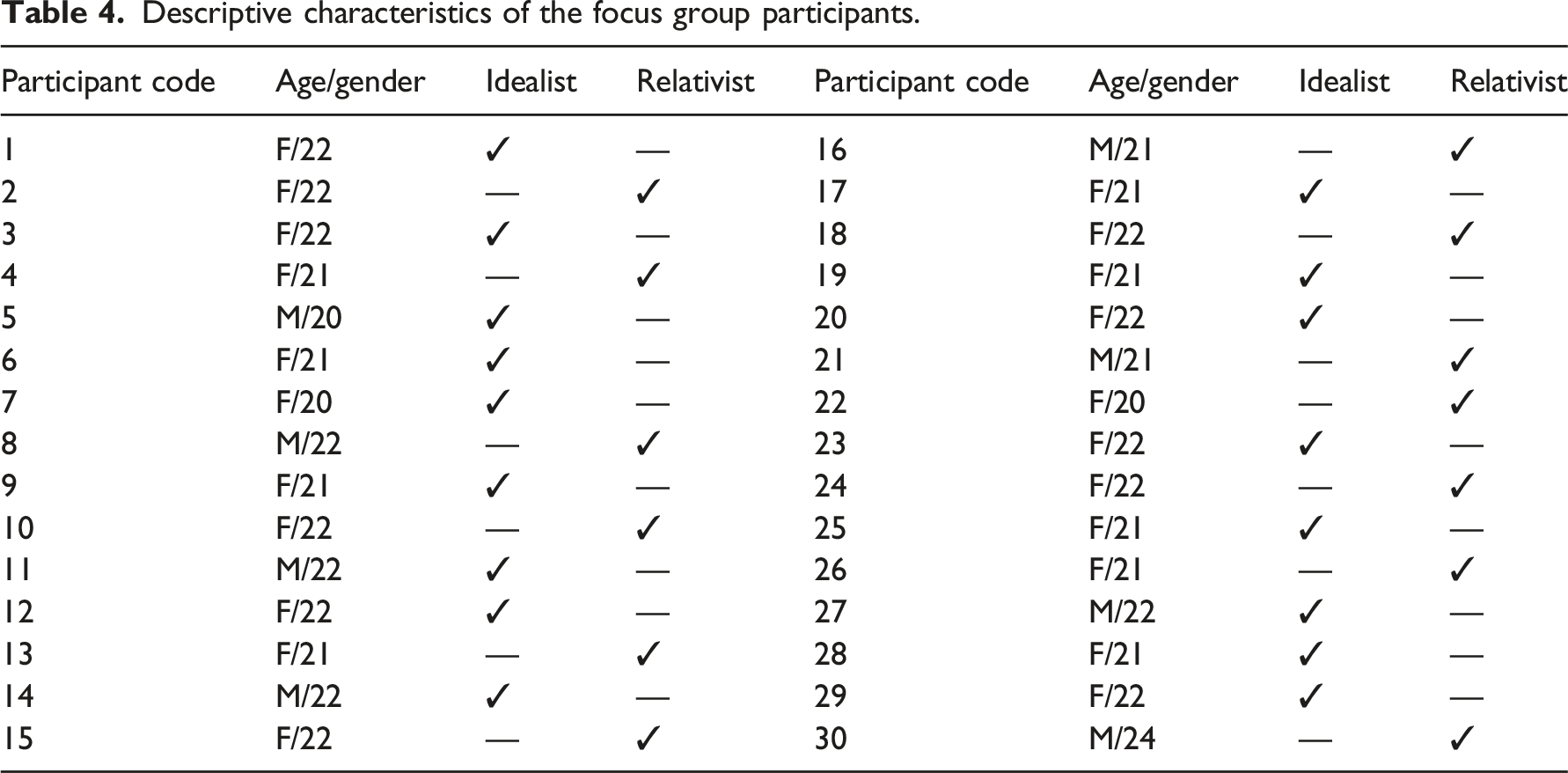
Prior to the formation of the focus groups, the ethics positions of the participants (n = 30) were examined since the participants may have different ethics positions. Accordingly, the ethics positions of the participants who checked the “I want to participate in the focus group interviews” box in the questionnaire we implemented in the quantitative phase of the study and confirmed the questionnaire number were analyzed one by one using the Ethics Position Questionnaire scale included in the questionnaire. It was determined that 22 participants were idealists and 8 were relativists in terms of their ethics positions. Then, inclusion of an equal number of idealist and relativist participants in each group was planned to increase interaction within the group and enrich the data, and three focus groups were formed, each consisting of 10 participants. Participants, who were divided into two groups according to their positions as idealists (n = 22) and relativists (n = 8), were assigned to three different groups by choosing one person from the relativist group first, using the coin toss technique. The same process was used with the idealists, and then the groups were merged. While one group included five idealists and five relativists, the other two groups included six idealists and four relativists. Thus, consistency was ensured with the information that the number of focus group participants can vary and that focus group members can generally consist of 6–8, 26 10–12 27 people, but the ideal group should consist of 6–10 28 people.
Data collection tools
In the first phase of the study, qualitative data were collected using the Participant Information Form and the Ethics Position Questionnaire. A semi‐structured, piloted interview guide prepared by the researchers was used during the focus group interviews (Figure 1). Focus group questions.
Participant information form
The form developed by the researchers in line with the literature consists of seven questions on age, gender, education level of parents, their economic status, the place where they lived the longest, and whether they took the ethics course (elective, 2 credit hours) that is included in the curriculum of the nursing faculty.
Ethics position questionnaire (EPQ)
The five-point Likert-type EPQ, consisting of 20 items and two sub-dimensions measuring moral idealism and moral relativism, was developed by Forsyth. 29 The idealism sub-dimension of the scale reflects the extent to which concern for the well-being of others is central to an individual’s moral code (for example, people should make sure that their actions never intentionally harm another). On the other hand, the relativism sub-dimension is about the belief of an individual in the universality of his/her moral principles (for example, an ethical situation may vary between societies).
This study used the Turkish version of the 19-item scale, whose validity and reliability analyses were conducted by Yazıcı and Yazıcı. 30 The Cronbach’s alpha value of the scale was reported to be 0.90 for 19 items, 0.92 for the idealism factor, and 0.84 for the relativism factor. 30 In this study, Cronbach’s alpha values were determined as 0.75 for the idealism factor and 0.76 for the relativism factor.
Semi-structured interview guide
The semi-structured interview method, 31 which is the most common data collection tool in qualitative research, was used in this study. First, an interview guide consisting of questions related to a few main themes was developed based on the literature. 32 This guide was presented to three academicians who are experts in the field to seek their perspectives on content validity. Based on the experts’ feedback, minor changes were made to the questions. Then, a pilot study was conducted with 10 students who were not included in the sample group to finalize the questionnaire (Figure 1). The pilot study also served the purpose of checking the environment where the focus group interviews will be held and the voice recorder.
Procedure
This study was conducted with 4th year nursing students in the Faculty of Nursing of a state university in Turkey between October 2021 and August 2022. The first author is a female with a PhD in mental health nursing who is experienced in qualitative research. The second author is a female mental health nurse with a PhD. The researchers had no previous relationship with the participants. The questionnaires were then distributed to students in a classroom (during a recess between two classes) by the second researcher and collected once students completed the questionnaires. Then, the first author conducted the focus group discussions face-to-face in a meeting room on a specific day and time at the university where the study was conducted. The interviews were conducted in three groups (for each group, n = 10) which lasted an average of 110 min. In the interviews, the ethics position regarding decision-making processes in clinical practice were evaluated and discussed. The interviews were recorded with a voice recorder.
Analysis of Data
The Statistical Package for the Social Sciences (SPSS) 26.0 program was used to analyze the data obtained within the scope of the study. Frequency and percentage analyses were used to determine the descriptive characteristics of the participants. In the analysis process, first, the Kolmogorov–Smirnov test was performed for the normality distribution of the variables, and it was determined that the data were not normally distributed. The Mann–Whitney U test was used to compare the variables of two independent groups with the scale scores, and the Kruskal–Wallis test was used for the comparison of more than two groups.
Qualitative data were analyzed manually in six steps using thematic analysis. 33 In the first step, the second author (Y) transcribed all focus group discussions. In the second step, both authors (N, Y) read these reports independently, and the data that stood out were coded. In the third step, themes were developed from the codes. The fourth step involved checking for data saturation. As both researchers conducted more than one focus group interview in the same study, they examined whether the identified themes emerged in each group and concluded that data saturation had been reached. In the fifth step, the authors had a discussion to finalize the themes. If no consensus could be reached, an expert opinion (from a faculty member in the psychiatric nursing department who is experienced in qualitative research) was sought, and in the last step, the themes were finalized.
Ethical considerations
This study was conducted in accordance with the Helsinki Declaration after receiving written permission from the X University Social and Human Sciences Scientific Research and Publication Board (Date: 11.10.2021, number: E34743463-605.99–18,462) and the X University Faculty of Nursing, where the study was conducted (Date: 27.09.2021, number: E−87,103,392–105.02.02.01–259,592), and written consent forms from participants. It was explained in detail to the participants who will take part in the focus group discussions that the research will be conducted in accordance with the principle of confidentiality and will be recorded with a voice recorder. A detailed explanation was also provided, stating that all the records will be carefully stored by the second researcher on an external disk and password-protected computer and that no one other than the researchers is authorized to access the records. In addition, the ethical principle of confidentiality-respect for private life-do no harm-was considered, the identity information of the participants was not included, and the coding system was used in the analysis of qualitative data.
Results
Quantitative analysis
Descriptive characteristics of the participants (n = 180).
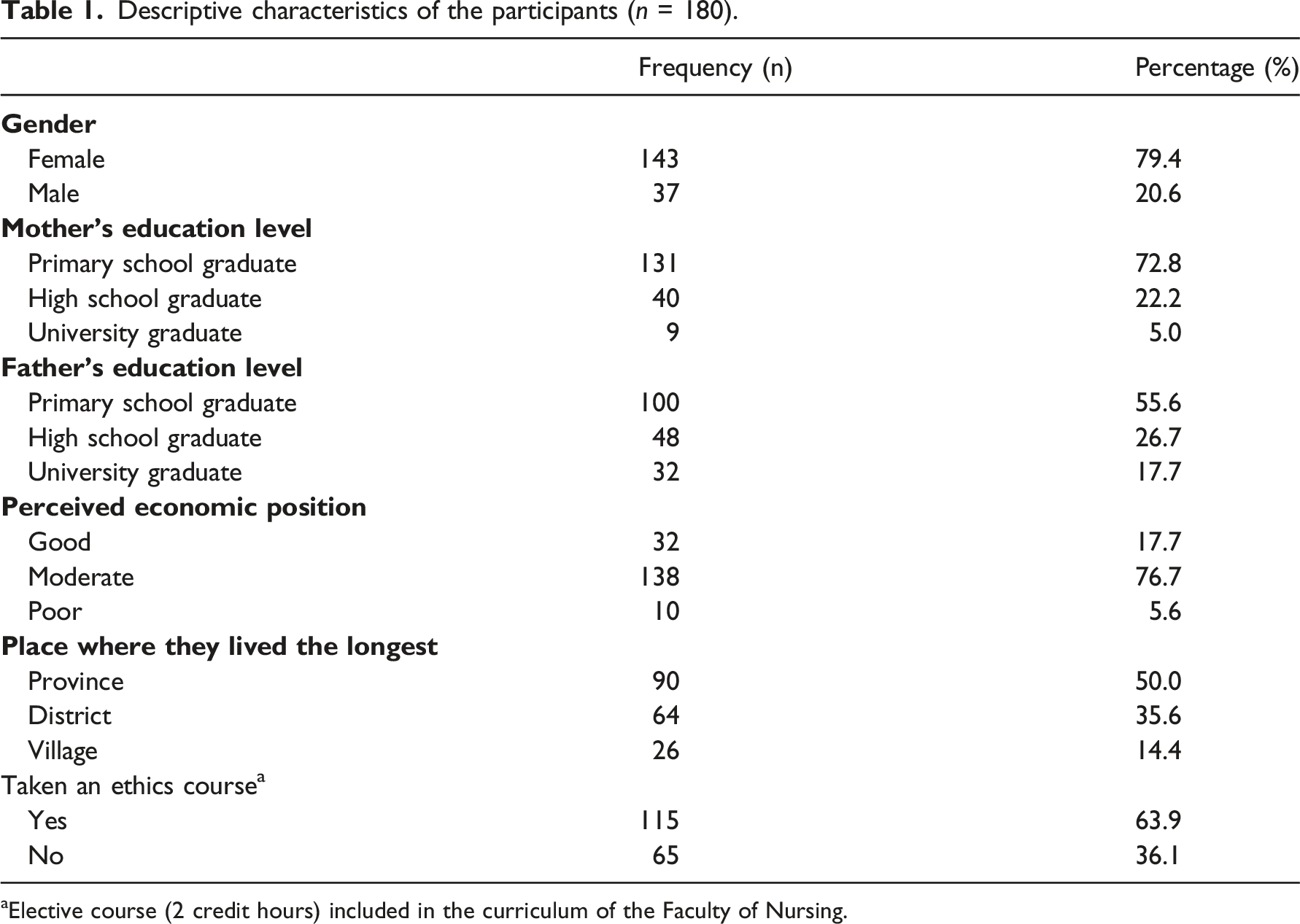
aElective course (2 credit hours) included in the curriculum of the Faculty of Nursing.
The EPQ scores of participants.

Comparison of the EPQ according to the descriptive characteristics of the participants.
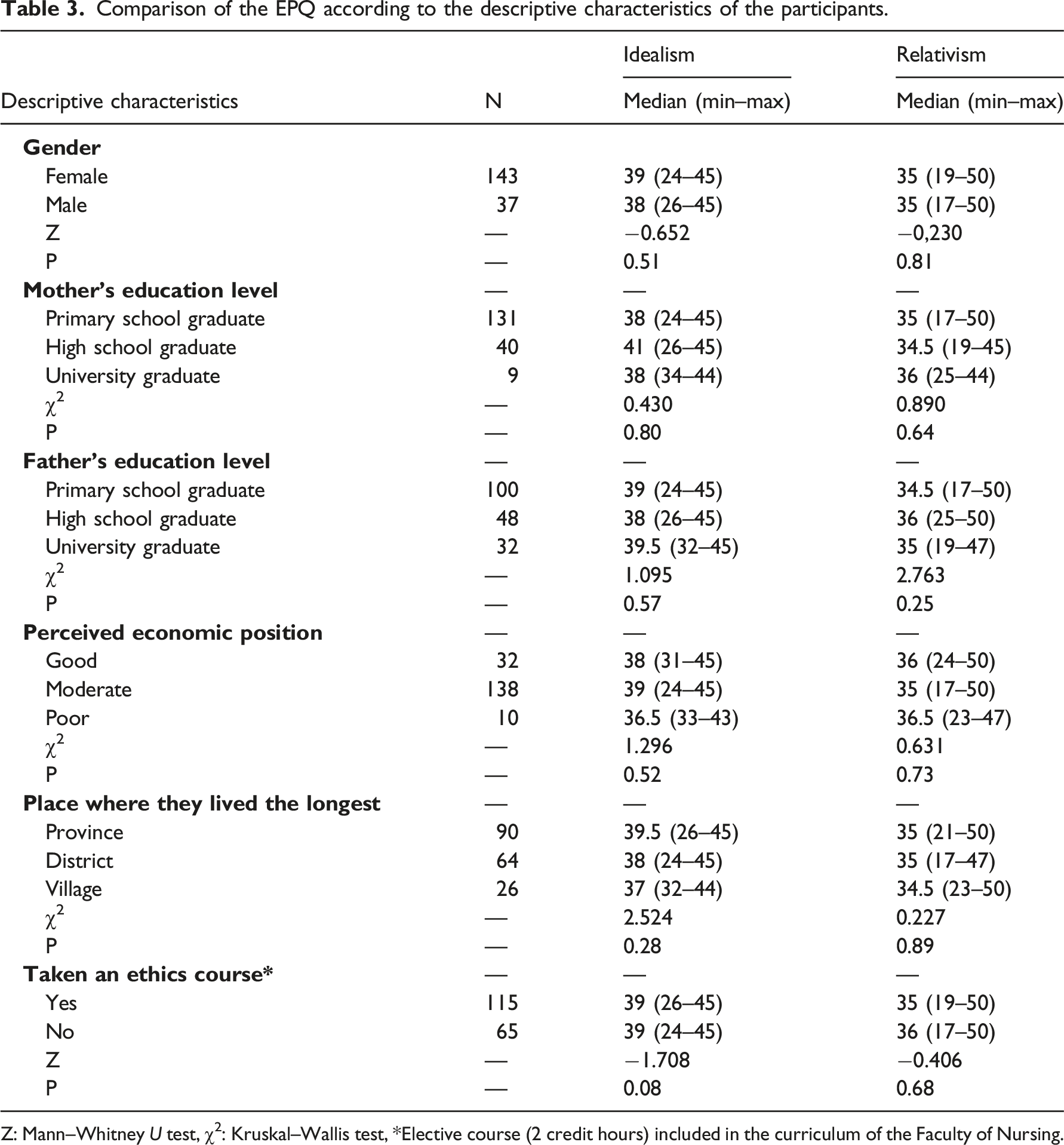
Z: Mann–Whitney U test, χ2: Kruskal–Wallis test, *Elective course (2 credit hours) included in the curriculum of the Faculty of Nursing.
Qualitative analysis
Descriptive characteristics of the focus group participants.
The themes obtained from focus groups interviews.
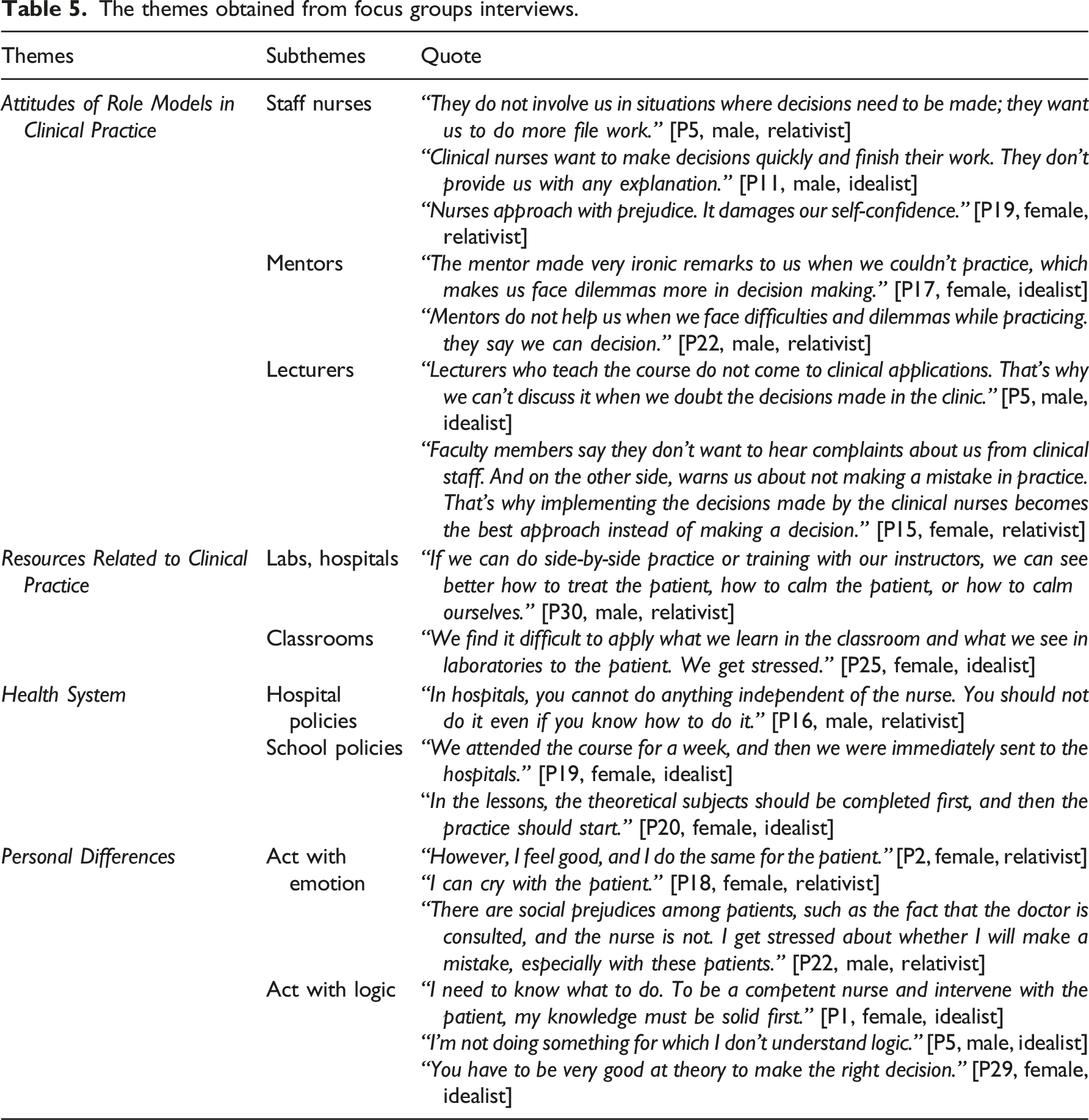
Attitudes of role models in clinical practice
The participants reported that the attitudes of clinical nurses, mentors, and lecturers generally affected their ethics positions in the clinic. They mentioned that they were particularly affected by the negative attitudes and unfair criticism of clinical nurses, mentors, and lecturers.
Resources related to clinical practice
Participants discussed the importance of clinical practice resources in clinical decision-making and its relationship with ethics position. They specifically discussed the differences between the sources related to clinical practice in the form of classrooms, laboratories, and hospitals. They stated that bedside patient evaluations and practices in hospitals had a permanent effect on them and made them feel more idealistic. On the other hand, they stated that although they learned how to practice in classroom and laboratory environments, they had a difficult time transferring the knowledge they acquired to the patient, and they were very stressed.
Health system
Participants in the focus groups reported the effects of the health system on ethics positions. While some participants stated that only hospital policies limit the ethics positions of nursing students, others stated that both hospital and school policies limit the ethics position. They especially drew attention to the negative impacts of this situation on idealism.
Personal differences
Some participants shared that people who act with emotions are more affected by negative experiences, social prejudices toward the profession, and prejudices of patients/clinical staff against nursing students. At the same time, they stated that ethical principles that show appropriate behavior under all circumstances would not be valid. Others stated that an idealist stance should be exhibited by doing research, following the current literature, emphasizing the ethical principle of doing no harm, and putting logic before emotions in the clinical decision-making process.
Discussion
Exploring the factors impacting ethics position in clinical decision-making in nursing students using mixed methods and evaluating the data holistically are important characteristics of this study. Another characteristic is that each focus group includes an equal number of participants with different ethics positions. Thus, while no results could be obtained regarding the factors affecting the ethics positions of nursing students in the quantitative phase, different views and understandings on the subject examined in the qualitative phase were revealed, thereby eliminating the methodological gap. Additionally, consistency was ensured with the content knowledge that “the strengths of another method are used to complement the weaknesses of one method in the same study,” which is described as a strong side of mixed methods. 34
In the first phase of the two-phase study, the relationship between the ethics positions and the demographic data of the participants was examined because it is known that nurses may face complex and ethically challenging situations in hospitals. However, no matter what, decisions that nurses make, particularly regarding patient care, should be in accordance with ethical principles. 35 In such cases, the importance of ethics position was emphasized, and it was stated that people with idealistic characteristics avoid harming others under all circumstances and comply with ethical standards. 36 It has been reported that the ethics positions of individuals is affected by variables such as age, gender,37-39 knowledge about the role of scientific qualifications, and the development level of the country. 40
The idealism mean score of the majority of the participants in both phases of the study was found to be higher than the relativism mean score, but no relationship was found between the ethics positions and the sociodemographic characteristics of the participants. The reason for this is the fact that participants with similar sociodemographic characteristics may have the same cultural-religious characteristics because culture and religion are closely related to patient care. Therefore, the culture and religion of the nurse cannot be separated from nursing practices and nursing care practices,41,42 and thus the ethics position may be affected.13,15
Although there are criticisms of the focus group method in the literature, such as the researcher’s close involvement in the method, which leads to subjectivity, 43 the findings related to the subject examined in this study, in which focus group interviews were conducted, may be considered important in terms of integrating the known literature information. As a matter of fact, as determined in this study, it has been reported in previous studies that role models, clinical resources, health policies, and personal characteristics are effective in the clinical decision-making of nursing students, 44 and ethics positions also affect their individual decisions or decisions regarding patient care. 30 However, the issue, which has been addressed separately as clinical decision-making and ethics position, was examined as the factors affecting ethics position in decision-making in this study and was evaluated holistically with the previous literature information. With this aspect in mind, the study revealed important and helpful findings in terms of educational strategies for nursing students.
Limitations of the study
This study is not without limitations. The first limitation is that the sample of the study consisted of participants with the same cultural characteristics. The second limitation is the use of the focus group method in the qualitative phase. Considering that the individuals have different personal characteristics, participants may not have openly shared their honest opinions in the group setting.
Conclusion
In the study examining the positions of idealism and relativism of nursing students, the EPQ results of the quantitative phase revealed that the idealism mean scores of the nursing students were higher than the mean scores of relativism and that the idealism and relativism mean scores did not have any differences according to the demographic variables. The focus group interviews revealed that the ethics positions of nursing students in clinical decision-making are influenced by the health system, role models in the clinic, personal differences, and resources related to clinical practice. Accordingly, awareness can be raised by providing training to nursing students by academic instructors on ethics positions and the factors that affect ethics positions in clinical decision-making. In order to raise awareness in all nursing students, it is recommended that the ethics course in nursing be included in the education curricula of nursing faculties, not as an elective but as a compulsory course.
Footnotes
Declaration of Conflicting Interests
The author(s) declared no potential conflicts of interest with respect to the research, authorship, and/or publication of this article.
Funding
The author(s) received no financial support for the research, authorship, and/or publication of this article.
