



Abstract
Background
Changes in health needs led to an increase in virtual care practices such as telemedicine. Nursing plays an essential role in this practice as it is the key to accessing the healthcare system. It is important that this branch of nursing is developed considering all the ethical aspects of nursing care, and not just the legal concepts of the practice. However, this question has not been widely explored in the literature and it is of crucial relevance in the new concept of care.
Objective
The purpose of this scoping review is to identify the ethical aspects of the development of telemedicine from a nursing practice perspective.
Methods
A scoping review of the literature based on Arksey and O’Malley’s framework. The search was conducted in Scopus, PubMed/MEDLINE and CINAHL databases, from 2012 to 2022. A total of 1322 articles were retrieved, of which 12 met the inclusion criteria.
Ethical considerations
The research was conducted in accordance with the best scientific practices.
Findings
The most relevant aspects were the safety of the patient, the benefits for the user and the digital competence of the professionals. Informed consent and patient’s willingness to use new technologies were relevant to the practice, as was person-centered care and how telemedicine can influence the quality of the therapeutic relationship. Another relevant issue was the concern about professional competence for optimal outcomes.
Conclusion
It is necessary to further explore and develop the ethical aspects of the new practices, disassociating them from the legal aspects only. Professionals demand more training providing them with more competence and confidence.
Introduction
Technological advances and society’s access to electronic devices have opened e-health as another gateway to health content for the general population, leading, in recent years, to the implementation of telemedicine in the practice of health care. 1 Global health needs and the emergence of worldwide pandemics such as SARS-COV2 proved to be a catalyst for the use of this practice by healthcare professionals. 2 During the first months of the pandemic, the number of teleconsultations skyrocketed to compensate for the health care needs of the population, 3 giving rise to the priority of its implementation in health policies. 4
The innovations in global health foster the transfer of some medical competencies to nurses and the development of telemedicine to provide solutions for patients with access difficulties. 5 Advanced nursing practice competencies play key role in the implementation of this type of care,6,7 enabling remote diagnosis and treatment, continuous monitoring and therapy adjustment, support for patient self-care, 8 and facilitating the use of providers in large communities. 9
In recent years and in line with social changes, the use of telemedicine in relation to health has been explored, although most of these articles were aimed at learning about the logistic aspects of the implementation, the perception of the users10,11 or even of the professionals, leaving the ethical aspects aside.
There is evidence related to ethical aspects 12 in telemedicine, but no conceptual studies have been found in relation to nursing. Initially, there were efforts focused on the implementation of telemedicine, but without prior consideration of its ethical bases.
The ethical aspects of telemedicine practice should be based on the aspects reflected in the ethical codes of healthcare practices. 13 While it is true that the practice of e-health involves some specific ethical aspects which must be thoroughly explored, 14 given the distance from the patient, phone assistance and the use of health technology generate new ethical challenges such as equity or safety. 15
There are key aspects that are already covered in the treaties on the implementation of telemedicine12,16 that concern patients, such as patient safety and data protection, patient autonomy, person-centered care and equity of services,15,17 but with the development of the practice, nuances are appearing on the fundamental concepts.
New ethical aspects related to telemedicine appear in current literature, including the need to establish specific laws and regulations for health technology,15,18,19 the responsibility of the practitioner,15,19 informed consent,15,20 the participants’ ability to use the technology 21 or how the technology can influence the practitioner-user relationship.20,22
Extensive literature can be found on the description of telemedicine, especially in recent years, from the perspective of program implementation as seen from the patients’ point of view. This study, through a literature review, explores the ethical aspects of telemedicine practice when the health care provider is a nursing professional.
Purpose
The purpose of the review was to identify the ethical aspects related to medicine that arise in the development of healthcare practice from the perspective of nursing professionals. The ultimate goal is to expand knowledge about the perception of nurses regarding the ethical implications of the implementation of telemedicine in practice.
The review question was:
Which necessary ethical concepts related to telemedicine practice have been identified by nursing professionals?
Methodology
To achieve the objective, the method of choice was a scoping review because the implementation of telemedicine by nurses is an evolving concept and we sought to conduct a broad search to identify the most relevant aspects. The methodology was based on the framework developed by Arksey and O’Malley. 23 The five steps described in the framework were followed: (1) to define the research question, (2) to identify relevant studies, (3) to select the studies, (4) to plot the data, and (5) to collate, summarize, and report the results. The search protocol was performed following the Prisma-SCR methodology for scoping reviews. 2
Eligibility criteria
To be included in the article, the chosen papers had to be focused on the practice of telemedicine with patient interaction performed by nursing professionals. The inclusion criteria were: (1) articles that focused on the perception and experience of nursing professionals (2) practicing telemedicine with patient interaction and (3) addressing the ethical aspects of the use of the technology.
Peer-reviewed journal articles published between 2012 and 2022 in English, Spanish or Portuguese were included. Qualitative articles, quantitative articles, consensus papers, and literature reviews were included. Articles focusing on the perspective of other healthcare providers or those referring to other areas of health technologies, in which there was no direct interaction with the patient, were excluded. Articles that considered the ethical perspective to be imparted to nursing students were also excluded.
Sources of information and search
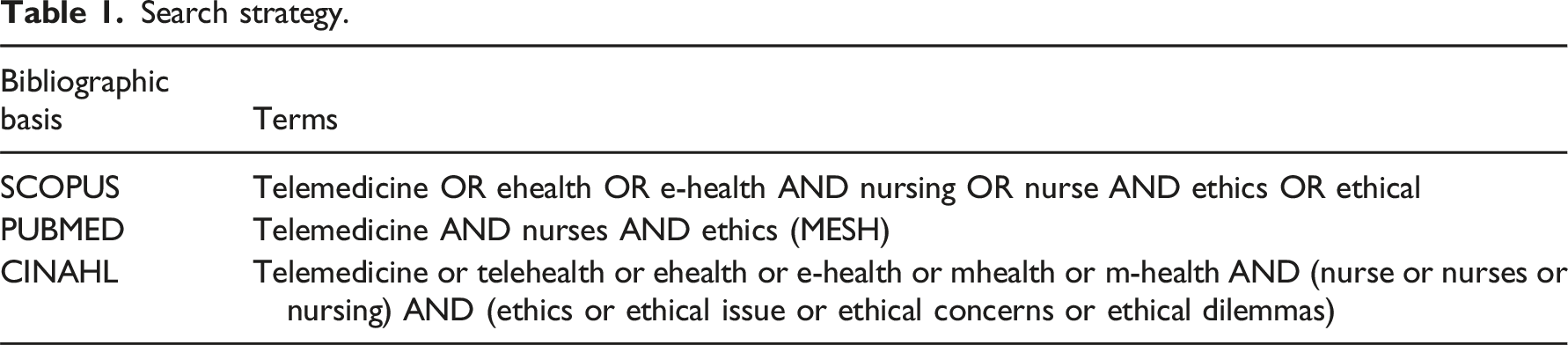
The literature was identified by means of a systematic search. The bibliographic databases used were Scopus, Pubmed, and Cinahl due to their relevance in health aspects related to the health professions, especially nursing.
When the scoping review was performed, gray literature documents were reviewed, but they were not included in the study since the documents found, mostly telemedicine implementation guides or ethical-legal guides, did not reflect the perspective of nursing professionals, which was one of the inclusion criteria.
Search strategy.
Selection of articles
The articles identified in the search of bibliographic sources were transferred to the Mendeley bibliographic manager, where duplicates were initially removed. The first step consisted of reading the titles of the articles and then the abstracts, discarding the ones which did not correspond to the inclusion criteria. For greater consistency, all the selected articles were reviewed by two investigators. The included articles were selected by consensus.
In this process, many articles were discarded because they did not fit the objectives of the study. These were grouped into three categories: articles focused on technology implementation processes without considering ethical aspects, those that reflected the experience or opinion of other professionals or patients, and finally those in which the health technology was not directly related to patient-professional interaction.
The initial search retrieved 1322 articles, of which 31 were eliminated as duplicates. Of these 1253 were excluded after reading the abstract, leaving 38 articles for an in-depth review. Finally, 12 articles met the eligibility criteria. The details of the selected articles are shown in Figure 1. PRISMA flow diagram illustrating the method of data collection and selection of studies.
Ethical considerations
The scope review was conducted following the ethical basis of research by identifying sources and respecting authorship.
Results
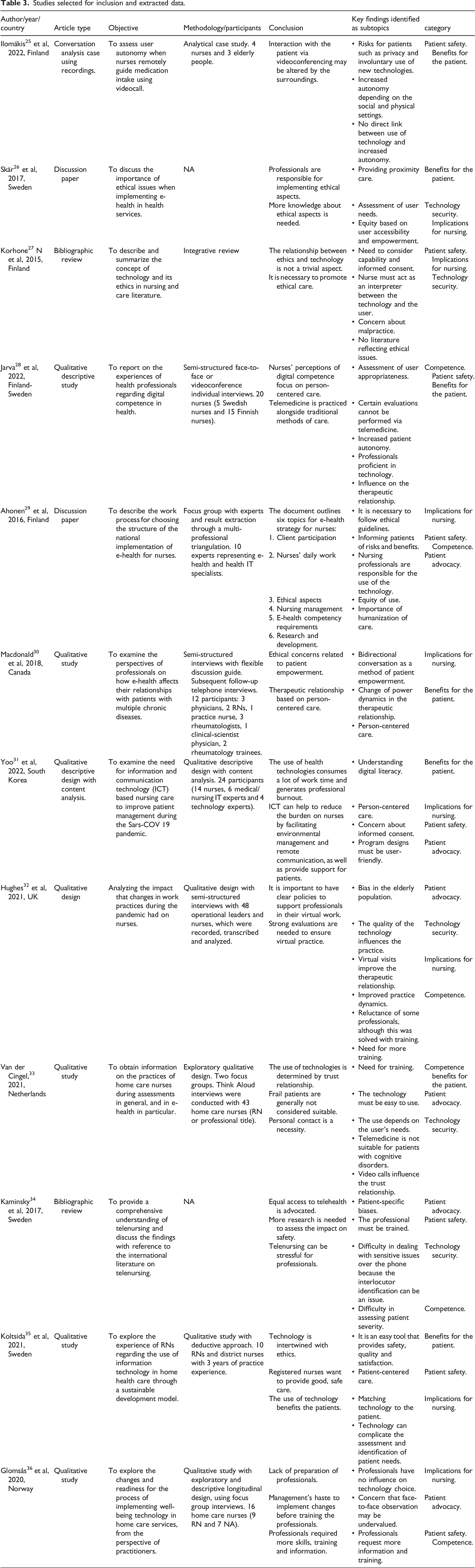
The 12 articles selected in the study included nine studies of a qualitative nature and three literature reviews. The countries of origin of the articles were Finland, 3 Sweden, 3 Norway, 1 United Kingdom, 1 Netherlands, 1 Canada, 1 South Korea 1 and one of them was a collaboration between Finland and Sweden. This demonstrates the growing interest in North European countries. Six of the twelve articles were published in the last 3 years.
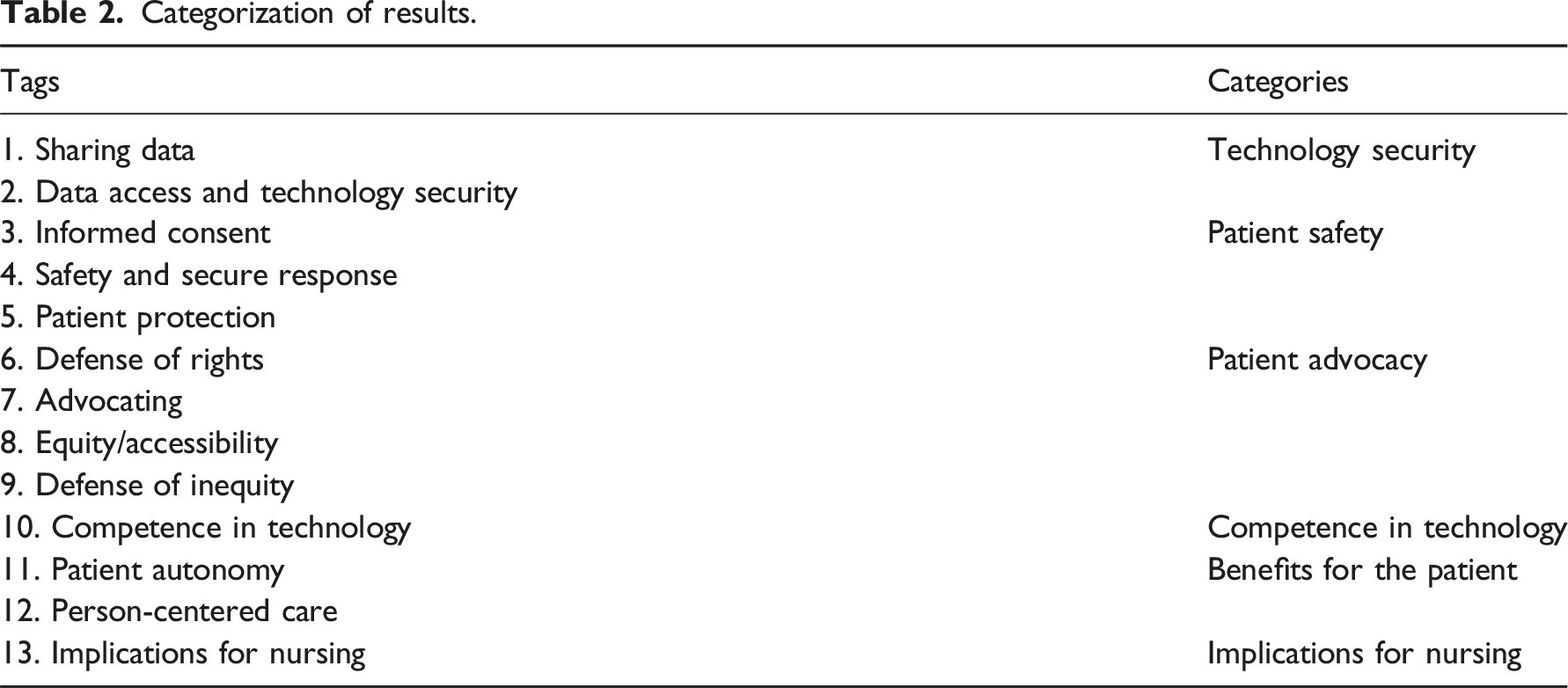
Categorization of results.
Studies selected for inclusion and extracted data.
Topics
Technology security
The articles mention the need for e-health to be practiced within the ethical standards of professional practice.14,20,26 The importance of the functionality of the technology is also identified as relevant to the relationship with the patient, that is, aspects such as the use of devices, the interface of the programs or the fluidity of the network should be intuitive and easy to use. The authors consider that the distance in therapeutic relationship and disconnection is aggravated when there are technical issues,32,33 and that priority should be given to user-friendly applications and devices that allow users to learn the technology easily or to use it intuitively. 31 Other, more technological aspects, such as Internet access or the quality of the connection, can affect the virtual care experience.
Patient-related aspects
Patient safety is an aspect clearly identified in the articles reviewed. Professionals identify safety mainly with the informed consent of users, but other aspects such as the safety of the transmitted information or bias in the identification of potential health problems of the patient are also mentioned.
Among nurses, when asked, maintaining patient privacy is a primary concern.25–27,29,31,33 They are concerned about discussing sensitive problems over the phone, or providing critical information to family and friends, as they cannot be certain of the interlocutor, 34 and that in some situations the users may not be able to express their needs to the professionals because of the presence of other people, such as family members, who are needed at the time of the assistance to use the devices. 32
Another patient safety aspect that was identified is the concern about the information transmitted in both directions of the communication. This refers to the fact that the patient may misinterpret the information provided, as there may be no adequate feedback and the patient may be unable to correctly follow treatment indications, 27 or the professional receiving information may not be able to perceive the real condition of the patient, a particularly serious aspect in situations of telephone triage or assessment of emergency situations that may underestimate the severity of the patient.34,35 Another aspect identified by Glomsås is the concern that the change of care model may lead to underestimate the importance of observation, leading to a poor follow-up of the user’s other needs, which otherwise, during an in-person visit, can be easily identified. 36
The authors agree that the use of health technology should not compromise the quality of service, social interaction, or the human aspects of a therapeutic relationship. 29
Patient advocacy by nursing practitioners regarding the use of technology is yet another of the points identified in the review.29,31–34,36 This aspect refers to considering whether telemedicine is appropriate and adapted to the physical, cognitive, and economic capabilities and skills of the user.
Some studies reflect the concept that there is a practice bias 34 when the technology is not available or the user does not have the capacity to use it, 27 and that a group of vulnerable patients, both physically and economically, may be left out of the care practice. 32 Specifically, Jarva et al, consider that telemedicine is not suitable for elderly users28,32 due to visual or motor impairments or cognitive problems 33 and that it is important to identify and emphasize that there may be a digital literacy deficit. 31 Considering all these aspects, the role of the nurse must be adapted to become an interpreter between the technology and the user, 27 assessing whether the methodology is appropriate for the patient and providing support when necessary. 28
The benefits of telemedicine constitute another widely acknowledged aspect among the authors of the articles.25,26,28,30,31,33,35 The aspects reflected in this section include accessibility without the need to travel, the positive effect on patient autonomy and empowerment, and person-centered care.
The results show that professionals consider health technology as an efficient and flexible practice with no geographical, institutional or professional barriers. 26 It improves accessibility to medical 32 and specialized care, 26 especially in rural areas. 27 The articles selected support the concept that telemedicine has a positive effect on patient autonomy.26,27,30,32–34
Another aspect identified by the authors in this review is person-centered care. It is considered of fundamental importance that the practice of care and the planning of the technology to be used should be conducted from the perspective of person-centered care.26,27,29–31,35 However, some professionals find a conflict with the new technologies, and consider it important to use telemedicine once there already exists a face-to-face therapeutic relationship of trust.14,33 The implementation of the technology must be adapted to the needs and well-being of the patient 35 and not dictated by cost or management aspects.
Technological competence of professionals
Digital competence has been defined as confident, critical, collaborative, and creative use of information technology. 37 This aspect is identified with the skills and trainings of professionals in the use of digital technology. It is a key aspect for avoiding biases in the use of technology by the professionals and to avoid negative impact on the therapeutic relationship. The digital competence of the professionals is a point clearly identified by some of the authors.28,29,32–34,36
Nursing practitioners consider that they need to be competent in the practice of telemedicine 28 by knowing the platforms they use 33 and that they are responsible for using telemedicine in their daily practice. 29 Technological competence is identified as the most influential factor for the implementation of telemedicine 28 and for encouraging user participation. 36 According to Hughes, reluctance to use technological platforms disappeared when users increased their confidence in the use of devices. 32 The most technologically competent professionals show more confidence and satisfaction with the use of telemedicine. 36
In general, professionals perceive digital health systems as easy 32 even though they may require technical skills. 28 A greater need for training was identified32,33,36 to increase confidence and empowerment in e-health.
Implications for nursing
The impact of how telemedicine will influence the nursing profession is the last of the points identified in the review.26,27,29–32,35,36 How technology can influence the dynamics of care practice, the care relationship and the new dimension of nursing as a profession is a point repeatedly identified by professionals.
In the literature on care and nursing, ethics in the technology context is not widely addressed, and when discussed, it focuses only on the benefits and risks of its use. 27 The use of health technologies, boosted during the pandemic, has opened new frontiers for the development of nursing and the way in which care is provided. 32 Although there are clear benefits such as reduced number of visits 36 or flexibility of virtual care, 32 it must be noted that heavy workloads are a barrier for the practitioners to devote their time and resources necessary to adapt to these new practices, using new technologies in care. 33
In addition to following ethical care practice guidelines, nurses must use their power and knowledge to ensure that the patient’s dignity, autonomy, and possibilities for participation are maintained. 31 This change in care model may pose challenges to the evolution of power dynamics in therapeutic relationships. 30 Finally, training nursing students in health technology is considered essential for the nursing profession. 29
Discussion
The objective of this review was to explore the perception of how professionals experience the ethical aspects when using telemedicine, however, although it is true that there is literature on the implementation38–40 and initiation of the use of devices, 41 there is little research available on the ethical aspects of health technology from the nursing perspective. It is important to identify those aspects relevant to nursing as a profession, since the majority of literature sources focus on the perspective of users,42–44 students,45,46 or other professionals.47,48
The ethical aspects considered at the beginning of telemedicine were those related to practical implementation issues, such as accessibility and privacy, 49 more related to the legal aspects of service implementation.50,51 With the increasing use of health technology, it is necessary to point out new ethical challenges that nursing professionals are concerned about, such as person-centered care 52 or the impact on the therapeutic relationship. 15
Threats to patient security and privacy are persistent in the ethics of telemedicine. In addition to the basic technological issues, new concerns arise, such as the importance of verifying to whom health data is being disclosed, both because the interlocutor cannot be verified and because the presence of family members is necessary for effective communication. In relation to this aspect, Perry et al report that the need to use technology can overburden the caregivers of those users who cannot use telemedicine on their own. 53
There are authors who reflect the risks for privacy and security, such as Toader, who states that cybermedicine increases the risks of breaches of privacy and confidentiality, 20 or Methan, who refers that health technology potentially increases the security breaches of patient information. 21 Korhohen et al also identify telemedicine as a potential source of harm to the individual in the way that healthcare technology may deal with patient privacy and confidentiality. 27
Informed consent constitutes a widely identified aspect by different authors in the literature.15,19,20,54 It is a key ethical aspect in the use of health technology. It is necessary for the patient to be aware of the advantages and disadvantages of the use of health technologies. 54 It is considered priority to inform the patient of the benefits and risks of the technology. 26 Authors such as Keenan stress that this step should be formulated in an episode prior to the use of devices,22,31,55 except in emergency situations. Stanberry states that the information must be clear and simple, being especially sensitive to patients who are not familiar with information technologies. 56 It is important to remember that informed consent is bound to the principle of patient autonomy and this aspect cannot be relegated solely due to organizational issues.
As for the transfer of information, authors such as Nesher suggest that poor communication can hinder care, as patients can, voluntarily or involuntarily, withhold key information for the analysis of their situation. 57 Therefore, authors such as Jarva et al consider that some care practices should not be carried out via telemedicine. 28 In contrast to this view, authors such as Kaplan consider telemedicine to be a valuable practice for “forward triage.” 15
The benefits of telemedicine are widely acknowledged in the existing literature.19,54 However, authors such as Toader state that telemedicine cannot be identified as a “generic solution,” therefore it is necessary to carefully identify the users, 20 a concept also referred to by Metha et al, commenting that telemedicine scenarios should be sensitive to the user’s capabilities and needs. 21
It is vital that healthcare technology should be subordinated to the needs of the patient and that patient-centered care should be one of the guidelines that direct the development of telemedicine. Demiris points out that implementation should not be based on cost savings or “face-to-face” visits. 58 According to Kaplan, it is important to keep in mind the importance of the person-centered relationship, to avoid dehumanizing the patient by focusing solely on how the technology works. 15 Several documents advocate the shared use of telemedicine and in-person visits. The AMA guidelines consider that telemedicine should be complementary to in-person care, whenever conditions allow it. 14 Other authors, such as Fleming and Toader, believe that telemedicine should not replace traditional medicine, but should complement the in-person visit in the continuity of care.20,55
The correlation between telemedicine and increased patient autonomy presents some divergence among authors. The prevailing view is that digital technology has a positive effect on patient autonomy and empowerment, with authors such as Parks et al, stating that telemedicine enables patients to have a better control of their own care. 59 They consider that digital services encourage patients to have an active attitude towards their health and to set common goals with the professionals, 28 and that the use of health technology generates confidence in the user's ability to solve future health problems. 34 In contrast to this idea, authors such as Percival et al report that the use of telemedicine can increase the isolation of patients with mobility difficulties. 60
In the new scenario that telemedicine brings, the aspect of technological competence of the professionals is of fundamental importance. With the experience of the pandemic, professionals were forced to use techniques with which they were not familiar, in addition to all the care burden they had to deal with. The urgency of the situation added to the perception that it was a methodology implemented from the management services, without considering the professionals and users, and without prior training, may have hindered the acceptance of telemedicine by the professionals. According to Chaet, technological capacity to practice telemedicine falls under the responsibility of the practitioner. 54 Training in technology is a key aspect to increase the competence of nursing professionals, thus facilitating the development of telemedicine as a complementary health care practice.
The heart of the nursing profession practice is patient care. The therapeutic relationship is a foundation of care, and the literature review reveals a concern for the transformation it may undergo over time. It is important to embrace new technologies that allow continuity of care for those patients who need it, from the perspective of the user's knowledge. We should take advantage of the benefits that telemedicine offers and investigate how to open new paths in health care practice. Professionals who do not have training in information technology should approach it with a positive attitude and increase their competencies, so that it does not become a barrier in proposing telemedicine to our patients. Nursing must have the ability to see this new field as an opportunity rather than an overload of work. 33 It is essential to train students in aspects of information technology so that they can share knowledge with colleagues who do not have such training. 45
This scoping review demonstrates the lack of research by professionals in the field of ethics of information technologies. It is essential not to forget that telemedicine is a methodology of care in expansion and that, as nursing professionals, we must develop this new way of providing care, but on a solid ethical foundation.
Conclusions
Upon review of the literature, we found that the literature that addresses the ethical aspects of telemedicine from the experience of nursing practice is insufficient. It is necessary to bring to light those ethical aspects that underpin the nursing profession in virtual care.
It is essential to apply ethical concepts to the practice of telemedicine, which should be offered when the patient’s circumstances and needs allow it. Virtual care should not undermine the therapeutic relationship and trivialize the humanization of care. Person-centered care is an aspect that should not be subordinated to other legal or technological aspects. It is important to adapt technology to the specific needs of the users and to respect their preferences for care, although in the coming generations such barriers will diminish due to better technology knowledge.
Telemedicine is emerging as a new care model, although it is still recommended that it should be a complementary practice to in-person appointments. To implement telemedicine, informed consent is a key aspect and must be obtained prior to providing care.
Professionals require more training in digital competencies, especially prior to the implementation of virtual programs, in order to increase their competence and confidence so that the transition to a new system of care is more effective and generates less reluctance.
Footnotes
Declaration of conflicting interests
The author(s) declared no potential conflicts of interest with respect to the research, authorship, and/or publication of this article.
Funding
The author(s) received no financial support for the research, authorship, and/or publication of this article.
