



Abstract
Our paper addresses the complex role of Business Improvement Districts (BIDs) in current processes of inner-city restructuring and the function of BIDs in the implementation of new forms of social control in downtown areas. Our thesis is that, in the context of recent urban renaissance initiatives, BIDs are expanding their ‘clean and safe’ profile to be a much more comprehensive programme. Their goal is not only to produce safety and cleanliness in the urban environment but to influence the symbolic dimension of what the city is and for whom it is made. This implies indirect forms of governing the way in which the city is used, which go unnoticed if BIDs are identified solely as a tool to create ‘clean and safe’ public space. We will substantiate this claim with a case study on the current restructuring of downtown Los Angeles (L.A.). Since 1999, downtown L.A. has been profoundly ‘revitalized’ as a living and entertainment district for affluent residents. The nine BIDs covering the main parts of the downtown play an important role in making this gentrification happen by providing the appropriate context for restructuring. Beyond overt measures such as security forces or CCTV, the BIDs also have an important impact on the ‘geographical imagination’ (Harvey, 1973) of the city. The examples elucidate the anticipation of a broadening field of activity for BIDs, not only in securing an ‘urban renaissance’ but also in framing the way it is performed symbolically.
Introduction
‘BIDs are here to stay – and, moreover, to multiply, diversify, and innovate.’ (Houstoun, 2003: 142)
The buzzwords ‘urban renaissance’ and ‘new urbanity’ signify a currently growing interest in metropolitan inner-city living in the Global North (Buzar et al., 2007; Porter et al., 2009). Research on gentrification has documented the often profound changes for local neighbourhoods resulting from this reorientation of buyers, developers and city planning (Atkinson and Bridge, 2005; Lees et al., 2007). One important aspect of change relates to questions of security, the accessibility and quality of public spaces, and the employment of security-oriented policies (MacLeod and Ward, 2002: 162; Atkinson and Helms, 2007; Helms et al., 2007). In this paper we address the complex role of BIDs within these processes of inner-city restructuring. 1 As Jerry Mitchell observes, BIDs play an important part in advocating urban renaissance policies: ‘To varying degrees, BIDs are not only actively immersed in marketing downtown districts and supplementing sanitation and security services in both large and small cities; they are also very involved advocating downtown revitalization policies to citizens and local officials’ (Mitchell, 2001: 121; see also Ward, 2007). As a case study from downtown Los Angeles will illustrate, BIDs contribute to the production of space in a wider sense, shaping the public imaginary of urban neighbourhoods. In our case study, BIDs play a central role in establishing a particular concept of ‘urbanity’ – with far-reaching consequences for social life in the inner city. In the numerous practices and interventions at the local level either conducted or advocated by the BIDs, the inner city is exclusively conceived as a ‘live, work and play’ environment for the affluent middle and upper classes and is thus shaped accordingly. As BIDs have also become an international model of revitalization (Ward, 2006: 55), it is important to acknowledge this wider impact of BID policies, going far beyond the provision of ‘submunicipal local goods like sanitation, security and capital improvements’ (Hoyt and Gopal-Agge, 2007: 949) that is usually described in the literature. As our case study shows, BIDs take part in producing an extended assemblage of social infrastructure, security arrangements, regulations, forms of surveillance and a new degree of social control in addition to – and beyond – ‘safe and clean’ public space.
Conceptually we reach back into the toolset of recent power theory to capture the whole range of BID practices and their effects in our case study. For example, Michel Foucault (1982) has created an understanding of ‘governing’ that includes both the direct forms of regulating conduct and the indirect effects of a so-called ‘power/knowledge’ nexus. Building on Foucault’s works, governmentality studies have developed a nuanced conceptual toolkit to analyse activities of social ordering and governing in terms of their political rationalities (Rose and Miller, 1992; Osborne and Rose, 1998, 1999; Isin, 2000). Applying these concepts in our context allows an analysis of the work and self-conception of the BIDs as part of a multifaceted interplay of power relations structuring the way in which urban space and its appropriate uses and users are imagined and governed. The approach may help us to understand the connections between the contingent exercise of power in local settings – where the formal structures and the activities of BIDs have achieved a great deal of variation (see Hochleutner, 2003: 279) and where actors often just seem to act upon what they perceive as concrete problems without further reflecting on the ‘powerful definitions of truth about best cities’ (McCann, 2008: 897) that their practices produce – and the overarching rationalities of governing that are being (re)configured here (Rose and Miller, 1992; Dean, 1999; Rose, 1999; Legg, 2005; Huxley, 2006). Special emphasis is put on the role of space as a catalytic element in this power/knowledge nexus. As Mustafa Dikeç argues, ‘urban policy is guided by particular ways of imagining space, and different ways of imagining space have different implications for the constitution of perceived problems and proposed solutions’ (Dikeç, 2007: 287). The same argument is sustained by Steve Herbert and Elizabeth Brown, who claim that ‘space is not just impacted by neoliberal policies, but . . . its conceptualization importantly helps legitimate those policies’ (Herbert and Brown, 2006: 756). Policy strategies developed by the BIDs, as well as implicit processes of restructuring the ‘geographical imagination’ (Harvey, 1973) of the city, can equally be conceived and analysed as differentiated outcomes of local power struggles, contextualized in a ‘near-universal embracing of a particular model of urban revitalization’ (Ward, 2007: 782) currently taking place in many cities in the Global North (Porter et al., 2009).
The case study is part of a research project that focused on the restructuring of downtown Los Angeles (L.A.), an urban restructuring initiative undertaken by private actors and public–private partnerships, and, at the same time, was a process where the notion of an ‘urban renaissance’ was widely celebrated and an omnipresent subject in the debate. Important aspects of this urban governance process that we focused on were not only the policies and actors but also ‘their perceptions, action repertoires, policy discourses and embedded cultural assumptions’ (Coaffee and Healey, 2003: 1982). As a latecomer in the current wave of inner-city revitalization, downtown L.A. provides an excellent case to study contemporary ideas and visions accompanying the ‘urban renaissance’ in which the new downtown is supposed to be safe and clean, convenient and healthy, yet at the same time also exciting and lively, diverse and ‘edgy’. Our thesis is that the BIDs here are involved in an organized staging of urbanity, ambitiously supporting the experience of consuming urban space as a ‘life, work, play’ landscape.
Empirically, we retraced the debates and arguments surrounding the ongoing ‘renaissance’ of downtown L.A. mainly through interviews with BID representatives, real-estate developers and city officials. Press releases by the BIDs and their different self-portrayals and revitalization strategies provided empirical material as well. We have used this material in addition to several field trips to get a comprehensive overview of the numerous activities deployed by the BIDs and other actors to sustain the process of restructuring downtown L.A., to promote new urban living and to help make the process a successful endeavour. In the process of inner-city restructuring, BIDs play a central role, but they are certainly not the only actor pursuing the goal of transforming the downtown into a ‘live, work, play’ environment. Where BIDs go beyond their narrow ‘safe and clean’ profile and further participate in transforming the ‘geographical imagination’ of the inner city, they also forge partnerships with other actors (in our case, most notably with real-estate developers) to achieve their goals.
Using the conceptual lens of governmentality allows us to enquire into the work of BIDs that play a leading role in sustaining the vision of a new downtown and to point out the effects of social control in the inner city produced by this vision: mainly, we found that the mode of governing social relations in the city is characterized not only by discipline and control – as many of the studies on urban security policies and on BIDs suggest – but also by the fact that it cultivates a certain degree of difference and is motivated to manage risk proactively instead of completely erasing what is conceived of as ‘dangerous’. Both the vocabulary and the policy practices – influenced in particular by Richard Florida’s concept of the ‘creative class’ (2002) – now pursue the idea that a manageable, ‘colourful’ degree of irritation and uncertainty may even be considered helpful in order to establish authentic (and, thus, marketable) urban aesthetics.
As Kevin Ward has noted, ‘[t]he “cool” and “creative” city may be the new policy kid on the block, but both discursively and substantively what this means for the urban politics of revitalization bears more than a passing resemblance to the entrepreneurial urbanism of the late-20th century’ (Ward, 2007: 782). BIDs themselves have accompanied and sustained this evolution of neoliberal urban policies by supplementing the heavy-handed disciplinary measures they started out with. This is not to say that BIDs have in any way slackened their efforts to create ‘safe streets’, a goal that both in the past and in the present often translates into aggressive approaches towards the uses and users of public space deemed ‘problematic’. But BIDs have in fact extended this package of measures by developing management strategies to proactively promote the use of the city as a ‘life, work, play’ landscape.
‘Revitalization’ in downtown Los Angeles
Although Los Angeles is certainly a somewhat over used example in urban studies, especially in the field of security-related urban governance (Soja, 1986; Davis, 1990; Loukaitou-Sideris, 1993; Dear and Flusty, 1998, 2001; Caldeira, 1999), we think that in many regards the ‘urban renaissance’ currently taking place in downtown L.A. provides an excellent case to study recent visions of inner-city restructuring and conceptions of urban living now operating under the buzzwords of ‘revitalization’ and ‘renaissance’ and also for the important role BIDs play in safeguarding the renaissance by establishing the necessary environment and security arrangements.
Since 1999, the Adaptive Reuse Ordinance has permitted developers to convert vacant office and commercial space into residential use in the downtown area of Los Angeles. The passing of the ordinance was the initial trigger for a redevelopment boom that has been taking place ever since. This ‘unprecedented renaissance’ (DCBID, 2007a) is further sustained by the completion of several landmark entertainment developments such as the STAPLES Center, L.A. LIVE and the Walt Disney Concert Hall. The main focus of the redevelopment initiative, however, is to bring new residents into the area. More than 7000 new and Adaptive Reuse housing units had been built up to 2002 (DCBID, 2007a). The initial speed of this process surprised even long-time observers.
At the same time, the disparity between the new downtown aimed for by a range of actors including the various local BIDs and the current popular perception of downtown could hardly be greater. For decades, the degree of urban blight in most of its neighbourhoods has been extremely high, sustaining the district’s image as a ‘ghost town’ after business hours. Furthermore, the eastern part of downtown L.A., also known as Skid Row, has the largest concentration of homeless individuals in Los Angeles County. In 2007, a street count revealed more than 5000 homeless people in the downtown area (LAHSA, 2007).
This point of departure has led to a restructuring process beset with social tensions. The influx of financially well-off residents into the newly built residential developments has produced an intense spatial proximity of social realities that could not be any more polarized. Up to now, the Skid Row area was commonly perceived as a ‘no-go area’, and often the only people frequenting the neighbourhood from outside, aside from the homeless, were policemen, paramedics and social workers. Now Adaptive Reuse developments are marketed as luxury residences and sold at prices comparable to developments in Beverly Hills and Santa Monica. At the same time, a few blocks away or sometimes even in the same streets, shelters provide beds for the homeless, SRO hotels offer precarious housing or people put up tents to sleep outside. This highly charged situation brought about by the redevelopment initiative is very likely to initiate processes of displacement, even though this is publicly denied by the developers (Lacter, 2005: 1). The restructuring of downtown L.A. and the influx of well-heeled new residents into the buildings around Skid Row have put new pressures on the local actors to improve and secure the area and to regulate the urban poor. Many of the private actors and public–private partnerships involved in the redevelopment process have singled out the presence of homeless people and the visibility of homelessness within the area as the main obstacle to achieving the much sought-after urban renaissance.
‘Downtown Los Angeles is on the cusp of an urban renaissance. . . . However, this renaissance is threatened every day by street encampments, drug deals, overdoses, and panhandlers.’ (CCA, 2002: 7)
Private actors have repeatedly challenged the city to solve the safety problems in the downtown area to make it possible to capitalize on the economic benefits of downtown L.A.’s renaissance. An overt example is a policy paper issued in 2002 by the Central City Association (CCA) of Los Angeles. The CCA is a business organization advocating legislative initiatives that ease investment in downtown L.A. and is the founder of the Downtown Center Business Improvement District (DCBID). The economic rationale operating in the CCA’s strategies demands immediate change. Otherwise, according to the CCA, ‘big businesses, entrepreneurs, workers, shoppers, residents, and tourists will not live, work, or play in a place they believe is unhealthy and unsafe’ (CCA, 2002: 7). These claims resonate well with the demand for security practices in the aftermath of a physical regeneration of the downtown area predicted early in the literature (Mair, 1986; Mallett, 1994).
And yet the unique ‘edgy urban atmosphere’ problematized here also serves as an important selling feature and needs to be preserved according to many of the BID representatives, real-estate developers, sales agents and other actors we spoke to. The newly built residential developments are uniformly marketed as the ‘ultimate form of urban living’ (Packard Lofts), as the ‘most exciting living experience’ (South Project) and as places to ‘feel the electricity of the city’ (Little Tokyo Lofts). The conflicting objectives informing the restructuring of downtown L.A. are obvious. The new downtown is supposed to be safe and clean but it also has to impart the feeling of an exciting, spectacular and ‘edgy’ environment, otherwise it will fail to attract the creative urban pioneers desired by the actors involved in the restructuring process. It is particularly the work of the local BIDs that reflects efforts to combine these conflicting aims into a comprehensive strategy – a strategy that eventually can be conceived as a sophistication of the privatized city, providing the comforts of a protected environment without losing out on the excitements of urban life.
In the context of the downtown L.A. renaissance, from the very beginning the initiation of BIDs was regarded as a key feature to activate revitalizing effects. In this regard the Los Angeles case study provides yet another example of the BID’s success story as a circulating policy model, appraised as best practice in all kinds of contexts (Hoyt, 2006; Ward, 2006; McCann, 2011). The establishment of the BIDs in downtown was strongly influenced by examples from other cities undergoing processes of inner-city restructuring:
“To revitalize downtown, we first looked at what other downtowns were doing. We toured Denver, Philadelphia and Manhattan. Whatever they had done that worked had to be molded and adapted to Los Angeles.” (Fine, 2006: 1)
The establishment of the first BID in Los Angeles, the DCBID, has been a cumbersome process though and needed three years of lobbying and preparation. The city played an important proactive role in this initiation as the founding process was facilitated through the provision of public money from L.A.’s Community Redevelopment Agency (CRA). ‘[T]o help “jump start” the recovery of Downtown’ (CRA, 2000), the agency also provided start-up funds for a BID initiative in the Fashion District at the same time. Not least, it was because of the drive of the CRA in 1998 that the DCBID was established as a pioneer in Los Angeles, collecting money from 480 landowners: ‘a special voluntary tax assessment that will fund programs to make downtown safe, clean, friendly and to help spread the word that downtown is a dynamic place to live, work and play’ (CCA, 2003). Once established, the model rapidly took hold all over downtown L. A. Altogether, nine BIDs have been implemented within the downtown area (see Figure 1), all of which are further organized in the Californian Confederation of Downtown Associations (CCDA).
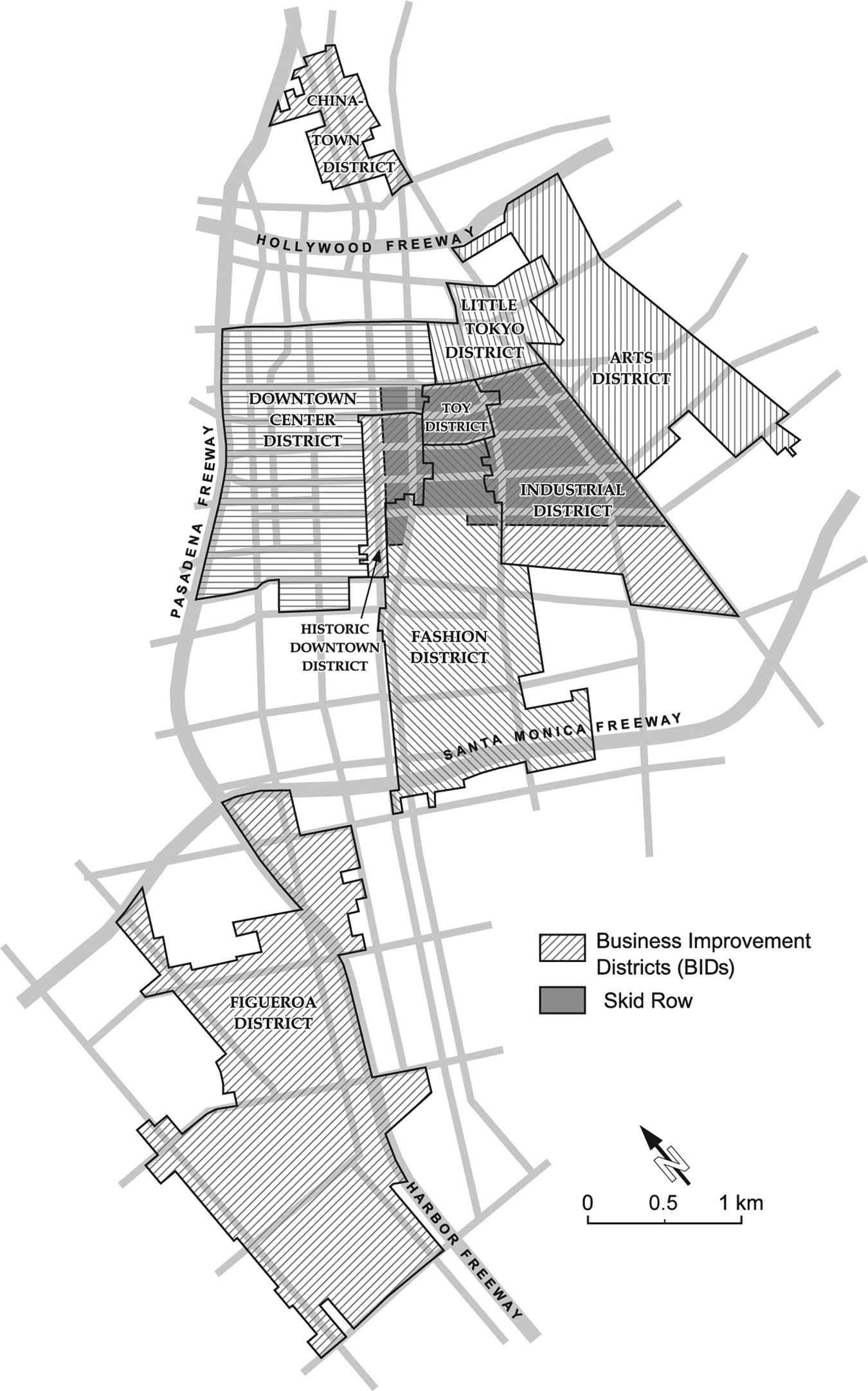
Downtown L.A. BIDs in the Confederation of Downtown Associations.
As we have mentioned, empirical analysis of the practices undertaken by the BIDs suggests that these practices go beyond the ‘clean and safe’ principle that BIDs are usually known for. But this does not mean that the ‘clean and safe’ slogan has become obsolete as the official BID mantra. In an interview, a representative of the Central City East Association (CCEA) sums up this key competence of the BIDs represented by the CCEA:
‘The BID actually has, you know, millions of dollars to go out and do, you know: “Safe and clean! Safe and clean! Safe and clean!” And for me to run around and, you know, scare the legislators. Which I love to do!’
2
The ability to establish a secure and clean environment still constitutes the BIDs’ fundamental expertise and is therefore crucial for their self-legitimating strategies. All official self-representations of the different BIDs in the downtown share this emphasis on safety and cleanliness as a common starting point to explain their work and, therefore, their existence as legitimate actors regulating public space. The provision of security and cleanliness is paraphrased as ‘clean, safe and friendly’ (Fashion District BID, 2007), a ‘clean, safe, and exciting environment for all Angelinos to live, work, shop, and play’ (HDBID, 2007), a ‘safe, clean, economically vibrant, and aesthetically pleasing environment’ (Figuera Corridor Partnership, 2007) or the maintenance of a ‘safer, more secure and cleaner environment’ (CCEA, 2007). As a vital component to this policy, all of the BIDs in downtown L.A. have established private security services. Owing to the social tensions shaping the conditions of the work of the BIDs in downtown, the BIDs have even intensified their security workforce and established new forms of cooperation with the local police to train their employees in the private security sector – training that in turn provides the necessary legitimization to further expand the private security forces and prove their professionalism to critics. In 2006, the DCBID even established a ‘BID Academy’, where the DCBID private security force, called the ‘Purple Patrol’, is trained by the Los Angeles Police Department (LAPD) to better face downtown’s challenges (DCBID, 2006).
And yet, the grounding discourse of the so much sought-after urbanity for downtown implies a particular challenge to the conventional BID concepts of safety and cleanliness and to the common measures of ordering public space usually implemented by BIDs. Here, the security policies employed have to fulfil a double-sided function: on the one hand, they have to ensure the provision of comfort and security to persuade their target audience to ‘move back’ to the inner city; on the other hand, they have to preserve at least a certain amount of the area’s rough and raw character, which is considered urban and exciting compared with the uneventful ‘white bread’ suburban environments. In the following section we exemplify this ambivalence by discussing examples of recently established BID policies that can be seen as paradigmatic in going beyond the simple maintenance of a safe and clean streetscape.
Place-making: Staging liveability
The first example of a more ambitious goal for BIDs can be summarized under the heading of ‘place-making’. Beyond the notorious furnishing and cleaning of public space, different actions we found are directed towards the production of a particular ‘urban’ environment. The aim here is to ‘spin-doctor’ the city’s atmosphere more profoundly in order to provide the necessary milieu for a ‘life, work, play’ environment to flourish. A closer look at the different BID security policies shows a modified handling of the key concept of ‘security’ and thus an intensified focus on more indirect and ‘discreet’ ways to produce a secure environment. Lawrence O. Houstoun has called this an effect in which ‘hospitality trumps security’, leading to a new ‘emphasis on the district’s friendliness’ (Houstoun, 2003: 160). But with this new focus on the district’s appearance, security does not lose importance as a central objective. Instead, it expands into new meanings and new corresponding practices. New fields of intervention are identified that were not relevant to the production of security before.
In the practices of the BIDs in downtown, ‘security’ is most commonly conceptualized as a broad synonym for ‘quality of life’. This leads to a corresponding logic of security provision that focuses on an equally large and, at first sight, rather undefined field of intervention. A range of measures is broadly directed towards the ‘urban appearance’ of the district instead of solely safeguarding its cleanliness. The BIDs, for example, try to establish a thriving cultural and nightlife scene by systematically encouraging popular chain businesses to establish stores in downtown and by urging the restaurants and clubs that already exist within their neighbourhoods to extend their business hours to boost downtown’s importance as an entertainment centre and to mitigate its image as a district to be avoided at night. Together with restaurants, clubs and galleries, the DCBID and the Arts District Improvement District regularly organize open house days and nights with free shuttle buses connecting the different locations. Bus tours for private buyers interested in the downtown housing market take place on a monthly base.
Most importantly, the BIDs not only try to secure a thriving urban downtown by encouraging businesses to move to the area, but also work together with the real-estate developers building locally to investigate the target audience of potential residents and visitors. By undertaking extensive demographic surveys, the BIDs are able to produce differentiated knowledge about the people already living in the newly built residential developments, their reasons for moving to the downtown area, and their lifestyle choices and needs. Unlike conventional census data collected by the state, the BIDs’ demographic surveys peer deeply into the ‘live, work and play’ habits and expectations of these new downtown residents. A range of questions is chosen to render the population visible by collecting data about consumer habits (such as the ‘average dining-out index’, indicating the frequency with which people usually go out for dinner in downtown L.A. restaurants and the prices they are willing to pay, or questions investigating the grocery chains where the new residents usually buy their food) and ‘lifestyle related’ data (such as household type, sexual orientation, level of education and cultural activities). The survey results are used to optimize the sources residents typically use to learn about events and activities in downtown L.A. and to recruit preferred restaurants, retailers and service providers to the area. Currently, there are efforts under way to recruit retailers and eateries to 7th Street in downtown L.A. In the 2011 survey, the DCBID encouraged residents to name specific types or brands of business they would like to see on that particular street. It goes without saying that the BID will also undoubtedly claim to guarantee the streetscape’s safety and cleanliness once it is ‘revitalized’. But the example shows the deep involvement in preceding processes of deciding how exactly a ‘life, work, play’ landscape should look and how urban space should be arranged accordingly.
The survey results have proved to be of great use to the development firms building real estate in downtown L.A., as several developers confirmed in our interviews:
‘. . . just to find out who is moving here, why are they moving here, what are the services that are missing, what are they doing, what would they like to be able to do downtown. And that’s providing us a lot of good information about who the market is . . . For us the last census was in the year 2000, which is a long time ago now. And for downtown which has changed so rapidly it’s no longer valid. So this kind of new information that’s being generated by the Business Improvement District has been very helpful.’
3
The detailed knowledge produced by the BIDs is used by the developers to further consider the specific lifestyle needs of possible future residents throughout the whole planning process – from floor plans and amenities right up to the fitting retail stores and service providers placed in the buildings once they are finished.
To create the desired ‘live, work and play’ population for the revitalized inner city, the BIDs, together with the Los Angeles Conservancy, host Saturday Housing Bus Tours where potential residents are shown the different construction sites and are informed about downtown amenities and the fashionable nightlife along the way. On this extensive tour through downtown, interested visitors, together with a couple of BID representatives, visit six or seven model homes among the currently available residential properties. The bus tour includes an introduction to downtown’s different neighbourhoods and a trip to new landmarks such as the STAPLES Center, L.A. LIVE, the Walt Disney Concert Hall and the Cathedral of our Lady of the Angels. BID representatives ‘also inform the visitors about other iconic developments under construction, most notably the Grand Avenue and Park Fifth project sites’ (DCBID, 2007c). Throughout the four-hour tour, the BID tour guides further push the image of downtown as hip and trendy by praising its nightlife scene and by offering alleged ‘insider tips’ on clubs and bars.
Even the most obvious and conventional strategies of security provision such as the private security forces are at least partly involved in producing a ‘life, work, play’ environment to be consumed easily by new residents and visitors. In order to avoid the impression of being harsh zero tolerance representatives, the private safety patrols have to serve as contact persons for tourists and consumers and as guides to the district’s amenities. The DCBID’s Purple Patrol, also labelled ‘The Friendly Team’ (DCBID, 2007b), supplies inside information about the downtown area and free maps produced by the BID that point out a range of shopping and dining possibilities. The Purple Patrol’s district ‘ambassadors’ are equipped with hand-held computers and printers that provide printed walking and driving directions to 600 locations within the district, tools used to steer people’s movements, to create specific perceptions of the inner city and to support the desired behavioural patterns in public space. BIDs have been criticized for indiscriminately furnishing urban space with their trademark seating benches, street lights, flower tubs and rubbish bins – blatant forms of place-making that effectively blur distinctions between different types of unique urban life by creating inner cities that basically look the same everywhere. At least in our case study, these efforts to influence the shape and design of urban space and the character of the infrastructure obviously go even further. With the conceptual help of governmentality, seemingly banal practices of market research, recruiting retailers and organizing cultural events all undertaken by the BIDs can be read as a specific mode of governing social relations in the inner city. Instead of exclusively securing the area of downtown by repressing and punishing what is perceived as ‘antisocial behaviour’, the BIDs play a proactive role in constantly supporting the preferred uses and users of the new urban spaces. Although this approach may lack a coercive element and primarily tries to work ‘at a distance’, it is all the more invasive in the ways it arranges urban space and gathers information about the subjects it is interested in. The practices of the BIDs reveal a governmental strategy in which the desired forms of subjectivity ‘are to be fostered through the positive, catalytic qualities of spaces, places and environments’ (Huxley, 2007: 195).
Selective masking of the homeless population
The different measures of ‘place-making’ aside, another crucial strategy the BIDs use to secure the ‘urban renaissance’ in downtown is a selective masking of the homeless population. This strategy is carried out in two steps. The first step is a discursively produced ‘segmentation’ of the homeless population. The aim of this segmentation is to make it possible to discriminate between different ways of dealing with the problem of homelessness. Carol Schatz, the president of the CCA, insists on this requirement for approaching the problem of homelessness. According to her, the CCA’s main approach to alleviate the problem of homelessness as the key ‘obstacle’ in achieving revitalization is to ‘segment the different homeless populations’ (Fine, 2006: 1). The BIDs follow this strategy firstly by consistently evaluating the homeless population. As the measures taken show, to segment the allegedly different homeless populations in fact means to classify them on a ‘deserving’ vs. ‘undeserving’ nexus – ‘You have those that truly need help and can use it, those who have lost jobs, and those who have mental illness. And then you have those who I call the criminal element, who continually use drugs and refuse help’ (Fine, 2006: 1). Interestingly, the BIDs here pursue an approach that is, at least to some extent, comparable to the numerous efforts to investigate the lifestyles, needs and expectations of the ‘work, life, play’ community they want to set up in the new downtown. To render the different populations they are dealing with - visible with the help of comprehensive surveys - seems to be the first line of treatment for the BIDs to deal with the problems they have defined.
Of course, in order to segment the various groups among the homeless population and to treat these groups differently, the BIDs first need information about the population as a whole. This is again realized through newly forged collaborations with other organizations. In 2007, the Los Angeles Homeless Services Authority (LAHSA) initiated the Greater Los Angeles Homeless Count. In one night, 1100 volunteers were teamed up and deployed to designated areas throughout the city to count the homeless street population. The resulting report was the most comprehensive ever developed for Los Angles and one of the largest homeless count operations in the United States. Though this is not an activity directly initiated by the BIDs, it surely is the effect of constant lobbying by them and other private actors investing in the area, encouraging the city finally to confront the problem. BID representatives enthusiastically welcomed the count and supported it by providing volunteers for the downtown area. The survey proved that the downtown area, and especially the part known as Skid Row, has the greatest concentration of homeless persons in all of L.A. County – data that are now often used by the BIDs to demand a dispersal of the homeless services traditionally located in downtown to make the rest of the city take its ‘fair share’ of the problem. The BIDs strongly advocate the dispersal of services as a promising measure to manage the visibility of homelessness in downtown.
Another measure of segmentation is the BID ‘A.C.T.I.O.N.’ programme. The programme consists of a training week for Purple Patrol employees offered by the California Hospital Medical Center (a mental health centre). The initiative is intended to serve as a pivotal component of the DCBID’s broader efforts to address the homelessness problem. ‘A.C.T.I.O.N.’ here stands for ‘Ambassador Community Training for Intervention, Wellness, Outreach and Networking’. The training focuses on signs of mental illness among the homeless community, providing ‘culturally competent and compassionate interaction’ with the mentally ill (DCBID, 2000). Purple Patrol security guards are encouraged to interact actively with the homeless, to search for signs of mental illness and to place mentally ill individuals in contact with services they may need to better serve them. The aim is to educate the private security service to differentiate the homeless population, to deal appropriately with each group and to ‘help individuals who are willing to help themselves’ (CCA, 2002). The BID A.C.T.I.O.N. programme shows the extent to which activities undertaken by the BIDs not only go beyond the mere provision of cleanliness but also interfere in established structures of social service provision and existing partnerships in the social service sector. The new collaboration established between the BID and the California Medical Health Center to help the mentally ill in downtown is, at least according to the BID, a ‘sterling example of community partnership and a welcome signal to all those who are eager to make Downtown a thriving, productive and caring community’ (DCBID, 2000).
The downtown BIDs establish a diversified and selective approach towards the different homeless groups they identify. The problem of the ‘chronically homeless’ and mentally ill people living on the streets is – according to the strategies enforced by the BIDs – best dealt with by dispersing services on the one hand and by getting people to these services more efficiently on the other. A third group among this segment of ‘deserving’ subjects is treated differently. The activities directed towards this group, the so-called ‘involuntarily homeless’, mostly comprise workfare measures, establishing a precarious inclusion. A significant example that highlights the BIDs’ interpretation of what ‘inclusion’ means in this context is the collaboration with CHRYSALIS, a local non-profit organization offering job training and employment services for the homeless. The DCBID, HDBID, Figueroa Corridor BID, Toy District BID and Industrial District BID all use CHRYSALIS as a resource for hiring low-paid workers for their maintenance and safety teams – homeless people in effect policing other homeless people on the streets.
The second segment of homeless people identified by the local actors is the so-called ‘service resistant’, a group of people who allegedly ‘will not accept help if it is offered’ and instead ‘proactively choose’ to live on the street (CCA, 2002). The activities against this part of the homeless population are aiming at a harsh repression. The most important example is the Safer Cities Initiative implemented in Skid Row in 2006. The initiative was brought forward not least by the intense lobbying of BIDs, which are now part of this public–private collaboration established to police Skid Row. This ‘unprecedented partnership between the Mayor’s Office, the LAPD, the City Attorney, Central City East Association and service providers will use enforcement, enhancement, and outreach efforts to reduce crime’ (CCEA, 2006). The enforcement element basically consists of an intensified police presence in the area of Skid Row; zero tolerance is the guiding paradigm. The different BID safety teams work closely with the LAPD to target narcotics-related crime as well as misdemeanour offences. This strategy of intensified policing resulted in a huge increase in arrests according to police statistics. Nearly 12,000 pedestrian citations were issued in 2007 alone. Especially for homeless people, these fines are difficult to pay and the citations thus often result in arrest warrants. As research has shown, the Safer Cities Initiative has led to an increasing incarceration of homeless people (Blasi, 2007).
Besides being a central stakeholder in the Safer Cities Initiative, the downtown BIDs are involved in further activities to sustain the ongoing eviction of homeless people from the area. In 2006, the CCEA financed the installation of CCTV systems in the eastern part of downtown and also enforced monthly street-cleanings, which became an impressive joint action by police, private security forces, firemen with hoses in protective clothing using high pressure jets of water and large street-cleaning trucks. One effect has been the destruction of the temporary shelters used by the homeless in the area.
BIDs revisited: safeguarding urbanity and its political effects
The paper has aimed to explore the ways in which BIDs take part in the production of specific ideas about urban life that are currently becoming effective in the planning and marketing of urban space. Our goal was to addresses the complex role of BIDs in processes of inner-city restructuring and to show that, in the context of recent trends of re-urbanization and ‘urban renaissance’, BIDs are expanding their ‘clean and safe’ profile to a more comprehensive programme. Their goal is not only to provide safety and cleanliness in the urban environment, but to influence the symbolic dimension of what the inner city is and for whom it is made. The paper thus argued for a reconfiguration of the perception of BIDs first and foremost as a tool for creating ‘clean and safe’ inner cities and for the investigation of how BIDs are involved in the production of urban space in a wider sense, deliberately shaping understandings of urbanity and urban life in the city.
We considered the ideas of urbanity presented by the activities of BIDs not only as discursive supplements or as additional ideological glue for a restructuring process that is happening anyway, but as elements in the urban government of people, becoming effective through the shape and design of the new urban environments, through the mode of self-formation advanced by the ‘live, work, play’ discourse and through the uses of urban space this discourse advocates. In the privatized city, not only technocrats, city planners and municipal officials, but increasingly also private actors such as BIDs play a central role in attempts to ‘governmentalize’ bodies and space. In our case study, this trend is signified most obviously by the ambitious efforts by the BIDs to render visible the populations they are dealing with (both the desired ‘life, work, play’ population and the problematic homeless population) and, thereby, also to make them governable. Surveys as comprehensive as the ones regularly conducted by the BIDs in downtown L.A. would hardly be necessary if BIDs were indeed only interested in providing a ‘clean and safe’ streetscape. An analytical perspective dismissing these activities as mere market research underestimates the extent to which the BIDs programmatically take part in attempts to govern urban behaviour.
The work of BIDs results in a powerful contemporary vision of the revitalized city, in which conventional strategies for securing urban space are supplemented by emerging efforts to capitalize on its diversity and ‘edginess’. The vision of urban life thus becoming operative in the current restructuring of downtown is in itself surprisingly contradictory – characterized by developing secure environments and at the same time trying to produce a more holistic and authentic version of urbanity. BIDs take on a leading role in promoting the renewed inner-city neighbourhoods and the excitement of ‘rough’ and yet also strangely secure ‘frontier living’ in an urban environment. A range of measures undertaken by the BIDs can be seen as grounded in this conflicting goal of securing the inner city for the new affluent middle- and upper-class residents while simultaneously preserving the rough urban aesthetics as a unique selling point that differentiates downtown as a product from others.
Despite the ubiquitous emphasis on the excitement, liveliness and diversity of urban spaces, the environments produced by these practices are far from being in any way less controlled, policed or regulated, and the social fabric itself is still quite rigidly determined. We identified two main mechanisms of social control either introduced or at least sustained by the work of the BIDs we examined. The measures subsumed under the heading of ‘place-making’ can be seen as a mechanism of social control working as a ‘spin-doctoring’ of the probabilities and possibilities of consuming and acting upon urban space, as well as a ‘governing at a distance’ of those uses and users of the inner city deemed eligible. This BID strategy appears particularly intelligible to the actors, because it fits well with current planning discourses at large, promoting the idea that it is impossible to master plan urbanity and that area-based policies designed to activate the ‘inner capacities’ of urban environments are preferable to top-down planning and direct intervention, let alone classic social policy attempting to compensate for disparities.
This ‘cosmetic’ approach to the underlying structural problems and social tensions shaping the city also guides the second set of BID measures more directly aimed at the regulation of homeless people and the visibility of homelessness in the new downtown. These measures highlight the double function of BIDs in social control, not only their numerous and ambitious efforts towards a ‘clean and safe’ environment, but also their crucial influence on the symbolic dimension of what urbanity means and for whom and for what uses the city is made. The measures directed at the homeless people living in downtown furthermore reveal that, although experimenting with new kinds of strategies to govern urban populations at a distance, BIDs have not abandoned the disciplinary set of practices they started out with, practices that much more directly punish individuals and their behaviour. In fact, in the context of downtown L.A., BIDs have even expanded their security workforce; they have forged new security-oriented partnerships and have intensified their efforts to ‘clean up’ the streetscape, aggressively targeting all kinds of behaviour deemed problematic along the way.
As our case study shows, BIDs have a pivotal function in the new modes of social control accompanying the ‘urban renaissance’ and the continuing privatization of inner cities. These strategies in effect steer possible political efforts away from dealing with the structural causes of social tensions. The efforts instead concentrate on a surface beautification, mostly undertaken by the BIDs, whose official ‘safe and clean’ objective fits well with the new inner-city planning paradigm.
It is important to realize that BIDs were transferred to downtown L.A. as a policy model to initiate downtown revitalization. In this sense they are yet another example of the way inter-urban policy transfer is happening today; their representatives are strongly influenced by mobile policy knowledge about best practices. The ways in which BIDs in downtown engage with the new planning paradigm signified by the buzzword ‘urban renaissance’ furthermore bear a lot of resemblance to inner-city restructuring currently happening in other metropolises as well. However, the specific set of measures chosen by the local BIDs and their concrete strategies for revitalizing the inner city are highly context sensitive and can be fully understood only taking into account of downtown L.A.’s unique history. It is for this reason that further research on the ways in which BIDs seek to governmentalize bodies and space can be conducted only through specific case studies in the locales where they are operating. If BIDs are indeed a ‘government of our time’ (Briffault, 1999), more detailed research has to be conducted on the strategies with which BIDs target specific urban populations through their work, in what direction and by what means they seek to govern the uses and users of public space, what kinds of alliances they forge with other actors to pursue their goals, and how they take part in the transformation of public space, infrastructure and the daily life of cities.