




Abstract
This paper examines the discourses and practices surrounding urban governance and cultural diversity in relation to issues of economic development and labour market inclusion. The paper sets out the conceptual and political importance of an approach to the governance of cultural diversity in relation to the urban economy that is embedded within specific historic-spatial settings, and draws together wider institutional contexts with the specificities of urban spaces and places. Through examination of recent changes in the economic governance of London, a global city characterized by a rapidly growing and highly diverse population, the paper demonstrates the conflicts and contradictory tendencies evident in contemporary governance discourses and practice towards diverse populations. The analysis presented demonstrates how governance in London has developed in face of the tensions that exist between the spatially rooted costs and benefits of diversity within the urban economic development process, and the contradictions apparent within a discourse that seeks to combine notions of community cohesion and economic inclusion with neoliberal economic practice and widening levels of inequality.
Keywords
Introduction
The growth of cultural diversity across Europe’s cities and regions is highly uneven in its extent, nature and impact. Indeed localized variation is set to grow further, as the intricacy of migratory flows increases in relation to the already complex existing geographies of ethnic minority populations and cultural and religious diversity (Williams, 2009). The result is a set of challenging issues for the practice of urban governance. Despite the focus of much high-profile policy and academic debate on issues of multiculturalism, integration and assimilation at the level of the nation-state, the everyday realities of living and working in diverse societies are predominantly an intensely local experience. In seeking to understand the practice of governance in relation to population diversity, it is at the level of cities, districts and neighbourhoods that national policies are delivered and regulatory frameworks enforced, and where the social, political and economic tensions of diverse societies are manifested most strongly (Amin, 2002). Urban governance authorities not only have to respond to the often uncomfortable realities presented by racism and prejudice in order to retain consent and legitimacy, but also have the opportunity to build upon the potentialities presented by the presence of diverse populations in terms of developing cosmopolitan urban lifestyles and economic prosperity (Fainstein, 2005).
In relation to processes of urban economic development, the governance challenges presented by diversity are particularly striking. Whereas the economic benefits of diversity are often most evident at the level of the performance of the national economy, it is at the local level that the consequences of economic integration and exclusion are readily apparent. Interestingly, the presence of a diverse population is increasingly recognized as a competitive asset that provides new opportunities for urban economic development (Florida, 2002), although such discourses have frequently been framed around a narrow focus upon highly skilled workers, largely ignoring the majority of the ‘diverse’ workforce (Syrett and Sepulveda, 2011). Developing systems and processes of urban governance in response to these realities presents a challenging governance agenda given the often highly politicized nature of debates related to race, ethnicity and migration and the fundamental tensions evident in reconciling diversity, equality and material well-being within a ‘just’ city.
This paper has two related objectives: first, to detail the conceptual and political importance of an approach to the governance of cultural diversity that is sensitive to localized contexts, concentrating particularly on the issue of urban economic development, which has to date received only limited attention; second, to set out a contextually embedded understanding of governance and diversity through analysis of economic development processes and policy practice within the case of London, to demonstrate the governance challenges this presents and the resulting responses. In the first section of the paper we examine existing debates on governance and diversity to demonstrate why the urban governance of economic development has an important and growing role with regard to issues of diversity. We then analyse the governance of diversity within London, one of the most cosmopolitan and ethnically diverse cities in the world, concentrating upon experiences within the labour market. We conclude the paper by considering the implications of the governance challenges and contradictions evident in recent practice for the development of liveable, prosperous, inclusive and cohesive cities.
Governance, diversity and the city
Much of the study of change in urban governance over recent years has focused upon the apparent shift away from the formal institutions and procedures of government to a wider governance process. This involvement of a range of cross-sector stakeholders, operating through partnerships and networks within and across multiple levels, has reconfigured local democratic practice and raised fundamental concerns related to representation, accountability and legitimacy, not least in relation to often marginalized ethnic minority populations (Beebeejaun and Grimshaw, 2007; Blake et al., 2008). Central to understanding this wider process of governance change has been the ‘rescaling’ of the state, prompted in part by the need to increase economic competitiveness within a globalizing economy (Brenner, 2004), and how this has led to the emergence of new and reconstituted scales of governance (Jessop, 2002).
In the governance of diversity, processes of state rescaling have led to a shift away from the past political-institutional focus upon distinctive national regimes, particularly in terms of archetypal national responses of exclusion, assimilation and pluralism to citizenship and immigration issues (Castles, 1995; Koopmans and Statham, 2001), towards greater recognition of subnational variation and the growing transnational and post-national nature of contemporary processes of migration, economic development and global politics (Tambini, 2001). Subnationally, it is evident that national states rarely in practice demonstrate a consistent and uniform governance approach towards cultural diversity across their national territorial space and different policy areas (Vermeulen, 1997; Alexander, 2007). Thus, although the government role of the nation-state remains critical in relation to key issues of immigration, citizenship, race relations and identity (Castles et al., 2006), the uneven geographies and histories of diversity mean that local contexts, rooted within wider local–global scalar relations, are critical to any understanding of its contemporary governance (Amin, 2002; Keith, 2005).
Central to the governance challenges presented by increasingly diverse societies is how to balance the development of cultural pluralism and the existence of pluralistic identities with some degree of consensus over values and a sense of common belonging. Where liberal-democratic societies are characterized by high levels of diversity, the tension between the ability to recognize and preserve difference yet still pursue equality between residents and citizens has become more apparent (Goodhart, 2004; Koopmans, 2010). In recent years, fears over the negative impact of ‘too much’ difference and diversity (Grillo, 2007) upon social solidarity, social capital and community cohesion have moved to the fore politically, largely in consequence of the combination of higher levels of immigration and the impacts of various civil disturbances and terrorist attacks. This increasingly influential discourse has emphasized the existence of so-called ‘parallel lives’ between different ethnic communities resident within the same urban areas (Cantle Report, 2001), and that areas with higher levels of diversity are characterized by diminished levels of trust, community cooperation and social capital, not only between different ethnic groups but also, at least in the short term, within them (Putnam, 2007).
As part of this developing discourse, national government policy responses increasingly have sought to rediscover and reassert central elements of national identity and citizenship and to promote greater ‘integration’. The resulting emphasis is upon the need for migrants and ethnic minorities to become like the host society, for example through the use of language assessments and citizenship tests. A number of national states (for example, Denmark, Holland, the UK) have seen a marked shift from a past commitment to multiculturalism as a normative political project that emphasizes the recognition and safeguarding of ethnic and cultural difference and identity (Parekh, 2000; Modood, 2007) towards policies of integration and assimilation (Joppke, 2004; Phillips, 2010).
Yet the argument underlying such policy practice – that diversity reduces connections with, and confidence in, others – remains strongly contested (Cheong et al., 2007; Flint and Robinson, 2008; Phillips, 2010). In reality, how differing communities interact across different spaces in relation to work, education and everyday life within an increasingly fluid and connected world remains poorly understood. The nature of proximity and distance between culturally diverse populations and the range of feelings engendered – from a sense of threat and discomfort from the presence of Others, through to one of excitement and being attracted to the ‘exotic’ – are highly complex (Bauman 1988, 1995). And, as Keith (2005) points out, it is at the level of the street, neighbourhood and cultural quarter within cities that encounters between ‘host’ populations and incoming ‘stranger’ groups take place and relations are embedded.
Such spaces are therefore important because they mediate the considerable tensions between the liberal traditions of human rights and responsibilities and the communitarian traditions that emphasize belonging, mutuality and bonds that characterize the everyday realities of multiculturalism. As such, this (re)making of multicultural societies in sites in neighbourhoods, localities and cities within national and transnational contexts lies at the heart of conceptualizing governance practice (Amin, 2002; Uitermark et al., 2005; Forrest and Dunn, 2010). To understand how and why localized governance traditions and practices emerge and to understand their relative significance requires contextual analysis that situates urban governance responses to diversity within wider local–global scalar relations and considers the contested and varied temporal trajectories of different policy approaches embedded within varied urban spaces (Arapoglou, 2012; Kalandides and Vaiou, 2012; Kandylis, Maloutas and Sayas 2012).
Diversity and urban economic governance
Although the significance of varying spatial contexts and their relation to the development of local governance has been increasingly recognized in academic research on diversity (for example, Koopmans, 2004; Uitermark et al., 2005; Alexander, 2007; CIC, 2007; Neill and Schwedler, 2007; Blake et al., 2008; Forrest and Dunn, 2010), the tendency to focus upon issues of legal migratory status, citizenship, equality and rights has often led to a relative neglect of the economic dimension. However, the relation between economic development, diversity and urban governance is crucially important for at least two reasons. First, the nature and extent of economic inclusion and exclusion within the urban economy are fundamental to the lived experience of citizenship for migrants and ethnic minority populations, and it lies at the heart of understanding the operation of processes of integration and exclusion for these groups, whatever their formal status. This economic dimension relates not only directly to issues of material well-being, with all the related impacts this has upon other social dimensions (for example, health, education, housing), but also to the development of social networks, social capital and local communities. Second, as urban economic policy has become increasingly influential over recent years, with cities focusing ever greater energy and resources in pursuit of becoming more entrepreneurial and globally competitive, there is increasing evidence of cities and regions developing policies and governance arrangements that respond to the economic consequences of rising levels of diversity.
The growing importance of urban economic policy has resulted in the governance of diversity within cities increasingly being characterized by an interaction between political and economic imperatives. Wider political approaches by city authorities to cultural diversity display a range of positions fundamentally related to assumptions concerning host/stranger relationships (Alexander, 2007) (see Table 1). These positions have evolved over time as the permanency of diversity has been recognized and resulted in varied assimilationist, pluralist and integrationist policy approaches. Although strongly rooted within national state policies towards issues of immigration, citizenship and identity, the particular politics and policy of diversity are differentially realized within specific urban contexts and across policy domains (Alexander, 2007). In the realm of local economic policy, these have sponsored different types of labour market and enterprise initiatives (see Table 1). Yet, increasingly, approaches to diversity are rooted within the pursuit of urban economic competitiveness, recognizing diversity as an asset through which cities can pursue their competitive strategies. This has led to the development of a range of policy interventions over recent years in which cultural and population diversity are actively used as means to improve the skills and knowledge of the workforce, promote entrepreneurial activity, creativity and innovation, develop trade and business networks through diaspora relations, as well as exploit the presence of diverse urban environments and populations to attract skilled workers, visitors, investment and events (Syrett and Sepulveda, 2011).
Diversity and urban economic policy

Source: Adapted from Alexander (2007: 35, 211–13).
The developing relationship between these political and economic approaches to diversity within specific urban contexts reveals the potentialities and constraints evident in pursuing political approaches towards diversity and race relations through the economic development process. In the realm of labour migration, for example, a variety of policy practice has emerged that recognizes the economic benefits of labour migration as well as the potentially negative impacts in relation to community cohesion and social exclusion. City authorities have developed a variety of strategies, ranging from those that seek to promote labour market inclusion through active interventions to help develop language skills, recognize qualifications and develop social networks, through to exclusionary policies that actively marginalize minority populations within the labour market. More recently, despite the limitations imposed by national-level regulations, there is a growing number of examples of towns, cities and regions seeking to develop their own immigration practices in response to economic needs and social pressures, developing mechanisms that seek to ensure the necessary supply of labour market skills and/or restrict/exclude certain economic migrant workers (Varsanyi, 2010).
Understanding precisely how, and with what consequences, economic development activity and political approaches to diversity have come together in the discourses and practices of urban governance requires spatial-historically sensitive contextual analysis, and, in this regard, the rest of this paper turns to explore the particular case of London. This examination draws upon a range of secondary and primary materials. It comprises analysis of strategy and position documents produced by London-wide governance authorities, including those of the Mayor, the Greater London Assembly (GLA) and the London Development Agency (LDA), London boroughs, and other business and third-sector stakeholders, such as London First (London’s leading business-led organization), London Citizens, Community Links and the Migrant Rights Network. It also pulls together findings from evaluations of economic policy initiatives operating within culturally diverse areas in London (for example, Green, 2006; North et al., 2007; Pattni, 2007; Swash, 2007) and insights drawn from primary analysis of the development of new migrant entrepreneurship and the policy environment in London (Sepulveda et al., 2011).
Cultural diversity and governance in London
London is widely accepted to be one of the most multicultural cities in the world. It has a long history as a globally oriented multicultural city with significant levels of inward migration and it accounts for 40 percent of the UK’s migrant population. Yet, even against this background, the high rates of immigration that from the late 1980s through to 2007, combined with an increase in the variety of source countries and migration channels, produced a significant rise in the level and extent of London’s population diversity. By 2008, 33 percent of London’s population was born abroad (Piggott, 2009), a significant rise from 17.6 percent in 1986 (LSE, 2007). Whereas London’s major sources of migrants had traditionally been drawn from its former imperial territories (for example, India, Bangladesh, Ireland and Jamaica), in this period other major sources became increasingly important, notably migrants from the European Union (EU) (especially Poland), and economic migrants, refugees and asylum seekers from a wide variety of countries from across the global South. As a result, by 2001 there were migrant communities of 10,000 or more in London from 42 different countries, and by 2006 populations of 40,000 and over from 18 different countries (Spence, 2005, 2008).
The process of the ‘diversification of diversity’ that has taken place in London is captured by Vertovec’s (2006) notion of ‘super-diversity’. This describes a situation where the urban ethnic minority population is no longer drawn from one or two major dominant source communities and diversity is characterized by the dynamic interplay of a number of variables. These include not only nationality, ethnicity, language, religious tradition, regional and local identities, cultural value and practice – which relate to the country of origin – but also to legal status, migration channel and other variables such as gender, social class, age and labour market experiences. However, the extent of this population diversity displays significant spatial variation (COMPAS, 2010). A number of predominantly inner-city London boroughs have some of the most ethnically diverse populations within the UK. The 2001 census revealed nine London boroughs with a minority ethnic population of more than 50 percent, with Newham having the highest indices of diversity (Piggott, 2006). In contrast, certain outer London boroughs – for example, Havering (5.9 percent), Bexley (8.4 percent) and Bromley (10.4 percent) – have a much lower percentage of foreign-born population than the London average (Finella, 2006).
Processes of immigration and increasing diversity have played a key role in London’s recent economic dynamism and its development as a major centre for the financial, creative and cultural industries within the global economy. Since the 1980s, London has pursed a neoliberal economic development model comprising flexible labour markets, high levels of mobility and globally competitive enterprise activity. This has pulled in large numbers of migrant workers attracted by the availability of jobs, the relative ease of integration into the labour market and the appeal of living and working in a diverse multicultural city. The positive impacts of population diversity have been evident not only in the development of the labour market, where in-migration has drawn in a wide range of high-, intermediate- and low-skilled workers to meet the labour demands of a growing city economy (LSE, 2007), but also in entrepreneurial activity, innovation and creativity and in attracting investment and events.
The importance of diversity to this economic development process has become increasingly acknowledged by city authorities and business leaders across London as it has developed its global city role and become ever more embedded within flows of people, knowledge and goods (LDA, 2010). The combination of a globally oriented liberalized economy, a reasonable level of welfare state provision and increasing population diversity underwrote (up until the economic downturn in 2007) strong economic and employment growth within a relatively cohesive multicultural urban society. Yet it also generated high and rising levels of inequality, population churn and deprivation concentrated in particular neighbourhoods, communities and social groups. Although issues of multiple deprivation and social exclusion are prevalent within many minority ethnic communities, they are also evident within ethnic majority white working-class populations. Ensuring that these inequalities and their associated geographies of race and ethnicity produced through the economic development process do not lead to a breakdown of community relations and the growth of discriminatory, racist and xenophobic attitudes and practices presents a major governance challenge. This issue is yet more pressing in light of the severe disturbances in London in the summer of 2011.
Multiculturalism and beyond
Approaches to the governance of diversity within London have played a leading role in the development of a wider national pluralist regime. The pluralist approaches that evolved from the 1970s onwards led to a stated national commitment to multiculturalism. This was grounded in the principle of balancing difference and equality in an inclusive society and underwritten by the development of anti-discrimination legislation (Parekh Report, 2000; Ratcliffe, 2004). 1 Yet, from the turn of the 21st century, a greater emphasis upon intercultural and integrationist approaches became apparent, in what has been officially termed the ‘community cohesion’ agenda. This shift was prompted by the race disturbances in Oldham, Burnley and Bradford in 2001 and the terror attacks in London in 2005, alongside wider worries over the scale of immigration, which produced a significant increase in levels of hostility towards immigration and multiculturalism nationally. 2 The national political response has been a strengthening of anti-immigration rhetoric and a tightening of immigration restrictions, notably through the introduction in 2008 of a new points-based system for non-EU citizens.
The move towards the community cohesion agenda and a reappraisal of past multicultural practice (Cantle Report, 2001; Community Cohesion Panel, 2004; CIC, 2007) has generated intense controversy (Robinson, 2005; Phillips, 2006; Flint and Robinson, 2008; McGhee, 2008; Perry, 2008; Chan, 2010). The shift towards an integration agenda has resulted in the introduction of citizenship tests, a strong emphasis upon improving language skills and a marked change in funding practices for voluntary and community ethnic groups, moving funding away from ‘single identity’ activities (for example, defined in terms of a single ethnicity, nationality or religion) towards activities that ‘provide opportunities for interaction’ between different groups (CLG, 2008: 5; Afridi and Warmington, 2009).
Within the highly centralized British state, this national context is key to understanding the development of the governance of diversity within London. However, London generally, and different boroughs and localities within it, demonstrate varying trajectories and experiences in governing diverse populations. In terms of race relations and diversity at the London-wide level, there has been a strong emphasis upon the promotion of a multiculturalist agenda over a significant period. The operation of pan-London formal government, now led by the Mayor and the elected GLA, was hindered between 1987 and 2000 by the lack of London-wide government structures. But, prior to its abolition in 1986, the Greater London Council (GLC) had developed a strong anti-racist and pro-multicultural agenda, which was resumed upon the restoration of London-wide governance in 2000. Central here was the role of London’s first Mayor (and former leader of the GLC), Ken Livingstone, who developed a number of initiatives that celebrated multiculturalism and promoted anti-racist behaviour and policing and, after the terrorist bombings in 2005, used this event to reinforce positively the importance of multiculturalism in London (Morphet, 2007).
At the level of the 32 London boroughs that provide local government in London, the extent and nature of responses to cultural diversity demonstrate considerable variety – a reflection of the very different histories and geographies of ethnic community settlement and development across the capital. In terms of local-level politics, minorities have made a significant impact within a number of boroughs and electoral constituencies (Solomos and Back, 1995), which is reflected in high levels of elected councillors and Members of Parliament from ethnic minority groups. This voting power has forced ethnic-related issues onto local political agendas, as has the development of an extensive set of civil society organizations related to migrant and ethnic minorities (MRN, 2010). At the local authority and neighbourhood level, the reality of working with, and providing services to, diverse multicultural populations over a number of decades has developed a depth of experience relating to everyday governance practice. Other London boroughs, in contrast, particularly in outer London, have much lower levels of participation from ethnic minority groups and a more restricted experience of, and political commitment to, issues of multiculturalism, cohesion and integration.
London is commonly advanced as an example of a mature and robust cosmopolitan society. Anti-immigration attitudes within London are significantly weaker than elsewhere in the country. 3 However, there are areas where anti-immigration and racist views are strong and under active contestation – as, for example, in a number of areas where British National Party councillors have been elected (Keith, 2008) – and racial discrimination in multiple forms and spaces continues to persist (see Herbert et al., 2008). Experiences and attitudes of diversity and multiculturalism in London, and the nature of governance processes that relate to them, are therefore uniquely realized within these particular spatial settings. These are informed by, and they themselves inform, the development of wider national and, indeed, international governance approaches.
Economic development and diversity in London
The centrality of diversity to the economic model that has underpinned London’s recent growth and reinforced its leading national and global status has meant that related governance issues have assumed a higher profile. Successive mayors have pointed to diversity as one of London’s ‘greatest assets’, and its significance as a competitive asset for London was emphasized in the use of population diversity as a crucial element in London’s successful bid to host the 2012 Olympic and Paralympic Games. In consequence there has been increased attention to how governance arrangements and policy initiatives can support the development of diversity as a competitive asset in areas such as city marketing, enterprise and business development, and the labour market.
Such developments over the past decade have been informed by the evolution of two interrelated wider strategies. First, there have been efforts to build the image of London as an open and inclusive cosmopolitan and multicultural city, in order to attract overseas high-skilled workers, investors, students and tourists, as well as major international events. This has seen the development of a wide range of marketing efforts promoting London’s economic development, inward investment and tourist strategies on the basis of its unique ‘global talent hub’, innovative and diverse business environment, varied cosmopolitan lifestyle, high-quality provision of diverse cultural attractions and higher education establishments.
Second, a rising number of initiatives are related to minority cultures, religions and their associated locations, which seek to celebrate difference and promote participation of ethnic minority groups as well as to develop cultural and ethnic-based enterprise clusters and to attract visitors. This is well exemplified by the promotion of an ever-growing number of festival and carnivals, ranging from the long-established Notting Hill Carnival (located in West London and rooted in the Afro-Caribbean community) through to the Carnaval del Pueblo (South London, Latin American community), Diwali Festival of Lights (Central London, Hindu/Indian), Eid Festival (Central London, Muslim) and Chinese New Year (Central London, mainland Chinese and Honkongese). These events are actively marketed as visitor attractions, as are London’s different ethnic spaces, such as Brick Lane or ‘Banglatown’ (located in East London within the Bangladeshi/Muslim population), Chinatown (Central London) and Brixton Market in South London, traditionally rooted within the local Afro-Caribbean population but now comprising a range of ethnic groups. This combination of marketing London’s diversity with the active strengthening and celebration of its ever-widening cultural offer was encapsulated in London’s marketing slogan of the ‘world in one city’, as used in London’s successful 2012 Olympics bid.
Labour market development
The arena where the significance of population diversity has played most directly into the development of the London economy and where governance issues have been most apparent has been the labour market. In the development of London’s role as a global centre for finance and for creative and knowledge industries, the ability to attract investment and mobile, high-skilled workers has been crucial. Although historically always an attractive location for such workers, from the late 1980s the combination of economic opportunities and an era of increased cosmopolitanism further enhanced London’s appeal to the so-called ‘creative classes’. Also critical to London’s economic development has been the inflow of intermediate-skilled workers (from nurses to skilled construction workers) and less skilled workers to operate in the growing low-wage and casualized service economy, which has ensured the availability of appropriate workers and the avoidance of labour shortages.
The economic benefits enjoyed by the London economy through large-scale population flows from the late 1980s until the 2007 economic downturn were rooted within national-level economic policies that promoted the development of a liberal economy, flexible labour markets and relatively relaxed immigration policies. London’s government authorities lack any ability to vary national immigration policy to meet its particular labour needs and, although this was not an issue in the past, the advent from 2008 onwards of a period of more restrictive immigration policies and stronger enforcement has led to the emergence of increased tension between the Mayor and central government. The Mayor, along with prominent business interests (such as London First), have argued that restrictions on the flow of high-skilled workers and international students will negatively impact upon London’s role as a ‘global talent hub’, as well as directly upon export earnings in sectors such as higher education, and damage its reputation for providing a liberalized business environment (London First, 2010).
Despite the marketing focus upon attracting and retaining high-skilled migrants, the vast majority of the immigrant population in London comprises a wide range of intermediate- to low-skilled workers. Alongside the economic benefits provided by these workers (Wills et al., 2009) are a number of challenges related to economic integration and their impact upon local labour markets. For certain groups, such as refugees, asylum seekers and lower-skilled economic migrants, there can be difficulties in entering and sustaining employment in the labour market. A number of barriers are apparent that relate to language abilities, lack of information and knowledge about the local labour market, and lack of recognition of qualifications and skills, as well as employer attitudes and the impact of legal status on the right to work. One notable characteristic is a consistent finding that many new arrivals tend to work below their skill levels (Anderson et al., 2006), with the result that existing skills are not fully deployed and their full economic contribution is not realized.
Because issues of labour market integration are dealt with predominantly at the local level (Giguere, 2006), the response has been the emergence of a range of work integration initiatives, supported by local authorities and other local organizations, as well as by the LDA, targeted at different ethnic groups and communities (see Table 2). These have typically focused on supply-side measures such as providing English-language training and support with CV writing and job search activity. However, the development of these types of approach has encountered a number of tensions. First, given limited resources, although targeted and intensive approaches are often more effective, targeting can prove divisive, encouraging competition between different groups for resources (Green, 2006). Second, although ‘work-first’ approaches may be successful in getting new arrivals into work, this can then lock them into low-pay, low-skill labour markets and limit their ability to develop their careers (Datta et al., 2007). Third, planning and delivering such services in a context of high mobility creates uncertainty over the numbers and characteristics of migrant stocks and flows, making it difficult for local agencies to predict and plan and to ensure that appropriate resources are in place (Green, 2007).
Employment and self-employment inclusion initiatives for migrants and ethnic minorities in London
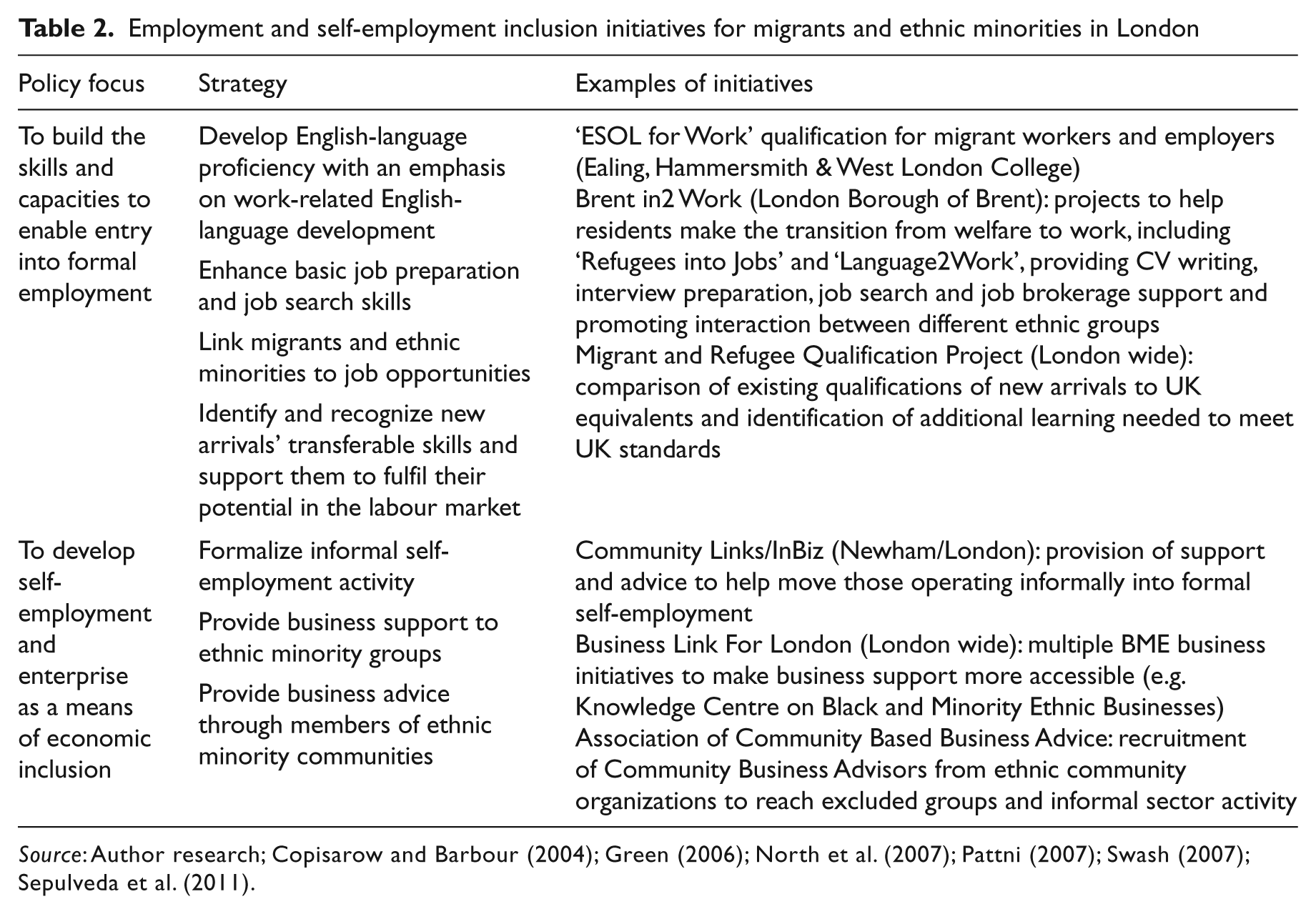
Source: Author research; Copisarow and Barbour (2004); Green (2006); North et al. (2007); Pattni (2007); Swash (2007); Sepulveda et al. (2011).
A further set of challenges concerns the impact of migrant workers upon the operation and regulation of primary and secondary labour markets in relation to issues of pay, unemployment, working conditions and job security. Overall, the presence of large-scale immigration appears not to have had any overall negative impacts upon employment and unemployment rates in London. However, there is evidence that the presence of large numbers of migrants working in low-skilled jobs has had a negative effect on wages at the bottom end of the labour market (LSE, 2007). The growth and persistence of low-wage employment in the London economy reflect wider structural changes, as low-skilled, low-wage, flexible and casualized employment in the service industries (for example, cleaning, catering, security, care work) has grown significantly. The presence of large numbers of migrant workers, strongly motivated to earn money for savings and remittances, who also often have limited or no access to benefits (depending on their migratory status), has provided a workforce willing to fill these jobs at low wages. This has ensured a high level of competition for these types of job, even during the period of strong employment growth in the late 1990s and early 2000s. As a result, the existing long-term unemployed – those least competitive in the labour market – have struggled to gain and sustain employment (TUC, 2007). Where sectoral and occupational segregation become severe within parts of the labour market, with certain jobs becoming closely associated with groups of particular ethnicity or migrant status in the labour market to create a so-called ‘migrant division of labour’ (Wills et al., 2009), migrant or ethnic workers can become locked into particular types of employment. This also has the effect of excluding other groups from participation, owing to employer recruitment practices and other workers feeling uncomfortable working within segregated workplace environments, a situation that can generate resentment between different population groups.
The vulnerability of migrant workers, particularly those who are undocumented, has allowed some employers to pay wages below the national minimum wage rate and to provide poor working conditions and job security – a situation that is enabled by the fact that migrants are frequently employed in working arrangements not covered by agreements between trade unions and employers (Commission on Vulnerable Employment, 2008). Despite these problems, given the generalized commitment to the pursuit of liberalized, flexible labour markets there has been limited attention paid by city or local government authorities to actions seeking to strengthen regulation at the bottom end of the labour market and improve levels of pay, benefits, working conditions and job security. Indeed, the scope for local- and city-level responses is limited in this regard because regulation of these activities is controlled largely by national policy. Where there has been activity on these issues, often this has been led by third-sector groups. Some impact has been achieved from high-profile broadly based campaigns that have brought together diverse third-sector groups, including migrant-based organizations, with local and city-wide government authorities and trade unions to campaign on specific issues. Examples here include campaigns in relation to low wages, through the pursuit of a London Living Wage, as well as on the regularization of undocumented workers and informal working practices (see Table 3).
Political campaigns related to the London labour market

Notes:
London Citizens is a grassroots charity working with local people in the pursuit of social, economic and environmental justice; it has a membership of over 100 civil society organizations from across London.
Community Links is a community-based organization based in East London.
These broad coalitions have had varying success in influencing London-wide and national policy direction, but they have brought together diverse communities in the pursuit of common goals and interests in relation to the wider problems of economic integration that beset those most marginally positioned in the labour market (for example, low pay and undocumented and informal working). By addressing the broader material conditions of the economically marginalized, such activities help to counter the growth of feelings among host populations and different minority groups that they are ‘losing out’ in the labour market to other population groups and ‘cheap labour from abroad’, feelings that are targeted by extremist parties seeking to promote racist agendas.
Governance challenges
Consideration of the evolution of policy and governance activity in relation to diversity and labour market development within London demonstrates a number of major issues. The first relates to the spatial imbalance that exists between the costs and benefits of diversity within the economic development process. The operation of labour markets takes place across a range of scales beyond the neighbourhood, predominantly at the wider spatial scales of the sub-region, the city and beyond, and it is at these levels that the benefits of diversity are most apparent. Certainly the wider London economy has benefited from increased diversity, particularly through immigration processes providing the appropriate skills for its development. In contrast, the social and economic costs of diversity are concentrated within particular localities. It is at the local level that the consequences of increased competition for low-wage jobs become apparent, as do the challenges and costs arising from increased pressure on the provision of public resources and of dealing with the impacts of high levels of population churn in neighbourhoods that act as reception areas for incoming migrants. A longstanding complaint from many London boroughs is that, given high levels of mobility, population estimates that provide the basis for central government budget allocations significantly underestimate migrant population levels, leading to considerable budget shortfalls. Within London itself, the strong reliance of local and city governance on central government finance means there are no effective mechanisms to transfer funds and redistribute wealth to areas in greatest need. The London Strategic Migration Partnership, in place since 2009 and chaired by the Deputy Mayor, has responsibility for developing a strategic overview of key issues related to the integration of migrants in London and the coordination of activity across sectors and authorities, but it lacks the means to redistribute resources on any meaningful scale.
The second challenge concerns understanding the evolving local–central state relations that are central to the trajectory of governance practice. In some areas, such as city marketing, devolution of power and the development of the Mayor’s office and related agencies have provided the basis for a more prominent and proactive pan-London role (Syrett, 2006), part of which has included the promotion of the ‘diversity dividend’ within its branding and marketing activity. However, in other key areas, such as in relation to low-wage employment, the regulation of migration flows or the regularization of undocumented workers, the ability to act locally is constrained by the national regulatory context. This lack of direct influence over key dimensions of the London labour market clearly inhibits the capacity of London’s governance authorities to act in relation to its particular economic and social needs and is a source of growing conflict in its relations with central government. One consequence is that stakeholders and interest groups from across business, the third sector and the local state have pursued their agendas by leading nationally oriented campaigns in relation to issues such as worker regularization, wages and reform of the immigration system. The varying impact of these campaigns demonstrates the limitations of reliance upon political lobbying activity and the differential power of interest groups to pursue their interests in this manner; but it also shows that such local action does have the ability to influence national-level debates and governance practice.
The third challenge involves the increasingly well-established shift away from particularist policies and activities towards pluralist provision serving diverse populations. This is a response in part to changes in national policies towards integration and cohesion, but also to the realities of operating within a context of super-diversity. In super-diverse areas, the fairness of pursuing particularist policies aimed at supporting the needs of specific ethnic groups has increasingly come to be questioned (Vertovec, 2007; Harrison, 2009). This reflects not only the practical problems of recognizing and supporting multiple ethnic groups in areas of considerable diversity but also the awareness that in certain neighbourhoods it is elements of the ‘host’ majority white population that may be suffering significant levels of deprivation and exclusion. 4 Such situations can lead some to argue that it is these ‘host populations’ groups who are the victims of discrimination, an argument that extremist political groups are always keen to exploit. The need to contest such arguments and to retain local legitimacy has encouraged local government in the direction of pursuing policies that centre on providing equality of access across population groups.
Conclusions
Diversity and multiculturalism present one of the strongest tests for contemporary urban governance, as institutions seek to balance the conflicting tendencies of libertarian and communitarian imperatives within liberal democracies and to reconcile the rights and responsibilities of migrants, ethnic minority communities and city residents with the desire for a sense of belonging, community and strong social bonds (Keith, 2005). The governance of urban economic development activity itself presents particular challenges, given that such activity routinely cuts across boundaries between the state, business and civil society and requires effective inter-agency cooperation (Skelcher et al., 2008). The governance of diversity in urban economic development is hence confronted by issues in relation to legitimacy, consent and accountability, which are often poorly served by traditional models of representational democracy and politics. The centrality of space and place in the playing out of diversity issues in the everyday life of cities points to the importance of developing an understanding of governance activity as rooted within local contexts – understood here in terms of their relationship with wider national and global processes – in order to develop socially just responses that contribute to the development of prosperous and economically inclusive cities.
The highly diverse city context presented by London demonstrates how economic governance practice is constituted within and across multiple scales. National-level policies in relation to migration, citizenship and economic inclusion play a central role in providing the wider regulatory context within which the development and realization of the governance of diversity is rooted. Yet, to understand the development and contradictions of governance practice and the working experiences of migrants, ethnic minorities and host populations, the variegated city context remain crucial. Differing London boroughs, localities, neighbourhoods and businesses demonstrate very different histories and experiences of multicultural living and working, which informs contemporary governance processes. In some situations, lengthy experience of multicultural working means there is strong formal representation of certain minority groups and a wealth of practical knowledge of issues related to consent, legitimacy and accountability within contested situations. In others, diverse populations are poorly served and integrated into existing formal governance arrangements.
At the pan-London level, the value placed upon plurality and the multicultural nature of the city in terms of its overall economic competitiveness is widely accepted and promoted across a range of governance stakeholders from different positions. For business interests and the current Mayor, support for economic liberalism within a global economy places a high value on the need for unrestricted flows of high-skilled workers and students for the health of London’s neoliberal growth model and wariness over a more restrictive immigration policy. At the grassroots level, multiple community organizations representing the plethora of minority populations within the capital have been highly vocal at local, city and national levels in opposing the shift towards anti-multiculturalist sentiments and the imposition of greater restrictions on their economic integration. Rather than a generalized ‘retreat from multiculturalism’, the shift towards a greater emphasis upon integrationist measures remains a highly contested process in London, unevenly developed over time and place, and played out within a wider city context that remains receptive to the acceptance and celebration of difference.
Although London provides a unique story of the economic development of a diverse city, the governance challenges encountered are of significance not only to other multicultural global cities but also to urban environments experiencing increased cultural diversity. First, London demonstrates the inherent contradictions of seeking to develop both a highly liberalized and globalized urban economy and cohesive communities. The growth of inequality and poverty within the London economy has taken place within patterns of work and worklessness that demonstrate an important ethnic dimension. Although the liberalized urban economy has had success in pulling in many migrant workers into the labour market, the nature of that economic integration process has reproduced inequalities and insecurities within the city’s residents and workers that have undermined the development of stronger social bonds. Second, the need to address diversity in relation to ‘super-diverse’ populations has contributed to the shift in practice away from actions oriented towards single minority groups towards ensuring a degree of equality across varied communities. Such change generates considerable tension, particularly at a time when local and city-wide authorities are faced with the pressure to support equality across diverse groups, while experiencing large-scale cuts in public funding, and where certain minority ethnic groups have been accustomed to support from past policy practice. Third, the scalar dimension to practice reveals the importance of developing and integrating governance practice across and within multiple spatial scales. In particular, improvements to the experiences of workers, migrant or otherwise, operating at the bottom end of the labour market require a combination of reformed national-level policies on pay and working conditions alongside more localized initiatives and delivery that are rooted within an understanding of the realities of living with diversity in specific local contexts.
Footnotes
Acknowledgements
An earlier version of this paper was presented at the 8th EURS Conference in Vienna in September 2010. We would like to thank conference participants, anonymous referees and the special issue journal editor Vassilis Arapoglou for their helpful comments.