




Abstract
The paper introduces the concept of territorial assets and discusses their role for regional development. Focusing on European societies and taking into account different strands of the literature on place and territorial capital, we argue that the endowment with – and mobilization of – such territorial assets could be seen as a key aspect of regional policy, producing changes in the attraction (and/or retention) of specific segments of population and, in a longer-term perspective, influencing sustainable development strategies. In this light, ‘territorial attractiveness’ – characterized in this paper in both conceptual and operational terms – is presented as a powerful element in European spatial policy, allowing regional development strategies to be more systematically integrated under an overall objective of territorial cohesion, while taking into account their implications in terms of human mobility.
Introduction
In recent academic and European Union (EU) debates on regional economic development and territorial policy, place assets and spatial qualities have increasingly been understood as factors for the attraction of economic agents and consequently as important features for local development strategies. However, the capacity and the potential to attract population and migration flows largely remain unexplored. This paper focuses on the territorial assets of European regions and how their mobilization can determine changes in the attraction (and/or retention) of specific segments of population and, in a longer-term perspective, influence sustainable development strategies. The approach adopted analyses the existence of specific combinations of territorial factors and the different groups of residents/population with their different interests. This goes beyond the simple idea that mobility is based on the deterministic presence of consumable territorial factors; rather it focuses on the potential existence of territorial patterns in which the complexity of individual choices may be articulated with combinations of spatial factors and social needs. In this sense, the paper is about both how assets are ‘consumed’ by users and how they are ‘produced’ and thus operate as forces of attraction and retention in a dual sense. Its main objective is therefore to contribute to the definition of ‘territorial attractiveness’, from the conceptual point of view and in policy terms, to contribute to the creation of a more systematic basis for the integration of regional development strategies into spatial policy, while taking into account their implications in terms of potential users’ mobility.
In order to explore the associated policy implications, we focus on EU policies because in recent years the EU has attached increasing importance to attraction factors in local development processes. If sustainable development and cohesion are the main EU policy aims, territorial attractiveness needs to be addressed strategically to ensure equitable responses to societal needs. Differences in attractiveness may explain, in part, variations in territorial performance. At the same time, policy may explicitly seek to boost the attractiveness of places to enhance their competitiveness, by mobilizing territorial assets, or to reduce regional disparities, through concerted efforts at a national or continental level to assist ‘lagging regions’ to catch up with more advanced ones.
Thus, local development and spatial policy in the EU face the challenge of developing a common understanding of the concept of attractiveness and its relationship with the EU’s major policy objectives. Given this, it is helpful to draw on the existing body of knowledge dealing with the way(s) in which attractiveness may contribute to both sustainable economic performance and cohesion across Europe.
The structure of the paper is as follows. We first introduce some of the key EU policy debates on (territorial) cohesion, attractiveness and mobility since 2000. We then review how the literature on attractiveness relates to that on territorial quality (particularly territorial capital) and seek to produce a ‘generic’ concept of attractiveness. This refers to the mobility of populations, thus distinguishing it from the mainstream economic approach to attractiveness, which usually focuses on firms and their localization processes. We identify some common traits in the array of disciplinary approaches on which conceptualizations of attractiveness draw, and we produce an operational framework addressing the most important objectives identified in these debates. In the fourth section we develop a tentative conceptualization of territorial attractiveness that is then related to two key issues: the spatial dimensions at which it can usefully be applied and the object(s) of attractiveness, that is, the ‘target groups’ (or mobile populations) assumed to play a key role in processes of urban and regional development. Based on this framework, in the final section we map out a future research agenda that seeks to integrate this body of knowledge into territorial attractiveness in order to respond to the challenges contained in key EU policy documents, before finally bringing together and summarizing our arguments and drawing conclusions.
One final point needs to be made: our focus in the paper is on cities and regions because the factors that are deemed necessary for ‘success’ are essentially identical. Nevertheless, we recognize that the two are not equivalent, and that, although cities may be seen as the key to a region’s overall success, they exist in a complex relationship of interdependency with the region in which they are situated. However, this relationship may take a number of different forms (for example, a unified city-region, polycentric or monocentric) and these relationships are by no means necessarily harmonious.
Attractiveness as an (EU) policy concept
Spatial and non-spatial policies, particularly those of the EU, may have a significant role in enhancing the attractiveness of places and regions by changing endogenous factors (determined mostly by geographical, cultural, institutional and historical factors) and producing shifts vis-à-vis the relative ‘positioning’ of regions. It is therefore important to understand what constitutes the attractiveness of European cities and regions and the implications of this for the development of policies to enhance the impact of European Spatial Directives, at a variety of scales, as well as the importance of sectoral (non-spatial) policies. Thus we first discuss the increasing significance of the spatial dimension in EU development policy and its understanding/use of the concept of attractiveness; second, we draw some policy implications and indicate ambiguities in the current policy domain.
The rise of a territorial focus
Examining the role of attractiveness as a policy concept with reference to regions and cities in EU policy discourse makes it clear that it emerged only gradually in the post-2000 period. The Lisbon and Göteborg Strategies made no explicit mention of these issues. Put simply, Lisbon was largely concerned with making the European economy the most competitive in the world, and Göteborg bolted on a sustainability dimension; in neither case were the spatial impacts explicitly considered. As a narrative illustration of these changes in thinking, we will primarily use the Commission’s reports on economic and social cohesion, and associated documents, as exemplars.
The European Spatial Development Perspective (ESDP, 1999) signalled the inauguration of the recognition that the economic and social dimensions had spatial/territorial impacts that policy needed to take into account. What began to develop was an argument that policy, at European, national, regional and local levels, needed to be framed with this in mind and that it could, if developed and applied in an integrated and targeted manner, address regional disparities/imbalances. Thus, in the Second and Third Reports on Economic and Social Cohesion (CEC, 2001, 2004), there was more of a focus on these issues, particularly in the light of the impending accession of a new group of member states. The Third Report argues:
In policy terms, the objective is to help achieve a more balanced development by reducing existing disparities, avoiding territorial imbalances and by making both sectoral policies which have a spatial impact and regional policy more coherent. (CEC, 2004: 27)
Here the focus is on territorial imbalances ‘that threaten the harmonious development of the Union economy in future years’ (CEC, 2004: 27) – for example, the over-concentration of economic activity and population in the core area of Europe (or, as the ESDP calls it, the ‘pentagon’) and a range of other territorial disparities. Mobility is understood as taking place at a European level into the pentagon from outside and within countries to capital cities and growing cities producing a range of imbalances at different spatial scales. The Report goes on to argue: ‘These territorial disparities cannot be ignored, since . . . they affect the overall competitiveness of the EU economy’ (CEC, 2004: 28). The answer proposed is the promotion of more ‘balanced development’ to reduce the disparities.
Thus, by around 2004–5 a more explicit consideration of the role of cities and regions in relation to territorial cohesion and addressing territorial disparities began to emerge in EU policy documents (see CEC, 2004, 2005). Cities were increasingly seen as ‘engines of regional development’, and attractiveness, and by extension mobility, is understood partly in terms of accessibility but also, reflecting the influence of Florida’s work (2002, 2003), in broader terms related to quality of life and the role of culture as a ‘“soft” locational factor in attracting knowledge workers’ (CEC, 2005: 12). In addition, the notions of balance and harmonious development imply a desire to see a more even distribution of economic activities across the European space, with particular attention being paid to lagging and/or peripheral regions.
In the Fourth Report (CEC, 2007), attractiveness and mobility appeared as factors to be addressed by policy because they affect cohesion. The causes of mobility were conceived primarily in economic terms: ‘Economic factors in the form of differences in income levels and employment tend to be the main factors inducing people to move between regions’ (CEC, 2007: 44). This was seen to apply particularly to capital cities, in all regions, which attracted population from within their own countries and other countries. The key determinants of attractiveness were seen as ‘good basic infrastructure and accessibility; a well educated work force; good ICT infrastructure and extensive use of ICT; a relatively high level of spending on R&D’ (CEC, 2007: 74). But, the Report also noted that ‘[n]on-economic factors, . . ., in particular, the quality of life and the attractiveness of the environment, seem to have an increasing effect. The regions concerned include a number with relatively low levels of GDP per head’ (CEC, 2007: 46). Also included among the non-economic factors related to quality of life were levels of health provision and effective institutions. Thus, a more complex notion of attractiveness and mobility (and, by association, the reasons for mobility) had begun to develop.
By the time of the Fifth Report’s publication in 2010 (CEC, 2010a) an apparent sea change had begun to take place in thinking, signalled by the Green Paper on Territorial Cohesion (CEC, 2008), whose subtitle was ‘Turning Territorial Diversity into Strength’. From the very outset the Green Paper emphasized Europe’s rich territorial diversity and the need to draw on this in strengthening cohesion and growth. Thus it argues:
Territorial cohesion is about ensuring the harmonious development of all these places and about making sure that their citizens are able to make the most of inherent features of these territories. As such, it is a means of transforming diversity into an asset that contributes to sustainable development of the entire EU. (CEC, 2008: 4)
Although attractiveness is not explicitly discussed, it is clear that diversity is a factor of attraction that can be utilized to generate growth by both attracting investment and mobile populations while retaining existing residents. Although the Barca Report (2009), with its emphasis on a place-based approach, had yet to be published, the notion of a more general ‘place-based approach’ is also implicit in this strategy. The Green Paper represents a step away from understanding a place-based approach as referring to a restricted range of ‘special urban and spatial initiatives’ towards a more generic approach bringing together the territorial, the social and the economic dimensions in an integrated manner focused on meaningful places of intervention (see Barca, 2009: 93). A key assumption underlying this approach is that only by focusing on the (diverse) strengths of places can more harmonious development can be achieved. Indeed, the Barca Report went on to provide a much more solid foundation for such a strategy to operate as a general approach.
The Sixth Progress Report on Economic and Social Cohesion (CEC, 2009) highlights several of these themes: ‘The goal of territorial cohesion is to encourage the harmonious and sustainable development of all territories by building on their territorial characteristics and resources’ (2009: 11). Moreover, following Florida, the Report contains a specific focus on creativity and innovation, arguing that these two factors are crucial to regional development in all regions (2009: 4–6). Central to this process is the attraction of talent and visitors. So-called ‘soft factors’ such as tolerance are seen as underlying the process and explicit links are made between diversity, tolerance and creativity: ‘Tolerance of different backgrounds and lifestyles helps not only to retain and attract talent, but also to create the open environment in which creativity thrives and diversity is valued’ (2009: 5).
The Fifth Report sums up this line of thinking:
[T]he regional diversity in the EU, where regions have vastly different characteristics, opportunities and needs, requires going beyond ‘one-size-fits-all’ policies towards an approach that gives regions the ability to design and the means to deliver policies that meet their needs. This is what Cohesion Policy provides through its place-based approach. (CEC, 2010a: 13)
Within this context, greater consideration is given to the impacts of migration, from outside and within the EU, on either exacerbating or ameliorating regional disparities (CEC, 2010a: 84–90).
Policy implication of attractiveness
The above policy narrative contains a duality. On the one hand, there is the dominant discourse that EU policies should support the competitiveness of regions (and cities) through development strategies designed to boost regional economic growth and, currently, to assist in recovery from the economic crisis. On the other hand, there is the cohesion approach, which places greater emphasis on spatial issues (territorial and social cohesion, sustainable development, and so on) and disparities, supporting initiatives directed at lagging regions.
More recently, the place-based approach has emerged as a mediating factor facilitating more long-term, sustainable development processes, tailored to territorial characteristics. The focus has moved towards strategies that, to varying degrees, support endogenous development and/or the attraction of capital and firms. Understanding of the dynamics of population mobility has gradually shifted an assumption that population fluxes are determined mainly by economic factors towards one that incorporates some generalized notion of the ‘search for quality’. This recent emphasis, based on territorial diversity and a ‘respect for the uniqueness of place’, could be seen as an attempt to ‘build a bridge’ between competitiveness and cohesion.
Nevertheless, ambiguities remain concerning notions of place and mobility in EU policy. The free movement of people is one of the pillars of the EU. However, there are inherent tensions underlying this principle when it is related to territorial cohesion and economic development. Local populations are comparatively fixed in terms of human capital relative to a place, and each place has its own identity, national traditions, specific welfare structures, and so on that additionally tie people to them. In this situation, cohesion is crucial and local factors (that is, endogenous characteristics) can (potentially) boost economic growth. Place-based policies are thus central. The problem is that this emphasis on the endogenous characteristics of place is to a certain extent an ‘article of faith’ – attempting to square the cohesion circle by arguing that all places have the potential to grow/develop if only the right policy mix and associated forms of mobilization of assets can be achieved. There is little evidence to demonstrate that such an ‘ideal’ can be achieved because much of the evidence suggests that labour movement (a particular form of mobility and attraction) for a significant section of the ‘mobile’ population is largely determined by employment opportunities (that is, it is based on economic factors). Other forms of mobility may reflect the importance of soft factors or be temporary forms of mobility related to ageing populations (for example, second homes) and various types of tourism.
Clearly different discourses have been stressed by different EU policy orientations, leading to different strategic policy options depending upon the particular objectives assigned to cities and regions (Servillo, 2010). Several variables may influence the attractiveness of places and its political applicability. What this discussion highlights is the complexity, variable meanings and vagueness associated with attractiveness and cohesion in the policy discourses of the EU.
The concept of attractiveness: meanings, perspectives and challenges
Here we develop a ‘generic’ notion of attractiveness on the basis of an overview of theoretical approaches seeking to identify the capacity of places to ‘attract’ and how this impacts (positively and negatively) on places. In the following subsections we explore it from two points of view. First, we consider the concept of the quality of places and the rise of a new cultural-economic paradigm. The focus is on the knowledge-based and creative economy and on factors identified as crucial in determining the quality of places and economic development. Second, we utilize the concept of milieu and its focus on ‘local factors’ to understand the complexity of situated economies, which highlights the (complex) notion of territorial capital and the mobilization of assets.
The quality of places and the new cultural-economic paradigm
The notion of ‘quality of place’ has become increasingly important in the debates on urban and regional competitiveness. These debates have deployed a wide-ranging literature on various aspects of quality of life (a concept with multiple definitions), the value of urban amenities and other place characteristics. Increasing attention has been paid to ‘soft’ subjective measures associated with economic competition (Trip, 2007), particularly their impact on economic development (for example, how they affect firms’ location decisions), rather than people (for example, Rogerson, 1999; McCann, 2004). By contrast, Foster (1977) emphasized the importance of investments in social infrastructure for people rather than only for firms, others (for example, Clark et al., 2002) highlighted the importance of public and lifestyle amenities in cities to attract talented high-tech staff, and Portney (2003) related the level of environmental quality that individuals experience to a city’s economic growth. The discourse has progressively shifted from a focus on the ‘quality of the economic environment’ to the ‘quality of places’. This has emphasized the more intangible aspects of a place that are embedded within local socio-spatial configurations and relations.
In parallel, the issue of empirically assessing the attractiveness of cities and regions has been addressed in two main ways: (1) through the measurement of what are believed to be the most important aspects of a city or region’s factor endowments; (2) by an evaluation of the outcome of these endowments in terms of actual economic performance. Most studies, however, focus on factor endowments: the more endowed a city/region, the greater its chances of prospering.
For at least two decades the primary focus, with regard to the type of assets, has been on the so-called knowledge society. Here the leading edge of growth and innovation in the contemporary economy are sectors such as high-technology industry, neo-artisanal manufacturing, business and financial services, and cultural and creative industries. Together these sectors constitute a ‘new economy’ (Trip, 2007) that is strongly reliant on the creation of new symbolic meaning, something that is closely associated with situated knowledge and its articulation with global cultural and information flows. The considerable growth of cultural industries in the last decade, along with their importance for the economy as a whole (Russo and Van der Borg, 2010), has led to arguments that a new ‘economic order’ has emerged (Simmie, 2005) that assigns culture and information a key role in regional and urban economies.
The epicentre of this revolution is the city (or city-region) and the new role such areas have acquired as the main hubs of global networks and flows (Amin, 2002). The growing profile of this ‘cultural-economic paradigm’ (Amin and Thrift, 2007) affects not only the economic morphology of cities but also, increasingly, the physical (Soja, 2000) and social landscape. The face that the ‘successful’ contemporary city presents to the external world tends to be organized around the living (and consuming) environments of high-end segments of the job market, including state-of-the-art educational facilities, expensive shopping and catering facilities, and high-quality residential enclaves and cultural amenities.
A corollary of this is that the (perceived) capacity of cities to access, process and creatively use information and knowledge to produce competitively and innovatively is strongly linked to the characteristics of cities’ social capital and their consumption landscapes. Thus cities seek to engage actively in an ‘upscaling process’ whereby they attempt to become central nodes in the global knowledge economy by nurturing the appropriate conditions (for example, the ‘openness’ of deregulated forms of governance) in an attempt to increase their chances of attracting mobile and talented human capital, which is considered the main engine of innovative and competitive economies. The capacity to do this is assumed to create a ‘virtuous circle’ whereby success breeds success related to the synchronization of urban spatial dynamics with global trends.
Florida has moved these debates from a conceptual dimension to a policy-oriented terrain (2002, 2003, 2008; Florida and Gates, 2001; Florida and Tinagli, 2004), with considerable influence on policy debates. The debates seek to relate urban economic development and the behaviour of ‘creative’ workers, rather than firms or managers, addressing the conditions that collectively make a city an attractive place of residence and work for the ‘creative class’. The relevant attributes are considered to be economic and spatial diversity, leisure and cultural amenities that reflect the interests of this class, a diverse population, the chance of informal meetings in so-called ‘third spaces’, safety, vibrancy and indefinable aspects such as authenticity, tolerance, street life, etc.
However, Florida’s work has been criticized for a number of shortcomings. Among these is that he treats the ‘creative class’ as an undifferentiated mass (Markusen, 2006) and fails to recognize significant economic, social and political differences between the various groups lumped together and the very different roles they play. Furthermore, Scott (2006: 11; see also Scott, 2008: 80–3) argues that Florida ‘fails . . . to articulate the necessary and sufficient conditions under which skilled, qualified, and creative individuals will actually congregate together in particular places and remain there over any reasonably long-run period of time’. Moreover, the process by which pools of creative talent lead place economies to be competitive remains a ‘black box’: most critics argue that when policy makers go beyond the attractive rhetoric of Florida’s work there is little of substance to guide actions (for example, Markusen, 2006).
Although insights from Florida’s work are relevant, particularly with regard to ‘quality of place’, more attention needs to be paid to the process elements that coalesce to create attractive and competitive locations. From this point of view, one has to question whether specific conditions and retention policies for the creative class are sufficient to guarantee the success of local development strategies.
Milieu, territorial capital and mobilization of assets
Central to this approach are the concepts of local milieu and innovative milieu, which have helped move the debate forward in terms of understanding the complexity of situated economies, focusing on the capacity of regions to develop and/or attract new productive capacities (Cambridge Econometrics, 2003) while simultaneously addressing the needs of those who live there (that is, in terms of employment and services). Instead of focusing on one particular ‘group’ (for example, the ‘creative class’) as the driving force in the process and on whom all efforts must be targeted, this approach recognizes the importance of (often intangible) sociocultural aspects in constituting development factors.
Local milieu has four basic characteristics (Maillat, 1995): (1) a group of actors (firms, institutions), relatively autonomous in terms of decision-making and strategy formulation; (2) a specific set of material (firms, infrastructure) and immaterial (knowledge, know-how) elements; (3) institutional elements (authorities, legal framework) and interaction capacity between local actors based on cooperation; (4) internal self-regulating dynamics and the ability of actors to modify their behaviour and find new solutions as their competitive environment changes. These are the ‘static characteristics’ of the milieu that constitute the resource endowments of a place. Alongside these, some form of (local) dynamism is seen as necessary to initiate (and perpetuate) the creative process. This is referred to as an ‘innovative milieu’ characterized by a ‘common understanding’ based on common behavioural practices as well as a ‘technical culture’ linked to a specific type of economic activity (Coffey and Bailly, 1996).
Territory is not simply a ‘container’ in which attractive location factors may or may not happen to exist, but is an ensemble for collective learning through intense interaction between a wide range of actors (Moulaert and Sekia, 2003; Moulaert and Nussbaumer, 2005). Territory is a socially produced space, both a result of and a precondition for learning – an active resource rather than a passive surface (Coffey and Bailly, 1996; Hallin and Malmberg, 1996).
The above elements – which add to, and do not substitute for, more traditional, material and functional approaches – can be encompassed and summarized by the concept of territorial capital. This notion was proposed in the regional policy context by the Organisation for Economic Co-operation and Development in its Territorial Outlook (OECD, 2001) and has gained increasing influence in the policy-making and EU institutional debate (Dutch Presidency, 2004). The concept addresses the combination of material and immaterial aspects of regions and their capacity to influence economic development and symbolic representation (Smith and Von Krogh Strand, 2011). In particular, the concept of territorial capital includes a functional and a cognitive approach, arguing that material assets are able to generate their greatest impact on growth when non-material, cognitive assets such as trust, cooperation or a sense of belonging are present (Camagni, 2008; Camagni and Capello, 2009).
Although not explicitly using the term ‘territorial capital’, Deas and Giordano (2001) explored the relationship between the sources (the stock of assets in a city) and outcomes of competitiveness (the result of attempts to exploit these assets by firms) across a sample of urban areas. They argued that urban asset bases provide a strong predictor of competitive performance but that this general pattern is interrupted in some cities where competitive outcomes are stronger or weaker than might be expected given their underlying asset bases. Two aspects can be underlined here: a definition of assets that is similar to the notion of territorial capital; and the focus on the mobilization of local assets as crucial to the difference in performance between places.
The second point reflects the assumption that the effectiveness with which assets are exploited is conditioned in part by the actions of individual and collective agencies (as well as through more nebulous ‘market forces’), but also by the way in which a territory is governed. This refers to what Buckley et al. (1988) termed the ‘management process’, which can be used to understand the efforts of local policy actors to create, exploit, supplement and replenish local asset bases and to transform liabilities into assets (Deas and Giordano, 2001). Moreover, it suggests the need to recognize that there are a range of ‘different users’ in a territory who do not have a uniform set of needs; the ability to both recognize and find a way of reconciling differing needs is a mark of an inclusive governance system.
It is thus necessary to consider the concept of attractiveness from a governance point of view, particularly two aspects. First, governance can be a factor of attractiveness; a well-established and reliable governance system can be a factor of localization. Second, attractiveness is a concept that shapes the territorial governance process itself, most notably the ‘mobilization process’ through which territorial assets are activated. Moreover, it draws attention to the ‘production’ of attractiveness (that is, as an active process) rather than simply to its ‘consumption’ by users.
Territorial attractiveness and mobile populations
In this section we bring together the threads of the debate to introduce a tentative conceptualization of territorial attractiveness. This represents an integrative framework for spatial policy aspiring to serve as a basis on which to develop a research agenda on the coherence and consistency of regional development in the context of the general objective of ‘territorial cohesion’, as articulated by the European Union (see the introductory section).
Here we first provide an overview on population flows and factors of attractiveness and address the issue of externalities and potential conflicts between populations characterized by different ‘mobilities’. Then we present a theoretical model that integrates the notions of territorial capital, mobilization of assets and ‘audiences’ to produce a more nuanced and flexible notion of territorial attractiveness.
Mobile populations and different potential users
Having discussed different notions of ‘attractiveness’ and how places may engage in development processes based on the attraction and retention of human capital, we now consider the targets of attraction policies. We present human mobility as a heterogeneous phenomenon, articulated at different and multiple levels with place and development processes, including the existence of ‘fast movers’ and ‘slow movers’ who are characterized by different capacities to reconfigure places according to their lifestyles and habits.
In terms of what drives mobility in the contemporary age, and who is ‘on the move’ and with what consequences, we need to understand the complexity and variety of factors such as work, civic freedoms and convenience that underlie migration (see Williams, 2009; Perrons, 2010) and elements that are encompassed in a new social epistemology of mobility (Sheller and Urry, 2006; Urry, 2008). In this approach, different ‘audiences’ may be attracted to a city or region for different reasons and according to varying patterns of ‘transience’ (Martinotti, 1993), which may qualify both the duration of their stay in that area once attracted there and the ‘stability’ of the relations that they establish with places. In our mobile society, the simple binary of extreme volatility (for example, traditional tourism) and sedentary livelihoods has been overlain by several other ‘fluid’ and interstitial forms of mobility. This ‘fluidity’ also increasingly suggests that the same factors may attract flows of varying scope and thrust that were once believed to be associated with distinct spheres: hence the disappearance of the ‘absolute worker/resident’ in contrast to the ‘absolute tourist’, and the appearance of mobile denizens or consumers characterized by varying degrees of transience: specific groups of ‘fast movers’ are more willing and able to switch between places on the basis of emerging opportunities, whereas slow movers are ‘locked in’ to their work or social context.
Such flows are mobilized by a much wider palette of pull factors than good employment or leisure amenities, encompassing intangibles such as social and cultural vibrancy, safety and tolerance, and good public services. These factors, in turn, are potentially present to varying degrees (or have been ‘boosted’ through explicit ‘attraction policies’) in geographical patterns that break down the traditional binary between urban and rural environments and, at a larger scale, between the affluent north and the lagging south. In this complex context, the identification of universal trends in mobility is difficult. Although unevenly distributed employment opportunities continue to be the main ‘neoclassical’ driver of migration (ESPON, 2008: 24), this is increasingly interwoven and overlapping with other factors, to produce a richer (and to some extent chaotic) map of mobilities, where the traditional south-to-north and east-to-west trends reveal finer textures of flows within and between different types of region and/or geographical area, and different levels of ‘stickiness’ or resilience of such flows. Such factors exert different degrees of pull for specific groups, producing a highly segmented mobility pattern, whose main traits may be the following:
highly skilled expert labour flowing to the traditional and new economic capitals of Europe or to their green belts within metropolitan areas;
middle-class households moving out of congested city centres to well-connected second-rank cities;
young educated talents fleeing to ‘hotspots’ that offer a good balance of low entry barriers and opportunities for start-ups (for example Berlin and Barcelona);
unskilled labour forces from lagging EU and non-member countries looking for a large pool of positions in traditional sectors (for example, commerce, construction and tourism) – although they are also subject to strong ‘path dependency’ that is socially constructed through earlier migration waves, sometimes dating from postcolonial flows, and to an increasing level of sensitivity to local democratic qualities in the face of stricter immigration policing and a less tolerant attitude among sectors of traditional residents.
This classification, derived from works that address fine-grained and qualitative aspects of mobility and population change (for example, Nijkamp, 2011: 19; also Hoggart and Hiscock, 2005; Addison, 2008; Kabisch and Haase, 2011), reveals that, although the main generative environment of a knowledge-based and mobile society is the city (Bauman, 2000), within metropolitan regions there are different places and settlement types (from densely urbanized city cores to green areas at their boundary) that may appeal to different audiences.
At the other end of our ‘stickiness spectrum’ of mobilities, temporary or non-structural migrations are also arguably mutating into a more complex phenomenon. The dominance of mass tourism is increasingly questioned by the progressive erosion of its economic and sociological foundations; the consequent disbandment of its mono-directional core–periphery pattern, shifting the middle classes of Europe from the industrial north to the sunny south, and to a lesser degree from the urban to the rural in specific periods, is giving way to a far more complex and polycentric pattern. Categories of unorganized, independent, special interest travellers (for example, short-stayers in urban destinations), as well as new fluid forms of leisure- or non-work-driven mobility, increasingly overlap, in a confused manner, with the features of other mobile residents. Examples of this are second-home owners, retired couples buying property in the sunny belt of Mediterranean Europe and becoming permanent residents there, foreign students on Erasmus visits, neo-bohemians ‘finding themselves’ in a big city for a few months and working on a part-time basis (Quaglieri Domínguez and Russo, 2010) and health tourists.
The attraction factors for these varied forms of tourism may be very different. Neoclassical considerations of price and accessibility (crucially tied to the degree of ‘industrialization’ in the structure of the local tourist supply) may remain predominant with regard to what remains of the old mass tourism model, whereas other ‘post-Fordist’ forms of tourism are more sensitive to genuine place qualities and experiences, ‘mental’ or cultural accessibility, and a certain ‘visitor-friendliness’ in the organization of tourist experiences (Russo and Van der Borg, 2002; Richards, 2007).
Cities and metropolitan regions are the hub of a dense web of human mobility whose drivers and patterns have dramatically multiplied in recent decades, sharing traits of the different factors that make them attractive. Thus, following Martinotti (1993), we acknowledge the emergence of ‘externalities’ (inconsistencies or fruitful synergies) from the superimposition of different populations inhabiting, using, consuming, mobilizing and characterizing places to different degrees and according to different capacities. The attraction exerted by a place on some audiences as a consequence of its collective capacity to mobilize territorial assets in a certain direction may either strengthen or reduce the attractiveness of that place for others. This can be seen in relation to the simple binary of the two macro-categories of tourists and residents, as shown in Figure 1, but this analysis could also be articulated in a more sophisticated way when more finely segmented categories of place users or audiences are considered, revealing key issues that attraction policies should consider.
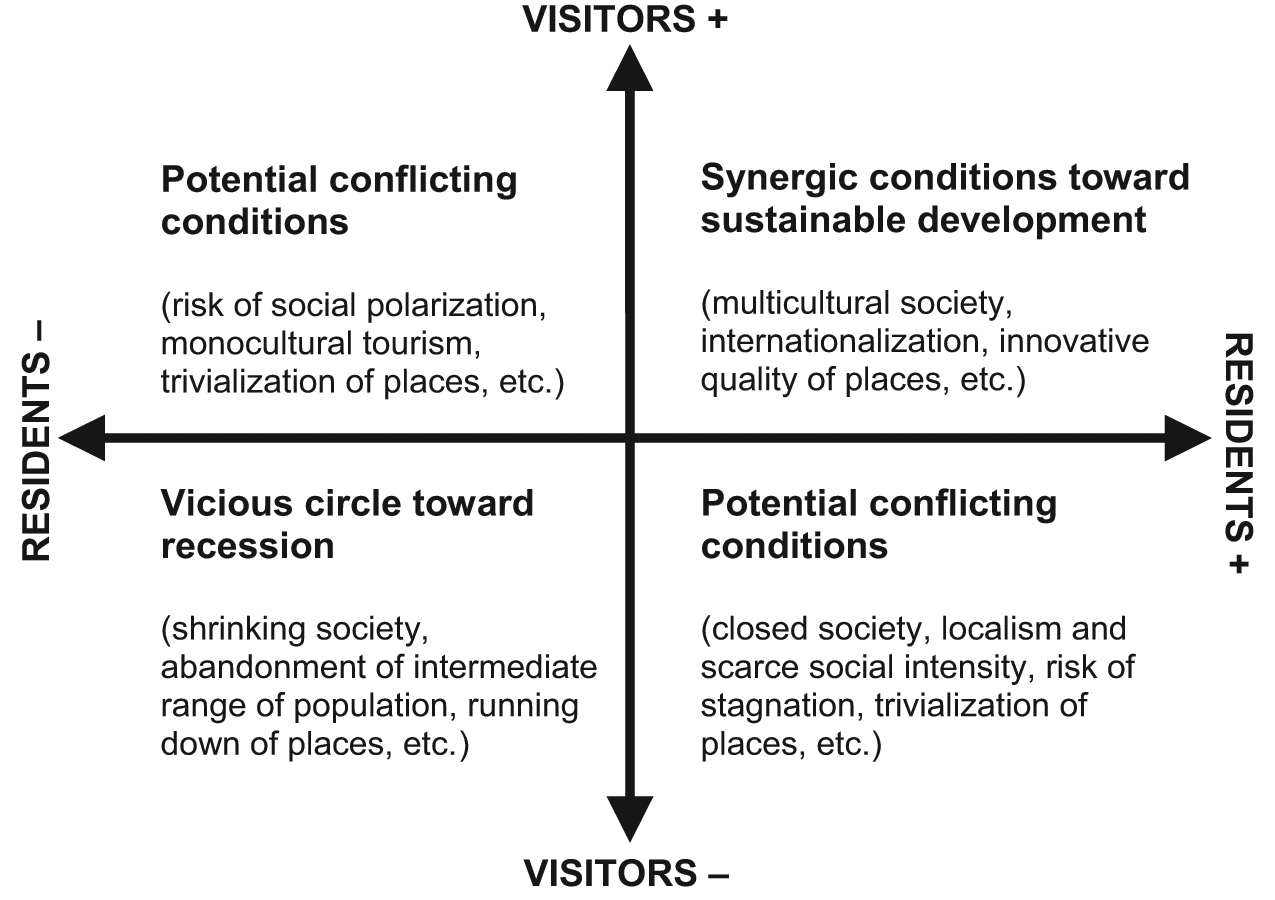
Visitor–resident externalities
For instance, although it can be argued that new knowledge workers, university students and neo-bohemians, on the one hand, and blue-collar workers, long-term residents and immigrants, on the other, all contribute in various degrees and ways to the development of a competitive city, their mix and compatibility can be problematic. In fact it is commonly observed how upmarket workers gentrify popular areas and crowd out older residents, who, however, provide character and a sense of ‘identity’ to places, contributing to their attractiveness. Second-home residents or ‘silver’ long-stayers are believed to bring a sustained contribution to the local societies in which they relocate (Rodríguez, 2004), but they are also seen as placing intolerable pressures on the level and delivery of public services and health. These relations are also highly dynamic and follow evolutionary patterns (Quaglieri Domínguez and Russo, 2010). Certain groups ‘construct’ places through their practices – as is the case with bohemian populations in city centres, artists’ collectives or traditional social groups – which in this way become attractive to other groups, such as traditional tourists and upscale workers, producing a transformation through gentrification and displacement.
Territorial attractiveness: an analytical framework
This suggests we need an interpretative scheme able to analyse the processes of perception of place and spatial economies for different types of users and to assess the overall outcome(s). Accordingly, our theoretical overview of the attractiveness of places involved three main aspects. First, we identified the asset side of the attractiveness of a place and its different characteristics; then we specified the different potential users for whom attractiveness should be measured. However, in the middle of this duality, we identified the way such assets are mobilized and the underlying policy objectives to be achieved (for example, enhancing attractiveness while simultaneously addressing potential conflicts between different populations). The scheme in Figure 2 helps us to understand the interpretation of the concept and the relationships between the different elements.
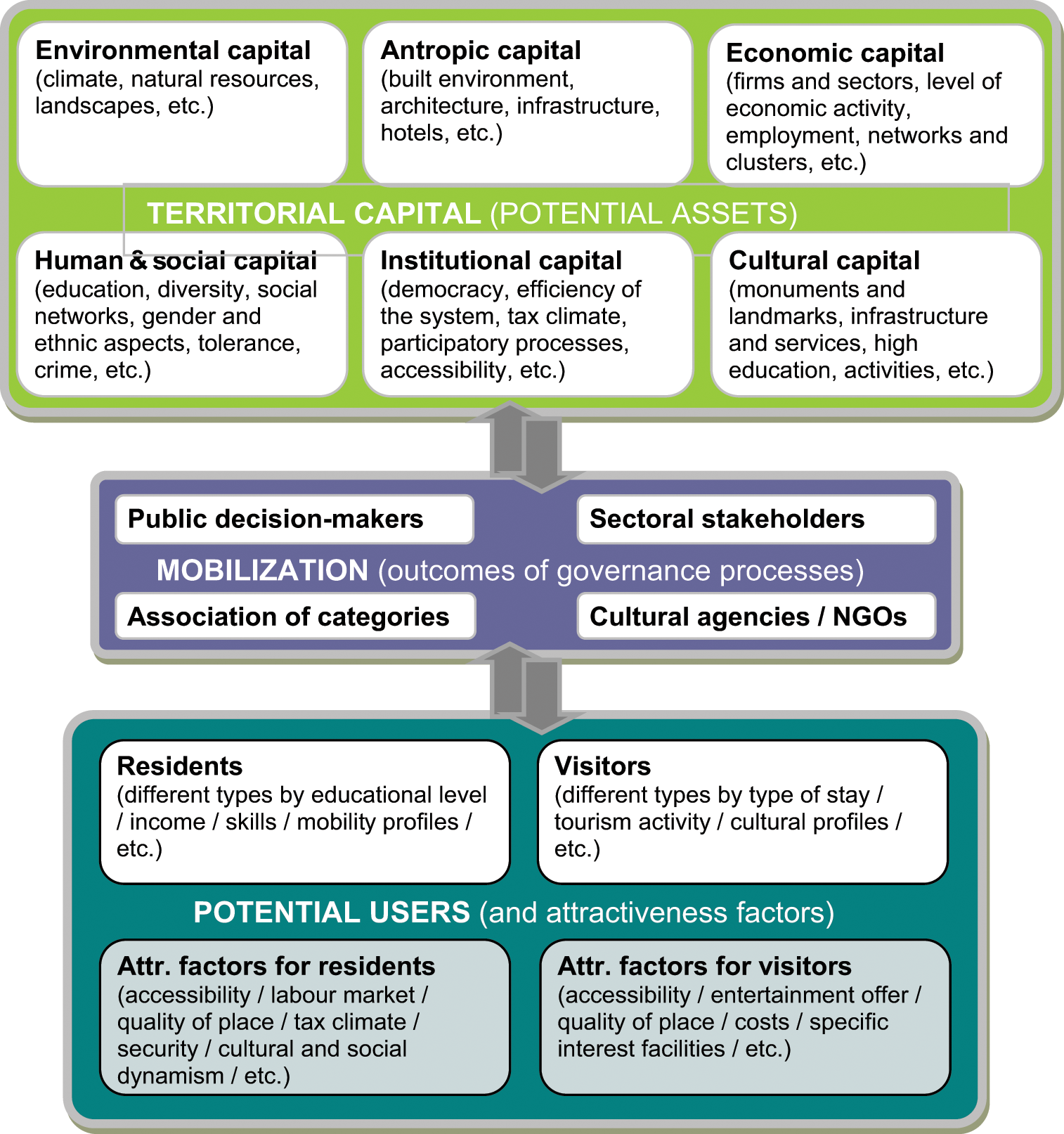
Process aspects defining the attractiveness of places, and linking assets to users through mobilization strategies
In this scheme, territorial capital is a crucial dimension of the attractiveness of places. It is intended as a complex system of natural and socioeconomic elements, defining the uniqueness of local assets. Deas and Giordano (2001) identified four elements of the ‘static capital’ of a place: the economic, institutional, physical and social environment. However, according to Camagni and Capello (2009), a stronger distinction based on the utilization of assets would allow a more fine-grained focus on the governance aspects. In order to achieve this, we divide the physical elements into antropic capital (the man-made elements, where agents can have decisional responsibilities) and environmental capital, the latter being a combination of ecosystem characteristics (climate, landscapes, and so on). Moreover, the distinction between human and social capital, on the one hand, and cultural capital, on the other hand, highlights the education and diversity of the population and its social network capacity, its tolerance and so on in the former, and the presence of cultural features and activities of the local scene in the latter. Institutional capital has a dual status, being both a feature of attractiveness and necessary for the mobilization of assets.
Secondly, the attractiveness of a place stems from a combination of different assets and from the way(s) they are mobilized, both by governmental and non- governmental organizations (NGOs) and by institutional actors (sectoral stakeholders, NGOs, etc.). This approach offers a dynamic perspective on territorial capital, since the relationship between assets and attractiveness is potentially mutually reinforced through a continuous process of mobilization that seeks to enhance the existing stock of assets. In this context, governance arrangements are crucial to the mobilization and use of assets. This requires the existence of links, often articulated through organizational arrangements (for example, partnerships) between stakeholders, local authorities, agencies and citizens, in order to identify, create and mobilize assets and develop policies to achieve specific (attractive) strategies.
Third, territorial attractiveness is not an undifferentiated concept with regard to all categories of citizens or for all possible target groups. The attraction exerted by a place on some ‘audiences’ as a consequence of its collective capacity to mobilize territorial assets in a certain direction may either strengthen or reduce the attractiveness that the same place has for others.
To sum up, the scheme in Figure 2 takes into account the broad perspective elaborated in the previous theoretical debate, including the role of hard and soft assets, social aspects of attractiveness and intangible elements. Moreover, it moves beyond static milieu factors to include a dynamic process of mobilization of assets through more or less institutionalized governance processes. This gives a policy dimension to the concept, which leads to a further consideration: attractiveness is a concept that should be specified in relation to certain categories of possible users/inhabitants for whom the assets are mobilized.
Final remarks: towards a research agenda on attractiveness of regions and cities
We have argued that the concept of territorial attractiveness is a powerful way to draw attention explicitly to the spatial aspects of places and emphasize their complexity, while simultaneously acknowledging their differential capacity to provide and mobilize attraction factors, with regard both to existing and potential future residents and to various types of visitors. This approach requires the identification of what makes a place ‘different’ and ‘unique’, assessing how such characteristics can be utilized, identifying problems and then developing longer-term concerted action that simultaneously addresses a number of different issues and audiences in order to enhance the attractiveness of a place. In this sense, the paper has pointed to the importance of the assets and potentials characterizing territories and the modalities through which such assets can be mobilized in order to contribute to the creation of new development paths and visions.
The richness of the EU territory resides in the diversity of its places and the variety of their characteristics, representing strong economic assets in terms of development potentials and the main factors through which equity and cohesion can be pursued. As we have seen, the attractiveness of a territory is crucial for its development strategies, not only for the exploitation of its resources for tourism but also in a broader sense. Places need to be able to attract (and retain) capital, labour and intellectual skills and to improve their economic performance both in a competitive global context and for supporting sustainable strategies.
Nevertheless, it is sensible to bear in mind that not every place can achieve this transformation and that there will be ‘winners’ and ‘losers’ in the race for enhanced attractiveness. Nor will places that enhance their attractiveness necessarily be able to achieve some sort of magical equilibrium (in either the short or the longer term) between the different audiences (for example, types of resident and types of visitor) they seek to address. Tensions and even conflicts are likely to be inherent in this process.
A crucial aspect in this quest for balance concerns governance processes, where the role of different stakeholders represents the strategic dimension necessary to activate the assets that constitute territorial capital. This aspect deserves particular attention. As we have suggested, this requires more flexible and inclusive modes of governance and leadership that focus on what exists in terms of assets and how these can be developed in the future to enhance the quality of place without sacrificing particular (marginal) groups to the perceived need to enhance competitiveness and without generating spatial and social conflicts.
From an EU perspective, a research agenda must face the challenge of developing a common understanding of the relationship between the concept of attractiveness and the policy aim of competitiveness and cohesion of European regions and cities. This will provide evidence on how the attractiveness of European regions and cities for residents and visitors can contribute to the EU’s ‘Europe 2020’ agenda. However, an approach has to be found that does not impose a ‘common model’ on all places. Rather, it requires a ‘flexible’ placed-based approach within an overarching strategy that genuinely seeks to achieve a balance between different orientations in a multilevel governance framework.
On this basis a number of empirical research questions can be raised, of which two are of particular relevance. First, the relationship between the key factors/criteria of attractiveness and specific audiences needs to be investigated. Second, this approach needs to be developed and an analysis made of to what extent, and how, such key factors/criteria have been mobilized to achieve a particular outcome (or set of outcomes) related to attractiveness.
Key factors/criteria and audiences
‘Attractiveness’ is a complex and multifaceted set of characteristics; the relative balance of factors that attract varies depending on the groups that are at the centre of attraction strategies (high-skilled workers, second-home owners, tourists, and so on). A key component of research into regional development, therefore, is identification of the roles of environmental, physical and social attributes in reinforcing (or diminishing) the attractiveness of regions for each group. Our discussion on the nature of the relationships between bundles of place-based assets and their influence on the location decisions of the particular communities of interest or stakeholders suggests that three main variables should be taken into account: the different factors that constitute attractiveness, the categories of citizens related to them, and the different scales at which they are considered. For instance, depending on which particular categories of citizens are the focus of interest or on the particular scale at which the analysis is conducted, results will differ both in terms of our understanding of how ‘attractiveness’ functions vis-à-vis a particular group(s) and with reference to a given territory’s ‘attractiveness’ (for example, neighbourhood as against city-region).
Mobilization processes
The usefulness of the concept of territorial attractiveness and its value as a component of regional policy depend on how it is defined, on the particular object of analysis (for example, the type of city/region) and on the type of citizen targeted (for example, highly educated workers, low-class labour forces, different forms of tourism), and also on whether it addresses governance processes as key strategic aspects of the development process. Two elements are important in terms of this policy dimension: first, the role of public authorities and the associated capacity to strategically instigate and direct mobilization processes; second, the differential capacities of stakeholders to mobilize assets in a multilevel governance framework. This means that the role of ‘agency’ (including organizational/institutional actors and leadership) and the local networks through which mobilization is possible are central to understanding the mobilization process. Moreover, there can be no assumption that what has been successful in the past will be successful in the future, pointing to the importance of the capacity for ‘learning’ and innovation in governance arrangements. The implications are that such arrangements must be seen as dynamic and fluid and that ‘systems’ of governance that have been successful at mobilizing their assets in the past may later exhibit forms of atrophy.
Here the EU can play a crucial role. Taking into account the EU policy debate, the crux of the issue is the extent to which the development and exploitation of assets, and the consequent generation of attractiveness, are the result of relatively unplanned market processes or of conscious government interventions. This relates to the distinction made earlier between an approach based on enhancement of economic performance – stressing the importance of making places more attractive in order to strengthen their (economic) capacity in a global context through the use and consumption of territorial assets – and one that addresses the social balance and equilibrium between regions and, within them, between different types of resident and visitor, for whom the preservation of territorial aspects and the enhancement of quality are at stake. This is summarized in Figure 3.

Mobilization strategies
Based on the above, a number of policy-oriented conclusions may be identified and linked to the key issues in current EU spatial planning debates (Europe 2020, cohesion, sustainable development). For instance, if we take the Europe 2020 strategy (CEC, 2010b), there is a need to acknowledge the potential consequences of different choices and emphases in the translation of smart, inclusive and sustainable development into operative policy strategies. This could, for instance, lead to the decision to invest more resources in top-ranking science parks (thereby enhancing competitiveness) rather than in the fight against social exclusion, or vice versa. The outcomes of these choices may well change the patterns of attractiveness of places by favouring some places over others and exacerbating existing inequalities and creating new ones. This in turn has implications for Europe’s overall social, economic and territorial cohesion and the relationship between different territories. Producing ‘winners’ and ‘losers’ in turn could lead to new population movements.
The challenge for policy makers and the research community is to provide a systematic evidence base (as advocated by the Barca Report) for strategic decision-making and multilevel governance processes. By systematically following this approach in relation to different policy concepts and objectives, it could be possible to identify the nature and implications of imbalances in territorial attractiveness today and as regards future developments with reference to specific user groups and/or objectives. At the same time, it may be possible to indicate the significance of the role of the ‘mobilization process’ and multilevel governance vis-à-vis territorial performance and attractiveness. Although it would be rash to pretend that such systematic evidence would solve all the problems of territorial cohesion and sustainable development, it would help provide a firmer foundation for informed decision-making at all spatial and governance levels.
Footnotes
Acknowledgements
This paper is based on research carried out for the ‘Attractiveness of European Regions and Cities for Residents and Visitors’ (ATTREG) project, ESPON programme 2013/1/7. We acknowledge all the project consortium partners who contributed to the discussion that led to this paper and thank them for their ideas and helpful remarks. An early, considerably different, version of the paper was included as an Annex in the ATTREG Inception report. Of course the views presented in this paper are ours and do not reflect those of the project as a whole or of ESPON. We are also grateful to two anonymous referees, whose comments helped us to improve our work substantially.