




Abstract
Results of a new large-scale study question the role of creative talents in fostering economic prospects. It is shown that in Europe, with its cultural diversity and long urban history, Florida’s concepts have to be used with caution. The new study suggests that in Europe, along with so-called ‘hard’ and ‘soft’ factors, there is a third crucial group of factors, related to personal networks, which impacts on economic perspectives. These networks include personal links, professional and social relations and other types of local social connections related to people’s life courses. This appeared to be strong and consistent outcomes of a survey among employees and interviews with employers, managers and trans-national migrants, conducted simultaneously in 13 European cities. It was also made clear that so-called hard conditions, especially job availability, were the second most important factor. Incidentally soft conditions were relevant, but never of prime importance. ‘Soft’ factors such as diversity, openness, amenities, and tolerance were hardly mentioned as relevant deciding factors for settling in a specific city. It also became clear that contemporary conditions that make some European cities more attractive than others for these industries offer only a partial explanation. The current fashionable focus on fostering ‘creative talents’ to improve economic prospects is not an option for all European cities. An alternative view on urban policies, associated with concepts that seem to be crucial for Europe, has been suggested.
Introduction
Fostering economic prospects through the attraction of creative talent, the encouragement of openness, tolerance and social diversity and the realization of cultural amenities has recently become a popular strategy of urban policy-makers. This concept, re-created by Richard Florida for the US and then emulated worldwide, is often seen as a low-cost way of making successful any city, big or small. As often happens with fashionable theories, the original concept soon gained a wider interpretation, and cities in different parts of the world started enthusiastically investing in cultural facilities and supporting young talent with a belief that this must be the right way to make their cities more competitive. Florida’s well-known three Ts (Talent, Technology and Tolerance) were often regarded as necessary conditions for becoming modern and dynamic. Investing in creativity, culture and talent looks appealing, as they contribute to the quality of life. However, a more difficult question is if this indeed makes cities more competitive, ensuring their future economic success.
According to Florida, improving the soft factors that enhance quality of life and quality of environment, and that support the levels of tolerance, openness and diversity, makes cities attractive for the so-called ‘creative class’, with the assumption that the creative class is highly mobile (Florida, 2002, 2006). This suggestion provoked an on-going debate in the academic literature and received many critical comments, which argued that it is not individual skills but firms (agglomeration economies) that drive economic growth (Storper and Manville, 2006), that building innovative cities takes time (Hall, 2004) or that the creative city idea is merely a neo-liberal hype (Peck, 2005). Many other critics have found this theory not sufficiently proven and based on incorrect assumptions (Markusen, 2006; Pratt, 2008). Several scholars have expressed more critical views on the suggestion that ‘salvation though creativity and knowledge’ is in easy reach if city leaders would only make sure to create a climate of tolerance, diversity and openness and if they would support the development of technological innovation (Glaeser, 2005; Storper and Venables, 2004).
Apart from these theoretical and empirical criticisms there is also a limitation to Florida’s work because of the fact that his views are based on (thin) American data and from the beginning it was not clear if findings from that context would – if at all – also work in other parts of the world. That was why the European Union (EU)-funded ACRE project 1 was launched in 2006. The idea was to test some of Florida’s assumptions in the European context in a wider theoretical and more solid empirical framework, and to find out what are the most important conditions for developing creative knowledge cities in Europe.
The literature on urban economic growth addresses both notions of path dependence and historically grown assets that may impact on current opportunities (see for example Fielding, 1991; Hall, 1998; Simmie, 2005) and more contemporary dimensions such as agglomeration and urbanization advantages (Krätke, 2003; Phelps and Ozawa, 2003), current connectedness to global networks (Scott, 2006), space availability, position in networks where tacit knowledge and ‘buzz’ can be combined with codified knowledge (Bathelt, 1998; Bathelt et al., 2004; Grabher, 2004; Helbrecht, 2004; Lambooy, 2002; Ricardo and Sánchez Moral, 2011), and the presence of a range of facilities (see for example Derudder et al., 2003; Taylor, 2004). This pushed us to approach the main research question of the project in two steps.
The first step implied an analysis of the so-called deep structural factors that may be important to the development of creative knowledge regions. These factors reflect the wider and historical economic, political and societal positions of the urban regions, which have created pathways that might have shaped or frustrated the development of conditions for creative and knowledge-intensive industries.
The second step focused on the more contemporary conditions and addresses four different fields of theory simultaneously. We distinguish hard (classic) conditions; cluster theories; the impact of networks; and soft conditions. All of these factors may impact upon the settlement behaviour of those who are most directly involved in the development of creative and knowledge-intensive industries in European urban regions. We decided to focus our attention on three so-called ‘target’ groups in particular: managers of firms in creative and knowledge-intensive industries, highly skilled employees and highly skilled transnational migrants in these firms. One of the important questions we addressed is what they regarded as the most important conditions for their decision to settle in the urban region.
Deep structural factors and pathways: confronting theoretical positions of urban regions with empirical findings
The importance of the deep structural, historically developed conditions in the potential development of urban regions has received substantial attention in the academic literature. Fielding (1991) used similar concepts to understand the on-going economic attraction of the London metropolitan region. It is important to know the position that certain cities have held in history. Cities have developed certain profiles – physical, economic and social structures – which cannot be changed ‘overnight’ (Hall, 2004), but inevitably have an important impact on further developments in the current era. For example, cities that developed as capitals usually have more diversified economic structures than cities that predominantly developed as manufacturing centres. The economic profile of a city as it developed centuries ago will still have major impacts on current positions. Think of Amsterdam’s financial and insurance service sector profile that developed in the 17th century. This still has a substantial impact upon today’s urban profile. These deep structural conditions may be compared with the port-related and manufacturing industry profile that developed in the second largest Dutch city, Rotterdam, some hundred years ago. That historically grown, once strong, profile currently complicates economic restructuring towards a more diversified service sector city.
Some urban regions had in the past been important in a longer-established European cities system. Some managed to sustain this status; some did not. Those which did have often been able to build a range of ‘development layers’ on top of each other. The literature suggests that if a city has been able to develop multiple layers of development where it had a strong position it develops an enduring advantage over other cities that have not been able to do so (Bontje and Musterd, 2008).
This is closely related to whether or not a city has been strongly affected by the industrial revolution. Some cities have been developed in a short period of time and experienced a short boom period, but have not been able to diversify their local urban economies. Cities and towns with a mono-functional economy tend to be highly vulnerable today and many will have to cope with long-lasting economic problems. The best-known examples are the coal-mining areas, steel production areas or areas that have been dominated by one type of development in manufacturing industries at a certain stage in their history. The lesson to learn for future developments is that mono-structural development is risky when the economy is entering a new phase. Such cities have a weak background to start reforms and restructuring, in contrast with more diversified multi-layered urban economies.
This dimension of economic restructuring has been addressed in several studies over a long period of time; amongst them the well-known work of Kondratieff (1935) about structural cycles of economic development, which are used in current debates as well. Kondratieff showed that there are cycles of approximately 50 years in which economies show roughly 25 years of growth, often interrupted by short periods of recession, and 25 years of decline. Four of these cycles can be shown to have occurred over the past 200 years. Some argue that the developed world is now in the middle of the fifth cycle, in which biotechnology and informatics play a major role. As history showed, each new cycle is accompanied by major economic change.
Over the past two decades new approaches in economic geography, called evolutionary economic geography, have dealt with these deep structural experiences as well, and with the economic development paths and trajectories that are considered to be crucial for the understanding of change in the economic and economic geographic landscapes (see for example Boschma and Martin, 2007; Frenken and Boschma, 2007; Martin and Sunley, 2006). These landscapes, in their turn, will have an impact on further dynamics. The concept of path dependence has taken centre stage in these new approaches, implying that contexts, once developed, have a contingent impact on future developments. In geography, therefore, ‘place dependence’ has also attracted interest.
Although evolutionary economic geography and the key concepts applied in it are not without dispute, these new approaches offer valuable frameworks for thinking about long-term structural regional change effects. Economic transformations leave their legacies and thus construct the basis for further development. Furthermore, the models of change do not apply to the whole world in the same way. Some parts of the world belong to the same systems but do not profit from growth in other parts of the world; in some countries certain processes may last longer and keep these countries longer in certain economic structures, delaying the shift to another structure. The same holds for cities within a country that may develop differently because of different historic positions. Some authors, such as Malecki (1991), have pointed to the association between specific economic developments and the organization and ideologies of the state. Fordist types of production, for example, tend to be associated with welfare states in which regimes have developed that are rather centralistic and subsidy-oriented. Mass production and mass consumption are also associated with that model. In contrast, post-Fordist types of production tend to be associated with privatization, decentralization and entrepreneurship. The linked ideology is focused on individualism.
It is important to distinguish between the economic and societal dimensions that underlie the types of development pathways experienced in metropolitan regions:
a) The economic dimension relates to general technological change, industrialization ‘models’ and macro-structural trends as described above (changing proportion of manufacturing industry and the service sector, sometimes with domination of specific types of industries or activities, sometimes without it). In addition this relates to economic organization, institutional, organizational and financial systems for business and the development of the labour market and skills.
b) The societal dimension includes the historical, cultural, demographic, political and geopolitical dimensions in a broad sense, as well as innovation, technological and creative policy.
Current conditions for development in the creative and knowledge-based industries are to a large extent dependent upon the sophisticated twists of the economic and societal dimensions, not just over the past 50 or 100 years, but over the course of centuries. These have formed a distinctive pathway for each individual city or urban region.
With these ideas in mind, at the first stage of the ACRE research we positioned the 13 urban regions on the basis of this deep structural history, or pathways that they had gone through. The cities were classified according to the most important elements of their pathways, and then ranked (Table 1). The ranking was made by the experts of the ACRE local research teams who decided upon the relative position of a certain urban region within the whole group of selected areas. It was subsequently refined on the basis of 13 ACRE reports that were produced with a focus on the pathways of selected cities (ACRE reports 2.1–2.13, http://acre.socsci.uva.nl/results/reports.html). These positions were related to the employment figures in the creative and knowledge intensive industries, as well as to data on per capita gross domestic product (GDP) per urban region (Table 2).
Theoretical position of 13 European cities according to their deep structural factors.

Ranking: 3, strong; 2, medium; 1, relatively weak or no score.
Tests of deep-structural positions with employment and per capita GDP information a (figures for 2000–2006).

Source: ACRE reports 2.1–2.13 (http://acre.socsci.uva.nl/results/reports.html).
Source for GDP figures: Eurostat, data for the NUTS 3 level; supplemented/updated by national and regional statistical offices.
Because the employment data refer to national statistics they are sometimes difficult to compare. In some cases (e.g. Munich) the data contain only employees who are subject to social security, and freelancers are not included.
The comparison showed that, although there is a relationship between the expected positions based on deep structural experiences and the empirical outcome, it is not sufficiently strong to fully understand the strength and the weakness of the selected urban regions in creative and knowledge-intensive industries. There is a weak and not very pronounced correlation between cities with a slightly stronger historical structural position and current per capita GDP (see more in Musterd and Gritsai, 2009). The most likely explanation of the moderate association is the joint and possibly strong impact of contemporary conditions that are different between cities.
Contemporary factors: ‘hard’ and ‘soft’ conditions for urban economic development and the importance of ‘personal trajectories’
When we turn our attention to the impact of current conditions, we can build on at least three important fields of theory: ‘classic’ location theory; theory in which the attraction of talent is the key issue (we call this ‘soft’ conditions location theory); and theory that pays ample attention to personal networks. Here, we will address each of these theories.
We can state that today’s cities and urban regions should all be able to meet ‘classic’ or ‘hard’ location conditions at least at a basic level. Many cities are generally able to offer agglomeration economies, cluster opportunities and adequate connections with the outside world. However, there are still considerable differences between cities and urban regionsof different countries regarding these conditions; therefore maintaining good positions in areas such as (tele)communication networks, road systems, railway links and accessibility by water and air remains a conditio sine qua non for all. Availability of capital and qualified labour and the wider institutional settings as well as tax policies, rent levels, the cost of labour and legislation regarding labour and wages also belong to the essential factors offering different opportunities to different urban regions (see for example Derudder et al., 2003; Sassen, 1991, 2002; Taylor, 2004). Differences between urban regions in these respects will result in unequal positions in economic competitions.
In general, there are reasons to expect that urban centres in central and eastern Europe will show a weaker position in terms of ‘hard’ conditions for economic development in new creative and knowledge-intensive industries. However, there are a few factors that provide some counterbalancing effects. First of all, some of the cities in eastern and central Europe may regain their former central geographical position. For instance, Budapest may benefit from the EU expansion in the sense that the city clearly comes closer to the centre of gravity of Europe. Second, given the high level of education in eastern European states, cities in the east have certain advantages in the transformation into a knowledge society: many of the new member states have a high share of qualified labour, still seen as the most important factor for economic development. Third, while many of the hard conditions may be especially important for larger firms, they are partly less important for smaller start-ups. Therefore the fact that hard conditions overall may be less developed in some contexts does not have to imply that economic development of new activities will not be possible in these contexts (Andrusz et al., 1996; Dövényi and Kovács, 2006; Enyedi, 1998a, 1998b; Kovács, 1994; Stanilov, 2007)
The work of Richard Florida (2002) has triggered the shift of attention towards the relevance of so-called ‘soft’ conditions for urban economic development and provoked a big academic and societal debate. At the centre of this debate is the idea that it is first talent, and then the firm, that is important to stimulate economic growth. Following that idea, an attractive urban public environment, an attractive residential environment, tolerance of alternative lifestyles and/or ethnic diversity, a lively (sub)cultural scene and a proper ‘look and feel’ (Helbrecht, 2004) would be more important for the new creative activities than the traditional ‘classic’ factors, including the availability of jobs. The presence of sufficient high-quality meeting places for businesses and for leisure purposes is also regarded as an essential condition. In earlier work, long before Florida came up with his ideas, there were references to the quality of space and to amenities in general, and residential and recreational environments in particular (Cox, 1972; Jacobs, 1961; also see Clark et al., 2002). The extra impulse given to this type of theory typically relates to the fact that in Western environments economic growth is related to creative industries and knowledge-intensive industries, in which culture, creativity and knowledge have taken centre stage, especially in cities (see also Zukin, 1995).
Although contemporary factors are mostly understood as a combination of the well-known hard and soft factors, conditions may also be related to personal networks, which include personal links, professional and social networks and other types of local social organizations related to people’s life courses (Grabher, 2004). They connect people with certain places, including places where they were born, where they have friends, where their family is living and where they studied (Turok, 2004). 2 Networks and linkages are relevant in the organizational sphere, in terms of cooperation between individuals and firms, and are quite important for urban economic growth.
The importance of personal networks as conditions for urban economic development is closely connected with the issue of mobility and therefore is especially relevant to Europe, with its fragmented space created by cultural diversity, its complicated mosaic of states, languages and religious boundaries and the importance of historical pathways in urban development. Given the variability of European welfare states and the viability of the continent’s cultural barriers, it is easy to imagine that Florida’s ideas, built purely on North American empirical data, would not necessary work in the ‘old world’. For some reason this argument seems to be suppressed by the enthusiasm of policy-makers and many academic scholars, inspired by the perspective of taking a seemingly easy road to success (see more in Martin-Brelot et al., 2010).
Contemporary factors: fieldwork tests
To explore the factors behind the decisions of the main actors of the creative knowledge sector to settle in a certain city region, three surveys in a so-called integrated methodology were organized in 13 city regions: (1) a large semi-structured survey among highly skilled employees in selected sectors of creative and knowledge-intensive industries (2373 responses), (2) in-depth interviews among managers (n approximately 300) and (3) in-depth interviews among transnational migrants operating in the creative and knowledge-intensive sector (n approximately 300). These surveys were based on the same methodology after selecting similar sectors and focusing on similar target groups. We included firms of certain sizes, similar locations in the city etc. to control for these variations and created similar sampling frames. For each group of actors attention was focused on the proportion of responses that favoured indicators that refer to each of the three dimensions (hard conditions, soft conditions and personal networks; more information about definitions and methods can be found in the Appendix).
Highly skilled employees
When the answers of the employees are classified according to the three dimensions (hard conditions, soft conditions and personal networks, see Tables 3 and 4), it is clear that soft conditions are not particularly relevant to employees who are considering settling somewhere, while personal networks appear to be very important.
Indicators, derived from questions asked to highly skilled employees, subdivided according to three main dimensions.

Principle motives of city choice of highly skilled employees related to networks, hard and soft factors for different subcategories.

The domination of personal networks is clearly seen in 11 out of 13 city regions. Only in the two German cities (Munich and Leipzig) do hard conditions still seem to be more important than anything else. Soft conditions are mentioned relatively frequently only in Amsterdam. However, even there, network-related variables are more important. Table 5, which shows some specific controls for a set ofvariables that theoretically may influence the score distribution across the three dimensions, shows that soft factors are not more important for the young or people on low incomes. Self-employed people pay attention to these soft conditions a little more frequently, but for them too networks and hard conditions are predominant. An important finding is that, for those respondents who only recently settled in the city, hard factors (especially the availability of jobs) remained the most important consideration. Nevertheless, the general finding is that highly skilled employees settle in urban regions mainly because of already existing personal networks.
Highly skilled employees ranking indicators as most important, classified as indicators for networks, hard, and soft factors (by special categories).

If we rearrange the survey results along the lines of the most important elements in the current academic debate about conditions for urban economic development – the first emphasizing the importance of employment opportunities, the second (Florida) focusing on openness and tolerance, or diversity, and the third stressing the role of personal networks – a very clear picture once again emerges. We calculated the relative share of respondents that ranked indicators as the four most important from a list of 26 that belong to one of the three dimensions (Table 6, Figure 1).
Questions of the survey with current debates highlighted.

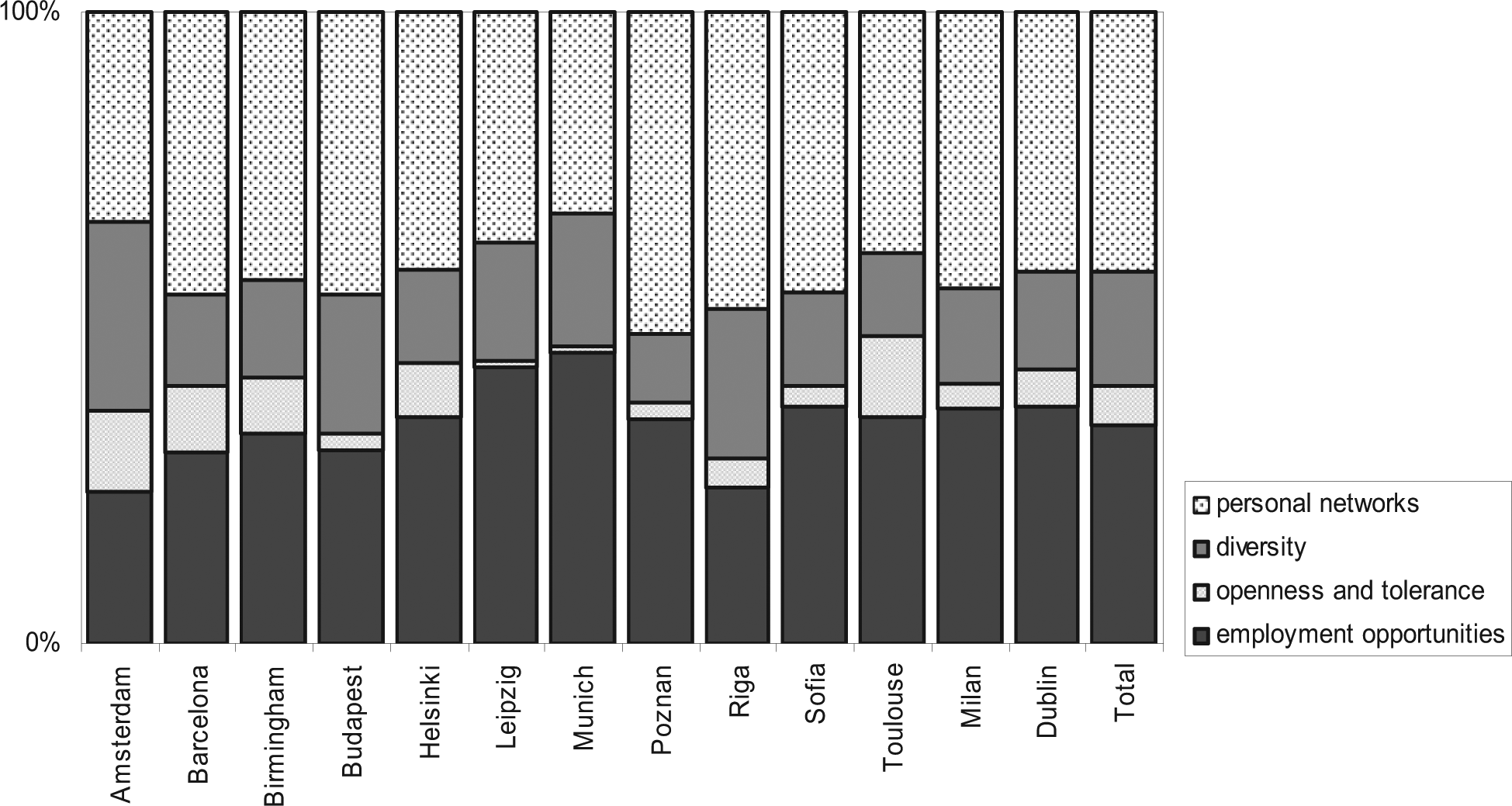
Relative share of respondents that ranked indicators as among the four most important from a list of 26 indicators, assembled in specific dimensions, per urban region.
Among highly skilled employees, personal networks and employment opportunities are seen as the most important factors explaining their choice of a city, while openness, tolerance and diversity play a limited role. Although for some of the cities they may be significant, there are indications that soft conditions are more important to retain people than to attract them to certain places.
Managers and transnational migrants
A similar conclusion was drawn from the results of the interviews with the managers and the transnational migrants. Available space does not allow us to elaborate on these findings too much, but a major finding is that hard factors and personal networks were also decisive for their locational choices, although for managers the labour pool and the infrastructure were more important than for others. Both groups mentioned the importance of universities, which are recognized as a key element for thedevelopment of new economies. Interestingly, there is a difference between managers working increative industries and those working in knowledge-intensive industries. The managers of knowledge-intensive industries tend to pay more attention to the classic (hard) factors than people who work in the creative industries, and some clear examples of actual cases proving this different appreciation were found in several ACRE cities. Smaller firms pay a little more attention to the importance of networks than larger ones. For transnational migrants personal networks and personal trajectories play a prominent role but employment opportunities remain crucial.
The views of different actors on their cities did not always coincide. There was an especially pronounced difference between local residents and transnational migrants. For example, in Birmingham local employers and employees find the city region quite strong in soft conditions, whereas transnational migrants do not. Sofia is seen by the locals as a city with strong hard conditions, but this view is not shared by the transnational migrants. In contrast, in Riga local people working in the creative knowledge sector are rather pessimistic about the strength of the city in both hard and soft conditions, whereas transnational migrants are more positive on the soft conditions of the region. In such cities as Amsterdam, Barcelona, Munich or Leipzig the views of different actors are more or less unanimous. For a more elaborate account of the analyses that focus on managers and transnational migrants we refer to Musterd and Murie (2010) and especially chapters by Dainov and Sauka (2010), and Pethe et al. (2010).
A conceptual synthesis of the empirical findings
A comparison of the relative importance of the three groups of contemporary factors tested by the main actors of the creative knowledge sector can be summarized as follows.
First, we found that in all 13 urban regions jobs and other ‘classic factors’ still matter more than attractive urban environment and cultural assets. The latter can be the ‘icing on the cake’ but the availability of jobs definitely is most important for the European creative and knowledge workers when choosing a place to live. Soft factors, diversity and tolerance in Europe appear to be not as important as many want us to believe. While not being relevant for attracting the creative and knowledge sectors, they nevertheless may be rather important for retaining personnel and companies after they have already chosen a certain city.
Second, as regards the contemporary factors, the importance of personal trajectories, places where people have been born or grown up, where their parents or friends live or the universities where they studied, are key to the understanding of urban growth. Even in a city such as Toulouse, base of the international aviation industry and a unique technological complex of industries, 75% of the managers had some personal link with Toulouse before they came to work there.
Third, it became clear that deep structural factors (or pathways) and contemporary factors are important to understand the development of creative and knowledge-intensive industries. None of the three groups of contemporary factors can be considered crucial for the success of the creative cities without taking into consideration the historical, political and cultural background of the urban region. Although all of the cities we referred to have seen modernization of their economies through the growth of knowledge and creative industries, these sectors have not developed to the same extent or in the same way. This confirms that the creative city can not be made overnight by adopting a Florida-type formula or indeed any other formula. There is path dependency and successful developments can generally be linked to some historical roots.
These findings, which have to be seen as hypotheses that require further empirical testing, open a new stage of the debate about the creative/knowledge city. Our research suggests that at best the US-based ‘creative city’ idea works for a limited number of cities under specific conditions. Although this idea became very popular in many places, and was seen as a low-cost way out of urban economic problems, it soon became clear that its value would be limited. Some well-known cultural centres, such as Amsterdam, Barcelona and Munich, have favourable conditions for the creative and knowledge sectors. These cities will benefit from these conditions with or without additional policies. However, other cities, for example Toulouse, seem right to capitalize on direct investments in technology, rather than in art galleries and culture. In some former manufacturing industry centres such investments are probably not bringing quick results and will soon be seen as disappointing.
At the same time our city studies counsel against the overly sceptical view that it is a waste of time for any but a few special cities to aspire to developing their competitiveness by fostering creative knowledge industry. A more robust view is that strategies to grow such sectors need to take account of the histories, assets and barriers facing different cities and would not expect the same form of success in all cases. Capital cities and those with histories as centres of the arts and culture and of university education can build on these resources. However, the cities that fit this mould each have very different histories and outcomes and this requires strategies fit for these different positions. Cities that do not fit this mould have to build on other assets that are just as critical in explaining the scale and nature of their emerging creative and knowledge economies.
In some urban regions that have been hit hard by the de-industrialization process, especially those regions that are characterized by a relatively monolithic industrial profile, authorities and private entrepreneurs reached some success by investing in the creative knowledge sector while re-using and converting old industrial buildings into modern art centres or knowledge incubator centres. Acting that way, some of the cities substantially changed their profile – such as Essen in Germany, which in the last years become increasingly known as a cultural centre, or Birmingham, where clusters of innovative creative industries have replaced clusters of heavy industry. Such developments are indeed positive but, again, it is difficult to estimate if the growth of creative and knowledge sector is strong and stable enough to give these cities a new future, or is it just one of the remedies to rescue them from stagnation, while the real motor of economic growth is elsewhere in other economic sectors.
Characteristics of the local regional contexts are key to understanding economic development perspectives. This means that almost always a tailor-made type of intervention is required. A best-practice type of thinking is dangerous because it denies the impact of context. Even cities that seem to be similar actually are not. Developing competitive cities is not an activity that can be carried out by applying standard recipes that have been written down by a single professional. It is not something you can make or remake like a standard product with the help of a common set of tools and instruments. Cities and urban economies are not T-shirts that can be produced in much the same way across the world. On the basis of our large-scale European research activities, from which we have presented some empirical material, and on the basis of the literature discussed in this paper, we would suggest thinking of cities as mainly ‘context’; it is about the individual and collective histories and about networks that have developed in a differentiated way over a longer time path. In the words of evolutionary economic geography we could say that contexts, as soon as they have been developed, tend to have a continuous impact on future developments (Frenken and Boschma, 2007). These contexts tell us what kinds of transformations are feasible. Cities are multi-dimensional, multi-layered, established in different eras and multi-scalar entities, often existing for thousands of years and they have been built upon and adapted for a wide variety of societies. Their historically grown and contemporarily shaped economic, political, cultural and social structures will be expressed in economic opportunities and job creation, and will also show in the existence – at a certain level – of personal networks that are relevant for further economic development.
New challenges for policy-makers
This creates new challenges for European policy-makers. When they intend to invest in the creative and knowledge sector they should not just copy the experience of other cities or follow fashionable trends but have realistic expectations based on knowledge of the historical pathways and place-specific contemporary characteristics of their city and region. Cities require tailored policies, more or less unique for each city. The idea of tailored policies may sound self-evident but is absolutely counter to the long-prevailing strategy of ‘best practices’. Policies that proved to be successful in one city may fail in another one if place-specific characteristics and the knowledge of a certain pathway are not taken into consideration.
If policies aimed at supporting creative and knowledge-intensive industries are seen as an instrument for making their cities not only more attractive, but internationally more competitive, they should include a more complicated set of instruments than only supporting creativity and culture. The research outcomes of the ACRE project on which this paper is based show that job opportunities and personal networks (both nationally and internationally), and not amenities, cultural environment, openness, diversity and tolerance, are decisive for attracting skilled workers.
Policies that stimulate job creation and that invest in ‘classic’ hard conditions, such as airports, tax systems, business parks and telecommunications, are not new to urban policy-makers; but developing policies that could capitalize on personal networks is not an automatic line of thought among policy-makers. In fact, it is a policy area where innovations would be welcome. What we see is that some urban policy-makers have only just begun developing some strategies that relate to networks. Initiatives include the support of alumni associations, the encouragement of short-term international mobility of people to develop wider personal networks by creative workers, and the encouragement of student exchanges between EU countries, as well as other exchange programmes for schoolchildren, young employees, etc. Policy-makers could invest in supporting any action in which international exchange is involved. They could support emerging networks and migrant entrant programmes.
Related to these ideas are policy initiatives that help to retain qualified local people. Many cities have important education centres. Students coming to these cities usually build up personal networks. Many of those who have experienced the city for a couple of years will have developed some sense of attachment to people in that place. Not all local policy-makers capitalize to the same extent on these personal networks. If insufficient jobs are available to keep them there, the personal networks might help to retain them if at least some perspective can be presented. Together with higher education institutions and people from the private sector, policy-makers might consider investments in new ideas with often limited venture capital injections.
The approach set out in the ACRE programme involves understanding the resources and distinctiveness of each city – and how to draw on this to make decisions and choices about policy and development. To be efficient such policies have to be realistic, and they should take into consideration that the focus on cultural amenities, diversity and tolerance seldom will be the key to success. Job opportunities and investing in other hard factors, as well as building upon the existing personal networks, seem to offer more promising perspectives. In all situations an awareness of the impact of local context is crucial and therefore policies that are being developed to stimulate urban economic development should be tailor-made. Knowledge about the local context assumes (1) considering the local strengths, (2) being realistic about the potential of a city and its capacity to attract creative and knowledge-intensive industries and (3) using historically strong images to nurture confidence in the local businesses.
In addition, local urban developments should: (1) be seen as being part of the wider economic development of the city-region, (2) recognize that the creative and knowledge industries are highly diverse, with each of them having specific requirements, (3) understand the role of universities and research institutions in the creation of the new knowledge and stable personal networks, and (4) create opportunities for improved economic and social outcomes by exploiting interdependencies between businesses, creative talent and markets (see Musterd et al., 2010).
Apart from the challenges local policy-makers have to deal with that relate to pathways, classic location conditions and capitalizing on existing personal networks, many urban leaders also have to cope with the legacy of post-socialist cities in central and eastern Europe. This usually adds a dimension to the problems cities have to cope with. The policy strategies to be developed to cope with the problems are, however, not fundamentally different from what we have discussed so far. Just as elsewhere, policy responses could include focusing on the positive aspects of past legacies; balancing strategic ‘top-down’ policy intervention with more flexible and entrepreneurial context-related ‘bottom-up’ approaches that facilitate local networks and entrepreneurs; improving classic conditions such as coordination between different policy- and decision-making bodies (at international, national and locallevels); building airports and other infrastructure;and stimulating public–private partnerships and other (personal) relations, including strengthening relations between universities and cities in such a way that knowledge transfer and innovation can spill over into the city and the region.
Beyond the pursuit of economic competitiveness, policy-makers should also reflect upon the wider social impact of new policies towards urban economic development. For example, the creative and knowledge economy embraces well-paid professional employment and careers within large corporations; but it also includes freelancers and low-paid and unsecured employment. All of this may contrast with the jobs and lifestyles of others living in the city. How the creative and knowledge sector develops and what the balance is between different activities affects the pattern of inequality and cohesion within the city. This may draw attention to actions and services that should be undertaken to connect and embed these new activities within the wider structure of the city and to address tensions and inequalities.
Cities that master the three crucial features (pathways, hard conditions and personal networks) – and are capable of integrating them into their context-specific policy and strategic planning – are more likely to create competitive economies than cities that fail to do so. Cities that know how to combine these developments with limiting the negative externalities that coincide with building creative knowledge cities will be the real winners.
Footnotes
Appendix
Funding
This research was supported by the European Commission, DG RTD, Social Sciences and Humanities, FP6, Priority 7 ‘Citizens and Governance in a knowledge-based society’, grant no. 028270.