




Abstract
So far little research has been undertaken on analysing automotive clusters from a knowledge base perspective. Existing studies provide ambiguous hints as to which knowledge base is crucial for automotive manufacturing and innovation processes. This article therefore aims to analyse the knowledge base configuration of automotive clusters in more detail. It does so by investigating the nature and geography of knowledge sourcing and interactive innovation processes of southwest Saxony’s automotive firms. Drawing on face-to-face interviews with representatives of 58 firms and social network analyses of knowledge transfers we show that the firms rely heavily on the synthetic knowledge base whereas the analytical knowledge base is comparatively weak. In the face of its precarious position between the highly innovative western automotive centres and the low-cost sites in central and eastern Europe, it is at least uncertain whether this knowledge base configuration will safeguard the clusters’ competitiveness in the long run.
Keywords
Introduction
A wide body of literature identifies knowledge as a crucial factor for firms, industries, regions and countries as a basis to strengthen their competitiveness (Asheim et al., 2011; Asheim and Gertler, 2005; Cooke et al., 2004; Crevoisier and Jeannerat, 2009; Moulaert and Sekia, 2003). There is also a widespread consensus that knowledge and innovation processes have to be seen and analysed as highly complex phenomena which differ substantially between different industries (Malerba, 2005; Pavitt, 1984). Recently, the knowledge base concept was introduced to this field of theoretical discussion by Asheim and Gertler (2005), who built upon ideas first developed by Laestadius (1998). The authors argue that knowledge sourcing and interactive innovation processes in industries are strongly shaped by their specific knowledge base. They distinguish the analytical from the synthetic knowledge base, each implying particular combinations of tacit and codified knowledge, different knowledge exchange partners and knowledge sources, various types of innovation and different spatial dimensions of knowledge transfer relations.
Knowledge creation and processes in the automotive industry are highly complex (Dicken, 2011; Sturgeon et al., 2008). They contain both elements related to product innovations, as well as to process and organisational innovations. Owing to the presence of different segments in the industry, market demand ranges from relatively inexpensive cars for mass markets to premium automobiles. Moreover, environmental regulations on emissions, car safety regulations and the increasing use of electronics and software in cars stimulate innovation pressures and knowledge flows. On the production side and in related process and organisational innovations, one can observe the modularisation of production and the increasing role of first-tier suppliers in developing these modules in shared platforms. The geography of the automotive industry has also changed in recent years in the following ways (Sturgeon et al., 2008). In general, design and research and development (R&D) functions stay close to headquarters, whereas production activity has been relocated increasingly to consumer markets and to emerging markets, such as China, Brazil and India. The geography of automobile production is also concentrated in trading blocks, such as the North American Free Trade area (NAFTA) and the European Union (EU). Within these blocks it tends to move to low-cost locations. Clustering, however, is persistent, particularly because of increasingly intensive relationships between original equipment manufacturers (OEMs) and first-tier suppliers. Moreover, ‘because of deep investments in capital equipment and skills, regional automotive clusters tend to be very long-lived’ (Sturgeon et al., 2008: 304). Although we realise the complexity and multi-faceted characteristics of knowledge creation and processes in the automotive industry, as well as the changing geographies of the industry, the current article tries to reduce this complex picture by focusing on the recently discussed knowledge bases.
The current array of literature on the automotive industry presents an ambiguous picture concerning its crucial knowledge base. Frequently, industries such as the automotive industry or the machinery sector are said to be shaped in particular by the synthetic knowledge base. According to this body of literature, these industries rely strongly on engineering expertise and tacit knowledge, and interactive learning appears mainly along the value chain between customer and supplier (Dicken, 2011; Sturgeon et al., 2008). However, there is also a literature to be found on science-based activities in the automotive industry (e.g. Becker and Peters, 2000; Calabrese, 2001; Frenken et al., 2004; Krätke, 2010; Peters and Becker, 1998; Thomke, 1998). Their findings give rise to expectations that the development and production of automobiles are primarily reliant on analytical knowledge input. Though all these studies provide hints to which knowledge base is the crucial one in this industry, so far little research has been undertaken in terms of analysing one particular automotive cluster by explicitly drawing on the knowledge base concept (an exception is Strambach and Dieterich, 2011, who refer to the importance of the symbolic knowledge base for the automotive industry in Baden-Württemberg).
In order to fill this research gap our aim is to analyse the knowledge base configuration of the cluster of southwest Saxony’s automotive firms (hereafter AutoSWS firms). Related to this overall aim, the following research questions will be tackled: What are the characteristics with regard to the labour mobility networks, mirrored by the sourcing for highly qualified labour, and how can we explain them? Which information sources external to the firm are particularly important to enhance the firms’ technological expertise? How intensive are knowledge interactions between the interviewed firms themselves and which are the most important knowledge exchange partners? Where are these partners located? And, finally, what differences can we identify with regard to the nature of knowledge flows?
The automotive industry has a long tradition in southwest Saxony (SWS) and it still is the unchallenged centre of automotive manufacturing in eastern Germany (Jürgens and Meißner, 2008). We find some OEM production plants in this region (Volkswagen Mosel/Zwickau) building mid-priced cars (Golf, Passat) as well as engines (Volkswagen Chemnitz), in addition to many small suppliers (only nine supplier companies have more than 500 employees) (Jürgens and Meißner, 2008). All parts of the value chain are represented in Saxony (Scheuplein et al., 2007). There are, however, no globally operating first-tier suppliers (Jürgens and Meißner, 2008: 45). Of the 50 largest automotive supply firms worldwide, 11 have their headquarters in Germany, but none of them in eastern Germany (Scheuplein et al., 2007: 34). Most companies are externally controlled, particularly by firms with headquarters in western Germany (Scheuplein et al., 2007). There is relatively little R&D employment and investment in the automotive industry in SWS (around 1% share of the total German automotive industry) (Jürgens and Meißner, 2008: 30). Employment in automotive R&D is also decreasing in eastern Germany, as more and more R&D work is subcontracted. On the positive side, knowledge networking between automotive small and medium-sized enterprises (SMEs) and other knowledge partners is relatively intensive in comparison with other industries in eastern Germany (Jürgens and Meißner, 2008: 41). Related to these characteristics, the automotive industry in SWS finds itself in an uncertain position, stuck in the middle between the highly innovative western automotive centres, driven by large-scale investment in R&D, and low-cost sites in central and eastern European countries (Jürgens and Meißner, 2008). Since SWS is not competitive with its eastern counterparts concerning labour costs, it is important to understand on which knowledge base the AutoSWS firms rely in order to stay competitive, and whether this special orientation will actually be beneficial for that region in the end.
In order to shed light on the nature and geography of knowledge sourcing and interactive innovation processes, we apply common descriptive statistics as well as social network analysis (SNA). The results are based on 58 standardised firm interviews and seven expert interviews. All the interviews were conducted between March 2009 and March 2010, the majority on a face-to-face base and a few by telephone. Further details on the methods and interview partners will be given in the third section. Before the empirical results are presented in that section, the next section provides the conceptual background to the research. The final section summarises the key findings and draws some conclusions.
Comparing the synthetic with the analytical knowledge base
Following Asheim and Gertler (2005), we argue that innovation processes of firms and industries differ substantially between various sectors and are strongly shaped by their specific knowledge base. Two types of knowledge bases and related activities can be distinguished: analytical (science-based) and synthetic (engineering based). This typology goes beyond traditional knowledge typologies (e.g. the tacit/codified dichotomy) and thus provides a better understanding of knowledge creation in diverse industries. It helps to characterise the nature of the critical knowledge that the production process and innovation activity cannot do without. According to Asheim et al. (2011: 898), this distinction always
refers to ideal types, most activities are in practice comprised of more than one knowledge base. The degree to which certain knowledge bases dominates, however, varies and is contingent on the characteristics of firms and industries as well as between different type of activities (for example, research and production).
Each knowledge base implicates specific combinations of tacit and codified knowledge (Nonaka and Takeuchi, 1995; Polanyi, 1966), qualifications and skills that are required by organisations as well as different innovation challenges and patterns of knowledge exchange, which in turn affect the sensitivity to geographical distance for interactive learning (Amin and Cohendet, 2004).
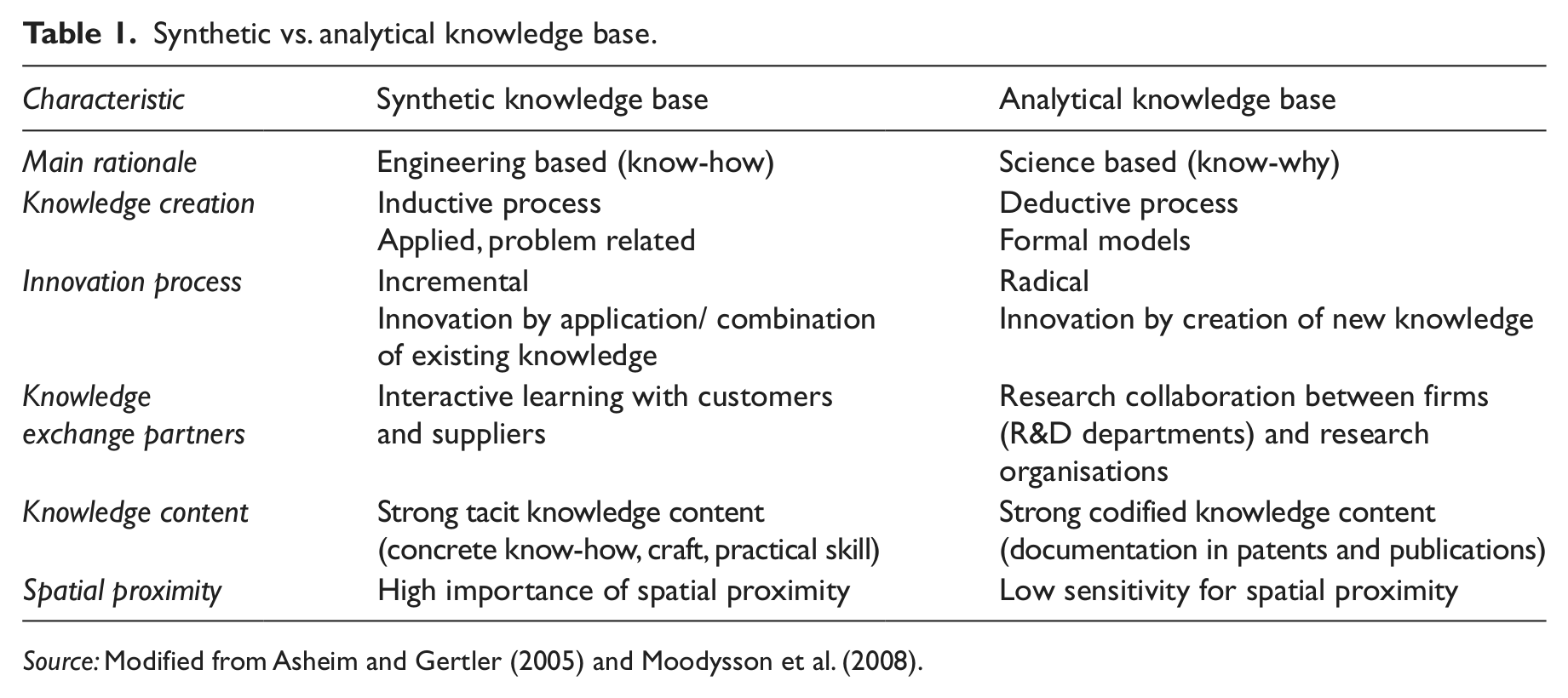
Product and process innovations within industries that draw on the synthetic knowledge base take place mainly through the application or (new) combination of existing knowledge with the aim to solve a specific problem that comes up in the interaction between clients and suppliers (Table 1). In this way knowledge formation is characterised as an inductive process. Characteristic activities are, to mention some examples, practical work in general, but also system design, prototyping, fine tuning and testing. Many of these activities are visible within the automotive industry. The emphasis within R&D is more on the ‘D’ part in the form of product or process development. If research is a matter of interest, it mainly involves applied research, even within industry–university relationships. Although collaboration with universities and other research organisations can play a significant role for firms’ innovation processes, interactive learning is often dominated by industry–industry links. Knowledge embodied in a particular technical solution or engineering work is at least partially codified (e.g. technical blueprints). However, because knowledge often arises from experience gained at the workplace, and through learning by doing, using and interacting, tacit knowledge is typically more important than in the analytical knowledge base (Johnson et al., 2002; Nonaka and Takeuchi, 1995). The strongly tacit nature of knowledge mostly requires being in the same place at the same time in order to share this knowledge (Audretsch, 1998). As a result, the synthetic type shows a stronger sensitivity towards spatial proximity between innovation and production partners. Professional and polytechnic schools as well as on-the-job training are of particular importance to provide an adequate educational background facilitating concrete know-how, craft and practical skills. The knowledge creation and application process is dominated by the modification of existing products and processes with the aim of achieving greater efficiency and reliability of new solutions, or to raise the practical utility and user-friendliness of products from the customers’ perspectives. Accordingly, innovation processes in such industries are of a mainly incremental nature. They mostly take place in existing firms, whereas spin-offs are relatively less frequent (Asheim and Coenen, 2005; Asheim et al., 2007, 2011). Empirical research that refers to the automotive industry in Saxony in particular (Beckord, 2007; Borras and Tsagdis, 2008) or in eastern Germany in general (Jürgens and Meißner, 2008; Scheuplein et al., 2007) strengthens expectations that some of these characteristics can be found with regard to the AutoSWS firms.
Synthetic vs. analytical knowledge base.
Source: Modified from Asheim and Gertler (2005) and Moodysson et al. (2008).
Innovation processes within industrial settings that draw on the analytical knowledge base strongly depend on scientific knowledge input (Table 1). Knowledge creation is often based on deductive cognitive and rational processes, or on formal models that require abstraction skills. Examples are laboratory-based research or scientific discourses. Basic and applied research as well as systematic product and process development belong to the core activities of firms. In order to turn knowledge into innovation in a successful manner, firms often have their own R&D departments, but they also rely on research results from universities and other research organisations. The strong influence that comes from the scientific basis is also reflected by significant academic spin-off activities. Knowledge inputs and outputs involved in innovation processes always include combinations of tacit and codified components (Johnson et al., 2002; Nonaka and Takeuchi, 1995). Face-to-face contacts facilitate exchanges of both; nevertheless, in the analytic case face-to-face contacts are less important than in the synthetic case, because knowledge is more often codified, and therefore easier to exchange between globally distributed actors (Asheim et al., 2007). There are several reasons for the existence of strong codified knowledge content: knowledge generation is often based on reviews of existing studies and the application of scientific principles and methods; innovation processes are rather formally organised (e.g. in R&D departments); and results tend to be documented in reports, electronic files or patent descriptions. These activities require people with specific qualifications and capabilities such as analytical skills, abstraction, theory building and testing, and documentation. As a consequence, the core of the workforce needs a university education and/or research experience. The application of knowledge in such industries is often integrated in more radical product or process innovations. These innovations often build starting points for new start-ups and spin-offs (Asheim and Coenen, 2005; Asheim et al., 2007, 2011).
Recently interesting extensions have been made to the theoretical debate about knowledge bases pointing to the growing importance of what we would like to summarise under the label of related variety. Knowledge variety is increasingly seen as a source of regional knowledge spill-over, measured by related variety within sectors. On the other hand, in the case of unrelated variety, variety is seen as a portfolio protecting a region from external shocks (Frenken et al., 2007). Similarly, Boschma and Frenken (2011) refer to regional branching. Mechanisms through which this occurs include regional entrepreneurship, firm diversification, spin-offs and labour mobility. Cooke (2011: 303), in turn, recently coined the term ‘transversality’ ‘between industries in pursuit of innovative cross-fertilization or cross-pollination that support business and other kinds of institutional innovation’. Cooke (2011: 309) sees a clear shift from clusters to new kind of policies stressing related variety:
traditional sector and cluster policies reached a point in their evolution where significant growth or employment gains were less forthcoming that previously thought likely or experienced … accordingly, some innovative regional policy regimes … began exploring the innovative potential of horizontal interactions among different regional and extraregional sectors or clusters.
In a similar vein, Strambach and Dieterich (2011) observe a qualitative shift from cumulative knowledge dynamics to combinatorial knowledge dynamics. According to Strambach and Dieterich (2011: 7):
the creation of ‘combinatorial knowledge’ … gains a more prominent position for firms in innovation development. In contrast to ‘cumulative knowledge’, that is knowledge which builds on or is directly dependent on already existing stocks of knowledge, ‘combinatorial knowledge’ comes into existence by the unification of originally separate knowledge bases. It is characterized by bringing together formerly separate knowledge bases spanning over distinct organizational, sectoral and territorial contexts.
In order to achieve the production of combinatorial knowledge, cognitive distances need to be overcome, which makes it a big challenge for firms.
In the following section of the article we analyse a number of indicators with the aim of investigating the configuration of the knowledge base for the production and innovation process of AutoSWS firms.
Knowledge sourcing and interactive innovation of automotive firms in southwest Saxony
Before we detail the empirical results of this case study, we describe the regional economic and institutional setting in which the AutoSWS firms are embedded. We then refer to data and methodology issues, and profile basic firm characteristics. The core of our empirical work deals with the recruitment sources and firms’ innovation performance, and finally we analyse the firms’ knowledge networks.
Southwest Saxony: institutional framework for the development of the automotive industry
Southwest Saxony is located in the south-western part of the Free State of Saxony and borders on the federal states of Thuringia and Bavaria in the west, and the Czech Republic in the south (see Figure 1). The population of SWS is about 1.6 million and stretches across four counties and the major city, Chemnitz (with a population of 244,000). As the region was part of the former German Democratic Republic (GDR), its economic system had to undergo extensive transformation processes after the collapse of communism in 1989. In 2009, the unemployment rate in SWS (13%) was still considerably higher than the German average (8%). The region is strongly shaped by its manufacturing activities: whereas SWS’s employment share in the manufacturing sector was 27% in 2009, the corresponding value for Germany was 19% (Bundesagentur für Arbeit, 2010; IHK Chemnitz, 2010; Statistisches Bundesamt, 2010).
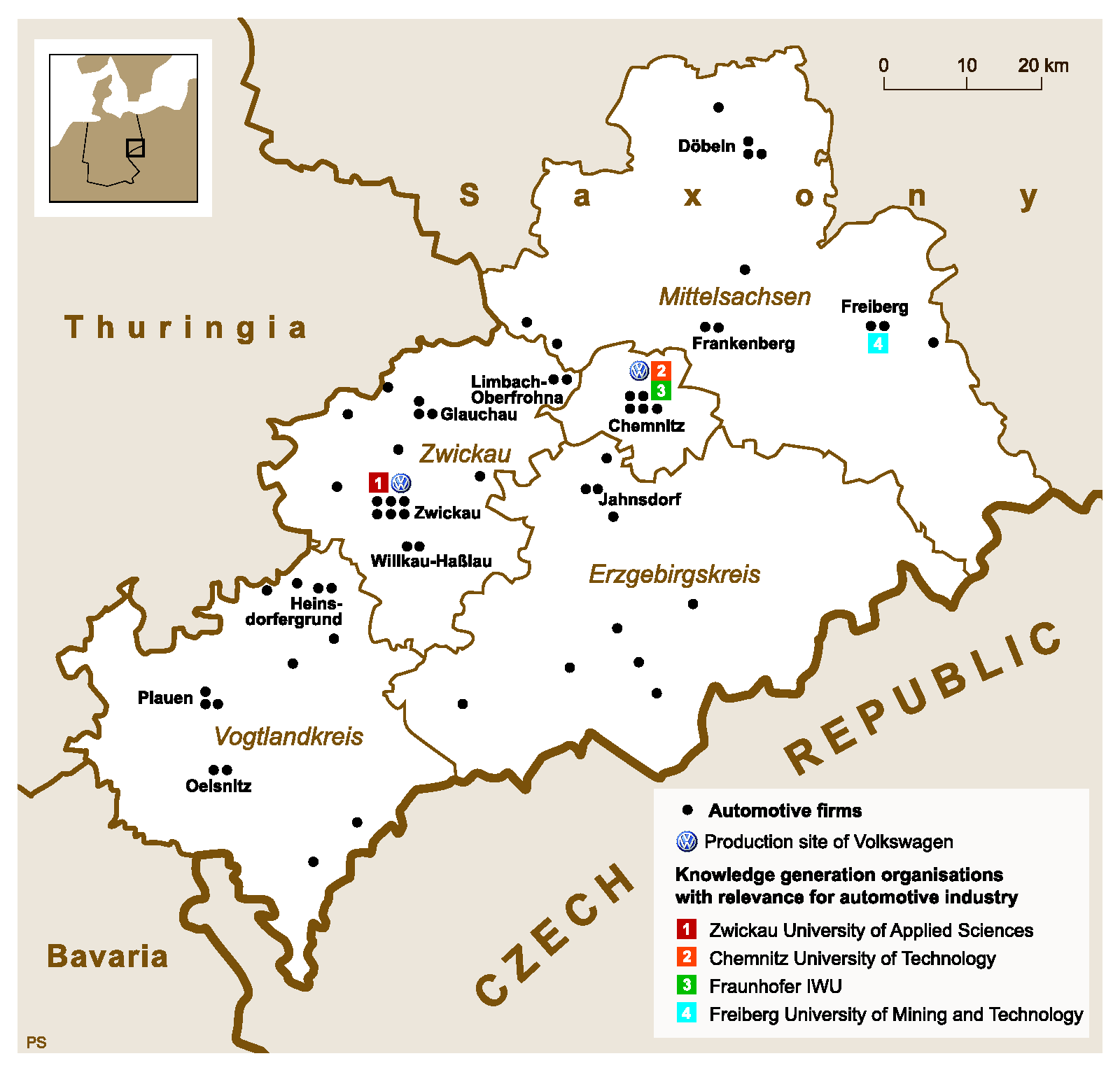
Location of automotive firms interviewed.
SWS has a rich history in producing cars and is still the unchallenged centre of automotive manufacturing in eastern Germany (Scheuplein et al., 2007). The 58 automotive firms interviewed benefit not only from spatial proximity to adjacent OEMs (Volkswagen in Mosel, Chemnitz and Dresden, as well as BMW and Porsche in Leipzig), but also from specialised research and education facilities nearby (see Figure 1) (Blöcker et al., 2009).
Moreover, there are a number of organisations in SWS that build up a fairly thick supportive infrastructure targeting the competitiveness of the regional economy. The Saxon automotive supplier network AMZ is the central cluster initiative that promotes networking between automotive suppliers along the value chain (Scholta, 2005). Parallel network initiatives are run by Volkswagen Sachsen GmbH at the firm level and the Automotive Cluster Ostdeutschland (ACOD), which acts as an umbrella organisation for all automotive initiatives in the regions of eastern Germany (Jürgens and Meißner, 2008). Other institutions that target the development of the regional industry, though without a special focus on the automotive sector, are the regional Chamber of Industry and Commerce in Chemnitz as well as the Saxony’s Economic Development Agency in Dresden (Beckord, 2006; Borras and Tsagdis, 2008).
Data and methodology
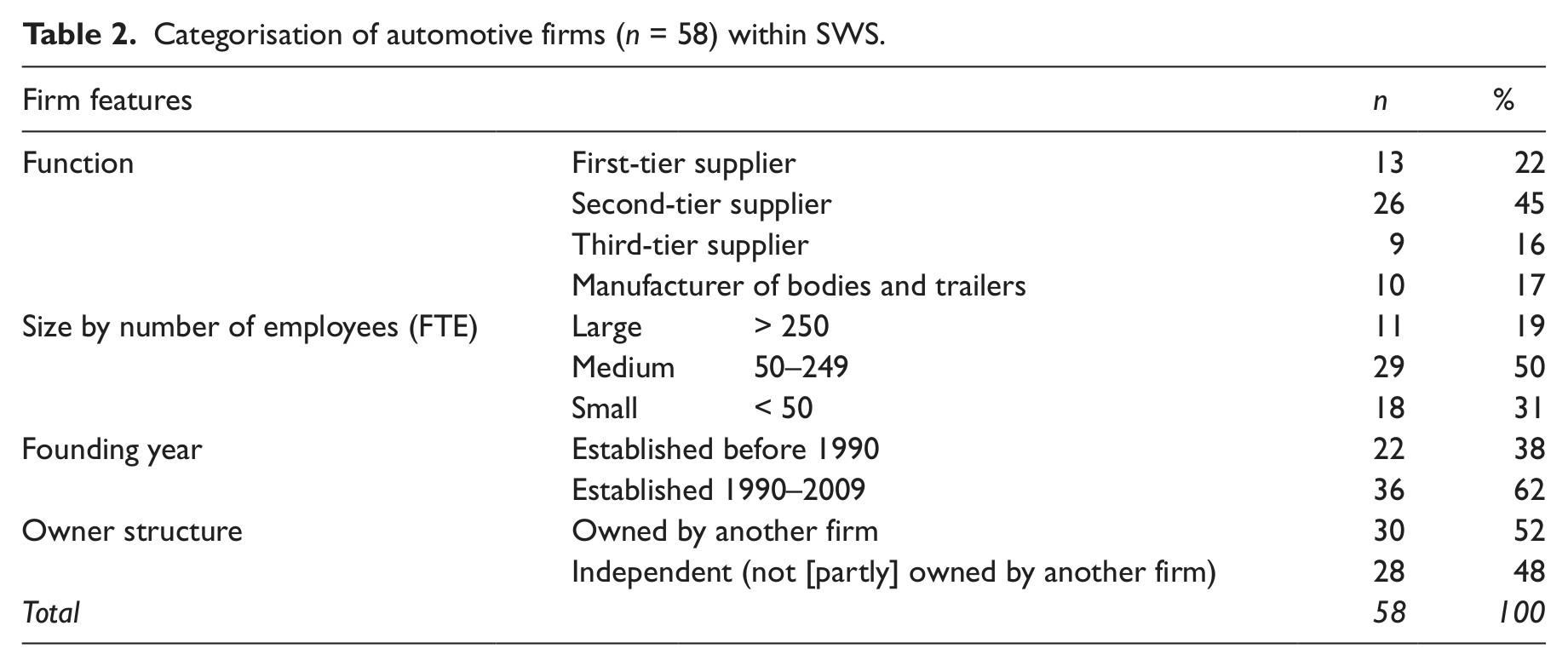
The case study is based on standardised personal interviews with CEOs or executives of 58 of the 112 automotive firms (52%) we identified in SWS. Our sample is restricted to manufacturing firms that clearly focus on producing automotive parts, components, modules and whole systems, or firms that produce bodies and trailers (see Table 2). The identification of regional automotive firms is based on own desk research and different databases offered by the regional automotive cluster initiative AMZ, the Saxony Economic Development Corporation and Creditreform.
Categorisation of automotive firms (n = 58) within SWS.
All interviews with firm representatives were conducted between March and October in 2009 and contained primarily quantitative elements. In March 2010 seven semi-standardised expert interviews followed in order to discuss the interpretation of some preliminary results. One general outcome of these expert interviews was that the sample and its subgroups can be regarded as representative for the whole population. Accordingly, the picture we will draw in the course of the following analyses should provide a comprehensible understanding of knowledge sourcing and innovation processes in the SWS automotive industry as a whole.
In order to analyse knowledge sourcing and interactive innovation processes, we apply a combination of descriptive statistics and sociometric techniques in the form of social network analysis (SNA) (Scott, 2000; Ter Wal and Boschma, 2009; Wasserman and Faust, 1994). Our study contributes to a growing body of case studies in economic geography and regional economics applying SNA (see, for example, Boschma and Ter Wal, 2007; Graf, 2011; Krätke, 2010; Morrison, 2008), which is well suited to study networks of relatively small clusters of firms in a statistically robust way, but which is at the same time static in character and time-consuming because of the necessary interviews (Ter Wal and Boschma, 2009). The analysis contains 630 technology-orientated knowledge relations as well as 480 market knowledge relations.
Basic firm characteristics
Nearly half of the 58 participating firms categorise themselves as second-tier suppliers (i.e. suppliers of automotive components). First-tier suppliers (i.e. suppliers of modules and whole systems), third-tier suppliers (i.e. suppliers of standard parts and materials) and manufacturers of bodies and trailers make up the second half in more or less equal parts. Two-thirds of all interviewed firms maintain direct supplier relationships with OEMs either partly or exclusively (Table 2).
Furthermore, we identify a predominance of SMEs, with on average 169 employees per firm. Only every fifth firm can be considered large. In comparison with their western German counterparts, eastern German automotive firms are on average considerably smaller (Günther et al., 2005; Scheuplein et al., 2007).
Most sampled firms were established right after the fall of the Berlin Wall and the start of the reunification process in 1990. Nevertheless, SWS shows a long tradition of automotive manufacturing. The region was not only the cradle of eastern Germany’s automotive industry but also one of the three places in Germany (besides Rüsselsheim and Stuttgart) that have produced cars for more than 100 years (Boch, 2001). Therefore, it is not surprising that seven out of 58 firms showed trajectories reaching back to the nineteenth century.
Finally, the sample shows a balanced picture of independent firms and those that are owned by another company. Most of the latter ones are owned by companies located in western Germany. They usually influence the daily business at the SWS’ production sites, although the exact character of decision-making powers is highly complex and an empirical question that differs from case to case. According to what Scheuplein et al. (2007)already stated with regard to the eastern German automotive industry in general, most location decisions are made outside the region. This can be interpreted as a risk factor for this region when it comes to declines in automotive production.
Human capital and recruitment sources
The investigation of human capital and recruitment sources provides a first way to establish which knowledge base is crucial for automotive firms within SWS to meet market requirements. The figures presented in Table 3 are clearly in line with the assumption that the automotive firms located in SWS provide good examples of an industry that strongly depends on the synthetic knowledge base. Far the highest share of labour consists of workers who have had practically orientated vocational education and on-the-job training. Only one out of ten employees has an academic degree. Of these, the majority have an educational background in engineering studies, reflecting the importance of technical know-how. At least every tenth graduate is educated in other subjects, for example business administration, which typically represents the white-collar management positions. Education in the natural sciences plays a minor role whereas artistic studies with a rather creative background do not play a role at all, as the group of firms interviewed shows.
Educational background of employees of automotive firms (n = 58) in SWS.
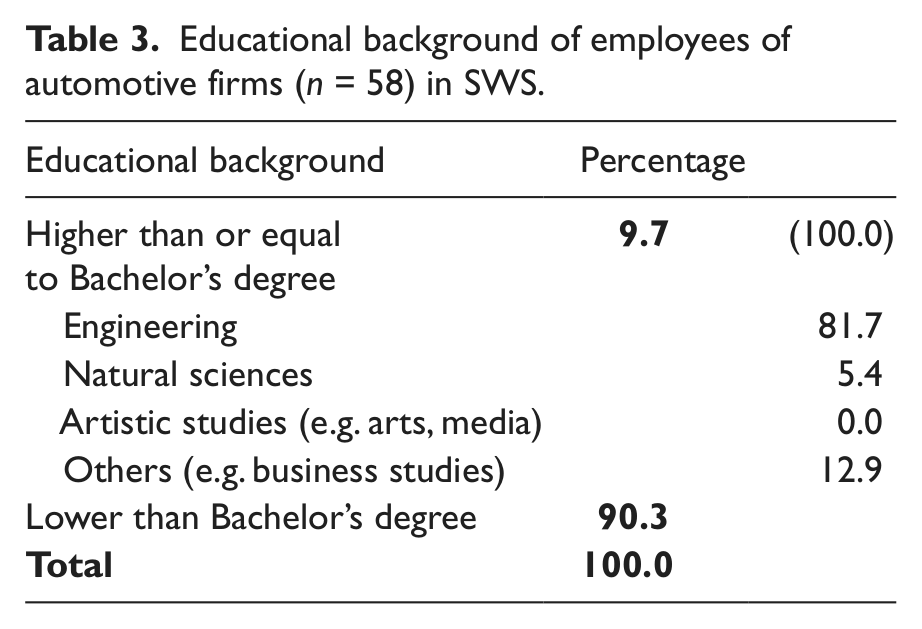
Table 4 emphasises the clear tendency of AutoSWS firms to build on applied and problem-related know-how rather than to search for talented people doing basic research (know-why), which is said to be pivotal for developing the analytical knowledge base. Universities as a source of recruitment are ranked significantly low in importance in comparison with universities of applied sciences (Fachhochschulen): more than 70% of the participating firms value universities of applied sciences as ‘very important’ or at least ‘important’ for recruiting highly qualified labour, whereas the corresponding share for universities is not even half of that value. More than 40% indicated other firms within the automotive sector to be ‘(very) important’ as a recruitment source. The potential of profiting from related variety – i.e. raising innovative power through cross-sectoral labour mobility (Boschma et al., 2009; Frenken et al., 2007) – seems to be unexploited so far. If other sectors play a role as a source of recruitment, firm representatives most frequently mentioned the mechanical engineering sector as being key here. Since this ‘neighbouring’ cluster managed to develop and keep sophisticated engineering competences over decades in SWS as well, and because modern automotive production lines depend strongly on using tailor-made machines, there is a strong potential within this region to benefit from strengthening related variety through inter-cluster labour mobility.
Recruitment sources for automotive firms (n = 58) in SWS.
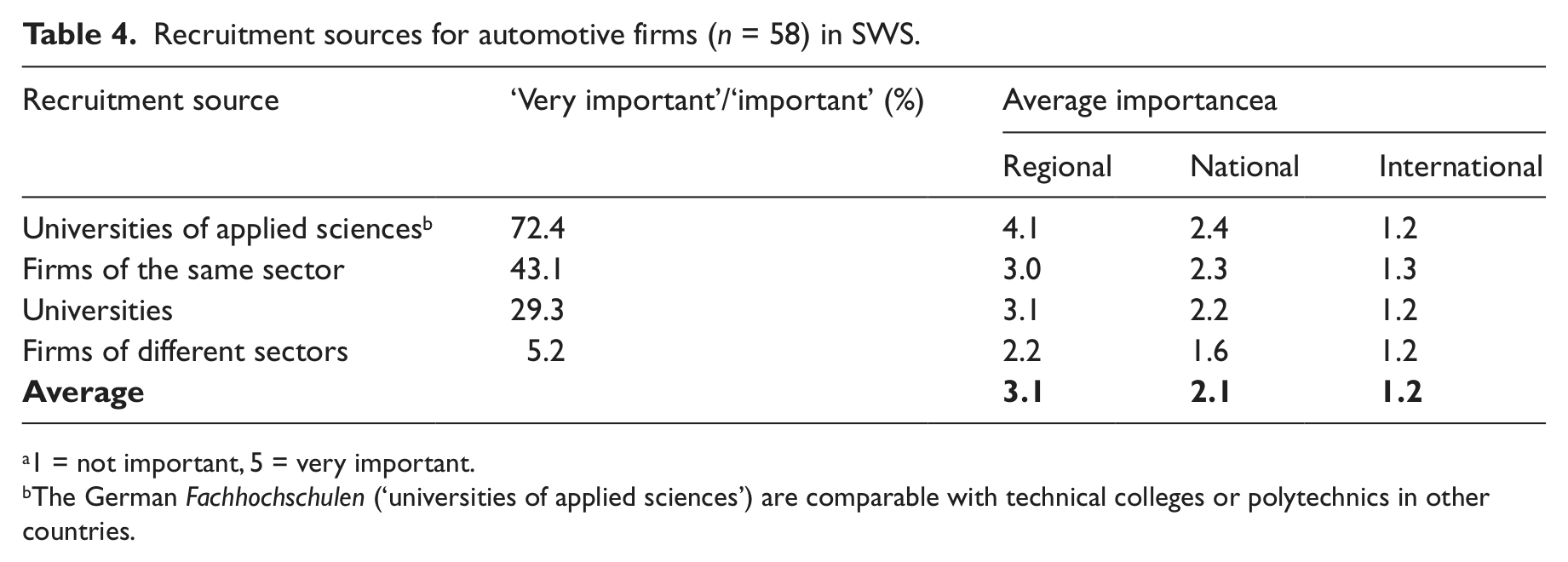
1 = not important, 5 = very important.
The German Fachhochschulen (‘universities of applied sciences’) are comparable with technical colleges or polytechnics in other countries.
Besides these differences in evaluating diverse kinds of recruitment sources, we notice that selecting highly skilled labour is mainly concentrated in SWS: the average automotive firm in SWS gains its personnel from recruitment sources in close spatial proximity rather than from universities or companies far away from their own location. On the one hand, this regional focus might be due to SWS’s traditionally well-established system of higher education, particularly in terms of engineering-orientated degrees. On the other hand, firm representatives hinted at difficulties in competing with automotive clusters from western Germany or other European countries to attract highly qualified workers from other regions. This is considered to be a result of the lower attractiveness in terms of income levels and living conditions.
Summarising the results of Tables 3 and 4, we see that both the relative importance of applied and engineering-based knowledge as well as spatial proximity to recruitment sources suggest that the synthetic knowledge base is of particular importance for the working process in SWS’s automotive cluster.
Firms’ innovation performances
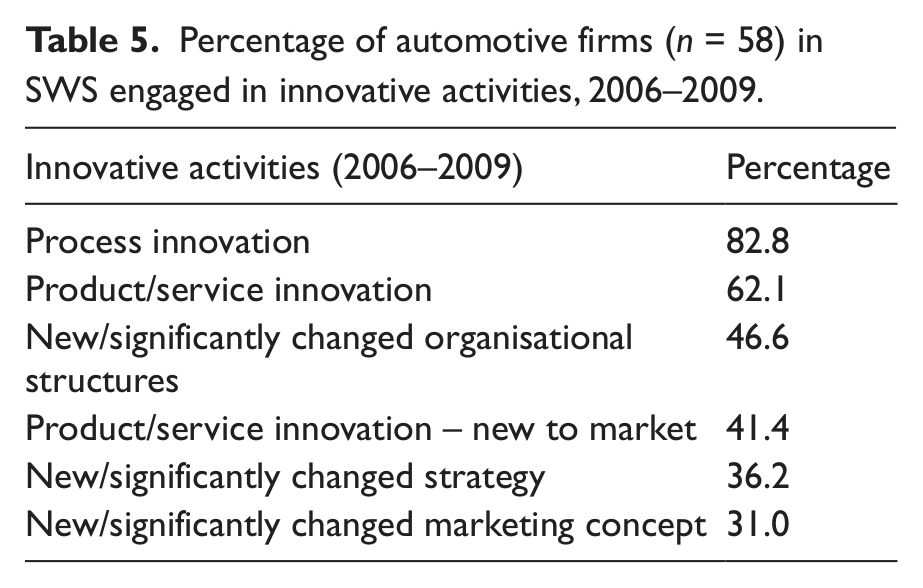
Table 5 provides an overview of the firms’ engagement in innovative activities. More than 80% of the 58 firms claim to have conducted process innovations between 2006 and 2009. Next, approximately 60% of firms have developed and commercialised new products (including services), of which two-thirds were not merely new to the firm, but new to the relevant market as well. In nearly 50% of all cases organisational structures have been fundamentally changed during this period, reflecting the ongoing restructuring processes within the automotive industry in general, and within eastern Germany’s economy in particular. A considerably lower share of firms changed market-related strategies or marketing concepts. Behind these aggregated figures we discover that branch plants are stronger in process innovations whereas the ‘independents’ (firms not [partly] owned by another firm) are better at developing product innovations (see also Fuchs, 2008, in more general terms). One possible explanation for this difference can be found in the work of Scheuplein et al. (2007), who discovered that extra-regional mother companies (especially OEMs) often see eastern Germany as an experimental ground for testing new production and logistic processes.
Percentage of automotive firms (n = 58) in SWS engaged in innovative activities, 2006–2009.
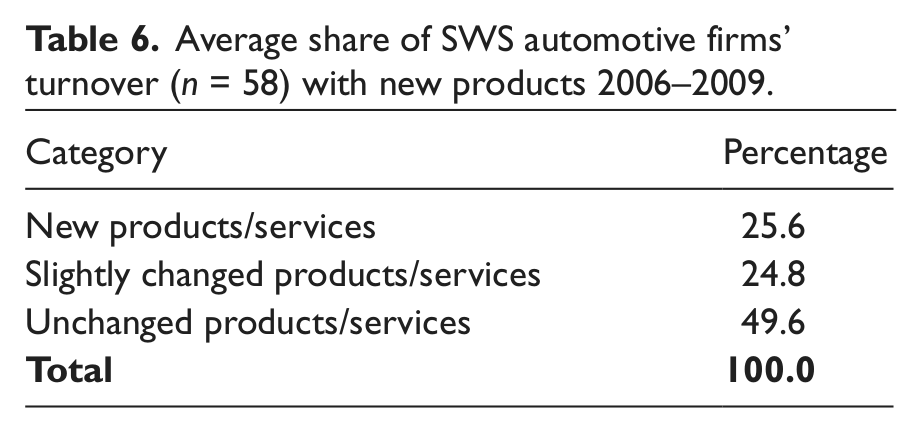
On average, between 2006 and 2009 only one-quarter of the firms’ turnover resulted from the sale of new products or new services (Table 6). The weak performance of regional automotive firms in generating radical technological innovations tentatively indicates that the analytical knowledge base is rather underdeveloped. However, this does not mean that incremental innovations are of greater importance instead – which would be a feature of the synthetic knowledge base. Slightly modified services and products only account for another quarter of the firms’ turnover. The remaining half – the major share – refers to unchanged products or services, indicating the limited efforts of many firms at coming up with new technical solutions. However, these results have to be interpreted carefully, because standard deviation figures indicate high disparities regarding the specifications made by the firms.
Average share of SWS automotive firms’ turnover (n = 58) with new products 2006–2009.
Patent statistics provide further suggestions that radical innovations are rather rare in the SWS automotive sector: only one-quarter of the firms have applied for patents between 2006 and 2009, numbering on average five patents per firm, and almost every third patent was a co-production with one or even more organisations external to the firm (Table 7). In contrast to industries that draw more strongly on the analytical knowledge base (cf. the work of Plum and Hassink, 2011, on biotechnology firms in Aachen, Germany) we can conclude that patents as a kind of transmitter of codified innovation-related information are rather underrepresented in the automotive industry of SWS.
Patent activities of automotive firms (n = 58) in SWS 2006–2009.

In considering the allocation of R&D employees (i.e. personnel who are primarily occupied with the development of new products, services and processes), only every third firm indicated that it employed R&D workers, namely 6.5 full-time equivalents (FTE) as the mean and 5.0 FTE as the median (Table 8). With regard to the 39 remaining firms that do not employ any full-time R&D staff, the average time that workers dedicate to R&D is no more than 2% of their working time. In addition, only one-tenth of firms indicated that they owned an R&D department. Given this, basic R&D plays a minor role in contrast to the application or new combination of existing knowledge, indicating a strong concentration on the synthetic mode of knowledge creation. Besides the relatively low performance in developing human capital, low levels of investment in R&D activities hold the risk of decreasing the firms’ competitiveness.
R&D employees in SWS automotive firms (FTE) (n = 58).
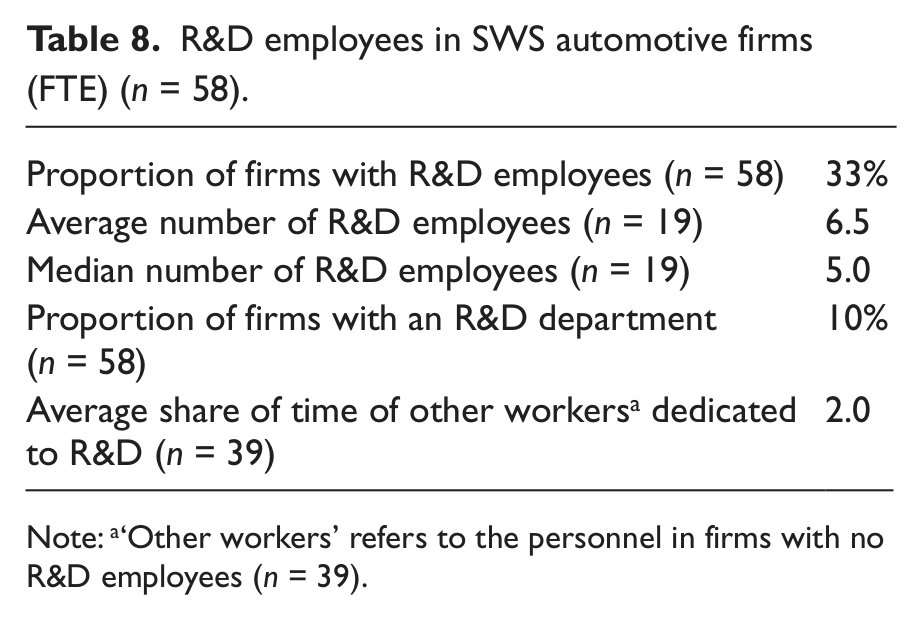
Note: a‘Other workers’ refers to the personnel in firms with no R&D employees (n = 39).
Knowledge exchange patterns: market and technological knowledge networks
Gaining access to technological knowledge is a precondition for automotive firms to advance product and process innovation. However, in order to bring innovations successfully to the market, knowledge of market issues is a crucial factor for firms’ competitiveness (Boschma and Ter Wal, 2007). This type of knowledge includes, for example, information concerning consumer preferences, market developments, competitors’ strategies or product faults. We now consider this distinction to gain a more fine-grained insight in knowledge exchange than by only looking at technological exchange issues (Figures 2 and 3). The case study focuses on the whole system of knowledge linkages appearing within and outside the SWS automotive cluster. Thus, the aggregated data following hereafter do not necessarily reflect the particular knowledge network structure of one specific firm.
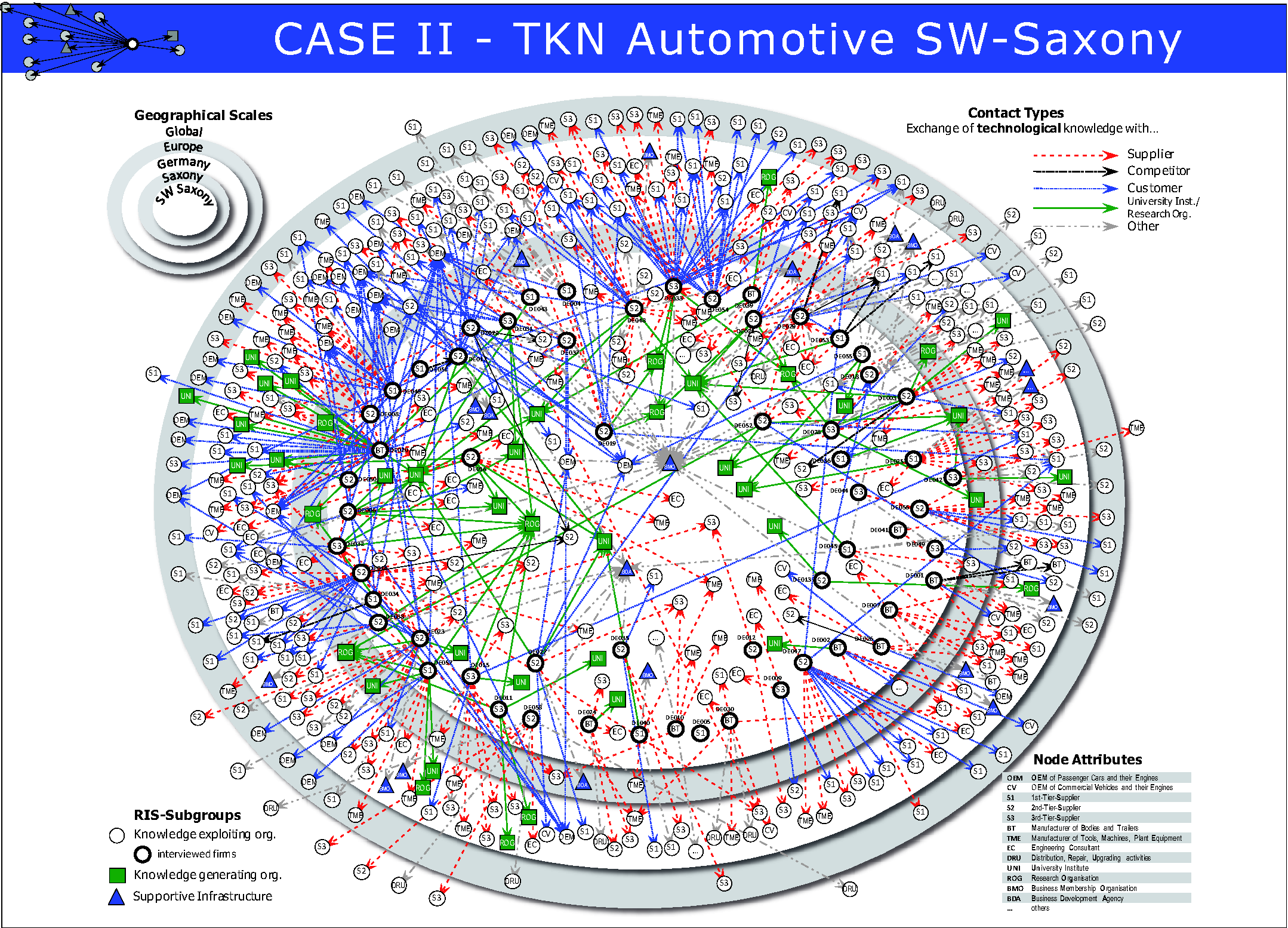
Technological knowledge network of automotive firms (n = 58) in SWS.
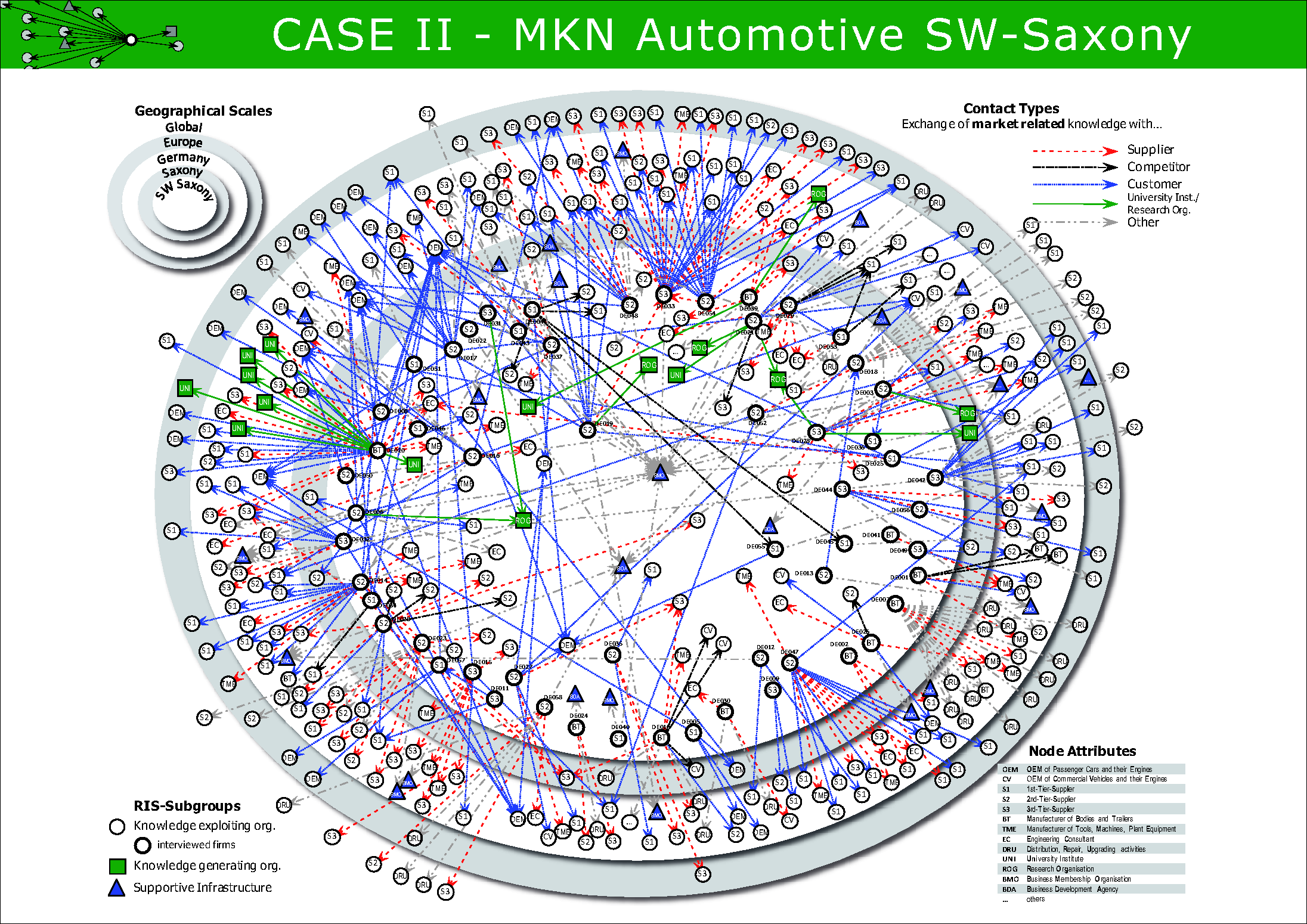
Market knowledge network of automotive firms (n = 58) in SWS.
Knowledge flows between AutoSWS firms
Table 9 concentrates on potential knowledge flows between the 58 interviewed firms themselves. Leaving out all other mentioned contacts, we are able to quantify particular dimensions of network structures and network positions within the region from a sociocentric perspective. Nevertheless, these network indicators have to be interpreted carefully: although we try to give an overview of network activities within SWS’s automotive cluster in general, we have to take into account that only 58 out of 112 participated in our study. Hence blind spots within the clusters’ network are inevitable.
Knowledge flows between 58 automotive firms in SWS: summary of sociocentric network indicators.
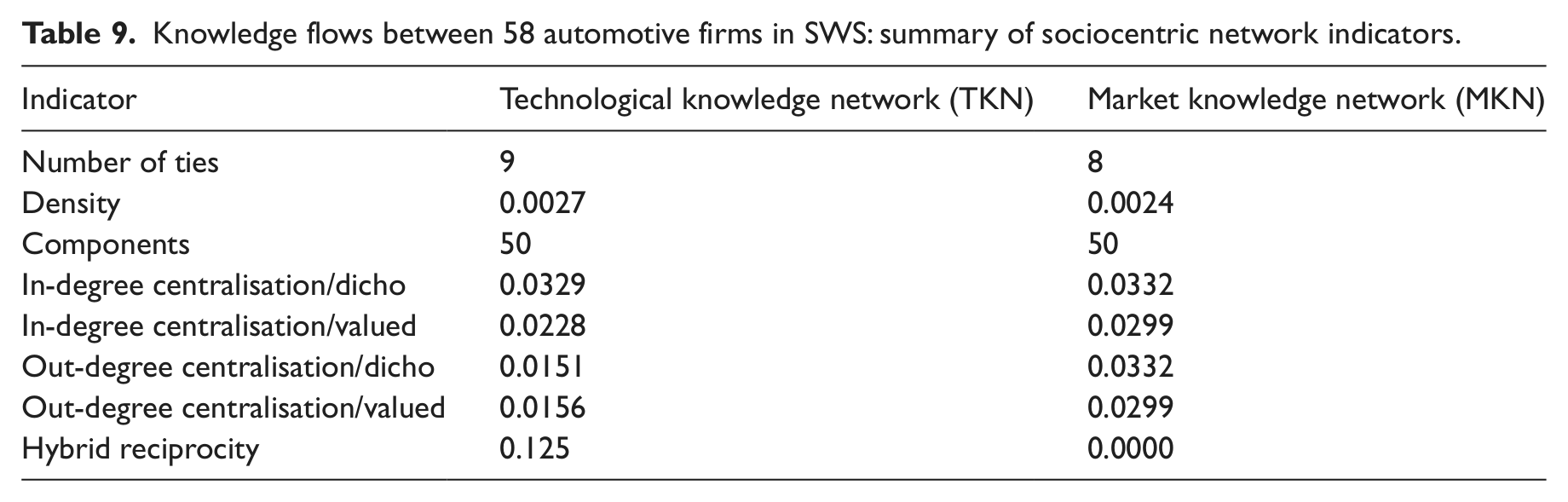
As a result of the low number of identified ties (i.e. knowledge flows) between the 58 firms, the calculated network densities – expressed as a ratio between the actual number of ties and the maximum number of potential ties (Wasserman and Faust, 1994) – are quite low. Whereas the technological knowledge network (TKN) is characterized by a density of 0.0027 (i.e. 0.27% of all potential inter-firm relationships between the interviewed firms are exploited), for the market knowledge network (MKN) this number is low as well (0.0024). Both figures clearly demonstrate that continuous directed interactive learning between automotive firms within the region is scarce. According to the high number of network components we can deduce that the TKN and the MKN are both of a rather fragmented nature. Each network consists of 50 components out of 58 potential ones. In detail, they show completely identical component structures: each network contains four dyadic components and two components with three members in each case. All other firms remain completely isolated. Another similar indicator that is helpful to analyse network structures is the degree of centralisation. The stronger a network is centralised, the more hierarchical is its architecture. In this case, all centralisation indices are relatively low and therefore point to a rather homogeneous structure. Combined with the very low network densities it becomes obvious that this homogeneity of network positions is situated on a very low level of inter-firm knowledge exchange activities within the regional automotive industry.
The hybrid reciprocity measure indicates the share of reciprocal relations. For the TKN, only one out of nine relations is reciprocal, i.e. only in one case do both firms designate each other to be a knowledge exchange partner. For the MKN there are no reciprocal relations at all. This finding shows that even though, firm X mentioned another firm Y as an important knowledge source, this does not necessarily mean that firm Y points out firm X as a relevant knowledge network partner in return. As a consequence, knowledge flows are not automatically bidirectional. Nevertheless, we will use the term knowledge exchange relationships in the following, keeping this peculiarity in mind.
Nature of knowledge flows
Table 10 shows how the average AutoSWS firm describes the characteristics of technology-orientated knowledge interactions by differentiating between practical- and scientific-orientated knowledge transfer and those which contain a mixture of both. In doing so we are about to leave the sociocentric perspective (which was restricted to the networking activities between the interviewed firms only) and refer to the aggregated examination of the firms’ complete egocentric knowledge networks. Seven out of ten knowledge interactions are clearly practically orientated. Hence, interactive learning between AutoSWS firms and other organisations are rather characterised by inductive processes. These firms use the knowledge provided by collaborators in order to solve a specific product- or process-related problem. They learn and create knowledge predominantly by doing, using and interacting (the DUI mode). However, at least one-third of all knowledge interactions contain scientific content as well, indicating that, although the synthetic, engineering-based knowledge content is prevalent, production and innovation processes in SWS’s automotive industry cannot work without any analytical, science-based knowledge input. The additional average importance measures highlight the high relevance of practical-orientated knowledge, though the minority of ‘mixed knowledge flows’ is ranked highest.
Characteristics of knowledge flows in a TKN.
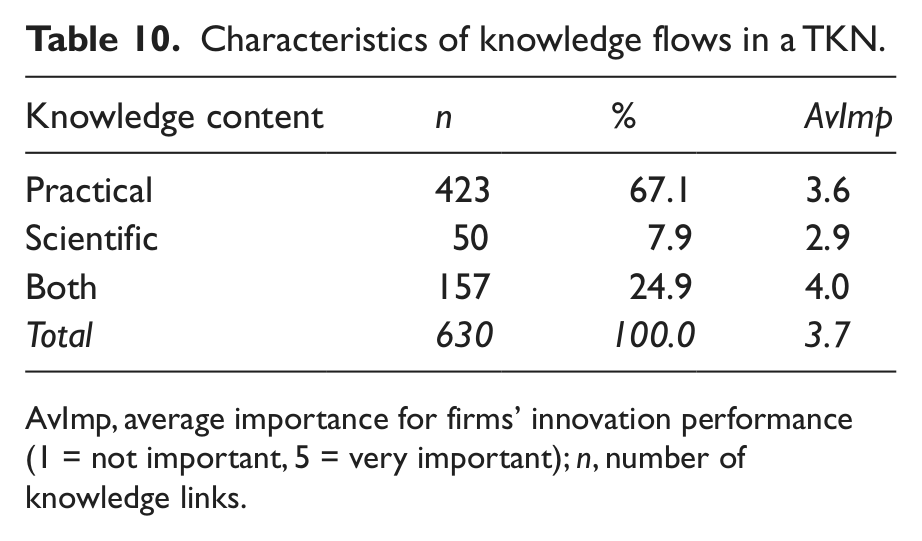
AvImp, average importance for firms’ innovation performance (1 = not important, 5 = very important); n, number of knowledge links.
Spatial organisation of knowledge flows
Furthermore, we observe that relatively small distances to network partners are important to gain access to other knowledge sources that are external to the firm (Table 11). One possible explanation for this spatial boundedness of knowledge flows – a feature of the synthetic knowledge base – is the great deal of practical-orientated knowledge that is highly tacit in nature (Sturgeon et al., 2008), demanding face-to-face interactions on a regular basis. Another explanation for this rather regionally and nationally bounded pattern of knowledge flows can be found in the geographical distribution of supply chains. Companies with which SWS automotive firms exchange knowledge are typically companies with which they are connected by supply chains as well. Production networks and knowledge networks co-evolve in this industry. Knowledge is typically product based, not only in terms of technological knowledge, but also concerning market potentials. Since Germany can be regarded as the core of European automotive manufacturing (VDA, 2010) as well as of machinery engineering (VDW, 2010), it should not be surprising that the product-based knowledge flows remain mainly within the national borders.
Geography of TKN and MKN.
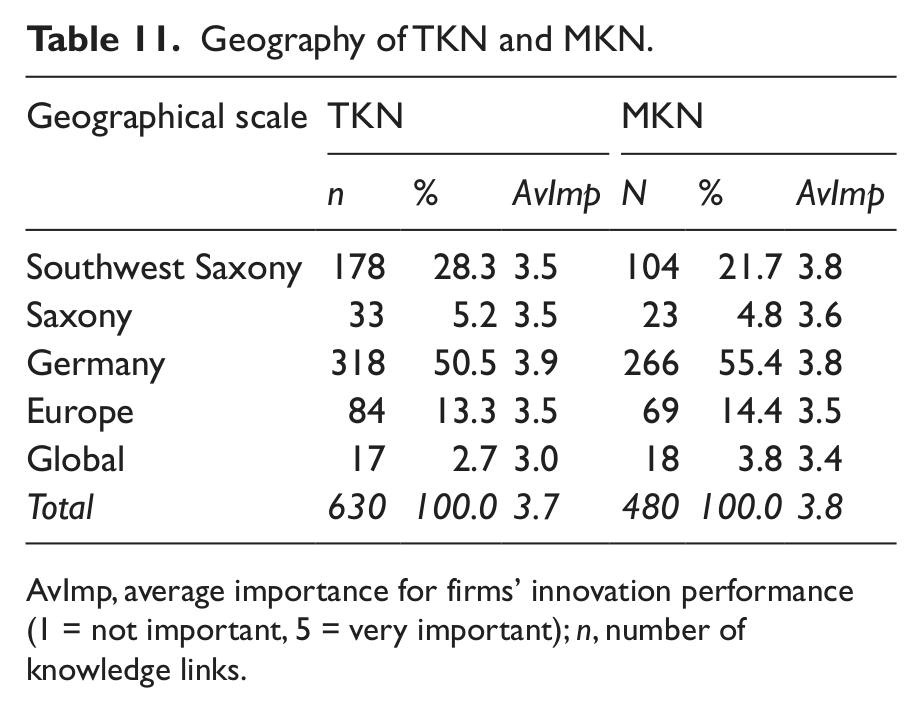
AvImp, average importance for firms’ innovation performance (1 = not important, 5 = very important); n, number of knowledge links.
In more detail, the geography of interactive innovation processes within the TKN looks as follows: three out of ten knowledge relationships stay within SWS. Since only 5% of all 630 contacts refer to the wider regional context, i.e. the rest of Saxony, it seems justifiable to state that SWS is the core of automotive expertise in Saxony, and Saxony itself is regarded as being the unchallenged centre of automotive competence in eastern Germany as a whole (Scheuplein et al., 2007). Nevertheless, the bulk of contacts refer to the wider national context. In fact, a considerable share of knowledge pipelines connects the SWS automotive cluster with other (western) German automotive hot spots such as the regions around Wolfsburg (with Volkswagen’s headquarters) in Lower Saxony, Stuttgart (Porsche and Daimler) in Baden-Württemberg, or Munich (BMW) and Ingolstadt (Audi) in Bavaria. Knowledge flows on an international scale make up only 16% of all relations, clearly dominated by intra-European knowledge flows. According to the evaluation of each contact with respect to its importance for the firms’ innovation performance, knowledge flows at the national level rank the highest, in contrast to global contacts, which rank lowest. This qualitative finding underlines the quantitative outcomes described before, i.e. the dominant integration at the national level and the limited use of knowledge from the “outside”.
Compared with the share of contacts indicated for the TKN, the extra-regional relations within the MKN play a more important role. Nevertheless, international contacts clearly remain underrepresented, too. The indicator describing the average importance of contacts shows that there is no clear picture indicating that short-distance relationships are of greater or lesser significance for obtaining market information in comparison with relationships that cross regional or national boundaries.
Contact types
In addition to the spatial dimension of knowledge flows, we examined which types of contacts are particularly important for exchanging technological or market-related knowledge in order to strengthen the firms’ capacity (Table 12). Regardless of whether we refer to the TKN or the MKN, knowledge is mostly exchanged with suppliers and customers along the value chain. This group of contact types makes up more than two-thirds of total relations for each. Thus, this general finding corresponds with the assumption that the synthetic knowledge base is particularly relevant for the enhancement of competences adapted to automotive products and related processes.
Contact types within TKN and MKN.
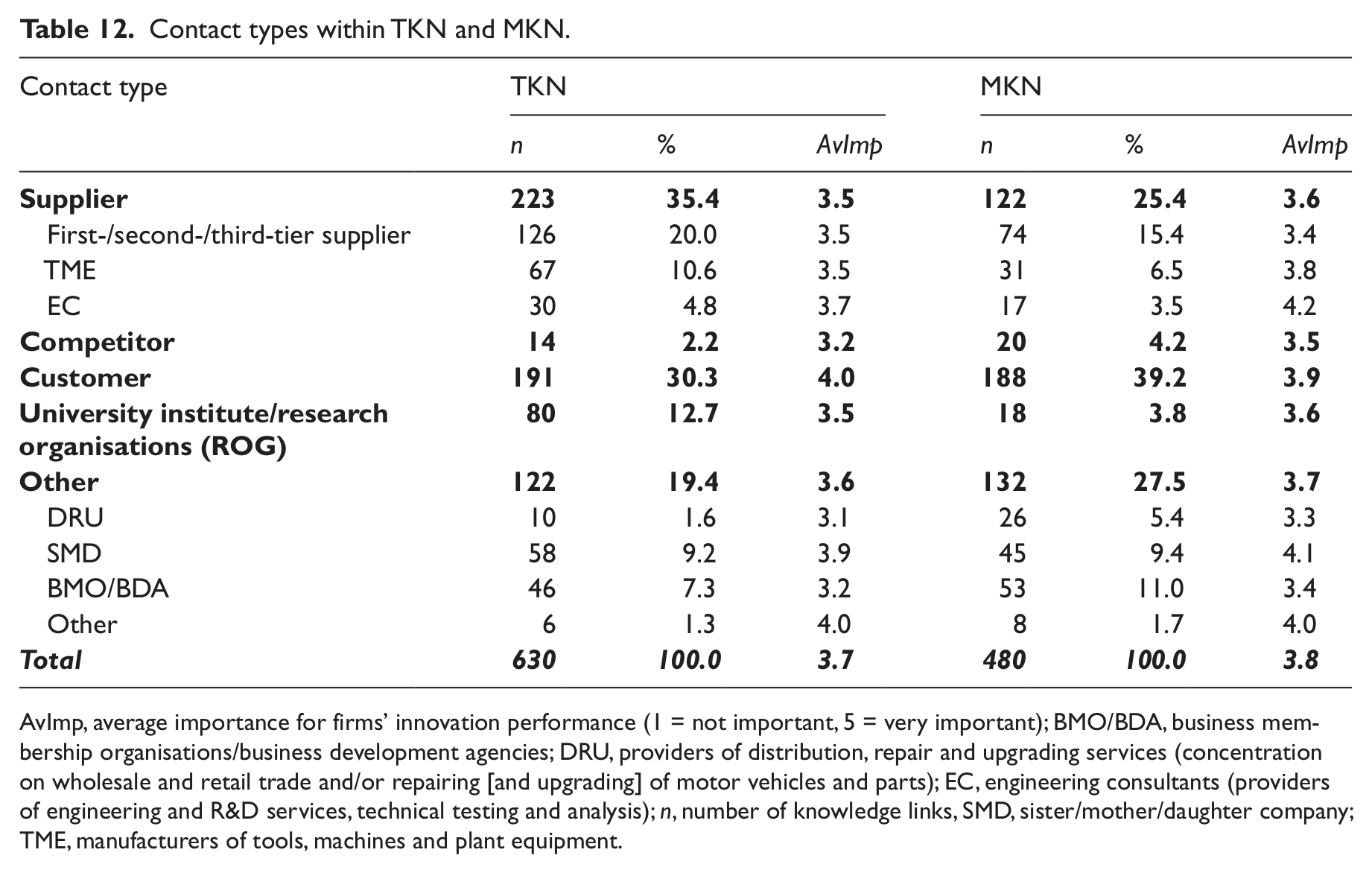
AvImp, average importance for firms’ innovation performance (1 = not important, 5 = very important); BMO/BDA, business membership organisations/business development agencies; DRU, providers of distribution, repair and upgrading services (concentration on wholesale and retail trade and/or repairing [and upgrading] of motor vehicles and parts); EC, engineering consultants (providers of engineering and R&D services, technical testing and analysis); n, number of knowledge links, SMD, sister/mother/daughter company; TME, manufacturers of tools, machines and plant equipment.
According to the sheer number of contacts, knowledge formation along the value chain within the TKN is rather driven by suppliers, whereas customers rank higher with respect to their average importance for firms’ innovation performance. Suppliers of parts, components and whole systems form, in total, the largest sub-section of the supplier group. Half as many supplier-orientated ties refer to suppliers of tools, machines and plant equipment (TME), with a stronger focus on process innovations than on product innovations. Engineering consultants (ECs), as ‘suppliers’ of engineering and R&D services, technical testing and analysis, are not as relevant, indicating the low level of effort among AutoSWS firms to develop new products. In terms of deliberately chosen network partners, competitors play a minor role only. Customers rank directly below suppliers. Today, OEMs do not simply specify product-related requirements to their suppliers; they increasingly shift engineering responsibilities to first-tier suppliers. Interactive learning along buyer–supplier relations is therefore highly relevant for innovation processes within the automotive industry (Sturgeon et al., 2008). In contrast to the analytical knowledge base, sharing knowledge with university institutes and research organisations is rather infrequent. We may assume that other automotive clusters (e.g. around Stuttgart, Munich or Wolfsburg) feature a higher percentage of science-orientated relations (Jürgens and Meißner, 2008). Almost 20% of all contacts within the TKN refer to the remaining group of other organisations. This group is clearly dominated by relationships either with sister, mother or daughter enterprises (SMD) or with business membership organisations and business development agencies (BMO/BDA) as representatives of the supportive infrastructure. Nearly one out of ten technologically orientated knowledge transfers stay in-house (SMD). These contacts rank relatively high with regard to their importance for the firms’ innovativeness. BMOs and BDAs score 7.3% and therefore may play a role in the firms’ TKNs as well. They function as knowledge brokers. These bodies screen and provide technical information as well as market insights, and they try to increase networking between firms. According to the frequency of mentions, the cluster initiative AMZ is the major intermediary within this network (see the central blue triangle ‘BMO’ in Figures 2 and 3).
To what extent can we observe different ranking orders of contact types for the MKN? According to the total number of mentions, again interactive learning along the value chain is of particular importance. However, our survey shows that the ‘centre of gravity’ has moved to the customer side. If one takes the perspective of the AutoSWS firms, the customers are closer to the market. They can provide the latest data on market issues, which are crucial for evaluating future market trends, and they also help to estimate the market potentials of products that have been developed further. University institutes and research organisations were considerably lower than other contact types in terms of number of mentions. When we look more closely at the sub-categories of ‘others’, we recognise a reverse order in comparison with the TKN: the share of mentions for BMOs and BDAs slightly increases, whereas the corresponding share for the category of SMD remains nearly at the same level. In terms of the importance rating we observe relatively equal evaluations between the TKN and the MKN.
Combining contact types and spatial scales
Table 13 shows which contact type dominates at a certain spatial level. Technology-orientated knowledge flows that stay within the regional boundaries exhibit relatively high shares of contacts with suppliers. In contrast, the corresponding proportion of knowledge transfers with customers is more dominant on the wider national and European scales. Furthermore, for the local and regional levels we can identify a relatively high proportion of relations with research-orientated institutions as well as with bodies of the supportive infrastructure. The comparatively high percentage of TKN links to SMD companies at the national and international levels goes in line with the assumption that a considerable number of SWS automotive firms are influenced by company-internal decisions taken outside the region. Finally, the more detailed sub-categorisation of contact types within the TKN reveals a strong endogenous potential for engineering-based knowledge inputs (cf. the corresponding data for contacts to TME and EC).
Dominance of different contact types depending on geographical scales of knowledge network links.
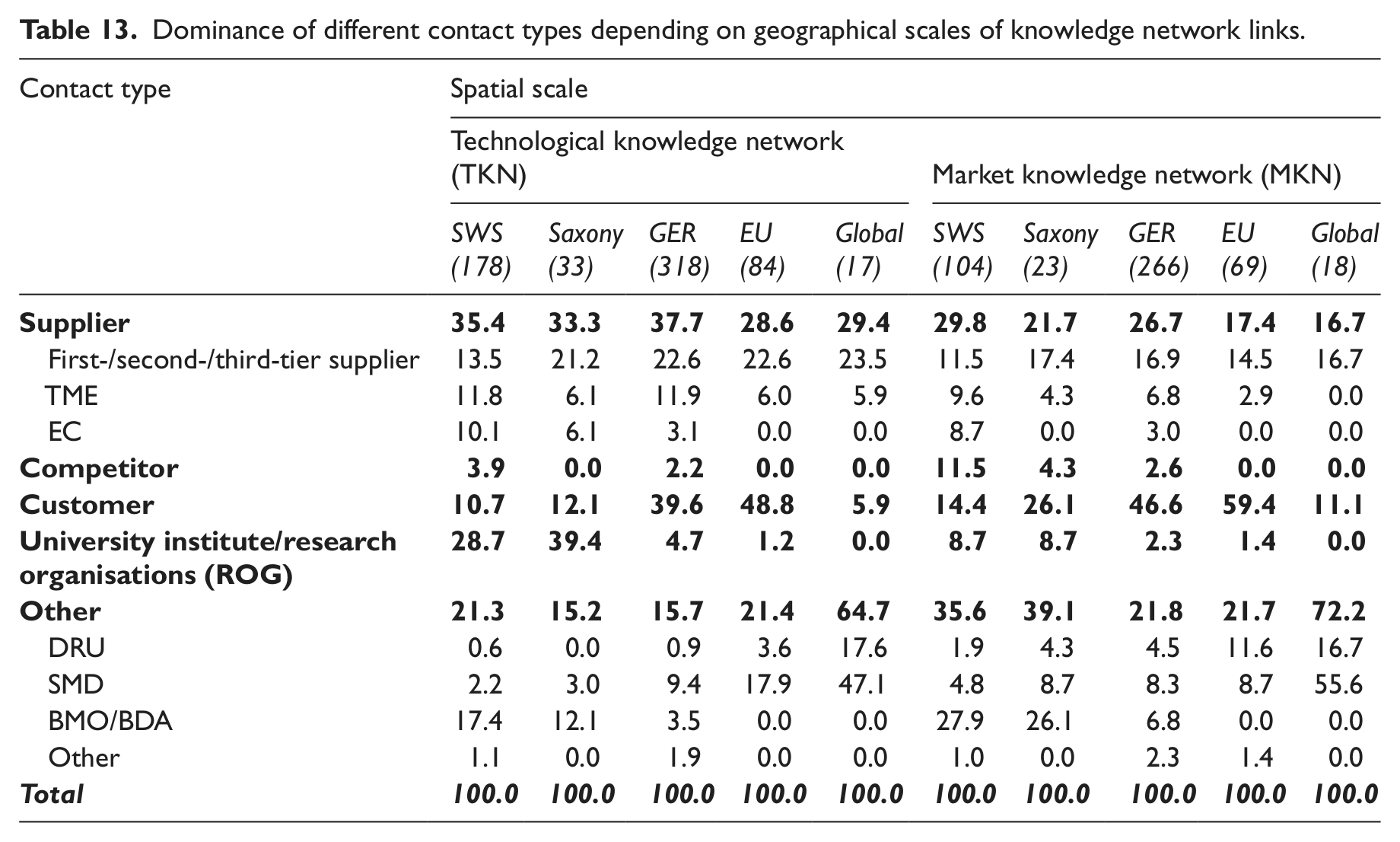
The most striking differences in the MKN’s spatial distribution of different knowledge exchange partners in comparison with the TKN’s distribution are the following. First, at the national and European levels the share of relations with customers even exceeds the corresponding shares for the TKN at the expense of the supplier shares. Thus, customers who are located in other parts of Germany and Europe are – by number – the most important sources to receive market information from. Second, BMOs and BDAs act as central providers of market knowledge at the local and regional levels (Table 13).
Conclusion
The aim of our paper has been to analyse the knowledge base configuration of southwest Saxony’s automotive firms. The main outcome refers to the prevailing knowledge source for the AutoSWS firms. It can be said that the conventional AutoSWS firm relies heavily on the synthetic knowledge base, whereas the analytical knowledge base is less important: R&D activities are rather weak and most likely weaker than, for example, in western German automotive clusters that contain large-scale R&D facilities of OEMs and leading first-tier suppliers. The main part of the workforce is made up of blue-collar workers who are educated on the job and/or through vocational training. If more highly educated personnel are needed, AutoSWS firms prefer graduates of engineering-orientated programmes provided by neighbouring universities of applied sciences. It becomes obvious that problem-related know-how is more important than expertise in basic research. New products or processes are of a rather incremental nature that is based on the application or combination of already existing knowledge. Since engineering-based, applied knowledge is more important than science-based knowledge, the accumulation and transfer of particularly tacit knowledge plays a decisive role within the firms’ production and innovation processes. It leads to a comparatively high sensitivity to spatial proximity between the firms and their knowledge network partners. Here, the SNA turned out to provide an excellent tool to make these knowledge flows visible. Although regionally bounded interactions between the interviewed firms themselves are rare, we observe a multiplicity of knowledge transfers between the AutoSWS firms and regional suppliers, knowledge-generating and cluster-supporting organisations within SWS. Overall, the firms’ TKN and MKN are dominated by vertically orientated interactions, connecting the AutoSWS firms with suppliers and customers along their value chains. These knowledge flows most often end within the boundaries of Germany; only a few pass these boundaries and thus progress to partners in other European countries.
These outcomes are limited, however, by the shortcomings of single case studies: the outcomes cannot be generalised because of their high degree of context specificity. In the case of the AutoSWS firms, a relatively high share of production sites shows typical characteristics of branch plants, doing standardised work instructed by headquarters located outside the region. In addition, we find a handful of innovative firms, some of them regionally rooted, original Saxon companies, benefiting from the rich expertise in automotive production accumulated over a century in this region. Because SWS was part of the former GDR, some businesses have undergone strong transformation processes since German reunification. In order to prevent hasty generalisations in the shape of one knowledge base for all automotive clusters, more research is needed that focuses on identifying the crucial knowledge base of automotive clusters in other regions (see for instance Strambach and Dieterich, 2011).
SWS’s automotive industry finds itself in a precarious situation or sandwich position (Jürgens and Meißner, 2008). It is stuck between the highly innovative western automotive development and production sites, and low-cost sites in central and eastern Europe. On the one hand, AutoSWS firms cannot compete with their eastern counterparts in terms of labour costs. Taking part in price competition with low-cost countries by cutting labour incomes is obviously not realisable, because of considerably higher costs of living, or because of the power of trade unions in Germany. On the other hand, the firms’ low performance in the analytical mode of knowledge creation holds the risk of losing the capacity to come up with highly innovative technical solutions, which is a precondition to keep pace with their western counterparts. There is a danger that the automotive cluster in SWS becomes locked into this sandwich position, with strongly negative consequences (Hassink, 2010; Martin and Sunley, 2006). The strong dependence on just one OEM, namely Volkswagen, makes the cluster of small suppliers more vulnerable, particularly since ‘we must question the staying power of smaller, lower tier, local suppliers, however well supported they are by local institutions and inter-firm networks’ (Sturgeon et al., 2008: 306–307).
It is questionable whether moving from the current synthetic knowledge base towards an analytical knowledge base is the right strategy, as it is unlikely that R&D departments of the OEMs will be relocated to SWS in the future. The same applies to moving towards a more design-intensive symbolic knowledge base, as is observed in Baden-Württemberg by Strambach and Dieterich (2011). As an alternative, we recommend two strategies. The first strategy is to internationalise knowledge flows, so that the supplier base industry in SWS will become more integrated in emerging value chains in eastern Europe (Jürgens and Krzywdzinski, 2009; Jürgens and Meißner, 2008: 65; Pavlínek et al., 2009; Pavlínek and Janák, 2007) . One example of such a strategy is the cooperation with suppliers in neighbouring Lower Silesia in Poland that is initiated and supported by AMZ (Jürgens and Meißner, 2008). The aim is to look for complementarities in the supply base in both regions. The second strategy refers to supporting related variety and by doing this developing market niches or smart specialisation. Examples include InnTex e.V., in which technical textiles produced in the region are used for car seats, and biofuels: OEMs as well as oil concerns are working on new environmentally friendly forms of fuels (Jürgens and Meißner, 2008). These are not central product innovations for the automotive industry as a whole, but niche markets in which firms in SWS can become specialised and competitive.
Footnotes
Acknowledgements
An earlier version of this paper has been presented at the 2010 AAG Annual Meeting in Washington, DC, USA. We have benefited from useful comments made by the participants at this event and particularly by extensive comments made by Franz Tödtling and two anonymous reviewers. We are also thankful to the firm representatives as well as the group of industry experts for spending their time with us. However, the usual disclaimer applies.
Funding
This research has been sponsored by the European Science Foundation and the Research Council of Norway.