




Abstract
This article connects two streams in the literature on local political leadership by identifying the effect of leadership in form on the altering nature of leadership behaviour in the era of governance as a promising field of research. In particular, it argues to proceed with a comparative new institutionalism agenda. In order to illustrate this approach it uses data from a comparative project on local political leadership in Europe and focuses on mayor business orientation as an aspect of external networking. The analysis shows institutional form matters, but is highly contingent upon leadership context and characteristics. Future research should not only improve the conceptualization of form and extend the scope of leadership behaviour under study, but also probe into the causal mechanisms that relate form, context and characteristics.
Introduction: changing conceptions of mayoral leadership
Over the last few decades and in many European countries, local government underwent substantial transformations to meet the manifold challenges it had to confront (Denters and Rose, 2005; Loughlin et al., 2011). One of the areas in which much activity in terms of discourse, reform and change occurred is local political leadership with a particular focus on the mayor. Leadership is then perceived as one of the main targets in need of adaptation to cope with the altering demands towards localities in the era of governance.
Following Mouritzen and Svara (2002), leadership is one of the core principles featuring in almost any democratic system of local government next to layman rule and professionalism. The asymmetrical relationship between leaders and followers to achieve common and/or compatible goals in public policy (Burns, 1978; Edinger, 1975) is often institutionalized in the executive branch of local government and particularly in the office of mayor. It is, however, in the specific setup of leadership and its relationship to the other principles mentioned that the particularities of various systems lie and much of the reformist activity has focused on.
As elaborated below, many European countries have witnessed a strengthening of local executive institutions with a tendency towards a model commonly known as that of the strong mayor (i.e. the ‘knight’ in the title). This model bears formal resemblance to the American mode of the executive-centred local government with a central place for the mayor (Savitch and Vogel, 2005). Much of the reformism and subsequent European literature (Berg and Rao, 2005; Borraz and John, 2004) is mainly concerned with these constitutive aspects of mayoral leadership in focusing on the changing formal institutions of office (i.e. mode of selection and/or functional competencies). The latter is evidently important to understand the clout that mayors have as constitutive arrangements outline opportunities and constraints for leadership. However, formal institutional approaches underplay that leadership is behavioural (i.e. direction geared towards action in carrying out a discrete number of key roles and tasks) and contextual (i.e. influence is contingent upon the interaction of leaders with their environment) as well. Both also play an important part in understanding the informal aspects of office (i.e. the values, norms, preferences and interests tied to the mayoralty). Here also, some have identified convergence with the American model focusing on growth-oriented policies and giving networks with business a central place in governance in an entrepreneurial and facilitative variant of local leadership (i.e. the ‘white satin armour’ in the title; Greasly and Stoker, 2009; Schneider and Teske, 1992).
Contrary to this is the American pendant (Svara, 2005), and with some exceptions (e.g. Bäck et al., 2006) the European literature does usually not provide elaborated empirical links between constitutive form, behaviour and context. These are, however, of crucial importance to understand the real-life implications of leadership and the way in which it is changing. This is particularly relevant, since in a substantial part of the reformist discourse on leadership it is often assumed that strengthening the executive would indeed facilitate the development of entrepreneurialism. The main logic assumed is that in electorally and/or functionally reinforcing the institutional base of the mayoralty, a visionary broker emerges who can meet the manifold challenges of local governance (Greasly and Stoker, 2009). In this reasoning, the strong mayor model is often acknowledged to best establish a leadership that both symbolizes the locality and enables the bringing of the shifting framework of local decision making together around a common agenda and in mutual partnerships.
This argument has been particularly relevant in cases where institutional reform meant the clearest breaking away from the past. As Wollmann (2005) concludes for Germany:
[…] it seems plausible that, by installing the mayor as a democratically legitimated and politically accountable political as well as executive leader the capacity of local government for pro-active policy-making and coordinated action increases. The directly elected chief executive mayor, possessing a combination of political legitimacy and administrative clout, has the opportunity to become the key local networker and to exercise a pivotal role in horizontal as well as vertical coordination of German cities.
Similar assumptions also diffused elsewhere (for an overview, see Larsen, 2005; Magnier, 2006). The empirical evidence underpinning the claim that strengthening form is a mechanism for altering attitudes and/or behaviour in the direction prospected is, however, scare and not well-developed, particularly from a comparative perspective
Therefore, the main aim of this article is to scrutinize the link between the institutional tendency towards the strong mayor model of political leadership (form) and the shifting substance and nature of mayoral agendas and networks in an entrepreneurial direction for European localities (attitudes and behaviour). It develops a plea for a more systematic research agenda and its potential by drawing on arguments from the literature that links local politics to new institutionalism (Davies and Trounstine, 2012; Lowndes, 2009). For empirical exploration, the article will reconsider quantitative data from a comparative project that studied mayoral leadership in 17 European countries. Before coming to that part of the analysis, the institutional transformation of local leadership and the shifting agenda of mayoral governance shall be outlined to clarify the persisting variety in the European polity that is an evident added value for our approach.
The strong entrepreneurial mayor as an isomorphism in times of governance?
Evidently, reformist efforts point to a certain degree of dissatisfaction with existing frameworks. Following the assumption by Mouritzen and Svara that the relationship between leaders, laymen and professionals is key to understanding the specificity of each system and looking at the traditional setup of local government in Europe from a leadership perspective, two ideal types come forward (Heinelt and Hlepas, 2006; Wollmann, 2009).
Traditional modes of mayoral leadership
In the first, local political leadership is relatively strong in that it dominates the council and the administration. This is achieved through a formal separation of executive and legislative powers (dualism), with the former being individualized by vesting them in the mayoralty. The latter is often elected (quasi-)directly and usually leans on majoritarian principles of decision making. As such, the model of leadership is rather presidential and oriented towards the role of a local notable. This model is traditionally identified with Southern Europe. These leaders often operated in an environment that stressed communalism (Wollmann, 2006): local government was the expression of a political community rather than an instrumental device to deliver services. As a consequence, averagely small localities operated under central supervision, enjoying few functions and discretion. Direct access to the centre and the subsequent potential for interest mediation was a fundamental asset to counterbalance the limited clout of localities (e.g. through dual mandate holding or party political networks).
In the second model, local political leadership is relatively weak due to either being non-local (the former local state model of communist Central and Eastern Europe, see Coulson and Campbell, 2008) or non-political (city managers embody the executive and its political component is merely ceremonial). Alternatively, local leadership does exist but is shared in a collective that is appointed or indirectly elected and whose powers are often embedded in the legislative (monism, such as in the collegiate or committee types of local government), nurturing a parliamentarian and consensus-oriented style of decision making. Here, leaders are first-among-equals and the model is traditionally associated with the North of Europe. In this model, leaders tended to function in more instrumentalist localities considered as central devices to provide place-bound services. Averagely large localities enjoyed more functions and discretion.
Governance as a challenge to mayoral leadership
Since the 1990s, Europe has witnessed a tendency to break away from some of these traditions, especially the more collective and consensual forms of leadership. While reasons, reactions and success vary in different contexts, a number of underlying tendencies can be identified. Many transformations in contemporary local government are seen in the light of the alleged shift towards local governance (John, 2001; Stoker, 2006). The latter results from broader economic and cultural shifts that trickle down to the political organization of localities and have clear effects on its leadership (Denters and Rose, 2005).
As a result, institutions associated with public decision making multiply and restructure, while new networks and policy initiatives emerge and gain importance. The new governance is both multilevel and multi-actor (Denters, 2011). Hence, decision making becomes more polycentric depending on key individuals located in different organizations and levels instead of hierarchic command from local government. As governmental power transforms, so does its role towards the enabling and integrating. These shifts may be problematic, tending to evoke dilemmas of coordination and accountability that put particular strains on leadership (John, 2001).
Towards the strong and entrepreneurial mayor?
Strengthening the executive, particularly in constitutive terms, is often the default response to this challenge. This aim has been attempted by using two, often interconnected, strategies that refer to the dilemmas of accountability and coordination stemming from the new modes of governance. The first one embraces the personalization of leadership selection; the second one the concentration of executive powers in the hands of individual leaders. Although not exclusively, these tendencies seem to condensate in the office of mayor.
The direct election of mayors is the marked example of the first tendency. While some countries could draw on the experience from previous decades, directly elected mayors were introduced or generalized from the 1990s onwards in a variety of countries such as Germany, Italy, Poland, Hungary and England and discussed in many more. Timing and context were important to understand the rationale of reforms (Larsen, 2005). During this period, an alleged crisis of democratic legitimacy was envisaged to be cured with the local level as a laboratory by providing a direct personal link between citizens and leaders. Giving mayors a direct mandate would make them more visible and should consequently provide a leeway to improve accountability (Borraz and John, 2004). Mayors would act as figureheads symbolizing the nucleus of government, clarifying the complexities of governance and revitalizing (involvement in) democracy. This logic also implied a form of dissatisfaction with appointing or indirectly electing mayors and entailed a breaking away from the predominating representative underpinnings of local government and thrived on an anti-party sentiment (Steyvers et al., 2008).
However, approximately half of all European countries still prefer to allocate the mayoral position alternatively (Guérin and Kerrouche, 2008). For one thing, the Nordic countries largely seem to stick to more indirect forms of nomination (Goldsmith and Larsen, 2004). Also, being part of a larger shift to personalizing the electoral system (Kersting, 2005), the direct election of mayors has softer counterparts usually based on preferential votes (e.g. France and Spain). In addition, the (constitutive) possibility of direct election is not always put into practice. In England for instance, only a few local authorities embraced the directly elected mayor (Copus, 2011).
The second tendency appeals to new demands in terms of coordination. Counterbalancing the stalemated pluralism of governance, ideas emerged to endow leaders with the capacities to integrate action and to provide direction (Larsen, 2005). Once again, mayors are often the actors in which hopes are vested. To that end, different means might serve that share the intention to provide mayors with the tools to become a political broker, that is, the synthesizer of interests and coalitions. On the one hand mayors might be given a degree of influence on the appointment of the executive or have a say in deciding on the chief administrator of the municipality. On the other hand, mayors can gain executive decision-making power. This is often attempted by establishing a clearer separation between the legislative and the executive branches of government, while at the same time concentrating executive powers in the hands of the mayor who acts as the individual CEO of the municipality. Such a concentration implies a de-collectivization of political leadership.
When electoral (direct) and functional (‘ceo-ization’) strengthening meet, leadership obviously tends towards the ideal type of the strong mayor. Yet, stronger executive leadership might be sought without these coinciding. As the case of the Netherlands shows, separating the executive from the legislative (or dualisering – see Denters et al., 2005) neither necessitates individualization of the executive nor provides direct electoral linkage through the mayoralty. Many English localities point to similar conclusions (Copus, 2011) and their Nordic counterparts tend to stick to more collective modes of decision making. Hence, comparative assessments indicate that the functional underpinnings of direct legitimacy are an exception rather than the rule in Europe (Borraz and John, 2004; Guérin and Kerrouche, 2008).
Whilst the above thus refers to a first stream in the contemporary European literature, stressing the variegated constitutional strengthening of the executive, others have focused more on the transforming substance and modes of leadership, scrutinizing how mayors actually behave once they arrive in office. In order to structure the varied nature of such behaviour, the literature has often associated mayoral leadership with a discrete number of key tasks (Leach and Wilson, 2000). Firstly, leaders set the agenda in developing strategic and policy direction. Secondly, leaders engage in building and maintaining networks both internally (cohesiveness) as well as externally (representation). Thirdly, leaders are concerned with the implementation of policy and task accomplished.
With the emergence of governance, also the nature and priority balance of key tasks transforms. The growing complexity and fragmentation of local decision making call for more and particular types of leadership concentrating on agenda-setting and network broking and giving way to entrepreneurial mayors with less focus on policy implementation. These entrepreneurs tend to be creative in favouring innovative and divergent approaches to problems of collective action in which their main outlook is the search for opportunities for local development. Entrepreneurs are also integrative in promoting aggregation and identity around a common framework for the locality. Entrepreneurs thus create vision, that is, an innovative representation of problems and solutions which others can connect to and which subsequently allows the mobilization and cooperation of relevant stakeholders (Magnier, 2006).
One influential line of thinking has argued that the context favouring the emergence of entrepreneurialism also bears on the substance of the associated vision. In particular, the political agenda is said to be focused on issues of economic growth in which public decision makers are primarily occupied with finding ways to optimize the position of their locality in an environment of growing competition between spaces. This convergence has commonly been associated with (but also criticized in) local politics in North America (Greasly and Stoker, 2009). Although some comparative accounts (Denters and Rose, 2005) have argued a similar paradigm shift towards economic development in contemporary Europe, these and other authors tend to be more moderate in assessing the leadership agenda univocally in this direction and stress the importance of anti-growth perspectives, redistribution and welfare orientations (Ramírez-Pérez et al., 2008). Comparative analysis in a European context (Magnier et al., 2006) shows that the bulk of mayors combine a developmental outlook with other priorities leading to ideal-typically contrasting visions for the city, with mayors characterized as caretakers (focused on service provision and quality maintenance), deprivation removers (solving structural problems in the fields of redistribution and amenities) or pro-growth (combining substantial aspects of development with more symbolic elements of marketing).
Next to agenda-setting evolving in a visionary direction, the second core task of mayors in building and maintaining networks is said to transform as well. Whereas the internal aspects of ensuring cohesiveness in parties and majorities have become more complex in a situation of increasing volatility and fragmentation of the local party system (Fallend et al., 2006), mayors also have to cover and concentrate on a more variegated form of external networking. On the one hand leaders need to engage in complex vertical power relations, sharing policy making with a variety of special purpose bodies, regions, central government and the European Union (EU). On the other hand, leaders operate in networks that challenge the traditional notions of community involvement and service delivery. Citizens tend to engage in more narrow, ad hoc and issue-specific forms of involvement that are not always compatible with the strengthened leadership (Delwit et al., 2007). Most European local governments have also given up the monopoly on producing and distributing public services to the benefit of autonomous agencies, public–private partnerships or contracting-out at arm’s length of leadership control (Denters and Rose, 2005).
As an essential feature of governance, decision-making power has thus been dispersed so command and control from the ivory leadership tower have given way to the capacity to establish networks, and to mobilize and focus fragmented actors in the direction of the visionary agenda. Mayoral leadership thus tends to become associated with the skills of brokerage (Denhardt and Denhardt, 2011). When agenda-setting meets networks, governing coalitions can be formed. Under certain circumstances these can develop into local regimes, bringing us to the question of dominance of and dependence on business interests and actors in coalitions and networks (Stone, 2005). Comparative accounts established that in Europe contacts with the business community are embedded in a broader civic arena in which a trade-off occurs with alternate associations. This arena is often complemented by an electoral and intergovernmental counterpart. To the extent that the mayoral agenda deviates from the narrow pro-growth perspective, alternative arenas gain influence (Mossberger, 2009; Ramírez-Pérez et al., 2008).
A comparative research agenda where institutions, agendas and networks meet
As the above shows, considerable efforts have been made to substantiate the literature on either the strengthening of the local executive in the direction of a directly elected and/or strong mayor or on the reorientation of leadership attitudes and behaviour towards entrepreneurialism with the mayor as a visionary broker. However, less research has explicitly tried to link the latter to the former, in particular from a comparative perspective. Current overviews of leadership research in the local context see the impact of institutional form on behaviour as one of the emerging streams in the literature next to the role of individual factors and contextual opportunities and constraints (Greasly and Stoker, 2009). In this stream, the effect of leadership form on leadership attitudes and behaviour thus becomes the central research question that we will try to elaborate further in this paper.
In contrast to a vast number of well-documented case and country studies, the comparative study of leadership institutions is less developed, in particular as the effect of form on attitudes and behaviour is concerned (Reynaert et al., 2009). In their synthetic account the focus of Greasly and Stoker (2009), for example, is mainly on the well-documented Anglo-Saxon countries. The seminal comparative study of Mouritzen and Svara (2002) they refer to is both indirect (drawing on leadership assessments by municipal chief executive officers) and less focused on the relationship between institutional form and proactive policy leadership. However, based on the same data Navarro-Yáñez et al. (2008) do find a modulating effect of institutions for a more specific aspect of cooperation with the business world in local leadership.
This illustrates the point that empirically studying the relationship between leadership form, attitudes and behaviour from a comparative perspective is indeed a promising endeavour. Above, we have already pointed out the relevance for assessing a substantial part of the reformist discourse. There are clear factual limits to this more policy-oriented perspective, however. The data we usually dispose of do not allow qualitative assessments or evaluations in that they would help to determine if the choice for a strong mayor does in fact lead to better governance. What we can scrutinize is if certain institutional forms are indeed systematically associated with specific types of attitudes and behaviour and the extent to which this relationship is in line with the reformist expectations. The potential of finding this relationship brings us to the question of causality. If leadership form tends to systematically covariate with leadership behaviour, we cannot simply assume the former is causing the latter and conclude thatinstitutions do matter (as intended). Superficialassociations may in fact be spurious, as both covariates are caused by deeper, underlying tendencies (e.g. the broader shift to governance). The fact that most comparative accounts that systematically include leadership form are cross-sectional does not simplify distinguishing causation from co-variation. Comparative accounts are thus usually unable to see if specific behavioural change is brought about in any given context by any specific type of reform, however, that is, to isolate effects. It may justshow the empirical validity of the broader reformist claim.
Co-variation invokes the question of mediation and dependency. If institutions matter, then how and why? This leads us to the second, more theoretical type of consideration that makes studying the relationship between leadership form and behaviour worthwhile but challenging from a comparative perspective. This draws on the basic insights and assumptions of the new institutionalism in political science (Davies and Trounstine, 2012). If we consider institutions as ‘…sets of shared understandings […] that refer to enforced prescriptions about which actions are required, prohibited or permitted’ (Ostrom, 1999: 50), we should qualify them as the given rules of the game variably recognized, accepted and applied by different players in different circumstances.
In developing a neo-institutional research agenda, Lowndes and Leach (2004: 560) note: ‘political institutions do not determine the behavior of political actors, but provide the framework of understandings within which actors identify, compare and select courses of action’. The authors continue to argue that the extent to and the way in which these frameworks have an effect on behaviour is contingent upon three considerations, which can also guide us in developing a comparative outlook. Firstly, when studying different manifestations of leadership, scholars should recognize the tenacity of informal elements that interact with their more formal counterparts. The rules in use may vary considerably from the rules in form and tend to carve out the ‘appropriate’ forms of behaviour. One can try to incorporate this consideration by including comparative leadership typologies in the analysis that integrate informal rules and aspects of institutions (Wolman, 2008).
Secondly, institutions do not operate in a vacuum as they are embedded in wider institutional frameworks. These are situated in the external political environment and/or within the local context. Lowndes and Leach (2004) specifically refer to the nature of central–local relations that constrain local action and that one can also try to incorporate in more comparative typologies next to a number of characteristics on the level of the locality. Together these factors form the core of the leadership environment.
Thirdly, institutions have meaning and effect only through the interpretation and behaviour of individual political actors. Institutions in practice do not only differ from their constitutional-formal core due to informal elements, but also because they gain meaning by the way in which institutional actors express them. Rules are (re)constructed by political actors seeking to apply them in varied political settings and reformulating them to shifting circumstances (March and Olson, 1989). Individual actors develop orientations (ranging from cognitions over perceptions and interpretations to preferences combining role orientations with self-interest), which in turn are influenced by those of other individuals. Together the latter form clusters of actor constellations. Following the assumptions of the actor-centred neo-institutionalism, leaders are expected to act strategically in trying to maximize preferences and interests within the institutional framework of office and the wider arenas of governance (Scharpf, 1997). In doing comparative research one should thus also try to include variables that inform on the characteristics of the key actors that embody or interact with(in) the institutions under study. Ideally, such an approach should also take into account the interplay between the three considerations mentioned above (see Di Gaetano and Strom, 2003). Figure 1 tries to summarize these arguments from the central research question and considerations.

Effect of leadership form on leadership attitudes and behaviour. A neo-institutional model.
Comparatively exploring the new institutional model of leadership
The model presented in Figure 1 is clearly not encompassing and many variables could be thought of as potential additions. Moreover, it is clearly (too) unidirectional. Given the underdevelopment of this field of research we argue, however, that a more parsimonious approach would be a useful starting point in exploring and developing a more embracing comparative institutional theory of mayoral leadership. We will try to illustrate the validity of this model by exploring a comparative dataset on mayors.
Design and data
This dataset has been developed in the context of the project Political Leaders in European Cities. This project studied political leadership in urban settings in 17 European countries and focused on the figure of the mayor. 2 For reasons of comparability and given the variegated nature of the territorial organization at the local level in Europe, only localities starting from or above a population threshold of 10,000 inhabitants were included. The quantitative data in this set were gathered by means of a survey among mayors in these localities in the period 2003–2004. The eventual number of cases obtained was 2711, representing an average and satisfying response rate of 36.7%. A more detailed description of the research process and development of the dataset together with the first results can be found in Bäck et al. (2006).
This set is particularly suited to pursue the comparative exploration that we aim for, as it includes data to make operational the main concepts and variables outlined in the model above. Moreover, it is one of the few existing comparative datasets that actually has the leaders concerned as a focal point. In taking these as the unit of analysis, the set finally allows one to overcome the common limitation in much comparative analysis of taking countries as a starting point: it allows for within-country variation while at the same time including the mixture of structures and cultures that countries comprise (Sellers, 2005).
In exploring, we will make a selection among many possibilities to make our central research question operational. As with other types of secondary data analysis, not all data cover the range of institutional aspects one might ideally hope for. Also, it is clear that using these mayoral survey data, results are contingent upon the subjective interpretation and reconstruction by our research subjects. Although a substantial part of the variables included have clear objective foundations for others, theoretically this dependency may evoke an actor-centrism blurring the distinctive effect of some variables in our model (e.g. when actor orientations interact with the reconstruction of the behavioural aspects of leadership). This calls for some caution in the interpretation of the data and qualifies too strong claims and findings.
Dependent variable: mayoral business orientation
As a dependent variable we will focus on one of the main themes concerning external networking as an important task of leaders, that is, the extent to which mayors orient towards business actors. In the wake of entrepreneurialism this is evidently a key reference point to assess mayoral leadership. As entrepreneurial leadership is associated with the paradigm shift in mayoral agendas towards economic development and the establishment, maintenance and mobilization of crucial actor networks gains importance, the development of governing coalitions with the business world (said to hold systemic power in the frame of growth policies; see Stone, 2005) is central. We assume that orientations towards the business world can reveal important perceptual and preferential norms and beliefs and provide guidance for the conduct of mayors in that direction.
In view of what has been outlined above and given the nature of our data, we do not intend to present a detailed in-depth account of the extent to which the local power arena is dominated by a leader–business dyad as in regime or growth machine analysis (Mossberger, 2009). Evidently, this dependent variable is only a partial proxy for wider entrepreneurial behaviour. Moreover, this orientation is non-exclusive, as it may imply an equal extent of direction towards other types of actors. The notion of broking does also imply that mayors will normally try to mediate between different interest groups not limited to the business world only. So differing degrees of business orientation should not be interpreted in too absolute terms. Rather, it reflects a relative openness to exchange with the business world in the variegated action space of local leaders. This is in line with the perspective of Kantor and Savitch (1993), who see government and business engaging in exchange relationships by using bargaining advantages.
The openness in external networking towards these actors is reflected in a number of items found in the questionnaire producing a more general factor of mayoral business orientation (MBO):
the frequency of communication with business representatives;
the guidance for developing leadership by managers in business;
the agreement that public–private partnerships/networks are equally important to solve problems of collective action;
the perceived influence of businessmen over activities in the locality;
the support of the business world during the last election. 3
Principal component analysis of these items shows this factor explains 36% of the variance found. This factor allows one to develop a reliable MBO index ranging from 0 to 20 and with an average score of 9.96 and 3.07 as a standard deviation. With Cronbach’s alpha at .60 some caution is needed with regard to the reliability of a scale based upon this factor. Given the extensive number of cases (from various countries) and the lack of a potential of improvement from the data (adding or omitting items does not lead to more reliability) we opt to pursue the analysis with this factor. Although empirically there is clear internal consistency (suggesting that the index is a valid representation of an underlying dimension), it is apparent that substantially it covers a range of varying aspects of the mayoral business exchange network. This index will serve as our dependent variable. Since its distribution is relatively normal (see Figure 2), we may further use ordinary least squares (OLS)-linear regression in trying to explain variation.
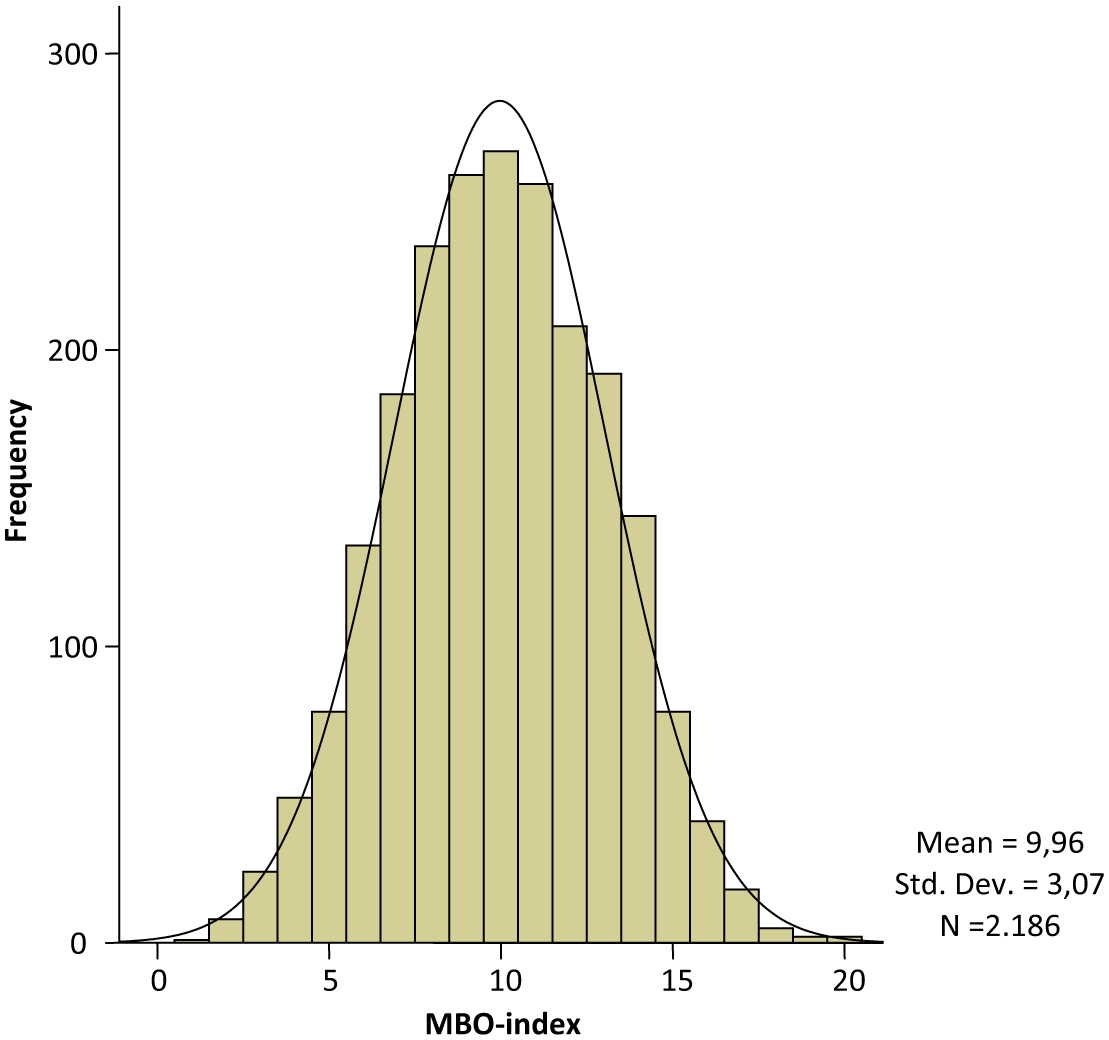
Distribution of the mayoral business orientation index.
Independent variables: mayoral leadership form, context and characteristics
In line with the model outlined above, three groups of independent variables are included in the analysis. Since we aim to compare the effect of these different groups and their particular variables, and given the fact that some of these will be categorical, all independent variables are categorized and recoded into dummies. We have conceived our independent variables in such a way that the presence of the characteristic under study is expected to co-vary with higher scores on the MBO index (with the exception of some categorical variables in the analysis, cf. infra).
First comes leadership form, that is, the formal-constitutive aspects of leadership and their related informal rules-in-practice. This group covers two aspects identified as central to leadership reform. The electoral aspect (of personalization) is made operational by determining whether or not a mayor was directly elected. 4 Its functional counterpart (the extent to which leadership is individualized) can be depicted by using the typology developed by Mouritzen and Svara (2002) to classify legislative–executive relations based on a combination of the acquisition and maintenance of the leadership position, the degree of control leaders have over the appointment of the rest of the executive and the extent to which leadership functions are integrated in one institutional position. In this scheme local governments are – in descending order of local presidentialism – either strong mayor, collective, committee or council-manager types. The strong mayor has the power of appointment over his cabinet and/or the leading members of the administration. He also functionally embodies the executive in being its CEO. He is usually directly elected and disposes of a majority in the council (due to majoritarian electoral rules). In the collective form, a separate executive does exist but is composed of actors elected in and functionally embodied in the legislative (monism). In the committee form there is no separate executive body. Executive functions are taken up by a different policy-related standing committee. Usually there is one more general committee of which the leader is usually considered to be the functional equivalent of a mayor. In the council-manager type all executive functions are taken up by a council-appointed manager. The mayor is merely ceremonial. 5 Given the reformist argumentation discussed above at more length (the mayor as a figurehead and synthesizer), we expect directly elected (Hypothesis 1a) and/or strong mayors (Hypothesis 1b) to be significantly more business oriented than their counterparts.
The second group of independent variables is leadership context. In line with Lowndes and Leach (2004) we focus both on the locality as well as on central–local relations. One rather straightforward but meaningful indicator characterizing the locality is municipal size. Hence we will distinguish populous municipalities from their counterparts with a lower number of inhabitants. 6 In line with the argument that an informal hierarchy exists in the extent to which cities experience and respond to competition in the international market place (Savitch and Kantor, 2002) and a tendency towards governance calling for a specific type of leadership (Navarro-Yáñez et al., 2008), we expect that in larger localities political leaders will be significantly more oriented to the business world (Hypothesis 2a).
A second indicator of leadership context is the institutional position of municipalities in the intergovernmental arena. Here we will use an extended version of the typology developed by Hesse and Sharpe (1991) to characterize central–local relations. Based on factors such as local autonomy/discretion, the constitutional status of local government and its rationale on a political–instrumental continuum, these authors distinguish between Franco, North and Middle-European, and Anglo groups. In the Franco group, local governments have a political function. The bulk of services is rendered by central government agencies, whilst in their limited functional space localities are heavily supervised. Instead they draw on a communalism that is constitutionally protected and the colonization of the central state in view of territorial interest mediation (e.g. by dual mandate holding or party political networks). This group is clearly contrasted with an Anglo-Saxon counterpart in which instrumentalism thrives over communalism. Local governments have an important functional scope but no constitutional status, rendering them a creature of state (with legally delegated competences based on the principle of ultra vires). Within this scope they can act rather autonomously. The North and Middle-European group is somewhere in between. Whilst strong emphasis has been given to shaping and delivering public services, local government is equally institutionalized as a political autonomous level of policy-making. 7 To this categorization, Central and Eastern Europe may be added as a separate path-dependent group (Heinelt and Hlepas, 2006). We expect the cases from the Anglo (HYPOTHESIS 2b) and Central and Eastern-European group (Hypothesis 2c) to be significantly more business oriented. Whilst previous comparative accounts have shown that the former were most keen to go along the tendency for New Public Management from the 1980s onwards (including an openness to private business principles and practices, see Denters and Rose, 2005), the latter have faced a more outspoken dependency on the private sector (e.g. for resources and local development) to solve problems of collective action (Coulson and Campbell, 2008).
The third group of independent variables refers to the characteristics of the key actors embodying leadership, that is, the mayors. It combines a number of background characteristics of those leaders, previously found to have an impact on leadership (Bäck, 2006) as well as a presumably important attitudinal variable. In terms of social background and drawing on arguments of group belonging, male (Hypothesis 3a) and/or university educated (Hypothesis 3b) mayors are expected to be significantly more business oriented. Whilst the argument on gender is fairly clear in the literature, with female mayors developing more inclusive networks (Weikart et al., 2006), the presumed effect of education is less straightforward. One may argue that a university education induces some kind of a cognitive awareness of the need to do external networking with the business world in an environment where political leaders are held responsible for the economic development of their cities and in which business actors are included in public decision making. The effect of university on business orientation might be more differentiated in being limited to specific types of education or in that it may lead to particular kinds of professions, for example, of the talking and brokerage kind. Unfortunately, the comparative data do not allow one to isolate the type of education nor a group within these professions who come from private firm management before entering the mayoralty. The dummy presented is hence the best proxy available. 8
In terms of socialization and apprenticeship we hypothesize that mayors who come from a non-partisan political background (Hypothesis 3c) score significantly higher on the MBO index. Partisanship has previously been found to redirect networking to arenas alternative to the business world, in particular electoral ones (Ramírez-Pérez, 2008). We also expect significantly higher scores for mayors who have held office in a business association (Hypothesis 3d). 9 Finally, the analysis includes one aspect of the mayoral agenda that may be expected to lead to a significantly higher degree of orientation to the business world, that is, the extent to which mayors consider attracting economic activities to the city as one of the main themes of their term (Hypothesis 3e). 10
Results: model behaviour or modest optimism?
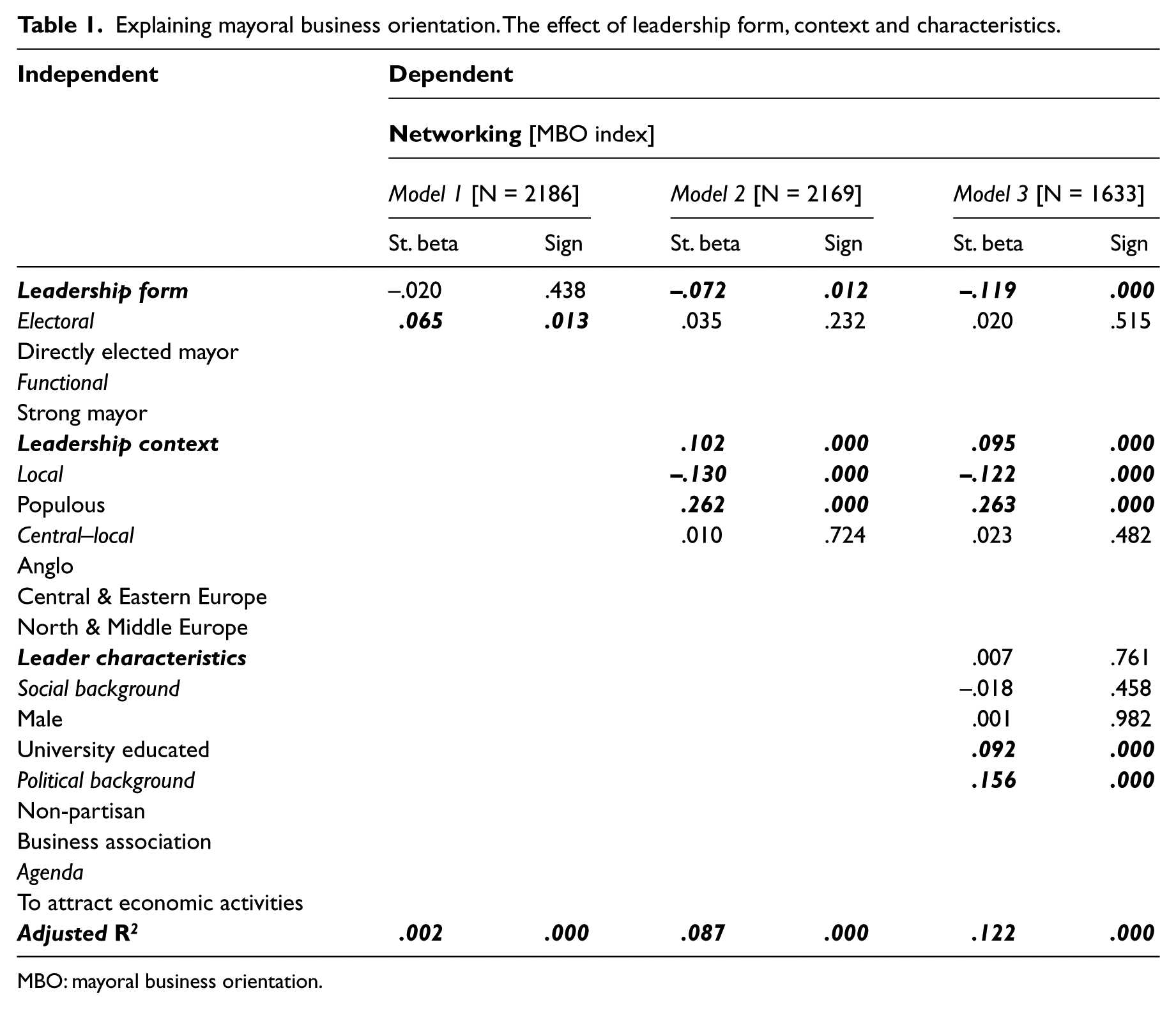
Table 1 presents the results of three OLS-regression analyses with the dependent variable for different groups of independent variables. 11 While the first model only considers the effect of leadership form (Hypotheses 1a and b), the subsequent models include, respectively, leadership context (Hypotheses 2a–c) and characteristics (Hypotheses 3a–e) to scrutinize and compare the explanatory effect of each new group of independent variables. Given this aim, an adjusted version of R2 is presented as an expression of the overall explanatory power of the model under study. Data represent standardized beta coefficients and significance levels (in bold and italic if significant). Given the large N of our dataset and the range of countries covered, we expect to find quite easily significant effects that in terms of explanatory power may be rather modest.
Explaining mayoral business orientation. The effect of leadership form, context and characteristics.
MBO: mayoral business orientation.
Model 1 only studies the effect of institutional form on MBO. Although these variables do have a significant effect, their explanatory power is very weak and entirely due to functional aspects of leadership form. In line with our expectations, strong mayors are significantly more business oriented. The electoral road to the mayoralty does not seem to matter. In this model, Hypothesis 1b is accepted.
Adding leadership context – as in Model 2 – enhances the overall explanatory power. Context first of all seems to modify the effect of institutional form but in somewhat unexpected directions. Being a directly elected mayor turns out to have a significantly negative effect on business orientation. On the contrary, locality does seem to matter in line with what theory predicts: being a mayor in a more populous municipality does lead to a significantly higher score on the MBO index. For central–local relations, the result is mixed. As expected, mayors from Central and Eastern European contexts are significantly more inclined to orient themselves to the business world in their leadership. However, in the Anglo-Saxon world this happens significantly less. In this model, Hypotheses 2a and 2c are accepted.
Finally, Model 3 includes also leadership characteristics. Adding this kind of variable tends to modify the effects of institutional form and context that have been found in Model 2, although the trends are rather similar. The increase of the overall explanatory power of the model is thus due to variables that comprise this lastly added group. Whereas social background does not seem to matter at all, one aspect of its political counterpart does. Mayors who have held a position in a business association are significantly more business oriented, suggesting that recruitment matters in terms of direction and continuity of exchange networks. Lastly, also agendas matter. Mayors who consider attracting economic activities to their city as one of their main priorities are significantly more oriented towards the business world. In this model, Hypotheses 2a, 2c, 3d and 3e are accepted.
Conclusion and discussion
This article has tried to integrate various streams in the comparative literature on local leadership in Europe, with a specific focus on the mayor. In addition, it has discerned the potential of a new institutional perspective to proceed within this literature. This perspective can help us to understand the causes, manifestations and consequences of different forms of leadership and to probe into the question whether institutions matter for mayoral leadership. We argued that this perspective should include the persisting variety in leadership form, attitudes and behaviour and the way in which these interact as well as qualify the effect of form as contingent upon context and characteristics. The European context provides an interesting ‘laboratory’ to empirically substantiate this perspective, since we are witnessing general tendencies to strengthen mayoral leadership where electoral personalization meets de-collectivization of the executive to provide leaders with improved tools to set the agenda and broker in networks to face the challenges of governance. Still, these tendencies are path dependent as form, extent and speed differ and interact with variegated environments.
Our exploration using data from a comparative European project has shown that leadership form does matter significantly for leadership behaviour. But considered in isolation, its effect is not particularly strong and is mainly due to the functional strength of local leaders. Moreover, when leadership context and characteristics are considered conjointly, the functional effect disappears and the electoral aspect of leadership form gains substantial importance. It does so in a direction that was not expected based on a number of claims from the literature and institutional reformist discourse. Directly elected mayors are significantly less oriented towards the business world. One explanation for this effect may be that in external networking this type of mayor is more oriented (and sensitive) towards (the claims of) those individuals, groups and actors on whom their direct legitimacy is founded (e.g. citizens, the party as a professional-electoral machine or the media), which is confirmed in categorical time management analysis on the same data (Getimis and Hlepas, 2006). Further research should reveal the way in which the specificities of a direct election have an effect on mayoral leadership.
To tackle the limited explanatory power of leadership form as such, future research might also reconsider the categories on which this comparative account has been based and which are prevalent in the comparative literature on the topic (Mouritzen and Svara, 2002). As this article has argued, different electoral and functional means might serve the same end or similar ones may operate with different effect, so it could be that there is more discrete variety underneath the dichotomous distinctions made in the analysis that has not been fully grasped. Currently, these categorizations are the only ones available, however, so scholars should embark on a quest to develop more fine-grained typologies for comparative research in local governance that can have greater explanatory capacity (Wolman, 2008).
In addition, the exploration has confirmed the importance of considering context and characteristics when scrutinizing the effect of form. Size matters but also the Central and Eastern European context is of particular importance for business world orientation. The latter has already been described in a number of country studies (e.g. Swianiewicz, 2006), but seems to be a more systemic feature of this type of country. Whilst the interaction of form and context is clear, the causal mechanisms are less straightforward and should be studied more in detail in future research. Hence, the field may benefit from applying path analysis or other types of structural equitation modelling to comparative data (Bäck, 2006). With the assumption that leadership form is embedded in the characteristics of the locality and central–local relations, the use of multilevel analysis also seems particularly promising to discern the mechanisms that comprise the interaction effect (Sellers, 2002).
For leadership characteristics, it is not so much the more general and distant background elements that matter, but rather specific aspects that are closely associated with the type of external networking under study. Having held a function in a business association and considering the attraction of economic activities among the priorities of one’s agenda leads to attuning more significantly to the business world. Hence, individual agency also modifies institutional frames. This agency seems embedded in actor orientations (such as the interpretations, preferences and role orientations stemming from coming from the business world or having economic development on one’s agenda) that in turn affect leadership behaviour (i.e. business orientation).
In addition, these findings (i.e. the effect of the mayoral agenda on networking) suggest that looking into the connectivity of different aspects of leadership behaviour may be worthwhile. Studying external networking through the extent of MBO leaves important aspects of networking out of sight and is even less informative on agenda-setting or implementation (and their interrelation). It may well be that the interaction between form, context and characteristics takes a different shape as other elements of leadership behaviour come under study. As the conceptualization of leadership has made clear, in the executive leaders have to reach different clienteles. With business groups embedded in a broader civic arena interacting with alternative electoral and intergovernmental counterparts, the picture might even become more complex. This might be of particular relevance in the European context, where multilevel policy entanglement and party politicized and consensual modes of decision making persist despite much reformist activity (Loughlin et al., 2011). It can be of interest for future research to study if, how and why institutional form affects the balancing between these aspects of leadership.
Whereas the former paragraphs point to more operational aspects, one more fundamental discussion needs to be addressed. Do these findings ultimately discredit the reformist claims outlined above? Focusing on the mere and strict effect of form on this particular set of attitudes and/or behaviour such a conclusion at first sight seems justified. At least it qualifies all too optimistic reformist stances that altering form in the direction of the strong mayor will straightforwardly lead to entrepreneurial leadership. Still, we think a more nuanced view is appropriate. For one thing and following Greasly and Stoker (2009: 133), we do not argue for a deterministic approach of social causation. A wide range of formal powers does not necessarily produce proactive and individualistic leadership. More probabilistic conceptions of institutional effect focus on ‘…whether they have made particular types of leadership more likely’. Despite its weakness, that probability is present and gains particular meaning when the proper nature of institutions is effectively acknowledged. Institutions do not determine behaviour but provide frameworks of understanding embedded in wider institutions and are given meaning and effect through the reconstruction of individuals under different circumstances. The relative increase in explanatory power of the models including contexts and characteristics underlines this argument. In addition and referring to the previous paragraph, despite its central importance in the wake of entrepreneurialism, business orientation is just one set of attitudes and behaviour in need of adjustment with wider concerns of mayoral leadership. The absence of strong institutional effects in this aspect does not discard the importance of form altogether.
As with many agendas in the comparative research on local politics, the new institutionalism is thus still very much work in progress and issues of correlation and causation remain central to its development. Most importantly, it needs to substantiate further whether institutions matter both in terms of outcome (with what effect?) and process (through which mechanisms?). In addition, it should probe into the conditions under which this materializes. With regard to outcome, Greasly and Stoker (2009: 127) have already pointed at the effect of institutions on individual political behaviour whilst acknowledging that: ‘…further research is required to examine just how important this influence is relative to the influences of structural features and individual interests’. In addition, Davies and Trounstine argue for a stronger focus on the process of mattering (2012: 63): ‘scholars have paid insufficient attention to testing the mechanisms by which these formal structures induce particular outcomes and analysing when the institutions ought to matter’. We hope this article helps to clear away the underbrush.