




Abstract
Past studies of business associations conducted in the late 1980s indicated that employers were reluctant to support devolution due to economic fears and political uncertainties. However, profound changes have altered the dominant economic and political paradigms over the course of the last three decades. Regional innovation has become a linchpin for competitive economies, whereas secession has become a skyrocketing political issue in Catalonia and Scotland, and a number of regional agencies have been settled throughout Europe, even in unitary states. Have business associations adapted to this new reality? This article examines 18 regional business associations from three Spanish regions (Catalonia, Andalusia and the Valencian Community) and three UK regions (Scotland, Wales and South West England). The first part of the article discusses six theoretical arguments linking business associations and regionalism. A general overview of the cases is offered in the second section. The third section of the article performs a fuzzy sets/Qualitative Comparative Analysis to identify the main factors that bolster the regionalisation of business associations. By way of conclusion, there are two routes towards successful regional business mobilisation. On the one hand, this happens in regions where a competent institutional arrangement has been established. On the other hand, this also happens when business associations recognise the economic and political strengths of the region while they are able to interact with regional institutions.
Keywords
Introduction
Studies of regionalism have rarely addressed the impact of devolution on the logics of collective business action. Nor have industrial sociologists paid much attention to the issue, as key early contributors noted, regional factors were ‘second in importance only to economic activity as an organizing principle for the structure of employers associations’ (Windmuller, 1984: 11). It was not until 1989 that a number of scholars first contributed to a collective book titled Regionalism, Business Interests and Public Policy (Coleman and Jacek, 1989). Its editors, in presenting the book, noted that business associations that are ‘active at the subnational level play a range of important roles in the strengthening and defusing of regionalist movements. They may act as important forces of national integration or they may play a leading part in struggles for regional autonomy. In either case, they are subjects worthy of further, intensive study’ (Coleman and Jacek, 1989: 1). However, only a rather small number of authors have somehow contributed to the topic since (Dixon, 2006; Keating et al., 2009; Jonas, 1996; Jonas and Pincetl, 2006). Roughly 20 years after Coleman and Jacek’s book, and after the growing academic interest in urban and regional studies, this article examines the current phase of organisational development and policy capacity of 18 regional business associations from three Spanish regions (Catalonia, Andalusia and the Valencian Community) and three UK regions (Scotland, Wales and South West England). Fieldwork, including interviews and documentary analysis, was carried out from 2008 to 2011; thus, the majority of opinions and pieces of documentation are enmeshed in that concrete political and economic context. Of course, future research is encouraged to assess the business adaptation to such new regional dynamics as the secessionist aspirations in Catalonia and Scotland, the abolition of Regional Development Agencies (RDAs) in England, and the emergence of recessionary trends in some regions in Spain.
This article draws upon the empirical evidence of the formation of a series of contextual changes that have steadily fostered new institutional incentives and policy challenges for businesspeople, which are even strong enough to encourage their associations to adapt to changes happening in the political sphere, as well as take advantage of the political force of regionalist movements (Keating, 1998: 103). Indeed, the state challenges a dispersion of authoritative power, as well as a rescaling of policy-making. This leads to leaner, decentralised forms of economic governance (Traxler, 2004). It is argued that the region has gained saliency when it comes to explaining economic, social and even political change. On one hand, to make it possible, or as a consequence of this, we have witnessed (or just rediscovered) the emergence of peripheral economies, regional institutions, regional elites and regional cultures. A new bunch of academic buzzwords accompanies the rescaling of policy-making, for instance, new regionalism, multi-level governance, the Europe of Regions, and so forth. On the other hand, traditional national associations, whatever their nature and scope, have gradually faced decline in terms of membership and power (Schmitter, 2008: 200). In consequence, economic organisations involved in national politics are clearly under stress (Crouch, 2003). In this context of shifting balance between power and representation, regional authorities are rapidly finding ‘real interlocutors who help them to reduce the institutional constraints on regional interventions, and increase their capacity of representation at the regional level’ (Trigilia, 1991: 321). Nevertheless, employers have traditionally been sceptical about the seductive promises of regional governments, raising objections to devolution due to its alleged negative effects on market unity, especially if regional governments impose them. In this regard, this study aims to assess under what circumstances genuine regional business mobilisation takes place. For the purpose of this article, ‘regional business mobilisation’ is defined as the situation where a business association has proven to be a regional actor in three key aspects: cognitive frameworks (regional discourse and demands), territorialised organisation (internal devolution) and public policy (access to regional institutions).
The article is structured as follows: firstly, a theoretical discussion serves to identify the key factors likely to foster regional business mobilisation. Six factors, whether economic or political, whether exogenous or endogenous, can be identified. Secondly, the selection of cases and the methodological aspects is discussed. Thirdly, a broad outline of the organisational evolution and policy strategies of selected business associations is offered. Finally, a fuzzy sets/Qualitative Comparative Analysis (fs/QCA) analysis identifies the proper combination of factors leading to stable, salient regional business mobilisation.
Linking debates on regions and business associations
Economists and political geographers have long noted that globalisation vastly focuses on firms’ competitiveness and on a policy agenda based on supply-side policies. This led a number of experts to theorise on the preconditions of the so-called supply-side economics, which purposely revived the functionability of the meso level of governance to the detriment of Keynesianism’s greatly sponsored centralisation. Apart from much more economic openness and monetary control, such a new regional model soon appeared to boost social capital, as well as to make regions and regional institutions become interactive hubs for political activities and economic processes involving ‘universities, basic research laboratories, applied research laboratories, technology transfer agencies, regional public and private (e.g. trade associations, chambers of commerce) governance organizations, vocational training organizations, banks, venture capitalists, and interacting large and small firms’ (Cooke and Morgan, 1998: 71). This paradigm represented a breath of fresh air for the institutional expectations of a series of regional business associations that were largely subject to top-down logics. Accordingly, Traxler (1995: 279) pointed out that this new scenario could have nothing but positive effects on a series of peak national business associations in rapid decline insofar as ‘more decentralization may enable the associations to equip themselves with a new source of helpful legitimisation when facing the declining member affiliation to the traditional political camps.’
However, only a small share of regions with solid industrial backgrounds and social cohesion were able to become champions of innovation. This argument is supported by Saxenian (1994) as the reason why Silicon Valley’s industrial project succeeded, while Route 128 rapidly fell short despite both sharing similar technological characteristics. Saxenian argues that Silicon Valley was able to combine a high-value industrial project with a decentralised mode of governance that permitted permanent co-operation and learning processes. On the contrary, self-sufficient companies that paid little attention to the benefits of regional synergies along Route 128. In this regard, some regions barely succeed in mobilising resources, developing strategies and conditioning the intermediation of regional interests (Lovering, 1999). Although regional authorities make major efforts to deliver resources and attract foreign investment, they cannot force companies to settle in their territory (Garmise, 1997: 79), nor even invest in regional projects. Following these and other examples, Keating (2001) highlighted that in no case will the economy determine the process of regional construction. Political scientists tend to disapprove of such fashionable concepts as ‘learning regions’ and ‘innovative milieux’ and their purely mathematically market-driven explanations. Drawing upon a political rationale, some authors argued that regional elites, beyond temporary needs, deemed it necessary to consolidate their own space for politics, relying on political, social, cultural and fiscal issues (Loughlin, 2001). For instance, in regions with their own language or dialect, regional elites will defend and promote their usage as a way to ‘construct’ their own homeland. Likewise, whereas the ‘new geographical economics’ focused on the endogenous formation of regionally based advantages (Martin, 1999), political scientists have necessarily directed attention towards the importance of interstate conflicts when it comes to shaping access to public resources.
At the same time, another key parallel observation concerns the extent to which regionalist and nationalist aspirations depend on institutional representation. The point is that regions are endorsed with an uneven variety of powers and institutions throughout Europe (Hooghe et al., 2008: 178). Most regions still encounter major institutional contradictions caused by their constitutional legacy, whereas other regions were merely established by central governments attempting to get European Union (EU) funds. This can have implications for the development, or sustainability, of the regional systems of interest groups. Obviously, the existence of self-governing institutions creates a series of opportunities for organised groups (Molins et al., 2010). The importance of having a powerful voice in the context of state transformation and economic crisis has generated a trend towards the development of more robust multiscalar decision-making, as seen in the last decade in Spain and in the United Kingdom with new transfers of powers to some regions. However, in fairness, the proliferation of regional governments has had at least two major consequences in terms of policy outcomes, namely, growing policy divergence across regions (Gallego and Subirats, 2012) and some heterogeneity in the mechanisms involved in policy provision (Dolowitz, 2012). Bearing this in mind, the most plausible expectation is the existence of a wide range of models of regional interest representation within the same country in which to find a varying number of actors, a different cross-regional distribution of power, various channels of interest representation, several patterns of policy provision, and so forth.
Furthermore, there are obvious differences between large companies and small firms in terms of needs, political demands and perceptions about the regions. Jones and Schröter (1993: 5) noted that ‘multinationals have ownership advantages, which can derive from, among other things, technology and marketing skills, and managerial and financial factors’. Small and medium-sized enterprises (SMEs) are unlikely to be able to take advantage of economies of scale. In effect, Wynarczyk et al. (1993) asserted that SMEs deal with much more external uncertainty than large firms do. As large companies mostly operate on a national scale, business associations representing large companies will deem it appropriate to minimise locational factors, including trade barriers, relative labour costs, host government policies, and so forth. In contrast, SMEs will be likely to interact with governments that show interest in solving their problems quickly (Giaoutzi et al., 1988: 11). According to Coleman and Grant (1985: 40), ‘if a sector is dominated by relatively few large firms, the growth of regional structures will be discouraged. However, in sectors where there are many small firms, associations will be encouraged to have regional units to service those firms in situ and to maintain contact with them.’ Needless to say, local and regional governments are eager to create new jobs, foster economic growth and increase social welfare.
However, the differences in terms of companies’ needs, which would explain a greater or lesser degree of regional orientation of the different types of business associations, must be balanced with the dispersion of power (internal devolution) within business associations. The emphasis on the distribution of resources, the constitutional links between territorial units, the internal decision-making mechanisms and other membership-related topics have monopolised most of the studies on business associations and regions (Jordan and Halpin, 2004). The crucial point is to know the degree of autonomy regional associations are able to acquire from the central headquarters. Accordingly, it is interesting to examine business movements outside the most representative business associations. For somewhat different reasons, and although business associations tend to copy state structures (Grant, 1989), the transfer of organisational power to the regional branches is always a very sensitive topic for the entire business association. The centre always tries to control decisions over resources, membership and policy demands. Devolution becomes too much of a challenge, especially for unitary associations. In a nutshell, Coleman and Grant (1985) noted that unitary associations retain power over major decisions and do not allow internal singularities, unless a sub-unit is recognised with a special status. Other types of business association show higher levels of territorialisation and dispersion of power, for instance, federal associations, confederal associations, and associations with affiliation arrangements (Coleman and Montpetit, 2000).
Finally, the debate on pluralism/corporatism is always timely when it comes to examining business associations at any territorial level. According to Jo Martin (2006: 63), ‘corporatist employers’ organizations have stronger links with policy-makers in government and in the labor movement than pluralist groups.’ Obviously, the establishment of corporatist mechanisms leads to a sort of ‘fabricated’ mobilisation induced by institutional rewards. Overall, the intermediation of corporatist interests seeks the formation of inter-organisational linkages between interest associations, political parties, governments, administrations and political institutions. Thus, economic policies are performed through the formal bargaining between the government and a few organisations, guaranteeing the stability of the agreements, and subordinating all interests to state priorities (Regini, 1982). Since this is a controversial point, the assumption is that corporatism acts every so often as a catalyst for the regionalisation of some business associations.
Cases and methods
This article examines the degree of regional mobilisation of business associations. It examines 18 cases of business associations from six different regions (Catalonia, Andalusia, the Valencian Community, Scotland, Wales, and South West England) from two different countries (Spain and the United Kingdom). These regions deploy unique features that facilitate comparison in dissimilar scenarios. This strengthens the explanatory value of the political and economic context, if any. Following Windmuller and Gladstone’s (1984) twofold categorisation of business associations, namely, employers’ associations and trade associations, this article examines six major regional business associations, six SMEs’ business associations, and six Chambers of Commerce. Of course, there is a larger number of sectorial business associations, business lobbies and business-related think tanks, but their main concern is often other than the state’s territorial architecture. From time to time, they issue reports on any tricky aspect of the regions, but their main interests relate to industrial relations, free market promotion and the defence of private managers’ contribution to society. Therefore, business associations are most likely to forge a broad view on devolution, meaning they monitor regional politics, accomplish business representation and elaborate regional manifestos, are those labelled as ‘comprehensive associations’, so to speak, those business associations that bring together companies from all sectors.
For Spain, I research the regional business associations belonging to the Confederación Española de Organizaciones Empresariales (CEOE), namely, Fomento del Trabajo Nacional (FTN), Confed-eración de Empresarios de Andalucía (CEA) and Confederación de Organizaciones Empresariales de la Comunidad Valenciana (CIERVAL), as representative cases of peak regional business associations. Confederación Española de Pequeña y Mediana Empresa (CEPYME), which is meant to be the main statewide SMEs’ business association, actually belongs to CEOE, so its autonomy seems to be somehow conditioned (Nonell and Molins, 2007). To overcome this, I research independent SMEs’ business associations, such as Petita i Mitjana Empresa de Catalunya (PIMEC) in Catalonia, Confederación de Empresas Pequeñas y Autónomos de Andalucía (CEPME) in Andalusia and Confederación Valenciana de Pequeña y Mediana Empresa (PYMEV) in the Valencian Community. Another three business associations are analysed, namely, the Barcelona Chamber of Commerce (BCC), the Valencian Chamber of Commerce (VCC) and the Granada Chamber of Commerce (GrCC). As for the United Kingdom, the existence of two differentiated employers’ associations (the Confederation of the British Industry and the Federation of Small Businesses) facilitates the selection of cases. I select their regional branches in the three afore-mentioned regions. In addition, I observe the Glasgow Chamber of Commerce (GCC), the South Wales Chamber of Commerce (SWCC), and the GWEBusinessWest (GWBW). For membership density, these Chambers happen to be quite representative associations in their respective territories.
Eighteen business associations are a considerably interesting example of mid-sized N-cases to perform a Qualitative Comparative Analysis (Ragin, 1987). During the course of the last 20 years, we have witnessed growing attention to a methodological approach, which has resulted in a vast number of publications on its various strengths and pitfalls, the feasibility and applicability of the early crisp set Qualitative Comparative Analysis (cs/QCA) and its related techniques (fs/QCA, mv/Multi-value QCA (mv/QCA)), and the development of computer-based software (fsqca, TOSMANA). Discussion of these and other concerns can be found in Ragin (2000) and Schneider and Wagemann (2010). For the sake of methodological comprehension, a number of statements are noteworthy in relation to the singularities of fs/QCA. Despite early attempts to build a methodology able to go beyond the recurrent qualitative and quantitative paradigms, QCA – in any of its forms – has mostly applied qualitative logics when it comes to the analytical process, because it works better with a mid-sized N of cases, roughly from 10 to 35. QCA is a comparative case-oriented approach, thus a proper application of the method requires previous knowledge about the outcome that the researcher aims to explore. QCA aims at ‘giving justice to within-case complexity’ (Rihoux and Ragin, 2009: xviii); thus, QCA merits causal complexity in that various combinations of factors – conditions – might lead to similar outcomes (equifinality). Therefore, QCA is sensitive to the analysis of necessary and sufficient conditions in terms of the presence/absence of a condition when the outcome is true. Moreover, QCA has elaborated its own procedure for the interpretation of results that consists of a raw table (in which the researcher shows the allocation of values), a truth table (that differentiates between true and false cases, as well as presenting counterfactuals), and also a truth table analysis (that clearly details solutions, coverage and consistency). Finally, focusing on this research, the qualitative study was full of complexities and nuances, which are impossible to summarise in a dichotomous logic. QCA in its fuzzy-set form hinges on fuzzy logic rather than on Boolean algebra. This implies cases are no longer tightly fit into two opposite categories (membership/non-membership in a set). Instead, fs/QCA allows degrees of membership in a set in intervals from 0.0 (full non-membership) to 1.0 (full membership) (Ragin, 2007). After completing the database and performing the qualitative coding, fs/QCA requires the calibration of data as a means of defining the various membership anchors. This research follows a direct method of calibration in three qualitative anchors set up for every condition at 0.8 for full membership, 0.5 for the crossover point and 0.2 for non-membership. Column-wise, Tables 1–6 indicate the qualitative coding for every condition, the qualitative meaning of each of the qualitative codes, the corresponding fuzzy-set calibration and the appropriate allocation of cases.
‘Regional economy’ and corresponding fuzzy-membership values.

PIMEC: Petita i Mitjana Empresa de Catalunya; FTN: Fomento del Trabajo Nacional; BCC: Barcelona Chamber of Commerce; PYMEV: Confederación Valenciana de Pequeña y Mediana Empresa; CEA: Confederación de Empresarios de Andalucía; CIERVAL: Confederación de Organizaciones Empresariales de la Comunidad Valenciana; GrCC: Granada Chamber of Commerce; VCC: Valencian Chamber of Commerce; CEMPE: Confederación de Empresas Pequeñas y Autónomos de Andalucía; CBI-S: Confederation of British Industry in Scotland; FSB-S: Federation of Small Businesses in Scotland; FSB-W: Federation of Small Businesses in Wales; FSB-SW: Federation of Small Businesses in South West; GWBW: GWEBusinessWest; SWCC: South Wales Chamber of Commerce; CBI-W: Confederation of British Industry in Wales; CBI-SW: Confederation of British Industry in South West; GCC: Glasgow Chamber of Commerce.
Source: own research.
‘Regional orientation’ and corresponding fuzzy-membership values.
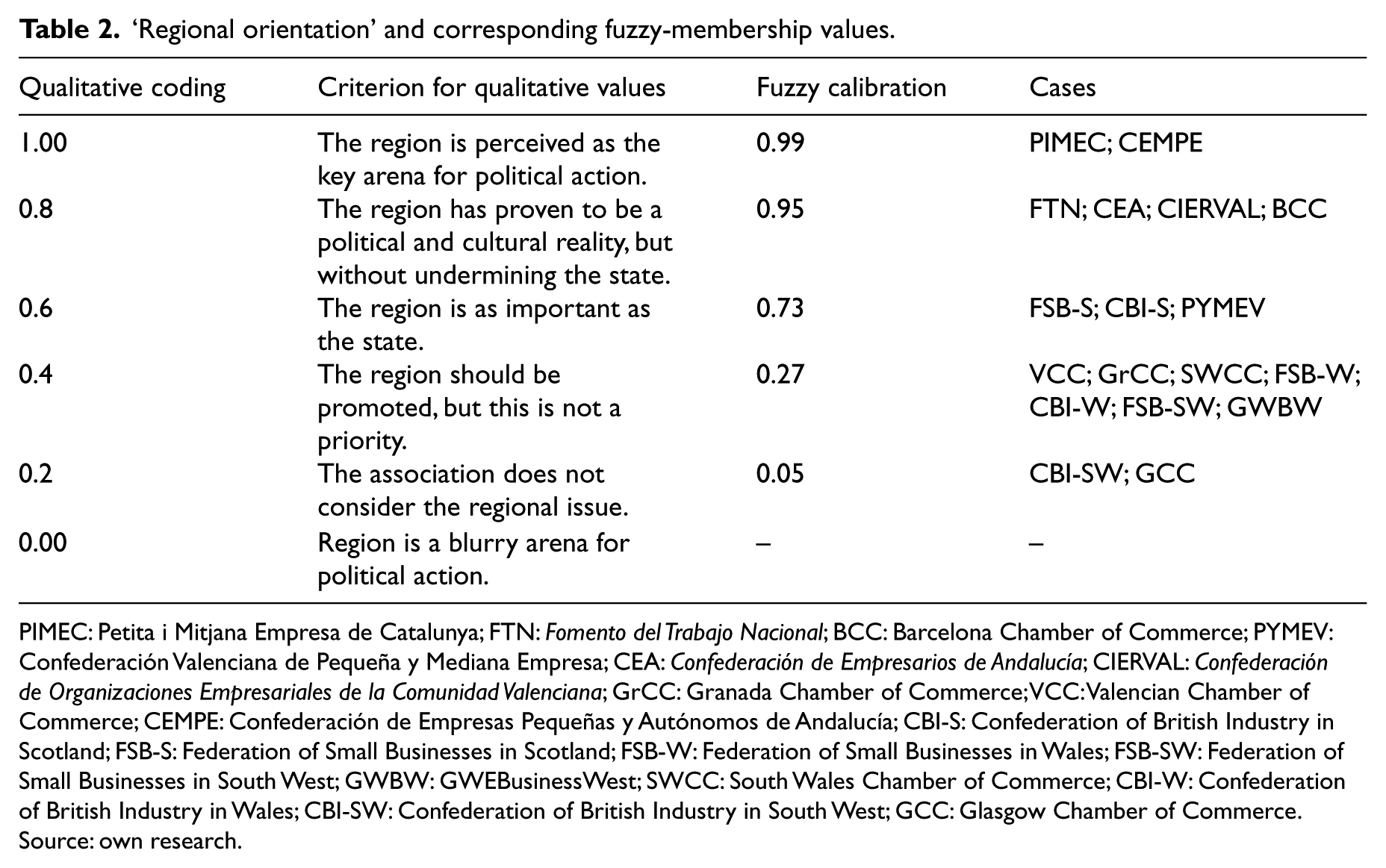
PIMEC: Petita i Mitjana Empresa de Catalunya; FTN: Fomento del Trabajo Nacional; BCC: Barcelona Chamber of Commerce; PYMEV: Confederación Valenciana de Pequeña y Mediana Empresa; CEA: Confederación de Empresarios de Andalucía; CIERVAL: Confederación de Organizaciones Empresariales de la Comunidad Valenciana; GrCC: Granada Chamber of Commerce; VCC: Valencian Chamber of Commerce; CEMPE: Confederación de Empresas Pequeñas y Autónomos de Andalucía; CBI-S: Confederation of British Industry in Scotland; FSB-S: Federation of Small Businesses in Scotland; FSB-W: Federation of Small Businesses in Wales; FSB-SW: Federation of Small Businesses in South West; GWBW: GWEBusinessWest; SWCC: South Wales Chamber of Commerce; CBI-W: Confederation of British Industry in Wales; CBI-SW: Confederation of British Industry in South West; GCC: Glasgow Chamber of Commerce.
Source: own research.
‘Regional institutions’ and corresponding fuzzy-membership values.
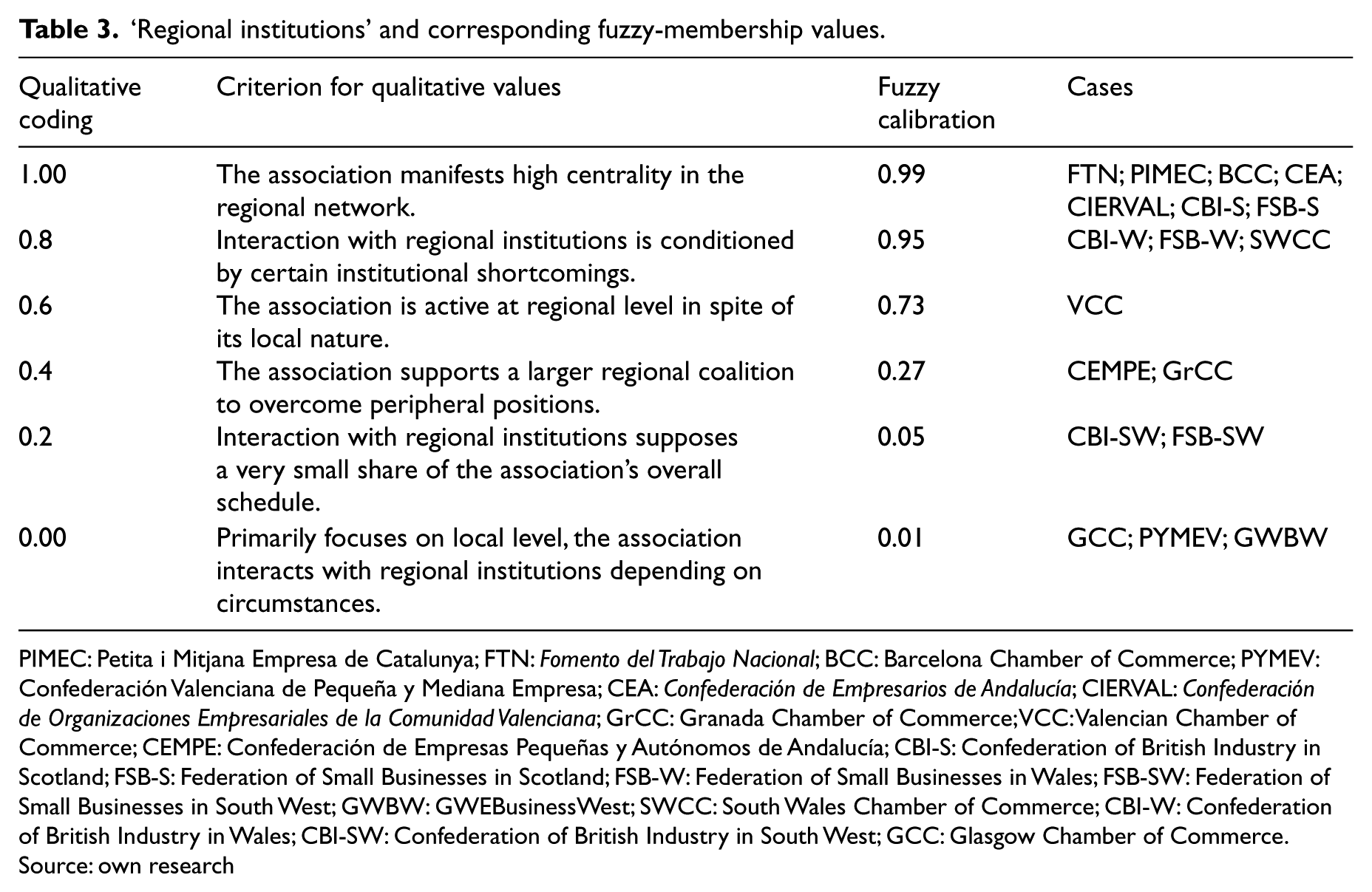
PIMEC: Petita i Mitjana Empresa de Catalunya; FTN: Fomento del Trabajo Nacional; BCC: Barcelona Chamber of Commerce; PYMEV: Confederación Valenciana de Pequeña y Mediana Empresa; CEA: Confederación de Empresarios de Andalucía; CIERVAL: Confederación de Organizaciones Empresariales de la Comunidad Valenciana; GrCC: Granada Chamber of Commerce; VCC: Valencian Chamber of Commerce; CEMPE: Confederación de Empresas Pequeñas y Autónomos de Andalucía; CBI-S: Confederation of British Industry in Scotland; FSB-S: Federation of Small Businesses in Scotland; FSB-W: Federation of Small Businesses in Wales; FSB-SW: Federation of Small Businesses in South West; GWBW: GWEBusinessWest; SWCC: South Wales Chamber of Commerce; CBI-W: Confederation of British Industry in Wales; CBI-SW: Confederation of British Industry in South West; GCC: Glasgow Chamber of Commerce.
Source: own research
‘Small and medium-sized enterprises’ (SMEs) and corresponding fuzzy-membership values.

PIMEC: Petita i Mitjana Empresa de Catalunya; FTN: Fomento del Trabajo Nacional; BCC: Barcelona Chamber of Commerce; PYMEV: Confederación Valenciana de Pequeña y Mediana Empresa; CEA: Confederación de Empresarios de Andalucía; CIERVAL: Confederación de Organizaciones Empresariales de la Comunidad Valenciana; GrCC: Granada Chamber of Commerce; VCC: Valencian Chamber of Commerce; CEMPE: Confederación de Empresas Pequeñas y Autónomos de Andalucía; CBI-S: Confederation of British Industry in Scotland; FSB-S: Federation of Small Businesses in Scotland; FSB-W: Federation of Small Businesses in Wales; FSB-SW: Federation of Small Businesses in South West; GWBW: GWEBusinessWest; SWCC: South Wales Chamber of Commerce; CBI-W: Confederation of British Industry in Wales; CBI-SW: Confederation of British Industry in South West; GCC: Glasgow Chamber of Commerce.
Source: own research.
‘Territorial differentiation’ and corresponding fuzzy-membership values.
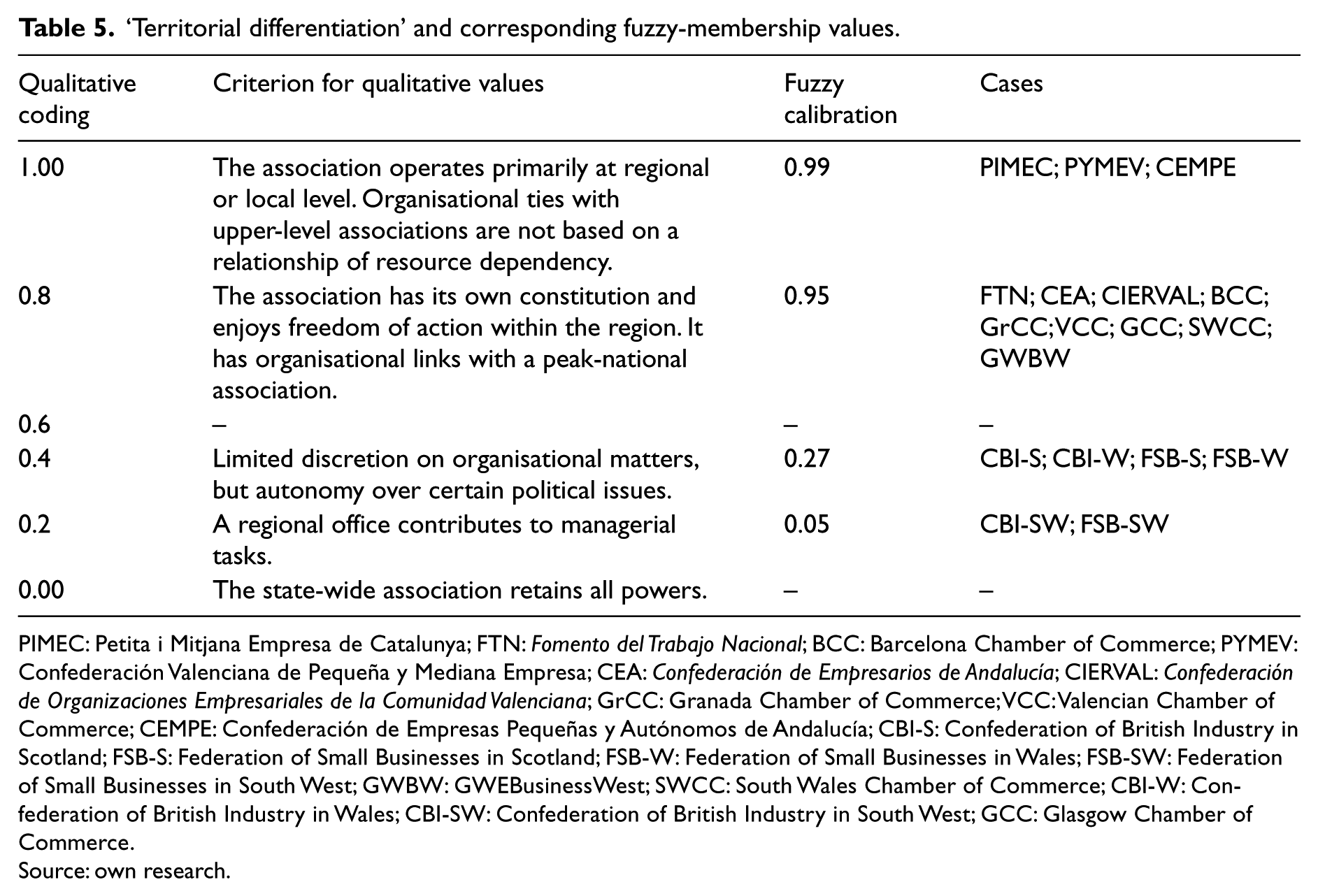
PIMEC: Petita i Mitjana Empresa de Catalunya; FTN: Fomento del Trabajo Nacional; BCC: Barcelona Chamber of Commerce; PYMEV: Confederación Valenciana de Pequeña y Mediana Empresa; CEA: Confederación de Empresarios de Andalucía; CIERVAL: Confederación de Organizaciones Empresariales de la Comunidad Valenciana; GrCC: Granada Chamber of Commerce; VCC: Valencian Chamber of Commerce; CEMPE: Confederación de Empresas Pequeñas y Autónomos de Andalucía; CBI-S: Confederation of British Industry in Scotland; FSB-S: Federation of Small Businesses in Scotland; FSB-W: Federation of Small Businesses in Wales; FSB-SW: Federation of Small Businesses in South West; GWBW: GWEBusinessWest; SWCC: South Wales Chamber of Commerce; CBI-W: Confederation of British Industry in Wales; CBI-SW: Confederation of British Industry in South West; GCC: Glasgow Chamber of Commerce.
Source: own research.
‘Regional corporatism’ and corresponding fuzzy-membership values.
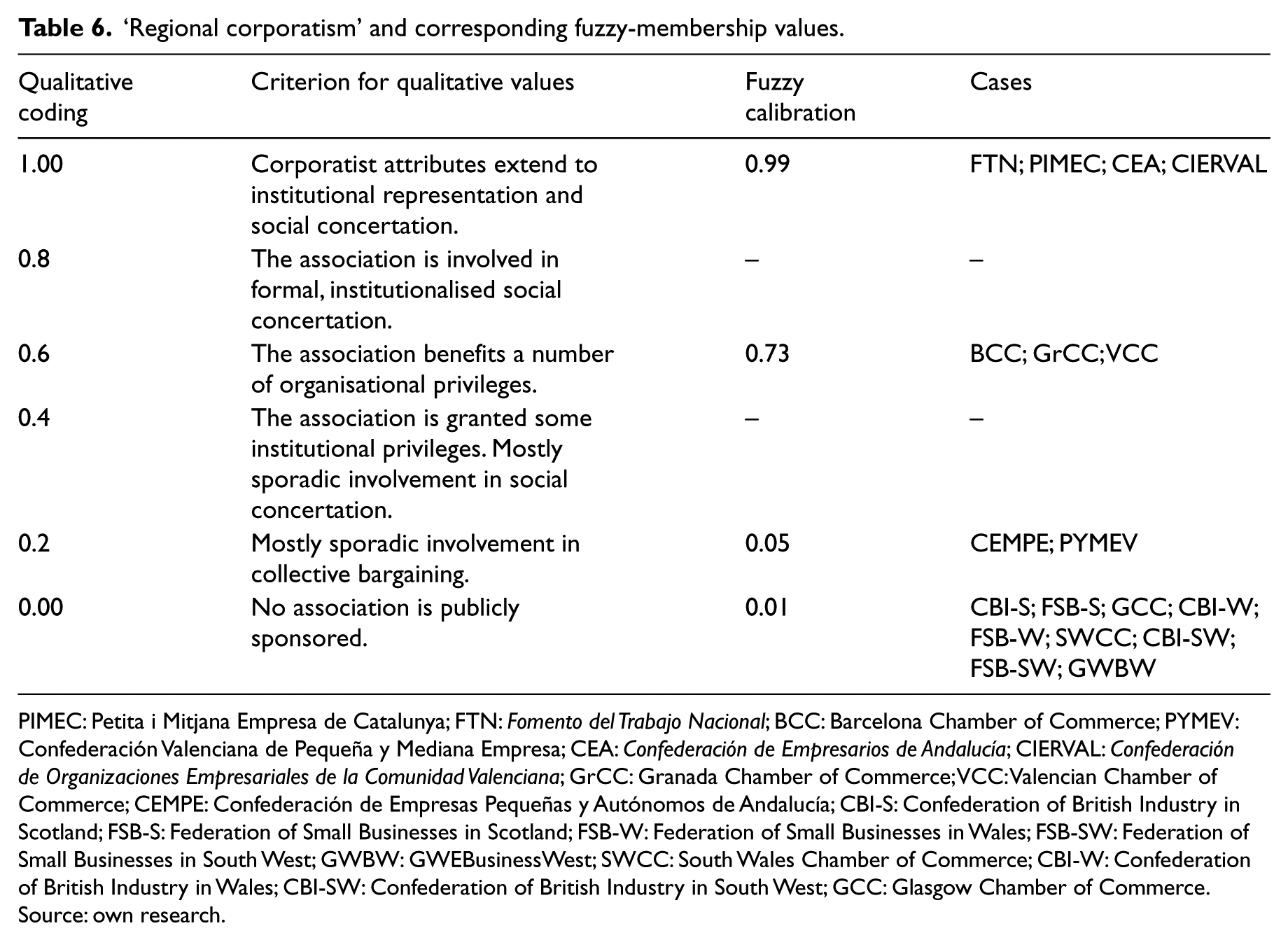
PIMEC: Petita i Mitjana Empresa de Catalunya; FTN: Fomento del Trabajo Nacional; BCC: Barcelona Chamber of Commerce; PYMEV: Confederación Valenciana de Pequeña y Mediana Empresa; CEA: Confederación de Empresarios de Andalucía; CIERVAL: Confederación de Organizaciones Empresariales de la Comunidad Valenciana; GrCC: Granada Chamber of Commerce; VCC: Valencian Chamber of Commerce; CEMPE: Confederación de Empresas Pequeñas y Autónomos de Andalucía; CBI-S: Confederation of British Industry in Scotland; FSB-S: Federation of Small Businesses in Scotland; FSB-W: Federation of Small Businesses in Wales; FSB-SW: Federation of Small Businesses in South West; GWBW: GWEBusinessWest; SWCC: South Wales Chamber of Commerce; CBI-W: Confederation of British Industry in Wales; CBI-SW: Confederation of British Industry in South West; GCC: Glasgow Chamber of Commerce.
Source: own research.
Business associations and regions in Spain and the United Kingdom
This section addresses the coding of qualitative data into different intervals, and the subsequent calibration of fuzzy-sets. For the qualitative data, as seen in the tables, I have detailed up to six distinct situations/categories/intervals for each of the conditions. These all attempt to capture a series of membership degrees within the conditions ranging from full membership (1) to full non-membership (0). The origin and meaning of every interval is the result of the views, typologies and categories I came across when examining the interviews, the documentary analysis, and the work by other authors. Every qualitative code is accompanied by a short description of its meaning. In addition, to better understand the information in the tables, I provide a short discussion on how business associations respond to the following topics: (i) the importance of regional economies for business associations; (ii) business ideological support for the region as a political project; (iii) business associations’ interaction with regional institutions; (iv) collective representation of small and medium enterprises; (v) territorial differentiation between associational lines; and (vi) access to corporatist resources at the regional level.
The importance of regional economies
In the debate regarding the extent to which the regions should gain economic significance in global markets, business associations have manifested a variety of stances over time. Of course, these stances somehow relate to the economic status of individual regions in that, for instance, Catalonia has long headed innovation, entrepreneurship and exports in Spain, while Andalusia’s economic profile is rather low-tech. In this sense, business views on the economic role of the regions seem to be in constant evolution. While FTN fiercely opposed the devolution of economic powers to the Generalitat in the years after the return of the Spanish democracy in 1978, nowadays all three business associations in Catalonia (FTN, PIMEC, BCC) are calling for a new fiscal status for the region similar to that of the Basque Country, the so-called Pacte Fiscal, which would establish a preferential position for Catalonia in the collection and transfer of taxes. Of course, they started to demand such a new fiscal status after a massive political campaign promoted by the various Catalan nationalist parties. In the other Spanish regions, business associations seem to avoid debates on territorial fiscal inequalities, although PYMEV overtly declares its preference for the region in undertaking a broad range of economic policies. The same applies to CEMPE insofar as its leaders believe the Junta de Andalucía can do better in promoting small firms. CEA and CIERVAL consider that regions certainly have a functional role in economic promotion, but they still believe the central government plays a key role when it comes to correcting economic imbalances. Chambers of Commerce agree with the idea of transferring greater economic powers to the regions, especially if regional governments pledge themselves to supply better infrastructures and business services to companies.
By comparison, there is widespread moderation among the business community in the UK regarding the contribution of devolution to the economy. Not only is this because devolution in Wales has proven to have little impact on the Welsh economy, but also because the central government still retains a decisive influence on major economic issues. In general, SMEs favour the territorialisation of economic activity to address such specific business needs as access to Internet in remote areas. As for the Confederation of British Industry (CBI), there are divergent stances. The CBI in Scotland manifests higher appreciation for the region than its sister associations in Wales and South West England (see Table 1). A somewhat erratic history of devolution in these two regions continues to be of fundamental significance for large companies to mistrust the fact that a regional government itself is the proper solution for the improvement of poor economic figures. Finally, the GCC persists in promoting local economy and rejects any ambition to become an economic actor at the regional level. Unlike this, the other Chambers feel more sympathy for their respective regional economies.
Regional orientation
The rhetoric about devolution has several clearly identifiable political themes. Perhaps the most frequently manifested by business is the political contribution to economic growth. No less powerful is the political meaning of the regions. Far from avoiding the public debate, business associations show preference, enthusiasm or disappointment when a political challenge emerges. In general terms, it is clear that business associations rarely promote constitutional reforms. Radical changes seem all the more unlikely for business in view of the unexpected uncertainties that could derive from such a fervent process. Business stances in relation to devolution do not always accord with the general political excitement. Business is attracted to a certain number of political measures, such as promises for lower taxes and less bureaucracy, which could be construed, at the same time, as attacks upon business comfort. However, it is frequently possible to detect an element of opportunism, to the extent that business associations like to compete and defeat, when regional elites try to favour particular business demands when public support to a particular regional project has been given.
Where secessionist aspirations have been announced, a very small number of business associations are willing to join the separatist alliance. This is the case of PIMEC in Catalonia, which has always had a strong regionalist tradition and political connection with the nationalist sphere. In Catalonia, other associations have shown reluctance to secessionist projects, despite actively promoting statutory reforms (FTN, BCC). Scottish entrepreneurs are far less supportive of Scottish independence. The CBI in Scotland is an active opponent in this regard. Indeed, Scottish businesses rarely favoured devolution before its implementation (Lynch, 1998). However, I can neither argue that they seek institutional involution nor reject Scottish cultural uniqueness. Where regionalism has not engaged in a trial of strength with the state, the general implication seems to be, on one hand, a spontaneous recognition of the region, in part to legitimise the very existence of the business association (CEA; CIERVAL) and, on the other hand, the implicit recognition of the region, albeit without the need to prioritise political issues over economic ones (VCC; GrCC; SWCC; Federation of Small Businesses in Wales (FSB-W); Confederation of British Industry in Wales (CBI-W); Federation of Small Businesses in South West (FSB-SW); GWBW). Table 2 details the opinions of business associations about the regions.
Interactions with regional institutions
After 40 years of regional experience in Spain, a couple of things are clear. Firstly, the constitutional nature of regional governments remains a passionate topic of popular discussion. Secondly, the expansion of regional governments has led to a large number of institutions, regional legislation, public representatives, officials, public agencies, policy programmes, and so forth. In fact, the regions are responsible for almost 30 per cent of overall public expenditure. Inevitably, business associations consider that business should enjoy a greater ability to influence regional governments’ investments and policy goals. Not all business associations are, however, as influential as is supposed. Some associations dominate business representation, while other groups struggle to survive. In this regard, PYMEV stands as a clear example of an association that is unlikely to consolidate a paramount leadership, causing the loss of its (once existing) representative rank and file. This benefits CIERVAL and, to a lesser extent, the VCC. In fact, only a few associations enjoy permanent access to regional institutions (FTN; CEA; CIERVAL; PIMEC; BBC) in the three Spanish regions examined (see Table 3).
The establishment of devolved institutions in the United Kingdom has generated a new style of articulating ‘government–business’ relationships. According to Keating (2005: 190), ‘groups can no longer opt out of the Scottish arena, claiming that their concerns are reserved to London or that they operate in global markets, since just about everybody has some matter requiring attention from the Scottish level.’ This also applies to Wales, but there are certainly exit options for interest groups. As the Welsh institutional framework has not been as robust as that of Scotland, at least before the Welsh National Assembly acquired full powers over the legislative process, Welsh-based business associations were encouraged to maintain strong policy linkages with their peak national associations. Bearing this in mind, in order to germinate a genuine policy community, the Welsh government was undoubtedly the main political promoter of an inclusive pattern of decision-making. In both Scotland and Wales, business associations have had the opportunity to channel their demands either through parliamentary consultation or by directly contacting the officials and elected representatives. On the contrary, business associations in South West England have occupied peripheral positions in regional politics. What happened in South West England is mainly a lack of interest from the main business associations to maintain active contacts with the South West Regional Development Agency (SWRDA) and other regional offices due to their low policy capacity.
SME business associations
Both in Spain and in the United Kingdom, specific SMEs’ associations are the product of a movement against the two major business associations (CEOE and CBI) that were not giving special treatment to small companies. In Spain, several SMEs’ associations were formed during the 1990s insofar as CEPYME proved to be an inadequate instrument to channel SME demands, especially because CEOE was mostly committed to help improve macroeconomic figures after Spain acceded to the Economic and Monetary Union. Chambers of Commerce attempted to strengthen their ability to represent small companies, but there were a number of employers’ demands that the Chambers could not provide. In the United Kingdom, a campaign against higher taxes for small companies was the origin of the Federation of Small Businesses. The dynamic behind this campaign was conceived to compete with the CBI for the separate representation of large and small firms. Therefore, the size of the company has proven to be a significant reason for the differentiation of business associations. Table 4 indicates which business associations best represent small and medium-sized businesses. As indicated earlier, some authors believe that SMEs’ business associations are more willing to co-operate at the regional level.
Territorial differentiation between associational lines
In Spain, the CEOE has acted as the main business confederation since 1977. Most regional branches of the CEOE were set up from 1977 onwards, except for the unique case of FTN in Catalonia. As the CEOE was intended to be a confederation, its regional branches kept their own constitutions, as well as being entitled to carry out a vast number of functions including, for instance, institutional participation, social concertation, media relations, and so forth. In organisational terms, the CEOE is structured around a confederal model. By the mid-1990s, various local entrepreneurs started to criticise the CEOE for its lack of sensitivity towards SMEs. This led to a new associational movement that fostered the establishment of independent SMEs’ associations in half of the Spanish regions. The early excitement was soon appeased, as these new associations were not able to ensure a similar degree of institutional status as that of the CEOE’s regional branches. Finally, Spanish Chambers of Commerce have long been public corporations with a confederal structure headed by the Consejo Superior de Cámaras.
The CBI’s regional structure was put into practice during the 1940s, the intention being to better supply services to members. With the advent of devolution, the CBI’s regional branches in Scotland and in Wales were endorsed with an enhanced status by which they are able to define their own policy strategies in relation to the several devolved matters. The CBI retains full powers over staff, resources, services and general policy guidance. As devolution marches on, the offices in Scotland and Wales are still optimistic about scenarios for greater internal devolution, whereas the CBI in South West England is gradually diminishing its organisational autonomy. Unlike the CBI, the Federation of Small Businesses aims at working in close relationship with small businesses, so the association has long encouraged grass-root logics. The FSB is comprised of 33 regions and 194 branches, which are articulated around regional offices and regional committees. Changes assumed from 1998 onwards mostly concerned policy issues rather than organisational ones. The Scottish and Welsh offices were granted extra decision-making powers, whereas policy committees were promoted to match regional agencies in England, for instance, the FSB South West Policy Unit (SWAPU). Currently, the FSB maintains four Area Polity Units (distinct centres of political influence), namely, London, Scotland, Wales and Northern Ireland. The willingness to maintain regional policy units across England is in decline as the RDAs were abolished. Finally, UK Chambers of Commerce are free to mutate organisationally insofar as they are private business corporations. In this regard, ‘the structure of chambers of commerce at the regional scale is extremely varied and has been subject to considerable change in light of the growing regional agenda’ (Valler and Wood, 2004: 1848). The SWCC covers an important area in Wales and has three Chamber Councils (Newport, Cardiff and Swansea). The GWBW stands as a private network of four local chambers around the Bristol area that still retain their own constitutions. The GCC maintains its own management team and representative bodies, although it belongs to the Scottish Chambers of Commerce (SCC). All three Chambers belong to the British Chambers of Commerce as well. Table 5 summarises the varying degree of territorial differentiation of every business association.
Regional corporatism and access to institutional resources
As Table 6 shows, the relationship between employers and regional governments in Spain has adopted a very familiar neo-corporatist pattern. Spanish regions have resorted to corporatist mechanisms for economic policy design since the 1980s onwards. Almost all Spanish regions have set up Economic and Social Councils and labour relations institutes, although some of them have since been cancelled due to the current economic crisis. More strikingly, a series of business associations has been granted public status (FTN; PIMEC; CEA; CIERVAL), which means these associations monopolise business representation, excluding most of the independent SMEs’ business associations (CEMPE and PYMEV in our analysis) from access to institutional privileges. The exception to this trend is justified by a political decision based on a regional rationale: the Generalitat of Catalunya sponsored PIMEC’s public status in order to counteract FTN’s centralist views during the 1990s. Moreover, the Statutes of Autonomy of the three regions recognise explicitly the right of business associations and trade unions to carry out their very functions in the economic sphere. Despite a recent change in the legislation that put an end to compulsory membership of Chambers of Commerce, Chambers are still endorsed with the task of providing legal advice to public administrations and implementing business-related public services. By comparison, devolution has not paved the way for a transformation of the industrial relations system in the United Kingdom. No business association is granted privileged access to policy-making. For instance, Scotland and Wales both have a number of legislative advisory groups (on education, health, social policy, and so forth) in which membership is appointed on the basis of individual reputation and experience. As mentioned, Chambers of Commerce in the UK are private organisations with no institutional privileges.
Examining necessary and sufficient conditions leading to regional business mobilisation
One should first point out that the regional mobilisation of business associations has occurred unevenly and in flat contradiction with some theoretical suppositions. The working definition of regional business mobilisation used in this research could be applied to roughly half of the associations analysed, namely, FTN, PIMEC, BCC, CEA, CIERVAL, CBI-S, FSB-S, CBI-W, FSB-W and SWCC. On the contrary, the other associations have shown insufficient features so as to be consistently regarded as regional actors. Many Chambers of Commerce (GCC; GrCC; VCC; GWBW) reveal a clear commitment to work with the local business community, although they may demonstrate a significant regional orientation. Other business associations (CBI-SW; FSB-SW) are simply not interested in contributing to the development of regional governance because it was never a credible project. In the case of the CBI in the South West, if there was ever any interest in enhancing its policy powers, it clearly has not reached full fruition.
As far as the typology of the associations are concerned, among the business associations that can be regarded as regional actors there are five main regional associations (FTN; CEA; CIERVAL; CBI-S; CBI-W), three SMEs’ associations (PIMEC; FSB-S; FSB-W), and two Chambers of Commerce, namely, the BCC and the SWCC. Among the business associations that are not real regional actors we encounter three SMEs’ associations (CEMPE; PYMEV; FSB-SW), four Chambers of Commerce (Glasgow; Valencia; Granada; GWBW) and one main regional business association (CBI-SW). The obvious conclusion is that SMEs’ business associations are by no means more involved in regional politics than other sorts of business associations. It seems that the business associations that have achieved higher levels of regional prominence either have strong organisational ties with national associations (FTN; CEA; CIERVAL; CBI-S; CBI-W; FSB-S; FSB-W) or have shown real intentions to accomplish business representation in the region (PIMEC; BCC; SWCC).
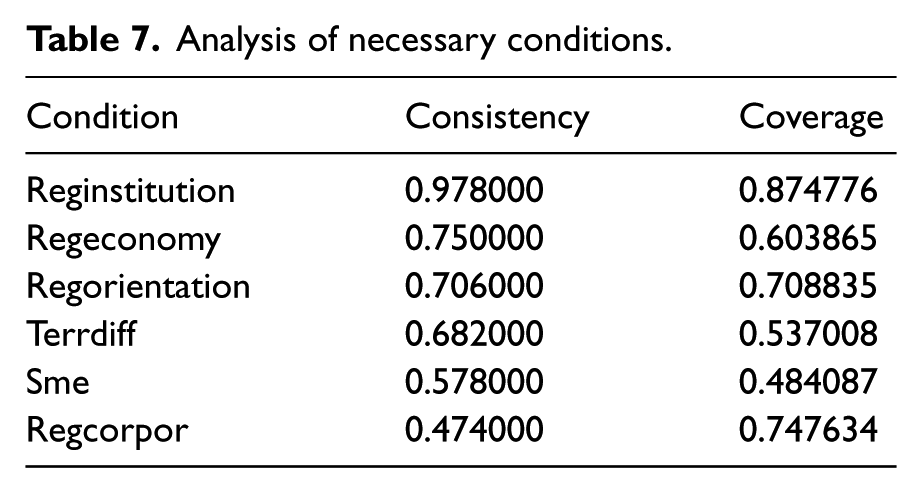
For a better analysis of the necessary conditions, Table 7 shows the consistency and coverage rates of the six conditions tested in the fs/QCA. A necessary condition happens to be present in (almost) all cases disclosing the outcome. The analysis of necessity revolves around the consistency and the coverage of each of the conditions (or combinations thereof). Bol and Luppi (2013: 206) point that ‘the necessary consistency is the proportion of cases disclosing both the condition and the outcome among the cases disclosing the outcome.’ Thus, a condition is necessary when the consistency score is close to 1. In addition, QCA examines the coverage of a necessary condition. Again, as Bol and Luppi (2013: 206) indicate, QCA shows ‘the proportion of cases disclosing both the condition and the outcome among cases disclosing the condition.’ In fs/QCA, a consistency rate higher than 0.90 indicates a strong condition of necessity. Table 7 indicates that the existence of regional institutions is a cornerstone for business associations to mobilise at the regional level. Almost every business association that managed to become a regional actor resides in a region with a considerable amount of regional autonomy. The second condition with higher score is ‘regional economy’, which takes account of the fact that business associations consider the regions can somehow contribute to economic development. This condition scores a consistency rate of 0.75, which manifests a somewhat indecisive result. However, since the establishment of business associations follows an intrinsic economic motivation (fiscal issues, economic competitiveness, economic growth, and so forth), I dare myself to suggest that it is a noteworthy condition as well.
Analysis of necessary conditions.
After determining the two pivotal conditions, we move on to the definition of the sufficient conditions, taking into account the methodological assumptions of equifinality. In short, fs/QCA favours the logical reasoning that various combinations of factors lead to the same outcome. Table 8 identifies a first configuration that is characterised by the conjunction of two conditions; namely, regional business mobilisation happens when regional business associations remain strongly tied to the guidelines and resources of a national business association (~terrdiff), so to speak, they belong to a unitary association or some of its variants, and in addition they lobby regional institutions on a permanent basis (reginstitution). The raw coverage of 0.318 indicates that this configuration covers almost the 30 per cent of positive cases. Interestingly, this first combination covers only cases in Scotland and in Wales. This means the United Kingdom has been able to create a unique model of regional business representation, although its very peculiar characteristics (pluralism, asymmetric devolution, unitary associations, and so on) raise serious doubts about the generalisation of the model.
Analysis of sufficient conditions.
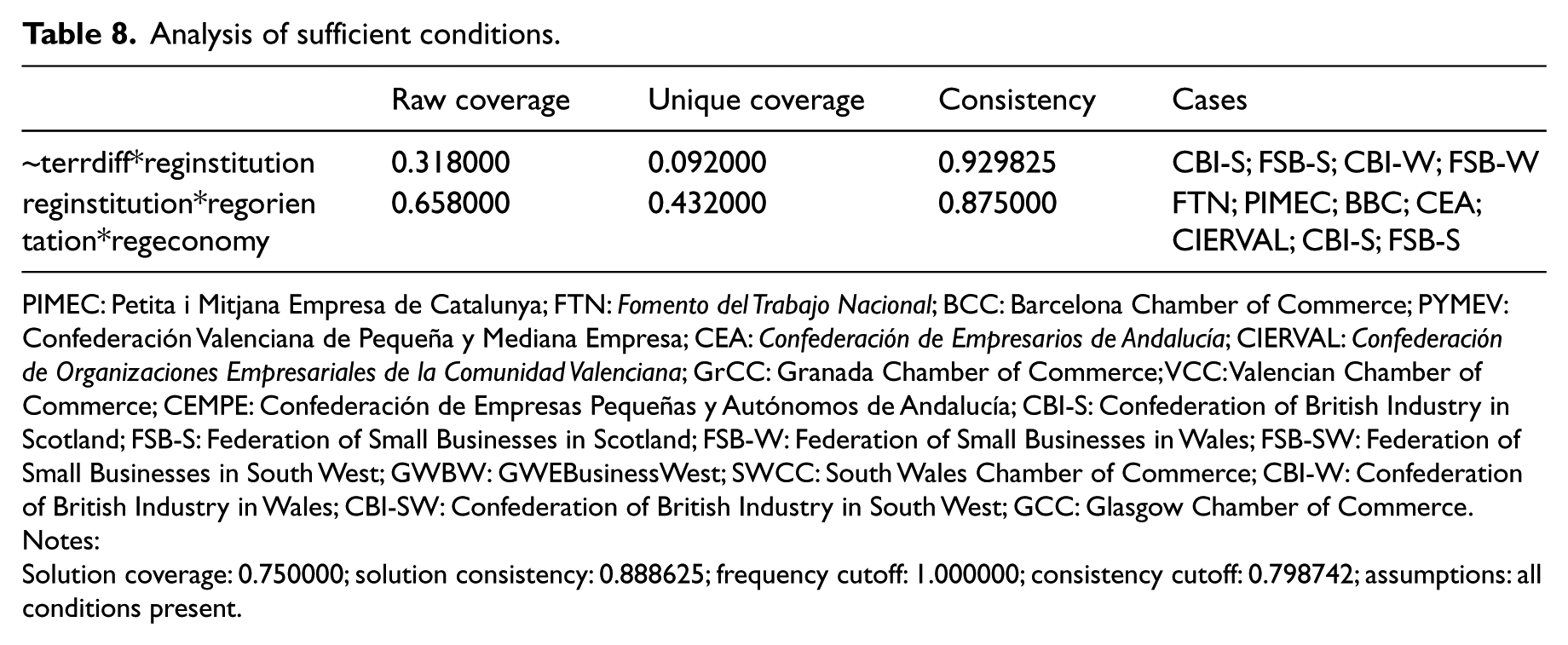
PIMEC: Petita i Mitjana Empresa de Catalunya; FTN: Fomento del Trabajo Nacional; BCC: Barcelona Chamber of Commerce; PYMEV: Confederación Valenciana de Pequeña y Mediana Empresa; CEA: Confederación de Empresarios de Andalucía; CIERVAL: Confederación de Organizaciones Empresariales de la Comunidad Valenciana; GrCC: Granada Chamber of Commerce; VCC: Valencian Chamber of Commerce; CEMPE: Confederación de Empresas Pequeñas y Autónomos de Andalucía; CBI-S: Confederation of British Industry in Scotland; FSB-S: Federation of Small Businesses in Scotland; FSB-W: Federation of Small Businesses in Wales; FSB-SW: Federation of Small Businesses in South West; GWBW: GWEBusinessWest; SWCC: South Wales Chamber of Commerce; CBI-W: Confederation of British Industry in Wales; CBI-SW: Confederation of British Industry in South West; GCC: Glasgow Chamber of Commerce.
Notes:
Solution coverage: 0.750000; solution consistency: 0.888625; frequency cutoff: 1.000000; consistency cutoff: 0.798742; assumptions: all conditions present.
Table 8 shows a second combination of factors that includes cases from both Spain and the United Kingdom. As the raw coverage shows, this configuration explains almost the 70 per cent of positive cases (0.658). Business regional mobilisation would be the consequence of the acceptance of the region as a political reality, combined with the idea that the region can contribute to the good functioning of the economy, and in situations where institutional representation is guaranteed. Of course, this happens to be a complex path towards the regionalisation of business associations, to the extent that it requires the presence of half of the six conditions. To its credit, however, it explains cases in very different economic and institutional environments.
Conclusions
So, under what conditions does a business association get involved in regional politics? This research argues that the existence of competent regional institutions is the mainstay of the regional mobilisation of business associations. To the extent that business associations represent interests before the government, it is unlikely that business leaders will be encouraged to put aside their comfort zone in national politics, even in local governance, to dramatically embrace regional politics when regional institutions cannot make a difference to their policy demands. Some signs of the development of a regionalisation of business logics were apparent in South West England, but, actually, these were too timid to be important. Where regional politics prove to be of great saliency to foster economic growth, although business associations tend to dislike constitutional reforms, they nonetheless assume that adaptation to state structure is a profitable asset. In this regard, Tony Blair’s decision to proceed with devolution in 1998 was a significant watershed, and business associations responded by eventually ceding control over a series of devolved matters to their regional branches.
However, it would be wrong to suggest that all comprehensive business associations that are present in a strong region have really become regional actors. Nor can it be said that sectorial business associations and other business lobbies feel special consideration for the regions. While much of the literature purports to be about the sophisticated outgrowth of interactive regional networks, much of it is thin on political analysis and evidence. The formation of regional systems of interest representation is a complex process resulting in some business associations that occupy a predominant position, some associations that refuse to take part in regional politics, and some associations that struggle to survive. Free interest competition in an open society remains a topical democratic aspiration, not a reality where interest groups accumulate large amounts of power, compete for the monopoly of representation, and seek trade-offs with regional governments. Moreover, historical trends cannot be overlooked when it comes to examining regional business associations. They do not come out of the blue. Before the flare-up of devolution in the UK and the Comunidades Autónomas in Spain, a number of business associations were already established at national and local levels. Regionalism itself has rarely induced the creation of new business associations. The majority of the most representative business associations at the regional level are connected either to the CEOE, the CBI or the FSB, from which they receive resources, members and political standing. National associations impose a number of constrains as well. So far, it is true that regional institutions help shape the organisational side of business associations, whether boosting internal devolution or not, as well as business associations help shape the economic side of the regions, whether supporting greater devolution or not. However, what would happen if the national associations came to suspend internal devolution? What would happen if Scotland and Catalonia became eventually independent?
Footnotes
Acknowledgements
This research was part of a project which ran between 2009-2012 called: ‘Business associations and regional interests’, supported by the Spanish Ministry of Science and Education (CSO2009-13647). A previous draft of this article was presented at the panel IPSA World Congress, Madrid, 8-12 July 2012. I am very grateful from comments, suggestions, and constructive criticism from Joaquim Molins, Rosa Nonell, and three anonymous referees of this journal.