




Abstract
Although the origins of the theoretical debate regarding political–economic alternatives are as old as Proudhon, Marx and Engels, discussion concerning alternative economic and political spaces has come to the foreground very recently. More specifically, in the field of geography the most influential approach has been that associated with work on diverse economies, developed initially by Gibson-Graham. Research in this area has increased at a significant rate, revealing a multitude of practices in what we call the hidden ‘neverland’ all over the world, while simultaneously posing a number of new and open questions. This article begins with a review of the main theoretical, methodological and epistemological assumptions underpinning the diverse economies approach. This is followed by a discussion of four concrete types of diverse/alternative spaces; those in post-socialist countries, alternative exchange networks, alternative food networks and the Mondragon cooperative corporation in Spain. The article concludes by arguing that while the debate on alternative and diverse economies may reflect a willingness on the part of the scholars to cooperate in order to build a postcapitalist future, it is also necessary to consider the possibilities and constraints operating at different scales, from individual to global, in order to consider the extent to which alternatives may be successful.
Keywords
“‘There is no alternative’ (Margaret Thatcher, UK Prime Minister 1979–1990) ‘There are no alternative options in those countries’ [Ireland, Greece, Portugal],
Introduction
The origins of the theoretical debate regarding alternative economies and spaces go back to the time of Proudhon, Marx and Engels. The focus of that debate mainly concerned the question of whether ventures in the development of a cooperative economy were able to challenge the dominance of capitalism. While Marx and Engels rejected this idea, Proudhon supported it. Although various types of alternative spaces have existed and operated throughout the history of capitalism, the dominance of the Marxist tradition entangled with the hegemony of capitalism during the 20th century did not leave enough room to develop an ongoing theoretical debate. Also contributing to this was the fact that for a considerable length of time, significant events, such as revolutions, wars, the confrontation between the social systems of capitalism and socialism, as well as the significant role of the state in regulating the economy in both social systems, placed alternative economic and political spaces at the margin of political and social discourse.
It was only during the 1980s that the debate on alternative economies and spaces gained some attention as a research subject. The starting point of the modern debate on alternatives in developed countries was the emergence of new social movements and the transformation of the welfare state. Nevertheless, research and theoretical analysis on alternative spaces has been dominated by approaches drawing on theories of the social economy, and the role of the third sector, thus limiting their transformative potential (Gibson-Graham, 2008a).
The last two decades have seen a growing interest in alternative spaces. This interest could be attributed to inspiration derived from movements such as the Zapatistas or the anti-globalisation movement, and the need to search for alternatives to global capitalism after the collapse of the state socialist regimes. An increasing number of social scientists have begun to research and theorise alternative economic and political practices (Holloway, 2002, 2010). In the field of geography, the most influential approach has been focused on diverse economies, developed by Gibson-Graham. 1 Her theoretical work, based on a groundbreaking, provocative, radical, as well as optimistic, approach attempts not only to change views of ‘the economy’ in order to highlight the importance of alternative spaces, but also to support the emergence of such spaces and reinforce their radical practices as a step towards a post-capitalist future. The diverse economies approach has boosted the broadening of the analysis of alternative economic practices (Jonas, 2013a) and inspired a large number of case studies in different types of alternative spaces and different places, which led Gibson-Graham (2008a) to announce the birth of the diverse economies research community in economic geography. At the same time, it has also provoked a debate that has proven fruitful in some cases (Fickey, 2011), such as the discussion concerning the notion of alterity (Fuller et al., 2010). Researchers working on the notion of alterity usually start from a different theoretical and epistemological background from that of Gibson-Graham (e.g. Lee, 2000). However, they have enriched and expanded the research questions and theoretical issues underpinning the exploration of alternative spaces, thus contributing to a lively and interesting debate.
This paper begins with a review of the main theoretical, methodological and epistemological assumptions underlying the diverse economies approach, as well as the relevant evolving debate concerning the notion of alterity. In the second section, we focus on four concrete types of diverse/alternative spaces: in post-socialist countries, alternative exchange networks, alternative food networks and the Mondragon cooperative corporation in Spain. These case studies are used to inform the theoretical debate presented in the first section in order to enhance and broaden it, while also highlighting new questions. Based on the analysis, the paper concludes by highlighting possibilities and constraints on alternative spaces.
Diverse economies and alterity
A crucial step forward in research on alternative spaces was the publication in 1996 of Gibson-Graham’s book The End of Capitalism (as we knew it), which was followed by a second book, A Postcapitalist Politics, in 2006 (Gibson-Graham, 1996, 2006a, 2006b). Gibson-Graham draws her inspiration from feminist theories (Judith Butler), and from post-structuralist (Michel Foucault), post-marxist (Ernesto Laclau, Chantal Mouffe) and post-modern (Jacques Derrida) approaches, as well as by the cultural turn in economic geography. She begins her theoretical work with a critique of the dominant ‘structuralist’ Marxist political economy approaches (Gibson-Graham, 2008b) and characterises these dominant approaches as ‘capitalocentric’. The main point in her critique concerns the theorisation of capitalism as an all-encompassing entity, which means that the structuralist analyses of capitalism, globalisation, development, and so on, have at their core an essentialist approach lead to the development of a narrative that represents capital flows as absolutely dominant. This entails that the variety of ‘other’ alternative or non-capitalist economic forms are rendered invisible. Thus, a large number of hidden and alternative economic activities are treated as marginal phenomena or even as subsystems of the dominant capitalist economy. These may include, for instance, unpaid labour in households or ventures such as consumer, producer and worker cooperatives, community-supported agriculture, local and complementary currencies, voluntary organisations and foundations, social and non-profit enterprises, movements, such as squatter, slum-dweller, co-housing or fair trade movements and their related consequent activities (Gibson-Graham, 2008a).
In order to reveal the full range of the variety of economic forms, Gibson-Graham et al. (2000) adopt a ‘narrower’ definition of capitalism by re-interpreting Marx. In particular, they focus on the class process – that is, on the way in which surplus is produced, appropriated and distributed – following a prior theoretical contribution made by Resnick and Wolff (1987). In contrast to an all-encompassing entity, capitalism is theorised as a type of economic relation that includes the capitalist enterprise in which surplus value is produced, appropriated and distributed on the basis of waged labour, private property, production for the market and mainstream-market finance modes (Gibson-Graham, 2010). This theorisation of capitalism allows consideration of other class processes that differ from the capitalist enterprise. It is specifically on this basis that Gibson-Graham proposes the concept of diverse economy. As Healy (2009: 338) explains, the diverse economy is a ‘theoretical proposition that economies are intrinsically heterogeneous spaces composed of multiple class processes, mechanisms of exchange, forms of labor and remuneration, finance, and ownership’.
Gibson-Graham (2010) focus on the diversity of enterprises, labour, property, transactions and finance (Table 1). The different types listed in each set of economic relations are categorised as capitalist, alternative capitalist and non-capitalist. 2 Moreover, they coexist and form an economic mosaic in which capitalism is but one version of economic relations. Gibson-Graham (2006a: 70) also employs the ‘iceberg metaphor’ to show that capitalist relations are a visible, yet small portion of economic life and that a whole range of invisible economies lies below water.
The diverse economy.
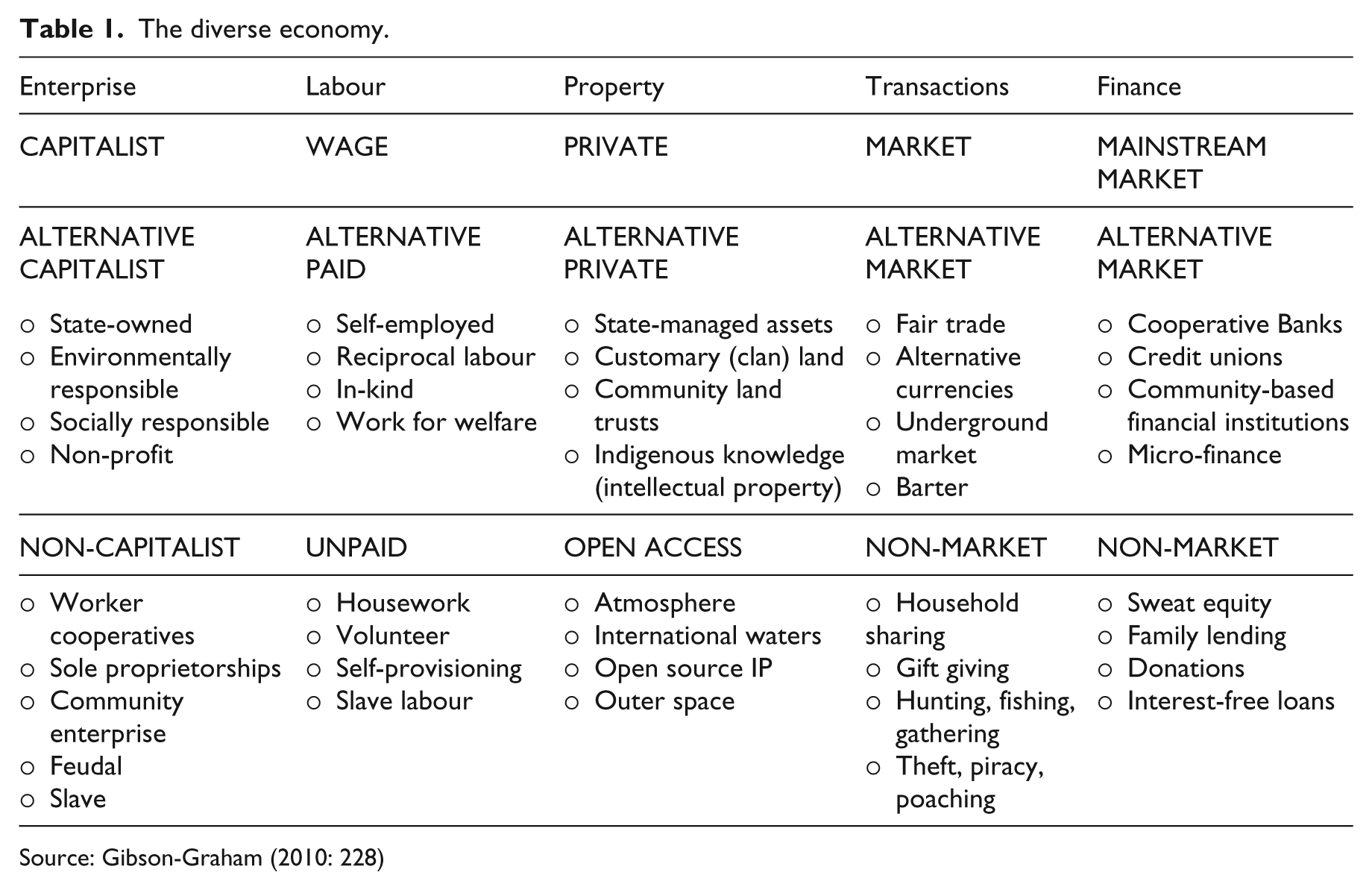
Source: Gibson-Graham (2010: 228)
The concept of diverse economies has been debated from different perspectives and has attracted fruitful and productive critical comments. Focusing on the informal sector of the economy, Samers (2005) argues that not all economic practices included in diverse economies are less exploitative than capitalism. He advises that there is a danger of political naïveté, in the sense that left thinkers may celebrate economic practices that are highly exploitative. In order to distinguish between exploitative and ‘progressive’ forms of economic practices, he proposes the need to focus on relationships and processes of production along with conditions of employment in the different forms of diverse economies.
In a similar vein, Jonas (2010) questions whether diverse economies should be examined irrespective of how alternative they are with respect to the mainstream. Schreven et al. (2008) argue that the different character of alternatives, which mainly concerns a disapproval of the status quo, is ephemeral. In addition, Amin et al. (2003) raise questions regarding the co-optation of alternative spaces and argue that they could be understood as complementary forms of the welfare state, in which case they are unable to threaten or replace capitalism. Furthermore, Jonas (2013a: 29–31) proposes to overcome binary thinking (alternative vs. mainstream); focusing on the consciousness of the people involved in alternative spaces. He suggests that the concept of ‘alterity’
…can be understood as a way of knowing, representing and narrating the ‘other’ in terms that exist outside one’s own categories (or the categories of a dominant narrative). Categories that serve only to legitimate already dominant sets of economic practices and social relations would be challenged and new categories would be developed in their place. (Jonas, 2010: 10)
The different degrees of alterity have been classified by Fuller and Jonas (2003) as alternative–oppositional, alternative–substitute and alternative–additional. Alternative–additional institutions are defined as ‘institutions or enterprises providing an additional choice to other extant institutions while not necessarily adopting or advocating values that seek to reject the (state or capitalist) mainstream’. Alternative–substitutional institutions are ‘institutions that act as a form of substitute for institutions once pervasive (in a particular place) yet have subsequently disappeared or moved elsewhere. In some cases these substitutes can be institutions of “last resort” allowing people to survive under extreme economic and social circumstances’. Finally, alternative–oppositional are institutions in which participants are actively and consciously alternative, incorporating the ‘different’ in terms of function and values, while also denying mainstream trends (Fuller and Jonas, 2003: 67; Jonas, 2010). Each category has different characteristics that refer to the mode of exchange, form of labour, measure of value, politics of distribution and the territorial identity of alternative enterprises. Moreover, categories of alterity have to be seen as dynamic and not fixed in time and space (Jonas, 2013a: 29). Alterity is contingent and related to material, social, political and strategic circumstances. As Jonas (2010: 4) argues, ‘alterity is itself diverse, context dependent and, above all, geographically specific’.
Lee (2010) incorporated the above-mentioned categories in a grading scale of the degree of alterity. He also combined this classification with the transformational power of an alternative venture on the determinants of the economic geography of a place. Complementing the three categories of Fuller and Jonas (2003), Lee proposes the following additional categories: (a) ‘variegated capitalism’, addressing different forms of capitalism based on the historical geography of each place, which is in contrast with the notion of a ‘unique’ global capitalism; (b) ‘displacement alternatives’, that is, ventures that subvert current economic geographies and replace them with others; and (c) ‘non-economic economic geographies’, referring to ventures that are shaped by non-economic incentives. Regarding the escalation of the transformational power, Lee (2010) classifies the categories as follows (from lower to higher power): variegated capitalism, alternative–additional ventures, alternative–substitutional ventures, alternative–oppositional ventures, displacement alternatives and non-economic economic geographies.
Gibson-Graham et al. deny an ‘a priori judgment about whether a practice is valued as good or bad’ (Gibson-Graham et al., 2013b: 285). However, this does not imply that all diverse economic practices could have the same value. As Gibson-Graham (2008a: 630) notes, ‘we are not interested in performing difference per se, nor are we necessarily interested only in the growth of “alternative” economic activities. Our political and strategic concern is to build community economies’.
Central to understanding the denial of an a priori judgment about whether a practice is valued as good or bad is the concept of performativity. Performativity – a notion borrowed from Judith Butler (1993) – could be defined as a ‘theory that discourse participates in constituting the reality it purports to represent’ (Healy, 2009: 338). In other words, knowledge has a productive power, influencing not only the world that exists, but also the making of future worlds. Gibson-Graham adopts the goal of Marxian theory to understand the world in order to change it, ‘but with a poststructuralist twist – to change our understanding is to change the world, in small and sometimes major ways’ (Gibson-Graham, 2008a: 615).
In this perspective, structural Marxist, capitalocentric approaches, despite their critical position against capitalism, have the performative effect to strengthen capitalism and to discourage non-capitalist initiatives. They demonstrate the hegemony of capitalism which subjugates all other economic forms, as they are in any case doomed to failure, to be co-opted and assimilated. In contrast, the diverse economies research programme aims at creating possibilities by encouraging, strengthening and proliferating alternative spaces.
Several scholars do not recognise the importance of subjectivity and discourse that is implied in Gibson-Graham’s approach. Instead, they theorise economy as a material reality that is independent of the perception and willingness of people (Castree 1999, as cited by North, 2008). It is without doubt the case that, based on such approaches, the diverse economies research framework is a utopian programme. However, Gibson-Graham does recognise the existence of a material reality shaped by capitalism and the state. As she answers to criticisms of utopianism,
we should affirm that our orientation toward possibility does not deny the forces that militate against it – forces that may work to undermine, constrain, destroy, or sideline our attempts to reshape economic futures but we should deny these forces a fundamental, structural, or universal reality and instead identify them as contingent outcomes of ethical decisions, political projects, and sedimented localized practices, continually pushed and pulled by other determinations (Gibson-Graham, 2006b: xxxi).
The focus here is on the ‘possible’ and not on the ‘probable’. The aim is to produce hope. Gibson-Graham (2008a) calls her approach a ‘weak theory’ which, in contrast to a ‘strong theory’, refuses to predetermine the outcomes of alternative spaces. Rather, she proposes a ‘weak theory’ so as to leave an open space for novelty and surprise and, thus, to offer the opportunity to face the difficulties, the limitations and the problems in the development of alternative spaces as issues of struggle and not as reasons for resignation.
Accepting the advantages of a ‘weak theory’, Roger Lee tries to bridge a materialist and a discursive view of the economy. On the one hand, he claims that economy is both socially determined and constructed and he adopts the notions of diversity and perfomativity. On the other hand, he argues that the materiality of economy is not reducible; that is, the economy has to produce, exchange and consume all the values necessary for the existence of human beings and society (Lee et al., 2004; Lee, 2006, 2010, 2013). Consequently, ‘producing’ hope is not enough. Possibilities of alternatives are constrained by the need to be effective in producing the necessary means for human and social reproduction.
Lee claims that economic geographies should be understood as material circuits of value (consumption–exchange–production–exchange–consumption). These circuits cannot be one-off events, because they ‘must be capable of reproduction both geographically and historically’ (Lee, 2006: 417) and, in this sense, they are ‘irreducible entities: they either happen or they do not’ (Lee, 2006: 417).
Central to Lee’s theorisation is the notion of value. Value is constituted by three interacting, yet distinct aspects. First, ‘life-sustaining’ value concerns the means for societal reproduction (things, ideas, relations and practices) that contribute to the sustenance or enhancement of economic activity or, in other words, to material success. People must be capable of producing value to stay alive and must also be prepared – or be forced – to produce more value than they need (i.e. surplus) to cope with potential interruptions to circuits of value. Second, Theories of Value are ‘transcendent interpretations of the origins and nature of Value….brought to bear on, and contested in, the practice, performance and regulation of economic life’ (Lee, 2006: 415). Third, values concern ‘the forms of life, relations, things, thoughts and practices that are held dear and are considered to be inalienable’ (Lee, 2006: 415). Among the above three notions, there exists a constant interaction resulting in ‘actual’ spatio-temporal circulated value. In particular, value ‘is evaluated not merely by the material requirements for reproduction [“life-sustaining” value] or the performance of Theories of Value but also by the values embedded within, and formative of, particular social relations of value’ (Lee, 2006: 419). Social relations of value as ‘shared, or imposed, understandings about the nature, norms, purposes and parameters of circuits of value’ (Lee, 2006: 419) constitute a framework of evaluation and legitimation of the ways value is distributed and the ways people engage in production and consumption. They are diverse and dynamic, and there is nothing predetermined about the emergence of particular forms of them; rather, their form partly depends on the imperatives of the ‘life-sustaining’ value.
Although social relations are a complex mixture of multiple logics and different notions of logicality we can identify prevailing social relations, which are power relations aiming at sustaining the material economic coherence needed for the reproduction of the social life. As Lee (2006: 420) notes, ‘once particular social relations of value have begun to take place, those engaged in and benefiting from them have an interest in ensuring that they may be extended and sustained’. To do so, prevailing social relations shape (always temporarily) economic imaginaries, through representational discourse about material success or failure. The latter are constructed by diverse and multiple practices and actors, such as day-to-day practices and social relations for making a living, the organised interests of businesses or labour and other activists, education and mass media. In this sense, they are dynamic and open to change; however, they also reflect power relations which constrain the possibilities of alternative imagination. These two kinds of constraints on possibilities of alternatives (imperative of material success and power relations) lead Lee to think, on the one hand, that progressive alternatives are frequently fairly limited in size and geographical as well as temporal reach, while, on the other, economic change becomes possible, perhaps, only through crisis (Lee, 2013: 70) in prevailing social relations that disrupt the circuits of value.
Power relations, the state and social movements
The debate about power relations is inherently associated with the role of the state and social movements. Surprisingly, an examination of these roles is entirely disregarded in much of the theoretical and empirical work of most researchers of alternatives. Considering that the theoretical debate about alternatives has been developed primarily with a focus on economic and social dimensions, Jonas (2010: 18) states: ‘I would argue that it is dangerous to ignore completely the role of the state. In understanding the circumstances under which alternative enterprises proliferate, it is important to show how many practical alternatives are in fact born out of struggles around and against the state’.
In one of his ensuing publications, while addressing alternative regionalism, Jonas points out that although the diverse economy research programme is the most significant component for launching the analysis of alternative economic practices, ‘it has often been reluctant to generate concrete abstractions about the social and territorial structures through which alternatives are performed’ (Jonas, 2013b: 5). He argues that there is still much work to be done in understanding the relationships between alternative social structures, power relations and institutions and the way these relationships are embedded in particular regions and territories. As a result, he claims that there is a need for linking alternative issues to regional culture, the state and progressive politics.
Nevertheless, there are a few scholars who combine the study of alternative spaces with the role of social movements. For instance, North (2006a) examines alternative currencies as social movements, while Pickerill and Chatterton develop a notion of ‘autonomous geographies’ (Chatterton, 2005; Pickerill and Chatterton, 2006). ‘Autonomous geographies’ are characterised by a mixture of confrontation and creation, bringing together activism and alternative spaces with the aim of dislodging capitalism and simultaneously constituting post-capitalist collective spaces (Pickerill and Chatterton, 2006). Although the diverse economies research programme is inspired by movements, such as that of the Zapatistas and alter-globalisation, in general, social movements are not fully incorporated in its theorisation. Nonetheless, the diverse economies research programme itself could be considered a movement, as it involves taking action rather than only theorising it. Gibson-Graham (2006b), in particular, emphasises the importance of engaging academics through action research. Beyond the production of a local language of economic possibility, there are two additional core elements of action research: ‘a politics of the subject – cultivating ourselves and others as subjects of non-capitalist development; and a politics of collective action – working collaboratively to produce alternative economic organisations and spaces in place’ (Gibson-Graham, 2006b: x). The politics of the subject implies a transformation of the self in order not only to overcome ‘those aspects of self that could be seen as accommodating and embodying capitalism’ (Gibson-Graham, 2006b: xvii), but also to acquire those mental and emotional elements required to build an alternative space instead of a mere confrontation with capitalism. The politics of collective action refer to a collective effort to build community economies as another economic reality (Gibson-Graham, 2006a). Within this framework, questions about our needs, the way surplus is produced and distributed, the social and ecological sustainability and the creation of commons are answered through ‘democratic negotiation’ (Gibson-Graham et al., 2013b). The latest book by Gibson-Graham et al., Take Back the Economy (2013a), reflects the consideration of the diverse economies research programme as a social movement, in that it is not merely an academic book, because it addresses the needs of activists and community members that want to build, and engage in, community economies. Moreover, it is a collective effort, designed for group work, which combines both theoretical and practical experience and aims at guiding both thought and action.
Community and localism in diverse economies
As far as the political goal of the diverse economy research programme is concerned, the use of the term ‘community’ has been a topic of debate. Given that this term typically implies community harmony and political unity, the problems of power relations and inequality that do exist in communities are excluded from the analysis (Aitken, 2008; Emerson, 2009). Drawing upon Nancy’s work (1991a, 1991b), Gibson-Graham (2006a) proposes an anti-essentialist conception of community. Being-in-common is an ontological fact, but it has no a priori significance; it is a ground of politics. The term ‘community’ implies the need to re-socialise economic relations by adopting an ethical approach and recognising the interdependence οf subjects and economic practices and going beyond an individualised performance without refusing or eliminating any singularity and individuality.
A related issue is that the term ‘community’ implicitly refers to ‘localism’. Many researchers of alternative spaces maintain that much work on economic diversity and associated alternatives focuses on the local level (Jonas, 2010, 2013a; Lee, 2006, 2013; North, 2013a; Smith, 2012). In particular, they question the relationship between local and other levels and ‘the extent to which diverse economic projects can be built to create anything more than local alternatives to neoliberal capitalism’ (Smith, 2012: 270). The relation between the local level and other levels is crucial both in economic (material) and in political terms (Jonas, 2010; Lee, 2006). Gibson-Graham responds to this critique by going beyond binary thinking, that is, local versus global, which shows a tendency to theorise the global as a priori more powerful, dominant, effective and ethical than the local while also excluding an appreciation of economic differences at the local level. Instead, she proposes a relational view, which concerns the relation of the local level to other levels (Gibson-Graham, 2002, 2010). As Gibson-Graham (2008c) argues, global connections between local alternatives should be further developed, and an instance of the latter is what happened in the case of the World Social Forum or in that of other solidarity economy networks.
In concluding this section, the above-mentioned approaches and arguments could be seen as outcomes originating from different schools of thought (Zademach and Hillebrand, 2013). However, what is shared by all participants in the related discussion is that they are hopeful that the alternative economic and political spaces can create a post-capitalist future. It is in this sense that we prefer to regard them as complementary rather than opposing. Based on that perspective, the arguments could be summarised and constructed as follows.
The acceptance of the performative effects of knowledge requires going beyond a capitalocentric approach to the economy. The theoretical proposal to view economy as diverse raises hope for change (at any time and in any place) and reinforces the emergence and proliferation of alternative spaces. The longevity, the effects and the outcomes of alternative spaces cannot be predetermined, in that they involve struggle against external constraints and internal contradictions. Alternative spaces are constrained by the existing – in concrete places and times – power relations, which, as we will see in the next section, produce internal contradictions. The discussion of power relations irrefutably implies that the role of the state as well as that of social movements have to be considered. Therefore, the given constraints and contradictions, on the one hand, and the different ways alternative spaces operate, on the other, imply different degrees of alterity. In other words, alterity has to be seen as a contingent matter, which reflects the economic, social and political circumstances and also strategic action. In this sense, alterity has to be seen as a dynamic process. In order to build a post-capitalist future, alternative spaces have not only to be oppositional, but also materially effective and interconnected beyond the local scale.
Exploring the hidden ‘neverland’: possibilities, contradictions and constraints
This section attempts to uncover the hidden ‘neverland’ of different types of diverse economies/alternative spaces. The spectrum of these spaces is quite vast and, for that reason, what follows is a selection of four indicative cases, that is, diverse economies in post-socialist countries, alternative exchange networks, alternative food networks and the Mondragon cooperative corporation in Spain. Thus, the theoretical discussion presented above is both informed and refined by empirical analysis while also posing new questions. Moreover, the analysis focuses on the contradictions and constraints associated with diverse economies/alternative spaces, together with the possibility of their achieving post-capitalist futures.
Diverse economies of post-socialist countries
Gibson-Graham (2006b: 244) asks ‘…what it might mean to call the countries of Eastern Europe “capitalist”. Does it mean that collective and communal and feudal and individual and family processes of production…no longer exist?’. Following her question, this section maps the diverse economic geographies that emerged in post-socialist countries of East-Central Europe (ECE). It is worth mentioning that this case is also illustrative of the danger of underestimating the role of power relations in this kind of analysis.
ECE countries were embedded in state-socialism regimes that collapsed in 1989. Therefore, an interesting question, as Smith and Timár (2010) point out, 3 is how societies in these countries, that have abandoned any hope for state-planned solutions, create diverse economies. What is even more challenging is to examine the ways households domesticate transition processes to the neo-liberal free-market. The latter could constitute potential spaces of transformation, thus enabling transformation in acts of everyday life and not only through dramatic acts of political protest (Stenning et al., 2010b). Domestication practices include the full spectrum of economic activities of households. What follows is a brief reference to a selection of such practices.
Starting with finance, Stenning et al. (2010a), in their investigation in Poland and Slovakia, found cases of diverse economies which could be classified in the four categories of finance, as these are mentioned by Leyshon and Thrift (1995: 319, 321); that is, regulated and unregulated market services and regulated and unregulated non-market services. The authors stress the generosity, ‘altruistic’ stance and feeling of community that were cultivated in people, especially in the unregulated non-market services. In relation to forms of labour, Williams et al. (2012), who follow a typology inspired by Glucksmann’s (2005) ‘total social organisation of labour’ (TSOL) approach, identify that in Ukraine there is a wide variety of employment forms (combinations mainly of labour in formal, informal, monetised, non-monetised, private, public and third sector). An interesting conclusion is that participation in diverse economies relates more to the affluent population covering a wide range of labour forms. With regard to diverse working practices in Poland and Slovakia, Stenning et al. (2010b) specify that most of them are an everyday response to labour market transformation while only some of them could be considered as active contestations. In relation to housing practices (for instance, exchanging, sharing, family financing, squatting), the same authors highlight the underlying values that are extraneous to the logic of the free market economy, alongside a desire to maintain these values through practices and relationships that make poor housing bearable. It is also worth noting their conclusion about the caring practices of households which generated contradictory spaces that, on the one hand, revealed a kinship and a sense of community while, on the other, helped preserve neo-liberalism.
Pavlovskaya (2004), who employed post-soviet states as her case study, formulated a model that represents the economic space of households. This model comprises four main dichotomies: formal/informal, monetised/non-monetised, state/private, public/private. The combinations of categories lead to different economic spaces (for example, ‘informal private non-monetised economy of public sphere’, which refers to helping a friend in their work). The model is used for mapping the multiple ways households adopt to ‘make a living’. In reality, a variety of the model elements merge together, thus leading to a conceptual deconstruction of the dichotomies.
Regarding the evaluation of the above diverse economies, Smith and Stenning (2006) unearthed three elements that should be considered. First, there is a need to reveal the different spheres of the economy and to comprehend the interactions between them; that is, the ways that practices of one sphere enable or constrain other practices in another sphere. 4 Generalising this issue, Smith (2012: 259) claims that ‘conceptual and grounded work needs to be done to consider the articulated nature of political economies, to explore how, where, and in what ways capitalist economies connect to wider (non-capitalist) economies, practices, and subjectivities’. A second element in the evaluation of diverse economies relates to acknowledging that certain activities cannot be considered as alternatives. This is related to the third element which regards the economic and social relations in diverse economies that might entail exploitation. Taking into account these three elements, the authors claim that it is impossible to classify the diverse economies in post-socialist countries as either alternative or ancillary to the process of transition to capitalism, because power relations should be examined before any attempt of classification.
The above focus on ECE countries is a very enlightening case in relation to the fruitful results that the mapping of diverse economy could produce. In particular, the fact that family and friendship networks are the main objects of research reveals the interplay between hidden forces of change and simultaneously of exploitation with institutional and non-institutional settings on the local, state and global scale. It has been shown that there are no dichotomies between different economic spaces in which households try to ‘make a living’, while solidarity and power relations may pervade all kinds of economic actions in these spaces. These relations shape every time in every place, and set a number of constraints for ethical decision-making. Consequently, contradictions are unavoidable and, thus, the alternative or ancillary nature of these actions to capitalism is a contingent matter.
Alternative exchange networks
Alternative exchange networks (AENs) establish local circuits of value through the creation of new forms of money/currencies (for example, a note or just an entry on a computer), which it is agreed can be used in trade transactions among members of a network (North, 2007). According to Lee et al. (2004: 597), the common characteristic of AENs is their effort to construct ‘circuits of value that are independent from mainstream institutions or processes’; however, as it will be shown, there are different types of AENs fuelling the diversity/alterity debate, along with contradictions within them.
AEN ventures date back to the utopian socialists. They were developed mostly during times of severe economic depression (for instance, in the early 1930s) and frequently faded away after the crises passed. The contemporary re-emergence of AENs originated with green movements in the course of the countercultural era of the 1960s (North, 2007). To illustrate the point further, in March 2012 3,418 such networks existed in 23 countries, across six continents (Seyfang and Longhurst, 2013b).
The main objective and role of AENs vary significantly. They may include tackling social exclusion and unemployment, improving local resilience, social capital, civic engagement and sustainable consumption, engaging in political struggle or acting as innovative niches (Seyfang and Longhurst, 2013a). The mutual exchange inherent in AENs builds a community (Schroeder et al., 2011), which could result in a reconsideration of social values on a collective basis (Seyfang, 2003) and enhances the cooperation and solidarity that are significant pillars of the solidarity economy (Moulaert and Ailenei, 2005). This multifaceted performance of AENs is, according to Gibson-Graham (2008a), a testimony of the diverse space of economic transactions that shape the community differently based on the capability of people to satisfy their needs directly.
For other authors, this diversity raises the question of the differences that exist among AENs. More specifically, North (2010) and Lee et al. (2004) identify three different types of AENs, which correspond to the alterity categories developed by Jonas (2010, 2013a). In particular, following North, the first type – alternative–additional AENs – concerns the diverse landscape of capitalist money, with each type meeting a specific need (for example, Green Shield stamps, store vouchers, Air Miles, Totnes Pound). According to Lee et al. this category includes the ‘amoral’, libertarian geographies that free trade from state institutions and ‘noneconomic’ ‘political’ purposes, thus handing it to the ‘amoral market’. The second type, alternative–substitutional AENs, include complementary forms of money, such as self-help networks, which facilitate the delivery of public services, thus reducing the role of the central state. According to Lee et al. this category includes economic geographies functioning on a standard hourly rate for all kinds of work, which commonly substitutes the functions of the welfare state. Finally, the third type, alternative–oppositional AENs, include alterative networks that challenge the capitalist system as a form of political contestation by facilitating the construction of ecotopian economic spaces. Moreover, according to Lee et al., this category includes moral geographies which try to redefine value itself and become animated, for instance, by ecologically sustainable values, sentiments of mutuality and directed communitarianism.
Beyond acknowledging the different alterity types of AENs, North argues that ‘the commitment is to the theorization of the conditions in which things might be different not to the barriers to change’ (North, 2010: 34). He recognises first that, except in two places, Argentina at the turn of the 21st century and currently in German Bavaria (North, 2013b), AENs are ultimately of small scale, with few active members and limited economic impact. The conditions that contribute to the longevity of AENs include (among others): the managerial capabilities of local activists, the mechanisms that build commitment, the existence of a network that covers many kinds of needs while being easily accessible, the members’ ability to understand how to use it and the credibility about its efficiency and effectiveness (North, 2006b, 2007, 2010). For Jonas (2009: 139), the most important factor is that ‘groups can use currencies to exchange for those resources they can also control’.
However, Lee et al. (2004) argue that before investigating the conditions that reinforce the AENs, we have to understand more deeply the contradictions that pervade them. For example, concerning the third type (oppositional-alternatives), Lee et al. reveal a considerable controversy about valuing the time spent by people with different skills producing services or goods with a different quality. Indeed, this controversy may disquiet the individual and is a real disincentive to trading. Another example concerns the power relations between the core group and the rest of the network members, which may lead to a gradual loss of community feeling. The exercise of power by the core group may sometimes lead to an unwilling compromise on the part of the network members, due to the significant amount of voluntary time core group members usually devote, which would be lost in case of direct conflicts.
Thus, there are many cases, in which AENs, being the subject of a transformative discourse, could be considered as ‘spaces of hope’ (Harvey, 2000), in that they constitute a radical break from mainstream economic practices. However, they are simultaneously ‘drenched in mainstream conventions’ (Lee et al., 2004: 609), insofar as they do not refashion criticism into concrete practices. In this regard, networks could be considered to function as ‘safety valves’ against pressures exerted on formal economy.
In conclusion, AENs are an alternative space that unearths, on the one hand, the diverse ways of transactions with different degrees of alterity and longevity and, on the other, their internal contradictions that are a result of constant struggle against constraints caused by different kinds of power relations on different scales (for instance, individual, collective, state). Thus, it is a space where ethical choices for a post-capitalist future could be made, insofar as the existence of power relations and sustainability issues is acknowledged.
Alternative food networks
Another third case in the hidden ‘neverland’ of diverse economies concerns food-related circuits of value: Alternative Food Networks (AFNs). AFNs are diverse spaces of production, exchange and consumption of food that address needs for healthy food and accommodate values of environmental protection and collective action through community building between producers and consumers. As was argued above in the case of AENs, we also encounter here a debate about alterity and diverse economies issues together with contradictions between intentions and practices.
According to Jarosz (2008), there are four main characteristics of AFNs:
The distances between producers and consumers are shorter; There is small-scale farming (both in terms of farm and market) while farming methods are organic or holistic; There are special meeting sites (venues) for food purchasing (for example, food cooperatives, farmers’ markets, local farm-to-school linkages); and The food cycle (production, distribution and consumption) is characterised by significant care for its social, economic and environmental dimensions.
AFNs emerged partly as a result of a series of crises in the standardised food chain (in relation to safety, nutritional value, and so on) and also of a change in policies (EU, WTO) regarding rural development strategies (Goodman and Goodman, 2009; Wilson, 2013). When they first appeared, the distributing networks of AFN products operated in parallel to conventional ones. However, the rapid change of consumer preferences, led to the creation of special shelves with AFN products in typical supermarkets (Goodman and Goodman, 2009). Indeed, Thompson and Coskuner-Balli (2007) argue that the co-optation of the organic food movement generated a countervailing response in the form of Community Supported Agriculture (CSA).
CSA concerns an investment by local people in the production of harvest by pre-purchasing the products of a farm or, in case of inability to cover the total amount needed, by contributing in kind by means of doing some work in the farm. In return, each member receives every week a box of farm products. In order to foster a sense of community, gatherings and other social events are organised at the farm (Thompson and Coskuner-Balli, 2007). In some cases, members are also involved in the decision-making process and/or the ownership of the farm and, thus, decisions are made collectively by farmers and by consumers (Cox et al., 2008). However, Pole and Gray (2013) claim that only a small proportion of participants join CSA ventures in order to build a community, while the vast majority do so principally on account of their need for fresh, organic, local food. It was exactly that observation which spurred the authors to investigate the ‘what’s up with the “C” in CSA?’ question in the title of their paper.
Such arguments have fuelled approaches that distinguish between different degrees of alterity that characterise diverse types of AFNs. More specifically, several authors consider that those AFNs which place emphasis on production and consumption processes are seen as manifesting ‘stronger’ degrees of alterity, than those which focus on place, since the former reflects a prominence of social and ethical values, while the latter addresses only economic and rural development issues, as, for instance, those that relate to increasing the value of local products in global markets and strengthening the local economy (Harris, 2009, Wilson, 2013). Follett (2009) argues that while different types of ventures are characterised as alternative, they are not similar in terms of their underpinning ethical values and conventions. As a result, there is a division between weak AFNs and strong AFNs in terms of alterity: the former operate with an entrepreneurial culture that protects the environment whereas the latter highlight, among other aspects, the importance of labour conditions, local communities and small-scale farmers.
On the other hand, several other scholars argue that the aim of such ventures is to shape completely new practices and not just to overtake the mainstream ones. There is, therefore, a need to discover concepts and analytical frameworks that accommodate the complexity and particular characteristics of food spaces (Wilson, 2013). What is noteworthy is the approach of Holloway et al. (2007), who suggest a methodological framework for revealing not only the diversity but also the practices resistant to dominant power relations.
Finally, Wilson (2013), inspired by the debate about autonomous geographies, suggests that autonomous food spaces could be one, among other, post-capitalist possibilities. In particular, following Chatterton’s (2005) three overlapping levels that constitute autonomous geographies (the territorial, the material and the social), Wilson (2013) suggests that research in autonomous food spaces could be oriented towards the investigation of physical places that facilitate a deviation from mainstream (territorial level), processes for the de-commodification of food (material level) and practices that form new social relations (social level).
To sum up, the case of AFNs reveals the alterity issues that are connected with concrete dimensions of the ventures and the different significance ventures assign to each one of them, resulting in more or less radical ethical choices. It is also worth noting that power relations produce contradictions even to those AFNs that are considered more radical (for instance, CSA). In this perspective, it seems that the mapping of new characteristics has to be accompanied by the mapping of external constraints and internal contradictions. Ultimately, the case of AFNs unearths the existence of different possible post-capitalist roads, such as the planning of autonomous geographies.
The Mondragon cooperative corporation
As Gibson-Graham (2003) notes, the Mondragon cooperative corporation is seen by many as a special piece of the puzzle of envisioning a post-capitalist future. This is due to its size and the diversity of economic sectors involved, the special role of academia and the Basque cultural identity in its evolution, and the material and political dimensions in the appropriation and distribution of surplus. However, there are certain contradictions regarding the cooperative nature of the enterprise and exploitative labour forms existing in some cases.
Mondragon was set up in 1956 in the Basque country (Spain), and today it enjoys a global presence with 110 cooperative enterprises (in industrial, service, financial, distribution, educational and research sectors) and 80,000 workers. Its major goal has been to increase employment by creating cooperatives as an integral part of an overall plan for social transformation. This goal has had a positive impact on the local economy. It is worth noting in particular that in times of crisis job positions were preserved due to a policy of retraining and transferring labour between different cooperatives (Davidson, 2012, Gibson-Graham, 2003; Sánchez Bajo and Roelants, 2011).
The ethnic and community identity (a long tradition of democracy and collective economic practices along with the oppression of the Basque cultural identity during the time of Franco) seem to have been one of the most powerful constituents of the cooperative collective (Gibson-Graham, 2003; Sánchez Bajo and Roelants, 2011). However, the evolution of Mondragon also reveals the role of academia in the production of a language of economic possibility and of cultivating the communal subject. In particular, the priest of the Mondragon town, who was an admirer of Robert Owen, set up numerous collective ventures (such as youth groups, a medical clinic and a vocational school funded by citizens). As a result, the notion of ‘cooperativism’ was widely spread in the local community (Gibson-Graham, 2003; Sánchez Bajo and Roelants, 2011). This led to the establishment of the first cooperative by students of the vocational school which was ‘crowd-funded’ by members of the local community.
Healy (2011) argues that cooperatives are appreciated, because workers are responsible for their decisions and actions, thus making these cooperatives ethical economic spaces. An area of responsibility of the workers is the way surplus is appropriated and distributed. As Lee (2006) points out, a surplus of value is always necessary to cope with potential interruptions of circuits of value in order for economic geographies to be ‘successful’ in material terms. However, ‘material success is a necessary but insufficient condition of life-sustaining value in economic geographies, since it is values … that inform social activity shape [in multiple ways] the particular forms and evaluations of ‘life-sustaining’ value’ (Lee, 2006: 415). Furthermore, Kristjanson-Gural (2011), also when discussing the issue of distribution, reads DeMartino’s (2003) notion of ‘class justice’ that consists of three over-lapping components – productive, appropriative and distributive justice. Kristjanson-Gural goes on to claim that, in order to achieve distributive justice, cooperatives have to enact regulations at three levels; at the level of the firm, the cooperative association, and the economy. The author considers Mondragon to be a significant model for such regulations; for instance, at the level of the firm, the salary cap that is decided by the general assembly is kept relatively low, so as to allow independence from loans as well as the ability to return a share of the benefits to society.
However, there is a contradiction regarding the cooperative nature of the enterprise and certain procedures that could be considered exploitative. The first concerns the workers that are non-members of the cooperative who, according to Seda-Irizarry (2011), serve as kind of reserve army of labour in times of crisis. The second relates to the workers employed in subsidiaries located abroad that are not cooperatives. According to Healy (2011), this is a case of direct exploitation of workers by worker-owners. Mondragon has made a commitment to explore ways for the participation of workers in the ownership and management of non-cooperative companies (Mondragon S. Coop, 2015). The question, then, is: would this be enough or will this contradiction always accompany the scaling up of alternative enterprises?
In conclusion, the Mondragon Cooperative Corporation is a case where the community interacted with academia in order for the communal subject to be cultivated and ethical decisions to be taken concerning the distribution of surplus. These decisions take into account the sustainability of the venture, together with questions of solidarity to members of the cooperative and also to the community in which the venture is embedded. In other words, through distribution of surplus, material efficiency is articulated into ethical choices about a post-capitalist future. However, external constraints obligate the venture to have a strategy of growth in a capitalist environment. These constraints are accompanied with contradictions that have to be overcome, perhaps through global networking with other cooperatives in order to avoid problems of scaling up.
Conclusions
In this paper we have examined some of the key issues concerning the diverse/alternative spaces debate. The relevant literature is increasing at a significant rate, thus revealing a multitude of practices in the hidden ‘neverland’ and simultaneously posing a number of new questions.
Given the current state of affairs, however, one of the most promising conclusions is that each of the different theoretical approaches concerned with the debate over diverse economies and alternative spaces offers an enriching contribution that illuminates different aspects of the ‘always-in-a-state-of-becoming’ topic of economic geographies. What is even more promising is the fact that in their attempt to advance the debate even further diverse economy researchers also make a considerable effort to establish their common and complementary aspects (for example, Gibson-Graham, 2010; Healy, 2009; Jonas, 2009, 2013a; Lee, 2011; Lee et al., 2008; North, 2013a; Smith, 2012). It is interesting to note that Zademach and Hillebrand (2013: 22) view this as ‘a diverse project itself, i.e. a set of approaches and schools of thought rather than a united front’.
However, we believe that this debate may also reflect a willingness on the part of the researchers involved to cooperate in order to build a reproducible present and future in a more ethical, sustainable, democratic and cooperative way. In this context, it is worth drawing some conclusions concerning the complementarity of the different arguments put forward by some of the above researchers, which could be likened to a coin of two sides.
One side of the coin focuses on the liberating force of realising that the individual has the power of choice while also being-in-common in concrete spatio-temporal relations. As Gibson-Graham (2006a: 192) argues and Lee (2011: 380) also cites, each path ‘towards differently imagined forms of social and economic development…has been treated as…an ethical and political space of decision in which negotiations over interdependence take place’.
The awareness of alternative choices is facilitated and inspired by ‘reframing’; that is, by revealing and mapping diverse economies of being-in-common, that are bestowed with values, such as cooperation, altruism, generosity, mutuality, solidarity that pervade the everyday circuits of value in parallel with anxiety and fear of antagonism (Gibson-Graham, 2006a, 2008a; Gibson-Graham et al, 2013a; Smith, 2012; Smith and Stenning 2006). Then, the cultivation of the communal subject could lead to performative collective actions, which are based on new or neglected, tangible and intangible resources, such as alternative exchange networks, food networks and cooperatives. In every step of such actions collective novelty and creativity are/have to be the objectives, oriented towards the reproduction of both the material and the non-material aspects of life (value and values) (Gibson-Graham and Roelvink, 2009; Lee, 2006). It is the success or failure in achieving these objectives which may fuel or decelerate the birth of new collective actions.
Equally, there is an awareness that choices are constrained by power relations existing at the individual, household, local, national and global levels, in diverse ways and in varying intensity (Lee, 2006; Smith, 2006, 2012). In particular, the disclosure, but also the awareness, of power relations which may penetrate the circuits of value at all levels (from individual to global) refer to both the ‘alternative’ and ‘non-alternative’ spaces (as was shown in the above case studies). The awareness that choices are constrained by power relations is a deliberating process, similar to the process of ‘reframing’, because it is the only way through which contradictions could be understood and overcome. This process is context-dependent and geographically specific (Jonas, 2013a; Lee, 2006; Smith, 2012). It may require the action of social movements and institutional arrangements through policy interventions at all levels (Jonas, 2010). At the same time, revealing power relations should be a sine qua non component in the analysis of collective action, as this is the way to justify the presence of the letter ‘C’ in concepts, such as Communal subject, Community based ventures and so on. After all, the ‘neverland’ ‘can be a place of fear and ambiguity as much as a landscape filled with wonder and hope’ (Jonas, 2010: 22).
Furthermore, it is important that research should participate in this ‘reframing’ and struggle by means of both intellect and action in unearthing, coordinating and interconnecting the communal efforts in every place in the world, and not simply by monitoring and analysing social phenomena. Such a role consists of a ceaseless process of promoting social innovation through the community while devoting effort to perform democratic actions in our everyday lives instead of a mere implementation of a ‘given plan’. Ultimately, the transformation of the world is a continuous learning process.
Footnotes
Acknowledgements
The authors would like to thank the two anonymous reviewers and the editor for their truly insightful comments which have developed further and reinforced many of the arguments of the present paper. At the same time, they would like to state that they have both contributed equally to all aspects of writing leading to the production of this paper, being inspired therein by what Lee argues in Collaboration involves far more than mere cooperation. More than the ability to develop a productive division of labour better to handle complex and profound issues. More even than the engagement in, as JKGG put it (p. xii), ‘a much more adventurous approach to reading, writing and the practice of research’. It involves, above all, an openness to argument, to positive self-critique and self-decentring. In short, an openness to difference and to other. : 117):