



Abstract
The temporary staffing industry has experienced significant growth in recent decades across many countries and sectors. The particular characteristics of the temporary staffing industry are influenced by the national institutional context in which they are embedded. This article presents empirical findings to investigate the concept of a national temporary staffing industry using two case studies, the UK and Germany. Through analysis of two national markets for temporary staffing, the article discusses the importance of investigating the wider institutional environment in which an industry is embedded, the interactions and interdependencies between the actors involved, and the relationships and activities through which an industry is co-created and constituted. Theoretically, this article seeks to stress the importance of considering how institutional systems change, rather than focusing on characteristics used to categorise socio-economic systems. Empirically, this article reveals the features and developments of two national temporary staffing industries within Europe. This advances our understanding of changes in the temporary staffing industry in two European settings, and also highlights the importance of considering geographically specific national varieties of economic systems as dynamic institutional ecologies.
Investigating the temporary staffing industry
In 2012, the temporary staffing industry (TSI) was valued at €300 billion globally, and since the early 1990s has experienced rapid growth in many areas of Europe, although the extent and rate of this growth has varied across the continent (Eichorst et al., 2013). Given the widespread growth of this industry, becoming increasingly global, questions have been raised about how best to understand its operations in national markets (Coe et al., 2010, 2011, 2012). While the exploration of this industry has experienced increased attention over recent years, charting the geographically uneven nature of its expansion, less has been said about the varied institutional arrangements that have contributed to the industry’s development, which this article aims to begin to address. While research has sought to understand the growth strategies of the industry and its activities in different countries (Coe et al., 2007, 2009a, 2011; Coe and Ward, 2013; Eichorst et al., 2013; Fu, 2015; Peck et al., 2005; Peck and Theodore, 2007a), this research seeks to extend the understanding of the industry by providing a comparison of particular institutional arrangements that shape different national TSIs.
This article presents empirical findings to develop the concept of a national TSI introduced by Coe et al. (2009a), using the case studies of the UK and Germany. The UK, with the largest TSI in Europe, remained highly fragmented. With an established presence in many sectors of the labour market, the industry sought to increase its presence in professional occupations, and its collaborations with public employment services. The TSI in Germany has experienced significant growth since 2003, yet resistance continued from the trade unions against the use of temporary agency work and the state remained greatly involved in determining working conditions. This article presents evidence of two distinct national variations of TSI, arguing that these are in turn a reflection of the complex historical, and contemporary, national institutional arrangements. In doing so, this article advances understandings not only of the activities and role of the TSI in two different socio-economic contexts within Europe, but also shows that when attempting to understand nationally embedded industries it is important to recognise both the impact of the wider institutional environment and the interrelationships of the institutions that constitute them, and how this can, in turn, influence institutional change.
The article makes three key contributions. Firstly, theoretically it contributes to discussions of differences between national systems. The case studies chosen are aligned to the liberal and co-ordinated economies suggested by the varieties of capitalism framework (Hall and Soskice, 2001), but instead of highlighting differences between types of economies, they stress the importance of individual national characteristics and their institutional ecology (Hall and Thelen, 2008) that influence the wider system, reiterating the argument of Peck and Theodore (2007b) that it is variegation that should be examined rather than variety. This is achieved by highlighting the specific features that dominate the national TSI in each case. Secondly, by documenting the key institutional actors in the different TSIs, key roles and relationships are identified, advancing the understanding of the place of TSI as a specific intermediary in the labour market, extending the work of Coe et al. (2009a) and Coe and Ward (2013), taking into account changing dynamics, and exploring the relationships that constitute these national systems and their role in institutional change. Thirdly, this analysis presents the TSI as a key labour market actor representing the business services sector that has been, until recently, relatively neglected in economic geography (although see Beaverstock et al., 2014; Faulconbridge, 2008; Hall, 2015). In doing so it extends knowledge around how this particular industry is shaped and guided not only by its own actions, but also by the wider institutional environment.
Theorising national variations in temporary staffing
The development of the concept of a nationally distinctive TSI is drawn from four key areas of literature around the following: varieties of capitalism and its debates; institutions; labour market intermediaries; and the TSI. The varieties of capitalism approach established by Hall and Soskice (2001) discusses the classification of national systems based on ‘institutional complementarities’, meaning that national economic institutions provide ‘comparative institutional advantage’ (Amable, 2000). In particular, they highlight the differences between the liberal economies typified by the USA and the UK, and the co-ordinated economies such as Germany (Hall and Soskice, 2001). Under the broad umbrella of varieties of capitalism a series of alternative taxonomies for different national systems have emerged, including business systems (Whitley, 1999), welfare regimes (Esping-Andersen, 1990), national systems of innovation (Lundvall, 1992), social systems of production (Hollingsworth and Boyer, 1999) and social systems of innovation and production (Amable, 2000). These theories seek to classify national systems according to their institutional arrangement and the importance of different aspects of these systems. In response, scholars have debated ways to consider contemporary changes in socio-economic systems, seeking to explain a much broader spectrum of economic formations (Becker, 2009): those that suggest liberalisation of economies has eroded features of co-ordinated economies (Streeck, 2009); those that maintain that institutional differences remain due to deep historical roots (Inversen and Soskice, 2009); and those that instead consider the key components, processes and drivers that can influence institutional change in these systems (Crouch, 2005; Thelen, 2012).
The importance of institutions in creating spatially different systems at national, regional and local scales has been discussed by economic geographers in response to the new institutional configurations that developed in the post-Fordist era of accumulation (Martin, 2002) and, more recently, in an attempt to develop a rigorous concept of institutions that can be used to explore institutional change (Bathelt and Gluckler, 2014). Following Martin (2002), the approach in this research draws inspiration from economists who distinguish between an ‘institutional environment’ and an ‘institutional arrangement’ (North, 1990). The institutional environment refers to
…systems of informal conventions, customs, norms and social routines (such as corporate behaviour, consumption culture, and socialised work practices), and the formal (usually legally enforced) structures of rules and regulations, for example laws in relation to employment, corporate governance and welfare provision. (Martin, 2002: 79)
The institutional arrangement refers to particular organisational forms (such as markets, firms, labour unions, city councils, regulatory agencies and the welfare state), ‘which arise as a consequence of, and whose constitution and operation is governed by, the institutional environment’ (Martin, 2002: 79).
This research sought to use this institutional lens to highlight that, for the TSI, it is not whether institutions matter, but what they are and how they matter. In order to understand the form and role of the TSI in each national context, an understanding of the wider institutional environment was necessary. North (1990: 118) explains this further, arguing that: ‘institutions connect with the past and the present and the future so that history is a largely incremental story of intuitional evolution in which historical performance of economies can only be understood as part of a sequential story’. As explored by Hall and Thelen (2008: 27), ‘national systems are host to an
…institutional ecology in which the strategies of actors are simultaneously conditioned by multiple institutions, and the process of institutional change is one of mutual adjustment, inflected by distributive concerns, with incremental impacts on the strategies of firms and other actors.
Furthermore, in order to understand institutional systems and how they change it is argued by Crouch (2005) that a research programme will need to consider the institutional context, governance mechanisms, relationships between actors and the wider institutional environment, providing a foundation for the approach utilised in this research.
Moving to consider a particular industry and its institutional environment, the concept of a national TSI, introduced by Coe et al. (2009a), suggests that the form, operation and development of the TSI are all affected by specific institutional arrangements. This was developed in the context of Australia, but changes to the Czech Republic, Japan, Poland, Sweden and the UK have also been considered as part of a wider project on the globalisation of the industry (Coe et al., 2008, 2009a, 2009b, 2011, 2012). This complements research on the development of the TSI in the USA and the UK (Forde and Slater, 2005; Peck and Theodore, 2002, 2007a; Ward, 2004). Building on the conceptualisation of a national TSI, evidence is used here to compare two distinctive national formations of the TSI influenced by their surrounding institutional contexts. For such purposes, the cases presented are the UK and Germany, broadly representing neoliberal and corporatist political economic systems within the European context.
The research took place in three stages. Firstly, desk based research sought to profile the TSI across Europe in order to identify trends and select suitable case studies. Once the UK and Germany were identified (for their different socio-political-economic systems, but also TSIs of different size and maturity), further collection of secondary data and relevant documents were collected in order to fuel the next stage of research. The second stage involved institutional mapping, a method rarely explicitly used in geography (or the social sciences), but widely used in policy making (Aligicia, 2006). This was critical in this research for providing insights into institutional and governance structure for these national TSIs; ‘mapping’ in this case represented a metaphor for the exercise of exploring the institutional arrangements in each national system. These institutional maps identified which institutions were fundamentally important to the particular national TSI, informing choices around stakeholders to interview, and began to reveal the key relationships shaping the industry.
In total 58 interviews were conducted with representatives from the key stakeholders in the industry (domestic and transnational temporary staffing agencies, trade unions, trade organisations and government representatives) in each country between September 2009 and December 2011, with a further five interviews in 2014 to address any changes in context. Interviews focused on developments in the TSI in each country, the activities of the different actors and important relationships with other institutions. In addition, 14 contextual interviews with European institutions (European Union (EU) representatives, European trade associations and unions) also took place to gain an understanding of the wider context the TSI was operating in. The research process was iterative, so the institutional maps were informed by interviews and further collection of secondary data, facilitated by interviews, was also incorporated into the research.
Varieties of temporary staffing: evidence from Europe
This section begins by profiling the size and characteristics of each TSI before introducing key institutions present in each case, as well as identifying the relationships that have driven or restricted its change. The purpose of this examination was to reveal two nationally distinctive formations of the TSI within the context of the EU. The wider EU context is important, as in 2008 the introduction of the European Agency Workers Directive (EP, 2008) was introduced in order to harmonise the regulation of temporary agency work across Europe, designed to remove unjust restrictions on the use of temporary agency work and provide a minimum standard for the treatment of temporary agency workers (Countouris and Horton, 2009).
By 2012, Europe represented 36.5% of the global market for temporary staffing and 35% of the world’s temporary agency workers, and a penetration rate of 1.6% (Ciett, 2014). The UK and Germany represented TSIs of different size and form, including the size of the temporary agency workforce, the number of temporary staffing agencies and the penetration rate, as shown in Table 1. Clearly in terms of size the UK TSI is much larger than Germany, across all metrics, which partly reflects the longer presence of the industry. The following sections explore the two cases in depth, analysing the different institutional arrangements present.
Characteristics of the temporary staffing industry in the UK and Germany.
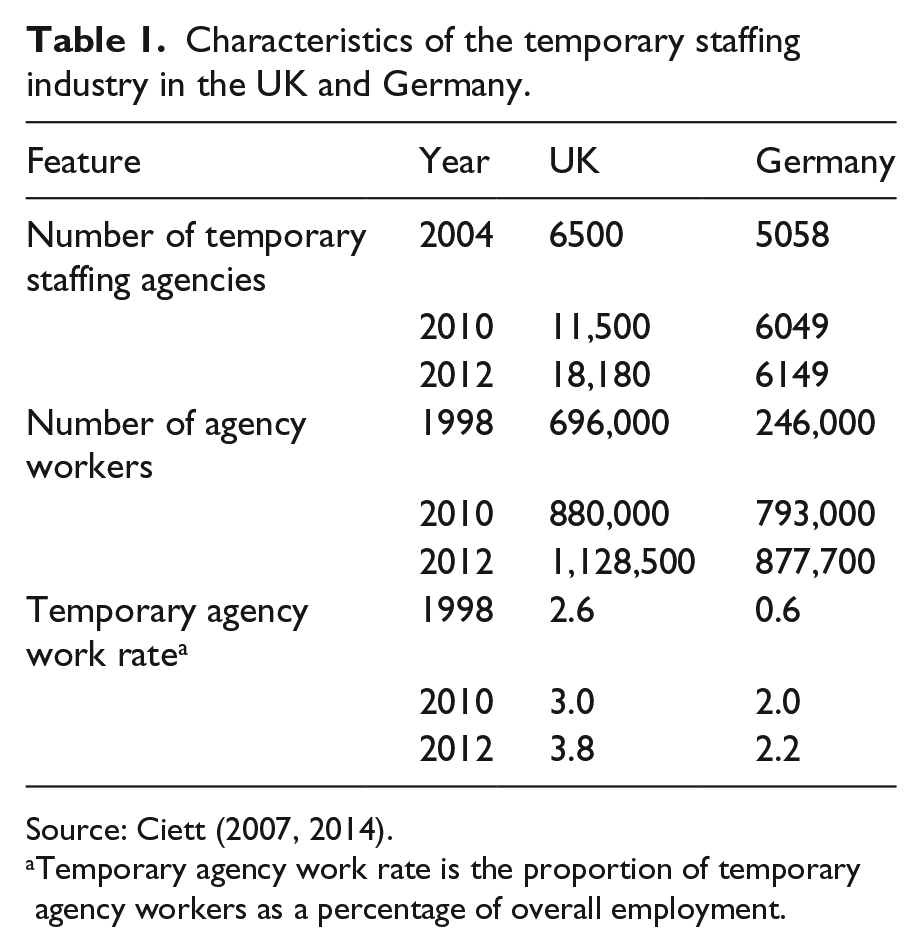
Source: Ciett (2007, 2014).
Temporary agency work rate is the proportion of temporary agency workers as a percentage of overall employment.
The United Kingdom: Fragmentation and blurring boundaries
Temporary agency work has a long history in the UK, dating back to the early 20th century (Storrie, 2002). It has experienced significant growth since the 1990s, driven by increasing demand for a more flexible workforce and the expansion strategies of many temporary staffing agencies (Forde and Slater, 2006). With such a long presence compared to elsewhere in Europe, a diverse TSI has developed to involve many sectors of the labour market, contributing to a market value of £19 billion in 2010 (Recruitment and Employment Confederation (REC), 2011). By 2012, temporary agency work represented 3.6% of all employment, which was more than twice the European average of 1.6% (Ciett, 2012). Despite a relatively high penetration rate, the UK TSI remained highly fragmented, with the top 10 agencies in 2010 – predominantly large transnational agencies – representing only 20% of the total temporary agency work market (Keynote, 2011). Compared to elsewhere in Europe, the relatively long presence of the TSI in the UK has allowed the industry to mature in terms of size, form and role in the labour market, as well as relationships between key institutions to be established and cemented.
Figure 1 displays the key institutions in the UK TSI. In this system the state has been required to introduce re-regulation to the UK labour market due to development in EU legislation – the European Temporary Agency Work Directive (EP, 2008). Welfare provision in the UK has increasingly focused on providing assistance into work, culminating in public–private partnerships (PPPs) with temporary staffing agencies. Trade associations and unions alike remain active in lobbying for their interests, and in turn have influenced both the European and national legislation that affects the TSI.
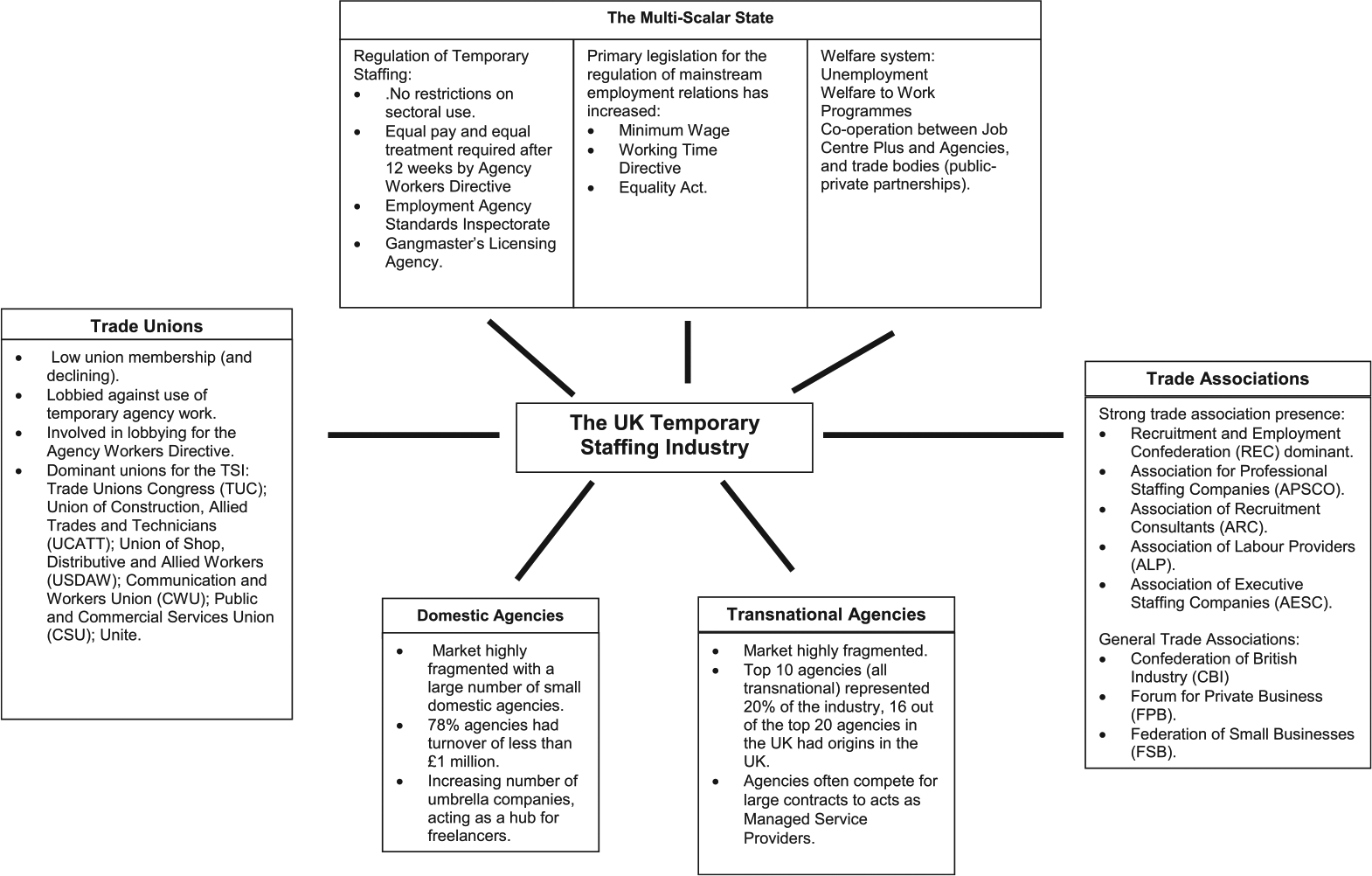
The United Kingdom temporary staffing industry.
The TSI remains highly fragmented and, despite the presence of some of the larger transnational agencies, the majority of the industry was comprised of small independent agencies:
There are thousands of small firms in the UK, often with a fairly narrow client base. It’s these small locally based firms, rather than the big national or international firms that make up the lifeblood of the industry. (UK Trade Association 3, February 2010)
Since the 1980s, a significant amount of restructuring took place as agencies gradually coalesced into larger groups through mergers and acquisitions (Coe et al., 2011). For example, the merger of Adia (Switzerland) and Ecco (France) formed Adecco in 1996 (Adecco, 2011a), with further acquisitions of Spring Group PLC and MPS Inc. in 2008, strengthening their position in the UK market as more sectors were covered (Adecco, 2011b). The relatively long history of temporary agency work created an arena for a complex institutional framework for the TSI. Temporary staffing agencies in the UK operate in a wide range of labour market sectors (REC, 2014). Agencies sought to expand into professional sectors of the labour market, although the bulk of their work remains in the high-volume low-margin positions (REC, 2014), increasingly through large-scale contracts both in the public and private sectors. For example, in 2010 there was even a national framework for the provision of temporary agency workers to local authorities, educational establishments and other public sectors organisations – Managed Service to Temporary Agency Resources (MSTAR) – established by the Public Sector Procurement organisation Pro5 (supported by the Department for Education (Pro5, 2011)). Six out of the 11 agencies mentioned by Pro5 (2011) were ranked in the top 10 temporary staffing agencies in the UK in 2020 (by turnover). Through these arrangements agencies could use other agencies to supply workers, but it was the larger agencies that would have the contract.
To complement their function as an intermediary for low-skilled (and often high-volume) workers, agencies sought to cement their position through expansion into more professional markets, as explained by an industry commentator:
The role of agencies isn’t only temporary staffing, they’re all trying to diversify their services as much as possible, they are all trying to move up the value chain. If you think of the lowest value being light industrial staffing, then you move towards the professional staffing end, so all the industrial businesses look to diversify into the professional staffing sector. Then the professional staffing agencies look to provide managed services. (Industry Commentator 4, July 2010)
Therefore, the role of the TSI in the UK has several layers. It serves as an intermediary to place workers in a range of professions, but despite what agencies and trade associations would lead the public to believe, the bulk of the temporary staffing remains in the low-skilled sectors.
Temporary staffing agencies also sought to secure their position in the labour market and even extend their role as a legitimate employer through their PPPs with the state and its public employment services. Agencies were keen to be considered as legitimate actors in the labour market, which was a prime motivator for the development of PPPs with Jobcentre Plus and local employment authorities. To some extent agencies were attempting to rebrand themselves as partners for public employment services, adding another dimension to the activities of agencies beyond simply placing workers. Collaboration between temporary staffing agencies (via the trade association, REC) and Jobcentre Plus (the public employment agency in the UK) represented a significant change for the UK TSI (Logan, 2008). The two actors were no longer seen as competitors, but as complementary features of a labour market, as explained by an agency regional manager:
In the past, recruitment agencies would have seen Jobcentre Plus as a competitor, but we are all in the same business – the business of finding jobs for the unemployed, so it makes sense to join up our efforts and draw on each other’s expertise – which will in turn offer our customers multiple opportunities to find work. (UK Domestic Agency 2, January 2010)
This was echoed by a trade association:
Traditionally, especially at a local level, the two [agencies and Jobcentre Plus] saw each other as competition and to some extent that has been eliminated. (UK Trade Association 1, February 2010).
The trade associations themselves sought to expand their membership, and develop links with other organisations outside government to develop their involvement in the wider labour market: they became involved in the Education and Employers taskforce, a multi-stakeholder group to facilitate work experience for young people; attempted to produce objective studies of the market; developed links with other institutions, including the University of Manchester, the Chartered Institute of Personnel and Development, Cordoba Consulting, Randstad and The Guardian, to produce research. In essence, they sought to promote themselves as legitimate employment commentators.
The REC represented the largest trade association for the TSI in the UK, accounting for around 67% of the total number of agencies in the UK as members (REC, 2012), with over 21 specialist groups, reflecting the interests of the corporate membership of the association as well as the entire TSI. The features of this, and three other key trade associations for the TSI, are displayed in Table 2, outlining how they developed over time and key relationships with other actors in the industry.
Features of trade associations representing the temporary staffing industry in the UK.
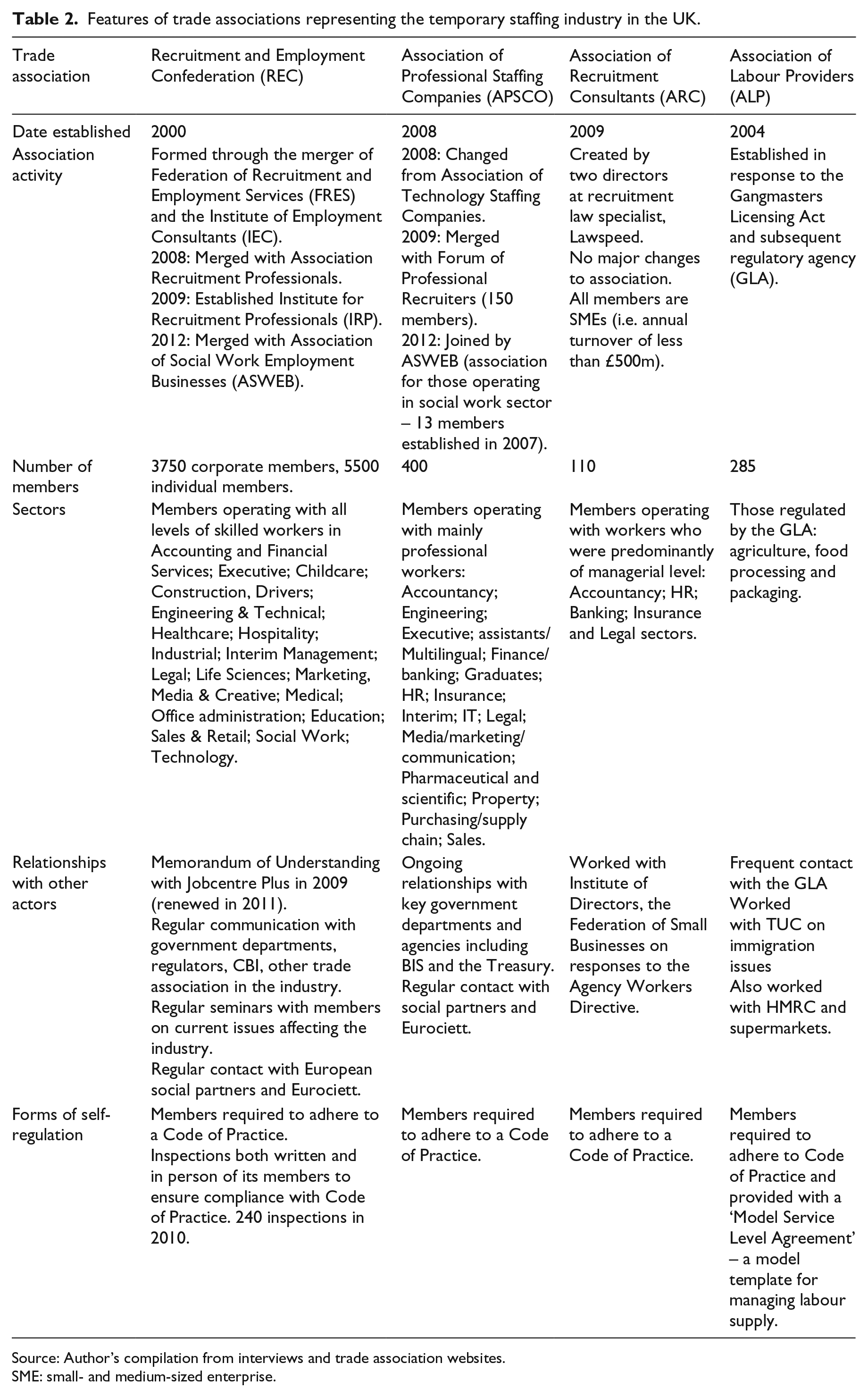
Source: Author’s compilation from interviews and trade association websites.
SME: small- and medium-sized enterprise.
It is important to recognise the influence of the wider European context on the developments that are being discussed in this article. Since 2010, temporary staffing agencies have experienced increased pressure from the transposition of the EU directive on temporary agency work (EP, 2008), the Temporary Agency Workers Regulations (HMSO, 2010), which sought to harmonise the conditions between temporary and permanent workers. While this Directive had a wider aim of removing unnecessary restrictions on the TSI across Europe, few restrictions remained in the UK. The implications of this were that the ‘neoliberal’ nature of the TSI in the UK left it more exposed to wide-reaching European influences, which sought convergence towards a common standard with a balance between flexibility and security (CEP, 2007). The particular element of the Directive that caused controversy was the requirement for temporary agency workers to received equal treatment to comparable workers (including pay); however, there were exceptions when this could be circumvented (BIS, 2011; European Commission (EC), 2014). In the UK, the transposed regulations stipulated that the right to equal treatment did not come into effect until after 12 weeks of working in one placement (BIS, 2011). Despite being considered a liberal political economic system, this feature meant it was subject to greater re-regulation to bring regulations in line with the rest of Europe. This suggests that while national institutional arrangements remain key to determining the features of the TSI, the European context cannot be ignored.
Germany: Growth and resistance
Temporary agency work has been permitted in Germany since 1972, after the establishment of the Arbeitnehmerüberlassungsgesetz (AÜG) – or Temporary Employment Act – when many legal restrictions were eliminated. By 2012 the number of temporary agency workers had reached 877,600, representing 2.2% of overall employment (BA, 2013). Until the introduction of a minimum wage in 2014, wages and conditions for temporary agency work in Germany were stipulated through collective agreements, negotiated by the trade unions and trade associations. As such, the relationships between the institutions involved in collective bargaining were central to the Germany TSI. This is reflected in the more extensive presence of trade unions and works councils in the German institutional arrangement for the German TSI, as displayed in Figure 2.
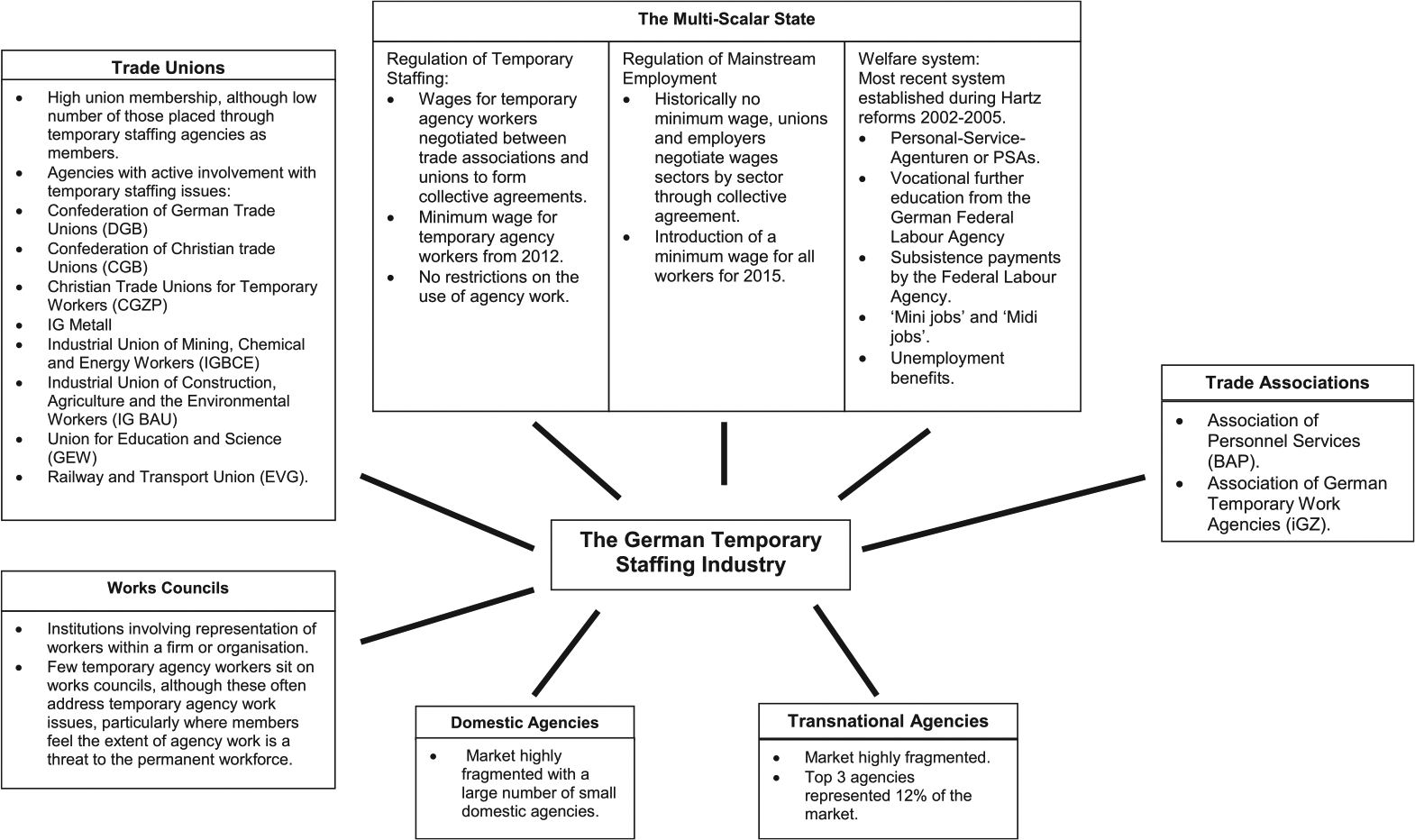
The German temporary staffing industry.
In comparison to the UK, in Germany there were a greater number of trade unions involved with issues related to temporary agency work. This is largely related to the aforementioned issue of collective agreements, but also a much stronger trade union tradition in Germany (Goerke and Pannenberg, 2007). Although trade union membership has declined dramatically in Germany since reunification, falling from 13.7 million workers in 1990 to 8.5 million in 2005, their role in determining features of the TSI remained prominent (EC, 2011). In addition, works councils – a panel of employees who represent the interest of workers in a firm – were also present. While legally independent from trade unions (the majority of work councillors also being members of trade unions), they tended to hold similar viewpoints with a negative view of temporary agency work (Goerke and Pannenberg, 2007).
In contrast to the UK, the German institutional landscape historically placed restrictions on temporary agency work, particularly around sectoral bans and over the length of assignments, contributing to comparatively slow expansion of the TSI (Eurofound, 2008). However, since legalisation in the early 1970s, the TSI underwent significant changes in terms of size, features and role, providing another example of a distinct national arena for the TSI. The German TSI has experienced substantial growth since the early 1970s, with particularly rapid growth since 2003. The penetration rate of temporary agency work in the German labour market more than trebled between 1996 and 2012, by which time it has reached 1.9%, slightly above the EU average of 1.6% (Ciett, 2014, 2015).
The national system for temporary staffing in Germany experienced rapid expansion after the enactment of the Temporary Employment Act in 1972 and de-regulation of the industry, which was cemented by subsequent temporary staffing agency growth. While these agencies operating in the market experienced growth in terms of the number of agencies, workers and turnover, the German TSI remained very fragmented, much like that of the UK (Ciett, 2000). Although growing over time in size, agencies remained small, which may evidence a comparative advantage of the small- and medium-sized enterprises (SMEs) in the German system, but also the importance of spatial proximity of the agencies to their customer base, given the regional variations that Germany experienced in the wider labour market (Spermann, 2013). This is not to say that there was not a growing presence of international firms in the German system, as seen in other professional service industries, such as law (Faulconbridge and Muzio, 2015) or executive search (Beaverstock et al., 2014). However, of the top international temporary staffing agencies in Germany only two had more than 20,000 workers placed annually (Ferreira, 2016).
Successive waves of legislative reform regarding temporary agency work acted as a primary driver of change (Spermann, 2013). Trade unions and trade associations were key in shaping changes in regulation alongside influences from the state – in particular the Federal Employment Minister – around issues of terms of use for temporary agency work and pay. As social partners linked through collective agreements for temporary agency work in Germany, both trade unions and trade associations had a crucial role in shaping the prevalence, and experience of, temporary agency work in Germany. Consequently, compared to the UK, trade associations exhibited much stronger relationships with trade unions. Germany did not, until May 2011, have a minimum wage as such for temporary agency workers. Minimum salaries were negotiated by sector via collective agreements between trade associations and unions. The actions of some in-house agencies prompted intervention by the state to ensure mistreatment of workers would not continue (Ferreira, 2016). This demonstrated the potential for direct state intervention in the activities of the TSI. After lengthy debates in parliament, a legally binding minimum wage was established for temporary agency workers:
The recent negotiations about the minimum wage for temporary workers for and opposed to equal pay for equal work has demonstrated to the rest of the market how dependent the temporary staffing industry is on decisions made by politicians in Germany. Hopefully in the future we can work to make it less dependent, and combine our efforts [with other trade associations] is therefore an important step towards a better representation of the industry…and hopefully we will be able to move on from all the media attention…and focus more on benefits agency workers bring to the market. (German Trade association 1, November 2011)
Like much of Western Europe, trade union membership has been in decline since the 1980s, attributed to the transition of the economy to more service sector orientation (Addison et al., 2011). This pattern runs concurrently with an increase in the number of workers employed in non-standard forms, particularly through temporary agency workers, although these workers rarely tended to join unions. Although some efforts were made by unions to engage with temporary agency workers, or with issues regarding their use, the underlying messages from trade unions remained negative. Trade unions stressed that temporary agency work should be used as a tool for short-term flexibility as the labour market demands, not as a viable employment option. For example, IG Metall, one of the most active unions on temporary agency work in Germany, launched a campaign on the negative impact of temporary agency work and started the initiative Leiharbeit fair gestalten: Gleiche Arbeit – Gleiches Geld – equal work for equal pay (IG Metall, 2007), and later produced a ‘Schwarzbuch Leiharbeit’ or Black Book of Temporary work that highlighted poor treatment of temporary agency workers (IG Metall, 2012).
Trade associations, however, have been a primary channel for agencies to promote the use of temporary agency work more generally, while agencies remained active in expanding their presence in the labour market, as part of ‘market making strategies’ (Theodore and Peck, 2002), building on skills’ gaps by developing training programmes specifically for temporary agency workers. For many years, German temporary staffing agencies invested to some extent in the continuing education of their employees, sponsoring forklift certification, IT courses and language training, and some agencies assumed responsibility for welding and soldering certificate training. The low costs for this form of continuing education were covered by client placement for a specified minimum period. However, a series of more intensive accredited training programmes for temporary agency workers were implemented via a number of agencies; when they could not provide the training programmes themselves, these were typically outsourced (Spermann, 2011). Education and training programmes included both short-term and medium-term qualification programmes for applicants and employees, alongside e-learning programmes (Spermann, 2011). In addition, some temporary staffing agencies joined forces with unions to provide further opportunities for training. For example, Positive Technicium, an arm of USG people, signed an agreement with IG BCE, the mining, chemical and energy trade union, to establish a professional training fund for temporary agency workers in 2010 (SIA, 2010). The aim was to encourage temporary agency workers to invest in their continuing professional development, as any other employer would do.
The role of temporary staffing agencies in the German labour market expanded from simply a short-term employment option. However, the TSI in Germany faced serious image problems, in part due to preference for standard full-time employment, but also in response to media coverage of the ‘Schlecker scandal’ 1 and trade union campaigns that presented temporary agency work as ‘slave labour’ (IG Metall, 2012). The German case not only provides an interesting example of where the TSI experienced significant development in a relatively short period of time, but it also highlighted a series of issues relevant for the consideration of how variegated TSIs are formed and shaped. Despite the expansion of transnational agencies into the German market and the introduction of EU regulations, it was the German state that continued to play a strong role in the operation of the TSI. Deregulation of temporary agency work acted as a spark for development, but the state later acted to protect temporary agency workers from abuse through introducing regulations on pay and conditions. This highlights how the state can play both the role of the de-regulator and re-regulator, and as such the potential for both dynamics should be considered in any exploration of a national system – convergence towards a neoliberal model should not be assumed.
Comparing national temporary staffing industries
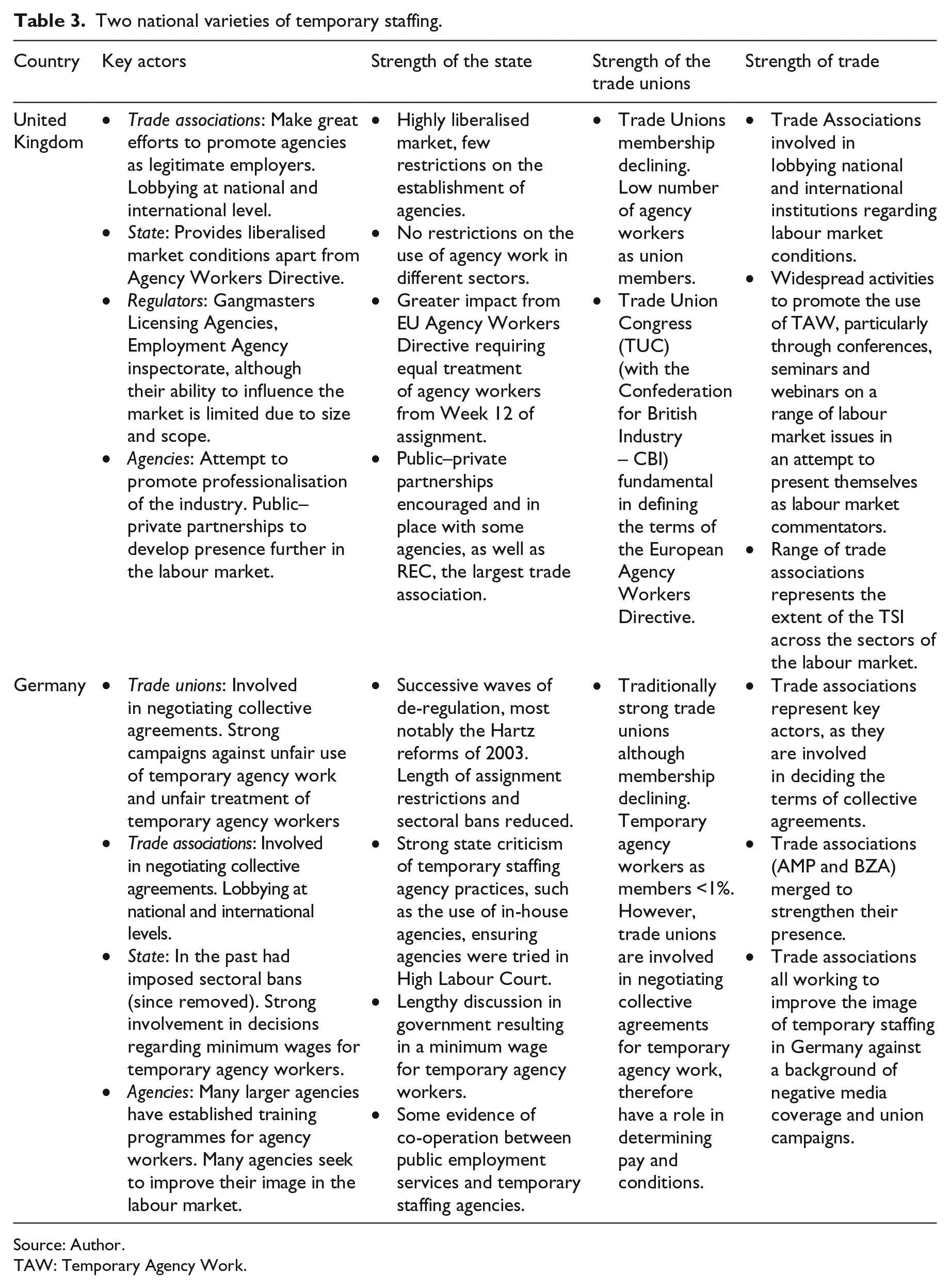
Having explored the individual institutional arrangements in the UK and Germany, the next section provides a comparison of some of the key features and relationships in order to consider implications for the understanding of the TSI. Table 3 provides a comparison of the key features for these two TSIs, highlighting the key actors and relationships.
Two national varieties of temporary staffing.
Source: Author.
TAW: Temporary Agency Work.
In the UK the TSI has matured, expanding into all sectors of the labour market, including efforts to move into more professional sectors (albeit not on the scale the agencies would like to suggest). An agreement between the Trade Unions Congress (TUC) and the Confederation of British Industry (CBI) influenced the final terms of the EU Temporary Agency worker Directive fuelled by arguments from agencies across the country trying to ensure their market would not be disadvantaged (TUC, 2008). Other state influences related to the presence of regulators (the Gangmasters Licensing Agency and the Employment Agency Inspectorate), designed to ensure adherence to regulations. In practice, the small size of these institutions meant their influence was relatively small. Temporary staffing agencies and trade associations sought to increase their links with public employment services in order to place workers, as well as provide some forms of training, in an attempt to erode the divide between the public and private sector intermediaries in the labour market. This not only cemented the position of some agencies in the labour market, but also raised their profile. The role of the TSI in the UK has gone beyond simply placing workers; while agencies are keen to be seen as legitimate employers, they are also active in trying to shape their labour market conditions – either through collaboration with other actors in their labour market or by expanding their presence.
In Germany, development of the TSI started at a later date than in the UK, with the largest growth seen after the Hartz reforms in 2003. Temporary agency workers became placed in a wider range of sectors: although larger proportions were placed in manufacturing than in the UK, in part due to the structure of the German economy. Temporary agency work was regulated largely through collective agreements, and this ensured the presence of both trade associations and trade unions as key actors in determining changes to the industry. While the state did not always play a large role in these agreements, developments in the industry regarding the use of in-house agencies and minimum wages meant much greater involvement of the state, culminating in the introduction of a minimum wage for all temporary agency workers. Trade unions remained a strong force in the German system, and significant resistance to the use of temporary agency work in the workplace was experienced, often manifested through works councils and trade union campaigns. Temporary staffing agencies have sought to improve their image in the labour market; one mechanism to do this has been to expand their services to include training courses for temporary agency workers. The role of the TSI in Germany remains largely concentrated in placing workers according to peaks and troughs in demand; however, agencies and trade associations were active in trying to develop this role to include greater collaboration with public employment services and a greater presence in the labour market in order to address resistance to market expansion.
This research reveals that the formation of the TSI is not pre-determined by the regulations of the state or the presence of certain institutions, but by a hybrid of both the forces from existing institutions and the agenda of other institutions to either foster development of the TSI (in the case of agencies and trade associations) or hinder its development (in the case of some trade unions). Instead, the institutional ecology of the TSI (Hall and Thelen, 2008) is simultaneously being affected by the relationships between, and strategies of, the constituent institutions of the system. The relationships between institutions are neither simple nor static; as such, any understanding of a TSI should take into account the potential for a multitude of industry development trajectories, based on past and existing institutional arrangements. Therefore, this suggests that in any exploration of variegated capitalist systems, be it a sub-sector of a labour market or a specific industry, it is vital to consider a broad range of institutions and the impact they may have on the wider characteristics of the subject of investigation.
In both countries the state played a role in influencing the development of the TSI, although this breadth of influence varied. The TSI can be empowered or restricted by a regulatory framework, which can impose constraints on temporary staffing agencies through either specific temporary agency work regulations or wider employment regulations. The empirical cases explored in this article suggest that the state can act as a prompt for growth via de-regulation, but also as an inhibitor for growth via re-regulation (of either temporary staffing or wider employment relations). Furthermore, while the state can provide the legal foundation for the growth of the TSI, the actions of agencies actively expanding their remit in the labour market will also affect its form and role. Therefore, as Wills et al. (2000: 1528) stated: ‘the state plays a key role, regulating the employment relation through legal measures’, but also that ‘the state, employers, trade union organisations, and workers are all involved in crafting the ever-changing geography of employment’.
It is clear that temporary staffing agencies undertake an active role in developing their presence in the labour market, either through expansion of the sector’s presence, diversification of services or involvement with public and private sector institutions. However, as Aoki (2001) argued, patterns of firm behaviour are deeply embedded within the institutional environment and, therefore, this role is influenced by wider institutional arrangements. These institutions underlie a geographically specific contextualisation of economic action (Bathelt and Gluckler, 2014) and, as shown in this research, an awareness of the potential for reflective, responsive and adaptive systems within these individual contexts. The evidence presented here demonstrates how agencies have involved themselves in a range of activities, including merger, acquisition and expansion, PPPs and training programmes, all of which were designed to expand their presence in the labour market. Consequently, greater theoretical attention is required to examine the role of temporary staffing agencies in shaping labour market outcomes, particularly given that many agencies have expanded their remit beyond simply placing workers to offer a range of employment and HR services to clients, as part of developing a staffing ecosystem.
The evidence presented here draws attention to the nationally distinctive formations of the TSI where actors have varying degrees of importance depending on the wider institutional context, driven by both historical and contemporary institutional arrangements. The empirical observations have moved beyond discussion of the form and characteristics of the TSI to identify key factors affecting development and the changes to institutions within the system. In many cases regulation created by the state (although often influenced by other actors) can act as a facilitator or inhibitor of growth, but this is not the only defining factor. In the UK, agencies actively sought to expand their operations, diversifying their services and occupational sectors; this was in combination with developing links with the public sector in an attempt to secure demand for their services. In Germany, the campaigns of trade unions against temporary agency work presented an obstacle for agencies; however, they continued to expand their network – and, in the case of some larger transnational agencies, offered training programmes, presenting themselves as legitimate labour market providers of both employment and skills development.
Through the understanding gained of the underlying power relations driving the development of national economic systems, more careful consideration must be made of the activities of a wider range of institutions. While temporary staffing agencies as firms in the system are vital, there are other institutions that can also affect the dynamics of the industry. As such, any consideration of wider national systems should take into account the variety of institutions that cooperate and collaborate to drive development and how these systems shift and transform over time as part of a particular institutional ecology.
Conclusion
This article has explored the institutional context for two countries in which the TSI operates, interpreting developments and changing dynamics between actors in order to emphasise the existence of nationally distinctive TSIs as a particular lens through which to explore features of institutional change. The analysis revealed a complex set of institutional arrangements, with nationally distinctive factors shaping the characteristics and development for the TSI, where the institutional context crucially includes the state (and its various agencies), trade associations and trade unions, plus domestic and transnational agencies (and in Germany, works councils). In addition, the wider European context cannot be ignored, particularly in the context of EU regulations, which required implementation at the national level.
This analysis demonstrates how the institutional context for the TSI affects a range of actors, not just the temporary staffing agencies, and also how these agencies have been active agents in changing their institutional environments in varied ways. The concept of a national TSI introduced by Coe et al. (2009a) has been reified through empirical investigation of the TSI in the UK and Germany, allowing the features of two national TSIs to be compared, providing two contrasting institutional arrangements for the TSI. The evidence presented here builds on this concept to explore the key relationships within these markets, rather than simply identifying the activities of the temporary staffing agencies and the presence of other actors. This analysis displays two particular applications of a national TSI model, for the UK and Germany. In doing so it highlights not only the importance of recognising institutional relationships as well as the presence of key institutions, but also the importance of monitoring change within any national system. Meanwhile, it also highlights the importance of the place-specific nature of the interrelationships between different institutions and the effect this has on the role of the TSI in the wider labour market.
This article explored different national TSIs in order to examine not only the variegated nature of their formation and development, but also to further both the theoretical understanding of, and empirical research on, the TSI. This research reveals that the institutional context for temporary staffing remains highly nationally distinctive in these countries, each with their own complex geographies, interactions and interdependencies. The key argument this article was designed to reiterate was the crucial importance of considering not only one type of actor (or part of a national system), but all components and actors as a developing system, whereby in each national context various actors represent multiple agents of change. Furthermore, it highlights that these systems require continued observation in order to understand the changing dynamics rather than considering industries in ‘snapshot’ view. The implications of this can be extended to suggest that any network of intermediaries or industry should be understood as part of a wider institutional context – part of a business system, which in turn create a particular form of economic co-ordination that over time will shift and alter in response to wider patterns of economic change and industry particularities that prompt change and transformation. TSIs are dynamic and their institutional transformations should be explored further in order to understand the drivers of change from changing market conditions, governance mechanisms or external influences. Investigating the institutional context for any industry can act as a platform to begin to understand the process of institutional change and the development of different institutional ecologies.
Footnotes
Declaration of Conflicting Interests
The author(s) declared no potential conflicts of interest with respect to the research, authorship, and/or publication of this article.
Funding
The author(s) received no financial support for the research, authorship, and/or publication of this article.