



Abstract
For more than two decades, cluster theory has served as a basis for widespread implementation of regional development policies in several countries. However, there are still persistent struggles in academia towards agreement on clear operational definitions of a cluster. In this article, we argue that this definitional haziness, reflected by difficulties in demarcating the scale and scope of clusters, leads to a stretching of the cluster concept when put into practice. We show how actors, through cluster projects, are utilizing strategies of “hubbing” and/or “blending” to develop their own understandings of both what clusters are and what they might or should be. Through studies of three Norwegian cluster projects, we argue that national cluster policies, through translation of an academically vague concept, facilitate a stretching of the original definition of clusters, giving regional stakeholders leeway to integrate other theoretical rationales instead. We argue that this is not taken into account in current policies.
Introduction
Use of “cluster” and “clustering” concepts has grown within academia and beyond, with Michael Porter’s understanding of competitiveness embraced globally by policymakers, industry leaders and scholars, leading to a profusion of cluster initiatives and projects. Theories on industrial clusters have been translated into concrete policies, and the intention of several national and regional policymakers has been to encourage and to strengthen clustering processes. Hence, the cluster has expanded from its original concept and, in the process, a “stretching” of the original (although vague) definition has occurred. This has essentially detached the concept from Porter’s seminal contribution (Desrochers and Sautet, 2004; Fløysand et al., 2012; Malmberg and Power, 2006; Martin and Sunley, 2003; Tödtling and Trippl, 2005).
As the popularity of cluster theories has spread beyond academia, the term and concept have gained content that does not necessarily conform to the strict theoretical propositions and models, and a cluster project does not necessarily imply that dynamic clusters exist, or that they will ever come to exist, within a particular geographical area. Our point of departure is that clusters are social constructions produced iteratively between the discursive/academic world and the material/practical world (Fløysand et al., 2012). Viewing an entity as a social construction opens up a high level of contingency (Granovetter, 1992). This implies, for instance, that cluster projects are not uniform or homogenous. Cluster projects have different origins, different profiles and different outcomes. Further, a social construction approach also means that understandings of an entity can be contradictory and contested (Marston, 2000). Thus, actors will have different conceptions of what clusters are, and policymakers’ conceptions of a cluster may not necessarily conform to the hegemonic academic definition of a cluster. However, the original cluster idea is still influential in European countries, and both successful and unsuccessful public cluster programmes and projects have been developed and implemented across several geographic regions (Isaksen, 2009; Sölvell et al., 2003; Uyarra and Ramlogan, 2012). Nevertheless, these programmes do not necessarily reflect empirical criteria (e.g., Malmberg and Power, 2006) and may not be in accordance with Porter’s cluster concept. In cluster projects, different cluster stakeholders, such as cluster facilitators, regional policymakers, research and development (R&D) institutions, industry associations and firms, add new, and often divergent, interpretations of the traditional academic understanding. Kiese and Wrobel (2011) argue, for instance, that cluster promotion represents a mix of differing rationalities between different stakeholders in the “practical action space”. Thus, stakeholders promote different ideas of what a cluster should be and in turn influence how a cluster project should be designed and practised. Inherent in any cluster is the agency of its stakeholders. Hence, in a cluster project, there is room for altering representations of not only what the cluster is but also what it should or could be. More importantly, such understandings can differ greatly from what researchers perceive that a cluster is and what it should be. In other words, when cluster theory, developed in the academic world, is operationalized by the applied world, the two do not necessarily correspond. Through this social process, clusters become a phenomenon with a life of its own.
In this paper, we discuss the policy implications of such discrepancies between cluster theory and cluster practice. However, as cluster policies are context-specific, the national frame certainly matters. We focus on cluster initiatives in Norway, and have selected three projects in the public cluster programme Norwegian Centres of Expertise (NCE). This is a programme aiming “to enhance sustainable innovation and internationalization processes in the most dynamic and growth-oriented Norwegian clusters” (http://www.nce.no/no/Om-NCE/About-NCE/). The programme is directed towards specialized, mature clusters with a strong regional foundation (Isaksen, 2009). The aim of this paper is to answer two research questions.
How and why is the concept of clusters stretched through policy application?
What are the political implications of this stretching?
To provide conclusive answers, we begin with a short discussion of what constitutes a cluster according to the academic literature. Secondly, we dig deeper into recent theoretical contributions on cluster development. We find that the scale and scope of clusters are widely debated in the literature and that this is the core issue in the discussion about what constitutes a cluster. Furthermore, we argue that in interplays between meanings attributed by academics and those added by practitioners, or encounters between theory and practice, the cluster concept is stretched. This stretching is related to both cluster scale and scope through various strategies of “hubbing” (utilization of geographical scale) and “blending” (utilization of industrial scope). In short, our case studies illustrate how cluster projects, using different strategies, are stretching and, to some degree, altering the cluster concept. Accordingly, there seems to be a discrepancy between the theoretical understanding of clusters, its application in Norwegian cluster policy and its operationalization through cluster projects. For example, the national cluster policy is linked to an understanding of clusters as specialized and regional, while, at the same time, there are cluster projects bearing resemblance also to ideas associated with the development of regional innovation systems (RIS) and the promotion of sectoral innovation systems. We argue that this is problematic, as such stretching might work against the political aims of the relevant cluster programme.
Theoretical background
What constitutes a cluster?
The literature on industrial clusters is multifaceted and rich. Porter’s (2000: 15) seminal definition of a cluster as “…geographic concentrations of interconnected companies, specialized suppliers, service providers, firms in related industries, and associated institutions (e.g., universities, standards agencies, trade associations) in a particular field that compete but also cooperate” has been important, but as was pointed out over a decade ago (Martin and Sunley, 2003), a clear and complete definition of a “cluster” is difficult. The struggle is still ongoing and has, most prominently, been linked to difficulties in establishing joint understandings of the spatiality (geographical scale) of clusters and, more recently, of the degree of specialization (industrial scope). In economic geography, special emphasis has been placed on the spatial vagueness inherent in Porter’s definition. A host of contributors have tried to refine the cluster term and conceptualization, and we find Malmberg and Power’s (2006) chapter on the conceptual headache of clusters and clustering to be especially interesting.
Malmberg and Power (2006) claim that clusters and clustering are vague notions and fuzzy concepts, and that the “headache” relates to Porter’s vague definition. They argue that the theory in itself offers something interesting but that, as mentioned, clusters are difficult to grasp. Malmberg and Power reduce some, although not nearly all, of the fuzziness by noting that “if one takes cluster theory seriously”, four criteria for identifying “true clusters” should be fulfilled: (a) there should be a spatial agglomeration of similar and related economic activity; (b) these activities should be interlinked by relations and interactions between local collaboration and competition; (c) there should be some form of self-awareness among the cluster participants and some joint policy action, expressed as “we are a cluster and we are determined to develop together”; and (d) the cluster should be successful, through measures such as innovation or competitiveness (Malmberg and Power, 2006: 57). Thus, a “true cluster” is regarded as a spatially bounded agglomeration containing related activities and based on co-opetition in which the actors share a feeling of belonging.
However, such cluster conceptualizations do not necessarily conform to practical use. Originally, cluster programmes and Western initiatives emphasized that clusters were regional and specialized (Fløysand et al., 2012; Sölvell et al., 2003). For instance, an international survey of cluster initiatives found that they “tend to have a narrow geographical focus … 50% have most of their members within one hour’s travel distance” (Sölvell et al., 2003: 10), and Isaksen (2009) argues that strategic networks to supraregional knowledge sources are important mechanisms for cluster upgrading and innovation. More recently, we have witnessed more diverse policy approaches to cluster development and implementation (Uyarra and Ramlogan, 2012). In evolutionary economic geography, the evolution of clusters is argued to be linked to processes of scale and scope (see also Njøs and Jakobsen, 2016). This constitutes the core of the criticism of the cluster concept: ambiguity inherent in cluster theory is related to the difficulties in clearly demarcating the challenges in defining scale and scope.
Scale and scope at the core of cluster haziness
The issue of cluster scale has been thoroughly debated in recent literature. The consensus is that external links are crucial for mature clusters. To be innovative, strong clusters are dependent on new knowledge, information and networks, among other items, to avoid lock-in and decline (Bathelt et al., 2004; Breschi and Malerba, 2001; Nadvi and Halder, 2005). It has been widely acknowledged that such ties need to be balanced between the local and the global; the embeddedness (Hess, 2004) of both clusters and firms within clusters has been extensively investigated (e.g., De Martino et al., 2006; Fornahl and Tran, 2010; Kramer and Revilla-Diez, 2011; Montagnana, 2010; Perkmann, 2006; White, 2004). Bathelt et al. (2004) argue, for instance, that the co-existence of intense local networking and a high number of external linkages facilitate collective learning processes that trigger innovation in the cluster. Although clusters are considered to be localized, regional phenomena with extra-regional linkages, the precise geographical boundary of such entities remains an empirical question.
Not only has the spatiality of clusters been scrutinized (Malmberg and Power, 2006; Martin and Sunley, 2003), but also the issue of the type of industry actors and associated institutions which should constitute a cluster—the scope of the cluster—is increasingly under investigation. As with the debate over scale, there is widespread discussion about how specialized or diverse a cluster should be. Porter (2000) originally argued that a cluster should include firms and institutions within related industries, while others have argued that more narrowly defined and specialized clusters are beneficial for development (Reve and Sasson, 2012; Sölvell et al., 2003). This is another definitional question that lacks an operationalized consensus among cluster scholars.
Until recently, the discussion about clusters has emphasized the importance of industry specialization, or linking clusters to an industry profile. However, new lines of research have been more sceptical (Cooke, 2012a, 2012b), as specialization can in fact work against innovation. Innovation is widely understood to involve new combinations of dissimilar knowledge types (Fagerberg, 2003). Linked to clusters, related variety (Boschma and Frenken, 2011) is an informative concept. It has been claimed that innovations within industrial clusters grow from differential knowledge shared between actors both within and between clusters or regions, while at the same time, knowledge between the actors should not be too dissimilar (Boschma and Iammarino, 2009). Regarding cluster mechanisms that trigger innovation, Aarstad et al. (2016) found that related industry variety is a positive regional driver for both innovation and productivity. Moreover, their studies showed that industrial specialization is a driver of enterprise productivity but does not have a significant positive effect on enterprise innovation. Relatedness is important also in Porter’s seminal cluster definition, but how to operationalize relatedness is still unresolved within the cluster literature.
In other words, the frontier of cluster research is struggling to explain what constitutes a cluster along the dimensions of both scale and scope. A fairly pragmatic consensus has been reached about the importance of balancing both scale and scope, and “mixing” the two dimensions is considered to be at the core of a true cluster. However, this does not necessarily single out a clear and exhaustive cluster definition. The haziness of the concept is present in academia, and considering that clusters are procedural entities in flux, operationalizing them is even more challenging. Thus, “cluster” is an academically elastic concept.
Encounters between theory and practice provide an opportunity for adding new meanings to the cluster concept, because translating theoretical ideas to practice is in itself an unclear task. The definitional haziness in the academic literature, prominently linked to dimensions of scale and scope, further challenges this translation. Thus, at the interface between theory and practice, agency is essential to understanding how the cluster concept is stretched and given new meaning. The role of policymakers, practitioners and other institutional actors in shaping the system has been partly overlooked in the literature (Isaksen and Karlsen, 2012). However, there are some exceptions. Uyarra and Ramlogan (2012) identified extensive heterogeneity in their review of cluster policy strategies, while Borras and Tsagdis (2008) make a distinction between a narrow and a broad approach to cluster policy. The first includes the direct involvement by the facilitator or cluster consultants, while the second includes a broader set of initiatives that influence cluster development. Aragon et al. (2011) discuss how cluster development strategies need to be linked to the level of development of the targeted cluster, while Fosse and Normann (forthcoming) emphasize that applied cluster project development strategies should be informed by a cluster’s life cycle (e.g. Isaksen, 2011). In addition, they observe that the competence, resources and professional networks of the cluster facilitator influence the strategies for cluster development.
Hence, viewing clusters as social constructions implies that different stakeholders have different ideas of what a cluster should be, in turn resulting in different strategies and objectives. Informed by our theoretical discussion, we introduce the twin terms “hubbing” and “blending” in conceptualizing how cluster project stakeholders (i.e., agents) stretch the cluster concept along the geographical scale and industrial scope dimensions. A hubbing strategy means that the cluster establishes new junctions or assemblage points outside the original geographical core area of the cluster, and is, as such, linked to utilization of geographical scale. Such strategies are intended to complement and further develop specialized clusters through extra-regional pipelines and the development of relations with specialized actors external to the cluster. This resembles the idea of global pipelines as a driver of innovation within the cluster literature (Bathelt et al., 2004) and also the focus on learning through connecting highly competent and specialized actors within the sectoral system of innovation approach (Malerba, 2002).
An alternative strategy for cluster facilitation is blending strategies. The key issue of the blending strategy is to ensure an upgrading of the cluster and a strengthening of the innovation capabilities of the cluster firm through facilitating blending or mixing of different but related competences. Thus, blending strategies are concerned with expanding the industrial scope of cluster projects by stimulating co-operation and learning between firms in related branches and firms with different but related knowledge. In practice, blending implies a stronger emphasis on the regional dimension and is, as such, linked to the theoretical concept of RIS and related variety (Boschma and Frenken, 2011; Cooke, 1992; Cooke et al., 1997; Uyarra, 2010). In the following empirical investigation, we elaborate on different stretching practices in our three cases chosen from the Norwegian NCE programme, exemplifying how hubbing and blending strategies are utilized to different degrees.
Empirical investigation
In Norway, the development and implementation of cluster programmes have been very closely linked to Porterian thinking. As shown by evaluations of the NCE programme (e.g., Røtnes and Jakobsen, 2012), Norwegian cluster programmes are very loyal to this theoretical approach, employing Porter’s definition and an understanding of clusters as (sub-national) regional entities consisting of firms, R&D institutions, government organizations and support institutions within the same/similar industries and where external pipelines are considered crucial for cluster development. Thus, in the Norwegian case, cluster policies represent an attempt to apply, through translation, the theoretical concept of clusters.
NCE is a public programme for mature and particularly strong clusters that are internationally competitive. Cluster programmes are one of the central pillars of Norwegian innovation policy, and the NCE programme is one of three national cluster programmes, grouped under the heading Norwegian Innovation Clusters. The ARENA programme is aimed at emerging, immature and potential clusters, and is intended to explore and to structure industry clusters in an early phase of development. Status and financing is given for 3–5 years. The NCE programme, initiated in 2006, is designed for mature clusters with a strong international position. Financing is granted for up to 10 years. The intention of the programme is to enhance innovation and internationalization in the most dynamic and growth-oriented Norwegian clusters. In June 2015, there were 12 active NCE cluster projects in operation. In 2014, another cluster level was initiated: Global Centres of Expertise (GCE). There are three GCE projects running in Norway (October 2015), all of which were previously NCE projects. Status and financing is granted for up to 10 years.
Our cases are selected from the NCE programme. This programme aims to “better the conditions for increasing value creation and strengthen [the clustered firms’] position in national and global value chains” (Norwegian Innovation Clusters, 2014: 2, our translation). The NCE projects are required to encompass “a clear concentration of firms, both SMEs and large specialized suppliers and a large share of globally oriented firms”. Moreover, it is required that the “cluster has an established position as an important national, and usually an international value creation environment within its value chain or technology base” (Norwegian Innovation Clusters, 2014: 2, our translation). The programme also highlights the importance of co-ordination and strengthening of vertical integration in value chains as one of the key characteristics of dynamic clusters. Hence, it can be claimed that the NCE programme emphasizes specialized clusters with a narrow scope.
In our analysis, we focus on three selected NCE projects: NCE Maritime, NCE Oslo Cancer Cluster (OCC) and NCE Subsea (Figure 1). 1 When selecting the cases we draw on our insight on Norwegian cluster policy and prior studies of cluster initiatives (see, for instance, Fløysand et al., 2012; Isaksen, 2009; Jakobsen and Onsager, 2008; Røtnes and Jakobsen, 2012). Our intention has been to select cases that illustrate different, but typical, features of the phenomenon we want to explore (George and Bennett, 2005), that is, strategies for cluster development that illustrate stretching of the cluster concept. The selected projects aim to develop mature clusters. The projects have been ongoing since 2006/2007, and have launched several cluster development initiatives. Based on our prior knowledge, they employ different strategies for cluster development. In other words, these cases illustrate cluster project strategies that we believe exemplify how the cluster concept is being stretched within a cluster programme, that is, we study “… what is considered to be a typical set of values, given some general understanding of a phenomenon” (Gerring, 2007: 91). Thus, we represent these cases not as statistically defined but rather as exhibiting various characteristics typical of the phenomena under study.
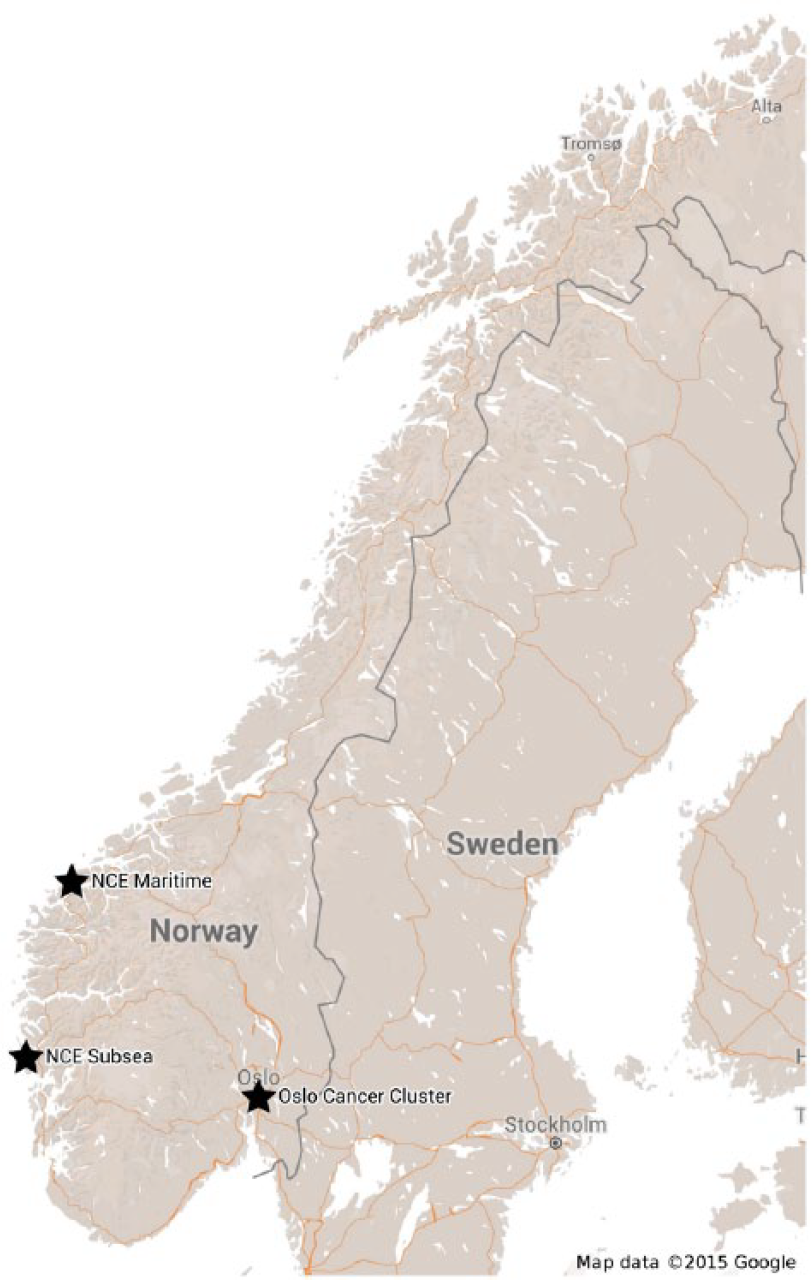
Location of the three cluster projects.
One of the strengths of qualitative case studies is the high level of conceptual validity that they offer through in-depth examination of descriptive indicators and variables. Use of qualitative case studies is an appropriate method for research that aims to contribute new knowledge about complex, causal relationships or to provide nuances to theoretical assumptions (George and Bennett, 2005; Yin, 2009).
Our main data source was semi-structured interviews with cluster project stakeholders (i.e., cluster facilitators, regional authorities, personnel at R&D institutions, cluster firm representatives, regional politicians and individuals within business organizations). In the NCE Maritime cluster project, we interviewed the cluster facilitator on two occasions, as well as individuals at eight cluster firms and seven other regional cluster project stakeholders; these combined 17 interviews were conducted from May 2011 to March 2014. In the NCE Subsea cluster project, we conducted eight semi-structured interviews from October 2011 to February 2014 with the cluster facilitator, individuals at five cluster firms and two other cluster stakeholders. Finally, seven interviews were conducted in the OCC project from August 2013 to February 2014, including two with the cluster facilitator and five with individuals at cluster firms. Our interviews covered questions on cluster evolution (both present and future), regional embeddedness, intra- and extra-regional cluster relations (networks), the geography of the cluster and firms’/cluster linkages to other (related) industries. Secondary data from strategy documents, annual reports, the projects’ home pages, newsletters and other analyses were also used in our analyses of all three cluster projects.
The maritime cluster in Sunnmøre: Dynamic and strong
The Sunnmøre area in the county of Møre og Romsdal in north-western Norway has been known for centuries as a region with a distinct entrepreneurial spirit and a solid restructuring capacity characterized by strong industry interconnections (Halse, 2014). Beginning in fisheries, the region has continuously restructured to cope with changing macro- and meso-economic shifts. Today, the Sunnmøre area’s dominant industry is maritime, and it also has a strong foothold in fisheries and furniture production. Maritime is presently one of the global leaders in designing, building and operating advanced and sophisticated offshore vessels, primarily for the petroleum industry.
This region is characterized by knowledge sharing and an eagerness to innovate. For instance, it is said that “you can nail a Sunnmøring to the wall, and he still gets fat.” This reputation is complemented by a culture emphasizing knowledge sharing and entrepreneurship. An informant explains:
I think this dates back to prehistoric times. I think that when the fishermen were out fishing, and had filled their boat with a catch, they could either let go of the rest, or they could give it to their neighbour, hoping that he would return the favour next time.
In other words, close linkages and high levels of trust between the actors have been built over a long period. This has formed the foundation for a regionally embedded maritime cluster, the activities of which span design, building and operation of custom-made vessels. This is strongly related to past industrial activities, most notably fishing. Moreover, in both the cluster and the region, there are long traditions for co-operation across sectors and industries, through both formal and informal relations. As stated by one informant, “In this region there is indeed a practical understanding of what industrial development is all about. It is a joint understanding.”
The maritime cluster in the Sunnmøre region is complete, consisting of shipping companies, designers, shipyards, suppliers, higher education institutions, R&D institutions and finance institutions. The cluster consists of nearly 220 companies and represents a complete value chain from subsuppliers to shipping companies, employing more than 20,000 individuals (Oterhals et al., 2014).
The NCE Maritime project
In 2006, the maritime cluster was awarded status as a NCE, and the cluster facilitator NCE Maritime was founded. In its application for NCE status, the regional actors wanted to include the regional industrial environment, not just the maritime sector, towards carving out a cluster reflecting the interlinkages between the historically dominant regional industries (furniture, fisheries and maritime being the most notable). This was to reflect the importance of knowledge sharing between different sectors, through which the regional tradition of cross-sectoral interdependence was implemented. This element of the application was rejected by the programme committee because the NCE programme emphasizes industry specialization. However, the cluster facilitator and regional development actors encourage interaction between industries and sectors in the region through cluster project facilitation and arrangement.
The NCE Maritime project is led by Ålesund Kunnskapspark (ÅKP), a regional development agency. ÅKP is jointly owned by private companies and municipalities, the Møre & Romsdal county administration, and government corporation Industrial Development Corporation of Norway (SIVA). ÅKP facilitates several projects, including NCE maritime, LEGASEA (a bio-marine cluster project), Norwegian Rooms (a furniture cluster project), ECOWindS (a project on offshore wind) and several incubators. In other words, NCE Maritime is one of several regional development projects facilitated by ÅKP, and the importance of the regional industry activity is reflected by this configuration. NCE Maritime is not treated as an isolated cluster project, and a key informant in the cluster highlighted the importance of seeing the different ÅKP projects in relation to each other:
ÅKP is a regional innovation system with an incubator, with NCE [focusing on the maritime sector], with bio-marine, and international projects. And all of this is interconnected. [The role of ÅKP] is to create a functional region. And that is one of the weaknesses of these NCE projects; they are assumed to live a life of their own. I think that is wrong.
The regional industrial heritage is again highlighted, in which regional development actors participate in broad activities that underscore cross-sectorial linkages and a wider understanding of regional development. This is also emphasized by one of the cluster stakeholders:
It is exciting that you have a petro-maritime cluster that, together with the marine, with offshore and with renewable wind energy, as examples, is moving along several dimensions. There is elasticity along several dimensions. It would have been much weaker if you only had one of the dimensions.
This is also exemplified by one of ÅKP’s strategies, which highlights the importance of increasing cluster scope to avoid lock-in. The term “ocean space” has been conceptualized by ÅKP and other regional development stakeholders, suggesting that the cluster consists of more than a petro-maritime dimension. The concept, in which “ocean space” consists of more than shipbuilding, is a striking illustration of the broadening of a cluster’s scope and the avoidance of narrow specialization. It incorporates development of the bio-marine industry, offshore wind, and fisheries—everything over, under or on the ocean surface. This is exemplified by a key actor in the cluster:
If, maybe, possibly, in 50 years, we are out of oil and gas, then I am sure we will still be doing strange things on the seabed that no one has thought of today. Because it is more about the thinking related to ocean space, and how this can form a basis for coming up with new things.
We argue that the NCE Maritime cluster project approach represents a blending strategy with a strong focus on the regional dimension and a widening of cluster scope through stimulating co-operation between related branches. This strategy bears a resemblance to RIS theory, where also the stakeholders’ intention is to develop a RIS with linkages to strong national and international knowledge environments.
The cancer cluster in Oslo: Strong roots in the region
The cancer cluster is located in the Oslo region, Norway’s dominant research and higher education region. Oslo represents an urban agglomeration characterized by heterogeneity of a wide range of industrial sectors and public institutions (Aslesen and Isaksen, 2007; Foyn et al., 2011; Herstad and Ebersberger, 2014; Onsager et al., 2010). This capital region has a long history in the field of cancer diagnostics and medicine and, as such, the roots of the cancer cluster can be traced to strong historical factors dating back to the 1932 establishment of the Radium Hospital. As the world’s first cancer hospital, the Radium Hospital is now one of Northern Europe’s largest cancer treatment facilities. Furthermore, in the 1950s, the Cancer Registry of Norway and the Institute for Cancer Research were established. In 1986, the Norwegian Radium Hospital Research Foundation was established with an aim of strengthening cancer research and financing start-ups through a Technology Transfer Office (TTO). However, in 2007, the TTO was phased out following a merger between The Norwegian Radium Hospital and Rikshospitalet University Hospital. A new TTO was established, and the Foundation continued as a “… pre-seed investor and project developer focused on cancer” 2 with the aim of strengthening cancer research at Rikshospitalet University Hospital, including The Norwegian Radium Hospital. Today, the Foundation facilities the OCC.
Small Norwegian-owned biotech firms represent the largest group in this cluster. Most of these firms are highly specialized in developing cancer diagnostics and medications and are characterized as spin-offs from technology and knowledge developed at the Radium Hospital, the University Hospital and the University of Oslo. These firms can potentially generate radical innovations, and their knowledge is highly sought internationally. Often small companies, they are dependent on interaction and collaboration with hospitals, other academic institutions and industry and expert environments to grow and remain in compliance with strict and long-lasting regulatory phases for drug development. Development of new drugs usually takes from 10 to 15 years, and Norwegian biotech firms are often dependent on international pharmaceutical companies to complete drug development. This is because of high costs and because the population of Norway is insufficient to produce valid results in some trials (Aamdal, 2012).
The OCC project: Developing a narrow niche in a global system
In 2004, the Oslo Life Science (OLS) project was initiated and, in 2006, an application for NCE status was submitted. The project was rejected by the programme committee on the basis of being too broad (Isaksen and Karlsen, 2012) and including too many activities within the field of life science. The partners therefore decided to focus exclusively on cancer and the creation of a new cluster organization, the OCC, focused on oncology (the study and practice of treating tumours), representing a more narrow niche. OCC received NCE status in 2007, and the cluster project has approximately 70 members employing around 1500 individuals in cancer-related activity (Furre and Flatnes 2010). The members include biotech companies, pharmaceutical companies, R&D institutions, university hospitals, universities, support organizations, financial institutions and regional development actors in the field of cancer R&D. OCC’s main aim is to develop a leading global oncology cluster. The cluster project’s strategies have matured in recent years, with special focus on attracting seed capital, internationalization and development of international partnerships. Since its inception, OCC has grown both geographically and through the inclusion of service firms.
OCC represents a fairly well-developed and formalized innovation system, with a wide range of actors specializing in different parts of the value chain (e.g., production, services and research) (Furre and Flatnes, 2010; Isaksen and Karlsen, 2012). According to Skåholt et al. (2010), actors have different roles across the long-lasting development phase. The biotech firms are the core entities, R&D institutions serve as “facilitators” and the global pharmaceutical firms are potential collaborators for product commercialization and marketing. Hospitals are important actors in the development phase, because this is where medical practice is carried out, and they are thus an important source of innovation-relevant knowledge.
This may suggest a way in which the regional scope of OCC is challenged, because its dependence on actors beyond the merely interdependent regionalized firms is crucial for development of both the firms and the cluster. Small biotech companies need big pharma to move into late development stages, such as clinical development (Kleyn et al., 2007), gaining visibility and positioning themselves in relation to global actors. As few big pharma companies are located in the region, the OCC strategy is to link-up formally with other European oncology knowledge hubs. This is manifested through various international partnerships between OCC and other clusters. In 2009, the European Oncology Partnering Platform was formed and organized in close collaboration with the main partner Cancer-Bio-Santé Cluster in France. According to OCC, this partnering platform has been further developed with the Swedish–Danish Medicon Valley Alliance in 2011 and the Paris-based Cancer Campus in 2012 and 2013. These formal international efforts can be seen as indications of how specialized knowledge-intensive activities in this narrow discipline must be complemented by resources beyond those available in the Oslo region.
According to Skåholt et al. (2010), OCC has also gained a more strategic role in promoting and positioning the cluster internationally as a leading oncology agglomeration. OCC has a role as “spokesman” or mediator in promoting the cluster’s expertise internationally, through working to establish formal arrangements with other specialized agglomerations and facilitating conferences. For the core biotech firms, it seems that the cluster’s most important internal activities are what it does externally. Hence, the OCC project can be considered to be a construction seeking to utilize the scale dimension through a narrow scope, that is, a hubbing strategy.
The OCC cluster project reveals a way of thinking based on sectoral systems of innovation rather than mere cluster-based thinking. A sectoral system of production and innovation includes a set of new and established products for specific uses and the set of agents carrying out market and non-market interaction for the creation, production and sale of those products. Such systems include both firm and non-firm organizations (e.g., R&D institutions, financial institutions, government agencies, etc.). There is a strong focus on how to stimulate knowledge development and learning processes within the system (Malerba, 2002).
The NCE Subsea cluster in Hordaland: A new cluster in a new industry
The Bergen region in the county of Hordaland is on Norway’s westernmost coastline and is known as a region with an industrial base in maritime and marine, with an emphasis on petroleum. Approximately 11% (28,000) of the Hordaland workforce is petroleum related (Blomgren et al., 2013). Within petroleum, the region is a global leader in subsea maintenance, modification and operation (MMO).
The subsea industry is relatively new and has grown in importance since its beginning in the 1980s. The national oil companies Statoil and Hydro, which have since merged, were pioneers in developing technology for subsea oil and gas extraction. Based on their work, world-leading technology and expertise have since been developed in Norway, giving the country a strong position in the global underwater industry. The subsea industry is experiencing rapid growth and in recent years has been proclaimed to be among the most innovative sectors of the petroleum industry (Sasson and Blomgren, 2011). As development of offshore oil and gas fields have become increasingly complex, because of deeper waters and larger distances from land, among other things, subsea extraction of oil and gas has become increasingly important. In addition, the aftermarket is experiencing rapid growth, leading to a development boom.
The key actors in the subsea cluster are the operator companies, system suppliers and sub-suppliers. The cluster consists of around 140 companies, employing approximately 12,000 individuals. 3 However, the Hordaland subsea cluster is, relatively speaking, lacking a technology development focus. Equipment and technology development, such as systems engineering, is conducted mostly in eastern Norway, where many of the large subsea firms are headquartered or have located their technology development activities. This is summarized by one of our informants, “We have very, very good operational competence, that is, everything from installation to maintenance, modification, re-fabrication and so on. In that field we are a leading global environment”. With this as a basis, an application was submitted for NCE status.
The NCE Subsea project
The subsea cluster was granted NCE status in 2006. At this stage, the cluster was relatively immature, and the facilitator worked intensively on both building relations between the clustered firms and building a regional understanding of what a cluster is. The aim was obviously to stimulate collaboration and co-operation. In many ways, NCE Subsea was discovered and initiated from a top-down perspective (Fløysand et al., 2012). Given that the subsea industry is relatively new and in many ways can be regarded as a subsector of the broader petroleum industry, there are few specialized subsea firms in the cluster. In 2013, NCE Subsea consisted of 120 members, mainly from the industry, but also R&D institutions and the public sector. However, previous studies have found that only about 20% of the subsea firms in Hordaland operate exclusively within the subsea market (Jakobsen and Fløysand, 2011). Many are, or have been, active in other segments of the petroleum industry. Hence, NCE Subsea has a diverse member population. One of the informants explained:
To define the cluster as “this” or “that” is very hard, because the firms are very different. And that makes the cluster very complex; you have everything from the large system suppliers such as FMC, Aker Subsea, to even personnel agencies.
However, since NCE status was awarded, the cluster has developed a distinct strategy for subsea industry aftermarket specialization. This both has served as structuring for the direction of the cluster’s development and has helped to create a common identity and understanding among the clustered firms.
In its present strategy, NCE Subsea emphasizes the importance of increased co-operation with other segments within the Norwegian subsea industry. The cluster project seeks to unite and to promote the national subsea industry as a whole and is intending to take a leading role in the Norwegian subsea industry, encompassing a complete subsea value chain. The intention is to expand the cluster geographically by linking the cluster project in Hordaland to other areas of Norway by building satellites along the west coast of Norway, to the systems engineering agglomeration in eastern Norway and to the strong technical R&D environment in Trondheim (central Norway). The aim is to build a physical presence, or “subclusters”, in regions of Norway that have subsea activity, recruiting central actors with important expertise in different geographical contexts as members/partners.
We have had this discussion in the board and the idea is to diffuse where it is easiest. In other words, along the coast. That will put us in a stronger position, generating a constructive and uniting umbrella organization which also includes more of the environments in Eastern Norway.
In other words, this strategy is consistent with that of “hubbing”, in which NCE Subsea intends to utilize scale through the development of “satellites” and “subclusters” in other regions. Asked directly about this, one of the informants elaborated,
Well, the definition of a cluster is this geographical dimension, right. And then the question is if it is not better to take a global perspective on this, defining Norway as a cluster. But it is hard to answer. This [new strategy] is almost like some hybrid [cluster construction].
Comparison
We have presented three encounters between national cluster policy and cluster practice, exemplifying how the haziness of the cluster concept leaves opportunities for cluster stakeholders to stretch the concept along the scale and scope dimensions. The NCE Maritime cluster project approach has been a blending strategy, a stronger focus on the regional dimension and a widening of scope. As argued in the theory section above, this strategy bears resemblance to ideas drawn by theories on RIS (Figure 2). Secondly, OCC has its geographical core area in the capital region, but the cluster project shows clear ambitions of developing into a Sectoral System of Innovation within oncology. This implies stretching through a hubbing strategy, in which a strong focus is on attracting external seed capital and development and nurturing of linkages to international knowledge agglomerations. Lastly, the approach of NCE Subsea bears similarities to the hubbing strategy of OCC. However, NCE Subsea has a national focus, trying to strengthen linkages to other parts of the Norwegian subsea industry by developing satellites and subclusters in different geographical areas. That project also intends to unite and promote the national subsea industry as a whole. The inclusion of other subsea sector areas in Norway implies a minor expansion of the scope of the sector (different subclusters have different specialties). Still, the approach resembles the rationale of developing a national Sectoral System of Innovation. Figure 2 illustrates how these three projects, through their practice, have stretched the cluster understanding on which the Norwegian cluster policy is built.
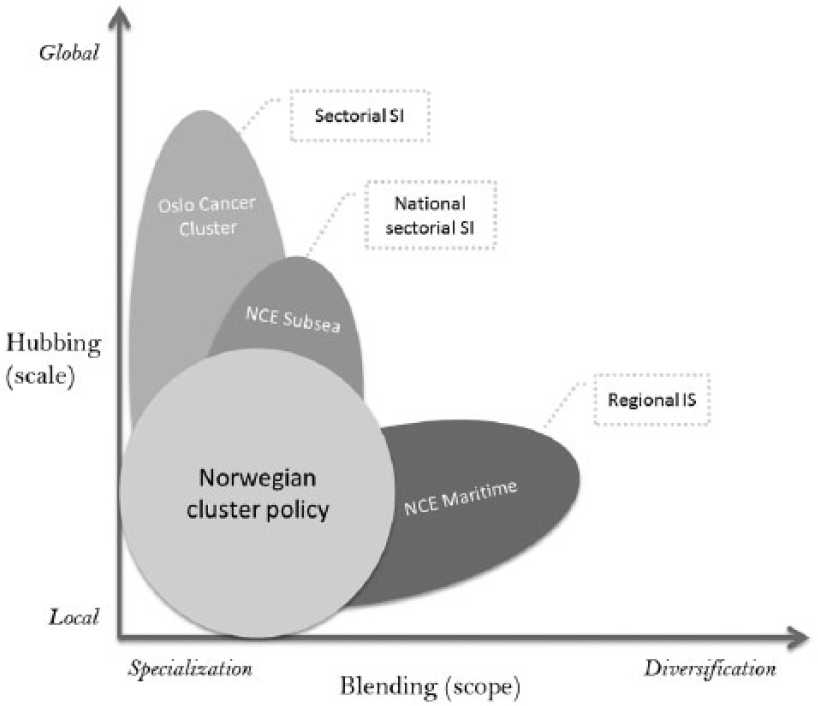
Stretching of the cluster concept.
Concluding discussion: Implications for cluster policy
Our three case studies illustrate how cluster projects, employing different strategies, are stretching, and to some degree altering, our understanding of a cluster. There seems to be a discrepancy between the theoretical understanding of clusters, the understanding of clusters found in national cluster policies and the understandings traced in the different cluster projects. This heterogeneity in the Norwegian cluster discourse corresponds well with observations in other studies. A recent review of a number of cluster programmes in European countries concluded that “cluster policy is multi-dimensional, multi-instrument policy, informed by a mix of rationales. The development of clusters therefore means different things in different places” (Uyarra and Ramlogan, 2012: 35; see also Kiese and Wrobel, 2011). This is in correspondence with a conception of clusters as social constructions, implying that, as noted by Granovetter (1992) and Marston (2000), there is room for the actors involved in its operationalization and practical use to fill the concept with context-specific meaning. Thus, we believe that the haziness of the concept gives cluster stakeholders room for promoting alternative representations of what a cluster should be, that is, informing why this stretching practice is taking place in Norwegian policies. The cluster concept provides different meaning and different opportunities for the actors involved (Fløysand et al., 2012; Kiese and Wrobel, 2011), and our cases illustrate how cluster stakeholders launch strategies that they believe are advantageous for the member firms.
The haziness of the cluster concept, and the implications of this haziness, are not fully considered in cluster policy and cluster programmes. As our investigation shows, the cluster projects address short-term industry challenges. In addition, these projects seem to provide a suitable framework for improving networking and innovation within the participating firms (Furre and Flatnes, 2010; Jakobsen et al., 2012). Cluster programmes in Norway, such as the NCE, are linked to the development of regional, specialized industry agglomerations by stimulating upgrading mechanisms, such as networking and learning (Fløysand et al., 2012; Isaksen, 2009; Sölvell et al., 2003). However, the projects that we selected challenge both Porter’s original academic definition of co-located firms in related industries and the hegemonic definition in Norwegian policy of a cluster as a specialized regional industry agglomeration. The selected projects’ strategies are not necessarily strongly linked to Porter’s ideas about cluster theory but they do bear resemblance to other theories on how to support regional industrial development, for example, RIS and Sectoral Innovation Systems theories. The question is: does it really matter that the actors operate “outside the box” as long as the projects provide financial value?
From a firm or industry perspective, it may not matter at all, but from a policy angle, we believe that several implications merit reflection. The first is justification of the policy. Regarding targeting groups, cluster policy can be placed somewhere between a nationally oriented industry policy that promotes a narrowly defined set of industries, or “national champions”, and a broad regional innovation policy prioritizing the development of regional capabilities and regional institutional thickness (Boekholt and Thuriaux, 1999; Jakobsen and Onsager, 2008; Uyarra and Ramlogan, 2012). The intention of cluster policies borrowing from Porter and others has been to stimulate the competitiveness of geographical concentrations of similar and related firms and associated institutions. It can be argued that OCC and NCE Subsea, with their narrow industry scopes, are closer to a traditional industry policy promoting national champions, insofar as it is used as a rather narrow and isolated policy tool. The complexity of industrial activity highlighted by the RIS literature is, thus, subordinate. It can similarly be argued that NCE Maritime, with its rather broad scope and regional focus, is closer to the regional innovation policy thinking with its attempt to build constellations and constructions facilitating a more complexity-informed understanding of innovation and industrial development. Until now, the justification of Norwegian cluster policy has been that it is a suitable instrument for stimulating competitiveness and innovation among co-located firms. Instead, our selected cases seem to promote development of national industry champions and establishment of efficient RIS. Both objectives are important for a national economy, but whether this should be the intention of national cluster policies needs to be debated. Seen from an academic perspective, an industry-driven policy may lead to path extension rather than encouragement of novel solutions and new development paths (Njøs and Jakobsen, 2016. In other words, it may hamper long-term innovation and value creation. It can also be argued that it is difficult to find an appropriate balance between national and regional innovation policy instruments when cluster projects represent something other than the intention of cluster policies. Moreover, consistency between a programme and its projects is important when it comes to linking policy instruments to the grand challenges of a nation, such as environmental issues, the centre–periphery nexus and the tension between growing and declining regions. Industry-driven cluster initiatives may indeed emphasize “more of the same” rather than stimulating economic renewal.
A second policy implication of stretching is policy evaluation. Development of policy instruments requires an ability to synthesize experiences and results across various initiatives, as well as from related policy instruments. However, there are challenges associated with both how to compare heterogeneous initiatives and the potential benefits of learning between projects when the initiatives are quite disparate and built on differing rationales. It is also difficult to identify best practices when different objectives are sought through different strategies.
A third implication, closely related to the learning issue, is policy support for cluster initiatives. Our selected cases are part of the NCE programme operated by Innovation Norway, a public innovation agency. In order to ensure an efficient programme, there is a need to develop guidelines and practical advice for cluster projects, their operation and how to ensure financial value. Such advice and guidelines should be informed by the rationale upon which the programme is based, in addition to experiences from completed initiatives and other related programmes. When the practice of the actors diverges from the original cluster idea on which the programme was originally built, development of efficient support systems needs to be informed by broader theoretical frameworks, not just cluster theories. As we have shown, guidelines may also be needed on how to develop RIS and how to ensure the establishment of efficient value chains and well-functioning sectoral innovation systems.
Our paper adds to the theoretical debate on industry clusters by illustrating how the cluster concept is being stretched through implementation. Clusters are not static but are social constructs imbued with specific meaning by practitioners in order to achieve their ambitions. The stakeholder’s role in defining the cluster concept has until now been largely overlooked in the literature. We believe that such stretching practice needs to be reflected upon in cluster policy and programmes. Certainly, a strong argument can be made that different regional challenges call for different solutions and, consequently, different cluster strategies (Cooke, 2012b; Tödtling and Trippl, 2005). We also know that cluster projects must be strongly embedded among clustered firms and institutions to achieve legitimacy and to have any meaningful contribution to their development (Fløysand et al., 2012). On the other hand, “unlimited stretching” makes it difficult to justify the policy and to evaluate how it fits with other instruments for innovation at both the regional and national levels. Such stretching also makes it difficult to use cluster policy as an instrument for solving significant problems, such as regional renewal, regional imbalance and environmental issues.
We argue that this conceptual haziness illustrates the need for the development of an innovation policy that does not rely exclusively on the vague concept of “cluster”, and further research should investigate the practical implications of the conceptual stretching on processes of regional development. The struggle to develop joint understandings of clusters in theory and practice has been ongoing for more than 20 years, indicating that it may be more fruitful to look for a wider selection of concepts when seeking to promote regional development and to increase innovation through national policies.
Footnotes
Acknowledgements
We would like to thank the reviewers and the editor for helpful comments that enabled us to improve the paper.
Declaration of Conflicting Interests
The author(s) declared no potential conflicts of interest with respect to the research, authorship, and/or publication of this article.
Funding
The author(s) disclosed receipt of the following financial support for the research, authorship, and/or publication of this article: This work was supported by grants provided by the Research Council of Norway.
1.
At the time of submission of this paper, all three of our cases had NCE status. However, NCE Subsea and NCE Maritime have since been granted GCE status. This necessarily led to changes in the two cluster projects’ strategies. In our empirical investigation, we report on observations of the projects when they were under NCE status.
