



Abstract
Drawing on a framework that integrates discursive practices and relationalism, we explore the relevance of relational ties for the cross-state mobility of naturalised third-country nationals (NTCNs) within the European Union, examining how relational ties facilitate their mobility to the UK. Our data derive from in-depth interviews with NTCNs of West African origin living and working in the UK. Emphasising how co-ethnic diaspora-based networks produce (un)planned cross-state mobility outcomes, we identify five stages in the mobility process: sensemaking of an imperfect structural incorporation in the naturalised country; co-ethnic diaspora conversations; squaring circles; reconnaissance visits; and taking the plunge. Our study reveals how shared collective identities are replicated in transnational networks to inform mobility decisions. Although West African NTCNs may lack the social and cultural capital needed to exploit opportunities in industrialised societies, relationally they are well endowed. The geographically extended relational capital they bring with them, and the access to opportunities this affords, we suggest, helps compensate for deficits in situated social capital and constitutes a primary determinant of success in cross-state mobility.
Keywords
Introduction
Official statistics on European Union (EU) migration suggest that EU citizens have become ever more mobile. The number of EU citizens exercising their right to free movement as promoted by the Schengen Agreement (1985) and Convention (1990) and enshrined in the 1992 Treaty on European Union (TEU) to relocate to another EU country is increasing (Geddes and Scholten, 2016; Herm, 2008). In this regard, the emerging literature on international migration has extended our understanding of the historical and motivational factors driving migration within the EU (Castles, 2004; Kahanec and Zimmermann 2010). In particular, existing research has focused on students, retirees and self-initiated expatriates with the balance of attention directed towards explicating how self-development, work opportunities and lifestyle choices determine EU mobility patterns (Krings et al., 2013; Recchi, 2008). Despite the proliferation of cross-state mobility research, we know relatively little about the mobility patterns of European naturalised third-country nationals (NTCNs) – migrants who live in one country for several years and become naturalised citizens, before relocating to another EU member state (Besson and Utzinger, 2008; Føllesdal, 2000), who have become part of the growing number of ‘free movers’ in the EU. Recent statistics show, for example, that approximately 141,000 people, 7% of those who came to the UK under EU rules, were born outside the EU (Devichand, 2013). Nevertheless, cross-state mobility decision-making can be complex for NTCNs, as it may entail renouncing welfare rights and, at times, better public services to relocate to another EU country (Devichand, 2013). Such risk is magnified by the fact that most NTCNs regularly lack the requisite social and cultural capital to exploit opportunities in other countries. To date, research on European NTCNs has addressed these lacunae by exploring the mentalities and motivations of NTCNs to embark on cross-state mobility. Research has suggested the search for better jobs and self-development opportunities are fundamental drivers of cross-state mobility among NTCNs (Ahrens et al., 2016; Van Liempt, 2011). Yet, such empirical evidence fails to shed light on the processes together with the broader social and cultural dynamics within which NTCNs’ cross-state mobility occurs. We propose that socio-spatial relations in the form of relational ties and shared collective identities replicated in transnational migrant networks inform the cross-state mobility decisions of NTCNs. In this regard, we argue that NTCNs’ geographically extended relational capital substitutes for deficits in their situated social capital to produce serendipitous (un)planned outcomes for their cross-state mobility. At a time when EU migration constitutes an acutely political contentious issue, not just in the UK which at the time of writing is preparing for Brexit, but across a range of EU member states, we contend there is an urgent need for new research to elucidate and articulate the dynamics of NTCN cross-state mobility.
The purpose of this article is therefore to enrich and extend our understanding of the patterns, process and practices of NTCN cross-state mobility. Drawing on a framework that integrates discursive practices and relationalism, we examine this process with regard to NTCNs who resided in one EU member state for a period, acquiring naturalised citizenship, after which they moved to another state. Specifically, we focus on NTCNs of West African origin that relocated from EU member states to the UK, to whose stories we give prominence within our analysis of their cross-state mobility.
We aim to contribute to the literature on NTCNs in the following ways. While prior research has examined why NTCNs move to other countries within the EU (Ahrens et al., 2016; Devichand, 2013; Van Liempt, 2011), this paper draws on relationality and practice theory to explore the how of NTCNs’ cross-state mobility decisions within the relational and practice realm of meaning (Schatzki et al., 2001). Prior theorising and empirical studies regarding cross-state mobility seldom assume a relational perspective. Employing an explorative qualitative research approach, our paper challenges categories and assumptions of official narratives on cross-state mobility by opening up new possibilities for rethinking the influence of kinship and relational networks on the mobility decisions of the EU’s West African citizens. Thus, in illuminating the broader socio-cultural dynamics of NTCN mobility within the context of the EU, our paper provides an opportunity to deepen our understanding as to how the practices that form the nexus of cross-state mobility can be interpreted within cross-state mobility discourse.
The paper is structured as follows. Firstly, we provide a brief review of cross-state mobility of NTCNs. Secondly, we delineate a relational and practice approach to NTCN cross-state mobility. This is followed by an overview of our research context and methodology. We then present our research findings in the penultimate section followed by discussion of our findings and conclusions.
Cross-state mobility of migrants
Globalisation and upward mobility trends have triggered the contemporary turn to transnationalism in analysing the wider social, historical and intellectual contexts within which people, particularly from relatively poor countries, migrate to richer nations (Balibar, 2009; Pettigrew, 1998). Characterised by particularism and nuances, recent theorising on transnational migration has tended to focus on the mobility experiences, patterns, forms and trajectories of precarious migrants (Alberti, 2014; Gilmartin and Migge, 2015), low-capital migrants (Kothari, 2008) and high-capital self-initiated expatriates (Doherty, 2013). Regularly overlooked from this analysis are those migrants who constitute onward migrants – individuals who leave their country of origin, settle in a second, EU country for a period of time, then migrate on to a third EU country (Collyer and Haas, 2010). As Devichand (2013: 1) candidly puts it: What if we were told that thousands of people from Africa we’ve seen arriving here are not, in fact, fleeing poverty at all? Or that, legally speaking, they’re not even Africans, but rather nationals of such generous welfare utopias as Sweden, Denmark and Holland?
Recasting how low-capital migrants may realise their preferred destination, Paul (2011) developed a multi-stage model to show how such migrants work their way up a hierarchy of destination countries, accumulating the necessary capital in the process to enable them to finally gain entry to their destination of choice. At the other end of the spectrum are those migrants who, for varying reasons, remain in their first country of destination, seeking to garner the capital they require to integrate and settle there for the foreseeable future, and who may never consider migrating to another country. Fulfilling various prerequisites of integration (e.g. language, residence requirements, fees and administrative discretion), they go on to achieve citizenship (Besson and Utzinger, 2008; Dronkers and Vink, 2012). Generally, NTCNs have equal rights to other citizens, regardless of where they were born or why they were eligible for nationality (Fannin, 2010; Kelly and Hedman, 2016). However, their overall structural incorporation, in terms of access to jobs, education, political participation and socio-cultural integration, often remains below levels enjoyed by indigenous citizens (Ahrens et al., 2016; Itzigsohn and Saucedo, 2002).
In the context of the EU, which provides unrestricted mobility between its member states, many NTCNs have become onward migrants, relocating from their naturalised home countries to other EU states (Lindley and Van Hear, 2007). In addition, differences in integration policies among EU member states mean that free movement within the EU enables many NTCNs to complete certain aspects of their integration process (e.g. education) in a second member state (Kraal and Vertovec, 2017). This new pattern of migration has sparked scholarly interest into the nature and dynamics of NTCNs’ mobility (Bauböck, 2011; King and Ruiz-Gelices, 2003; Lindley and Van Hear, 2007). Nevertheless, while empirical work exploring the agency, motivations and mentalities of NTCNs’ mobility is beginning to gain traction (Giralt, 2016; Joshi and Deb, 2015; Kelly and Hedman, 2016; Van Liempt, 2011), research on the micro-practices and mobility processes enacted by NTCNs to facilitate their moves within and between EU states remains sparse. We extend this line of research by examining the cross-state mobility practices of West African NTCNs into the UK.
Our conceptualisation of NTCNs’ cross-state mobility draws on a practice-relational approach, grounded in an existential ontology of being in relations with others (Chia and Holt, 2006; Emirbayer, 1997; Tsekeris, 2010). Departing from a narrow focus on the ‘why’ to the ‘how’ of cross-state mobility, our practice-relational approach offers a pragmatic alternative interpretive lens to understand how socio-spatial relations between people, places and the actions they take within the contingency of mobility acquire shape and form. Two main advantages of using a practice-relational approach apply for the purpose of our inquiry. Firstly, practices as a nexus of activities provide insight into how people discursively and reflexively account for their actions across specific moments of enactment. Secondly, our emphasis on relations allows us to account for the performativity of mobility and the socio-spatial relations within which mobility is constituted as a ‘relationally embedded human activity’ (Tsekeris, 2010: 140). In the following section, we present our practice-relational approach to specify its logics that guide our empirical inquiry.
A practice-relational perspective on naturalised third-country national cross-state mobility
We turn to a practice-relational approach to provide insight into the broader socio-cultural dynamics within which NTCNs embark on cross-state mobility and make sense of their own actions and behaviours in their mobility processes (Sandberg and Tsoukas, 2011). Schatzki (1996: 89) describes a ‘practice’ as ‘a temporally unfolding and spatially dispersed nexus of doings and sayings’ that permeates everyday social life and its evolutions. Ordered across space and time with individuals as ‘carriers’ (Reckwitz, 2002), a practice from this perspective may be viewed as the active integration and linkage of various activities and tasks, including materials, meanings and forms of competence (Hargreaves, 2011; Warde, 2005).
Providing empirical articulation of how practices, as delineated by Schatzki (1996), may temporally unfold in a given context, Shove et al. (2012) outline three salient dimensions of practices that shape the entwined nexus of activities contributing to the spatial, dynamic and temporal features of a social practice: namely materials, meaning and competence, which constitutively serve as a unified analytical starting-point for theorising a practice. Materials refer to tangible and intangible things, including materials, technologies, infrastructure and, in our case, epistemic objects – those that are ‘always in the process of being materially defined’ (Knorr-Cetina, 2001: 184), which may include EU passports, laws and regulations. Meanings constitute the social and symbolic significance of participation consisting of aspirations, emotions, ideas and motivations that allow meanings to materialise to inform and constrain identity and action. Competence refers to embodied competences, projects, intelligibility, techniques, knowhow and tasks across ‘time-space’ (Schatzki, 2010). Practices represent the outcome of the performative linkages between the three elements (Shove et al., 2004). In our case, we argue that the linkages emphasise ‘intentionality’ and its reproduction, driving the activities that contribute to the stable features of NTCN mobility that we conceive as comprised of bundles of practices.
While Shove et al.’s (2004) conceptualisation serves as the analytical starting-point to our practice approach to mobility, at the core of our perspective is the priority we accord to relationality and social ontology. Thus, on the assumption that relations are ‘congealed’ in everyday social life (Hamera, 2006), and also that these are fundamental to notions of kinship, community and identity, as articulated by Bauman (2000), we shift attention away from the individual or set of individuals to their social relationships, interactions and situated activities that come together to define their social life (Cheng and Sculli, 2001). In this regard, we place emphasis on ‘the patterned consistency of actions emerging from such interactions rather than on the micro-activities of individual agents’ (Chia and MacKay, 2007: 24), or what Somers (1998: 67) describes as ‘the relational processes of interaction between and among identities’. Such a relational ontology allows us to examine how the structural incorporation of our set of individuals, their interpersonal ties and interaction with EU institutional rules come together to shape a set of mobility practices whose spatial and temporal reach remains complex and under-researched in migration discourse. Drawing on the work of Bauman (2004: 24), who explores the notion of identity and community in modern society, particularly amongst refugees, such a relational ontology emphasises the need for and processes of identification, which become ‘ever more important for the individuals desperately seeking a “we” to which they may bid for access’. We argue that the mobility decisions of NTCNs are embedded in a nexus of social relations, and that shared collective identities, in the context of migration, are frequently reproduced in transnational networks to inform migrants’ mobility decisions (Leblanc, 2002). Contributing to the wider debate on emerging EU migration patterns, and the movement of unskilled migrants in particular, we argue that migrants’ relational networks, their interdependent relationships and interactions with kin have a salient influence on their onward mobility decisions.
While the inward migration of low-skilled migrants dominates national politics in various EU member states, research on the processes of migrant mobility is sparse. In particular, what increasingly requires elucidation in the new patterns of intra-European migration is how migrants’ mobility decisions come to be interpreted, labelled and judged within EU migration discourse. Our objective in this study therefore is to explore NTCNs’ mobility decision processes in the context of a Europe that, following the TEU, Schengen and related legislation, is near-borderless, yet where the end of free movement of people is now being openly challenged in various countries, some of which have reinforced their national borders in view of the ongoing refugee crisis. The main research question driving this study is, therefore, how does the mobility of NTCNs within the EU link to their relations and shared collective identities? In the following section, we chart an overview of our empirical research context.
Empirical research context
We developed our contribution in the context of the EU where the TEU bestows EU citizenship on persons holding nationality of any EU member state. This citizenship allows EU passport holders to move freely, study, work and settle in EU member states as they see fit. Our empirical research context was the UK, which at the time of writing remains an EU member state notwithstanding ongoing Brexit negotiations. Our choice of the UK was based on the premise that it offers a particularly rich context to study and theorise about Europeans invoking their EU citizenship rights obtained in another member state and, further, that it has welcomed over the years large numbers of West African migrants, originating from such countries as Ghana, Nigeria and Senegal. The EU’s policy of unrestricted labour mobility has intensified European migration into the UK, as the country remains relatively resilient compared to the largest Eurozone economies in terms of growth and unemployment (Lynn, 2016). Moreover, having English, the universal language of public discourse and commerce as its native tongue (Julios, 2012), the UK has become a melting-pot for migrant cosmopolitanism. It is also a country that, following the Brexit vote, is acutely conscious of inward migration, with government promises to restrict annual immigration levels to the ‘tens of thousands’ being repeatedly broken (Guardian, 2017). Despite the political attention accorded to this issue, the discourse rarely mentions that inward migration into the UK includes NTCNs who have in fact gained EU citizenship in another member state, in part because data on the granting of citizenship are normally deeply hidden beneath published statistics on UK migrant stock. Figure 1 shows the number of EU nationals applying for a British National Insurance (NI) number, a unique code comprised of letters and numbers allocated to individual workers. Possession of a NI number is crucial, since it enables access to the British social security system and is intended to ensure tax and NI contributions are properly recorded against workers’ names.
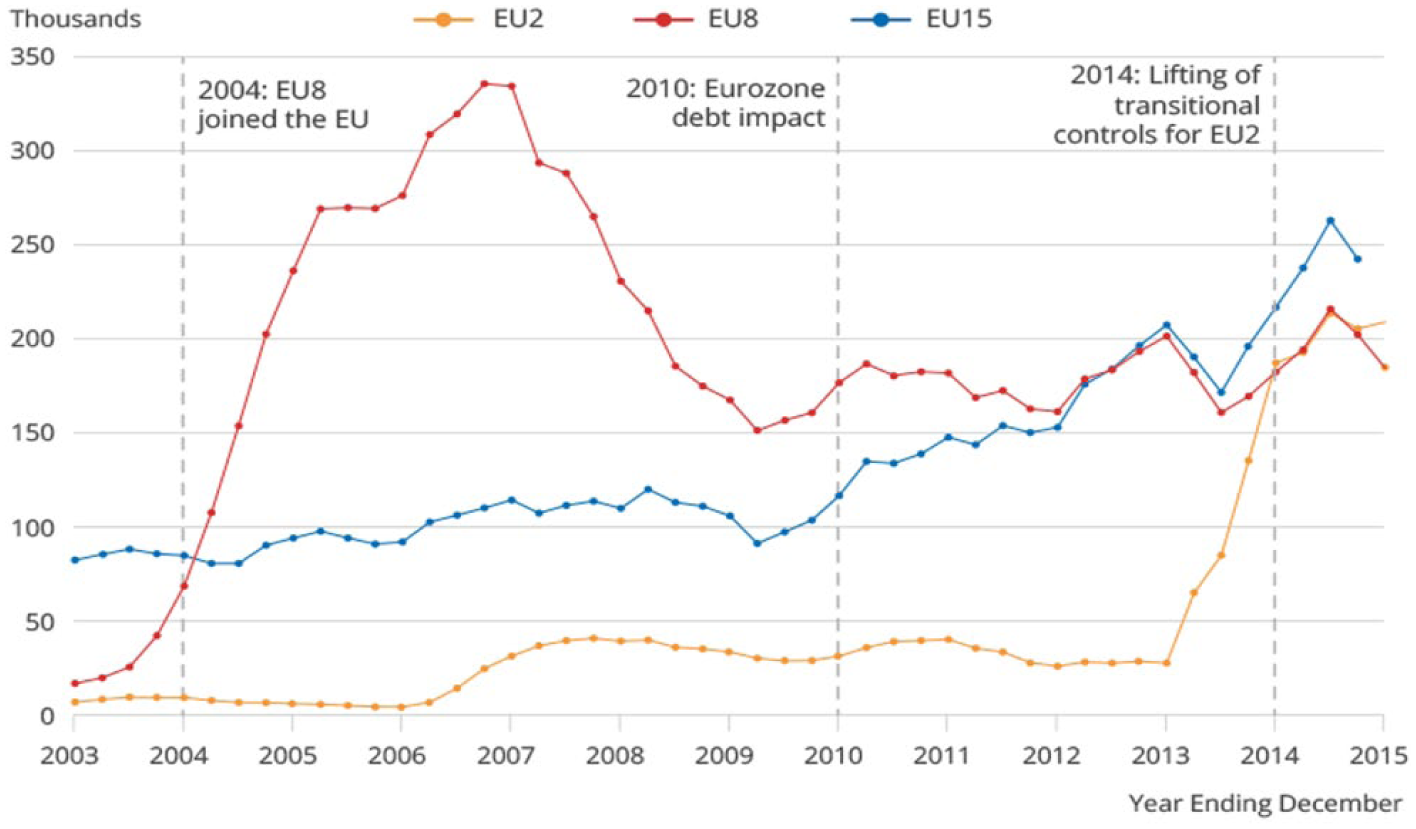
Overview of National Insurance number registrations data for European Union (EU) citizens, from year ending December 2003 to year ending December 2015.
The Organisation for Economic Co-operation and Development (OECD) observes that migrants across Europe have poorer employment prospects in their naturalised countries (OECD/European Union, 2015). The NTCN share as reported by the Migration Observatory fell from 9% in 2005 to 6% in 2007, before rising again to 9% (264,000) in 2015 (Migration Observatory, 2015). Using place of birth as an organising device, Table 1 provides an overview of the number of onward European migrants residing in the UK.
Onward migrants residing in the UK according to the 2011 census.
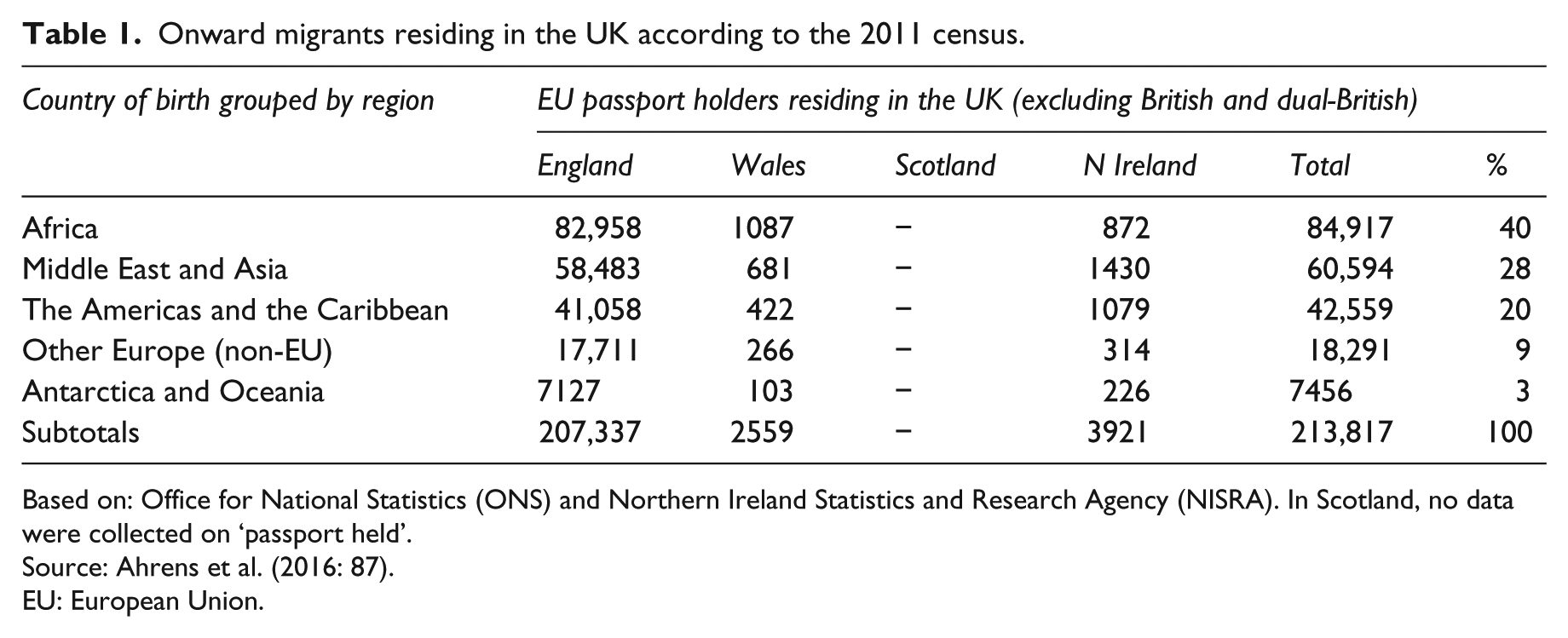
Based on: Office for National Statistics (ONS) and Northern Ireland Statistics and Research Agency (NISRA). In Scotland, no data were collected on ‘passport held’.
Source: Ahrens et al. (2016: 87).
EU: European Union.
Extending beyond the arithmetic on the flow and stock of EU migrants in the UK, we know very little about how these onward migrants come to relocate to the country. Since 40% of onward migrants residing in the UK were born in Africa, we chose, as mentioned, to study the mobility practices of NTCNs from the sub-Saharan geographic region of West Africa, since migrants from this region have come to represent a growing and distinct minority group living in urban areas in advanced industrialised societies (Kothari, 2008; Riccio, 2008). Most importantly, our West African NTCNs represent an ethnically diverse yet specific group of NTCNs who are rarely studied as a singular and defined category, even though they share a common or similar ancestry, socio-historical background and a comradeship and solidarity often reproduced in their transnational communities in the developed world (Cross, 2009; Nwanko, 2005; Sarpong and Maclean, 2015). In what follows, we explain the research methodology that guided our empirical inquiry.
Methodology
Given that we seek to interpret the social life-worlds of NTCNs, we adopted an exploratory qualitative research approach to advance insight into their onward migration within the EU. We conducted our study in Bristol, the largest city in the South West of the UK with a population of 449,300. Like other British cities, Bristol is diverse, with 16% (69,200) of its population belonging to a black or minority ethnic group (Bristol City Council, 2015). In 2016, Bristol elected the first Black Mayor of a major European city (Bristol City Council, 2016). In our effort to reach African-European migrants, we first negotiated access with a local employment agency that prided itself on having a diverse workforce on its books, specialising in temporary and permanent recruitment in multiple sectors. We then devised three purposeful sampling criteria (Patton, 2002), which the agency used to identify potential participants for the study. Firstly, participants needed to be first-generation West African migrants holding an EU (not a UK) passport. Secondly, they needed to be living and working in the Greater Bristol area. Thirdly, they should be employed in non-professional capacities where their skills and accumulated career capital could not account for their self-initiated expatriation and international mobility (Altman and Baruch, 2013). The agency identified around 60 people who had registered with them and met our sampling criteria. About 42 of these potential participants were contacted and asked whether they wished to take part in our study. Only 14 of them agreed to do so, confirmed a date when they were available for interview, and agreed that the agency could share their contact details with us. In addition, we managed to enrol six further participants through referrals and snowballing (Groenewald, 2004). In all, the 20 individuals who participated in the study originally came from the following countries: Cameroon, Ghana, Nigeria, Senegal and Sierra Leone, and were mainly male (n = 16). Aged between 23 and 50, the average age of our participants was 39.5 with 70% (14) educated up to college level in their third countries. Together, they reported an average of 12 years living in their naturalised countries, followed by approximately 6 years residing in the UK. We present a summary of the socio-demographic particulars of our interviewees in Table 2.
Summary of interviewee socio-demographic information.

Practices are often subsumed within a culture at a tacit, taken-for-granted level (Schatzki et al., 2001). We therefore chose to utilise retrospective NTCN accounts of their relocation to the UK to develop our understanding of their experiences. Data for the study came from in-depth interviews conducted over a six-month period, the majority of which lasted approximately 1.5 hours, and all of which were digitally recorded. Commencing with assurances of confidentiality and the collection of basic socio-demographic information, we then invited interviewees to relate the story of their migration from Africa, their life in their ‘home’ EU countries and their subsequent mobility journeys to the UK. The interviews were an iterative process as we learned more about participants’ mobility stories. They were transcribed verbatim within 24 hours of collection, and interviewees accorded pseudonyms to preserve confidentiality. Before transcribing the interviews into readable formats, we listened carefully to the audiotapes several times to help us recall retrospectively some of the episodes of emotional attachments and body language presented by participants during the interview. This reflective retrospective exercise helped us to develop additional ‘field notes’ that enabled us to better understand our participants, while engaging in what Nicolini (2009) terms a ‘zooming in-zooming out’ approach to understand in context the seemingly unique individual mobility journeys of our research participants.
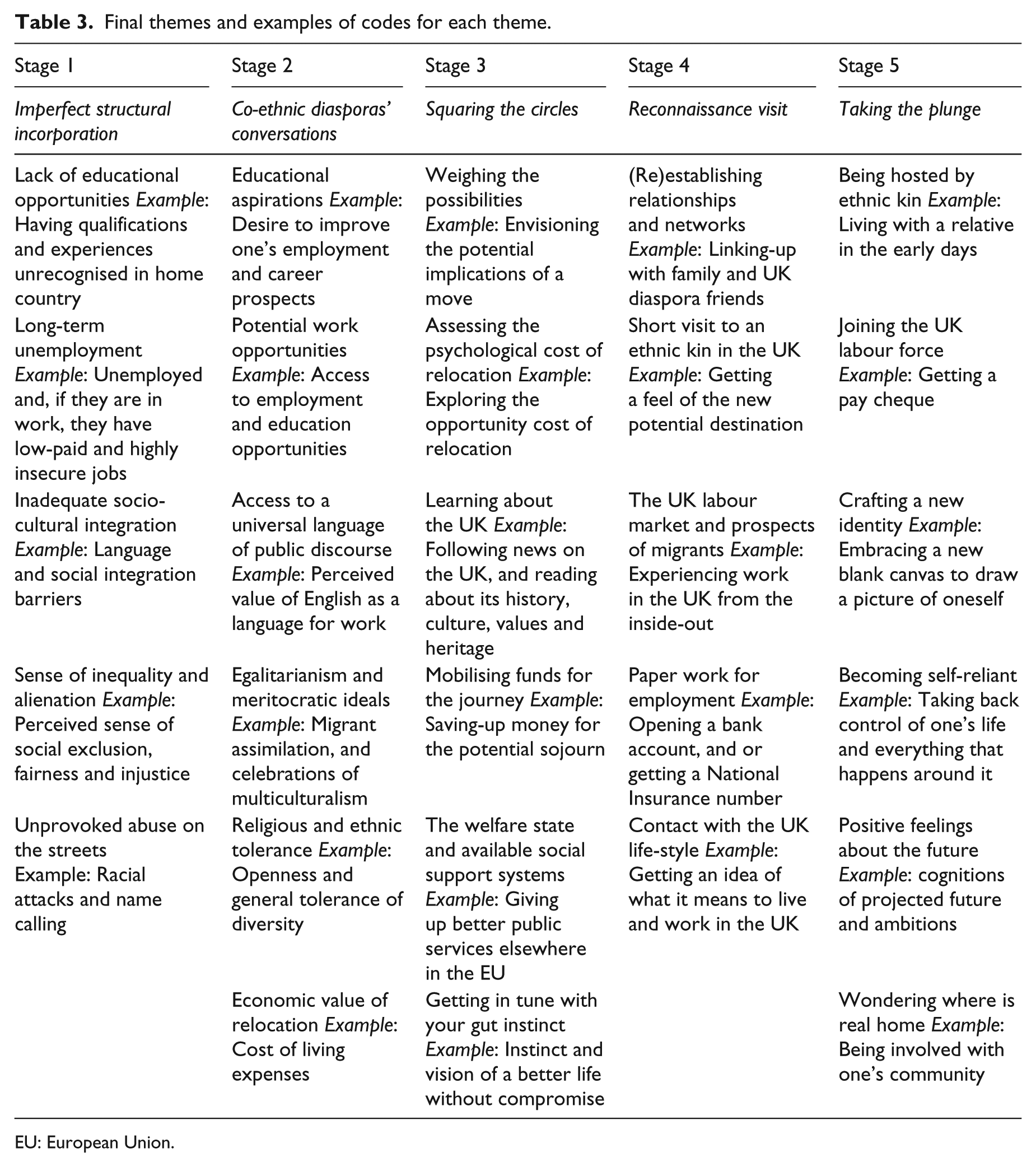
The full data analysis followed three steps. Firstly, following our practice-relational theoretical perspective, the initial textual analysis focused on mapping the ‘doings’ and ‘sayings’ of interviewees onto the three practice dimensions of materials, meanings and competence, as identified by Shove et al. (2004), which served as our basic social processes (BSPs) (Glazer, 1996). We did this by engaging in an iterative line-by-line coding of our data to ensure the relevance of our BSP. Secondly, we engaged in temporal bracketing of the narratives (Langley, 1999) to identify why our research participants chose to relocate to the UK, how they came to reach that decision and how it unfolded within the flow of their mobility events. This led to a broad array of segments that were further categorised based on their similarities and analytical connections. Thirdly, drawing on theoretical insights from the extant literature, the identified segments were interpreted iteratively to develop preliminary second-order codes. These overarching themes were then sorted, reconstituted and indexed (Miles et al., 2013) to generate the following analytical categories: sensemaking of imperfect structural incorporation; co-ethnic diaspora conversations; squaring the circles; reconnaissance visits; and taking the plunge, to explore viable theoretical explanations of our NTCNs’ mobility journeys.
Before presenting the fine details of our findings, we wish to reflect on the limitations of our methodological design. Firstly, given our sampling strategy, we only considered the immigration and integration histories of West African migrants. Other groups of migrants hailing from different geographic regions might have had a different experience (Joppke, 2007). There is thus a risk of conflating diverse NTCN experiences under the homogenous umbrella of ‘NTCN mobility’ without accounting for what Tapia and Alberti (2019) term ‘migrant intersectionalities’, the multiple differences between individual categories of migrant. Secondly, while we carefully formulated our interview questions to invite participants to tell their own stories, we are unable to rule out the potential impact of egocentric biases, memory loss or embellishment in our respondents’ retrospective accounts (Lyle, 2003; Smith et al., 1999).
Five stages in naturalised third-country national cross-state mobility
In our effort to develop an explanatory theory that sheds light on NTCNs’ experiences of relocating to another EU country, we draw on the tripartite scheme of ‘practice’ as developed by Shove et al. (2012) to delineate a loosely structured analytical framework showing how the mobility process of NTCNs may come to be labelled and judged within cross-state mobility discourse.
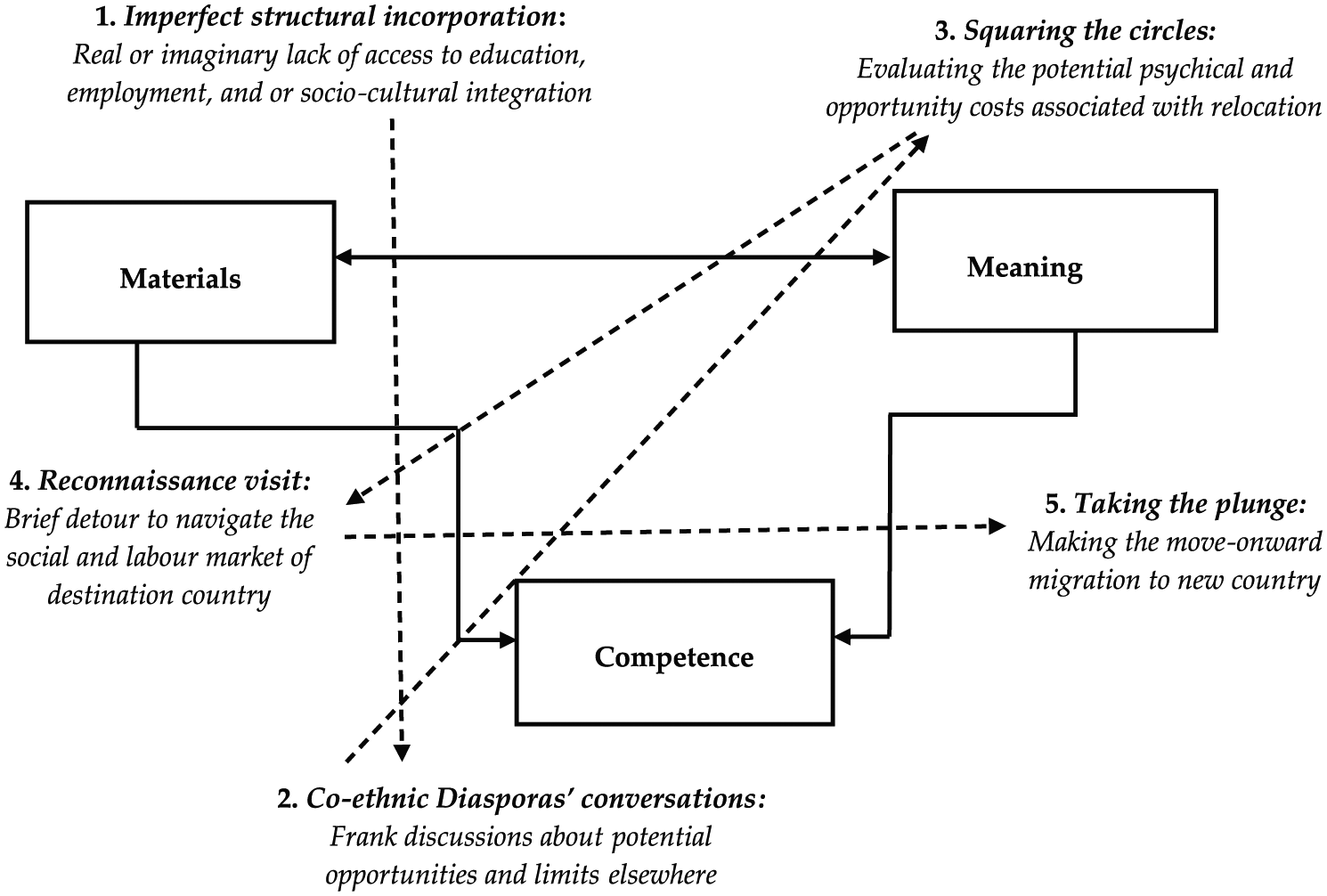
Visualising naturalised third-country national relocation.
While our NTCN mobility reductive scheme (as shown in Table 3) is linear in directionality, we recognise that the mobility process is dynamic and recursive in practice. We now present the fine details of our findings.
Final themes and examples of codes for each theme.
EU: European Union.
Stage I: Making sense of imperfect structural incorporation
Compared to native citizens, the strains of migrants’ settlement and assimilation in the ‘cultural crossroads’ occasioned by mobility (Bauman, 2004: 14) often lead to their imperfect structural incorporation (in terms of their access to education, political participation and employment) and inadequate socio-cultural integration (feelings of belonging, language proficiency, lack of social networks) in their destination countries (Ahrens et al., 2016; Van Liempt, 2011). This imperfect structural incorporation in the everyday lives of our NTCNs, we observe, manifests itself in the form of limited social mobility, long-term unemployment, lack of access to education and training and a general lack of social capital needed to tap into opportunities in industrialised societies. In typical sensemaking fashion (Weick, 2009), our NTCNs turned their imperfect structural liability outcomes and equivocal situations in their naturalised home countries into comprehensible narratives to justify, and legitimise, their move to the UK. Sensemaking in this way helped our NTCNs to rationalise and interpret their circumstances (Weick, 2011) and then construct a narrative that served in turn as a springboard to action (Maclean et al., 2012; Weick et al., 2005). The issue of social mobility became more pronounced whenever those interviewees who were also parents alluded to their aspirations for their offspring as a fundamental reason for relocating. Ophelia, for example, specified that she wanted her children to have better opportunities in life than she had experienced: I asked my husband, do we have examples of children who have stayed in Italy and completed their education and were working in the public service? I realized there were none, so moving to the UK, we thought, could improve the life-chances of our children. (Ophelia)
Ophelia’s children are Italian by birth. However, taking into account other migrants’ experiences, her interpretation of her own imperfect incorporation made her realise that her children were likely to face limited opportunities to achieve their potential, prompting her to reach the conclusion that they would enjoy better prospects elsewhere, outside Italy. Here, it is the dynamic forces of aspiration, as argued by Mische (2009), in the form of ‘hope’ that drive people and undergird their cognitions of brighter futures for their children. Our data evidence also suggests that lack of jobs, career and educational opportunities in our NTCNs’ naturalised countries forced them to rethink their stay. From this perspective, a third of our participants identified the 2008 financial crisis as the single most important event that precipitated their decision to relocate to the UK. As Barack highlights: The economy was simply bad. There are no jobs in Spain. Even the native Spaniards are moving out in droves. If I had a job in Spain, I wouldn’t have left the place. (Barack)
Here, Barack laments the dire state of the job market in Spain, especially for non-native jobseekers. While the absence of employment was a major catalyst that galvanised participants’ urge to move on, the general sense of an inadequate socio-cultural integration coupled with a perceived lack of opportunities featured prominently in the narratives of most interviewees. Farouk summed this up as follows: I could not communicate well and integrate well into the community, so that was the first reason for coming here. Secondly, I wanted to get an education to better myself. I thought England offered the best chance for me to progress because of the language. (Farouk)
Farouk proceeded to argue that while continental Europe may behave generously towards migrants in granting them leave to remain, many employers did not see migrants through ‘the eyes of compassion’ if they could not speak the native language fluently. This meant that he struggled to find a ‘decent’ job, and had little chance of securing the higher education he craved. While the literature suggests that migrants who speak their destination countries’ language are more likely to succeed, the situation, we found, was often no better for those who managed to master the native tongue: I schooled there so I speak Dutch fluently. But you know what? There is a problem about the Netherlands if you didn’t grow up there as a child. You will experience subtle segregation in your social life. They call you ‘allochtonen’… You may get a job but you have no chance of climbing the organizational ladder. (Paulina)
Paulina’s is an interesting case in point. While she claims to be fluent in Dutch, a sign of integration in her naturalised home country, as a ‘migrant’ she is dubbed an ‘allochtone’ – a derogatory label used in Dutch ethnicity discourse to describe minorities as social-benefit ‘scroungers’, unwilling to assimilate, or with cultural values incompatible with Western ways of life (Van Laer and Janssens, 2017). Being identified as a first-generation ‘allochtone’, she interprets, has frustrated her desire for social mobility within the Dutch system.
In general, while almost all our interviewees previously accepted their imperfect structural incorporation and integration problems as ‘normal’ migrant challenges, they expected their lives to improve on naturalisation. In this case, their new identities as citizens possessing equal rights to the ‘indigenous’ population made them experience their structural incorporation challenges more acutely (Weber and Glynn, 2006). To make better sense of their circumstances, NTCNs may begin actively to explore with their co-ethnic diaspora kin at home and abroad ways of potentially overcoming their challenges.
Stage II: Co-ethnic diaspora conversations
This stage of NTCNs’ mobility journeys involves verbal interactions with co-ethnic diaspora kin that transcend information exchange to focus in time on dissatisfaction with their imperfect incorporation in their naturalised states, and their desire to seek a better life elsewhere. Such conversations provided our NTCNs with a first-hand opportunity to share, learn and reflect on potential opportunities and limits in their naturalised states and other EU countries. The case of Noah is instructive. He was contemplating asking his family to join him in Germany, but was concerned about language and integration barriers. His sister who lives in the UK convinced him that his children would do better there: I was encouraged by my sister to come to the UK. It wasn’t on my radar, you know? So, let’s say my sister persuaded me to move here. I wasn’t thinking about going anywhere or leaving Germany because I was somehow settled in there. (Noah)
Co-ethnic diaspora conversations on mobility tend to focus on real or perceived access to employment and educational opportunities in the naturalised state vis-à-vis the targeted state. These conversations among diaspora kin help build honest, open and shared understanding of the situation and create the foundations for NTCNs to reflect on their decisions and consider alternative actions within a given frame of reference, or an entirely new frame of reference. Ricky, who had been struggling to find a ‘decent’ job in Amsterdam due to his limited language ability, thought moving to the UK where he would have access to a universal language of public discourse (Julios, 2012) might enhance his chances of capitalising on his skills. Feeling unsure, he corroborated with acquaintances to confirm: I had some guys from my region living in the UK. I asked questions, found out how the system works, I could find out how the education system works here, and I got some information from them. They said that if I could pop round, they could accommodate me and assist me to get a NI and get a job. (Ricky)
Similarly, Stevo, who had been unemployed for six months in Spain, heard on the news that the UK economy was prospering. He looked out the contact details of a friend who had moved to the UK several years previously to ascertain whether it was worth jumping ship: My friend in Spain came to the UK in 2007, before the global economic crisis. I lost contact with him so I had to travel to Tenerife to find his cousin to get his contact [details]. I spoke to him about my joblessness and he said it will be good to move here because there were jobs here that it won’t be as bad as Spain. (Stevo)
Like Ricky and Stevo, most participants while sharing their visions to improve their lives with acquaintances gained some insight into potential job opportunities and general life in the UK. Such conversations also helped our NTCNs to develop their understanding of how to engage with the whole mobility process. While not grounded in empirical facts, Reynolds, for example, argued that what he heard about multiculturalism, religious tolerance and equal opportunities in the UK drove his socially constructed realities about the country closer to the ‘truth’.
You know London is like Lagos, there are Nigerians all over the place, so I contacted a couple of Londoner friends I lived with back in Nigeria and told them I wanted to come to UK. They even told me it was easy to even get higher education there. (Reynolds)
Encouraging stories about the UK’s openness and tolerance of diversity, coupled with friends and acquaintances offering to play host until they found their feet, convinced most participants to make the move: I had two close friends in London. We were friends back in Nigeria and they have been here for a long time, so when I was thinking of leaving Belgium I contacted them, and one of them promised to accommodate me if I came to UK. (Stanley)
Our case evidence suggests that kin support, particularly the possibility of being offered temporary accommodation by a friend or an acquaintance, is a salient factor that helps keep co-ethnic diaspora conversations on mobility purposeful. As Bauman (2004: 50) observes: ‘To dare and take risks, to have the courage that choice-making requires’ demands trust in oneself, but also in relationships with others to inspire belief that ‘trust in socially made choices is well placed’. The mutual obligation to host friends and acquaintances, we were informed by our research participants, is deeply embedded in African culture.
Stage III: Squaring the circles
Following the co-ethnic diaspora conversations, our NTCNs entered a qualitatively different stage involving acts of connecting, or what Weick (2016) refers to as ‘interim struggles’, as they reflected on what they had heard, ‘squared the circles’ and ‘joined the dots’ about the potentialities and limits related to their proposed mobility. This particular stage in the mobility process assumes significance when the individual begins to envision the potential implications of the move for their immediate families and finances, and the threat of losing their friends and social benefits in their naturalised countries. Most respondents agreed that this stage in the transition process was like ‘walking on eggshells’. They were effectively ‘optimistic martyrs’ taking a gamble on their own lives. In this sense, they spent a considerable amount of time mulling over the move, and deliberating the potential consequences of their decision: It was not easy because I had to leave everything I had, I had to leave my apartment, basically leave everything behind. It was not easy, but I knew I had to take my destiny into my own hands. (Habib)
As argued by Sluzki (1992), in addition to the disruption to an individual’s social network support, his or her emotional needs are likely to increase during relocation. This was the case for Paulina, a single mother, confronted with the difficult decision of leaving her children behind to relocate to the UK.
I tell you, it was difficult, very difficult. Leaving friends, your home and going into the unknown once again. It was a trying period, as a lone woman raising my kids. I had to leave my children with my mum for the time being. It was emotionally challenging. Sometimes, you have to dig in and think of your kids. I had to put my emotions aside and make up my mind. (Paulina)
Paulina’s emotional stress was exacerbated by the need to save money for a move she could not empirically confirm was worth the effort. At the other end of the continuum, our data suggests that those respondents with limited family commitments who experienced long-term unemployment in their naturalised countries spent little time contemplating the potential consequences of their proposed mobility, being seemingly propelled by blind faith, instinct and a vision of a better life without compromise: I heard so many stories from people, so I did a little bit of research on England, and came to understand I could get help from the government to integrate into the community. (Farouk) No, it was really not a difficult a decision because things got rough. I was not working but I still had bills to pay. So, why will you die in a place when you can move on to another place to make ends meet? (Marcus)
Reflecting the proverb ‘nothing ventured, nothing gained’, Farouk and Marcus claimed they spent little time reflecting on the consequences of their proposed sojourn. Both argued the stories they heard about the success of non-white people coupled with their basic research on British post-colonial migration made them believe they would definitely be accommodated by the system. Most participants stated that while they were quite optimistic about a better life in Britain, the psychological and financial cost of mobility made them cautious and wary of making the move. The primary risk, they claimed, related to losing their welfare rights in their naturalised countries if they relocated. If things did not work out as expected, they argued, they were going to struggle to get back on the welfare ‘treadmill’. In their efforts to prevent that happening, the path travelled by most respondents was to make a quick visit to the UK to ascertain for themselves whether the ‘positive stories’ they heard about the UK tallied with realities on the ground.
Stage IV: Reconnaissance visit
To satisfy themselves that they were indeed making the right decision, our NTCNs embarked on what we call a ‘reconnaissance visit’ to the UK. This ‘holiday visit’, which often lasted a week or two, was undertaken to purposefully get a feel for life in the UK, and possibly complete a full evaluation of the psychological and economic costs associated with mobility. Immediately prior to the planned visit, our participants sought to (re)establish relationships and networks with families, friends and acquaintances in the UK, in order to position themselves within a network of possibilities to facilitate their mission. As Jason explains: I visited one of my friends who lives in London and told him my job and family problems. He advised that I relocate to start fresh in the UK. Anyway, I went back and made up my mind to come to London. (Jason)
Jason, a carpenter in Ireland, had struggled to find employment following the 2008 economic meltdown. Around the same time, he divorced and lost his home. Given this disruption, he explained, his visit was intended to ascertain for himself the available short-term support he could obtain from his friend and the state to ease his transition to living and working in the UK. For Noah, the visit prior to his move was designed to enable him to experience the British lifestyle directly and acquire a more nuanced appreciation of the country before committing to relocating: I wasn’t very sure I was making the right decision, so I decided to visit my uncle who lived in the UK to see things for myself. My impression was that the UK was a very laid-back country, very liberal and a very open society. What I didn’t like about it was the chaos. It was very, very disorganized. The streets are not tidy and people just litter; it didn’t happen in Germany. But, I felt comfortable – it was an open country, very relaxed and had a huge migrant community. (Noah)
Noah deplored the UK’s litter habit relative to German orderliness. However, apart from the ‘ungentrified urban neighbourhoods’ that Noah lamented, he recounted that noticing migrants in professional occupations, coupled with a visit to his uncle’s workplace and a local football match, encouraged him to relocate to the UK. While Germany’s Chancellor, Angela Merkel, has welcomed migrants with open arms, some parts of the country, especially the former Länder of East Germany, which prior to German reunification had not experienced immigration, have proved less welcoming (Maclean et al., 2017). Notably, none of our interviewees had considered relocating to the EU member states of Eastern Europe, all being attracted by the more affluent West. As proof of identity and right to work remain probably the most important resources required to access employment opportunities in the UK, some of our respondents, with their European passports at hand, used the opportunity to apply for a NI number or register with local employment agencies. The case of Dennis is illustrative: I was taken to a job agency to register on the very day I landed. After registration, they asked me whether I was ready to work that day. I found myself on a night shift in a bread factory on the same day. I got a bank account the next day. That was awesome! (Dennis)
For Dennis, while the focal act of his visit was to help him bridge his ‘perceptual based knowing to categorical based knowing’ (Weick, 2009), obtaining a job so easily strengthened his resolve to make the final move. As inferred from our participants’ narratives, they seem collectively to construct and maintain a widely shared belief that getting a feel for life in the UK via their initial visits not only enriched their decision-making about relocating, but also enhanced their transitional understanding and interpretation of the opportunities the UK could afford them and their families. The final stage of the mobility process occurred when our NTCNs packed their bags to make a ‘journey of no return’.
Stage V: Taking the plunge
We refer to the final phase of our NTCNs’ mobility as ‘taking the plunge’. Encouraged by favourable impressions gleaned during reconnaissance visits, our NTCNs at this stage made their final move to the UK. Rather than renting accommodation, most participants on entering the UK chose to live with a relative or friend while they found their feet: I had somewhere to perch for free. To open a bank account, they needed a reference; it wasn’t easy until a bank advised me to call HMRC, to request data from them that had my cousin’s address on it before my account was opened. (Marcus)
Even those who could not embark on a reconnaissance visit because they had no relations in the UK still managed to find other UK-based migrants to host them without cost. Their hosts helped them find work and sometimes supported them financially until they became self-reliant or received their first pay cheque. This applied to Dennis, who claimed he had enough savings to rent a flat in the UK, but who decided to reside instead with a distant relative he barely knew: When I decided to move to the UK, I looked for Cameroonians on Facebook living in Bristol. I found this lady [Monica]. She was kind to host me for a week so I could sort myself out. (Dennis)
The temporary ‘free’ accommodation frequently offered by relatives often lasted two to six months. These arrangements, we found, characterise the life-worlds and sense of cohesion among West Africans frequently reproduced in transnational networks (Leblanc, 2002). This sense of cohesion provided our NTCNs with a similarity of approach and support, and affirmed their determination to settle in the UK. Having found a job and their own accommodation, those who left their families in their naturalised countries urged them to join them immediately: You know, I left my family back in Amsterdam. They joined me after three months. By then, I had my own place, and a job. The little boy got a place in the local school too. We began everything afresh. (Ricky)
We interpret Ricky’s take on his family’s ‘beginning afresh’ as embracing a new blank canvas to paint a picture of himself and his family as he resumed control of his life and encountered potential opportunities. An emerging thread running through the actions and doings of most participants at this final stage is their subjective prioritising of practices often aimed at crafting a new self-identity. Such new identities may entail joining local clubs and church parishes, where they make friends, socialise and become involved in their communities.
Discussion and conclusion
In this paper, we have analysed the dynamic processes of NTCN mobility to another European country, specifically the UK. We drew on a framework that integrates discursive practices and relationalism to construct a new theoretical framework to analyse the processes involved in NTCNs’ mobility. Our practice-relational theoretical formulation of cross-state mobility directs attention to this important yet relatively underexplored phenomenon, while also providing a 360-degree perspective to unpack NTCNs’ mobility dynamics in practice. Emphasising how taken-for-granted co-ethnic diaspora-based networks produce (un)planned mobility outcomes, we identify five stages in the mobility process: sensemaking of imperfect structural incorporation in the naturalised country; co-ethnic diaspora conversations; squaring the circles; reconnaissance visits; and taking the plunge. This casts new light on how the complex web of practices enacted within the context of co-ethnic relationships and interdependencies among NTCNs come to be reproduced and socially appropriated in the context of intra-European mobility. Our study, therefore, shows that extended interpersonal relational networks in the form of personalised bonds of attachment, such as family, relatives, friends, colleagues or hometown fellows, reflecting culturally mediated dispositions, provide the context for sensemaking within which NTCN mobility plays out (Weick, 2009). Our framework builds on Shove et al.’s (2004) ‘circuit of practice’ in an attempt to visually explicate and summarise the pragmatic stages of NTCN inter-state mobility as it unfolds in practice. It demonstrates that the potentially real or imaginary inadequate structural incorporation of our NTCNs in their ‘home’ countries frequently sparks the idea of relocating to another country (Ahrens et al., 2016). Our NTCNs’ orientation to relational ‘others’ and interactions with their ethnic kin help them prepare for ‘lift-off’. Relational interdependencies between individuals and their kinship networks provide NTCNs with the necessary capital for ‘upswing’ in the form of personal support required to successfully negotiate inter-state mobility. In this respect, although NTCNs of West African origin may generally lack the social and cultural capital needed to exploit opportunities in industrialised societies, relationally they are well endowed. Bauman (2000) observes that communities have never been so sought after as they are now that they are hard to find, in a shifting world where nothing is certain. In an increasingly individualised and atomised Western society, where many of the traditional support structures of social cohesion have fallen apart, such relations function as metaphorical ‘life-jackets or lifeboats’ for West African migrants (Bauman, 2004: 91). Randall (1987: 460) identifies ‘belongingness as the ultimate need of the individual’. The relational capital these migrants bring with them and the access to communities and hence possibilities that this unlocks in their destination country represent, we suggest, one of the primary reasons for subsequent success in mobility, enhancing their chances of a successful integration in their chosen country.
Our research makes several contributions to the literature on cross-state mobility and a conceptual contribution to the development of practice theory. Firstly, it provides a theoretical basis for studying mobility patterns of individuals within the EU with an emphasis on low-skilled migrants, as a logical extension of NTCN research conducted at the macro level. In this regard, our argument draws on existing research on the cross-state mobility of NTCNs (Ahrens et al., 2016; Devichand, 2013) to facilitate theorisation pertaining to the socio-cultural dimensions of cross-state mobility within the EU, particularly with respect to West African migrants. While extant research concentrates on NTCN group categories, including demographics, employment rates and ethnicity, our study turns the spotlight on the linkages between relational ties and practices in context that shape diasporic networks and cultural allegiances negotiated in highly localised ways to aid their cross-state mobility. Secondly, our study contributes to the ‘contingency and meaningfulness of spatial movement’ (Rogaly, 2015: 529), providing useful insight into the transient movement of NTCNs, how they interpret their own mobility and how they build their lives around storylines related to their mobility, rather than mere vignettes of the transitory nature of EU nationals exercising their right to free movement. Thirdly, and most importantly, we show that the NTCN disposition to rely on kin, as evinced by their desire to draw on their immediate networks of extended family, friends and acquaintances, derives not only from their shared cultural heritage but also from their status as non-elite cosmopolitans inhabiting marginal, interstitial spaces with limited social capital (Kothari, 2008). The corollary of this limited social capital, we found, is richness in geographically extended relational capital that helps to compensate for the former. Even in cases where initially interviewees had few or seemingly tangential contacts, these relational ties proved powerful in terms of the reciprocal obligation they engendered. This is a powerful antidote to ‘a world of fleeting chances and frail securities’ (Bauman, 2004: 27). It is in this regard that we make our original contribution. In explicating how people act in the context of cross-state mobility, our empirical findings contribute to the development of practice theory by showing how situated practices deconstructed into ‘several elements, interconnected to one another’ (Reckwitz, 2002; Schatzki, 1996), can facilitate theorisation about the influence of temporal socio-spatial relations on routinised behaviours. The seemingly mundane nature of these practices means that they are likely to be disregarded as unimportant. We identify, articulate and unpack them here because we think they conceal important truths, highlighting key patterns in the human stories behind NTCN migration, about which little is known.
Our study has implications for managing cross-state mobility within the EU. Firstly, our perspective draws attention to the mobility processes of European NTCNs, showing that these are not merely triggered by the unique European project that facilitates free movement of labour, but also how social ties, kinship and relationality converge to organise the meaning and mobility strategies of low-skilled, low-paid migrant workers in general. While prior research on NTCNs focuses on the reasons and motivations for their onward migration (e.g. Ahrens et al., 2016; Paul, 2011; Van Liempt, 2011), our study draws on the narratives of NTCNs to illuminate the realities of low-skilled NTCN mobility among West African migrants and how the social processes of mobility are embodied in lived experience and kinship networks, all of which is encompassed within EU institutional arrangements for the free movement of labour.
In this way, our study has implications for policy-makers in the UK and EU. While attention in the run-up to the Brexit vote was very much focused on inward migration to the UK, those amongst headline figures who were NTCNs were largely overlooked and, hence, ‘invisible’. This implies, at one extreme, the effective decentralisation of UK immigration to the other 27 member states, each of which has eligibility criteria for admitting non-EU migrants into the EU. We have shown, however, that NTCNs have well-developed strategies for ‘moving’ to the UK from other EU countries where they have already acquired citizenship, because the attraction of the UK may outshine that of other, ostensibly more ‘migrant-friendly’ states (like Germany, according to Noah), and because their naturalised citizenship of their original destination gives them the right to do so. At the time of writing, the UK government appears undecided regarding levels of EU migration (of which this represents a hidden form) post-Brexit or during the transitionary period. Our work therefore confirms the need for further attention to be accorded to a ‘politics of mobility’, as argued by Cresswell (2010), at UK and EU levels that takes account of ‘openness, movement and flight’ while acknowledging the legitimate ‘pulls towards settledness and even closure in the context of the social construction of the identity of place and of the rich ambiguities of “genealogical identities”’ (Massey, 2005: 173).
Emphasising the nuances and similarities in the cross-state mobility stories of our NTCNs at a time when migration to Britain is increasingly being challenged, our work may serve as a starting-point to deepen understanding of seemingly circumstantial NTCN cross-state mobility practices among West African migrants in order to fully characterise their antecedents and processes, and the consequences of NTCNs’ dispositions and relationality on their (im)mobility within the EU.
While our study has generated insights into the cross-state mobility of West African NTCNs within the EU, it is neither exhaustive nor without limitations, which in turn creates fresh opportunities for further research. Firstly, our findings are limited by the socio-historical conditions and cultural specificity of the group of NTCNs we studied. While our theory building is grounded in an endogenous understanding and interpretation of NTCN cross-state mobility, we encourage similar studies on other groups of NTCNs, for example, Chinese and Indians, to ascertain whether additional insights and findings can be observed or generated. Secondly, our model, which draws on a practice-relational perspective, rests on Shove et al.’s (2004) unified practice framework, which may be too rigid for a fully comprehensive expression of the transformational, complex and sometimes contradictory social practices bound up with transnational mobility. A more expansive set of potential elements comprising cross-state mobility may be needed fully to unpack the transformational scaffolding of mobility in ways that reflect emerging tensions characteristic of contemporary transnational mobility.
Opportunities for further theorising include how NTCNs negotiate their non-work identities, such as family and nationality at work (Ramarajan and Reid, 2013), following their relocation to other EU states. In an era when intra-European cross-state mobility for work purposes has come under intense scrutiny, future research could examine how NTCNs interpret and respond to different sorts of social and organisational debates on EU migration, increasingly fuelled by myths rather than evidence. Like geographically mobile employees (Hippler, 2010), future research could explore in detail the cross-state mobility outcomes for NTCNs. In particular, their satisfaction with the post-mobility environment and perception of change between their pre- and post-mobility environments may help us better understand why NTCNs may ‘vote with their feet’ when it comes to cross-state mobility.
Footnotes
Declaration of Conflicting Interests
The author(s) declared no potential conflicts of interest with respect to the research, authorship, and/or publication of this article.
Funding
The author(s) received no financial support for the research, authorship, and/or publication of this article.
