



Abstract
Real estate development is an intensely social process dependent on rich networks of relations between public and private sector actors. Previous work has explored how far such relations are formalised in large cities through shared coalitions of interest intended to promote urban growth. Relatively little attention has been given to networks in smaller cities, which is the concern of this paper. Drawing on detailed research in a small Scottish city, the paper explores how its local network was characterised by strong reliance on network construction and reproduction through trust and reputation. Significantly, within such local networks, competition and collaboration can exist side by side, without subsuming normal tensions into consistent agendas or formally defined ‘partnerships’. Controlling land for urban expansion provides a particular focus for these tensions, since it can allow certain interests to gain network dominance. These findings raise important concerns around whether small cities should rely on informal networks to promote growth instead of constructing formal coalitions that may attract more externally based actors. Such choices have profound implications for the capacity and transparency of development networks, and thus for the accountability of the urban development process.
Keywords
Introduction
This paper explores how real estate development is organised in small cities and its implications for urban growth and democratic accountability. It is widely believed that such development is not driven solely by market exchange, still less by policy command, but is a highly socialised form of production, in which the complex web of relations between many different actors is crucial to explaining outcomes. The word ‘network’ is often deployed to describe this form of production, with the implication that in different cities and at different times, particular forms of local network will emerge that have profound impacts on the way those cities change over time.
It is perhaps surprising that, despite strong theoretical foundations, relatively few attempts have been made to understand how local development networks actually operate. Research has concentrated on the broader contribution of networks to growth coalitions and urban regimes, especially in larger cities, but there has been little published on the extent to which the structure and organisation of such networks in different cities open up or close down opportunities for development itself. This paper is intended to redress this imbalance through a detailed investigation of the particular network that appears to have characterised one small city in Scotland in recent years. Its key purpose is to uncover some of the distinctive characteristics of small city networks and the extent to which they may be prone to informality, exclusivity and dominance by a narrow set of local interests. By exploring how network management (Klijn et al., 2010) creates a specific set of development outcomes, this paper offers new insights on how network structures and relationships at a small city level can help explain whether or not individual projects are delivered, the extent to which public and private sectors share common agendas and the implications of these for accountability and good governance.
Here, we agree with Bell and Jayne’s (2009: 683) assertion that ‘small cities have been ignored by urban theorists who, in seeking to conceptualize broad urban agendas and depict generalizable models… have tended to obscure as much as they illuminate’. While some scholars have deployed quantitative analyses to compare the economic performance or potential of small cities against medium-sized or larger ones (see, for example, Erickcek and McKinney, 2006; Rubin, 1986), there has been remarkably little previous investigative work into network dynamics at a small city level. We seek to fill that gap and challenge the presumption that what may be known about development networks in major cities can be readily transferred to smaller places.
Two specific dimensions of scale, which generated our interest in small cities, are especially worthy of close investigation. Firstly, actors with significant resources may be better placed to dominate development networks in smaller cities than in much larger ones. So, in this paper, we investigate the relationship between city size, network structure and any consequent potential for the most powerful local interests to capture development networks in small cities and deploy them to their own advantage.
Secondly, such networks may be less formal, and indeed less obvious, in smaller than in larger cities. This is often because the key actors are already well-known to each other, having built longstanding relations of trust through established business and social connections. Although informal networks in small cities can be difficult to investigate, it is important to do so since the evidence we report in this paper raises worrying concerns around exclusivity, fragility and democratic accountability that derive directly from their very informality. We therefore concur with Bell and Jayne (2009) who, in arguing that smallness cannot be understood merely by reference to population size, density or growth, call for research that ‘pursue(s) an understanding of the ways in which smallness is bound up with particular ways of acting, self-images, structures of feeling, senses of place, aspirations and so on’ (Bell and Jayne, 2009: 690). Our work thus focuses on the issue of urban scale, and the domains in which real estate development, and the networks that support it, might be considered distinctive in small cities.
In developing specific research questions, we chose to reflect the approach of Eva Sørensen and Jacob Torfing (2005, 2009), who have created a substantial body of research over several years exploring how urban governance networks operate in practice, the extent to which such networks variously contribute to or detract from the democratic nature of policy development and how networks need to be managed to secure the best possible outcomes from them.
Specifically, we draw on three key themes emerging from the literature to construct the analytical framework through which to interrogate the research data. The first theme around network governance focused our interest on exploring evidence of tension in our case study city between public and private sector interests and considering its implications for the city. The second theme around network dynamics made us interested in dispositions of power within the local informal network and in the broader consequences of this for urban growth. The third theme of network inclusion and exclusion made us want to identify those actors at the core of the local informal network and those at the edge, and to investigate exactly how such selectivity was achieved and what its implications were for the future of the city. We expressed this analytical framework as three central research questions through which we connected our interrogation of the research data to the key themes from the literature.
To what extent does the way in which local development networks in small cities operate reflect an unresolved tension between the business interests of their most powerful members and what might be considered the shared interests of the city as a whole?
How vulnerable are local development networks in small cities to capture by their most powerful members and how far does this constrain a city’s ability to grow?
How far does the reliance of small city local development networks on informal connectivity, trust and personal reputation exclude certain actors who might have a significant contribution to make to city development?
The paper now proceeds as follows. In the second section, we review the literature from which the three research questions are drawn. The research method is explained in the third section, while the fourth section outlines the main development challenges faced by the chosen city – Inverness – over the past 25 years. Drawing on planning records that detail exactly who was at the forefront of building Inverness between 1997 and 2013, and on our own rich interview material, the fifth, sixth and seventh sections then provide a detailed empirical investigation of the three research questions. The closeness of key actors revealed by this account raises broader concerns over transparency and accountability in a small city’s network, which are discussed in the final section.
The concept of development networks
Development actors and modes of governance
Real estate development is widely regarded as an intensely social process, in which relations between key actors are crucial to successful negotiation. Although developers are often portrayed as near-theatrical impresarios who co-ordinate and drive development forward (Fainstein, 1994), their effectiveness will depend on linkages with other key actors, such as landowners, funders, investors and knowledgeable professionals and, of course, the local state. In the latter context, day-to-day contact with planners, transport engineers and other local officials can be as important as high-level connectivity to senior politicians. The concept of local development networks embraces all these actors, as well as the local media, trade associations and so on. Crucially, the actual composition of particular networks will vary significantly over time and space and can be ascertained only by empirical investigation.
The significance of local networks reflects the complexity of putting together individual development projects and long-term strategies for a city or region (Kostiainen, 2002). Such endeavours require a mode of governance that can promote effective co-ordination between many different actors. In this context, markets seek to co-ordinate social and economic life through the price mechanism and hierarchies try to do so through authority, while networks work primarily through trust and collaboration (Bradach and Eccles, 1989). This means that the delivery of real estate development now depends on ‘decision-making processes (that) take place within complex networks of actors’, with the capacity of local political leaders and institutions crucial to success (Klijn et al., 2010: 1063).
Network collaboration and structures for real estate development
Local development networks evolve from what Henneberry and Parris (2013: 231) describe as ‘episodic project collaboration’. Such networks often grow and mature experientially as successful collaboration on particular projects generates ‘swift trust’, promoting subsequent actor co-operation. Henneberry and Parris (2013) identify a two-layered ecology that explains network relationships behind projects. The inner ‘organisational’ layer consists of the core development team driving the project forward, operating within the firm(s) that employs that team and marshalling resources to deliver a portfolio of projects. Both of these are surrounded by the project’s ‘epistemic community’ or variety of external professional specialists called upon to solve particular tasks. Even if the core team and firm(s) remain unchanged from one project to another, the epistemic community is usually reconfigured for each project.
Beyond this inner organisation layer can be found an outer ‘social layer’ reflecting the looser ‘personal networks’, both professional and private, of all involved in the inner organisational layer. As Lawton Smith and Romeo (2012) note when studying business and professional networks in Oxfordshire, there can be both ‘formal’ networks, which normally have officers, fees and regular meetings, and looser or more ‘informal’ networks of relationships that strengthen social or business ties and that may well emerge out of more formal relationships. Crucially, as well as providing lasting support, ‘it is through these networks that reputations are brought into focus and trust is instilled’ (Henneberry and Parris, 2013: 233). It is important to know whether this process operates differently in networks characterised more by informality, such as those we can expect to find more often in smaller cities.
Network interests and tensions
Much of the literature on broader growth coalitions and urban regimes presumes that city governments and local business elites share a common agenda constructed around urban growth and local economic development. Almost always, real estate actors are portrayed as operating at the core of formal networks, often supported by the local media, universities and business interests. We should not necessarily expect such a broad array of interests to coalesce in informal networks operating in smaller cities. Whereas the early concept of growth coalitions saw these interests coming together as independent participants acting autonomously (Logan and Molotch, 2007; Molotch, 1976), 25-years’ work in urban regime theory since Stone’s (1989) seminal exploration of Atlanta has provided a more nuanced explanation. Different situational variables reflecting the local (political) culture of each city influence the ways in which the urban resource base is shared, organised and mobilised, such that a distinctive ‘urban political order’ might be achieved to pursue development objectives (Stone, 2015).
Whilst urban regime analysis mostly derives from US work, it remains an important lens through which to conceptualise urban development in Europe precisely because it highlights a fact that is often neglected in the network governance literature — that, in reality, the agendas and participants of governance networks can be very different in different places and that this can lead to different types of socioeconomic outcomes. (Blanco, 2013: 276)
Here, the Finnish experience reported by Kostiainen (2002) reveals how motives for participation in informal local networks vary according to distinctive local conditions. For example, not all network members are equally committed to, or indeed excited about, the prospects for urban and regional development since, ‘[i]t is not the primary aim of all network members to develop an urban region as such; some of them want to reach their own goals by means of the network’ (Kostiainen, 2002: 615).
Put crudely, some network members might be more interested in protecting or enhancing their own business interests than in promoting local economic growth as a whole. It is important to know whether smaller places, and especially those characterised by more informal networks, are more prone to such conflicts of interest. When present, they can influence local business attitudes towards the overall pace and direction of development, the extent to which it requires local capacity to be strengthened by externally sourced skills and finance and any expectations around local leadership.
Network dynamics, capture and domination
Much recent research on the operation of urban policy networks has embraced ideas of uncertainty and shifting dynamics in networks, most notably the range of theoretical and empirical work undertaken in the name of ‘assemblage’ studies. Whereas networks were once commonly thought of as ‘“flat” organisational forms that are characterised by informal relationships between essentially equal agents or social agencies’ (Heywood, 2000: 19), McFarlane and Anderson (2011: 162) identify a common concern in assemblage work in analysing the ‘play between stability and change, order and disruption’ in explaining how urban policy networks operate.
McCann and Ward (2012: 42) openly seek to ‘encourage both an attention to the composite and relational character of policies and cities and also to the various social practices that gather, or draw together, diverse elements of the world into relatively stable and coherent “things”’ through assemblage approaches. Since development networks are often said to be dominated by short-term business interests, the relationships between key actors can change quickly according to market conditions and commercial opportunity.
If ‘cities can be understood as assemblages of materials and resources, knowledge and understandings’ (McCann and Ward, 2012: 43), then unpacking the nature of the trade-offs between different components of local networks becomes crucial to understanding their practical operation. Networks provide an effective means to share intelligence and gain tacit knowledge. For example, a recent study of UK housebuilders revealed the importance they place on networks, not markets, to source their land supplies and shows how companies exploit networks to enhance their own competitiveness (Adams et al., 2012). Crucially, developers preferred to be well embedded in particular places because their operational efficiency requires place-specific knowledge and close connectivity with local professionals and decision-makers (Charney, 2007; Henneberry and Parris, 2013). Does enthusiastic participation in local development networks confer an added advantage in smaller places, simply because of the closer connectivity between key actors?
Network inclusion and exclusion
Network relations are highly dependent on trust and reputation, reflecting how deeply economic and political life is embedded in social relations. According to Cabral (2005), reputation is about whether we believe a particular actor to be something, while trust is about whether we expect that actor to do something. The very imperfection of markets makes trust essential in business relations since, as Gössling (2004: 675) argues, ‘In a perfect market, actors do not have to trust each other. Information is perfect and costless, contracts are complete, and enforcement of contracts is costless in the sense that it is not related to any transaction costs’. Trust can provide a more effective way to cope with market imperfections than reliance on contracts, guarantees, insurances and safeguards. As Macaulay (1963: 58) originally argued, ‘businessmen often prefer to rely on “a man’s word” in a brief letter, a handshake, or “common honesty and decency”- even where the transaction involves exposure to serious risks.’
However, reliance on trust and reputation rather than formal contracts does carry significant risk. Indeed, trust is always matched by vulnerability since irrespective of how far trust ‘alleviates the fear that one’s exchange partner will act opportunistically . . . the risk of opportunism must be present for trust to operate’ (Bradach and Eccles, 1989: 104). At least at a personal level, trust thus depends on relative proximity to the person to be trusted (Brien, 1998), together with knowledge of their likely motivations (Hardin, 2006) and capabilities (Larson, 1992). This is why Granovetter (1985) stresses personal experience rather than general information about a prospective business partner. Although he highlights the advantages produced by connectivity into the widest set of networks, Granovetter (1992) also argues that reputations experienced first-hand will be more reliable than those observed at a distance. This is even more relevant in smaller cities, where first-hand contact, at least within the city, is likely to be the business norm.
Close internal connectivity and reliability can thus be portrayed as a potential strength of local development networks and a clear expression of the ‘social capital’ that has become highly pervasive within the literature. For example, in places where local and regional developers have a substantial market share, dominant companies may see significant advantage in leading local development networks and turning them to their own advantage. However, such closeness also gives rise to significant concern around who might be excluded, implicitly or explicitly, from important networks and why, and about the broader implications of this. If actors with legitimate interests are excluded, it undermines network accountability and legitimacy. Some local networks, for example, may be very inward-looking and serve to discourage fresh talent and enterprise, whether individual or corporate. Others may operate as an ‘old-boys club’, attracting only those of a certain gender, social status or political outlook. Others still may reinforce rather than span the public–private divide, accentuating barriers between businesses and local council (Adams et al., 2012). Picking up Bell and Jayne’s (2009) earlier comment that smallness is bound up with particular ways of acting, the extent to which small city networks may be especially prone to such exclusivity is an important matter for empirical investigation. We now turn to explain how we researched these issues in one small city in the north of Scotland and to set out what we found.
Research approach and methods
Empirical context
The research was undertaken in Inverness, Scotland, using the city as a single case study. A case study method was considered appropriate to generate the kind of rich in-depth material required to address the research questions. The research was seen as exploratory, opening up the field for further investigation and generating ideas and propositions that might extend the existing literature and be subsequently tested elsewhere. The case study combined qualitative and quantitative data and proceeded in three stages, as set out below, once ethical approval had been granted.
The first stage of the research interrogated the electronic web-based database of all planning applications submitted to Highland Council (HC), which is the local administrative authority for Inverness. This concentrated on proposals for major change in Inverness, and not on small-scale applications. This search was thus limited to major planning applications submitted in the Inverness area during a period of almost 17 years from January 1997 to November 2013. 1 In total, 646 separate major planning applications were identified during the 17-year research horizon (see Figure 1). For each application, information was collected on the name and contact details of both the applicant and, where given, the agent who submitted the proposal on the applicant’s behalf (usually an architect, surveyor or other development consultant). From this information, we produced detailed frequency tables on who exactly has built Inverness in recent years.
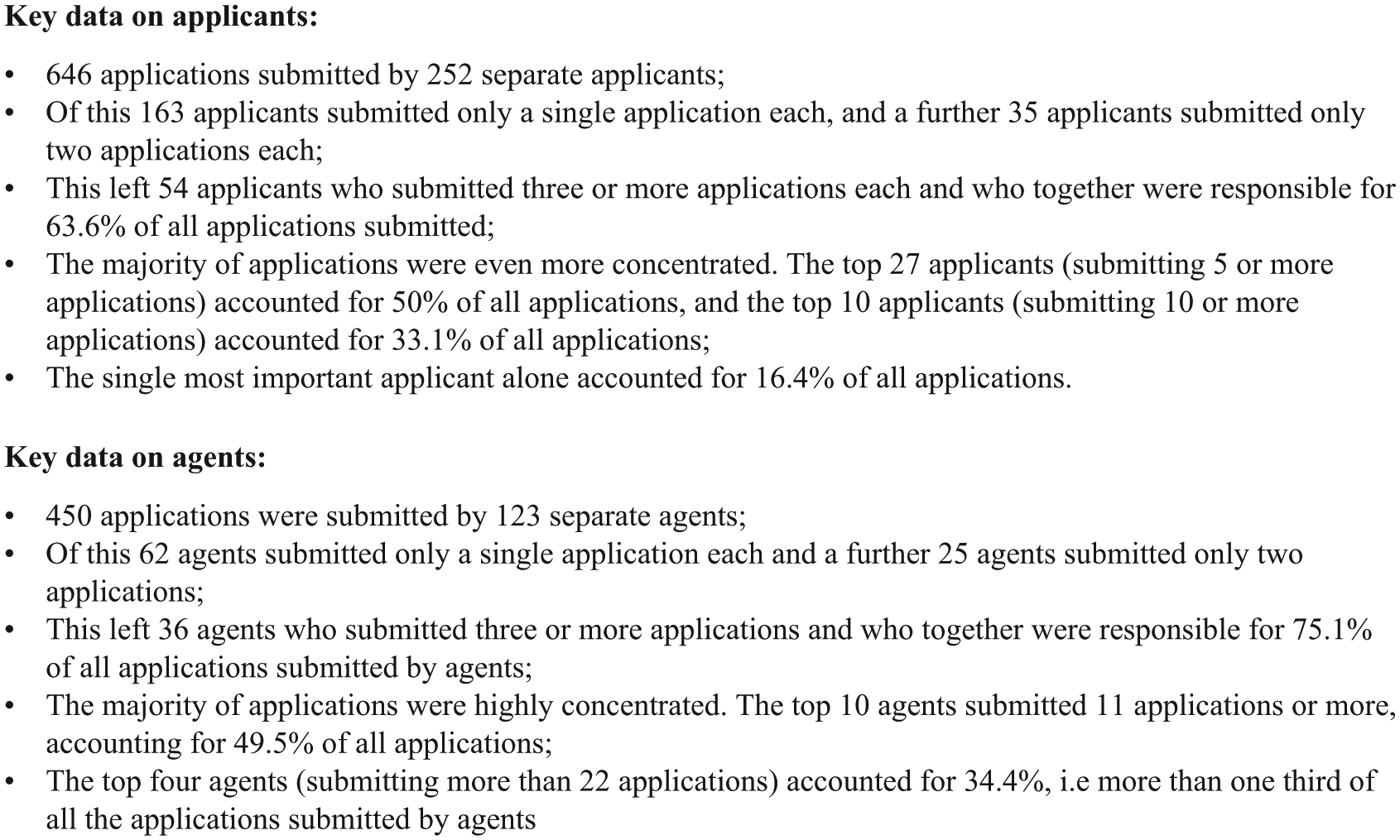
Key data on development applicants and agents in Inverness.
The second stage involved in-depth interviews with 13 key development actors. Initially, approaches were made to the top 10 applicants and the top 10 agents drawn from the frequency tables. Five of the top 10 applicants approached accepted the invitation for interview, and these included private sector companies and housing associations, as well as HC itself, two of whose senior officials were interviewed separately. Although the response rate was only 50%, it should be noted that two of the top 10 applicants in the 1997–2013 period were no longer in business. Four of the top 10 agents accepted the invitation for interview. Of these, three were architectural practices, while the fourth was a general building consultancy. Again, two of the top 10 agents in the 1997–2013 period were no longer in business.
Three further interviews were undertaken as a result of ‘snowballing’ out from the initial interviews, one with another architect and two others with representatives of Highlands and Islands Enterprise (HIE), the Scottish Government’s economic development agency for the area. All interviews were conducted with senior and experienced staff and followed a loosely structured topic guide. Most took place face-to-face, but on one occasion, the interview was undertaken by telephone. All interviews were recorded and transcribed and then analysed thematically to generate the material on which this paper is based.
The final stage of the research involved a detailed search of official planning documentation and other archival material to cross-check and extend the interview information. This was particularly helpful in setting the interview material in a broader context and discovering linkages between key players not necessarily mentioned during the interviews.
Inverness – A rapidly expanding small city
Similar in many respects to other small cities on the north-western periphery of Europe, such as Esbjerg, Galway, Gåvle and Kristiansand, Inverness is an urban centre of 67,000 people forming the core of a functional urban region of 150,000 people. As the northernmost UK city, Inverness provides administrative and other high-level urban functions for an extremely wide rural hinterland. It is the administrative seat of HC, the UK’s largest local government area, covering a territory the size of Belgium. Its sheer distance from other major centres of population makes Inverness relatively self-contained in terms of its settlement structure, travel to work area and so on. In this respect, it contrasts with other small UK cities, such as York, whose economy is becoming increasingly integrated with its much larger neighbour, Leeds (Brown, 2008).
However, given the extent of its regional functions, Inverness has a much more elevated position in the wider Scottish settlement hierarchy than its size would suggest: Inverness is only the 17th largest settlement in Scotland, 2 but is one of the seven formally recognised cities due to its functional importance. Consequently, we do not therefore presume that our findings will necessarily transfer to other small cities, which will have their own distinctive positions in their location and functional hierarchies. Indeed, analysis of particular local development networks must allow for variation in the way that the size and location of their host cities may interact to frame specific network characteristics.
In many respects, Inverness has been widely regarded as a ‘policy success’, with population growth of 17% between 2001 and 2011 (HIE, 2014). Its economic development strategy over the last 30 years reflects those of many European cities: continued investment in transport and latterly information and communication technology (ICT) infrastructure, improvement of the public realm in the city centre, public sector support for business development concentrated on high-value sectors, such as healthcare and life sciences, promotion of tourism to bring spending into the local economy and expansion of retailing and the creative arts. Figure 2 shows the location of Inverness and its key strategic development sites.

Map of Inverness.
Keen to maintain development momentum and establish Inverness’ status in government, thinking about Scotland’s economic and territorial development, HC articulated a City Vision for Inverness in 2010, the first coherent urban rather than regional development strategy for the city. It aims to develop human capital (skills enhancements, attracting key workers and specific professional talent), enhance the city’s ‘asset offer’ (environmental quality, public services and infrastructure provision – primarily improved transport links and ICT) and create a new ‘brand identity’ based around ‘livability’ and distinctive Highland culture. With this in mind, we now turn to explore the importance of local development networks to the city’s recent transformation.
Network interests and tensions: The extent of commonality or conflict between key actors
Interviewees often told us that the rapid growth of Inverness was driven forward by a shared sense of direction between all key development actors. In the contemporary environment, the degree of interaction between state actors and private developers was widely perceived to be important in advertising that Inverness has the kind of mature networked governance that would be expected of a city with credible growth strategies and the capacity to deliver them. As a senior council officer said to us, the success of Inverness over recent years was due to ‘a very close group of developers’ working in close proximity to the local authority.
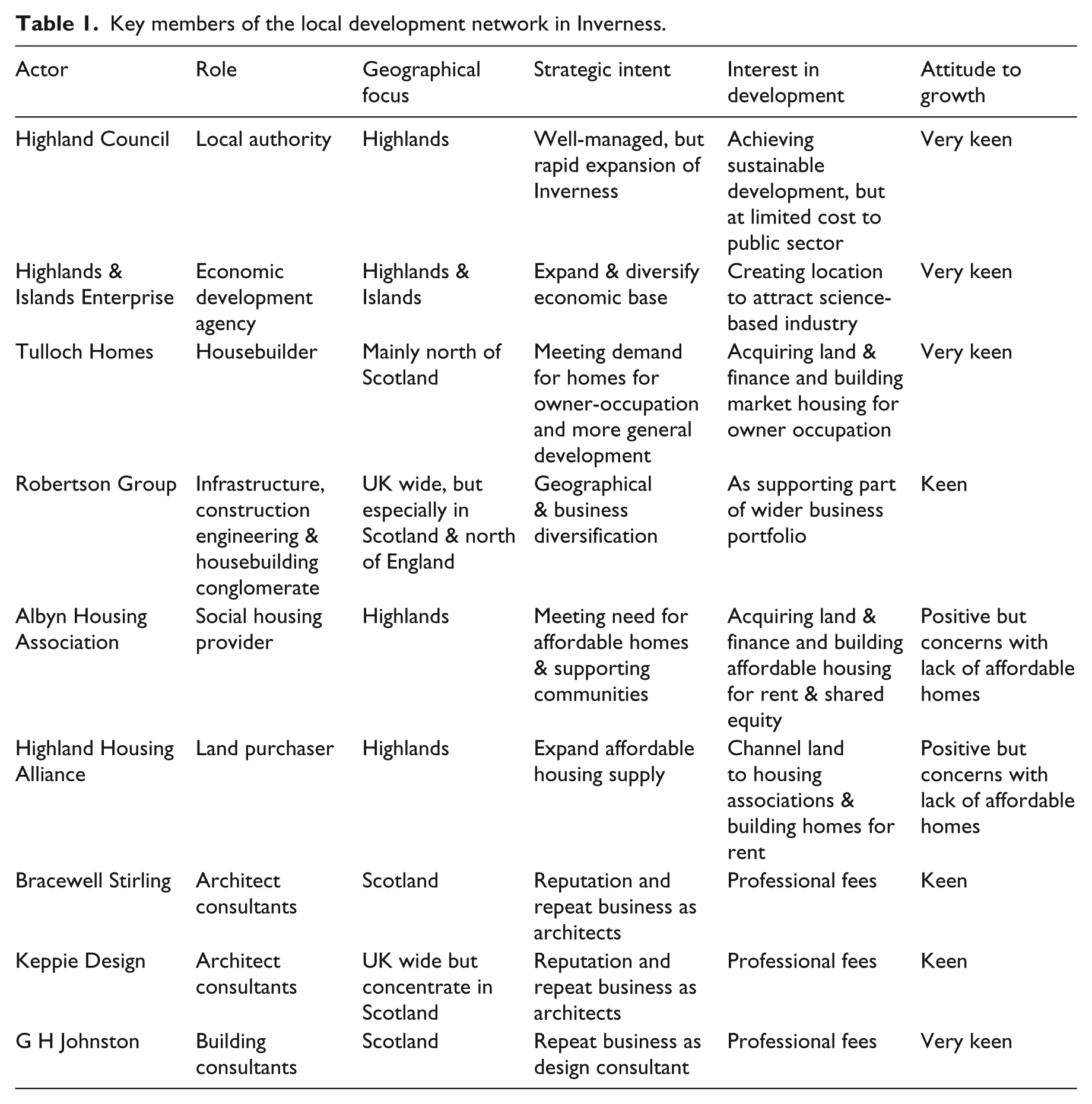
The two most prominent developers were perceived to be Tullochs and Robertsons, the former founded in Inverness in the 1930s and still largely concentrated in and around the city, and the latter established in nearby Elgin in 1964 and now much more diversified geographically and operationally. A small group of architectural and development consultancies depended heavily on these developers for continued work. As one consultant commented, ‘These are the guys that kept us in work through the recession’. This strong nexus was reinforced by a small number of community-based housing associations, seeking to meet housing needs neglected by mainstream private developers.
Table 1 identifies the nine most important organisations that our interviewees regarded as having comprised the local development network in Inverness in recent years. Two or three additional organisations could be added to this list, although there was no unanimity among interviewees of precisely who these might be. It was also clear that other organisations with a much broader focus than development, such as the Chamber of Commerce and Inverness Caledonian Thistle Football Club, were integral to the network.
Key members of the local development network in Inverness.
Beyond its organisational face, the local development network in Inverness actually comprised a closely knit group of perhaps 30–35 individuals with a common commitment to the development of the city
3
and whose paths crossed regularly both in the course of business and socially in the manner described by Lawton Smith and Romeo (2012) (see the second section). As one interviewee commented, because Inverness is a small city and geographically distant from anywhere of similar size: Everybody knows everybody else so if you’re involved in development there you will know everyone and if you start operating there you will get to know everyone pretty quickly and because of that there is a reasonably open, collaborative ethos.
Another said, ‘[t]he upside of being in quite a small place is that you can establish good relationships and work with people - the downside is that you can never escape’. Very close connectivity was thus an important characteristic of the small city network found in Inverness.
Some names were mentioned to us several times as particularly important and influential nodes in the network, such as two former senior Council officers, who one private sector consultant regarded as ‘great, really good players - I never heard anyone saying a bad word about them’. The same was true in the reverse direction, with one senior public sector official telling us to contact a particular private sector developer: ‘You must speak to X … Here is his number … just phone him and say you are doing a bit of research and that you spoke to me’. Crucially, without any formal growth coalition, there existed in Inverness what another interviewee eloquently described ‘as a kind of “development club” - which is a group of people who are more focused on that area of activity and they all spend an awful lot of time in each other’s company’. Informality, rather than formality, was an important feature of this particular small city network. Indeed, one of its most important distinguishing characteristics was the apparent absence of any need to formalise this network, since all its members appeared to share a strong belief in working together to promote the city’s growth. Yet, as one interviewee pointed out, the network’s long-term survival was threatened by its very informality since several longstanding and experienced members were approaching retirement with no obvious replacements ready to assume their places.
Nevertheless, despite this perceived shared agenda, significant tensions existed. To several private sector interviewees, the council had become too interventionist – perhaps even ‘politicised’ – and too focused on matters of design detail, creating unwelcome uncertainty for developers. One long-established developer harked back to an earlier age, when independent councillors were dominant and developers’ plans were rarely challenged. He recalled that One of the provosts (mayors) told me many times in the old days that what we should do is take developers like me and others, put them in a room, give them a blank canvas and say ‘what would you do’? So we did that conversationally for years.
Developers today looked to the local authority to provide a strategic vision for the city, and (as is commonplace elsewhere) often criticised it for not doing so effectively. Debates about development quality were a recurring source of conflict. As one interviewee commented, ‘the economic vision hasn’t been articulated as a civic spatial vision or place-making vision. There’s some beautiful parts of Inverness but there is some pretty awful bits as well’. Council officers criticised some developers for their lack of interest in place quality and for wanting to build housing estates with few social facilities. This reflected similar concerns across Scotland as a whole (see, for example, Scottish Government Council of Economic Advisers, 2008), suggesting that distinctive local development networks, even in small relatively self-contained cities, do not necessarily result in distinctive development products.
While the local development network appeared implicitly to have ratified an agreed future direction for Inverness, it provided no common or democratic forum to resolve disagreements. Common purpose seemed to extend only so far, beyond which individual organisations were ready to pursue their own agendas, even if this brought them into conflict with each other and risked undermining the city’s strategic objectives. This conflict was at its most intense around access to land. According to HC, the supply of development land in Inverness was ‘very, very healthy … but when you talk to particularly affordable housing developers, they’re saying “it’s not enough land” and that’s because you have land banking’ by the private sector. Indeed, one public sector observer we interviewed described this strategy by key developers as a ‘strangulation’ of the land supply. As next explored, certain network members thus appeared better placed than others to take advantage of the growth of Inverness and were intent on exploiting their financial muscle to do so.
Network dynamics, urban growth and land capture
In the mid-1990s, the then Chief Executive of Tulloch Homes took a decision that he recalls everyone at the time believed would be the end of his company but that ‘turned out to be a superb transaction’. With the help of ‘a very good and friendly bank, called the Bank of Scotland’, he bought 600 acres of development land located on the then edge of Inverness, which had already been identified by the council as suitable for future development. Some of this land was eventually developed for business park and retail development, but most was devoted to new housing. By correctly anticipating future growth trends, Tulloch’s strategy of land banking enabled the company to dominate housing output in Inverness over the next two decades.
Around 5,500 new homes were built by Tullochs as a result of this and other significant land purchases. However, not all network members were happy with Tullochs. One of the professional architects interviewed recognised the competitive advantage that land control had given Tullochs but believed it had limited opportunities for external market entry and thus – from his personal point of view – commissions from a wider group of developers. A senior council official took a similar view, saying, ‘It’s not a monopoly land situation but there is more concentration of land ownership so it is probably quite hard for other developers to get into Inverness area or it has been over the years’. Monopoly in this sense is, of course, a relative concept, and must be related to the overall extent of local land supplies. The smaller the city, the less land needs to be controlled for a single developer to achieve what the council official in Inverness saw as a ‘monopoly’.
Among several external developers reported to have tried to take advantage of the growth of Inverness in the early years of the 21st century were Barratt and Laing O’Rourke. Evidently, however, they did not find it easy to break into the local development network, unless working in joint ventures with Tullochs or another main player. In some cases, they seemed to lack the nimble ‘entrepreneurial’ approach to business that has served Tullochs well. One interviewee, for example, criticised the more bureaucratic approach of Morrisons, a large contractor–developer that he felt did not fully understand the differences between speculative development and public tendering.
Moreover, according to Tullochs’ former Chief Executive, the recession of 2008–2009 saw the rapid departure of most external developers because they could no longer achieve their required 20–25% profit margins. Tullochs, however, continued to operate in the city, if at a reduced building rate of 150 rather than 250 homes per year, because its longstanding land bank made a 15% profit margin quite sufficient. This resilience in the face of an unprecedented financial crisis became a key narrative in many of our interviewees’ articulations of the city’s strengths.
Trust, reputation and network exclusivity
The relative remoteness and limited size of Inverness appeared to enhance the importance of trust and reputation as network bonds. As one interviewee commented: ‘Your nearest competitor city is 100 miles away but that also gives you a good sense of cohesion … It’s a small community so everyone knows everyone and you get to establish good relationships and trust’. One architect emphasised how crucial personal recommendations were in building up business, for example, whether for delivering a ‘project on time, to budget – very important’ or simply for being ‘good at problem solving’.
It was also clear that companies who could not be trusted were deliberately kept at a distance. We were advised by two different interviewees, for example, to avoid talking to another potential interviewee. One from the public sector said, I wouldn’t go to them to be honest … I’d better not say too much … There have been issues reported in the press about them not delivering on their responsibilities in terms of they’ve got planning permission to build houses and they’re supposed to look after the common areas and they just walked away from it.
Another from the private sector was just as critical: ‘It’s a “how can we cut corners” type of organisation and we won’t work for these people’. We did, of course, hear many more positive narratives of the interaction between members of the development network and of the social capital evident within it which, just as for the more negative sentiments, indicated the importance of perception to reputation-building.
Although the Chamber of Commerce provided one well-established meeting point for business contacts, with its regular dinners evidently generating valuable opportunities to meet other business contacts socially, the real informal hub of the network turned out to be the local football team, Inverness Caledonian Thistle, which had been founded only in 1994, but rapidly made its way up to the Scottish Premiership. The rise of Inverness Caledonian Thistle was emblematic of the city’s growth, creating what Cox (1999) calls a positive symbol to which all citizens could relate, and provided a cornerstone for the local network. Here, our findings chime with the North American growth coalition literature that ‘Professional teams serve many latent social functions … sustaining the growth ideology is clearly one of them’ (Logan and Molotch, 2007: 81). The Inverness case study provides new evidence to show how sports franchises can permeate informal small city networks equally well as formal large city ones.
A key figure in the club’s success was the former Chief Executive of Tullochs, who as Chairman and subsequently Club President had invested £5 million of his own money in Inverness Caledonian Thistle. In a newspaper interview, he was reported as getting ‘his payback from having built a successful, sustainable club that reflects well on the Tulloch Group, fosters goodwill for the company and indulges his footballing passion’ (The Scotsman, 2011). The club’s formation had even been supported by the local state through investment from HIE, allowing it to nominate a member of the Board. This was thought to confirm Inverness’ arrival as a ‘proper city’ with real presence in Scottish national life.
What makes these connections significant is that, according to one interviewee, ‘quite a lot of business is done on a Saturday afternoon at the Caley Thistle’. As a mid-career woman, she felt excluded from what she saw as a gathering of men in their 50s, especially as ‘All of these people have been there for a very long time so they stop those who are the new people coming in to fill their shoes’. This comment was reflected by a different interviewee who said, So in some ways there’s quite a tight net group of people. And I think for folk that are not everyday part of that group, it can be difficult to have an open dialogue with them. They can be a bit clubbish I think and that raises difficulties.
Such exclusivity is likely to be a particular danger in the kind of informal network found in a small city such as Inverness and presents difficult challenges for a network style of governance in such a city.
The research thus highlighted two sides of closely knit local development networks. On the one hand, those at the centre of the network knew each other well, relied heavily on trust and reputation, could arrange to meet quickly and interwove their business and leisure connections. On the other hand, the network could easily be perceived by outsiders as a barrier to business. Although tentative, such conclusions raise serious questions about the ‘dark side’ of business networking. When that particular type of business is primarily focused on the future city development, those questions must all be of public concern.
Conclusions
Our work raises important questions about how development happens in small cities. We found several network members who were keen to explain how the existence of a close network, built on informality and trust, allowed development to occur faster than might otherwise be the case, and for Inverness to cope with the post-2008 recession better than elsewhere. This network resilience undoubtedly played an important role in sustaining the growth narrative of the city through difficult circumstances, and thus in supporting its population and economic growth.
Yet, the operation of the Inverness network also had uncomfortable implications for transparency and accountability. A recurring tension was apparent between its operational efficiency and the articulated strategy for the city. The small scale of Inverness meant that no formal ‘growth coalition’ was in place to manage the relationship between public agencies and private sector developers. Instead, the informal network had many attributes of a ‘club’ in which key private sector actors enjoyed strong mutual relationships based on longstanding trust. Although it minimised transaction costs, this ‘club’ mentality had clear downsides. Firstly, it presented a real barrier to the entry of new players into the local real estate marketplace. Although one local developer was especially dismissive of those who ‘dip in and out of markets they don’t understand’ (Sutherland, 2015: 161), markets that restrict new entrants increase the potential for oligopolistic behaviour, which can artificially inflate prices while lowering choice and quality for consumers.
Secondly, the centrality of the city’s football club, as a key node in which discussions around development took place, also raises important questions about plurality and openness. Transacting business informally in an environment tightly proscribed in terms of gender, ethnicity etc. raises concerns about transparency and good governance. However, as Romzek et al. (2012: 442) underline, to discover how networked governance really operates, we must explore informal accountabilities within such a ‘club’. Here, we found that key private sector actors within the ‘club’ often saw public authorities as located on the periphery of the network, not at its core. Whilst the task of public sector agencies is often defined as managing the ‘design and evaluation of enduring inter-organizational relationships, where trust, relational capital and relational contracts act as the core governance mechanisms’ (Osborne, 2006: 384), this becomes problematic when network discussions take place in an environment where the involvement of public officials is discouraged by protocol (e.g. the Directors’ Box of the local football club). We found evidence that the development network would often have reached consensus on a particular issue before substantive discussions with public agencies had taken place, thus undermining the local state’s power to deliver on its vision and objectives.
Our research framework was built upon the notion of scale as an important yet under-researched facet of urban networks. We previously noted that most theorising about urban governance networks relates to larger cities and metropolitan areas. In our study of a small city, we found evidence that network dynamics were rather different. Bovaird (2006) notes that public sector actors find it particularly difficult to control network operations and outcomes, given their multiple relationships with network actors and the complexity this brings. However, in Inverness, the social and cultural cohesiveness of a small group of around 35 actors appeared to reduce the capacity of the local state to implement its vision for strategic development. Indeed, a fundamental ‘incompatibility’ between networked governance models and democratic ideals (Klijn and Skelcher, 2007) may be magnified in small cities with limited public resources, especially if a few private sector actors are dominant.
This obviously raises important questions for public authorities charged with governing small cities, many of which have limited capacity precisely because of their small scale. However, it also presents a challenge to the current wave of network studies that emphasise the fluidity of network assembly and situational complexity. In our study, we found a network that was very tightly ‘bounded’ indeed; there was strong consensus between actors about who did and did not belong to the network, its rules and norms, and the cultural contexts in which trust was built and relationships maintained. Indeed, the network’s power in relation to the local state was enhanced by its consistency, cohesiveness and impenetrability, in part generated by the specific times and places in which business discussions took place.
Yet, despite apparent strength, informal small city networks such as that found in Inverness can also be characterised by inherent fragility. The greatest risk to the network was thus not the potential challenge from new market entrants or changing political contexts, but a lack of succession planning for when key individuals retired. In the meantime, however, although the Inverness development network may well be organised informally, its cohesiveness and ability to mobilise its power bestowed it with significant influence on the development trajectory for this particular small city.
In broader theoretical terms, our findings certainly uncover the kind of ‘messiness’ inherent in many policy processes that Chhotray and Stoker’s identify in their wider (2009) review of governance dynamics. Of particular importance is their notion of the ‘delegation’ of tasks between different governing organisations and institutions active in different geographies based on pragmatism rather than strict adherence to formal policy architectures. Thus, whilst the Scottish Government’s National Planning Framework (2004: 75) set a fairly unambiguous aspiration for Inverness as part of wider national economic development targets – that the city ‘needs to develop its role as the Highland capital, broaden its economic base, improve its connections to the other cities and the rest of the world, and attract a wider range of high quality jobs’ – in terms of the implementation of policy in pursuit of these goals, it largely ‘delegated’ or left the Inverness development network ‘to get on with it’ and deliver growth within this general framework.
Here we also find Paavola’s (2007: 93) work useful, in particular his observation that the key to understanding how multi-tier governance arrangements work in practice requires an analytical approach that ‘can gain resolution by looking at the functional and structural tiers, organization of governance functions, and formulation of key institutional rules as key aspects of the design of governance institutions’. For Inverness, the key institutional ‘rule’ we uncovered was the explicit pro-growth posture of the governing network, built of a strong sense of cohesion and shared direction between network members. However, whilst we identify the extent to which the cohesion of the network, its resilience and the shared interests of its members enabled generally ‘successful’ outcomes in Inverness, there must also be the risk that, on some occasions, small networks will lack the expertise and capacity to implement the kinds of development strategies that are primarily developed for larger places, and then replicated in small cities in order to achieve policy consistency at the national level.
In terms of the avenues for future research opened up by our work in Inverness, perhaps the most obvious research question arising concerns the extent to which small cities are able to leverage their distinctiveness and flexibility to enact different policies within overall strategic frameworks set by higher tiers, rather than simply implement ‘big city’ strategies and policies more quickly and effectively than elsewhere. Our research suggests that to understand this we need to interrogate more deeply how the kind of networks we found in Inverness operate and how this serves to structure local power relations, particularly in terms of who is able to become an ‘insider’ and be eligible for potential inclusion in the network.
So, for example, while we have identified the Directors’ Box of Inverness Caledonian Thistle as an important node within the network, we remain unsure whether such nodes provide a critical focus for substantive exchange on policy debates within the network, or merely help build the necessary trust and reputation to facilitate exchange elsewhere. Similarly, we need to know more precisely how network exclusivity operates, especially in relation to gender. To what extent, for example, does the lack of formality facilitate behaviours that would be deemed unacceptable in a more formal setting? These are the kind of issues where a substantive ethnographic study could prove particularly useful. Associated work might also distinguish more fully between the comparative importance of individuals and organisations in formal and informal networks and the implications of this for network survival. In this case, ethnographic approaches could helpfully be reinforced by interrogating documentary evidence that enables network connections to be mapped out in more detail.
Finally, we suspect that much more could be said about the political connectivity (or lack of it) of the kind of informal networks we found in Inverness. Are key network players also involved in local political parties, either directly or in helping to fund election campaigns? Or does network participation render such activity unnecessary? Knowing more about this would further address the essential question of whether informal development networks reinforce or subvert local democratic decision-making, which is crucial to ensuring smaller networks retain the high levels of transparency and accountability expected of any democratic governance structure.
Footnotes
Declaration of Conflicting Interests
The author(s) declared no potential conflicts of interest with respect to the research, authorship, and/or publication of this article.
Funding
The author(s) received no financial support for the research, authorship, and/or publication of this article.