




Abstract
The global or planetary reach of gentrification has become a mainstream in critical urban studies. Yet, the ‘travels’ of a concept originated in specific places and times have often brought about a loss of explanatory and strategic power. In this article, we argue that another concept, that of articulation developed by Laclau and Mouffe, is particularly adequate to help gentrification, touristification and financialisation to travel among places and levels of abstraction. In order to make this argument, we focus on Southern Europe, whose cities had long been considered scarcely gentrifiable and where, more recently, critical urban scholarship has made large use of gentrification, touristification and financialisation to explain the impacts of crisis, austerity and afterwards economic rebound driven by real estate and tourism. We explore from a multi-scalar perspective the trajectory of Mouraria, a historical neighbourhood in Lisbon – and particularly the dimensions of housing and local politics. We show how Mouraria, during the last decade, shifted from being a ‘deviant’ case – capable of taking advantage of neoliberal regeneration policies in order to keep its social diversity and most of its long-term residents – towards one ‘paradigmatic’ of urbanisation-as-accumulation and contentious urban politics. We explain this shift by focusing on its multi-scalar determinants, concluding that present urban change in many Southern European cities should be understood as the articulation of various processes, which include gentrification, touristification and financialisation.
Keywords
Introduction
In the aftermath of the global financial crisis and deep national austerity policies – often at the request of international lenders (Tulumello et al., 2020) – Southern European cities are experiencing ongoing turbulent changes: they have become ‘battlegrounds’ (Cocola-Gant, 2016) of investment, speculation and displacement. Three concepts generated in other contexts – gentrification, touristification and financialisation – have become linchpins of Southern European critical urban studies, often with scarce attentiveness to their contextual specificities (see the second section). In this article, we question the use of these concepts, taking steps from Thomas Maloutas’ critique of the travel of concepts that are ‘highly dependent on contextual causality’ (2012: 34) and Sequera and Nofre’s (2018) argument against the conflation of touristification and gentrification. On the one hand, we will provide further evidence of the limits of the concept of gentrification per se to explain current processes in Southern European cities. On the other hand, however, we will argue, contra Sequera and Nofre’s (2018) suggestion to ‘de-link’ touristification and gentrification, for an epistemological approach based on the study of the articulation (cf. Laclau and Mouffe, 1985) of these two concepts, plus that of financialisation. This approach, we will show, helps explain current transformations, increasing the analytical and strategic power of the concepts of gentrification, touristification and financialisation. In doing so, we contribute more widely to the development of global urban studies (cf. Robinson, 2016) by bringing fresh theoretical insights from a context, Southern Europe – and specifically Lisbon – that have long remained at the ‘borderlands’ of urban theorisation (Baptista, 2013) and can help us further our understanding of how concepts travel and are stretched.
Our epistemological strategy is exploring a case study from a multi-scalar and longitudinal perspective. We focus on the neighbourhood of Mouraria in Lisbon, a city that has lost almost a half of its population since the 1980s, where regeneration policies have been around for some three decades, bringing mixed results and, in some neighbourhoods, displacement (e.g., Mendes, 2013). Mouraria has been, since 2007, at the core of urban regeneration efforts by the municipality – themselves crucial to the municipal anti-crisis strategy. During the years in which Portugal was undergoing crisis and austerity (circa 2009–2014), Mouraria managed to take advantage of policies that elsewhere caused displacement (see the third section). As of the end of 2019, four years into the economic recovery of Portugal, the panorama was radically changed. While austerity was said to be over, and Lisbon to be thriving thanks to tourism and real estate (see the fourth section), Mouraria was experiencing a radical restructuring of its socio-spatial fabric (see the fifth section): on the one hand, processes described by critical urban scholars as gentrification, touristification or ‘tourism gentrification’; and, on the other, a transformation of local politics, with a shift from public participation towards contentious politics.
Keeping our theoretical goals in mind, we question the trajectory of change of Mouraria – focusing on the intersection between housing and local politics – looking at two periods that we characterise as the ‘crisis’ (2008–2014) and ‘post-crisis’ (2015–2019). Our methodological approach is longitudinal case study analysis: we focus on two periods close in time to foreground the factors of change – see Tulumello (2016a) on how this strategy allows one to ‘control’ for the context, allowing theorisation on multi-scalar causal determinants. Following Flyvbjerg’s insights (2006) on case selection, we will show how Mouraria has changed from being a ‘deviant’ to a ‘paradigmatic’ case. Deviant cases, where outputs of processes are different from those expected, are particularly useful to problematise grand theories: Mouraria, up until 2014, was deviant because regeneration policies did not produce the same patterns of gentrification described in other neighbourhoods of Lisbon. Paradigmatic cases, instead, ‘highlight more general characteristics of the societies in question’ (Flyvbjerg, 2006: 232): we will show how Mouraria has lately become paradigmatic of wider processes that are transforming cities throughout Southern Europe.
In operational terms, we take stock of, and repeat, a study carried out in Mouraria during the ‘crisis’ period (Tulumello, 2016b) and based on Ley and Dobson’s (2008) systematisation of the (spatial, socio-political and policy) factors capable of halting gentrification. We adopt this strategy for three reasons. Firstly, by repeating the same exercise for the ‘post-crisis’ period and questioning why Mouraria was suddenly not capable of resisting external pressures (see the sixth section), we focus our attention on the determinants for such a change. Secondly, Ley and Dobson’s framework helps overcome the long-held divide among supply and demand causes of gentrification (see Hamnett, 1991) and, in so doing, opening up to questioning the conceptual reach and explanatory power of the concept in and of itself. Thirdly, this also allows us to put into the picture the political and institutional dimensions that variegate global processes in local contexts, therefore overcoming the problem, emphasised by Maloutas (2012, 2018), of fetishising gentrification and similar processes.
Methodology
Our reconstruction of the ‘crisis’ period is based on a previous work based on data collected up to December 2014 (Tulumello, 2016b). That article used case study research – using evidences from policy document analysis, interviews with policymakers and descriptive statistical analyses (mostly from census data) – to analyse urban regeneration policies and their effects in Mouraria. We integrate Tulumello’s findings with a systematic literature review (see below).
We similarly reconstructed the ‘post-crisis’ period using case study research and triangulating mixed methods and sources of evidence, collected for ongoing projects on housing and participatory policies in Mouraria and Lisbon (see funding details).
Descriptive analysis of statistic data to account for real estate and demographic processes. A systematic comparison with data available for the ‘crisis’ period was impossible. While previous studies could rely on the 2011 national census, the next one will not be carried out until 2021. Although some data at the civil parish level (sub-municipal) are made available by the National Institute for Statistics, the administrative reform approved in 2012 has included Mouraria in a wider parish (Santa Maria Maior), which includes several other neighbourhoods (e.g., Baixa, Chiado, Castelo and Alfama). The real estate and demographic trajectories of the latter neighbourhoods are quite different from those of Mouraria, as processes described as gentrification and touristification predate those we analyse in this article – this being the main reason that made Mouraria a ‘deviant case’ as of late 2014 (Tulumello, 2016b). Data about the Santa Maria Maior parish cannot therefore be used as a proxy for Mouraria. Hence, we employed statistical data (collected through other sources, including reports and grey literature) that refer to the area of the pre-reform parish of Socorro, which roughly corresponds to the perimeter of Mouraria.
Media and journalistic sources and, in particular, generalist newspapers (e.g., Público, Diário de Notícias, Expresso) to support the reconstruction of planning and urban development; and neighbourhood magazine Rosa Maria (founded in 2010 by local associations, discontinued in 2016 and then relaunched in December 2018) to deepen our understanding of the perception of the neighbourhood by the local non-profit and social entrepreneur sector.
Participant observation during mobilisations for the right to the city, 1 useful to complement the understanding of political trends and community organisation.
Finally, we carried out a systematic literature review 2 on scientific texts about Mouraria published during the ‘post-crisis’ period (2015–2019). We collected 42 works, characterised by a significant internal variety. 3 As 21 works use data collected during the ‘post-crisis’ period, while 21 use data collected during the ‘crisis’ period only (Table 1), we were able to compare the two groups of works to question whether our peers had noticed the changes we describe. Beyond carrying out a qualitative thematic analysis, we performed a text analysis over the titles and keywords of the two groups: the findings are represented in Figures 1 and 2, which show the network of terms co-occurring in the same text (larger nodes are recurrent words, and darker nodes means that the word has connections with several other words).
Works on Mouraria published between 2015 and 2019.

Included in the review because it was published ahead of print on 10 January 2019.
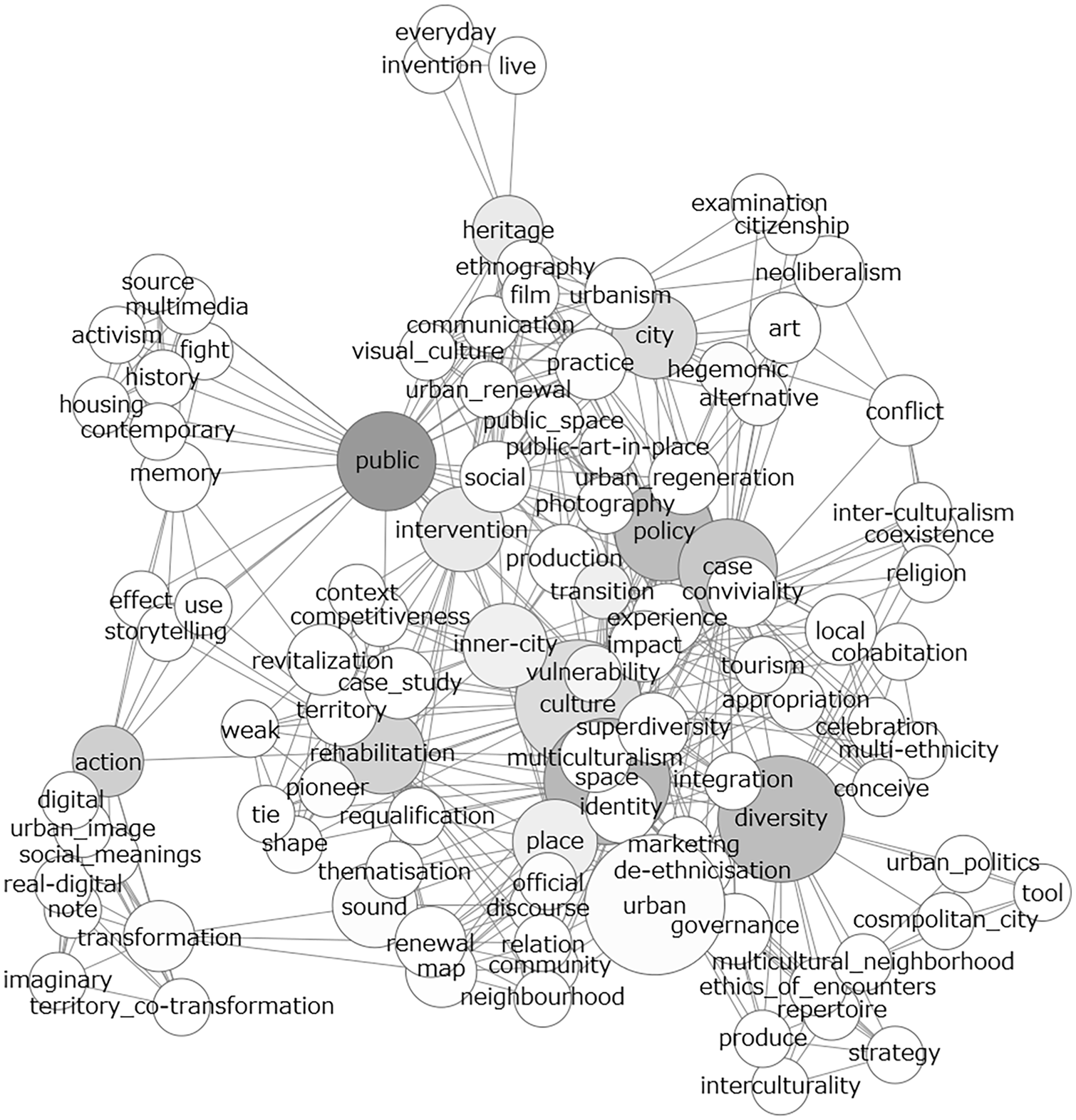
Text analysis of titles and keywords of works on Mouraria based on data from the ‘crisis’ period, 2008–2014 (our elaboration).

Text analysis of titles and keywords of works on Mouraria that use data from the ‘post-crisis’ period, 2015–2019 (our elaboration).
From travelling concepts to articulation
Gentrification is a ‘travelling concept’ (Maloutas, 2018). Originally developed to explain the influx of gentries and displacement of working classes in late 20th century British and North-American cities, gentrification has been, in the new century, used in critical accounts of urban change worldwide. Some argue it is an inter-contextual, global or planetary concept (e.g., Atkinson and Bridge, 2005; Lees et al., 2016).
While its global nature was becoming mainstream in critical urban studies, Maloutas argued that gentrification is a typical example of mid-range concepts, which are ‘highly dependent on contextual causality. [. . .] Looking for gentrification in increasingly varied contexts displaces emphasis from causal mechanisms and processes to similarities in outcomes across contexts and leads to a loss of analytical rigour’ (2012: 34). Contextual problems can be overcome, Maloutas (2018) added, only by adopting minimalistic definitions – for example, the compresence of capital investment, inflow of wealthier groups and expulsion of lower classes (see Clark, 2005) – therefore glossing over the social, spatial and policy characters that shaped gentrification in cities like London, Chicago or New York. This brings the risk of falling into the ‘theoretical banality’ (Maloutas, 2018: 255) of concluding that, in capitalist societies, wealthier groups have more power to decide where they want to live. This conclusion, beyond lacking explanatory power, has scarce strategic use, as it erases those contextual characters that have slowed down, or even halted, gentrification in several places, including Southern European cities (Maloutas, 2018).
Southern Europe is an interesting case to further this discussion: its cities, where gentrification was once considered to be marginal or absent (e.g., Malheiros et al., 2013; Tulumello, 2016b), have become central to critical literature on gentrification in the aftermath of the economic crisis and during the following economic rebound (e.g., Alexandri, 2018; Annunziata and Lees, 2016; Sequera and Janoschka, 2015). Concurrently, once at the ‘borderlands’ of urban theory (Baptista, 2013; Tulumello, 2016b), Southern Europe has become a context of theoretical development. Observing that tourism-induced change (above all, the flipping of residential into short-term rental units) often had a greater role than the substitution of lower for higher classes, some Southern European scholars have stretched the concept, suggesting that tourism is a new ‘battleground’ (Cocola-Gant, 2016) or stage for ‘symbolic violence’ (Mansilla, 2018) of gentrification. In his research in Lisbon, Mendes (2017) adopted, and extended, the concept of ‘tourism gentrification’ coined by Kevin Fox Gotham in New Orleans (2005). Mendes defined tourism gentrification as:
. . .the transformation of working-class and historical neighbourhoods of the urban centre into places for consumption and tourism, by way of expansion of the functions of amusement, leisure and touristic rental (including, e.g., holiday and short-term rentals), which progressively replace the traditional functions of residential housing, long-term rental and proximity retail, thus worsening [processes of] displacement and residential segregation, emptying neighbourhood of their original populations or making it impossible to low-income groups accessing housing in those areas. (2017: 491; our translation)
Mendes further widened gentrification by stripping Clark’s definition of the inflow of wealthier groups. This simplification has gone hand in hand with the conflation with yet another concept, financialisation (see Mendes and Jara, 2018), already applied in ‘semi-peripheral’ Southern European contexts (Rodrigues et al., 2016) and imported into urban studies during the last decade or so (see Aalbers, 2019a, for a review). Defined as the use of real estate as assets through various financial instruments, financialisation is a more abstract concept than gentrification. Scholars like Loretta Lees et al. (2008) and Aalbers (2019b) have attempted to unite gentrification and financialisation by arguing that the latter explains the investment dimension in the so-called fourth and fifth waves, 4 which deepened and expanded gentrification through new instruments (e.g., platform economy).
These conceptual gestures have contributed to show how local processes are increasingly embedded in global (financial) flows: Maloutas himself and his colleagues have recently suggested that short-term rental platforms may be making gentrifiable the once ungentrifiable Athens (Balampanidis et al., 2019: 14-15). Yet, conflating concepts with such different natures (some context-bound, some more abstract) reproduces the problems previously highlighted by Maloutas. Once stripped of the gentry, as in touristification and urban change driven by financialisation, what is left of gentrification? This problem was explicitly, if paradoxically, acknowledged in recent studies from Lisbon that described a ‘gentrification without gentry’ (Krähmer, 2017; Krähmer and Santangelo, 2018). Yet, what is the point of using gentrification in the absence of gentry, when the concepts of investment (for tourism, speculation or anything else) and displacement are at hand?
Sequera and Nofre (2018) contributed to this debate by theoretically criticising the incorporation of touristification within the gentrification framework. Gentrification and touristification entail different processes: different groups are displaced (working classes versus cross-class displacement); demographic trends are quite opposite (replacement versus depopulation); the property structure is different (homeownership versus real estate investment); and the actors involved in the two businesses often have conflictual interests (e.g., early ‘gentrifiers’ often become anti-touristification activists). Sequera and Nofre therefore advocated ‘de-linking’ touristification and gentrification. Thus, they did in a follow-up article (Sequera and Nofre, 2019) based on research undertaken in the historical Alfama neighbourhood in Lisbon; there, touristification – accelerated by short-term rentals since 2016/2017 – interrupted pre-existing processes of marginal gentrification and studentification. Different are the results of López-Gay et al.’s (2020) study on Barcelona from the perspective of international mobility. There, ‘floating’ European and North-American populations have created territorial enclaves in the touristified centre of Barcelona, showing that touristification and – specific forms of – gentrification can coexist in (Southern European) historical centres.
Notwithstanding the empirical specificities that partially explain these different conclusions – Lisbon and Barcelona are in very different stages of the processes here described – these studies provide us with important, complementary conceptual reminders: Sequera and Nofre (2018, 2019) are convincing in their critique of the conceptual unification of gentrification and touristification, while López-Gay et al. (2020), by showing a case of coexistence, warn us that we cannot ultimately de-link them. How do we get out of this (apparent) paradox?
Since the problem is with levels of abstraction and conceptual travel (see above), Stuart Hall’s discussion (1986: 7) of modes of conceptualisation in Gramscian Marxism can help us. Hall reminded us that ‘concepts can operate at very different levels of abstraction’, but that levels of abstraction should not be ‘misread’ for one another. As we have seen, concepts like gentrification and touristification – born as quite concrete ones – have been forced to take a higher level of abstraction to fit to a variety of different contexts. In the process they have been extremely simplified and, when used at the local level, their (now higher) level of abstraction has often been misread, making then ultimately less analytically (and strategically) powerful. The challenge is to make these concepts travel without giving up their concreteness. Our proposal is to use them through the lenses of articulation, as developed in Laclau and Mouffe’s (1985) discourse theory. Articulation is ‘any practice establishing a relation among elements such that their identity is modified’ (Laclau and Mouffe, 1985: 105). Developed to explain the construction of (discursive) forms of hegemony, articulation allows one to take ‘a middle position between structure and agency’ (De Cleen and Stavrakakis, 2017, 305), thus helping to mediate between multi-scalar determinants of change, such as transnational capital flows and local politics.
We argue that articulation is particularly adequate to connect local dynamics of change with mid-range concepts like gentrification and touristification, and the relations between the latter and an intermediate concept like financialisation. In what follows, we will provide empirical substance to this claim by focusing on the case of Mouraria, its multi-scalar links with Southern European phenomena and these latter context’s wider transformations.
Regeneration and local development: When Mouraria was a ‘deviant’ case
Mouraria is a historical neighbourhood in central Lisbon, characterised by significant social diversity. Its spatial fabric, typical of Arabic urbanism, is a maze of narrow alleys on the slopes of two hills, with generous public spaces (Almirante Reis Avenue and Martim Moniz Square) located on its western fringe. The neighbourhood has long been a frontier-land, in between the touristic neighbourhoods of Baixa and Castelo and the residential Anjos and Graça. Mouraria was one of those neighbourhoods that abound in Southern European centres, where migrant populations could find a ‘backdoor to the city’ (Malheiros, 2010); decades of institutional disinvestment have gone hand in hand with discourses about ‘decay’; and, recently, regeneration discourses and policies abounded.
In 2008, the socialist municipal government made Mouraria the flagship of its regeneration strategy, mobilising a number of programmes (Tulumello, 2016b: Table A2). Requirements for refurbishment were simplified and municipally owned dwellings were sold to boost private real estate and construction investment. The strategy for local development was shaped around three pillars: public space refurbishment; stimulus to entrepreneurship and tourism; and improvement of services for vulnerable populations. While the economic crisis hit Portugal (in 2009) and the country requested a financial bailout (in 2011), negotiating deep austerity measures, the regeneration agenda became, together with the attraction of tourism and international investment, the central feature of local anti-crisis policies, further increasing the symbolic importance of Mouraria for the municipal government. According to several authors (e.g., Carmo and Estevens, 2017; Corte-Real, 2015; Tulumello, 2016b), the regeneration strategy was typical of neoliberal policymaking: disproportionate investment in entrepreneurship and tourism when compared to social cohesion policies; absence of public housing policies; focus on concepts like capacity building, activation, partnership, participation and empowerment (on neoliberal co-optation of the participation agenda, see Miraftab (2004) and Falanga (2018)); and branding of cultural activities (especially Fado music).
Yet, while regeneration policies were fostering gentrification and touristification in other neighbourhoods in central Lisbon (Mendes, 2013; Nofre, 2013), Mouraria walked a different path. Up until late 2014, real estate prices were not growing, or were growing slower than in other parts of central Lisbon (Tulumello, 2016b: 129-132), and the influx of young households with relatively low economic and relatively high cultural capital was not causing displacement – rather, new and old residents were creating networks crucial for local development (Malheiros et al., 2013; Tulumello, 2016b). Indeed, studies about the ‘crisis’ period (see Figure 1) are dominated by discussions about Mouraria’s ‘super-diversity’, heritage and culture, and their role in urban change and development (e.g., Bettencourt and Castro, 2015; Galhardo, 2015, 2019; Mendes et al., 2016; Menezes, 2015; Oliveira, 2015; Oliveira and Padilla, 2017; Padilla, 2015; Padilla and Gallardo, 2015).
Mouraria was interpreted as a space of negotiation and conflict between, on the one hand, an institutional action driven by neoliberal ideas and, on the other, a ‘dense’ social fabric capable of organising on the grounds of its own socio-cultural diversity (Tulumello, 2016b; see also Carmo and Estevens, 2017): the latter, Tulumello argued (2016b), was being able to take advantage of the contradictions and ambiguities of neoliberal urban policies to undergo a path of local development. However, the question remained open as to ‘whether current trends [would] consolidate in local development, increased diversity, and social cohesion – or turn towards advanced stages of gentrification’ (2016b: 132).
Granted, signals existed of the ambiguity of ongoing processes, as exemplified by an episode in 2012, when the president of the republic visited the regeneration works in Mouraria. Activists from cultural alternative centre dA Barbuda denounced that local drug dealers had cooperated with the presidential security detail to maintain order, and afterwards threatened the activists, who had organised a protest (Largo da Severa N8 2012). The end of the activities of the collective – described by politicians and tourist guides as ‘a bunch of anarchists’ (Ropio, 2012) – and the eviction, in May 2012, of another squat (Casa de S. Lázaro), together with the clearance of graffiti and other ‘signs of dissent’, somehow anticipated the future path of the neighbourhood. While leaving the place, the collectives wrote a premonitory letter, arguing that ‘the people that are now expelling us [the drug dealers and long-term residents more generally] are likely to be those that will be expelled in turn by the process of “city cleansing”’ (Largo da Severa N8, 2012). However, things would only accelerate once processes starting in different places abruptly changed the context, in Portugal and in Lisbon – and to those processes we shall now turn.
‘Post-austerity’ in Portugal and Lisbon?
The year 2015 was one of sea changes for Portugal. Despite the conclusion of the bailout and the return to economic growth, the social impacts of austerity had eroded the support to the centre-right government. The November 2015 elections brought to power an unprecedented coalition made up of the centre-left Socialist Party and left-wing Communist Party and Left Block, in support of a socialist government. The new majority’s discourse was straightforward: it was time to turn the page of austerity. Some of the measures approved during previous years, including cuts to wages of public employees, tax increases and cuts to allowances, were reverted (Fernandes et al., 2018) and the minimum-wage was repeatedly increased. Amid a favourable external environment, economic growth was driven by exportations, especially tourism, and then by the stimulus to domestic consumption due to the easing of austerity measures (Teles, 2018). This also proved positive for national finances, with the deficit plummeting. Soon, progressive commentators found in Portugal the proof that an ‘alternative to austerity’ existed (Alderman, 2018; Jones, 2017), while global hype was building around Lisbon, now described as the ‘coolest capital in Europe’ (Dunlop, 2017).
There are, however, reasons to be sceptical of this narrative: housing is an excellent entry point to expose the ambiguous nature of the ‘post-austerity’ age. During the crisis, the national government approved, at the request of international lenders, a number of measures to liberalise housing and real estate: a reform of spatial planning (Law 31/2014 and Decree-Law 80/2015) made real estate operations easier (Tulumello et al., 2020: 77; see European Commission (EC), 2012: 78); a reform of the urban lease regime (Law 31/2012) eased the termination of rental contracts (Cardoso, 2019: 85; see EC, 2011: 87-88); and an extraordinary regime for refurbishment operations (Decree-Law 53/2014) allowed for exceptions from building regulations (see EC, 2011: 88). In addition, a Golden Visa scheme (Law 29/2012) was approved to grant access to the Schengen area when investing in real estate. 5 As tourism boomed in Portugal – international arrivals increased 150% between 2009 and 2018 6 – and in Lisbon, disruptive effects on the real estate market became evident, for instance in the boom in short-term rentals. 7 The hype surrounding Lisbon brought into the city other groups with purchasing power higher than that of local residents: European pensioners attracted by Portugal’s good weather and fiscal incentives, international students (see JLL and Uniplaces, 2019), and ‘digital nomads’ and startuppers – a field in which the municipality has invested heavily. 8 Investments eased by the reforms and growing international demand have pushed real estate prices sky high, with double-digit yearly growth almost everywhere in the city. As a result, more and more groups are being displaced away from central areas, prompting local critical researchers to use the concepts of gentrification, touristification and financialisation (see the second section).
This scenario forced housing into the core of the political agenda. As the national government acknowledged the need for policy intervention in 2017, a newly appointed Secretary of State for Housing has worked on a number of measures to stimulate long-term affordable rentals (included in the New Generation of Public Housing). 9 However, the Prime Minister and the Secretary of State repeatedly claimed that they had no intention to revert the liberalisation of the housing market and, indeed, none of the measures approved during the austerity years has been abolished or substantially reformed (Tulumello, 2019a). Some mitigation measures have been undertaken: an act providing temporary suspension of evictions of long-term tenants in vulnerable conditions (poor elderly or disabled people; Law 30/2018) and a provision allowing municipalities to put caps on short-term rentals (Law 62/2018; see the sixth section on its weak implementation in Lisbon).
In short, the field of housing gives us good reason to be sceptical of the trumpeted ‘end’ of austerity. This is confirmed by commentators from quite different backgrounds – in left-wing magazines (Príncipe, 2018; Teles, 2018) and political science journals alike (Fernandes et al., 2018) – who have argued that not much had changed either in fields such as health, education, university or public transport, with investment stagnating or further plummeting. Real estate and tourism have contributed to fostering that very economic growth that allowed the government to revert some austerity measures while keeping a strict monetarism – achieving a surplus in the 2019 national budget. In this sense, the unwillingness to revert to previous liberalisation measures may be due to the fear of killing the ‘goose that laid the golden egg’.
Austerity may have been eased, 10 but this happened at the same time as austerity was becoming even more entrenched into the institutional fabric (Tulumello, 2019). This has been quite clear to social movements for the right to housing, which have been growing in intensity and conflictuality at an unprecedented pace during the years of the ‘post-crisis’ (Accornero and Pinto, 2020; Di Giovanni, 2017; Falanga et al., 2019; Tulumello, 2019) – and, as we will see below, this is mirrored in political transformations in Mouraria.
MourAirBnb: Mouraria becomes ‘paradigmatic’
Rosa Maria understood that things were about to change in 2015. While, until then, the local magazine was following regeneration policies with optimism, emphasising how local associations had been capable of protecting vulnerable actors (see Tulumello, 2016b: 129), articles started to raise concerns about gentrification and speculation (Lino, 2015; Moura, 2015). In what follows, we trace the changes in the field of real estate and housing, and then discuss political dynamics (with a focus on the engagement in participatory policies and contentious politics), a crucial dimension of the local capacity to resist gentrification during the ‘crisis’ period (cf. Tulumello, 2016b).
Real estate and housing dynamics
Rosa Maria’s concerns were confirmed as the neighbourhood became the target for high-end real estate operations (Pellitero, 2017: 3; Quaternaire Portugal, 2017: 140-143). Among these, AMouraria, advertised as ‘the only gated community with a huge garden, pool and parking in the historic centre of Lisbon’ (apud Alemão, 2017), and characterised by problematic issues, was given the authorisation to build over an area appointed by planning instruments to be a green public space (Alemão, 2017).
Even more than by large operations, the built environment has been reshaped by tourism – which has become a central topic in works about Mouraria during the ‘post-crisis’ period (Figure 2; see especially Krähmer, 2017; Lopes, 2017; Mandoux, 2019; Muselaers, 2017) – and particularly short-term rental (Figure 3). Quaternaire Portugal (2017: 144) found that in the area surrounding Olarias Street, there were few short-term rental units in 2013 and about 60 (or, about 10% of the total stock) as of 2017. 11 As of August 2019, we found 454 active rentals in AirBnb and Home Away (386 of which were entire homes), and 65 listings on Uniplaces, a platform for student housing, 12 cumulatively more than 20% of the total stock. 13 In the same day we performed that search, we were able to find 10 apartments available for rent. 14 Although these data do not provide conclusive evidence on the causal role of short-term rentals on the shrinking of numbers of long-term rentals – but see Cocola-Gant and Gago (2019a) on this causal nexus in the close neighbourhood, Alfama – they are indicative of the status of the real estate market. That intense speculative processes were ongoing is made clear by the fact that 470 apartment transactions were registered between the second quarter of 2018 and the first of 2019, 15 meaning that roughly 20% of the housing stock changed hands in just a few months. Unsurprisingly, prices have skyrocketed: while as of late 2014 housing prices were significantly lower than in Lisbon, 16 in the last quarter of 2019 a square meter was sold for a median value of 3646 euros, that is, 14% more than the municipal average. 17

Hotels (red) and short-term rental facilities (black) registered in the centre of Lisbon and Mouraria in 2018 (adapted from CML, 2018: map 10; colour online only.).
These transformations were deeply felt by local residents in a social fabric characterised by groups with mid to low economic capital: not only the elderly, low-income households and immigrants, but also younger newcomers (Tulumello, 2016b: Table 1). Although statistical data about evictions and rental contracts not renewed are not produced at the local scale, 18 an ethnographic account has painted a picture of displacement in Mouraria (Muselaers, 2017: 41), suggesting that especially younger residents are being forced to leave the neighbourhood, while some elderly households have been protected by specific provisions. Indeed, we know that this is not the case for young households only, as Habita – Association for the Right to Housing, which organises households at risk of displacement, has seen since 2017 an exponential growth of requests for help, including many elderly households from Mouraria.
Although for a complete picture of demographic processes we will have to wait until the 2021 census, real estate trends seem to be implying that the regeneration of the neighbourhood is not bringing about the long-desired repopulation of Mouraria. The best quantitative picture available is provided by the swift acceleration, since 2015, of the long-term loss of registered voters in the old Socorro parish area (Quaternaire Portugal, 2017: 67). For a qualitative perspective, we can mention a local activist who noted that many flats have been bought by foreign individuals, who took advantage of the fiscal incentives of the Non-permanent Resident Scheme, but often do not even reside in the neighbourhood for the six months a year they are supposed to: ‘we wanted to rehabilitate to not have an empty neighbourhood and now that we rehabilitate we have an empty neighbourhood all the same’ (interviewed by Krähmer, 2017: 54; see also Lança and Paula, 2019).
Local politics, from participatory to contentious politics
Since 2007, Lisbon has been building an ‘incomplete system’ of participation by invitation (Allegretti and Spada, 2016). 19 Mouraria – one of Lisbon’s 67 Priority Intervention Areas – has been particularly active in two programmes: the participatory budgeting (PB) and the BIP-ZIP programmes. 20
In the two periods we are considering, Mouraria’s engagement adapted to the changing context and evolution of the city’s approach. As previously discussed (see the third section), during the years of ‘crisis’ the local community maintained an intense level of participation in the transformations of their neighbourhood. This allowed a neighbourhood barely representing 0.5% of the municipal population to obtain 22.8% of the resources distributed by the PB and 2.3% of the funds provided by BIP-ZIP from 2011 to 2014. 21 Many proposals, in the ‘crisis’ period, were for ‘hard’ investments (a kindergarten, refurbishment of public spaces and buildings, refurbishment of markets, an escalator), but the winners were often immaterial proposals, aimed at valuing welfare and social cohesion, promoting cultural identity and multiculturalism or innovation centres for improving access to health and employment, and capacity building for local organisations. At that time, strategies, such as street meetings before the voting of PB, helped to concentrate local voting on a few priorities. Several works in our review agree that the capacity of local actors to organise and attract participatory funds was crucial for local development during the ‘crisis’ period (Oliveira and Padilla, 2017; Padilla, 2015; Silva and Maia, 2017; Tulumello, 2016b; Xavier and Almeida, 2017). 22
Institutional changes since 2013 – reduced resources, rules for funding smaller projects in the PB (Allegretti and Antunes, 2014; Allegretti et al., 2016), changes in the rules of BIP-ZIP 23 – pushed Mouraria’s inhabitants and actors to change their attitudes, and their expansive contribution to participatory processes left room for a phase of small-scale adjustments. The number of proposals plummeted – 43 were submitted to the two programmes up to 2014, a dozen from 2015 to 2018 – and started changing, with the domination of green spaces and gardens, fairs, cultural events and street cleaning. In time, the capacity of mobilising locals for conquering funds was reduced, possibly an effect of the displacement of inhabitants and more generally a signal of shrinking social cohesion. At this point, the pocket-money distributed by participatory processes was just a drop in the ocean of hard investments in the area, and could cover, at most, small complementary actions for improving the quality of the daily routine and the aesthetics of heavily refurbished spaces. 24 This possibly explains why, starting in 2014, several organisations based in Mouraria disseminated their presence as partners in 14 BIP-ZIP proposals for other areas, searching for alliances that could look beyond the physical limits of their neighbourhood.
While participatory programmes were becoming less central to local development, increasing city-wide conflictuality in the field of housing reverberated in Mouraria. The most relevant episode was the success of the mobilisation launched during the summer of 2017 in defence of 16 households at risk of eviction because their landlord had sold the dwelling, located in Lagares Street, to a company that intended to change it into luxury or short-term rentals. 25 The households – and particularly the women – having received a letter informing them that their contracts would not be renewed, decided to fight back with the support of Habita and other groups and individuals. Taking advantage of the ongoing campaign for the municipal elections, which was building up around housing issues, the mobilisation pressured the municipality to either force the landlords to come to a deal or rehouse the families inside the neighbourhood. A first protest, organised during the festivities of the patron of Lisbon, was participated in by 200 people, a mix of long-term residents, new residents and activists from groups like Habita or Stop Despejos. Eventually, the municipality stepped in and negotiated with the landlord for the renewal of the contract for five years in exchange for expediting the decision on another development (Pincha, 2017). Granted, the output was only a temporary halt to the eviction, and in many other cases – which we knew about because of our participation in the activities of Habita – residents did not have the possibility or will to organise similar mobilisations. However, this process is worth mentioning for two reasons. Firstly, it saw the political empowerment of the women that led the struggle (on the gendered dimensions of housing politics in Lisbon, see Hernandez, 2018); and, secondly, considering a multi-scalar perspective, this episode was part and parcel of the building up of wider social movements for the right to housing (see the fourth section 4), for instance in the participation of the women of Lagares Street in the Caravan for the Right to Housing, which travelled Portugal in September 2017 to create networks of solidarity among struggles (Falanga et al., 2019).
Another relevant case is that of Martim Moniz Square, which has been during the last two decades repeatedly transformed by the municipality in partnership with private developers (Gomes, 2020). The latest project, for a large leisure and retail development, was announced without going through the consultation mechanisms usually in place for transformations of public spaces, generating a wave of protests in early 2019. A coalition of local and non-local actors advocated for the construction of a garden to contribute to the well-being of neighbouring areas and the municipal sustainability strategy and was successful in putting a halt to the project, which is now being reconsidered by the municipality. 26
In short, although limited and characterised by relatively fragile networks between residents and activists, these episodes testify the opening up of the local social fabric to a more contentious approach to politics and to a wider scale of struggle, city-wide and indeed national.
Explaining the change: Discussion
We have seen how ‘deviant’ Mouraria suddenly became unable to participate in, and even take advantage of, the neoliberal regeneration policies favoured by the local government – moving to building up resistance to increasing forces of displacement; and that the reasons for this shift are multifactorial and located in processes at several levels – from changing municipal participatory policies, all the way to European pressures for reform under austerity. Consequently, we can now question the factors of change, by repeating the exercise previously carried out to explain why local development in the ‘crisis’ period was not producing displacement (Tulumello, 2016b), using the three categories of factors capable of halting gentrification (spatial, socio-political, policy) systematised by Ley and Dobson (2008).
Firstly, let us consider spatial characteristics and the supply of property that may appeal to investors. With Mouraria being located in a perfect location for property development next to many amenities, a limit to gentrification was guaranteed by its Arabic spatial fabric, which reduces room for high-end housing and facilities like parking or green areas. This has changed, in part, as large developments like AMouraria are restructuring the built environment and the municipality has been refurbishing public spaces with the goal of dematerialising the spatial disadvantages of the neighbourhood (see DN/Lusa, 2018). Maybe more importantly, tourism has made the spatial disadvantage a competitive advantage: tourists are happy to experience living in a ‘typical’ neighbourhood with narrow and steep streets, and the small apartments of Mouraria are perfect for short-term rental.
Secondly, Ley and Dobson (2008) consider the social composition and capacity for mobilisation. While in the ‘crisis’ period Mouraria’s diversity and associative fabric were decisive for a type of social mobilisation capable of taking advantage of existing policies, especially participatory ones, the same actors have found it more difficult to organise once external capital became the first driver of urban change. At the same time, the ‘super-diversity’ of the neighbourhood (Oliveira and Padilla, 2017; Padilla and Gallardo, 2015; Tulumello, 2016b) is part and parcel of the recent, if yet far from consolidated, emergence of contentious politics – for instance, the collaboration of Portuguese and Nepalese women with foreign students and Portuguese activists in Lagares Street. This topic deserves further exploration, as one could speculate that the recent growth in, and new forms of, mobilisation may be influenced by the influx, in central urban areas, of educated and politicised youths, including from countries like Germany, Italy and France, with longer tradition of social conflict in the field of housing – an argument recently, if preliminarily, advanced for Lisbon more generally (Cocola-Gant and Gago, 2019b, 23; Accornero and Pinto, 2020). 27 Although it is too early to draw definitive conclusions – and without specific empirical research – hints exist of the transformation of the political arena towards growing awareness, among residents, of the insufficiency of institutional participation in the face of global transformations such as those that are impacting Mouraria.
Finally, Ley and Dobson consider the role of policy responses to gentrification. It was already obvious, during the ‘crisis’ period, that the absence of robust housing policies was the single most relevant factor that suggested a risk of displacement (Tulumello, 2016b). As national policies approved under austerity impacted Mouraria, this became even more evident. The municipality, beyond punctual interventions as in the case of Lagares Street, reacted in 2018, assigning 100 apartments to long-term residents in historical neighbourhoods, and putting some limitations on new licensing of short-term rentals (see CML, 2018). ‘Too little, too late’, one is tempted to comment as, for instance, the short-term rental market was probably already saturated in Mouraria. Problematic is also the disconnection between housing and participatory policies, 28 the latter having been crucial in shaping social transformations, and more generally the scarce resources allocated to social cohesion in face of the waterfall of investments in real estate and refurbishment.
Conclusions: From (touristic) gentrification to articulating urban change
The conclusion of the trajectory of Mouraria is quite familiar: it is the story of urban regeneration policies that, once successful, were shown to be designed to favour accumulation over local development. Yet, this does not explain the process: that there was a phase of local development, and how things changed. We sought to provide explanations by focusing on two distinct, yet close, periods in time – the years of ‘crisis’ (2008–2014) and ‘post-crisis’ (2015–2019) – and linking multi-scalar explanations and phenomena, from neighbourhood politics to national policy changes, and global tourism and speculation flows. The multi-scalar analysis of ‘deviant’ Mouraria becoming ‘paradigmatic’ offers a number of takeaways for the discussion of urban change.
With urban regeneration discourses and policies becoming one of the hallmarks of the Southern European version of capitalism as instruments of the attraction of capital flows, and facing the evidence that its cities are becoming increasingly shaped by global flows (cf. Balampanidis et al., 2019), we intended to reflect on the capacity of concepts like gentrification, touristification and financialisation to explain present trends. In Mouraria, local residents are being replaced only partially by gentries, and above all by temporary users, tourists and the use of real estate as a financialised asset – and this prompted critical scholars to use the concepts of ‘tourism gentrification’ (Mendes, 2017) and ‘gentrification without gentry’ (Krähmer, 2017; Krähmer and Santangelo, 2018). Our strategy to contribute to this discussion was that of considering the factors that once halted gentrification in Mouraria and then were suddenly not capable of doing so. If we were expecting that the change had been caused by transformations of the local (spatial, socio-political or policy) factors, we would had been surprised: not much changed locally; instead, powerful exogenous factors pushed change. During the last decade, Mouraria was capable of halting – even countering, to some extent – gentrification alone; and, despite some successful, punctual resistances, was dramatically reshaped when gentrification was combined with touristification and financial speculation. This story allows us to provide two types of takeaway – respectively with an analytical and a strategic nature – for research on urban change in Southern Europe and, more broadly, global urban studies.
In analytical terms, the case of Mouraria gives empirical substance to Sequera and Nofre’s (2018) argument about the incapacity of gentrification to encompass tourism-driven change. At the same time, however, contra their conclusive argument – and in line with López-Gay et al.’s (2020) conclusions – our case also suggests that gentrification and touristification (and financialisation) cannot be de-linked and analysed as independent variables of urban change. We have therefore resorted to articulation as the lens to frame these processes. In Mouraria, because of significant local resistances, displacement happened once gentrification articulated with touristification and financialisation, in the process losing one of its core characters, the presence of a ‘gentry’ replacing former residents. To come back to Maloutas’ (2012, 2018) definitional insights, articulation does not strip these concepts of their contextual characters, warning that some of them will be lost, and replaced by other characters, when they travel. At the same time, this also allows one to not reduce gentrification to hyper-simplistic definitions in the process. In other words, we have shown that the high level of abstraction of the concept of articulation allows mid-range concepts like gentrification and touristification, and an intermediate concept like financialisation, to have analytical power in contexts different from those where they originated.
Not only do these considerations constitute epistemological instruments crucial to fostering truly global urban studies, but they also help prevent the fetishisation (Maloutas, 2018) of gentrification. The capacity of articulation to lie in between structure and agency – and therefore to explore the different ways in which these latter interact and conflict at the local level – opens up to the strategic thinking that is crucial to critical urban studies. Coming back to Mouraria’s local politics, we have seen how, although social and cultural ‘density’ (see Tulumello, 2016b) can provide local fabrics with the instruments to take advantage of some regeneration policies, our case exemplifies the existence of tipping points beyond which local organisation is not enough – confirming that the structural problem is the way mainstream regeneration policies are biased towards making a commodity of urban space. This brings to two types of consideration – respectively with a more institutional and a more contentious dimension – for the strategic agenda of critical urban studies. Firstly, in line with Maloutas’ suggestion (2012: 34) to focus on causal mechanisms, by focusing on those local aspects that have long made life tougher for real estate speculation in central urban areas (e.g., low levels of spatial segregation, diversity of social fabrics and urban planning policies traditionally based on regulation) and how they have recently changed, critical urban studies can provide concrete instruments to local policy actors interested in challenging gentrification and touristification.
Secondly, while historical uneven development patterns, halted by the economic crisis, have been relaunched by austerity (see Hadjimichalis, 2011), burgeoning evidences of gentrification, touristification and financialisation show that Southern Europe is moving, from a region at the ‘borderlands’ of urban theory (Baptista, 2013; Tulumello, 2016b), towards becoming a paradigmatic space of experimentation of new forms of urbanisation-as-accumulation – and, at the same time, of the emergence of new politics and struggles for the right to the city. If, because of the increasingly central role of the circuit of urbanisation for global capitalism, the capacity of the ‘local’ in self-determining its own development path is increasingly being limited by actors and dynamics at different scales, we have observed that, once again, this can only happen on the ground through specific articulations, which are inevitably characterised by contradictions and fragilities. At the same time, this exercise also warns us of the importance of building international networks and scaling up, both for producing relevant knowledge and for supporting political struggles in cities throughout the world.
Footnotes
Acknowledgements
We had the opportunity to observe the mobilisations described in the article because one of us is member of local association Habita; we are grateful to the residents in Lagares Street and activists of Habita, Stop Despejos and Jardim Martim Moniz for their action on the ground. We are also grateful to the editors and two anonymous reviewers for the constructive commentaries that helped us strengthen our theoretical argument.
Declaration of conflicting interests
The author(s) declared no potential conflicts of interest with respect to the research, authorship, and/or publication of this article.
Funding
The author(s) disclosed receipt of the following financial support for the research, authorship and/or publication of this article: Simone Tulumello acknowledges funding from Fundação para a Ciência e Tecnologia (FCT), project ‘HOPES: HOusing PErspectives and Struggles. Futures of housing movements, policies and dynamics in Lisbon and beyond’ (PTDC/GES-URB/28826/2017) and the European Commission (EC), project ‘CONTESTED_TERRITORY. From Contested Territories to alternatives of development: Learning from Latin America’ (H2020-MSCA-RISE-2019, grant 873082). Giovanni Allegretti acknowledges funding from FCT, project ‘O orçamento participativo como instrumento inovador para reinventar as autarquias em Portugal e Cabo Verde: uma análise crítica da performance e dos transfers’ (PTDC/CS-SOC/099134/2008) and the EC, project ‘EMPATIA – Platform Lab our in Urban Spaces’ (H2020, grant 822638).
