



Abstract
With an activity-based approach, this article offers a new reading of cross-border integration by exploring the social and spatial conditions that predispose specific populations of Greater Geneva to cross its borders. Five different daily cross-border patterns were identified showing that travelling to the neighbouring country is still uncommon among the least qualified populations and women, and that this trend now extends beyond the mere cross-border labour market. Logistic regressions show that Greater Geneva is witnessing a functionalisation of its cross-border integration, revealing mechanisms where the increase of particular mobility may foster segregation and inequalities. This article argues for an approach where cross-border integration is not an objective but rather is a consequence of obligations and constraints that individuals face in their daily behaviours.
Introduction
In December 2019, representatives of the French–Swiss cross-border cooperation, accompanied by eminent politicians from both countries, inaugurated with great fanfare a new massive railway infrastructure: the Leman Express. This project, and its staggering costs, was intended to be a real showcase for good relations between neighbours in the Greater Geneva agglomeration. Above all, it is part of typical European rhetoric that aims to “erase” state borders and ease the daily lives of all inhabitants. Border studies tend to describe this desire as “cross-border integration”, particularly since the pioneering work of geographer/economist Henk van Houtum (2000). Transport infrastructures are generally among the most popular measures in this respect. The prevalence of these measures in Greater Geneva conveys the idea of an agglomeration with a high degree of “functional integration”.
The increase in cross-border mobility and its fluidity demonstrates the general idea of increasingly porous state borders in many ways. Objectively, firstly, since it generally shortens trips, making it possible to travel more quickly between an origin and a destination on either side of the border. Ontologically, secondly, it makes borders – often presented as places “wherever movement [. . .] is happening and controlled” (Balibar, 2004) – lose one of their core functions. Ideologically, finally, since it contributes to a valorisation of moving more and more, especially across the borders. However, while the public authorities are working to provide such opportunities, they certainly do not consider the entire population of cross-border agglomerations in which they settle, leaving the question of their general acceptance unresolved.
This article proposes to address the issue of cross-border integration through the Greater Geneva inhabitants’ programmes of activities. On this scale of the materialisation of individuals’ daily lives, we propose to observe if a cross-border region can be a source of opportunities or one of socio-spatial inequalities. Daily mobility reflects a range of activities that are more or less constrained – work, household maintenance, leisure, etc. – by the contemporary economic model and social structures. By refocusing our attention on ordinary individual behaviours, we address the issue of cross-border integration rather than reifying borders and limiting their different functions. We defend the hypothesis that by observing ways of living in border areas – places of activities, duration of activities, etc. – we can draw up a panorama of the social and spatial conditions that makes crossing borders feasible rather than compulsory or constrained. This hypothesis also suggests that cross-border integration (as it exists) is not “naturally desirable” at all costs.
The rest of this article proceeds as follows. The first section outlines the history of the concept of European and cross-border integration before stressing the importance of adopting a critical eye that takes account of all local populations rather than just cross-border workers. The second section describes the sources and harmonisation of available data and the different steps of the analytical methodology. The third section presents the results in four phases: (a) a preliminary descriptive analysis; (b) an exploratory multiple correspondence analysis (MCA); (c) identifying daily patterns by classification; and (d) the social and spatial conditions underlying these behaviours. The fourth section presents a discussion of the results and a general conclusion.
Current state of knowledge
Cross-border integration through the labour market
Over the last 50 years, with the rise of European construction, the evaluation of integration in cross-border regions has emerged as a major challenge for public policies. This has crystallised in particular by creating the European Regional Development Fund, the INTERREG and ESPON programmes in 1975, which initially sought to describe and develop functional relationships by stimulating cooperation between actors on both sides of the border in the fields of spatial planning and economic development. This dynamic underpinned the idea of a “borderless world” that supposes a disappearance of borders in Europe (Ohmae, 1999) through the free movements of persons, goods, capital and ideas. In this context, European policies have aimed to stimulate cross-border cooperation and integration by focusing on border regions. Beyond the institutional dimensions of borders and the meaning of the border for public policies, several contributions in social sciences have raised the process of border mutation that reflects the role of the socio-cultural dimension in the construction of borders (Paasi, 2001). Simultaneously, the social sciences have majorly contributed to the renewal of border studies (Newman, 2006a), suggesting that integration in Europe is a complex process. Previous contributions have already conceptualised this integration. In his famous paper published in the Journal of Borderland Studies, Henk van Houtum (2000) proposed three approaches for cross-border integration analysis: the “flow approach”, the “cross-border cooperation approach” and the “people approach”. From a trade liberalisation perspective, the flow approach (Anderson and van Wincoop, 2004; Mathä and Wintr, 2009; Nijkamp et al., 1990; Rietveld, 2012) measures the intensity of aggregate trade in goods and people between socio-spatial entities located on either side of the border. The measure of flows makes it possible to identify the degree of integration proportional to the volume of flows crossing national borders. Stimulated by the cross-border labour market, the fields of transportation infrastructure and urban structure have been gradually developed to analyse cross-border interactions (Böhme et al., 2017). The cross-border cooperation approach refers to the modalities of cooperation between actors on either side of the border (Anderson et al., 2003; de Sousa, 2013; Hooper and Kramsch, 2004). It focuses on attempts to harmonise markets, facilitate trades and deploy inter-institutional cooperation projects. Lastly, the people approach refers to the ways in which borders are produced and reproduced through the symbols, national affiliations and social representations associated with territories and localised populations on either side of the border (Donnan and Wilson, 1999; Kaplan, 2000; Paasi and Prokkola, 2008). This approach mainly refers to the relationship to otherness and the inflection this implies for the daily lives of the inhabitants of cross-border regions. This quick presentation of the three cross-border integration approaches reinforces the idea of Durand and Decoville (2020), who claim that cross-border integration is a complex and multifaceted process.
Whatever the approach, most of the research questioning the effects of European integration focuses on the labour market. Cross-border worker flows are the most common indicator of cross-border agglomeration integration (Pires and Nunes, 2018). Cross-border cooperation projects primarily aim to facilitate access to a common labour market by homogenising administrative procedures that differ between neighbouring countries (Medeiros, 2011). Finally, the individual perspective has mostly focused on populations that inherently have a special relationship with state borders (e.g. cross-border workers for Bolzman and Vial, 2007, international middle-upper-class workers for Andreotti et al., 2013, or migrants for Balogh, 2013). The importance given to the integration of the labour market (both politically and in academia) has to do with this phenomenon being fully in line with the neo-liberalisation processes in contemporary cities (Adam and Comby, 2020). Eager to be competitive, cities seek to attract qualified inhabitants and workers, even if this has to be done from a neighbouring country. In cross-border agglomerations, territorial units and the private sector have thus become of growing importance aside from state powers (Amilhat-Szary, 2007). In this article, we would like to take a step back and ask to what extent this development of the labour market guarantees “unconditional” integration for the inhabitants of a cross-border agglomeration where thousands of people work in the neighbouring country every day. We also wish to emphasise extra-professional activities, such as leisure or consumer activities (Spierings and van der Velde, 2008, 2013). To do this, we believe it would be useful to draw from the tools and concepts of critical border studies.
A critical approach to functional integration
Border studies have gradually become interested in the potential inequalities arising from the desire for integration. Critical border studies that consider the national border as a socio-political construction imposed “from above” question the way these borders are re-appropriated through individual practices and experiences “from below” (Newman, 2006b). This approach shows that liberal cooperation policies that aim to erase borders do not systematically result in increased mobility flows between two neighbouring countries (Strüver, 2004), or at least not for all of the inhabitants. To account for inequalities in access to cross-border space resources, it is necessary to move away from dichotomous national perspectives and think “from” the border (Cooper et al., 2014) to focus on the importance of local cohesion (de Ruffray and Hamez, 2009). The day-to-day experiences of borders on this scale are likely to reveal how people adjust to them in their daily behaviour. To this purpose, researchers have developed the concept of borderscapes, which advocate not only for an interdisciplinary approach to national borders but also to focus explicitly on the “experiences of crossing, acting and living borders also including those [. . .] of ordinary people” (Brambilla and Jones, 2020). In this vein, standard forms of cross-border mobility can also be thought of as practices highlighting a specific social order (Brambilla, 2015).
Work from various disciplines shows that cross-border (or transnational) mobility does not come without prior dispositions, depending on cultural and economic capital (Dubois, 2017b). For example, populations with higher education levels are socialised “to the borders” through university exchange programmes (Kuhn, 2015). The role of financial resources is more contrasted since “people of all socio-economic levels are brought to cross borders, but with (countries of) destinations or objectives that are significantly different” (Dubois, 2019). From the perspective of the border “as an engine for mobility” (Möller et al., 2018), some populations would take advantage of the differentials (especially in wages) to “make the most of their living space”. In the more critical perspective that we defend, the generalisation and the consequences of integration for people who do not wish – or cannot – cross the border daily remain much less documented.
Once again, the border studies literature has first turned for these questions to the labour market and cross-border workers (Gottholmseder and Theurl, 2007; Pierrard, 2008), emphasising the obstacles to and constraints of this way of life – although this population is not as homogeneous as often described in the literature. Cross-border workers generally occupy a dominant position in the cross-border agglomeration (Saez-Rodriguez, 2011), but are not exempted from all inequalities (Sologon and van Kerm, 2018). In their work, Bolzman and Vial (2007) report on various behaviours for these cross-border workers that depend on their acculturation level in the country of work and their representations about the foundations of national identity. Other work highlights the emergence and the role of mental barriers concerning borders (Paasi and Prokkola, 2008) that prevent full engagement with the neighbouring country (e.g. “sleeping abroad but working at home”, Balogh, 2013). These authors contribute to considering the cross-border labour market as a social structure that does not univocally benefit all resident populations and how it plays a part in transforming space (Kuhn, 2015).
Investigating all the activities of the entire population
In order to think of cross-border integration as both an individual phenomenon and one that is generalised to the various dimensions of everyday life, and to maintain the potential for critical analysis, the use of the activity-based approach (Chardonnel, 2007; Hägerstrand, 1970; Hallin, 1991; Lenntorp, 1976; Schönfelder and Axhausen, 2010; Susilo and Axhausen, 2014; Thévenin et al., 2007) can be enlightening. In cross-border agglomeration, few studies rely on a body of work that allows revealing the composition of daily activities in time and space – what we will call daily patterns. For example, Drevon et al. (2018) distinguished five spatio-temporal integration profiles among cross-border workers in Luxembourg, depending on the location of activities and the time spent in the countries of work and residence. The activity-based approach generally attaches particular importance to the association between the programmes and the social characteristics of populations concerned (Drevon et al., 2015; Drevon and Klein, 2020; Gerber, 2012) and their residence (Decoville and Durand, 2019).
In light of these considerations, this article contributes to a deeper understanding of the social conditions of possibility for the ordinary crossing of borders in everyday life. We make the voluntary choice to deal with this issue in a cross-border agglomeration that has a reputation of being “highly integrated”, given its flows of cross-border workers whose consequent spatial transformations are easily visible: Greater Geneva. We do this by taking into account (a) all the populations living inside the French–Swiss institutional perimeter and (b) all of the daily activities that they carry out. On this basis, we can identify daily patterns that bear witness to different forms of individual cross-border integration (HP). In particular, cross-border work, which is the most common indicator to assess the Greater Geneva cross-border integration, does not necessarily lead to individual cross-border integration for all daily activities (H1). Moreover, cross-border work is a form of individual cross-border integration with unequally distributed conditions of possibility among the resident population (H2). Lastly, extra-professional forms of individual cross-border integration also have unequally distributed conditions of possibility (H3).
Data and methodology
Data
The empirical demonstration is based on the modalities of deployment of the daily activities carried out by the inhabitants of the Greater Geneva cross-border area. The analyses use data matching between two standardised mobility surveys conducted in the territories of the French Geneva area and the Swiss Canton of Geneva. These are the “Enquête Déplacements Grand Territoire” (EDGT) of French Geneva and the Swiss Microcensus Mobility and Transport (MRMT, Office fédéral de la statistique and Office fédéral du développement territorial, 2017) surveys. These two surveys were conducted during the year 2015. Standardised in terms of data collection method, collected information and respondent recruitment methods, these surveys are both methodologically and temporally comparable.
The sample used consists of 40,427 activities carried out by inhabitants of Greater Geneva, of which 8351 and 3769 reside in France and Switzerland, respectively.
Analytical methodology
Our methodology focuses on two challenges. Firstly, it should grasp all spatio-temporal behaviours in the Greater Geneva area, not only those from cross-border workers. This is important since most of the studies in this region focused on this particular category of individuals. Secondly, it should help us identify the underlying social and spatial conditions necessary for such behaviours. Here, we want to test our hypotheses that cross-border differentials may foster opportunities for some populations while relegating others to the local residential area.
Our methodology unfolds in three sequential steps. Firstly, we perform an exploratory principal components analysis (MCA) to identify the main characteristics of a typical day in Greater Geneva. By doing so, we will be able to point out the main activities that structure daily behaviours and how they correlate with individuals’ socioeconomics. Next, we use hierarchical cluster analysis (HCA) techniques to divide our sample population according to the daily behaviour principal components. We identify and describe different groups with a specific strategy regarding the other side of the state border for each of them. Lastly, we use multinomial logistic regressions to test the relations between patterns of daily behaviours and individuals’ socioeconomics. By doing so, we find significant relationships concerning situations where specific behaviours are facilitated or made more difficult.
Results
Descriptive analysis of cross-border activities
Before getting to the core of our results, we briefly illustrate some general trends that are important to keep in mind. More precisely, we evaluate the share of time budget that the Greater Geneva inhabitants (as a whole) devote to their daily activities, and above all, the country – Switzerland or France – they “choose” for these activities.
In doing so, we address the functional specialisation of the French–Swiss cross-border agglomeration in its entirety for the first time. Figure 1 confirms that French residents spend almost half of their cumulative working time on the Swiss side of the border. For other daily activities (shopping, visiting relatives and other leisure activities), the Swiss and French sides are more autonomous, that is, individuals spend most of their time in their country of residence. Only 5–15% of these cumulative times are cross-border, far from the imbalance noted with professional activities. Restaurant/bar activities stand as exceptions here. While a small part of the Swiss residents’ cumulative restaurant/bar activities time is in France (<5%), French residents spend more time consuming on the Swiss side of the border (~40%). It is obvious at this stage that cross-border workers, who necessarily cross the border for their main activity, also play a predominant role here.

Share of activity time on the other side of the border by country of residence.
This brief overview of cumulative time confirms previous results on inhabitants’ daily activities in cross-border Greater Geneva and other comparable contexts, such as the Luxembourg agglomeration (Drevon et al., 2015; Drevon and Klein, 2020; Schmitz et al., 2012). The structure of the transportation network ensures general accessibility to Geneva and the various jobs it offers, which contributes to making Greater Geneva an agglomeration with a high degree of “functional integration” (Delaugerre, 2011; Sohn et al., 2009). Behind this process, our aim through this article is to better understand the consequences of a strategy that mainly focuses on increasing the flow of cross-border workers while other daily activities remain bounded in one’s country of residence.
Figure 1 also shows that people living in France spend more time consuming (restaurant/bar activities and shopping) in Switzerland than people living in Switzerland do in France. This result prompts us to question previous work that mainly focuses on the behaviour of cross-border workers (rather than others) (Bolzman and Vial, 2007) and insists on the consumption practices of the Swiss in France (rather than the other way round) in the name of greater purchasing power. Are small shopping trips in France that widespread? Under what conditions do French residents consume in Switzerland? Research is rarely concerned with the mechanisms that contribute to (or prevent) crossing the border beyond the dominant aggregated trends, whether it be at the sub-national or extra-professional level. Our approach allows us to observe ways of organising daily life on both sides of the border and identify the social and spatial conditions that underlie them.
Ways of showing individual cross-border integration
To perform our MCA, we construct different indicators from our data that relate to the intensity and variety, if any, of daily activities on the other side of the border at the individual level. More specifically, for each daily activity (work, shop, services, restaurant/bar activities, leisure and accompanying another person), we have a Boolean variable informing about the realisation of the activity in the neighbouring country (yes, no) for each individual on the day of the survey and a continuous variable with the corresponding duration of this activity (in hours). We add four other continuous indicators relating to the day of the survey: the number of activities carried out in the neighbouring country (n_actitivites_xb); the number of times each individual crossed the border (crosses); the time spent at home (time_home); and the total out-of-home activity time (time_out). Our MCA thus consists of a reduction from 16 variables, 10 of them being continuous and six of them being categorical, with two levels each. Tables 1 and 2 present some summary statistics for these indicators in our whole sample, with details for the population living on both sides of Greater Geneva.
List of categorical variables used as indicators.

List of continuous variables used as indicators.
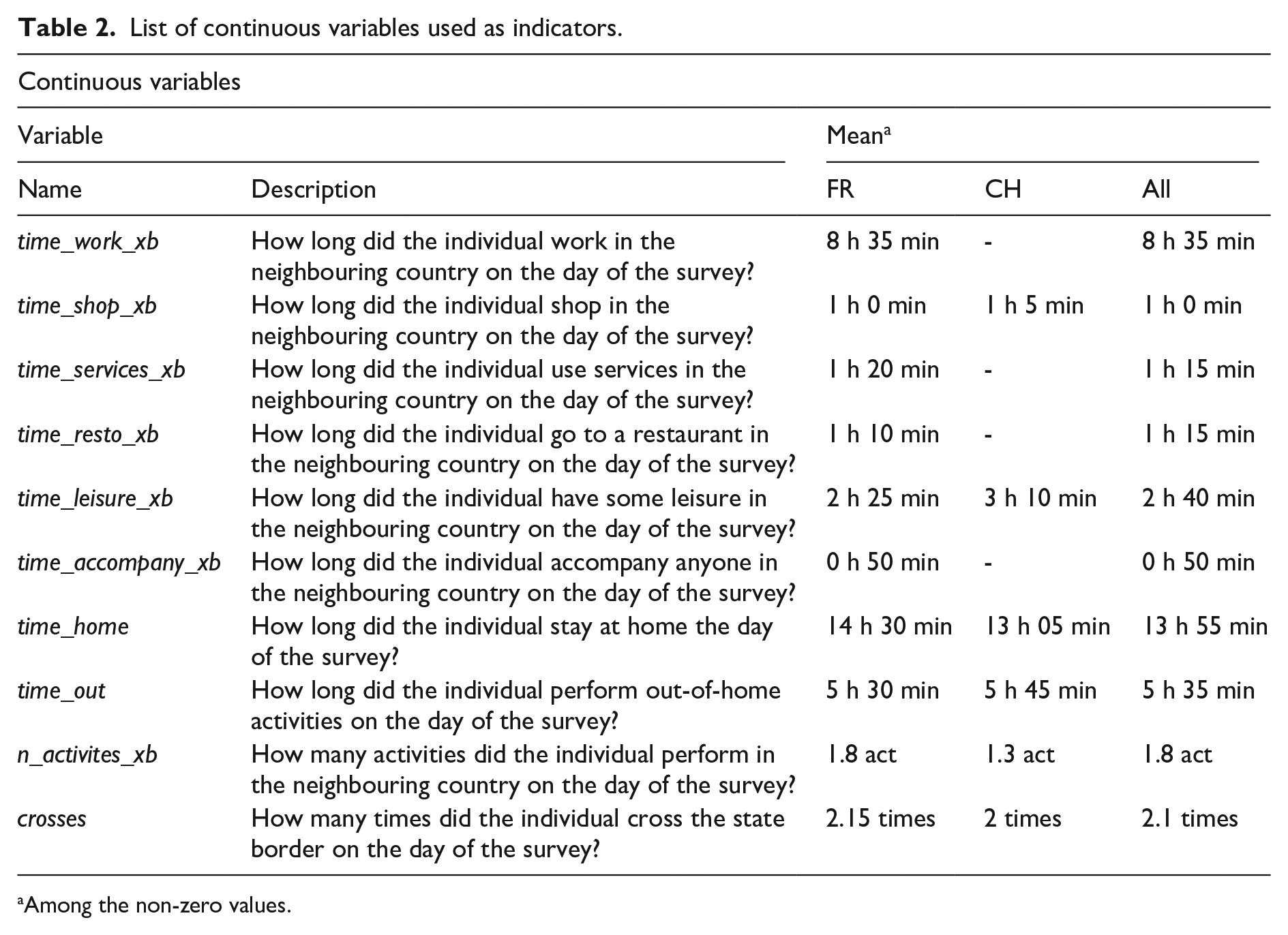
Among the non-zero values.
Figure 2 shows the resulting squared loads for the two principal components from our MCA after a varimax rotation. This geometric two-dimensional representation makes it easier to describe the underlying logics framing the deployment and the organisation of daily activities in Greater Geneva.
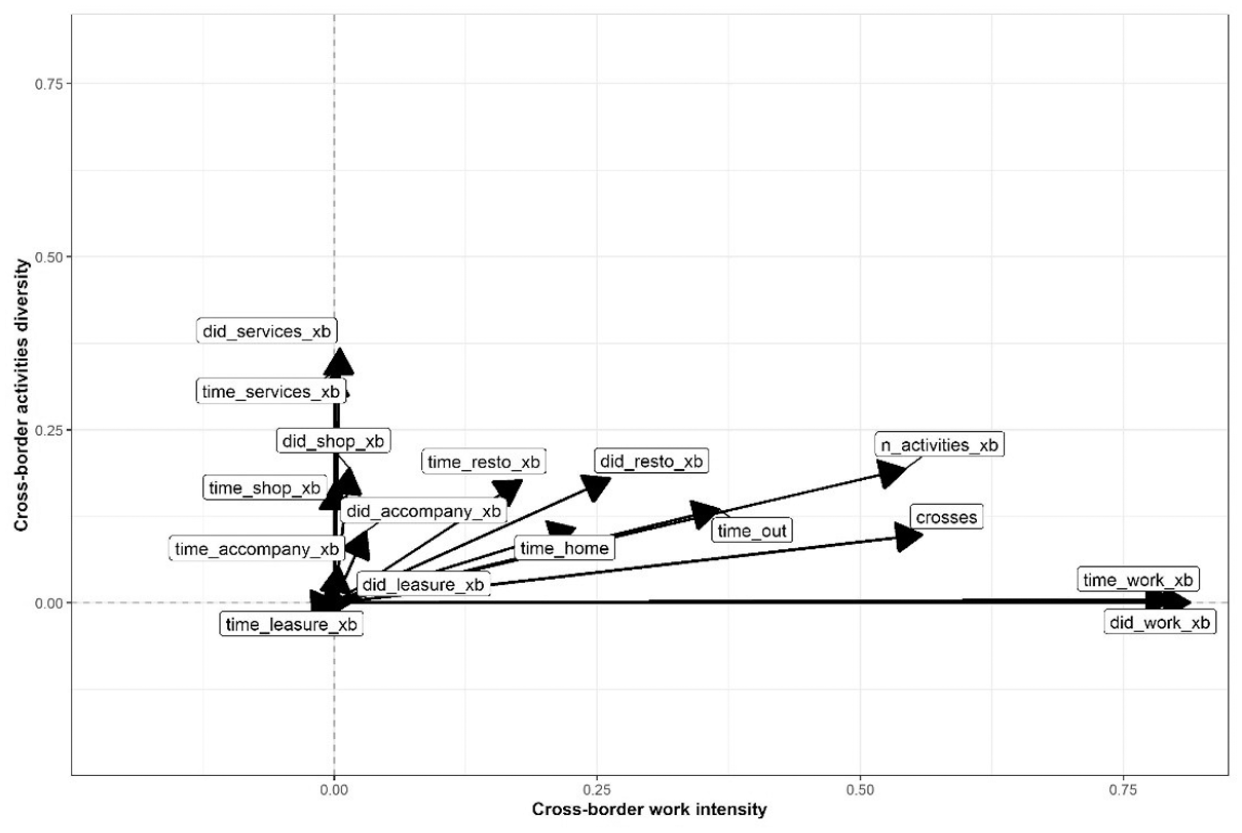
Squared loads for the two principal components.
The principal factorial plane (Figure 2) distinguishes two different “ways” of showing individual cross-border integration based on our indicators mentioned above. Our first principal component, entitled “cross-border work intensity” (horizontal axis, 23.8% of the variance explained), reflects the importance that the professional activity in the neighbouring country holds in Greater Geneva. The corresponding axis ranges from zero for the Boolean did_work_xb and no time of cross-border work (left-hand side) to one for the Boolean did_work_xb and high values for the duration of cross-border work (right-hand side). Other daily activities show low contributions to this principal component, apart from restaurant/bar activities. The explanation here is obvious since the latter activity is easier to “insert” between two time windows dedicated to a professional activity compared to more time and space consuming activities.
The second principal component, entitled “cross-border activity diversity” (vertical axis, 13.3% of the variance explained), deals with a combination of daily activities to be carried out in the neighbouring country. Thus, the upper part of the principal factorial plane will correspond to behaviours with a strong non-professional (services, shop and accompanying another person) presence on the other side of the state border and higher values for the corresponding durations. The lower part will concern behaviours that do not report such activities. Restaurant/bar activities are once again present on this axis, although we expect them to occur in “unconstrained” daily programmes, unlike the professional-related forms of restaurant/bar activities mentioned above.
Other indicators lie in intermediary positions and participate in the creation of both of our principal components. The number of activities carried out in the neighbouring country and the number of times individuals cross the border rely on cross-border work intensity and cross-border activity diversity. The higher contribution from n_activities_xb on the horizontal axis indicates that respondents often report several segments for their professional activity, such as interspersing with restaurant/bar activities. The same goes for crosses, which could be evidence of a tendency to combine non-professional activities once in the neighbouring country rather than multiplying round trips. Diagonal restaurant/bar indicators show that this activity can be part of professional activity-oriented days and non-professional activity-oriented days. Lastly, time_out and time_home are natural opposites as they are almost on the same line, but their coordinates reveal an antagonistic relationship between the two.
Going further, we project individuals’ socioeconomics as supplementary variables on the same principal factorial plane to explore the relationships between the social, spatial and typical daily behaviours in Greater Geneva (Figure 3). Given the latter diversity in terms of urbanity, and since MCA techniques facilitate the emergence of the most distinctive characteristics (Duval, 2017), we expect to find significant differences according to the characteristics of our sample.

Projection of supplementary social and spatial variables.
On the horizontal axis of the plane, relating to the degree to which people organise the day of the survey around work in the neighbouring country, we find about every French region on the right-hand half. This is a strong reminder of the importance of cross-border work on this side of the state border, where more than 50% of the working population travel to Switzerland daily in some municipalities. Nevertheless, we see important distinctions between Ain and Gex–Ferney, where individual cross-border integration is professional and non-professional, Bellegarde, where individual cross-border integration is mostly professional and Bonneville–Cluses and Thonon–Evian, where individual cross-border integration is much lower. At this stage, we hypothesise that a combination of factors ranging from distance to the border, cross-border transport infrastructures and regional unemployment rate to local development of real estate projects contribute to these specificities.
Moreover, men, higher educational levels, young professionals (between 25 and 49 years old) and more than two-person households with several private vehicles are all on the right-hand half of the principal plane. This is a first indication of the over-representation of these social categories among cross-border workers in Greater Geneva. We note that our sample reproduces the main trends observed by the cantonal statistics office in Geneva with regard to cross-border work. 1 In the lower left-hand frame, where cross-border work intensity and cross-border activity diversity are low, Swiss regions are located near individuals with secondary education and without any private cars. For most of the people concerned, these characteristics would therefore be obstacles to individual cross-border integration. This could be due to the structure of the Geneva cross-border labour market, which tends to employ in France for jobs in the tertiary sector 2 where qualifications are sometimes decisive (i.e. medical sector, specialised activities, etc.).
With regard to mobility, although this is bound to improve following the inauguration of new cross-border public transports, we think that the urban structure of French Geneva still makes the use of a car essential on a daily basis. We should also stress that public transport passes are widely democratised in Switzerland. Lastly, a few social categories (people over 65 years old, retired or non-occupied) cluster in the upper left-hand frame, showing low levels of cross-border work intensity but high levels of cross-border activity diversity. Although we expected this result, as people who do not have a job tend to have more time for other daily activities, we believe that it illustrates the importance of considering these populations when digging into cross-border integration, as their relationship with the neighbouring country reveals specific logics.
Our principal factorial plane illustrates the existence of multiple ways to maintain a relationship with the neighbouring country, and thus different forms of individual cross-border integration. It suggests that some populations are most likely to use Greater Geneva for professional purposes, while others only consider non-professional activities. Moreover, it also suggests a distinction between cross-border workers only considering Switzerland as a place to work and others for whom this situation leads to further activities there.
Cross-border daily patterns and individual integration
To deepen the diversity of the behaviours described in the previous section, we perform HCA on our data to identify five different cross-border daily patterns. We retained the first three principal components of our MCA according to the elbow plot (Figure 4), which altogether account for 50% of the total variance. Our groups, therefore, structure around individuals’ values of cross-border work intensity, cross-border activity diversity and leisure-only cross-border activity, 3 enabling hybrid forms of individual cross-border integration to emerge. We present a brief description of our five daily cross-border patterns in terms of the behaviours they reveal.
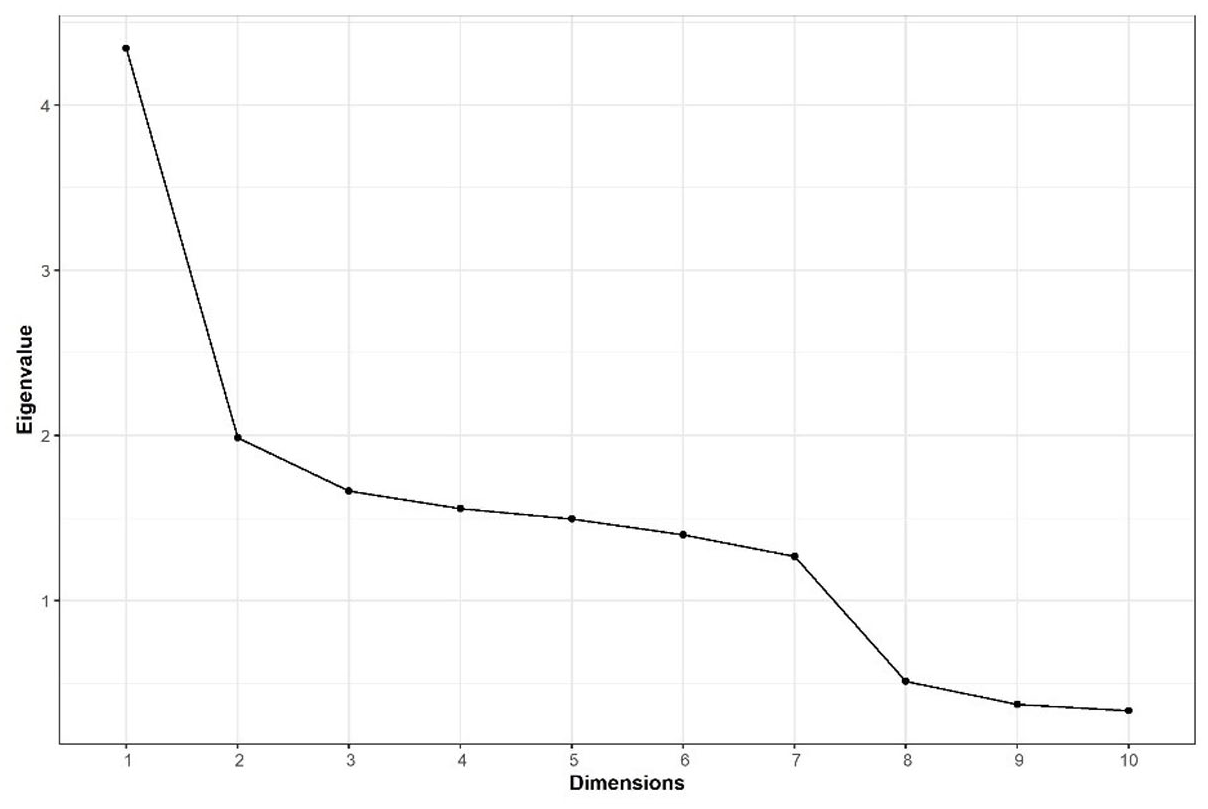
Principal components elbow plot.
No cross-border (“No-XB”): 78.9% of our sample. Behaviours without any activity in the neighbouring country. This pattern regroups all the surveyed days that took place, as a whole, in the country of residence.
Cross-border leisure (“XB-leisure”): 3.4% of our sample. Behaviours with usually one or two activities in the neighbouring country, with at least one being devoted to leisure. At least one leisure activity (3 hours as mean duration) for all surveyed days in this pattern, while other activities (mainly work or shop) are not excluded.
Cross-border buy (“XB-buy”): 3.4% of our sample. Behaviours with usually one or two non-professional short activities in the neighbouring country. It concerns shopping activities for more than 60% of the surveyed days in this pattern and services for about 25% of the surveyed days.
Cross-border multi (“XB-multi”): 4.4% of our sample. Behaviours with professional and non-professional activities in the neighbouring country. This pattern clusters surveyed days with the most cross-border activities (3.3 as a mean) and organised around work (7 hours as a mean). Going to a restaurant/bar is particularly visible, as it concerns about 75% of these surveyed days.
Cross-border work (“XB-work”): 9.9% of our sample. Behaviours with one or many professional activities but no others in the neighbouring country. We also find the heaviest workloads in this pattern (8 hours 45 minutes as a mean).
To illustrate the specificities of our daily cross-border patterns, we project each individual on our principal factorial plane with a unique colour referring to belonging to one of the five clusters (Figure 5). We highlight three principal challenges we can tackle with our HCA.
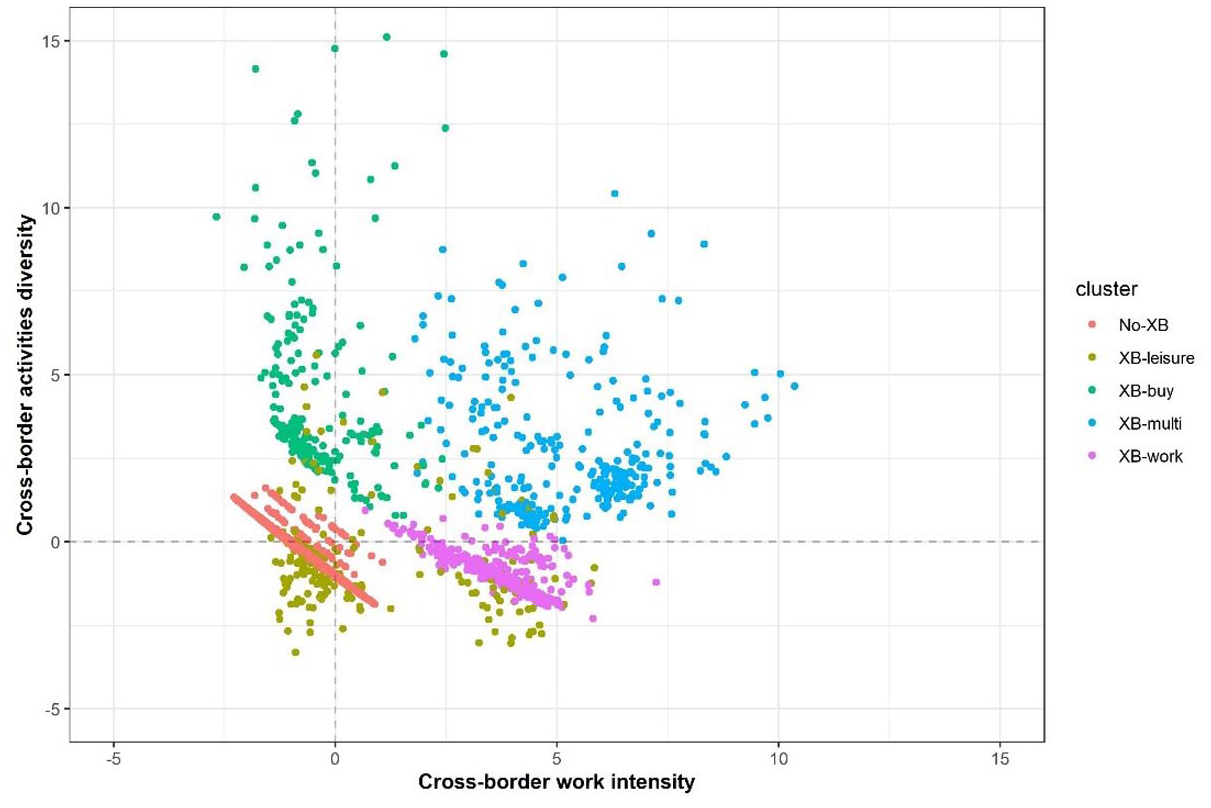
Individuals’ graph, segmented by daily patterns (colour online only).
Firstly, this classification gives us insights into the proportion of inhabitants in Greater Geneva who cross the border, for one reason or another, during the day of the survey. With 78.9% of our sample within the “No-XB” pattern, we show that a significant population does not travel to the neighbouring country daily, despite Geneva’s reputation as a highly integrated cross-border agglomeration. Despite the strong Franco-Swiss proximity, the state border remains a reality for a major population on the surveyed days, whether due to lack of interest, resources or information. We argue that our data sampling area, which corresponds to the institutionally defined perimeter of Greater Geneva, spread far beyond the region's functional core or, as Sohn et al. (2009) put it, its “metropolitan space”. Cross-border dynamics, including a competitive labour market and robust economic differentials, do not exert the same attraction for less urbanised spaces. For France, some medium-sized cities (i.e. Bellegarde) or more distant ones (i.e. Bonneville) show lower cross-border flows. For Switzerland, the time scale of the survey shows that more publicised practices, such as taking advantage of economic differentials for consumption, are marginal on a daily basis. By taking account of the entire resident population, we do not focus on a particular group (i.e. cross-border workers) that would necessarily engage with the border on a daily basis to conclude the level of cross-border integration at the agglomeration level.
Secondly, among the cross-border workers, we can see a difference between one group whose individual integration relies solely on their professional activity (i.e. “XB-work”) and another whose non-constrained activities also reveal an organisation on both sides of the state border (i.e. “XB-multi”). This is an important nuance, as it allows us to explore this inhomogeneous population (Bolzman and Vial, 2007) outside of their main daily activity. The majority of our cross-border workers subsample travel back to France as soon as they finish their professional activity, and they do not seize any other opportunity in Switzerland. Bolzman and Vial’s work shows that this is even more evident when their respondents work alongside a majority of cross-border workers daily. We take this result as a challenge to the idea that the mere fact of working in the neighbouring country is an effective driver of a wider individual cross-border integration. The predominance of the “XB-work” pattern (over “XB-multi”) can be understood as an example of what Latté and Hupfel (2018) refer to as “an economic mobility unaccompanied by any significant change of social behaviour”. Their work in Northeast France shows how working in Switzerland is a strategy for becoming more strongly and durably rooted in one’s region of residence. In addition, given that we do not know our respondents' nationality, we expect the “XB-multi” pattern to include a significant proportion of Swiss people who have moved to become homeowners due to the attractive land prices in France. These people would then keep most of their social life and habits on the Swiss side of the border, alongside their professional activity, which would constitute a case of “elastic migration” (van Houtum and Gielis, 2006), which also exists in other cross-border spaces (Carpentier, 2012; Clément, 2018).
These results allow us to elaborate on our first hypothesis. While many quantitative studies on cross-border regions focus on workforce exchanges as an indicator of their degree of integration (for example, Buch et al., 2009; van Houtum and van der Velde, 2004), we show that more than two-thirds of this population hardly linger in their country of work. Cross-border cooperation strategies aiming to decompartmentalise the Geneva labour market (in its current form) therefore do not guarantee greater levels of individual cross-border integration apart from professional activity. They could even increase socio-spatial inequalities, as we shall see in the following section.
Thirdly, to our knowledge, few studies deal simultaneously and at the individual level with multiple daily activities and with a broad range of populations residing in Greater Geneva and European cross-border regions in general. Exceptions include, for example, a study on trip chains around Luxembourg (Drevon et al., 2018) and a study on ways of life in the tri-national Basel region (Dubois, 2017a). This approach provides us with a structural perspective on the potential consequences of cross-border dynamics and how they affect everyday lives. It is not about making a difference between people who work or do not work in the neighbouring country nor knowing which people consume or do not consume in the neighbouring country, but rather to show that these behaviours are interrelated. In our case, they materialise in four types of daily cross-border patterns that need to be distinguished from each other. These patterns provide empirical evidence that “[a] border can be actively crossed in certain social practices at the same time as it is maintained as an element of difference in some other practices” (Paasi and Prokkola, 2008). Thus, we now turn our attention to the social and spatial conditions that favour (or restrict) the individual belonging to one or other of these patterns to provide comparative results.
Socio-spatial conditions for cross-border individual integration
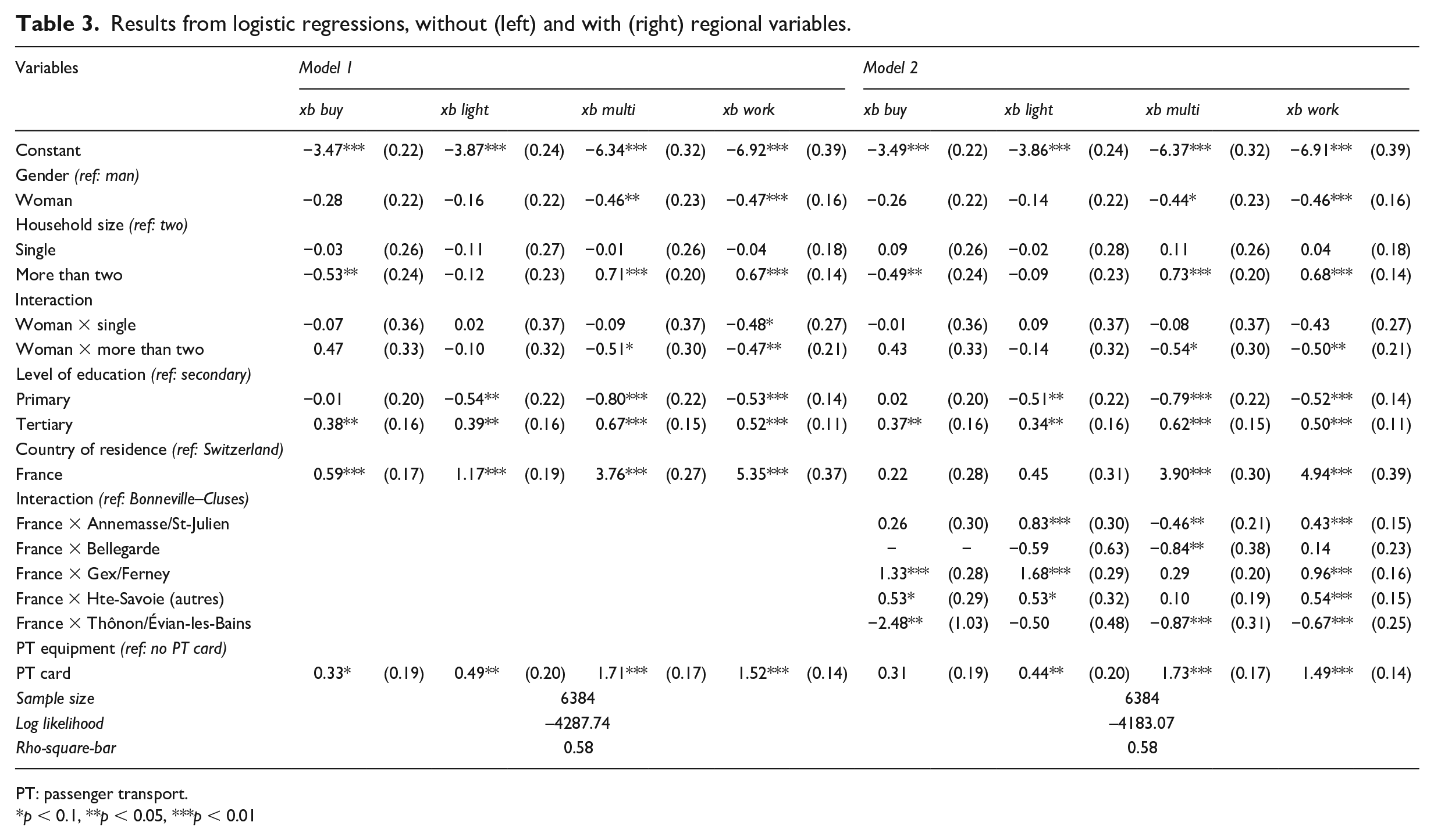
We perform multinomial logistic regressions 4 with membership of the daily patterns as our dependent variable (five categories, “no cross-border” as the reference) to explore the relationships between individuals’ socioeconomics and typical behaviours. In doing so, we approach daily cross-border mobility as the materialisation of a “continuous stream of activity” (Müller, 2016). We investigate the effects of the indicators retrieved and harmonised from the data collection process, the same as we projected on the exploratory principal factorial plane (Figure 3), and some of their interactions. We present the results in a two-step analytical process: the first specification considers the national scale for spatial variables, whereas the second specification integrates an interaction effect for the French side of the border at the regional level. In this way, we first direct our attention to the social conditions that enable each of the daily patterns under study before investigating what we believe to be an advanced form of regional functional specialisation. We could not do the same for respondents living in Switzerland, as daily cross-border behaviours remain exceptional for them.
Model 1: Social conditions
Our first specification (Table 3, left) shows right away that access to the neighbouring country in Greater Geneva, regardless of the undertaken activities, is strongly conditioned by the level of education. This effect has already been identified as crucial in the cross-border (Belkacem and Pigeron-Piroth, 2011) and transnational (Kuhn, 2015) literature. We believe that this is not only a sign that the tertiarisation of the economy has made the labour market more and more competitive, but also that the consequences of Geneva’s “monocentric” urban model of attractiveness (Sohn and Stambolic, 2015) now extend to the exercise of extra-professional activities. “XB-buy” is the only daily pattern not to be over-represented among populations with a tertiary education level and under-represented among populations with a primary education level. We think of two principal factors to explain this situation. The progressive economic development of the region has gradually led to an upward levelling of the local cost of living – especially on the French side of the border via the cross-border workers’ wages, resulting in higher prices for land, products and services. The economic differentials would then no longer be attractive enough for all Swiss residents, while only the skilled and high-income French residents would be eligible for consumption in Switzerland. This result is also to be read in light of the work from Spierings and van der Velde (2013), who noted in their Dutch–German case that consumption practices in the neighbouring country decrease over time. Another reason is that French Geneva is a region with a high proportion of residential migration, with the most highly educated populations being the most willing for that type of mobility. The dynamics of cross-border metropolisation would then coexist with a form of socio-spatial segregation, as may also be the case in Luxembourg (Diop, 2011, 2013). Still, we would need more information regarding individuals’ economic capital to verify these hypotheses.
Results from logistic regressions, without (left) and with (right) regional variables.
PT: passenger transport.
p < 0.1, **p < 0.05, ***p < 0.01
We also find significant relationships between daily cross-border patterns, gender and household size. We relationally interpret these social categories since their interaction reveals interesting insights. Compared to men, women present a lower tendency for any of the two daily cross-border work patterns, as other studies have already shown in Greater Geneva (Delaugerre, 2011) and other border regions (Broersma et al., 2020). This is true despite the health sector being among the largest providers of jobs in the region, increasing the number of women cross-border workers. Other predominantly male sectors (construction, manufacturing, transport, administrative services, scientific activities) structure the institutionalised regional labour market. Technical reports also highlight the fact that the employability of men with a low level of qualifications remains significantly higher than that of women in the same situation. 5 Following this line, we could expect an over-representation of a young and single (male) population at the beginning of their professional careers in both of these clusters.
Nevertheless, we find that working in the neighbouring country is more likely to be available to family household members (more than two people) who are in an intermediate and more stable position in their life course. We believe this result is evidence of situations with a need to balance between increased financial needs and the imperatives that a family household imposes on daily activities. Daily commuting across the state border is also proving to be a more attractive solution (rather than migration) for households that are more rooted in their region of residence, for example, through homeownership (Nowotny, 2014). Here, we can imagine the existence of logics similar to the Franco-Swiss region of the Jura Arc, where daily cross-border mobility is favoured by family households seeking a suburban residential context (Rérat et al., 2011).
When we look at the coefficients for the gender–household size interaction, we find a significant negative role in “XB-work” and “XB-multi” daily patterns. This means that not only are women (compared to men) less inclined to cross-border work, but they are even less so when they are part of a family-type household, that is, with more than two people. Thus, our results highlight that among the “border effects”, it would be important to question the adjustments that occur within the households to identify the reasons that lead to differentiated spaces of daily activities (across or within the country) between men and women. We think of several reasons that contribute to this result. Firstly, it is in line with other research that identifies, in European contexts, that home–work distances are longer for men than for women (Orfeuil and Ripoll, 2015). Secondly, when a new child arrives, social structures still contribute to the cessation of mothers’ employment, making them hardly eligible for cross-border employment when in a relationship. In this line, we can assume that most activities related to young children (nursery, school trips, etc.) are still taken care of by women. This would lead to a tightening of women’s space of daily activities close to their household’s home, especially since early childhood institutions are only rarely “integrated” on a cross-border basis. Finally, we mention that Gottholmseder and Theurl (2007) have already identified that having children restricts access to cross-border work for one of the household members in another neighbouring Swiss context, Austria.
We note that there are no significant effects of gender or household size with respect to the two non-professional cross-border daily patterns, except that families (more than two people households) tend to present “XB-buy” behaviours less often than other household types. This suggests a tendency to centralise certain extra-professional activities close to home when the household size increases, often decreasing available time.
Our results also point to the importance of mobility equipment when it comes to daily cross-border patterns. Having a public transportation card significantly increases the probability of going to the neighbouring country to do any activities, which suggests that it is a prerequisite to cross state borders on a daily basis. Given a sometimes-significant financial investment, it reduces the transport system's discontinuities, which are often crucial in border contexts (Dubois, 2019). That said, we see a growing interest in public transportation infrastructures among cross-border cooperation actors (for the importance of cross-border transport on integration, see Medeiros, 2019). This trend promises not only an increase in the use of these modes of transportation (Schiebel et al., 2015), but also an increase in the dependency they entail.
In our first specification, we control all the results with a binary spatial variable (i.e. Switzerland/France) that measures each individual’s place of residence. Obviously, working in the neighbouring country is much more present on the French side of the state border, judging by the value of the associated coefficients. More interestingly, our results reveal that the other cross-border daily consumption and leisure patterns are also more often undertaken from France towards Switzerland. This would therefore contradict Decoville et al.’s (2013) results that, in their words, present Greater Geneva as an integrated region by “specialisation”, whereas we show that it is rather a case of “polarisation”. In other words, our respondents are more likely to demonstrate each of the cross-border behaviours we study when they live in France, that is, where the standard of living – in terms of average income – is lower. These results enable us to question the approach to cross-border behaviours as independent daily actions, out of economic interest or purely rational. We argue that activities undertaken on the other side of the border are conditional to each other and are rooted in routines and habits invisible on a daily basis. This explains why, despite the differences that we have uncovered, we find that the populations making up the different daily patterns share similar characteristics, especially regarding education level. However, as mentioned above and in the literature (Durand et al., 2020), our research area remains deeply affected by cross-border differentials as a whole. Nevertheless, we argue that the most important resulting functional specialisation is the one operating on one side of the state border (i.e. in France) rather than the one operating across the state border. We now turn to our second specification of the model to support this result.
Model 2: Social and spatial conditions
The second specification of our model aims to detect effects specific to each of the French regions in our research area. To do this, we leave the national level binary variable (i.e. Switzerland/France) in the model and add, for France respondents, a variable capturing their region of residence (six altogether), using Bonneville/Cluses as the reference.
Firstly, this step does not induce significant effects on the other coefficients in the model, confirming our previous interpretations for the first specification. However, we can see that the addition of variables at the regional level distinctly modifies the “France” coefficients according to daily patterns membership. The “XB-multi” and “XB-work” coefficients are now the only ones that are positive and significant, while “XB-buy” and “XB-leisure” are now below the 0.1 significance threshold. This means that while the practice of cross-border work in Greater Geneva is a characteristic peculiar to the French area, residents of this side face different conditions of possibility/necessity for consumption and leisure behaviours on the other side of the border.
These conditions are due to the combination of at least two morphological factors in the agglomeration in line with previous research (Chilla and Heugel, 2019): the proximity (or accessibility) of a region to the border with Switzerland and the urban functions available to its residents close to their places of residence. In Gex/Ferney, in a predominantly suburban area directly adjacent to the state border, these two cross-border behaviours are particularly over-represented. Annemasse residents, whose recent development increasingly anchors it as a central urban core of Greater Geneva, show a trend towards cross-border leisure activities, but not shopping/services. The same applies to the more distant Thônon/Évian-Les-Bains, but in even higher proportions. The worsening conditions of access to the other side of the state border seem to disqualify these residents from shopping in Switzerland.
Our results demonstrate a dynamic of functional specialisation, which, although it stems from cross-border differentials, operates mainly on the French side of the agglomeration. While some municipalities and their populations are firmly “polarised” by the presence of another country close by – and especially the City of Geneva – others are only partially (if not at all) interested in or benefiting from “cross-border resources”. We see two important implications for these results. Taking a step back from our last specification, we see that the dispositions to the four daily cross-border patterns follow the same general trend. In regions where cross-border work behaviours are particularly developed, this is also the case for cross-border leisure and shopping/services behaviours, and vice versa. More than the mere consequence of the Greater Geneva spatial organisation, we believe this alignment reflects the driving and mandatory role played by the structure of the labour market on cross-border behaviours. In other words, it is especially in regions where the functional integration is high that the opportunities to cross the state border are the most accessible. This brings us to our second point. Our results show that it is too simplistic to think of border areas and their integration in terms of the opposition between two (or more) countries on either side of a state separation, especially in Greater Geneva. Going down to the regional level bears witness to the specialisation of a French space where cross-border integration is not only more or less at work, but above all, where its consequences are more or less visible.
Discussion and conclusion
Through our findings, this article contributes to a renewal of studies on cross-border integration that is more comprehensive, more focused on individual practices and more interested in local realities with Greater Geneva as a case study. About our main hypothesis, our methodological approach enabled us to identify five daily patterns that bear witness to different forms of individual cross-border integration (HP). We have shown that, although it is a widespread phenomenon in the region, working on the other side of the border is not enough for and leading to carrying out extra-professional activities abroad (H1). On the contrary, it seems that such an organisation is rather an exception. In addition, our regression models are unanimous, as the inhabitants who have access to cross-border work have privileged social and spatial conditions to do so (H2). Those with lower education levels, women – especially when they have children – and the least equipped people in a region where transport infrastructures are plentiful but where the cost of living is rising, are less likely to find themselves in such a situation. These populations are also the least numerous to present a daily cross-border programme that is not exclusively devoted to professional activity before “coming home”. Finally, we note that these unequal conditions of possibility affect not only the labour market but also other daily activities in the same way (H3). The programme of activities approach shows that work operates as the driving force behind daily cross-border patterns and that consumption or leisure follow similar trends, both socially and spatially.
From a functional perspective (Drevon et al., 2018), the results contribute to raising the issue of the overlap between “metropolitan” and “border” effects on daily mobility behaviour and daily activity location within Greater Geneva. In our case study, both effects operate interdependently and influence everyday spatio-temporal behaviour. On the one hand, Geneva polarises amenities and the labour market in the same way as a city without a national border (metropolitan effect), including in its “French periphery”. On the other hand, Greater Geneva is characterised by some of Europe’s largest border differentials. Our findings illustrate at least two specific consequences of the distinction arising from the “border” effect. Firstly, access to the metropolitan core (i.e. Geneva) from the French side is becoming a privilege for certain social classes with higher incomes living near the border. Secondly, important comparative advantages regarding consumption exist due to the Franco-Swiss border context. We argue that the most vulnerable populations are also the most sensitive to these economic differentials, as many Genevans do not cross the border for these purposes. This intuition could be completed by accounting for different border differential indicators (consumption costs, access to services, etc.), showing how they influence daily activity location.
Our work stresses the importance of addressing the consequences of cross-border dynamics on different scales interdependently. On the one hand, it is essential to start from a comparative, transnational perspective to measure the differentials (economic, administrative, legal, etc.) at stake. On the other hand, it is essential to adopt a smaller scale – sub-national or local – to translate the consequences of these differentials on daily behaviours. The latter may follow, ignore or even resist these dynamics. In our case, the extent of the cross-border work phenomenon is part of the urban space’s reconfiguration, but the mechanisms of functional specialisation operate mainly on one side of the border, in France. We situate our approach to cross-border integration somewhere between the flow approach – by measuring commuting flows (but not only) between France and Switzerland – and the people approach – by not taking for granted a good (or bad) functioning of the agglomeration based on the importance of these flows. Rather, it is by observing daily mobility practices and the populations concerned that it is possible to assess whether this integration does not reinforce certain socio-spatial inequalities.
With this in mind, it is essential not to marginalise some fringes of the local inhabitants from the analysis. There is a great deal of work on why people (especially cross-border workers) cross the border. There are far fewer who linger on those who, for lack of opportunities or interest, maintain a space of activities that does not extend outside Switzerland (or France), despite the French (or Swiss) proximity. We are helping to fill this gap by showing, for example, that retired people rarely go on the other side of the border but that they do spend time there on a few occasions. While our sample size did not allow us to do so, taking an interest in young people would also be important to better understand their relationship with cross-border living spaces. At this point, we note that the increased interest in the most mobile daily behaviours is part of the standardisation of cross-border practices, which tends to enhance their value both in the academic world and in European institutions.
In this article, we try to adopt a viewpoint that does not seek to be prescriptive and does not consider increasing cross-border flows to be an objective at all expenses. This means that the 80% of the Greater Geneva inhabitants who did not cross the border on the day of the survey should not be seen as a “potential” but as individual behaviours rooted in obligations, routines and habits that go far beyond cross-border issues. Above all, it is to be hoped that as few of these individuals as possible have been forced to question a well-established programme of activities because of the increase in cross-border flows. Beyond the debates on the different approaches to cross-border integration, the question here is whether it is desirable, and if so, by what means it could benefit all the inhabitants directly concerned.
In the case of Greater Geneva, the urban policies (in terms of transport infrastructures, housing, trade agreements, etc.) carried out over the last 20 years have led to a strong interdependence between new job opportunities and a cheaper workforce in the French region. This has resulted in the significant economic growth of the agglomeration and, on the global scale, comparative advantages in the competition that rages between western cities. This has also resulted in a strong specialisation of the labour market, residential spaces (mainly on the French side) and cross-border commuting mobility. Thus, individual cross-border integration mainly constructs itself through the prism of the labour market, regardless of personal situations in this respect. For some, the neighbouring country represents a sustainable income source but does not represent an opportunity for extra-professional activities. For others, it is still an “unfamiliar” place (Spierings and van der Velde, 2008), and there are specific and planned reasons for going there. These elements lead us to propose a reversal of perspective about the widespread idea of a Greater Geneva with a strong “functional integration”. Our analyses show that the agglomeration is in a situation of functionalising its integration, where it is a question of definition for what – and for whom – it is important to facilitate cross-border flows. This perspective is promising for at least two reasons.
Firstly, it leaves room for better identification of specific socio-spatial inequalities related to the border crossing. This includes broad dynamics, such as the increase in the spatialised socio-professional mix in the French part of Greater Geneva, resulting from the wage differential between border and non-border workers. This allows French employees and Geneva workers to have economic capital that gives them access to real estate reserved for wealthier social circles. This is also the case of social dynamics based on the maintenance, or immobility, on one side or the other of the border, as in the case of wealthy French residents whose situation does not depend on wage differentials on either side of the border. Secondly, it is a first step towards giving greater weight to the trade-offs – including family ones – that arise for households in the cross-border agglomeration. As we have shown, borders in some cases reactivate a gendered division of daily activities, with women having less access to the neighbouring country. It is important that we no longer see border crossing as an end in itself but as a response to needs and constraints that materialise in everyday life.
With this perspective in mind, it would also be possible to go beyond our research's limits, most of which stems from the costly process of data harmonisation between different national sources. Even though we have highlighted the inequalities in Greater Geneva, we lack information on the economic capital of our respondents. These elements could prove crucial in identifying ways of handling cross-border differentials that not just affect wages but also transport and housing costs. Although this phenomenon remains limited, we could not observe cases of “elastic migration” (van Houtum and Gielis, 2006) since we do not know the nationality of our respondents. We expect that some daily cross-border mobility is more of a homecoming than a leap into the unknown, which would not entail the same implications. Lastly, it is crucial to foster large quantitative surveys at the individual level in cross-border agglomeration to explore the diversity and complexity of border-related behaviours. While our data is already very valuable in that sense, it was not exhaustive enough to (a) focus on the inter-individual interactions conditioning daily mobility practices of the inhabitants or (b) highlight specific behaviours where individuals do not cross the border on a daily basis (i.e. in Switzerland). This means that there is still a lot to do in order to denaturalise border regions and the dynamics they entail.
Footnotes
Acknowledgements
We would like to thank Dr. Ander Audikana, Dr. Garance Clément and Dr. Laurie Daffe for their insightful and extensive comments on this paper. We are also thankful to the reviewers and editors for their feedback throughout the publication process.
Declaration of conflicting interests
The author(s) declared no potential conflicts of interest with respect to the research, authorship, and/or publication of this article.
Funding
The author(s) disclosed receipt of the following financial support for the research, authorship, and/or publication of this article: This work was supported by the Swiss National Science Foundation (Grant No. FNRS 10001A_179555).
