




Abstract
The entire aviation industry was severely hit by the COVID-19 pandemic, leaving airplanes stranded and airports empty of the usual hustle. While the full consequences of this crisis are yet unknown, it only adds fuel to the ongoing debates about the future of the aviation sector, including airport capacity and environmental challenges facing many hub airports around Europe. While conventional aviation research describes the development of hub airports as a function of varying geo-economic variables, this research sheds light on the societal underpinnings of the makings of hub airports. From an airport governance perspective, a case study of four European hub airports, representing both expanding and struggling hubs, was conducted. Based on interviews with 31 airport stakeholders from four different countries (i.e. Belgium, Finland, the Netherlands and Switzerland) as well as a review of strategic and policy documents, the authors argue that the development of hub airports and their corresponding governance models is a non-linear process, informed to a great degree by societal and discursive factors. The authors conclude that developing and sustaining a well-functioning hub airport that supports regional development necessitates an active stance from local, regional and national authorities. A clear and strategic governance model is needed, one that is not limited to ownership and regulation questions, but one that guarantees a wide-ranging consensus among airport stakeholders. Finally, the paper provides a perspective on future potentials and challenges facing European hub airports.
Introduction
Against the backdrop of ongoing debates about the future of the aviation sector, this paper discusses the production of aeromobilities at hub airports. While the many challenges related to capacity constraints, expansion plans and environmental footprints of hub airports became temporarily dormant because of the COVID-19 pandemic, these issues will come back with full force once the industry has recovered. As Doganis (1992) highlighted, airports are complex enterprises, acting as nodes of interchange for passengers and freight that are shaped by historical, legal and commercial reasons. Airports are also contested places, where commercial, operational and environmental agendas clash, often leading to fierce opposition to the growing externalities, such as noise or land-use changes (Dierkx and Bouwens, 1997). Airports in general, and hub airports in particular, are extremely important economic assets fostering regional development (Bowen and Cidell, 2011; Martin and Voltes-Dorta, 2010). As highlighted by Niewiadomski (2020), local and regional authorities see airports as gateways to the global economy, investment and tourism, and a source of competitive advantage, hence a condition sine qua non of regional development. While it is difficult to establish the extent of the many direct, indirect, induced and catalytic impacts, as well as the direction of causality (Goetz, 2015), there is near unanimous agreement that air accessibility is an ‘economic multiplier and serves as a critical factor influencing company location decisions’ (Niewiadomski, 2020: 174). This is the very business rationale of the myriad of airport city or aerotropolis developments sprouting at airports around the world, which reinforce this economic mechanism.
Conventionally, hub airports have been defined by their relative position within an aviation network, where the hub is the intermediate airport facilitating transfer between two locations, thereby exceeding the passenger count that could be sustained based solely on the size of its local catchment area (Budd and Ison, 2016; Hoyle and Knowles, 1998). In other words, hubs derive their meaning from the operations of a network carrier within a hub-and-spoke business model. Historically, 1 they were passive pieces of infrastructure rather than active players having a say in shaping the aviation market (see Bloch, 2018).
Such a static understanding of airports is no longer appropriate, as the increasingly turbulent and unpredictable aviation sector brought along significant variations in terms of transfer passenger traffic at various hub airports that cannot be explained by geo-economic variables on their own, for example, simply by referring to the catchment area characteristics (Burghouwt and Dobruszkes, 2014). The wave of privatization and liberalization sweeping through the industry in the last decades (Doganis, 2010) accompanied by the birth of new airline business models, particularly the low-cost carriers (LCC) (Burghouwt et al., 2015), meant that airports found themselves in a competitive landscape and, as such, needed to redefine and reorient themselves toward a new, more dynamic and interconnected market environment. With LCCs characterized by a more unconfined attitude, and traditional network carriers adopting some of the characteristics of LCCs (Thelle and Sonne, 2018), airports increasingly need to actively engage with airlines to attract new route offerings. This more dynamic landscape provides both opportunities, that is, by increasing the ease of establishing new routes and improving connectivity, and challenges to international hubs.
However, as we will show in this article, not all hubs are created equal. While some, like Amsterdam Schiphol and Helsinki Airport, have expanded as hubs, others, like Zurich Airport and Brussels Airport, have experienced the grounding or bankruptcy of its major network carrier, which left a glaring gap in the airports’ transfer passenger numbers. This article addresses knowledge gaps indicated by Goetz (2015) and Niewiadomski, who highlighted a dearth of research ‘on how the institutional, political and socio-cultural features of the places which airports represent shape air transport “from below”’ (2017: 5). In his further research on the relation between local/regional institutions and airports, and its impact on regional development Niewiadomski notes that ‘the involvement of local/regional institutions in shaping aviation “from below” has been explored very negligibly’ (2020: 173-174). Most notably, this topic was partly addressed by Cidell (2013), when discussing planning issues around the modernization of O’Hare’s International Airport, and Bowen and Cidell (2011), where the authors discuss airport mega-projects. While this article picks up these threads, unlike Niewiadomski’s account of regional airports in one country, here we focus on four hub airports from four different countries, thereby eliciting the context-specific political, historical, socio-economic and cultural dimensions that shape aeromobilities. By analysing four cases of European airports, we address the following research questions: How do different airport governance models shape the production of aeromobilities at selected European hub airports? How do these models help cope with challenges faced by hub airports?
The study presented in this article is part of a broader Danish research project investigating the future of airport cities, particularly focusing on the developments at Copenhagen Airport in recent years (Lassen and Larsen, 2020). 2 The article argues that developing European hub airports is a non-linear process, informed to a great degree by governance models that reflect societal and discursive factors. We conclude by highlighting that developing and sustaining a well-functioning hub airport that supports local and regional development necessitates an active stance from local, regional and national authorities. For this to happen, a clear and strategic governance model, guaranteeing a wide-ranging consensus among airport stakeholders, is necessary.
The following article falls into four parts. First, the article presents the theoretical foundation, from aeromobilities research and its understanding of hub airports to a new framing of airport governance. Second follows a description of data-collection methods regarding the selected European hub airports. Third, the results of the study are analysed and discussed. Finally, a conclusion and further perspectives are offered.
From conventional aviation toward aeromobilities research
The analysis in the article is founded in an aeromobilities approach. The conventional approach to aviation practice is often rooted in a ‘predict and provide’ mindset, where the primary focus lies in capacity expansion in response to a forecasted rise in demand (Cwerner et al., 2009; Dray, 2020; Goulden et al., 2014; Griggs and Howarth, 2019; see also Whitelegg, 1997: 14, 88). Under this approach, the aviation system (airlines, airports and air travellers) has mainly been considered a closed system with little or no focus paid to the broader context within which aviation is located and has not included the societal and cultural embedment and importance of aviation (for a larger discussion see Bloch, 2018; Lassen, 2009). Such an approach leaves the practitioners potentially blind to many of the patterns of meaning behind developing aviation, forces that can only be fully understood with more diverse qualitative methods (Lassen and Jensen, 2006).
For these reasons, this study takes its point of departure in aeromobilities research, a subfield situated within the broader field of mobilities research (Adey, 2010; Cresswell, 2006; Jensen, 2013; Kaufmann, 2002; Urry, 2000, 2007). Such a new turn toward mobilities aims to place mobility at the heart of the analysis of society and develop an understanding of how mobility forms and reforms the society. In this approach, movement should be understood not only as mobility but rather as mobilities in the plural, including various forms of corporeal, physical objects, and imaginative, virtual and communicative mobilities (Urry, 2007; see also Lassen, 2019a).
In this context, aeromobilities research departs from the conventional ‘predict and provide’ approach prevalent among aviation professionals and offers a more transdisciplinary focus on how aeromobilities are produced, reproduced, conducted and regulated in relation to various spaces, networks, systems and environments, as a way of ‘opening’ the ‘black box’ of flying (Lassen, 2006; Lassen and Larsen, 2020). This theme in aeromobilities research also indicates a need to bridge multiple scales connecting international air systems to local urban transformation processes and their consequences (Jensen and Lassen, 2011). Cwerner (2009) further argued that, thanks to this wide-reaching approach, many more dimensions of the aviation sector can be researched (e.g. by looking closely at technology, community, governance, time/space perceptions, social interaction, urban development and the environment).
Understanding hub airports through the lens of aeromobilities research
Within social sciences, airports have become somewhat demonized, epitomizing the placelessness (Relph, 1976) and the non-place (Augé, 1995), largely due to their generic design, common sign language and communication experience. However, Urry (2007) argued this is not the case, as airports increasingly have their own distinct identity, even if only because of branding undertakings. Sheller and Urry (2006) argued that airports should be understood as complex socio-technical assemblages. Another way of conceiving airports in mobilities research is to see them as prime examples of fixities and moorings that mobilities hinge upon (Cresswell, 2010); however, such a binary account of mobility/fixity is being questioned by pointing to the relational processes of ‘infrastructuring’ as central to the understanding of infrastructures (Adey, 2006b; Merriman, 2016). Even though airports are commonly seen as emblems of globalization and commodification, Kesselring (2009) and Cidell (2006) underlined their embeddedness in site-specific social, economic and political norms. Airports are also seen as places of friction, or liminal places, where movement is slowed or stopped (Cresswell, 2014; Mountz, 2010). Just as importantly, they are contested places, being the focal points of many local protests against aviation’s externalities, such as noise, air pollution and their impact on climate change (Kesselring, 2009). Moreover, as shown by the 2019 pro-democracy protests in Hong Kong and the Catalan protests, global hub airports can act as ‘mobile agoras’, sites of political manifestation and making of publics (Jensen, 2020). Accordingly, to better address the challenges to the continuous growth of aviation, aeromobilities research needs to focus on the ‘existing relations between social, spatial and environmental consequences’ (Lassen and Galland, 2014: 149). Against this backdrop, hub airports are in this article understood as relational, contested places embedded in ‘local and national cultures, histories and uses’ (Adey, 2006a: 360) lying at the heart of modern-day aeromobilities production.
Toward a broader understanding of airport governance
The following analysis of European hubs is theoretically founded on an aeromobilities framework with a particular focus on airport governance. As mentioned earlier, airline market liberalization caused the balance of power between airports and airlines to shift significantly, spurring new airport governance models. This topic has increasingly gained the attention of academia, as airports are no longer mere public utilities, but modern businesses operating as two-sided platforms, catering to airlines on the one hand (aeronautical), and passengers and tenants on the other (non-aeronautical) (Gillen, 2011; National Academies of Sciences, Engineering, and Medicine, 2009; Niewiadomski, 2020). Concurrently, changes in ownership and governance structures occurred, with many airports becoming privatised to a greater or lesser extent, with Gillen (2011) differentiating at least seven ownership/governance structures. In turn, this prompted new economic regulation models, which enabled researchers to study the relationship between ownership and governance structures on the one hand and airport performance on the other (Adler et al., 2015; Assaf and Gillen, 2012; Czerny et al., 2016; Gillen, 2011; Littlechild, 2018). However, reducing a governance model to ownership structures and whether an airport is operated by a public or private entity is too narrow. As pointed out by a summary report on airport governance issued by the National Academies of Sciences, Engineering, and Medicine, ‘[a]lthough professionals and academics from multiple disciplines have attempted to extract commonalities among airport governance structures, no associations have been definitively established’ (2009: 5–6). This report further underlines that focusing on financial efficiency and performance overlooks the interests and goals of the airport sponsor or other stakeholders.
In line with Stanley (2017), who indicates that deliberative stakeholder engagement might minimise the negative impacts of private interests at an airport, we argue that societal underpinnings and stakeholder involvement should be integral to airport governance. This research builds upon the general understanding of governance as proposed by Jessop (2000). Jessop sees governance as a tool to organize groups or individuals from different societal areas and levels through dialogue, negotiation and cooperation. It is a tool to coordinate common decisions and ultimately to bridge the gap between market and state (Jessop, 2000). While it is common in the relevant literature to see issues of governance and ownership structures as inseparable (Assaf and Gillen, 2012; Gillen, 2011), this article proposes to see governance as more than a simple reflection of the owner–operator relations.
There is no denying that who owns an airport or what the shareholder mix is are in many cases instrumental to an airport’s performance. Nevertheless, looking primarily at ownership structures and economic regulations is insufficient to understand the full picture. Other formal or non-formal networks of actors, with varying degrees of agency, shape the development of hub airports in ways that go under the radar of academic investigation. Therefore, drawing on Jessop’s understanding of governance (2000), we propose that airport governance should incorporate stakeholder engagement to a greater extent. Focusing on local and regional stakeholder involvement and partnerships makes it possible to fully tap into the potential benefits of having a strong hub airport for regional development.
Methods and sample
The study of European hub airports has been developed under the aeromobilities framework, requiring a transdisciplinary set of methods relying on both qualitative and quantitative methods to collect the data (Cwerner, 2009; Lassen, 2019b). The overarching research design relied on a case study approach, where cases were selected according to the information-oriented selection principles with a particular focus on ‘extreme/deviant’ cases compared with Copenhagen Airport (Bloch and Lassen, 2016; Flyvbjerg, 2006). For this reason, the following four European hub airports were selected:
Amsterdam Schiphol Airport (AMS), which had a similar number of passengers as Copenhagen Airport (CPH) up until the late 1980s (e.g. in 1986 there were 11.8 million passengers at AMS compared with 10.7 million at CPH) and which was more than twice as big in terms of passenger numbers as of 2019 (Copenhagen Airports A/S, 2020; Copenhagen Statistical Office, 1987; Royal Schiphol Group, n.d.; Statistics Netherlands, 2016). The airport has also managed to maintain a steady share of transfer passengers from 2000 onwards, ranging from 36.6% (2019) to 43.3% (2009) in this period (Royal Schiphol Group, n.d.);
Helsinki Airport, as an outstanding example of an expanding hub, which has nearly doubled its transfer passenger share from 20% in 2000 to 38% in 2019 (Finavia, n.d.);
Brussels Airport, as an airport that witnessed the bankruptcy of its main hub carrier, Sabena, and which has not managed to recover its transfer passenger share since (Brussels Airport, 2019; Observatorium voor Toerisme te Brussel, 2002, 2004);
Zurich Airport, as an airport that has weakened its hub position in the early 2000s, when Swissair fleet was grounded, and that has struggled to recover their transfer passenger numbers and share ever since (Zurich Airport, n.d.-a).
This selection represents two airports that have managed to maintain or significantly increase their transfer passenger share, and two others which saw their transfer passenger share significantly reduced since the turn of millennia (see Table 1, Figures 1 and 2).
Case Airports and Selection Criteria.
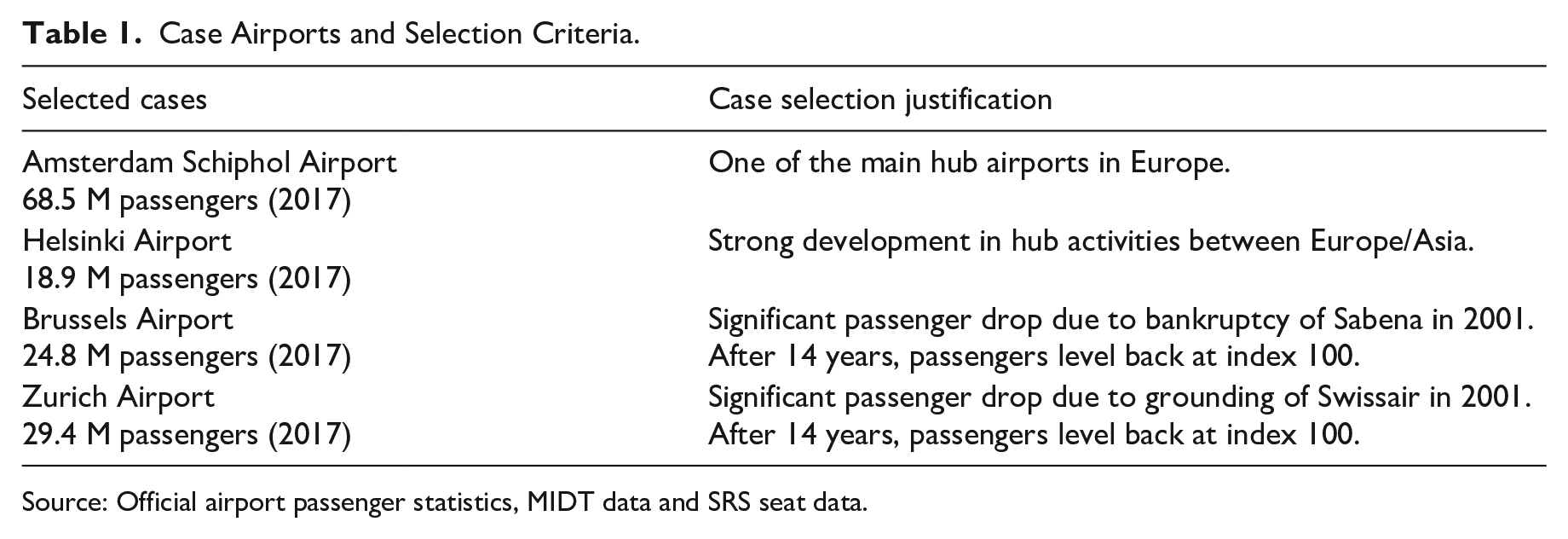
Source: Official airport passenger statistics, MIDT data and SRS seat data.
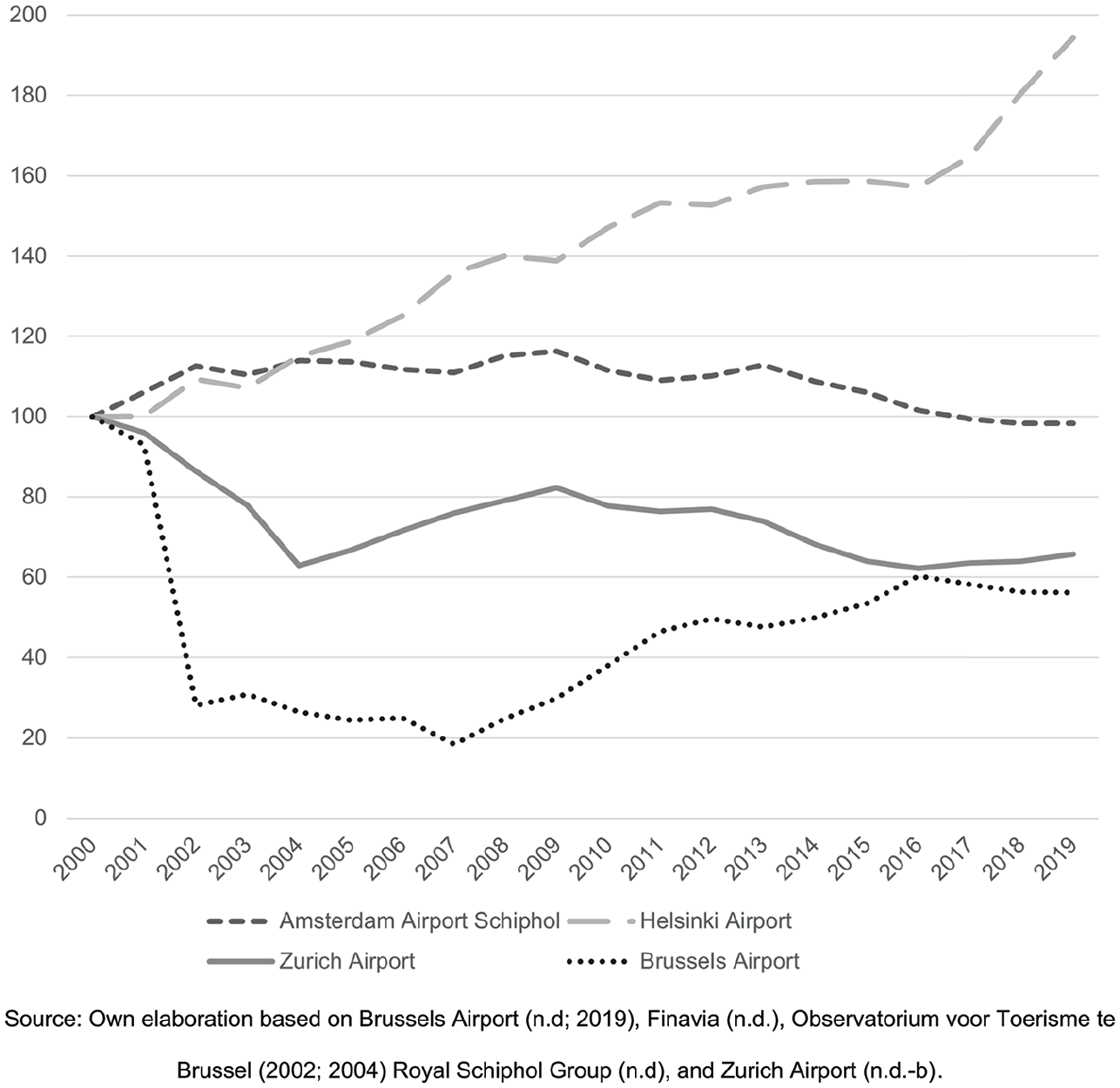
The development of transfer passenger share (index 2000 = 100).
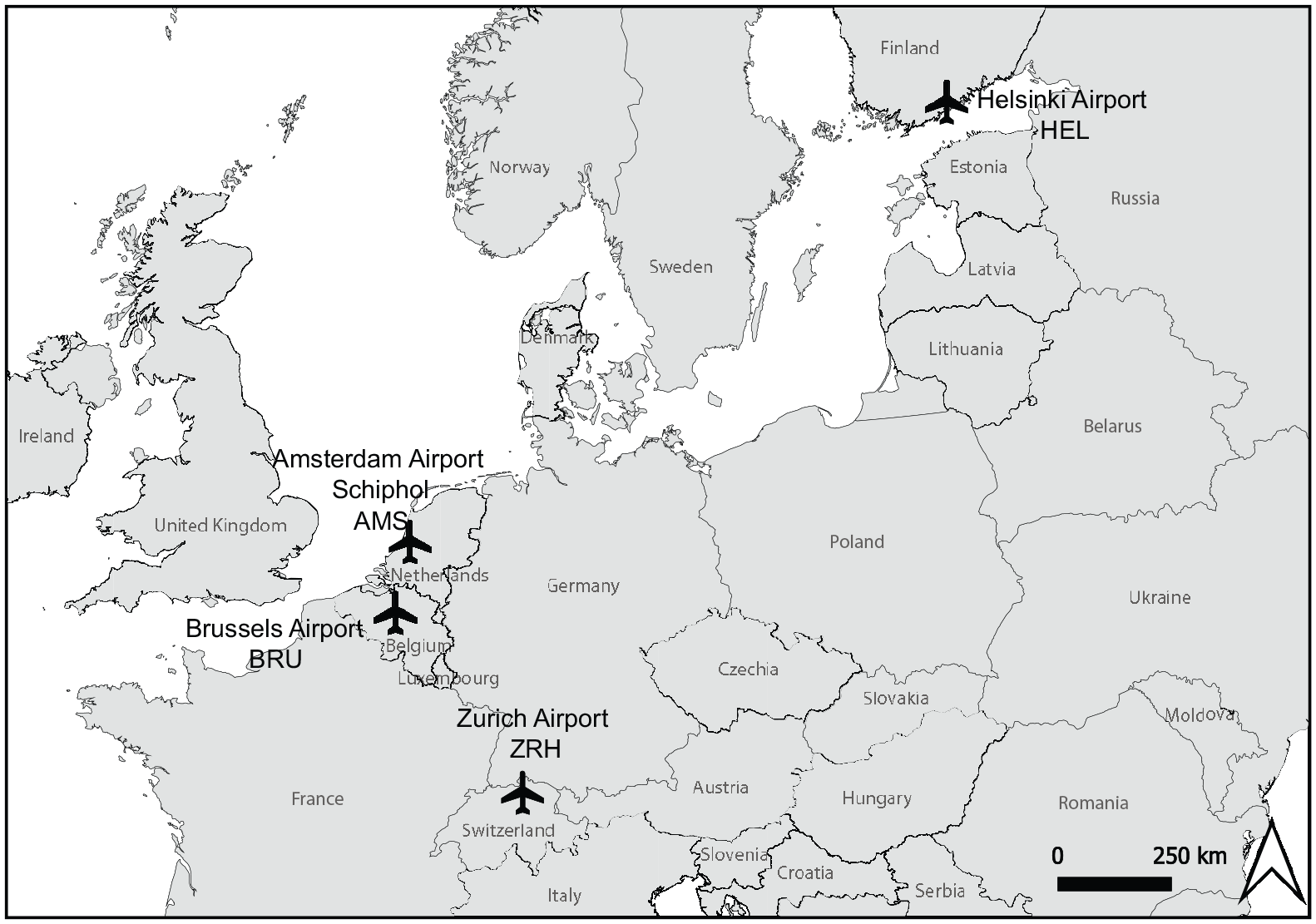
Selected European hub airports.
Once selected, the cases underwent a meticulous study from both a quantitative and a qualitative perspective. The former approach implied looking at the developments in passenger flows found in commercial databases, such as SRS Analyzer (departing seats data) and MIDT Sabre (transfer passenger flows data) and the airports’ connectivity based on the NetScan model used by ACI Europe. The latter approach focused on unearthing the underlying, often inconspicuous discourses and rationalities behind making airport hubs. For this reason, in-depth, semi-structured interviews (Kvale and Brinkmann, 2015) were conducted with 31 industry experts and stakeholders from four European countries in the period 2016–2017. The interviewees included representatives from airports, airlines, transport ministries or civil aviation authorities, tourism organizations, business confederations, unions, academia and the press (see Table 2).
Overview of the different types of stakeholders interviewed in relation to each case.
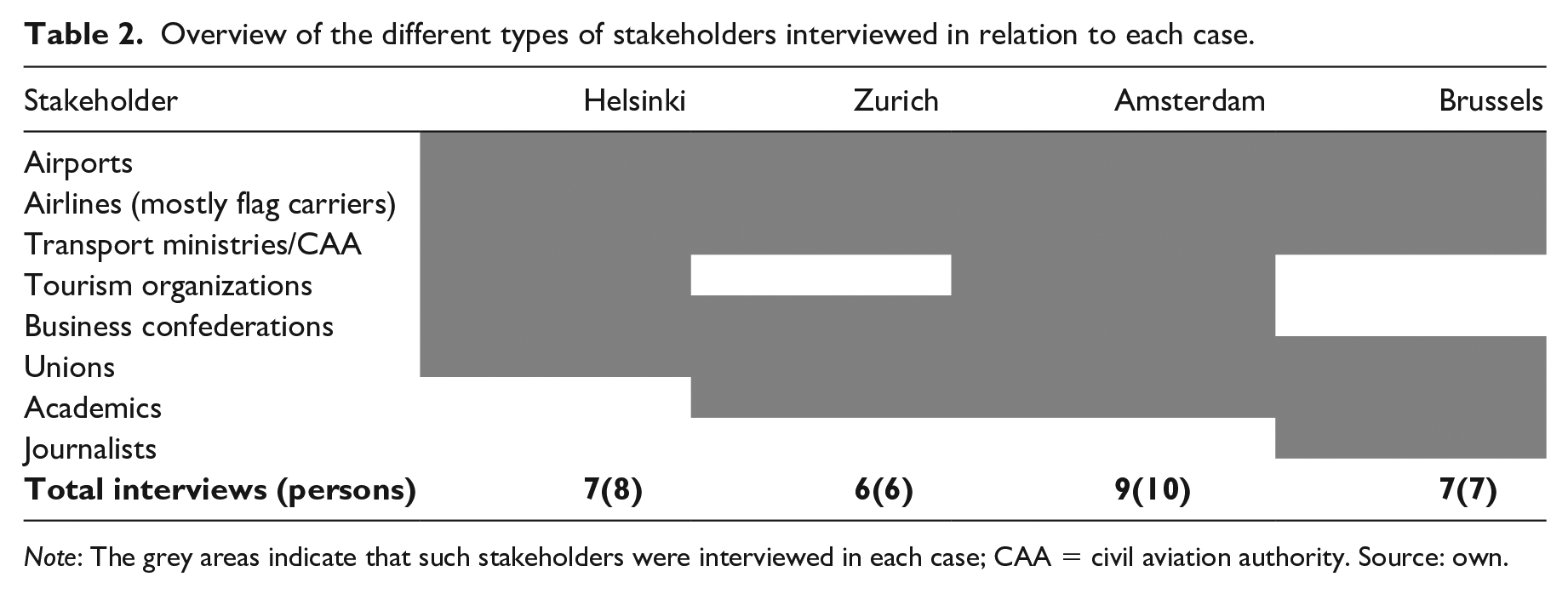
Note: The grey areas indicate that such stakeholders were interviewed in each case; CAA = civil aviation authority. Source: own.
To supplement these findings, a review of various written sources, such as strategic and policy documents, was undertaken. These sources were then subject to discourse analysis to uncover the patterns of meaning shaping the development of hub airports. Here, discourse analysis is based on the definition provided by Jensen (2005, 2007), who distinguished its three main dimensions, that is power-rationality, articulations and practices, focusing on the latter two dimensions. Lastly, the findings were summarized into lessons learned, and their transferability into the Danish context of Copenhagen Airport was assessed.
Comparing the many faces of airport governance at European hubs
Amsterdam Airport Schiphol (AMS)
Schiphol Airport is the Netherlands’ main airport, one of the largest airports in Europe and the main hub for KLM, residing at the heart of one of the most populous and wealthiest regions on the continent. Schiphol Airport boasts growing passenger numbers, with more than 71 million passengers travelling through the airport in 2018, more than three times its 1992 passenger count (Royal Schiphol Group, n.d.). Both its direct and indirect connectivity indices increased from 2008–2017 by approximately 20%, whereas its hub connectivity increased by 53% over the same period, solidifying the airport’s position as a major hub (ACI Europe, 2014, 2015, 2016a, 2017). The airport already ranked amongst the most developed airports in the world prior to WWII, which was partly fuelled by the 1928 Summer Olympics held in Amsterdam. Historically, the aviation sector benefited from the country’s colonial past, as maintaining a connection to its former colonies stood high on the national political agenda (Cresswell, 2006; De Jong, 2006). Further, the liberal mindset that characterized its tradespeople throughout centuries and strong spatial planning and engineering traditions resulting from the need to reclaim land from the sea and put it to best uses, have laid the groundworks for the Dutch aviation sector. The country also had a pioneering role in negotiating the first open sky agreements (e.g. in 1978 with the US and in 1984 with the UK), while KLM’s joint venture with Northwest Airlines further contributed to establishing Schiphol as a key node in global aviation. Lastly, the development of Schiphol was aided by a common understanding at both local and central government levels of its strategic importance as an enabler of global economic activity (Dierkx and Bouwens, 1997). This shows the favourable political, socio-economic and cultural conditions to build an airport governance model, aligned with Jessop’s (2000) definition of governance, where bridging the gap between the market and the state is the main priority. This is also reflected in the ownership structure of the airport, as the airport is owned by Royal Schiphol Group, which itself is publicly owned by the Dutch state (a nearly 70% stake), followed by the municipalities of Amsterdam (ca. 20% stake) and Rotterdam (2.2%), with Groupe ADP holding the rest of shares (8%) (Royal Schiphol Group, 2020). It is worth noting that Schiphol Group also owns the majority of shares in two of the other largest airports in the Netherlands, that is Eindhoven Airport (51% share) and Rotterdam The Hague Airport (100% share), which effectively means that the whole Dutch airport ecosystem is geared toward supporting Schiphol’s hub function (Royal Schiphol Group, 2020).
This airport governance model is further built upon the overarching discourse of a ‘balanced aviation hub as a societal engine’ (Bloch, 2018). This is illustrated by the following quote from an interview with the Head of Group Strategy and International Development at Schiphol Group:
Aviation used to be initially a luxury for the happy few, then it became an instrument and something like a stand-alone sector and now it’s become an essential element of society. (September 2016)
The key feature of aeromobilities production in the Netherlands is its mainport strategy, a strategy of creating a global hub airport that balances the socio-economic and environmental conditions of the surrounding areas (Burghouwt and Dobruszkes, 2014). Initially conceived of as a response to the weakening economy, to the ‘Dutch disease syndrome’ and to competitors on the common market, the strategy maintains its relevance today by safeguarding the airport’s position as the key gateway to the world. Head of Aviation Practice SEO Economics explains and elaborates on the background for the mainport strategy:
I think that has to do with the quite difficult situation the Netherlands was in the 1980’s. . . . we had the Dutch disease . . . we had a lot of revenue from natural gas in the Netherlands that we didn’t invest wisely which was called the Dutch disease, there was a lot of unemployment. We did not have a competitive economy and resulting from that there was initiative to revise the Dutch economy and that was the mainport policy. The mainport policy was not only Amsterdam it was also the hub to Rotterdam. Those were seen as like the future engines of the Netherlands . . . We traditionally have a strong position in logistics so, then it’s quite a natural thing to develop. (October 2016)
While this strategy has been endorsed in many official documents both at the governmental and corporate levels, the growth of aviation at Schiphol encounters friction, particularly at the hands of local environmental organizations that contest the airport’s externalities, such as noise and air pollution. To help mitigate arising conflicts, the airport governance model draws on a long tradition of the consensus decision-making model, which is rooted in consociational democracy, that is, one that is characterized by deep divisions along ethnic or religious lines (Jakala et al., 2018). This resulted in the establishment of the Alders Table in 2006, a stakeholder roundtable aimed at balancing the demands of a globally connected economy with a high quality of life for local inhabitants. The Head of Aviation Practice SEO Amsterdam explain the Alders Table approach in the following way:
Alders Table is a perfect example of collaborative decision-making and how to overcome the deadlocks by give and take mentality and by setting up a group of stakeholders that is most important for getting things done. Listen to each other, have certain rules on the table so about confidentiality, about transparency of result, about how you behave on such a table. (October 2016)
To this end, representatives from airlines, the airport, local stakeholders and inhabitants, as well as representatives from different ministries, all meet and partake in negotiations regarding new developments at the airport. As a result, numerous constraints have been placed on the airport, such as relegating leisure traffic to regional airports, in particular Lelystad Airport once open, and prioritizing hub-related aviation activities and introducing a maximum traffic cap to limit the externalities supplemented by a programme to soundproof houses in the affected area. Despite already having six runways, compared with only two at London Heathrow, for example, and the plans to relegate some traffic to Lelystad Airport, the capacity constraints have led some local entrepreneurs and residents’ groups to propose a seventh runway, which would be built offshore (Vella, 2019).
The airport governance models at Schiphol have been studied extensively over the years. This includes a comparative study of Amsterdam Schiphol’s and Frankfurt Airport’s governance models, where the Dutch governance, embodied by the Governance Forum Schiphol, was seen as leading to ‘unclear roles and monopolization of the actors involved’ (Van Wijk, 2008: 3), and a later study of the same governance body, which analysed its failure, concluding that it had an excessively narrow governance agenda that eventually led to its demise (Van Wijk et al., 2014). Elsewhere, Van Buuren et al. (2012) have studied the aforementioned Alders Table, concluding that it was a success in collaborative problem solving in a complex governance system. Others, however, elicited its flaws, seeing its advice as ‘primarily a Machiavellian exercise’ and going as far as to say that it did ‘not reduce or resolve the complexity of the governance system around Schiphol but rather postponed, perhaps even condensed and deepened it again into larger, newer and sharper controversies’ (De Jong and Boelens, 2014: 10).
As evidenced by these studies, even in a context where compromise seeking has long-standing traditions, the airport governance model in place is far from being unanimously acclaimed and is still ridden with controversies. Nevertheless, the case underlines the importance of political attention not only in terms of financial support but also engagement and time devoted to strengthening the main hub carrier, KLM, which merged with Air France, and to developing a platform that would involve more stakeholders, with consensus decision-making at its core. Even though it is debatable if the Alders Table delivers on all its promises, in principle, this approach acknowledges the airport’s embeddedness in a society and undermines seeing it merely as a stand-alone business.
Helsinki Airport (HEL)
Helsinki Airport, Finland’s main airport and a hub for Finnair, is another example of an airport that expanded its hub operations significantly. Indeed, the creation of a hub airport in Finland, a country with a small internal market and lying on the peripheries of the EU, required true ingenuity and strategic thinking. Although the airport is considerably smaller than Schiphol, it passed the 20 million passengers threshold in 2018 with a 35.6% transfer traffic share (Finavia, 2019), with hub connectivity improving by 50% between 2007 and 2018, according to the NetScan model. While its geographical location makes Finland the eastern outpost of the EU, putting obstacles to seamless transport between the two, at the same time, it makes Finland well suited to accommodate air traffic to and from East Asia. Unlike the Netherlands, Finland never had colonies, and therefore its embeddedness within the international transport networks was weaker at the outset. However, like in the case of Schiphol, the hosting of the 1952 Winter Olympic Games marked a key milestone for aviation in Finland with the inception of the new Helsinki Airport (Finavia, 2016a).
The development of Finnish aviation has been forged by the overall ‘Finland is an island’ discourse (Bloch, 2018), which reflects the country’s geographical location, as well as its historical and political situation, as stated by the Manager of Market Access and Aeropolitics at Finnair:
[In the] political world where big narratives always have the power . . . one is ‘Finland is an Island’, if you look at the map it is true, the long Russian border and then the Baltic sea. It is in the psyche of every Finn, in order to go to other parts of the world you either take a ship or plane, which obviously raises the importance of international ports and airports. (April 2016)
Given Finland’s low population density and relatively long distances between its main cities, maintaining an extensive rail network is challenging, and therefore aviation is better suited to guarantee domestic coherence. Thanks to the airport’s three-runway system and its location on the outskirts of the city, the Aviapolis, an airport city development, unlike many other such projects, actually includes housing developments, where about 20,000 residents already live (Vantaa, n.d.). Helsinki Airport is therefore mostly shaped by its position within the global aviation network rather than its local limitations. Hence, the political interest in expanding Helsinki Airport is as much an expression of the country’s interest in maintaining its connectivity to the outside world as it is of ensuring its inner coherence, as indicated by the Manager of Market Access and Aeropolitics at Finnair:
Finland is a country of long domestic distances, the cities and counties need domestic travel. [Politicians] are aware that many of the domestic routes will not make profit, even if it was a low-cost carrier that did operate them. The only way of keeping [the domestic] routes alive is if it is part of a wider network airline and brings network value. And the only way of doing that is if Finnair has a long-haul strategy. So I think members of parliament have acknowledged that the Asian strategy is a risk, but it is probably the only way anybody could see Finnair as an independent airline in the future – and as a result be able to serve the domestic market. (April 2016)
Within the Finnish aviation system, where Finavia, a state-owned company, manages most of the civilian airports in the country, the profits derived from international aviation at Helsinki Airport help cross-subsidize traffic to regional airports, which does not break even on its own. Within such a setup, similarly to Amsterdam Schiphol, Helsinki Airport does not face any competition from other airports in Finland. To make this strategy work, the focus on the Asian markets was already set by Finnair 30 years ago. A key enabler of this strategy was aviation rights negotiations with its largest neighbour, Russia, as well as the destination countries in Asia. In the case of Russia, as pointed out by the Manager of Market Access and Aeropolitics at Finnair, a good relationship was key to obtaining sufficient overflight rights, whereas in the case of Asia:
[In] all of Asia except Japan [you need to negotiate traffic rights], so it a risk and it is a challenge. It kind of forces you to think really long term and advance step by step and then of course . . . The point to point interest in Helsinki is quite limited, so to get traffic rights we always need to work quite a bit and have the support of local airports or local administrators – that is one option. Another option is working together with another carrier in that country. Another is having very high political support. (April 2016)
This requires a long-term strategic partnership with other carriers or with local airports and administrators in the destination countries. The latter is best exemplified by the ‘sister airport relationship’ established in 2016 between Helsinki Airport and Capital Airports Holding Company (CAH), the largest airport operator in China (Finavia, 2016b). These developments were further aided both by the Finnish businesses, which were one of the first in Europe to invest in China, and by the government, which, among other things, helped in negotiating traffic rights and in siding with Finnair during cabin crew strikes. Overall, the widespread willingness to turn Finland’s seemingly limited geographical location into an asset proved crucial to developing Helsinki Airport. The Finnish case provides a clear example of aligning the societal and political interest in maintaining domestic coherence with the demands of being connected to a global economy.
Brussels Airport (BRU)
Even though, at first glance, Belgian aviation and Brussels Airport might share many of the same underlying cultural and socio-economic conditions with its Dutch counterpart, there is, in fact, a vast discrepancy between the performances of these two airports. While the number of passengers between 1992 and 2018 nearly trebled, similarly to the number of passengers at Amsterdam Schiphol, growing from 9.2 million passengers to 25.7 million (Brussels Airport, 2019), this growth was far from linear. It is the number of connecting passengers which shifted most dramatically in this period, growing fast from nearly two million in 1995 to almost seven million at its peak in 2000, only to fall to just over one million in 2002 after Sabena’s bankruptcy (Observatorium voor Toerisme te Brussel, 2002, 2004). While at its peak transfer passengers accounted for more than 30% of all passengers (Observatorium voor Toerisme te Brussel, 2002), the figure reached its low point at 6% in 2007, and only managed to bounce back to 18% in 2018, considerably below the levels witnessed prior to Sabena’s demise (Brussels Airport, 2019).
As in the Netherlands, the aviation industry in Belgium is historically tightly interwoven with the country’s colonial past, as in its early days in the 1920s, the country’s national carrier Sabena ‘was more active in Congo than in Europe’ (Vanthemsche, 2000: 937). Like airports in Helsinki and Amsterdam, it was a large international event that triggered the construction of a new airport, in Brussels’ case, the 1958 World’s Fair. Due to the country’s size, aviation has always been a matter of international connectivity rather than internal coherence, with Brussels Airport acting as the gateway.
The federal political system in Belgium plays a key role in shaping airport governance in this case. The decentralization process in Belgian regional politics meant that ownership of airports has been on the regional level since 1992, apart from Brussels Airport, which was privatized with the federal government maintaining a 25% share. This decision meant that Wallonia owned two airports, Charleroi and Liége airports, which could compete with Brussels Airport, especially since they face laxer noise and night-flying restrictions (Bloch, 2018). This added fuel to the already fierce competition that Brussels Airport faces from large European hubs, such as Paris Charles de Gaulle, Amsterdam Schiphol and London Heathrow. As explained by a journalist at VTR news, this also undermined the overall support for Sabena, with regions more interested in boosting their own regional airports, rather than investing in the main hub carrier:
They [Charleroi airport] had two million [passengers] at the time, we say: ‘well, we can take some of the flights from Brussels into Charleroi, so it could be good for our regional development’. We had all different actors playing together, which meant that Sabena all of a sudden was not so attractive to save it anymore. (August 2017)
When Sabena peaked, it had more than 10 million annual travellers (Orban, 2019). However, after witnessing Sabena’s bankruptcy in 2001, the Belgian main airport has become the emblem of dehubbing, the process of partial or complete abandonment of an airport by a hub airline (Bhadra, 2009; Dennis, 2005; Redondi et al., 2012). It took Brussels Airport more than a decade to recover the pre-Sabena-bankruptcy levels of passenger traffic (Bloch, 2018).
When analysing the relative decline of hub operations of Brussels Airport compared with Amsterdam or Helsinki, a number of issues arise relating to Belgium’s federal makeup, resulting in a decentralized political environment and decision-making, as well as the airport’s locational challenges. For these reasons, the overarching discourse identified within the study was that of ‘decentralized production of aeromobilities’ (Bloch, 2018), which influences how the aviation policy is materialised. The Vice-President of Media Relations at Brussels Airlines reflected upon this, stating:
We have seen a lack of federal aviation policy because the two regions were doing their thing, and the national level . . . The only thing that really happened was, major decision, that was a decision taken 20 years ago now, or even more than 20 years, above 20 years ago, to privatize Brussels airport, to sell the majority of the shares in the airport. (September 2017)
With Belgium’s federal political system often resulting in problems in forming new federal governments, and ongoing antagonisms between the two main regions of Wallonia and Flanders, decision-making processes become extremely complex and consensus is hard to achieve. In this sense, the airport is a mirror of the society it is embedded within, becoming the focal point for the existing controversies, and engendering new ones simultaneously (Yaneva, 2016). This was also highlighted by the Vice-President of Media Relations at Brussels Airlines:
We don’t have that strong support that Netherlands has. The Netherlands, for example, have put much energy so that everyone is convinced of the importance of Schiphol for the economy and everything. The challenge of Brussels Airports to convince the regions of the importance of Brussels Airport is much more difficult. We have even people saying, ‘Let’s reduce the flights from Brussels Airport.’ Or, ‘Let’s move out of Brussels Airport.’ Things like that. In the regions, these things happen, these things happen. They don’t always see the national interest, the general interest anymore because of regional politics. (September 2017)
Therefore, unlike hub airports in the Netherlands and Finland, Brussels Airport has less institutional support, making the federal funding for ground transport infrastructure less accessible and receiving less political attention. The decentralized nature of the Belgian political system is also reflected in the airport’s ownership structure, with the federal government only having a 25% share, while 39% of shares are held by the Ontario Teachers’ Pension Plan and the resulting 36% split among APG (a Dutch pension fund), QIC (an Australian investor) and Swiss Life (an insurance company). The ensuing financialization of the airport’s operations meant a reorientation of the airport toward ‘practices of financialized capitalism (centred on risk–return rates, debt ratios and capital management)’ in a landscape where ‘intra-state tensions complicate the development of a strong, transparent regulatory framework, leaving little room for political debate or for the development of a state policy on the governance of financialised infrastructure’ (Deruytter and Derudder, 2019: 1364). An additional geographical limitation stems from the airport’s Z-shaped three-runway layout and the noise externalities related to it, which results in vocal protests from local inhabitants who oppose expansion plans at the airport (Noëth, 2018). The difficulties in resolving conflicts around the airport’s externalities, especially concerning night-time flying, were some of the reasons why DHL decided to transfer its primary logistics hub to Leipzig in 2008, although it has continued some of its operations at Brussels Airport and even opened a new regional hub in 2018.
The new ‘Strategic Vision 2040’ aims to remedy this situation and is built on a dialogue with various stakeholders through a platform called Forum 2040. While this platform might resemble the Alders Table in the Netherlands, its recommendations are not binding for the airport, as is the case with the Alders Table. Similarly, Airport Mediation, a governmental body that has existed since 2002, is only dedicated to dealing with noise externalities by informing citizens about flight paths and their noise impact, as well as collecting complaints and suggestions from residents (Airport Mediation, n.d.).
While the federal government is interested in improving the country’s connectivity, the federal setup and the competition between regions, resulting in the inability to overcome differences, as shown in the case of Sabena’s bankruptcy, make for a fragmented airport governance model. The strong position within international networks that Brussels enjoys thanks to being home to many international organisations counterweighs these structural shortcomings, leaving it to the market to solve growth issues. As shown, the decentralized decision-making, with many opposing, often irreconcilable, interests needing to be accounted for, together with locational challenges, prove to be the main barriers to building a more robust airport governance model and to fostering greater aviation growth at Brussels Airport.
Zurich Airport (ZRH)
Zurich Airport is the largest airport in Switzerland, located next to the country’s largest city, Zurich. Unlike in the Netherlands and Belgium, aviation in general did not develop through building connectivity with colonies nor was the airport built in relation to a major international event, such as the Olympics or World’s Fair. Like Brussels Airport, Zurich Airport experienced turbulence starting from October 2001 after the grounding, although not outright bankruptcy, of Swissair, the national carrier (Zurich Airport, n.d.-a). The grounding of Swissair hit transfer passenger numbers the most, and even though the transfer passenger share still amounts to a solid 28% as of 2018, it is well below the 40% share the airport enjoyed in its heyday (Zurich Airport, n.d.-b). The airport also shares with its Belgian counterpart a federal political system it is embedded within, albeit one additionally shaped by a long-standing tradition of Swiss direct democracy. The fragmented ownership structure reflects this, as the state holds no shares, whereas the Canton of Zurich holds 33.33% plus one vote, the City of Zurich holds 5% and the resulting shares are in the hands of private investors, none of which has more than a 3% stake (Zurich Airport, n.d.-c). This is also true for two other major Swiss airports. While Geneva Airport, the second largest airport, is wholly publicly owned by the Canton of Geneva, EuroAirport Basel Mulhouse Freiburg, the third largest airport, has no shareholders, however its Board contains eight representatives each from the French and Swiss States, including three representatives from the Canton Basel-Stadt and one from Canton Basel-Landschaft (ACI Europe, 2016b). The CEO at Geneva Airport recognizes that they compete with Zurich Airport, although at the same time he believes that it would be a shame if Switzerland did not have any hub airport (Weinmann, 2019). As such, this business environment resembles more its Belgian counterpart than the more centralised ones found in Finland and the Netherlands, where the primary focus is to support the main hub. Airport governance is further informed by a relatively low national political focus on aviation, as indicated by the Managing Director at the Center for Aviation Competence, University of St. Gallen:
Not really [high on the political agenda]. If you look at Swiss policies from the government still the financial industry seems to be very important and high on the agenda, tourism is very important on the agenda, the chemical pharma industry seems to be very important on the agenda. Aviation is not found on the top 10 list and for me aviation, if you have 80% export and import, is the number one industry – or maybe number two or three, but definitely not below number three and our government do not recognize it. (February 2017)
The reasons for the relative decline of Zurich Airport compared with Amsterdam or Helsinki are manifold; however, the overall discourse describing the production of aeromobilities at the airport identified within this study was that of ‘a clash of direct democracy and market economy’ (Bloch, 2018). This tension was underlined by the Head of Economic Affairs at the Swiss Federal Office of Civil Aviation who stated, the ‘biggest challenge is capacity, the capacity related to night-bound, to noise, to neighbourhoods, and it will be more and more politically difficult’. Because of the ownership structure of Zurich Airport, with the Canton of Zurich and the City of Zurich as its main shareholders, no infrastructural development that would increase the noise levels can pass without first obtaining approval from the canton. As a result, a long-term solution to the capacity issues that arise during peak hours would require holding a local referendum by the canton in which citizens would get to vote on whether to accept the changes. However, the whole process is estimated to take up to 20 years and is contingent upon local inhabitants agreeing to it explicitly (Bloch, 2018).
The grounding of Swissair meant a reorientation of the Swiss aviation policy from focusing on safety toward an approach concentrating on the broader economic benefits of connectivity to and from global business centres. Despite the heightened attention toward aviation, illustrated by bridge loans granted to Swissair to continue operations, a hands-off approach to airport governance persisted. The airport was further challenged by its location, with cross-border relations settled in a treaty between Germany and Switzerland in 2012, imposing restrictions on the available flight paths (Zurich Airport, n.d.-d). The Managing Director at the Center for Aviation Competence, University of St. Gallen, underlined that the runway system was challenged by intersecting runways and the area’s topography (e.g. Lägern Mountains), which limit capacity expansion:
That is true [there is a capacity issue in Zurich Airport], that is also homemade – I mean you build three runways that cross each other, you have a homemade problem. You have three runways, but a capacity of about 1.3 runways – I mean, it is just bad architecture! And that is historically wrong and we can’t change it any more. Why can’t we change it? Because the local people don’t want it – that is the negative effect of a direct democracy. In this case in Switzerland it is only the people living in the state of Zurich that can vote when it is about the airport, because the airport is on the ground of the state of Zurich and belongs to Zurich – it is not the central government airport, it is a Zurich Airport and by this Zurich people decide. (February 2017)
Even though Swiss aviation policies recognize the importance of the sector and of directly connecting to global business and financial capitals, because of Switzerland’s federal political system, where cantons enjoy significant sovereignty, the federal government is unlikely to impose a national strategy aiming at expanding the hub operations at the airport without first getting the approval from the cantons. While from a legal point of view, legislating aviation is the competence of the federal government, there would be major political backlash, should the federal government decide not to involve the local authorities, as explained by a project manager responsible for infrastructure at economiesuisse, a Swiss corporate union:
They are not really using this article to really promote their policies, because they have to . . . there are so many stakeholders that are in place here and they cannot just rule the way they want. They really have to take into consideration the opinions of local interests, the opinion of the cantonal governments, and so on. (May 2016)
In this context, the requirement of holding a local referendum by the canton in which citizens would get to vote on whether to accept the changes, constitutes a major obstacle for any expansion plans that could alleviate congestion. Such a complex decision-making landscape limits the elbow room for airport governance in terms of long-term expansion plans.
As showcased by Zurich Airport and its airport governance model, the external limitations placed upon the development of the airport by the federal system and the involvement of citizens via direct democracy play a key role. In this case, it could be argued that while stakeholders, such as local inhabitant groups, can affect whether the airport is expanded or not, they are not involved sufficiently in the elaboration of the plans themselves, which undercuts the possibilities of them being accepted in a referendum. For these reasons, alternative scenarios are considered, in particular ones where trains are integrated to a higher degree in the aviation system, replacing some of the short-haul routes, as indicated by the Head of Economic Affairs at the Federal Office of Civil Aviation (Bloch, 2018). Until recently there were also plans to relegate some of the general aviation and business traffic to Dübendorf Airport; however the federal government has now scrapped these plans (Nowack, 2020). It is, however, worth bearing in mind that these alternatives do not solve issues related to externalities, including those related to establishing and operating a train connection, as much as they are moved elsewhere. In many regards, much like Brussels Airport, the airport governance model at Zurich Airport struggles with a decentralized political environment, with many conflicting interests playing out in a decision-making landscape riddled with challenges that reach beyond national borders.
Cross-case analysis
As shown in the investigated cases, creating and maintaining a hub airport is a non-linear process resulting from a complex interplay between political, societal, economic, historical and cultural factors. In the following paragraphs we compare the cases and present four themes pertaining to airport governance models that emerge from this comparison:
their embeddedness within the context specificity;
how they can support broader societal (e.g. domestic cohesion) and economic challenges;
how a country’s administrative setup impacts airport competition within its borders;
how these models can balance the industry’s logic of constant growth with curbing its externalities.
While these findings do not reject the conventional aviation practice based on a ‘predict and provide’ principle (see above), they highlight a need for greater attentiveness to the site-specific characteristics shaping the making of hub airports.
First, across all four cases, airport governance can only be understood as embedded within context-specific webs of stakeholders and need not be merely reduced to the relation between who owns and who operates the airport. In that sense it is not possible to understand the airport governance model at Brussels Airport without understanding the underlying political tensions between the Belgian regions, or at Zurich Airport without understanding that cantons have the last say even though aviation is federal government’s prerogative. In the same vein, it is not possible to understand Amsterdam Schiphol’s governance without taking into account the country’s traditions of international trade and consensus-seeking politics, as exemplified by the Alders Table – a multi-stakeholder platform that keeps aviation growth in balance with residents’ needs. Lastly, Helsinki’s push for more connecting flights to and from Asia can only be understood by looking at Finland’s geographical setting and the underlying discourse of the country being an island.
Second, whereas Amsterdam Schiphol and Helsinki provide lessons on how to direct the overall political attention to developing a hub airport while navigating the societal complexities of a playing field with many stakeholders, the opposite is true for the airports of Brussels and Zurich. These airports are embedded within political systems, which, while ensuring a balance of powers between the regional and federal governments, are based on an understanding of an airport that is confined to its immediate context, not fully appreciating how it relates to other places. This approach introduces numerous challenges to the decision-making process in relation to pieces of key infrastructure of national importance, such as hub airports, which have an impact far greater than their immediate context. In the near absence of such hindrances, both the Netherlands and Finland developed discourses that stress the importance of being globally or internally connected, or, in other words, developing an understanding of airports as places that prioritize their relations to the outer world. This, in turn, engendered a political stance that pays close attention to aviation and recognizes its potential to help solve broader societal challenges without dismissing the need to accommodate aviation’s inherent externalities. Accordingly, this enabled both airports to exceed the limitations of their geographical setting, showing how a multifaceted airport governance model can help balance out the constraints imposed by an airport’s location and its externalities. This underscores the importance of viewing airports as relational places, not only in the sense that they are nodes within the global aviation infrastructure but also as places where the often-contradictory interests of different stakeholders play out.
Third, as shown in the case of Amsterdam and Helsinki airports, the political attentiveness should also be reflected in spatial planning legislation that provides a balance between a country’s different administrative levels, thereby safeguarding both national, regional and local interests. In contrast, as the examples of the airports of Zurich and Brussels demonstrate, this is difficult within federal systems, where regional or local authorities often have different interests than those of the national government and have the final word with new developments, including those concerning ground transport access to the airport. As highlighted, this also translates into increased competition between the hub and other regional airports in both Belgium and Switzerland, ultimately weakening the hub’s potential to compete on an international level.
Fourth, since the climate debate has only recently entered the industry’s agenda, it is mostly noise externalities that have enforced limits on new airport developments hitherto. This is particularly the case with the airports of Zurich (Hotz, 2016) and Brussels (Hope, 2016; Noëth, 2018), which are located close to densely populated residential areas and where opposition to runway expansion projects is fierce. In contrast, Amsterdam Schiphol and the Alders Table again provide lessons on how to maintain hub activities and alleviate noise externalities at the same time, although it does come at a cost, since non-hub traffic is to be redirected to another airport, the Lelystad Airport in this case. Helsinki Airport and its Aviapolis also show how to accommodate the need for residential developments in the neighbourhood of an airport.
Conclusion
The analysed cases illustrate that the development of a hub airport is far from a linear process or a mere by-product of economic growth and needs to be understood as contingent upon societal and discursive factors. Connectivity patterns unravel in a complex interplay of developing business models, failing airlines, historical baggage, and regional, national and international politics. These findings imply doing away with one-dimensional explanations of aviation growth and with one-size-fits-all solutions and instead redirecting the focus toward the location-specific, historically determined set of conditions as the basis of airport governance models. As exemplified by the cases of Amsterdam Schiphol Airport and Helsinki Airport, a clear strategic vision implemented by a collaboration of different government strata can help overcome the limitations of a country’s or an airport’s position within global traffic flows. Implementing such a strategy must be supplemented with a multi-stakeholder platform to resolve any arising conflicts, with which aviation, with all its externalities and climate impact, is necessarily fraught. The lack of such platforms can be seen with the airports of Zurich and Brussels, both failing to surmount the obstacles posed by their decentralized decision-making processes. Furthermore, the political setups of both Switzerland and Belgium make it difficult for the airports to overcome the limitations of their location, with dense residential areas in close vicinity of the countries’ main hubs, generating strong backlash against capacity expansions. These cases underline the importance of taking stakeholder involvement seriously and considering it a continuing feature of an airport governance model, rather than a one-off, ad hoc addition to an airport’s strategic planning. At the same time, while Amsterdam Schiphol’s governance model with the Alders Table is widely held as the example to follow, it is also disputed and can be seen as an example of explosion and implosion of politics, a key feature of the governance model in general (Jensen and Richardson, 2004). In the governance model, politics ‘explodes’ out of formal, parliament settings only to ‘implode’ into small, agile policy networks. The advantage is agility and speed; the drawback, however, may be lack of transparency and democratic accountability, as highlighted by De Jong and Boelens (2014).
Amidst the ongoing debate of aviation’s climate impact, appropriate handling of the industry’s externalities is paramount to any future developments of hub airports. The COVID-19 pandemic has brought global aviation to a halt, temporarily reducing the pressure to lower the industry’s environmental impact; however, these issues will not go away and will need to be addressed once aviation is back on its pre-pandemic growth curve. While some governments have tried to use this opportunity to push toward a more sustainable aviation industry post-pandemic, for example with the French government conditioning its aid for Air France, among others, on cutting domestic short-haul flights that can be substituted by a train journey of under 2.5 hours (although the real impact of these environmental conditions can be disputed, see Bannon, 2020), this stance is far from mainstream among the regulators or the industry actors. Most bailouts in the face of COVID-19 came with no environmental strings attached, for example Germany’s bailing out of Lufthansa or Denmark’s bailing out of SAS (Transport & Environment, n.d.; Wilkes, 2020). This shows that there are few regulatory instruments in place that shape or will shape aviation in a more sustainable way in the years to come. However, there are increasing calls from some researchers (see Gössling, 2020) to shrink the industry and further reduce its capacity on top of the reductions already made because of COVID-19. Furthermore, a newly published report commissioned by the European Commission (EC) and authored by the European Union Aviation Safety Agency (EASA) provides more direct evidence of the non-CO2 related environmental impacts of aviation, with the overall aviation’s climate impact now believed to be three times as high as that based on CO2 emissions alone (European Commission, 2020). This may push the EU legislative agenda toward more regulation of aviation’s environmental impact.
In the wake of new potential environmental legislation to limit the growth of aviation, airports might need to diversify to attract passengers travelling with other modes of transport. In this context, it is paramount that decision-makers at hub airports are clear about the kind of hub airport they envision and plan to develop, whether simply a home to a network carrier or an intermodal transport node, organizing ground transportation for the whole region or even country, or both. Overall, there is a strong trend toward both attracting greater air and ground traffic to a differing degree, hoping to achieve synergies with sprouting airport cities projects. Even though the vast majority of aviation’s greenhouse gas emissions physically take place outside of airports, hub airports will see themselves forced to lead the transition toward greener aviation because of their role as focal points, where the clash between different political agendas materializes. While this inevitably puts additional complexity into the decision-making field, it also opens the opportunity for hubs and other actors within the aviation industry to proactively set the agenda in a bid to show the industry’s readiness to combat its most troubling externalities and to pre-empt stricter measures implemented by national governments that could hamper the benefits aviation provides.
This study offers decision-makers insights into the production of aeromobilities in varying geographic and institutional settings, thereby laying the groundwork for improving airport governance and for better-informed decision-making. However, this study is limited in its scope, as case study research requires a focus on a small and, in this case, purposefully selected sample, which might therefore reduce the results’ universality. All investigated cases come from European market democracies, with all but one being members of the EU, and two additionally representing federal systems. While such scoping was a prerequisite to ensure comparability among the cases, great caution is needed when transferring the findings into different political, economic, and cultural settings. The authors of this research are aware of the potential limitations with generalization of case studies such as this; however, in line with Flyvbjerg, we argue that the value of a case study research lies in its depth in investigating the causes and consequences, rather than describing the problem and measuring its frequency (Flyvbjerg, 2006: 229). To better understand how the production of aeromobilities is shaped globally, further studies set in other regions or cross-regional comparisons are needed to help discern the conditions specific to a given geographical area from those more universally applicable. The need for such investigations is underscored by current aviation developments in China or Africa, where many new airports are being built in radically different political and economic realities, the study of which could enhance the understanding presented in this study. Lastly, with the climate change debate unfolding worldwide, it is paramount to study how the production of aeromobilities may come to be affected by new potential environmental agreements and legislation, as well as changing consumer preferences toward lower-impact lifestyles, aspects that until recently went below the radar of aviation scholars and decision-makers.
Footnotes
Declaration of conflicting interests
The author(s) declared no potential conflicts of interest with respect to the research, authorship, and/or publication of this article.
Funding
The author(s) disclosed receipt of the following financial support for the research, authorship, and/or publication of this article: This work was supported by the Innovation Fund Denmark (Grant No. 4019-00050B), The Capital Region of Denmark, Copenhagen Connected, Danish Metalworkers’ Union, United Federation of Danish Workers, and Confederation of Danish Industry.
