




Abstract
Experiments are heralded as beacons of hope for transformative change. But how effective can ephemeral micro-interventions be in achieving comprehensive structural change? This question is particularly relevant for non-technological experiments that are typically more place-bound than their technology-oriented counterparts. We argue that non-technological experiments may very well be impactful endeavors, but that knowledge and reflexivity about their contexts are key capacities for realizing their potential. Based on the literature, we define three context dimensions: structural conditions, political-institutional embedding, and imagined eco-social futures. By empirically delving into Graetzlmarie, an impactful governance experiment in Vienna, we show how “navigating context” in all the three dimensions has been a key capacity for the experiment’s success. It enabled adapting practices, self-conceptions, and objectives to specific but varying contexts, herewith ensuring the experiment’s impactful realization. Given the uneven distribution of such knowledge among actors in transformation processes, we discuss what this implies for experimentation. We argue for coordinating actors that serve as knowledge brokers and intermediaries between institutionalized policy and planning and ephemeral micro-interventions to achieve eco-social transformation.
Keywords
Introduction
The study of urban experiments has become a major stream of literature in the sustainability sciences and adjacent fields (Raven et al., 2019; Sengers et al., 2019). Experimentation is the catch-all term for a multitude of initiatives in governance, research, and societal practice that stand out due to their drastically deviating design as compared to established problem-solving approaches (Evans et al., 2016). On a normative level, experimentation also conveys a noticeable discomfort with the pace of incremental approaches in reference to pressing climate and sustainability issues (Torrens et al., 2019). Experimentation holds the potential to accelerate change in the quest for more climate-resilient cities and societies (Eneqvist and Karvonen, 2021) and sustainable socio-technical systems (Sengers et al., 2019). The experiment as such thus constitutes a beacon of hope for innovation toward transformative change.
The “experimental turn” in urban policy and practice, however, has also evoked criticism, as the proliferation of urban experiments often favors short-termism over strategies for transformative change (Torrens and Von Wirth, 2021), and a retreat of the local state from its governmental responsibilities (Bulkeley et al., 2016; Haderer, 2023). Experiments are also often limited in terms of legitimate decision-making and accountability (Oldenhof et al., 2020). It can hence be questioned whether delimited micro-interventions are capable of large-scale structural change at all, or whether this fuels false expectations (Meyer, 2023).
The latter is particularly important for those types of experiments that do not test new technologies, but rather try out new social or political practices and organizational forms to address specifically local societal challenges of eco-social transformation (Sengers et al., 2019). These do not conform to the conventional logic of niche innovation and scaling, market penetration, and diffusion. Their innovation processes and impact pathways are fundamentally different (Loorbach et al., 2020; Wittmayer et al., 2022), and their place-boundedness casts reasonable doubt on ubiquitous transformative capacity (Eneqvist and Karvonen, 2021). The type of innovation (Jensen et al., 2007) and its context (Coenen et al., 2012) are therefore key in studies of experimentation. This is where our contribution comes in.
We argue that experiments may very well be impactful endeavors, but that knowledge and reflexivity about their contexts are key capacities for realizing their potential—particularly when it comes to non-technological experiments that are intensely interacting with place (Sengers et al., 2019). We illustrate this claim with our study of a decidedly non-technological experiment in Austria, showing how “navigating context” is a key capacity for experimentation to come in full effect. Herewith, we add a more nuanced perspective to the critique of false expectations toward experimental micro-interventions for eco-social transformation and contribute to current policy-oriented debates on the facilitators and geographies of experimentation.
We begin with diving into the discourse on urban experimentation—its prime role as a tool of eco-social transformation, and recent criticisms of the experimental turn—and emphasize the significance of non-technological experiments for transformative change, making them the focal point of our further elaborations. We argue that for non-technological experiments in particular, context matters significantly for the successful implementation and realization of anticipated transformative impact. We thus introduce three dimensions of context from the literature that experiments are confronted with and that they need to handle during ideation and implementation. Empirically, we delve into an outstanding case study, Graetzlmarie in Vienna, that emerged from a comprehensive screening and survey on non-technological experiments in Austria. Studying the experimentation process from its onset to its outcome, we find how “navigating context” has been a key capacity for the experiment’s success. It enabled adapting practices, self-conceptions, and objectives to specific, ever-changing contexts, herewith ensuring the experiment’s impactful realization. We discuss the implications of these findings for the ambivalent reading of experiments as either transformative endeavors or bounded micro-interventions and—given the uneven distribution of knowledge among actors in transformation processes—what follows for the role of experiments as instruments of reproduction of power versus emancipation and transformation.
Literature review
Experimentation—transformative tool or bounded intervention?
Experimentation has in recent years gained popularity in the sustainability sciences and related fields, such as transition studies (Geels, 2019; Grin et al., 2010), strategic niche management (Seyfang and Smith, 2007), transformation research (Hölscher et al., 2021; Wanner et al., 2018), climate governance research (Anguelovski et al., 2014; Castán Broto and Bulkeley, 2013), and planning studies (Berglund-Snodgrass, 2022; Eneqvist and Karvonen, 2021). They all share the recognition that testing new and unconventional ways of dealing with societal issues in real-world settings has come to play an increasing role in political, civic, and scientific practice (Bulkeley et al., 2016).
Experimentation is often viewed as an expression of an increasingly challenge-driven political culture that aims to tackle grand societal challenges while being aware of their complexity and intertwined character that do not allow for universal solutions with predefined outcomes and impacts (Raven et al., 2019). Instead, they call for an iterative, non-linear trial-and-error attitude, where collaborative ideation, prototyping, and testing are key (Fünfschilling et al., 2019; Wanner et al., 2021), and the acceptance of failure and learning-by-failing are significant scenarios (Fünfschilling et al., 2019; Wanner et al., 2021). Hence, experiments are also referred to as a way of “reflection in action” (Torrens and Von Wirth, 2021). In the literature, three renditions of experimentation stand out:
Experimentation for sustainable innovation: Building on a systems perspective and prescriptive theories of transformation, the experiment here constitutes a key element at the early stages of an innovation or niche creation process (Fünfschilling et al., 2019; Raven et al., 2019). It is intended to stimulate novel solutions to sustainability problems in specific socio-technical systems such as energy and mobility. If deemed successful, the resulting products or services are meant to diffuse to other locations and to be scaled to initiate socio-technical regime change (Sengers et al., 2019; Wanner et al., 2021).
Experimentation as research approach: This perspective interprets experimentation as a key research method that revives the tradition of action research methodologies to engage diverse actors in practice-oriented research (Hölscher et al., 2021; Wanner et al., 2018). Researchers and research organizations are thus central actors in designing and devising experimentation, while the range of involved stakeholders varies to a great degree (Ansell and Bartenberger, 2016; Raven et al., 2019; Torrens and Von Wirth, 2021). The aim is to employ non-hierarchical, co-productive methods in real-world contexts to tap into new, actionable knowledge for transformation.
Experimentation in governance: This rendition regards experimentation as an alternative, almost paradigmatic mode of governing change that seeks to put new rules and regulations into practice ad hoc and evaluating the (un)intended effects “on the fly” (Matschoss and Repo, 2018; Zeitlin, 2016). As such, governance experiments are an expression of a new “politics of experimentation” (Bulkeley et al., 2016: 14), with decision makers increasingly relying on experimental approaches for quick wins and tangible results.
What all three have in common is that experimentation is seen as a countermodel to the established, formalized, incremental modes of governing change that are viewed as lacking agility and impact in the face of climate emergency (Evans et al., 2016; IPCC, 2022). While experimentation discourse has long been characterized by a bias toward technology (Levenda, 2019), there is now a growing recognition of non-technological experimentation as an important approach to transformative change.
From technology trials to transformative innovation
The significance of non-technological innovations for transformative change has become a conventional wisdom in experimentation discourse and associated innovation policy debates (Van der Have and Rubalcaba, 2016). These initiatives differ from commonplace conceptions of experimentation in terms of their primary focus on social innovation, that is, the modification of societal roles, practices, and deep-seated cultural values (Sengers et al., 2019; Seyfang and Haxeltine, 2012; Seyfang and Smith, 2007).
Such types of innovation are decidedly more place based (Eneqvist and Karvonen, 2021; Sengers et al., 2019). They typically emerge directly from the recognition of place-specific problems and the local societal implications of global challenges, respectively (Bärnthaler, 2022; Moulaert et al., 2005). Moreover, non-technological innovations are usually based on a different innovation mode of doing, using, and interacting instead of science- and technology-based innovation (Van der Have and Rubalcaba, 2016; Wittmayer et al., 2022). The novelty or “solution” that such innovations produce is how they adopt and adapt technological innovations from a global innovation system to embed them into the complex local political-institutional conditions in a very specific way and make them meaningful and useful tools in coping with local societal challenges (Rohe, 2020; Suitner et al., 2023).
The emerging discourse on transformative innovation advocates a similar notion, stressing the importance of initiatives that are not primarily technology oriented but aimed at novel lifestyles, business models, or organizational forms (cf. Loorbach et al., 2020; Novy et al., 2022; Pel et al., 2020, among others). They “seek to advance a social or just local economy, low consumption lifestyles, democratic and renewable energy systems, regional sustainable food systems or living and building in harmony with nature” (Loorbach et al., 2020: 252). The transformative innovation literature points particularly to the significance of context: “Such sustainability initiatives are inherently rooted in geographical contexts, political cultures, and driven by engaged citizens or entrepreneurs that often respond to opportunities or persistent problems in their specific environment” (Loorbach et al., 2020: 252). Hence, specific local conditions and the value-laden conceptions of place of local pioneers and lead actors are key variables to be taken into consideration. Rather than technology-based solutions, they focus on social change, that is, reconfigurations of roles and resources, practices, and interactions (Pel et al., 2020; Suitner et al., 2023; Wittmayer et al., 2022). As challenge-driven approaches, they utilize any combination of technical, political, nature-based, and/or community approaches that is considered useful to instigate such transformations (Loorbach et al., 2020).
This raises an important issue: While experiments aim to tweak the political-institutional structures and cultural value systems that stabilize the unsustainable patterns of modern social life (Mattioli et al., 2020), they are at the same time very much embedded in these structures. Put differently, if non-technological experiments are closely linked to the place of their implementation, how can they leapfrog incremental change processes in rigid structural contexts, if at the same time they cannot “escape” these contexts? The relevance of context for properly explaining how and why transformative endeavors fail or succeed in specific places has already been highlighted before (Van den Heiligenberg et al., 2017; Wanner et al., 2021). We argue that knowledge and reflexivity of these contextual variables are critical for non-technological experiments, as they constitute both the problem background and the framework for action of experimental initiatives. We distinguish these contexts of experimentation into three categories:
Experiments in context—three dimensions
The “real”—structural conditions
Urban experimentation discourse often points to the city as stage and object of transformative action and the innovative power attributed to it (Evans et al., 2016; Torrens et al., 2019). This stance also resembles the notion of the urban sphere as a societal laboratory and the city as a place of societal self-experimentation (Gross and Krohn, 2005). What this notion only implicitly addresses is the role that structural conditions—and the physical spatial structure of a specific locale in particular—play for experimentation. Following a critical realist stance (Sayer, 2015), we take the influence of these structural conditions on experiments seriously.
Research has already shown that the appreciation of and interaction with specific physical spatial conditions factors well into the design and implementation of climate-oriented planning and transformative action (Wamsler et al., 2013). The influence of an historically evolved urban fabric with its unique physical and functional spaces thus cannot be ignored as a determinant of how an experiment is devised and which social-ecological issues it aims to tackle on the very local level. In transformative climate governance discourse, too, the specifically constituted social-ecological-technological systems are regarded as key conditions for transformational endeavors (McPhearson, 2020). This involves local biophysical conditions and the exposure to climate threats as much as it includes social structure and the path-dependent (physical) constitution of infrastructure systems (McPhearson, 2020).

The three context dimensions of experimentation.
Bearing in mind the varying local consequences of global social-ecological crises, “real” local conditions hence constitute a significant context of experimentation. This is even more important when considering that experiments are a practice-based form of intervention, meaning, they are not just designed to respond to place-based challenges but also to interact with them (Sengers et al., 2019). Thus, a first crucial question is, which role these structural conditions play in the conceptualization of experimental initiatives.
The roots—political-institutional embedding
A geographical perspective on environmental policy and sustainable development has already been introduced two decades ago (Gibbs, 2002; Krueger and Gibbs, 2007), explaining how such endeavors are always embedded in institutional contingencies and particularities, multi-level governance arrangements, and networks (Bathelt and Glückler, 2011). The geography-informed strands of sustainability transition and innovation discourse picked up on this notion (Coenen et al., 2012; Coenen and Morgan, 2020; Shearmur et al., 2016), pointing, for instance, to the influence of formal and informal ties and networks (Ansell and Bartenberger, 2016; Fünfschilling et al., 2019), and administrative support (cf. Eneqvist and Karvonen, 2021; Kronsell and Mukhtar-Landgren, 2018) as critical resources.
In a similar vein, experimentation discourse has indicated the relevance of favorable environments (Torrens et al., 2019) and suitable habitats, that is, places endowed with certain success factors for experimentation, particularly the embedding in various networks and institutional contexts (Van den Heiligenberg et al., 2017). The embedding in suitable (local) political structures and processes is just as important in this regard. Bulkeley et al. (2016) thus call for scrutinizing the embedding of experiments in the specific logics of planning and local policy. Another key question, therefore, is how the experiment relates to and interacts with its political-institutional context. Does it emerge from and build on an institutionalized governance regime, does it aim at a deliberately counter-hegemonic form of future-making, or does it take some hybrid in-between shape?
The rationale—imagined eco-social futures
The critical role of discourse and future visions in shaping transformation processes has recently received increased attention as both a research perspective and co-creative practice (Dixon et al., 2023; Hajer and Versteeg, 2019; Tozer and Klenk, 2018). Cognitive conceptions of a viable future can motivate taking action in transformational endeavors (McPhearson et al., 2016). Researchers and practitioners are thus increasingly heralding techniques of futuring to create collective conceptions of an eco-social vision that serves as a joint guiding principle for further actions (Oomen et al., 2022). At the same time, different normative conceptions of a livable eco-social future compete for dominance to influence political decision-making and individual choice (Blühdorn et al., 2022). Powerful socio-technical imaginaries for instance shape perceptions of certain technologies, regulations, or practices as superior over others and consequently bias decisions and affect transformation paths (Jasanoff and Kim, 2009).
Experiments are not unaffected by this. Just like any other deliberate action, experimentation, its design, and its approach build on a rationale of systemic and normative knowledge (Urmetzer et al., 2020). It is in the nature of things though, that in flexible, ephemeral, multi-actor interventions such as experiments, complex knowledge often has to be reduced to simplified cognitive representations of “problem and solution” to keep things manageable in practice (Jessop, 2012). The relevant question is thus twofold: Which notions of the challenges and objectives of transformative action build the foundation to the experimental intervention, and to what extent do both differ from dominant eco-social urban future imaginaries or consciously compete with them (Sharpe and Barling, 2019)?
We consider these three context dimensions crucial for non-technological experiments, as their emergence, development, and impact are strongly linked to the structures, institutions, and discourses of place. In the following section, we present our empirical study of a select non-technological experiment along the three context perspectives to find to what extent and at what stages of the experimentation process contextual knowledge and reflexivity played a part in turning an isolated micro-intervention into an impactful experiment.
Navigating context in a non-technological experiment: The case of Graetzlmarie, Vienna
The empirical approach
Based on a comprehensive screening of over 1400 experimental interventions in Austria, we invited 218 relevant non-technological climate and sustainability experiments to participate in an online survey (Bhattacherjee, 2012). We queried to what extent specific local structural conditions, political-institutional embedding, and future visions of change in the face of social-ecological crisis had any influence on the implementation of the respective experiment vis-à-vis how the initiatives self-assessed their success. Of the 218 invited initiatives, 116 completed the survey. As a result, we found that all the three context dimensions were indeed recognized as important for the majority of non-technological experiments. At the same time, only a few reported of impacts that went beyond the immediate local problem, such as imitation in various other locations, or significant institutional change. We therefore selected one of these salient experiments—Graetzlmarie in Vienna—for a deep dive (Mabry, 2009) to understand how it achieved to evolve and succeed within its specific, multidimensional context.
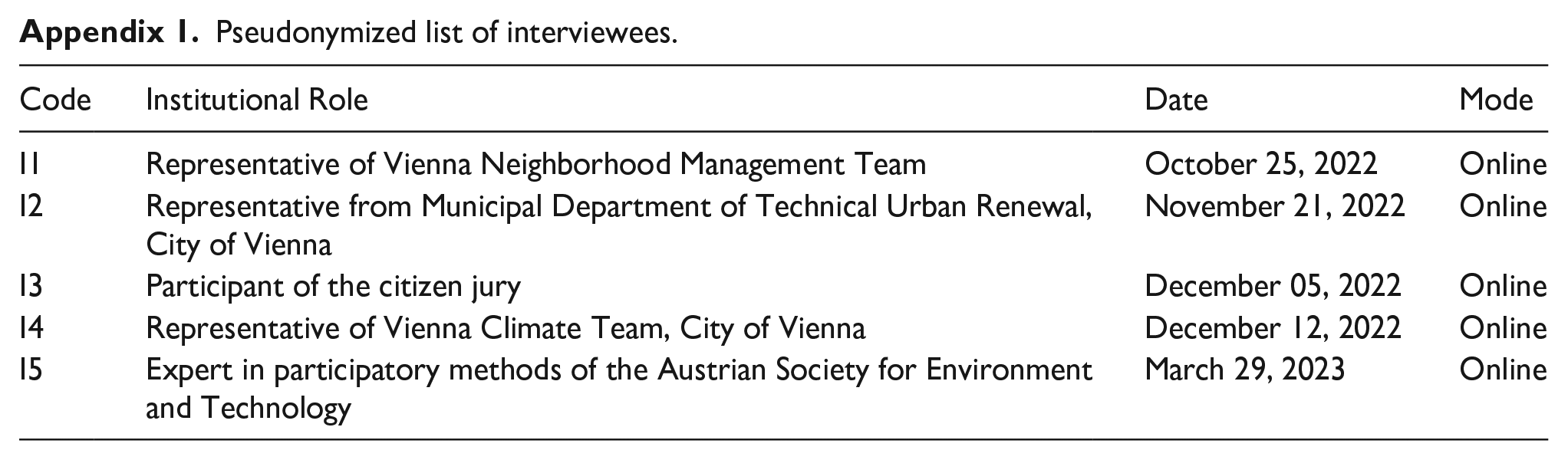
We conducted five narrative interviews with relevant actors involved in the conceptualization and realization of the Graetzlmarie initiative (Bryman, 2012) to redraw to what extent contextual knowledge and reflexivity played a part in successfully implementing the experiment (cf. Appendix 1). In addition, we selected relevant studies and policy documents on national, state, and local levels that are concerned with the specific challenges addressed by the experiment for content analysis (cf. Appendix 3). We selected 16 documents in a first iteration of general analysis and 11 in a second iteration of detailed analysis (Krippendorff, 2018). That way, we were able to mirror the self-conception of the initiative with their structural and normative context at the time being (Urmetzer et al., 2020). The following section traces the evolution of the experiment vis-à-vis the three context dimensions: 1
The Graetzlmarie experiment
Graetzlmarie is a local governance experiment implemented by the City of Vienna that tests the co-production of urban climate adaptation measures by local civil society and city administration (Magistrat der Stadt Wien, 2023). At the core of the initiative is a low-threshold idea competition in which citizens are invited to submit ideas for local adaptation measures—a deviation from Vienna’s well-proven paternalistic political culture (Suitner, 2021). This way, citizens’ knowledge of the local and individual climate change impacts in the neighborhood are picked up in the realization of local adaptation actions. The decision on the implementation of submitted ideas is made by a citizen jury. Elaboration and implementation are carried out in a co-productive multi-stakeholder process in which the idea providers are significantly involved. Funding is provided via a participatory budget made available by the City of Vienna, whereby projects can be supported with up to €30,000 (Magistrat der Stadt Wien, 2023). Graetzlmarie hence addresses concrete ecological and social consequences of climate change through knowledge co-production and co-creation of suitable solutions in urban public space. At the same time, the initiative supports mutual learning between institutionalized urban governance and planning actors on the one hand and a local citizenry on the other. The experiment immediately impacted residents’ ability to cope with climate change consequences by supporting them in taking action and by facilitating new forms of social interaction on the local scale. Beyond that, it significantly propelled institutional change within the political-administrative system by showcasing how co-creative approaches can aid the urban climate adaptation agenda of the city. The experiment was implemented in 2021 for an initial period of 2 years in the neighborhood of Innerfavoriten in Vienna’s 10th district. Its successful realization was very much shaped by contextual knowledge and reflexivity.
Structural conditions
Knowledge of the specific local conditions was decisive for the initiation of the experiment in three respects. First, climate change–induced rising temperatures and heat-islands in the densely built-up areas of Vienna were the main motivation to ad hoc put climate adaptation measures into practice. This specific neighborhood has been facing drastic challenges anyway due to its old building stock and its necessary conversion of energy systems, provision of adequate adaptation measures through green and blue infrastructure in public space, and redesign of mobility and transport through low-traffic neighborhoods (D11). Second, interviewees mentioned that the location of the neighborhood in Innerfavoriten was critical to the development of the experiment, as a recent urban development project near the main train station has drawn attention away from the renovation and retrofitting of old building stock and toward new construction (I2, I3). Third, the specific demographics and social structure of the neighborhood—on-average lower income and a comparably large share of a migrant population (D11)—spurred efforts of an inclusive approach to adaptation action and prioritizing the respective neighborhood.
Throughout the process of implementation, reflecting about and reacting to local conditions was key to achieve the goals regarding experimental neighborhood climate action that were set out at the beginning. Accommodating different needs and cultures of a migrant population and long-established residents in the old building stock, for instance, was a major challenge. Continuous word-of-mouth and physical presence through the co-creative workshops in the neighborhood came as an adequate reaction to picking up on these specific conditions. That way, Graetzlmarie managed to engage different societal groups and create social proximity between neighbors who would not have met and exchanged ideas on retrofitting and facilitating adaptation in public space without the initiative (I1, I3). Also, adapting the funding strategy and extending the funding period for the individual projects during the initial trial period were essential to create enough room for local residents to apply for funding (I1).
Political-institutional embedding
The successful implementation of Graetzlmarie hinges on its embedding in Vienna’s political-administrative system. The experiment is part of the urban renewal program WienNeu+, a funding program of the Municipal Department for Urban Renewal (Stadt Wien, 2023a). At the same time, it follows the transformational path set by strategies such as the Smart City Strategy (D3), the city’s Urban Development Plan (D8), and specialized development concepts for green space, mobility, public space, polycentric development, and an urban economy (Stadt Wien, 2023b). Graetzlmarie is hence rooted in Vienna’s institutional framework of both comprehensive strategic planning and action-oriented urban renewal on the neighborhood level.
The experiment was devised in reaction to the failed participatory district budgets in Vienna, which were hampered by the rigid structure of the Vienna City Constitution (I5). Graetzlmarie built on that experience, shortcutting the downfalls of district budgeting by launching a participatory budget for urban renewal projects on a city scale. By integrating local knowledge of residents and administrative actors, the initiators made sure that local agency was not sidelined (I4). The administrative unit also used its knowledge on tapping various funding opportunities and co-producing non-technological innovations on the neighborhood level that it had acquired in a prior implementation project (I2). The successful realization of Graetzlmarie was further influenced by the specific knowledge of local power dynamics, actor landscapes, and political will. The choice of location for the experiment therefore did not fall by chance on a neighborhood, where a critical mass of influential political, corporate, and civic actors was interested in experimenting with new forms of local climate action (I1, I5). The fact that the Vienna Climate Team (“Wiener Klimateam”), a larger and more intensely promoted initiative with a similar approach and orientation, was launched at almost the same time also shows how Graetzlmarie’s idea and success gave another push to a general cultural shift within the political-administrative system (I4).
Throughout the process, the experiment managed to accommodate to complicated political-institutional dynamics several times and adapt its approach accordingly. Even more, the combination of its placement “on the ground” with its institutional role as part of the City of Vienna enabled Graetzlmarie actors to give direct feedback on lessons learned from implementation that would immediately make administrative processes more effective. For example, a specific local greening initiative in public space within the experiment was initially confronted with rigid administrative rules that had the intended measure going through several loops of approval within the administration. Graetzlmarie significantly accelerated approval procedures and made cooperation with various municipal departments of the City of Vienna faster and more effective (I1). Also, Graetzlmarie actors knew that due to a change of the local neighborhood management team in Innerfavoriten in 2018, the typically well-practiced modes of communication and collaboration between public authorities and a resident population on issues of urban renewal were not as pronounced as elsewhere. They were therefore convinced that they had to fill this gap to some extent as part of the experiment in order to establish a viable process in the Viennese political-institutional context (I3).
Imagined eco-social futures
It is undisputed that Vienna’s long history as a city run by Social Democracy has massively influenced the self-perception of the political-administrative system (Novy et al., 2001). Urban policy and planning have thus long been interpreted as exclusively top-down-oriented tasks that only slowly and in selected matters were being supplemented by participatory approaches in recent history—a self-conception that has also framed Graetzlmarie (I4, I5). Strategic discourse also by and large represents an imaginary of Viennese urban development as prepared for eco-social exigencies and thus generally “fit for future” (D3, D4, D8, D9, D10). A recurringly mentioned challenge, however, is inclusion in the process of urban transformation and ensuring just outcomes of transformative action (D2, D3). In this regard, top-down solutions from the planning authority are no longer considered sufficient, but (experimental) interventions on a neighbourhood level that build on local expertise and solutions from a resident population are increasingly being called for (D1, D3, D4, D7, D9).
The core stakeholders involved in Graetzlmarie hold the same opinion, assuming that a profound change of practice is needed in Vienna’s urban renewal to create social-ecologically viable urban environments, as retreating to the regulatory competencies of planning will not do (I2, I4). Graetzlmarie’s general interpretation of “fit for future” as a social objective and climate resilience as a key quality of urban public space are telling examples in that regard. Thus, the politically intended approach of how local climate issues shall be dealt with in Vienna and the rationale of the Graetzlmarie actors that adequate adaptation should involve residents’ knowledge in co-productive settings match well. The fact that these actors are following and co-shaping the current shift in Vienna’s political and planning culture from the inside further facilitates the realization of the experiment.
The workshops that were held to motivate submissions did not just inform residents about what it means to transform neighborhoods into sustainable and climate-resilient places. They also contributed to a more differentiated perspective on climate-oriented societal needs “on the ground” with public sector actors and the role of an active citizenry, its local knowledge, and its only seemingly banal ideas for climate adaptation. The importance of the workshops for this kind of mutual knowledge transfer only became clear during the process, and they were hence increasingly used specifically for this purpose. Relatedly, raising awareness and reaching people who had never dealt with climate change was a specific goal of Graetzlmarie. However, it soon became clear that the objective of integrating diverse population groups could not be fully reached within this iteration of the governance experiment (I2). However, lessons were learnt from the difficulties in activating a diverse citizenry for co-creation initiatives. Subsequent endeavors thus, among other measures, expanded financial incentives and support and care services to enable the inclusion of citizens with low socioeconomic means and care obligations in climate action (I4, I5).
Based on these practical experiences, the principle of social integration and diversity, which is already strongly pronounced in Vienna’s urban policy and planning discourse, received even more emphasis and thus influenced the canon of goals and values in political-administrative climate adaptation discourse. The fact that this was not tackled in the framework of Graetzlmarie itself—for example, by adapting the approach in terms of content or methodology—was mainly due to the fact that key actors were already engaged in parallel with the preparations for follow-up initiatives, where this knowledge was immediately integrated from the beginning (I4).
Discussion: navigating toward impact
The aforementioned elaborations illustrate how context shapes non-technological experiments. The Graetzlmarie case has shown that knowledge and reflexivity of the structural, institutional, and discursive contexts of local eco-social transformation are critical for the successful implementation of an endeavor that deviates from established modes of governing urban change. Central individual and collective actors in experimentation must be aware of these multidimensional conditions, reflecting their influence on the foreseen implementation and outcome of the intervention. The case study also elucidates the necessary flexibility of experiments in dealing with changing contexts, such as (1) accommodating to complicated political-institutional dynamics by utilizing actors’ institutional knowledge for rearranging procedures, (2) reacting to unforeseeable needs appearing within the co-production process by changing means and methods on the fly, and (3) reinterpreting the role of the experimental endeavor within a wider local urban policy and planning context to address multilayered local societal challenges associated with eco-social transformation. To a great degree, the success of Graetzlmarie thus depended on contextual knowledge, reflexivity, and flexibility as key capacities of experimentation.
In consequence, the case study experiment achieved a reconfiguration of the institutionalized political activity space that governs eco-social urban development in Vienna. By integrating citizen engagement, a non-predetermined participatory budget, and a multi-stakeholder implementation process, the experiment demanded cooperation of various administrative units, and thus contributed significantly to breaking down silo structures in the city administration that had been hampering transformative governance so far. On the flipside, Graetzlmarie can also be viewed critically as a tool that served the City of Vienna in consoling committed citizens by allowing the realization of ideas with limited transformative power that are hence not expected to be met with much public resistance. However, the co-creative approach in developing local climate adaptation solutions clearly empowered a local citizenry to co-shape “their” eco-social urban transformation in an otherwise patriarchal local state.
Graetzlmarie thus is an ambivalent case. The experiment is successful in empowering a diverse citizenry for climate action because it is fitted well into local contexts and devised and governed by knowledgeable stakeholders from local policy and planning, who all follow the same principle of just and inclusive transformation. The key actors thus ensure that the experiment is both top- and bottom-linked—an essential quality of successful experiments (Sharp and Raven, 2021). On the contrary, it generates little immediate impact on the ground. Considering the pronounced agency of a traditionally strong local state for adapting public space to climate change, it can hence be questioned whether the initiative is the right approach to accelerate transformative change. However, as mentioned earlier, the transformative impact of Graetzlmarie is mostly institutional in that it enhanced Vienna’s participatory planning culture with a co-creative perspective.
Finally, it is important to emphasize that the Viennese context is quite specific. The history of Vienna’s urban governance and urban development policy over the past 70 years has been characterized by social principles that have resulted in a comparably balanced spatial structure and relatively equal socioeconomic status of the population. The city’s overall high level of prosperity and historically strong, paternalistic local state provide a unique starting point for addressing eco-social crises compared to other urban governance contexts. This, of course, needs to be considered in terms of the opportunities and challenges of responding to such crises through experimentation and in terms of the potential role of experimentation as a counter-hegemonic tool.
Conclusions
In this article, we picked up on the critique of false expectations toward experimental micro-interventions for eco-social transformation. We argued that experiments may very well be impactful endeavors but that they must skillfully navigate their context for realizing their transformative potential. We focused on non-technological experiments because of the increasing importance attributed to them when it comes to achieving transformative change and because they are typically more place-based than conventional (technological) experiments, which particularly raises issues of context. Building on different strands of experimentation literature, we defined three context perspectives: structural conditions, political-institutional embedding, and imagined eco-social futures. We illustrated the relevance of all the three on the evolution of the case study of Graetzlmarie, a governance experiment implemented by the City of Vienna. In the Graetzlmarie case, contextual knowledge, reflexivity, and flexibility all proved to be key capacities for the experiment’s impactful realization.
Multilayered contextual knowledge is therefore indispensable in order to be able to implement experiments effectively. This implies that experimentation is not for everybody, as the necessary capacities are often unequally distributed. Our case study illustrates this. Graetzlmarie was conducted by individual and collective actors from the political-administrative system, who understood how to blend their intervention into the unique administrative logics, urban development paths, and irrevocable institutionalized principles of urban politics and planning in Vienna. If experimentation necessitates such expertise, this raises the question as to whether it can be a suitable instrument for promoting just and inclusive transformation at all, or whether it perpetuates existing inequalities by favoring those interests that are backed by respective contextual knowledge and reflexivity. This again highlights the ambivalent role of experimentation as either an instrument for the reproduction of power or an emancipatory tool (cf. for instance, Røste, 2023).
From this point of view, state-led non-technological experiments such as our case study are important undertakings. Through co-creative climate action on the micro-scale, they empower a diverse civil society that lacks the capacities to take action in climate matters on their own, to have a say in transformational urban agendas, and co-create tangible adaptation projects. To ensure this, coordinating actors from local policy and planning that act as knowledge brokers and intermediaries between institutionalized policy and planning and ephemeral micro-interventions are needed. They are competent in surveying looming challenges arising from eco-social crises, initiating experimental ventures from within or supporting those emerging outside the political-administrative system by blending them into the local context they are knowledgeable of.
Hence, while we agree with the criticism of urban experimentation as a mere replacement of regulatory approaches for structural change, we advocate for a more integrated perspective that contemplates ways of embedding experiments into the repertoire of the local state. Our case study has shown that experiments that are being incorporated into or emerge from the institutionalized modes of urban policy and planning need not necessarily be deprived of their transformative potential per se. Instead, we point to the important role of the local state in facilitating experimental interventions—both from within and outside the political-administrative system—by lending them their unique contextual knowledge and reflexivity.
Footnotes
Appendices
Pseudonymized list of interviewees.
| Code | Institutional Role | Date | Mode |
|---|---|---|---|
| I1 | Representative of Vienna Neighborhood Management Team | October 25, 2022 | Online |
| I2 | Representative from Municipal Department of Technical Urban Renewal, City of Vienna | November 21, 2022 | Online |
| I3 | Participant of the citizen jury | December 05, 2022 | Online |
| I4 | Representative of Vienna Climate Team, City of Vienna | December 12, 2022 | Online |
| I5 | Expert in participatory methods of the Austrian Society for Environment and Technology | March 29, 2023 | Online |
Appendix 2
Declaration of conflicting interests
The authors declared no potential conflicts of interest with respect to the research, authorship, and/or publication of this article.
Funding
The author(s) disclosed receipt of the following financial support for the research, authorship, and/or publication of this article: This research was funded by the Austrian Climate and Energy Fund under the Austrian Climate Research Programme (ACRP – 13th Call), grant number ACRP13 – SIAMESE – KR20AC0K17998.
