




Abstract
The regional scale provides an important focus of research into the geographies of sustainability transitions. To date, this debate has been separate from research into the potential of a circular economy to drive sustainable economic development at the regional scale. Both literatures recognise the importance of collaboration between policymakers and industry, with network-building feasible at the regional scale seen as favourable for developing collaborations. However, insufficient consideration has been given in circular economy debates to the contrasting scalar contexts of regionally based public and private sector stakeholders. This article addresses the potential for a regional-scale sustainability transition based on circular economy strategies (especially industrial symbiosis) given scalar constraints on the agency of regionally based public and private sector stakeholders. The research draws on interviews and observations in two case study regions: North Humberside, England and Styria, Austria. Cross-sectoral scalar constraints outweigh the apparent embeddedness of companies in their respective regions, even with the formal regional scale of governance in Austria. We recommend better integration of different policy sectors and more empowerment to policymakers at the regional level for more spatially nuanced policies.
Keywords
Introduction
The urgency of the environmental and social need for a sustainability transition has far from decreased over the past 20 years, during which the literature on this topic has flourished (Geels, 2002; Jakobsen et al., 2022; Truffer and Coenen, 2012). Sustainability transitions literature captures several important ideas relating to change. One is the idea that change to a more sustainable future (however defined or prioritised) entails a journey from present circumstances (Hansen and Coenen, 2015). The concept addresses the paradox that sustainability requires a significant break with the present, yet future technologies and their adoption must emerge from and compete with the present (Geels, 2002; Köhler et al., 2019). Rather than strategic decision-making based on environmental or other assessments, outcomes reflect power imbalances and conflicts of interest within and between public and private sector stakeholders. Starting with an emphasis on technology and innovation understood as socially produced, the debate has been diversified by geographers emphasising the regional scale as a seedbed for innovation driven by specific policy arrangements and private actors (Cooke, 2011; Frantzeskaki et al., 2017), but also highlighting bottom-up as well as policy-driven transitions (Maye et al., 2022) and the influence of everyday practices (Affolderbach and O’Neill, 2024; Hobson, 2019). Thus, the concept provides a suitable frame with which to examine the geographic dimensions and barriers of a regional transition to a circular economy (CE).
In a CE, resources are kept in use for as long as possible, maximum value is extracted from them and materials are recovered at the end of product life via recovery ‘loops’ (Geissdoerfer et al., 2017). Energy-efficient short loops for a CE include product re-use, repair and resale (Reike et al., 2018). Medium loops comprise component recovery options such as remanufacturing or refurbishment. To be delayed as long as possible, long loop options for material or energy recovery include recycling of either pre- or post-consumer residues. These so-called R strategies (repair, remanufacturing, recycling etc.; Reike et al., 2018) offer specific steps that can be incorporated into an imagined sustainability transition (e.g. Fratini et al., 2019). Establishing a CE requires a transformative approach to production and consumption that designs out waste (World Economic Forum, 2015). The idea of a CE has gained significant attention in international policy (e.g. European Commission, 2019) within The European Green Deal, less directly in the UK, as an economic development and normative tool to help places reach sustainability targets (Calisto Friant et al., 2021; Gregson et al., 2015). For companies, options include the transfer of residues (wastes and/or by-products) for re-use or recycling by another company known as industrial symbiosis (IS; Chertow, 2000). Local IS networks have been argued to have benefits for regional economic development as well as for the environment (Schlarb, 2001). Herein, we are referring to a CE transition focused on collaboration within and relating to places, for which inter-firm collaborations, including IS, are an important option. Whether that would comprise a short, medium or long loop in CE terms depends on the level of reprocessing implied (if any). However, the geographic shortness of a regional loop adds a spatial consideration – offering potential resource retention and economic benefit locally, which may outweigh the benefits of non-local shorter loop options.
Successful implementation of CE initiatives, notably including IS, involves public, private and civil society actors from diverse sectors of production and consumption (Ghisellini et al., 2016). A CE sustainability transition is, therefore, a multisectoral one, with an additional breadth of stakeholders and interests compared to the numerous transition case studies of specific fields (notably transport or energy; Anderson and Geels, 2023). CE research focusing on specific places (‘place-based’; see Marsden, 2012; Sonnino et al., 2016) has highlighted the importance of the city’s role in developing CE initiatives (Campbell-Johnston et al., 2019; Petit-Boix and Leipold, 2018). Much of this work examines the potential challenges and barriers which cities and their stakeholders face when transitioning to a CE. To date, the CE has often been dominated by a business-focused agenda at the city level, raising questions about the placement of the CE within a broader multi-scalar and urban sustainability agenda (Murray et al., 2017). A CE is, therefore, a suitable topic for regional-scale case studies, in order to address the wide range of relevant interests at a scale relevant to policy intentions, that is, in part to examine the agency of regional-scale policymakers. Further developing the recent quantitative work on drivers and barriers to a regional CE within small and medium sized enterprises (SMEs) across the European Union (EU; Jové-Llopis et al., 2025), this work provides a qualitative lens of analysis, with stakeholders including large companies within two contrasting case study locations and explicitly addressing cross-scalar influences.
A considerable body of sustainability transitions work has built up over the last two decades drawing on the regional scale (Cooke, 2011; Truffer and Coenen, 2012; Yu and Gibbs, 2018). Recent work considers the types of transitions emerging in particular types of regions, whether defined by economic focus, for example petroleum-dependent regions (e.g. Jakobsen et al., 2022), or by prosperity/peripherality (e.g. Vale et al., 2024). Emerging debates around the potential for transitions driven from the regional scale and how that might be related to the characteristics of a given region are equally relevant to CE implementation. Furthermore, a relational approach addresses the complexity of interwoven relationships with different places and across scales (Affolderbach and Schulz, 2018). This has attracted attention in CE debates (e.g. Newsholme et al., 2022) but is underdeveloped in policy understandings and much of the CE literature, which has only relatively recent focused on spatial dynamics of implementation (Bourdin et al., 2024). By studying the spatial issues at play in two case study locations, we aim to uncover the common challenges that European regions must overcome in their transition to a regional CE.
Previous climate-related research has explored the constraints of developing regionally sensitive climate-related activities. Work by Jonas et al. (2010) sheds light on the diverse challenges and constraints facing regional-level stakeholders in climate-oriented regional development. Notably, in addition to the interwoven relationships mentioned above, regions tend to be porous, meaning that the spatial distribution of activities often transcends official borderlines of an administrative location. Previous research suggests that there are often challenges when seeking to foster climate collaboration between regional actors in a particular location (e.g. Bulkeley 2005, Bulkeley et al. 2012). Missing from the literature is an analysis of a CE-based regional transition, with the diversity of stakeholders involved, which applies the relational perspective of the sustainability transitions concept. This is required in order to uncover the implications of relationships that stakeholders may have beyond the regional scale, which this study aims to address.
Drawing on both the sustainability transitions and place-based CE literature, we highlight the challenges of scalar constraints on both public bodies and companies. We define a scalar constraint as a limitation on the agency of an organisation that derives from a relationship whose spatial expression does not coincide with the location. This study provides an in-depth analysis of scalar relationships within and between sectors in two contrasting case study locations (North Humberside (NH), UK and Styria, Austria). NH refers to an informal region comprising the City of Hull and East Riding of Yorkshire local government areas. It is a peripheral location within the UK, characterised by neighbourhoods with severe levels of deprivation (HCC, 2025). Styria comprises a formal, regional, level of governance for which there is no equivalent in the UK. The capital of Styria is Graz, which is the second city of Austria. We draw on interviews and observations with policymakers and companies, with the aim of understanding the scalar constraints on the establishment of a regional sustainability transition, drawing on CE practices (primarily IS) via the following research questions:
What CE collaborations are happening at the regional scale?
How is the agency of regional CE policymakers influenced by the national-scalar policy context?
How do companies respond to scalar influences when making efforts for a CE in the region?
By emphasising stakeholder views and agency at the regional scale (in two distinct locations), within a relational context, this article makes a significant contribution to theorisation of both sustainability transitions and CE theory at the regional scale, by drawing on cross-sectoral empirical insights. The following literature review will give an overview of previous research in relation to building place-based collaborations for a CE, from a business and policy perspective.
Significance of the regional scale for a circular sustainability transition
In this section, we build our theoretical framework with the purpose of understanding the interactions of companies and public bodies with respect to CE transition in specific places. To do this, we are conceptualising the CE transition as a particular example of a sustainability transition and using the regional sustainability transitions literature as our entry point to place-based debates. We are also addressing business literature to capture a company perspective on places through the concept of embeddedness.
The development of a CE requires cooperation between a wide range of stakeholders, across industrial sectors for closing loops (Ghisellini et al., 2016). That is, pre-consumer waste or end-of-life products are reinserted into the supply chain. This is partly a question of reverse logistics, though more ideally includes discussion around the design of new products. The contingences of geographic scale of collaboration are seldom explicitly addressed. However, post-consumer local scale loop closing offers environmental benefits (by reducing transport distance) as well as potential local economic advantage (e.g. by creating jobs in collection/repair locally; Stahel, 2016). The idea of a regional CE relates to earlier initiatives drawing on resource efficiency concepts such as IS, that is, a means of closing loops of production between proximally located companies. Moving from linear throughput to closed-loop material and energy use can reduce negative externalities associated with pollution and waste disposal, while also reducing demand for resources (Ehrenfeld and Gertler, 1997). IS has a particular relevance in this context as a resource efficiency initiative that is often studied with respect to specific places (e.g. Deutz and Gibbs, 2008; Virtanen et al., 2019) as opposed to (or as well as) within companies. Attempts to secure an economic–environmental win–win from local IS networks were unsuccessful in the US context (Chertow 2012; Deutz and Gibbs, 2008). This suggests a need for critical appraisal of the use of CE-related initiatives as drivers for regional sustainability transitions, as investigated by Niang et al. (2023) in France. However, the weight of policy interest in a CE in the European context, alongside the drivers for decarbonisation of industrial regions, means that the present policy context is very different to that in the US in the 2000s. IS is a CE option to explore for regions with a manufacturing presence, especially in geographic contexts with more regulatory emphasis on environmental efficiencies (e.g. in the Emilia-Romagna region of Italy: Mencherini et al., 2020). Notably, however, policymakers and the objects of their attention are spatially situated and subject to relationships across scales (Jessop, 2005), which is rarely considered in CE research.
Regions are sub-national territories that are politically contingent (Cooke, 2011; Lyons and Deutz, 2010), that is, their boundaries and governance function can change over time. Furthermore, geographic scales of activity or perception do not necessarily match scales, or levels, of governance (Warnaby, 2009), so that the desire for organising something may not be matched by the capacity to carry it out. Cities, for example, are important foci of consumption and production and have received considerable research attention on CE (e.g. Nogueira et al., 2020) and transitions (Affolderbach and Schulz, 2018; Frantzeskaki et al., 2017). They can have a degree of policy autonomy for CE initiatives as Turcu and Gillie (2020) explored in London but are constrained by and reflect national policies. Additionally, cities are not self-contained. Adopting a spatial definition beyond the formal territorial confines of a city allows an understanding of dynamics that extend beyond a purely urban scale (Ward and Jonas, 2004), which we are conceptualising as scalar constraints. The area around a town or city is a source of resources, including food for production and local consumption (Maye et al., 2022), recreation, a workforce and waste disposal (Lee et al., 2016). All these features are relevant to discussions of a CE – in addition to the industrial residues specifically relevant to IS.
The complexity of stakeholders relevant to a CE transition, as alluded to above, is only extended with the addition of place-based authorities and organisations (e.g. Anderson and Geels, 2023; Ghisellini et al., 2016). Regional policymakers are inherently focussed on their locality and are interested in retaining the potential benefits of a CE within their administrative boundaries (Bolger and Doyon, 2019). Public bodies have interests in developing CE approaches in part to create employment opportunities and to improve the welfare of local citizens (Malecki, 2018, Niang et al., 2023). New CE jobs offer a means to offset those that might be lost in presently carbon-intensive regions as a result of a net zero transition featuring low carbon energy generation or steel production. The EU Green Deal references to ‘just transitions’ suggest a concern to protect such regions, albeit the policy framework does not entirely match the rhetoric (Calisto Friant et al., 2021), and evidence suggests that social and spatially distributed benefits from CE development are contingent on the context and mode of implementation (Deutz et al., 2025).
Regional (Schulz et al., 2019) and city scales (Campbell-Johnston et al., 2019) have attracted recent attention in the CE literature, but with limited cross-over to date from the explicitly regional-scale focus in terms of place-based sustainability transitions. The familiarity of regional policymakers with their region of operation and stakeholders therein can be a factor supporting a regional transition (Jakobsen et al., 2022). Investigations of the spatial dimensions of a CE (Schulz et al., 2019, Tapia et al., 2021) have pointed to trust and alignment of stakeholder priorities as important but challenging issues to address locally. However, the question as to whether geographically, or economically, peripheral regions have the capacity or agency to be proactive in sustainability transitions (Vale et al., 2024) is equally relevant to CE as other transitions. The geographic context of CE activity is important to the form of development needed and likely outcomes (Deutz and Lyons, 2015).
Developing a regional-scale CE using IS implies harmonising the priorities of both place-based and business interests with their respective scalar constraints, the implications of which have not been examined. This article considers the challenges for creating a regional-scale CE that might arise from the differing priorities and values of companies and public agencies in the context of a specific place. Besides their different interests locally (e.g. Rincón-Moreno et al., 2021), stakeholders operate across different scales, that is, companies who may themselves range in scale from local to global and governmental bodies who each have a specific scale of interest (e.g. local), albeit influenced by other scales (e.g. national) (Randles, 2007). Therefore, having identified the region as a relevant scale for CE development for policymakers, whilst highlighting its scalar constraints, we next give attention to the role and interests of companies.
Company approaches and constraints for a CE
Companies are an important stakeholder in any discussion of CE (e.g. Chembessi et al., 2024), because they are responsible for their own (i.e. pre-consumer) material flows (including waste) and define the nature of post-consumer flows through product design. Companies are profit-driven organisations with consideration for product/service design, sourcing inputs, labour, production/distribution/aftercare and resource management (e.g. Bocken et al., 2016; Porter, 1985). Accomplishing those activities commonly involves commercial and collaborative/ownership relationships across multiple locations comprising the ‘value chain’ as well as branches of the company itself (Gereffi et al., 2005; Stabell and Fjeldstad, 1998).
Taking a relational approach to CE development analysis, it is notable that companies, not just spatially defined public bodies, are operating in specific places, with associated opportunities and limitations, and also subject to influences at other scales. From a value chain perspective, decisions, such as where a firm decides to locate and organise their supply chains, are multi-faceted topics that need to be investigated when building a CE at the regional level. Reasons for companies locating different aspects of operations internationally include cost reduction, wage rates and labour quality (Paul and Feliciano-Cestero, 2021; Stratman, 2008), market expansion, knowledge and human capital acquisition (Lewin et al., 2009) and innovation and growth (Lewin and Peeters, 2006). Previous research illustrates how specific resource-dependent supply chains are geographically tied to local regions (Shahmehr et al., 2015; Silvestre, 2015). Every function of a company in a global production network is grounded in a specific location, with associated environmental and social aspects in each geographic area (Goldstein and Newell, 2019), creating complexities throughout value chains (Coe et al., 2008).
Likewise, resource efficiency activities undertaken by companies are inevitably situated within wider value chain systems (Goldstein and Newell, 2019) and ownership structures (Dicken, 1976) to which the company belongs. Environmental and social aspects of company activities are grounded in specific geographic areas (Silvestre, 2015) generating potentially differing priorities as well as logistical complexities throughout supply chains (Coe et al., 2008). Furthermore, many companies are themselves situated in multiple locations and have ties to various international regions (Randles, 2007). As with CE literature, supply chain literature also fails to give sufficient attention to places and the environmental impact of companies on these locations (Goldstein and Newell, 2019). A business-centric approach to the CE may generate economic opportunities that are not necessarily captured within a given place, but more likely globally distributed amongst value chain partners (Goldstein and Newell, 2019). Scalar constraints, that is, influences on the choices of companies stemming from relationships beyond the confines of a given place, are not captured by studies focused on a transition at a given scale in isolation or studies focused on organisations without consider spatial relationships.
Economic geography and place-based IS research has drawn on Granovetter’s (1985) concept of ‘embeddedness’ (e.g. Coe et al., 2004; Jessop, 1998) to examine the relationship between companies and the locations in which they have a presence. Embeddedness, in the context of social networks, refers to how companies are built on social foundations and relationships (Granovetter, 1985). Thus, although companies have a degree of choice in their location that clearly does not apply to a geographically defined policy body, there is expectation that companies may nonetheless form an attachment or ‘embeddedness’ to the places where they are operating. Embeddedness can enhance inter-company connections for business performance (Uzzi, 1997), favoured also by proximity between organisations helping to foster personal connections and trust between them (Chembessi et al., 2024). Authors may expect a common commitment to the locality (e.g. Chertow and Ashton, 2009; Noguiera et al., 2020), although that may not be sufficient to replace business motivations for resource collaboration (i.e. a financial reward may still be expected; Paquin and Howard-Grenville, 2012). Developing a regional-scale CE may require expanding the underlying social embeddedness from the local to the regional scale in order to build the social capital and trust needed (Leder et al., 2020; Munonye et al., 2025) between a sufficient variety of organisations to have the technical capacity to increase the possibilities for IS collaborations (Sterr and Ott, 2004).
Recent work exploring the geographical implications of a CE in France investigates the role of local policy and territorial embeddedness in building a CE and the associated complexities (Bourdin et al., 2022; Chembessi et al., 2024; Niang et al., 2023). However, there have been calls (Bourdin et al., 2022; Ibanescu et al., 2026; Torre and Bourdin, 2026) for further research into the local dimensions associated with developing collaborations for a CE, which this article addresses in the context of NH and Styria. Additionally, we address the influence of embeddedness in a scalar context, which may influence company commitment to a regional CE in a specific place.
Thus, there is a parallel set of discussions around sustainability transitions and CE development that have so far had limited direct engagement despite the similarities of issues arising. Both fields attract contributions from a wide range of disciplines as well as interdisciplinary work, which brings fresh perspectives as well as different knowledges (Köhler et al., 2019). Notably, while our case studies are at the regional scale, we take a relational approach tracing relationships between the regional scales and elsewhere (Affolderbach and Schulz, 2018; Pierce et al., 2011). Both policymakers and private sector stakeholders exist and operate simultaneously across different scales. Previous CE work indicates that the scalar effect applies to companies as well as the more recognised scales of governance relating to policymakers (Cousins and Newell, 2019; Newsholme et al., 2022), with the risk for a conflict of interest between organisations that exist to prioritise specific territory and those that exist to prioritise their own economic interests.
For a local government agency, the most relevant relationship is at a larger scale of governance, typically the national government (or other higher scales, depending on the country), which regulates the actions of governmental bodies within its territory. Whilst those regulations may appear fixed at a certain time and place, they are historically and geographically contingent, which is illuminated by our comparative approach. For a branch of a company, its headquarters, other branches, suppliers, customers and environmental service providers might be located nationally or internationally. Any or all of these might have considerations that restrict the choices of a company with respect to regional CE collaborations. However, we also note the idea of embeddedness, that is, organisations, such as companies, that are not inextricably linked with their locality can nonetheless form an attachment that drives activities not entirely explained by commercial interest.
In this study, therefore, we analyse place-based authorities and companies in two contrasting regions to understand their perspectives on the potential for a transition to a regional CE. The key contribution of this research is in combining both company and policymaker (i.e., place-based) approaches to a CE transition across Europe. Rather than treating a given geographic or governance scale as an independent site for CE development, we explicitly consider the multi-scalar constraints. For the business perspective, we consider not just relationships between and within companies but also relationships with place-based bodies and with places (i.e., embeddedness). This comprises both a cross-sector and multi-scalar analysis, through which we ask: can their shared interests in the respective places overcome the contrasting scalar constraints on their ability to take CE action in the region?
Herein, we investigate potential for a regional CE-based sustainability transition to overcome these issues driven by means of comparative case studies to assess the wider relevance of constraints emerging from particular types of regions.
Methods
This research investigates constraints on a CE transition at the regional scale using NH, England and Styria, Austria as comparative case studies. One of the strengths of case study research is that delimiting the empirical field of interest (e.g. to a certain place and time) enables a rich contextualised, understanding of issue of interest (Easton, 2010). Herein, we consider the perspective of both place-based bodies (largely public sector) and companies in order to address the extent of their common interests focused on the respective places notwithstanding relational constraints across scales.
The case study locations of NH and Styria were selected for both commonalities and distinctions. Both locations are dominated economically by a medium-sized city (respectively Hull and Graz). They are similar in population size, the presence of manufacturing industry in the region and local CE ambitions. Both localities have been associated with IS. Humberside was home to one of the first regional franchises in the UK’s National Industrial Symbiosis Programme (NISP; Mirata, 2004), which was centrally funded from 2005 to 2012 (Wang et al., 2015) as a free-to-use service for the purpose of facilitating symbiosis exchanges. Connections made during this time included a focus on biowaste (Velenturf, 2016). Styria is likewise an industrial region (as in NH juxtaposed with agriculture), which was the location of an early study of self-organised IS network (Schwarz and Steininger, 1997). By-product exchanges at the time reflected a heavy industry presence (iron, cement making and coal-fired energy generation). There are, however, differences in the scalar governance context and the place in the national economy – with Graz the second city and Hull a more peripheral location with nationally significant levels of deprivation.
NH is the primary case study location. As Hull was the host city for the first two authors, relationships built up over time enabled engagement with local bodies including the use of observations as well as ‘one off’ interviews. Graz is the host city of the third author, whose engagement with local bodies provided insight and afforded an entry mechanism for the first author’s fieldwork. COVID-19 restrictions precluded a similar approach in Graz to that in Hull. Therefore, Styria acts as a location to corroborate NH findings, while also offering knowledge exchange opportunities between similar places on their respective journeys to developing regional CE initiatives.
Case study locations
NH comprises the city of Hull and the East Riding of Yorkshire unitary authorities (Figure 1). In 2021, Hull had a population of 267,010 (Hull City Council, 2022). It has undergone long-term industrial decline since the 1970s, particularly in fishing and other maritime industries contributing to the city’s social deprivation (Jonas et al., 2017). More recently, the city has been trying to build on its industrial and port assets for decarbonisation and growth (Deutz et al., 2024; Wurzel et al., 2020), with a significant presence of a bioeconomy (bioethanol, biodiesel and bioenergy production; Penn et al., 2014). The city boundaries of Hull tightly follow the built-up area; many companies are located in the neighbouring and more prosperous East Riding of Yorkshire; hence, there is a need to study both areas. NH is an example of a politically contingent region, where the location of industry cuts across local authority boundaries that have shift multiple times in recent decades. There is no consistent elected regional-scale government across England, but there are organisations with remits that cut across local authority boundaries. These include the Humber Local Enterprise Partnership, which works to support economic growth across the region (Humber LEP, 2019) and the Humber Waste Alliance. Both were based in Hull. The latter is a business-led resource efficiency initiative also including local authority participation, which was founded in September 2018, the meetings of which the first author attended from 2018 to 2021.
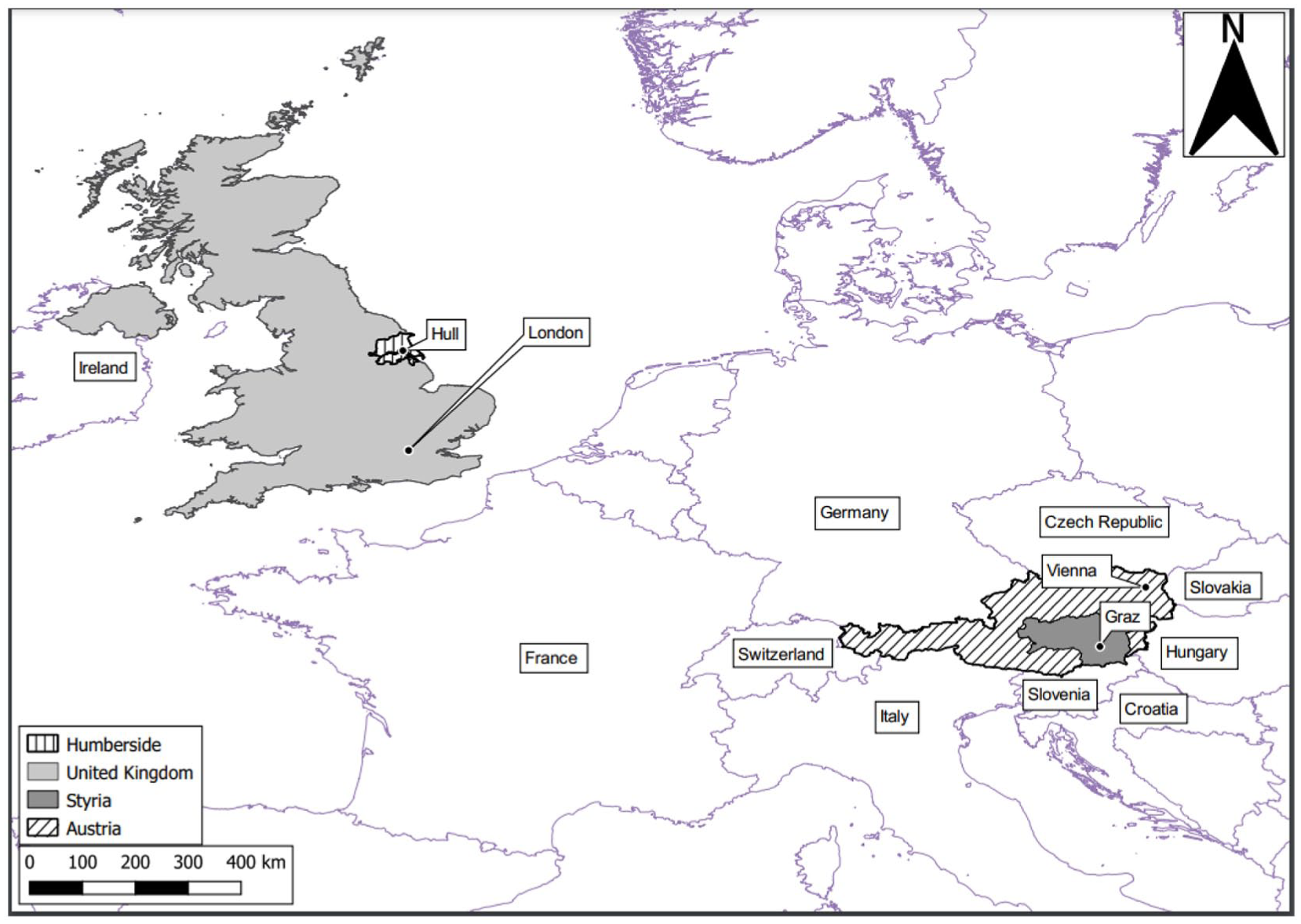
Map of Europe, with the case study regions shown in their wider national context.
Graz is the capital city and administrative centre of the province of Styria (Figure 1); it has an estimated population of 250,000 in 2019 (Austria Info, 2019). Styria’s Green Tech Valley Cluster has 300 active organisations focusing on green innovation and technology and has been recognised by the EU for the high-quality management and innovation of the cluster and claims to be an internationally leading technology hotspot for climate protection and CE (Green Tech Valley Cluster, n.d.). Styria’s economy relies on engineering and automotive companies. Many of the organisations in this study are located outside the administrative boundaries of the city of Graz; therefore, we have included the wider region of Styria as the case study location.
Data collection
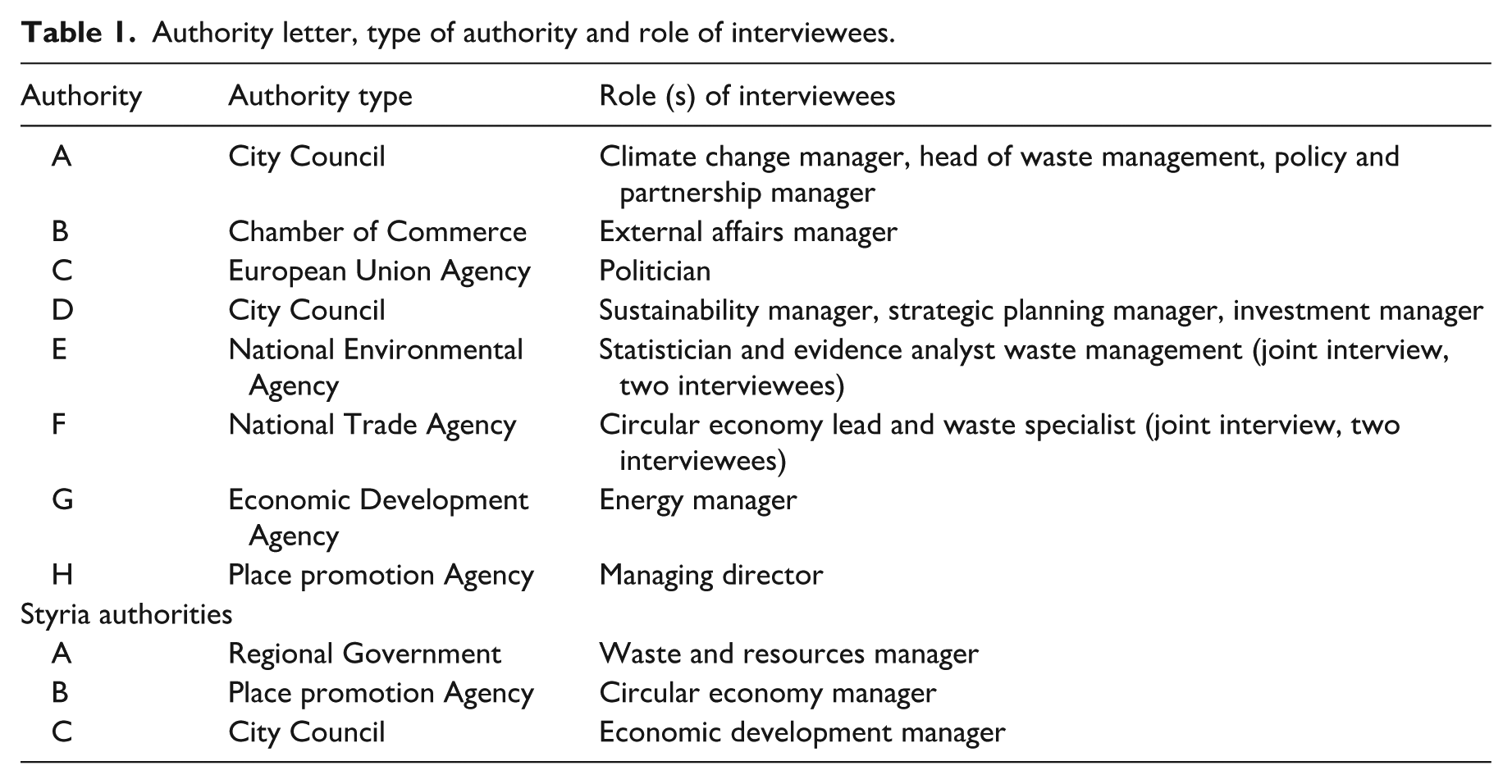
Interviews were the primary method for data collection in both locations. Semi-structured interviews covering a range of CE-related issues allowed for an open yet directed conversation on key issues of interest (Tracy, 2019). The first author conducted observations at a variety of organisations associated with the NH case study, for networking purposes and to gain insights to internal processes that could be explored in finer details during interviews. In total, 32 interviews were conducted with industry and policy representatives: 23 based in England, 1 EU official (via email correspondence), and 8 based in Styria (see Tables 1 and 2 for more details of interviewees). Interviews in Styria were complemented with informal discussions with key stakeholders at in-person meetings of the Green Tech Valley Cluster, which the first author attended in April 2019. Interviews lasted between 30 and 75 minutes and were conducted from spring 2020 to autumn 2021. Interviews were recorded, transcribed and coded. Interview topics examined the following key themes: geographic debates covering topics of economic development, local authorities, regional governance and the significance of places for companies in a globalisation context; and management debates including organisational structure, sustainability management, supply chain management, CE, waste management, decision-making strategy and the reasons for their presence in their respective region. These above topics were analysed with an IS focus on the proposed economic benefits and need for regional stakeholder collaborations for a CE. Interviews were deductively analysed, while still leaving openness for new insights to emerge through the semi-structured format of the interviews; these data were then inductively analysed, considering the emerging themes, in an iterative process.
Authority letter, type of authority and role of interviewees.
Company letter, company sector and role of interviewees.
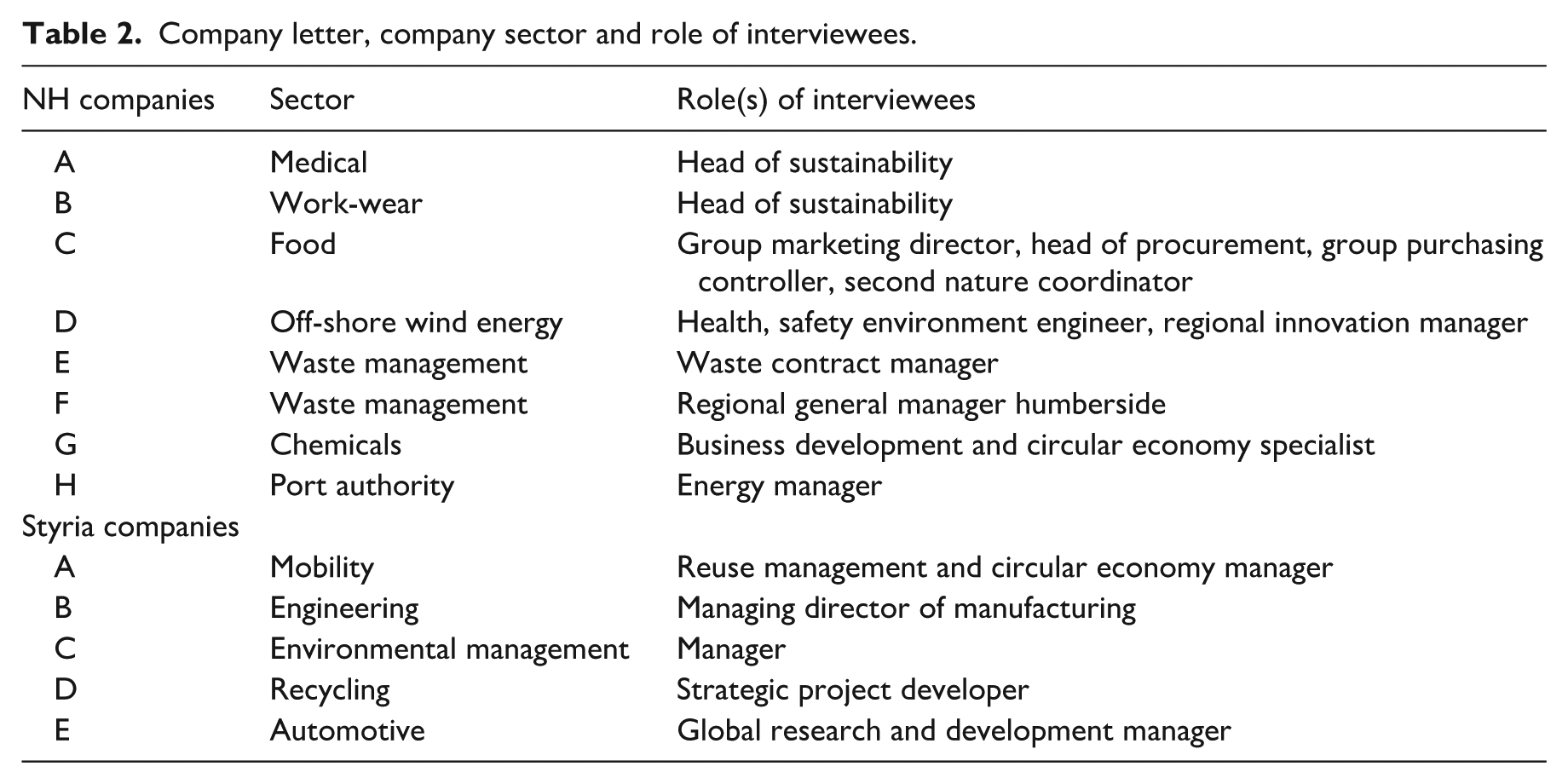
A diverse set of manufacturing firms located in NH and Styria were selected for interview based on their international scale of operations and working in the manufacturing sector. The companies studied in both regions operate in the manufacturing, food, medical, engineering and associated sectors. The research employed non-probability purposive heterogeneous sampling (Saunders and Lewis, 2012). Drawing on regional industry networking bodies, this sampling technique involved identifying respondents who were appropriate to answer the interview questions. Data from the interviews were coded, categorised and analysed based on the coding scheme, which was developed based on previous literature and emerging themes.
Findings and analysis
In this section, we review the evidence for CE activity amongst companies in the case study regions and consider the agency of regional policymakers in a scalar context and the extent to which the scalar influences on companies are offset by regional embeddedness.
Scalar context of policymaking for a regional CE transition
National regulations simultaneously set the expectations for action and constrain the possibilities in both case study locations. In the UK, CE policy is primarily governed through waste regulations, which are closely descended from pre-Brexit EU regulations. In Austria too, CE is seen as important element of environmental policy, with the Federal Waste Management Law (Austrian Government, 2002) and the Federal Waste Management Plan (Austrian Government, 2023) as key regulations at the time of this research. As in the UK, the waste focus suggests that the more pro-active aspects of a CE have yet to be entrenched in Austria’s policy. In both cases, CE is envisaged by policymakers (at both national and subnational scales) as part of wider transformative agendas, but with limited, if contrasting, local agency to bring these ends about.
At the EU level, the CE is seen as a key driver of economic growth and prosperity. In this research, the EU policymaker respondent viewed the CE as a tool to remain competitive, for example in terms of resource security at the EU scale. How this will impact on specific EU nations and their respective regions is less clear. The expectation of CE strategies to foster regional economic development is not matched by the design of CE policy. National-level policymaker interviewees discuss the CE as an opportunity for the UK to further increase economic growth. However, there is a lack of attention on the role of the region and local actors in fostering inclusive CE activities or the varying circumstances that they face. In the absence of regional-level government (at the time of the research), collaboration above the local scale requires the authorities involved to reach a shared vision with each other, which was not evident.
Whilst national (and supranational) policymakers envisage regional-scale CE transitions, in the UK, this is interwoven with decarbonisation and ‘levelling up’, that is, trying to correct for economic challenges over previous years as well as preparing for upcoming industrial change in response to climate change. NH is simultaneously contending with its present high-carbon economy (Jakobsen et al., 2022) and peripherality (Vale et al., 2024). Hull has displayed ambitions that bely its peripheral status (c.f., Vale et al., 2024) with developments relating to renewable energy drawing on the coastal location (Wurzel et al., 2020). The industrial make-up of NH’s economy make it one of the most carbon-dependent regions of the UK and, therefore, a prime target of the government’s decarbonisation agenda, which explicitly references IS as a strategy to be used (HM Government, 2021). Such CE activities may be more difficult to bring about at a regional scale than renewable energy development, as they rely on a diversity of companies and inter-firm collaboration. Present national policies do not provide additional support to compensate for challenges in deprived locations.
Styria does not share the social and economic challenges of Hull but nonetheless shares the assumption of the potential of local job creation and economic growth in association with a CE. Public sector bodies in both locations see a CE as primarily a company-driven exercise, but with a role for place-based organisations in influencing the process. Regional authority representatives in both locations recognised the importance of training and re-skilling citizens to accelerate regional CE activities. In both locations, public bodies expressed concern for developing skills locally both for those already employed but whose jobs might change and for the wider population (more notably an issue in Hull with a relatively less-well education population compared to the national level). However, while there are ambitions to improve local skills for a CE, there are no concrete strategies in place yet to re-skill the workforce away from heavily polluting industries. On the business side, interviewees in both locations rarely acknowledged the need for new CE-related skills in their organisations. The fact that no companies raised the issue skills may reflect spatially wider horizons for fulfilling skills needs. That is, their concern is for the company to meet its needs, not for the outcome locally.
Whilst there is an indication in national policies that local authorities could utilise their knowledge of local circumstances (e.g. as Jakobsen et al., 2022 speculate), local authorities in neither country had the policy tools or financial resources to engage with business to support the development of approaches to CE. In England, local authorities are required to implement national plans with limited input, as indicated by this quote from the Head of Waste Management, Authority A, Hull: ‘Honestly, it is not at a local level. So, that is more of a national level debate’. Local authorities do not have the authority or resources to incentivise, let alone require, for regional collaboration between companies or for companies to work with place-based bodies. The lack of regional input restricts the potential for developing CE activities tailored to the local contextual situation. Thus, there is a lack of alignment between national- and local-level policymakers in England, regarding power to influence change. By comparison, regional Austrian authorities appear to incorporate a more participatory approach to CE development compared to England, as discussed in the following quote by the Waste and Resource Manager, Authority A, Graz: ‘The different stakeholders have to be involved in the making of the waste management plan’.
Regionally, the CE is considered by policymakers in NH to improve economic growth by shifting away from heavily polluting industries to cleaner forms of production. The wider Humberside region was regularly cited by interviewees as having the heaviest polluting industrial cluster in the UK. However, the need for change, potentially including CE-related development to reduce carbon emissions, was seen as an opportunity for job creation and growth. A further motivator for reducing carbon emissions in the NH region is that the area is at risk of climate change effects, such as flooding from the Humber estuary.
In Styria, CE strategies were likewise seen as a tool to decarbonise the regional economy and to help meet national/EU greenhouse gas emission reduction targets. This approach was reflected in the promotional activities of the Green Tech Valley Cluster in Styria, who take on a prominent role for business development and economic growth, while also acting as a regional place promotion agency and facilitator of knowledge exchange, specifically in green-tech industries. Styria has a clearly defined regional governance system and more local power compared to NH. Regional policymakers in Styria appear to have more influence over CE activities, especially through the Public Private Partnership (PPP) approach implemented at the Green Tech Valley Cluster (Province of Styria is a key shareholder of the Green Tech Valley Cluster together with other public and private shareholders (Green Tech Valley Cluster, n.d.)). PPPs deploy private sector capital, along with public sector resources to help improve outcomes of public projects within an administrative location (Gerrard, 2001); they are often used for large infrastructure projects, which require public/private sector expertise and collaboration.
In practice, this article found that the level of regional CE collaboration, including IS, was minimal due to various barriers including costs involved and feasibility issues between stakeholders. Notably, despite having the dual advantage of the regional scale of governance and the more prosperous location, Styria has not had significantly greater success in terms of a CE transition. It would be misleading, therefore, to ascribe too many of the challenges faced by NH to its lack of a formal scale of government or its peripherality. Although collaborative approaches between companies and public bodies were more evident in Styria than NH, partly enabled by PPPs, evidence of inter-firm collaborations (such as active IS exchanges) was still limited in Austria.
This contrasts with the findings of work in France, where Niang et al. (2023) assume a more prominent role for regional policy in local CE deployment in France. Policymakers had limited authority or resources to persuade companies, whose focus was on value chain collaborations, which are rarely operationalised at the regional scale. In France, there appears to be a stronger level of national policy in support of regional initiatives than in the UK or Austria. Thus, national-scale policies are an important contextual factor for the development of a regional CE. There is a need for the voice and perspective of regional authorities to be more actively considered at the national level, to develop policies that would be more reflective of regional circumstances corroborating the arguments of Jové-Llopis et al. (2025), who call for tailored regional policies in a CE transition across the EU. This would give regional-scale policymakers more tools with which to engage other regional stakeholders, prominently including companies.
Regional companies in a scalar context
Companies in both locations had CE activities on their agenda as an environmental strategy, primarily in terms of waste management. This reflects the waste-focus of national environmental regulations which companies have adjusted to over a significant period of time. They did not regard CE development as being something on which they would collaborate with local authorities or other neighbouring companies, but seemed open to discussions reflected here by Business Development and CE Specialist, Company G, Hull: ‘I hadn’t really thought of the local authorities being able to help there, I’d always assumed it’s company to company. It would be great if there could be an initiative that the local authorities link up the correct people’. This individual at least had no recollection that such an organisation had existed in the form of NISP. CE development was seen as an activity internal to the company, potentially organised out of the region/country for international companies. Some companies discussed potential value chain collaborations. Thus, not only supplier-relationships, but also environmental relationships occur at scales up to global, that is, between companies with economic, not spatially driven, relationships.
Most companies studied in both regions showed a strong connection to their locality where they operate. Place-based networking of the companies indicates a level of regional embeddedness. In each location, the Humber Waste Alliance and Green Tech Valley Cluster members, respectively, showed an initial collaborative interest, but practical CE collaborations did not materialise during the study period. Company interest was more in sharing good practice or taking part in community-oriented activities (such as litter pickups) but not exploring more upstream CE strategies or considering neighbours as potential partners for CE collaboration through IS activities. Some interviewees appeared interested in potential IS collaborations. However, interest appeared to be at a non-strategic level and on an ad-hoc basis, which is unlikely to lead to fruitful long-term IS collaborations. In summary, although at least some companies were open to IS collaborations in principle, when it came to operationalising IS in NH, there was no evidence of this during the study.
The Green Tech Valley Cluster has a much longer history and more physical presence than the Humber Waste Alliance but still had a limited capacity to bring about CE collaboration between companies. These networking organisations help to build personal connections between companies and a level of social embeddedness which has been seen as a positive underlying factor for IS success (e.g. Leder et al., 2020; Munonye et al., 2025). However, ultimately, it may be the individuals representing companies who are well networked and trusting of one another on a personal level. What might have been more influential and long-term institutional connections between companies appear to be missing.
The effectiveness of regional embeddedness on company activity depends in part on company structure. Firms in both regions are part of internationally distributed companies, with strategic decision-making being passed down from international company headquarters to their NH/Styrian subsidiary. Examples in NH include a branch of the wind energy company Siemens Gemesa, based in Spain but with corporate offices also in Germany; or Smith and Nephew, a medical supply manufacturer founded in Hull 150 years ago but now with world-wide operations. A given branch of a company can have strong local connections but nonetheless be ultimately subject to decisions made elsewhere. IS collaborations are at risk of a partner pulling out, potentially inconveniencing other companies in the network (Chertow and Ashton, 2009). However, such decisions may not be taken by the company directly involved, that is, it might not be a local break in collaboration, but a decision from elsewhere to relocate or change policy on suppliers. This was evident in both NH and Styria, where larger companies studied follow a hierarchal strategy passed down from headquarters, which were often based in other locations nationally/internationally.
Regardless of company structure, manufacturing companies’ supply chains can span across national and international scales, limiting the potential for regional connections. Companies in both locations reported that suppliers are recruited based on costs and quality decisions, potentially reflecting company-wide (i.e. extra-regional) contracts and sometimes as part of long-term arrangements and/or reflecting specialist requirements. While many companies in both regions stated an interest in choosing regionally sourced materials, this was often not possible, due to reliance on global suppliers for niche materials (e.g. rare earth elements required for wind turbine production). However, particularly evident in the food industry in England, there was a theme of sourcing regionally due to the perishable nature of inputs. Thus, for some resources and sectors, there is a potential for regional CE collaborations (e.g. Maye et al., 2022), whereas a broader-based regional CE transition may be more difficult to bring about.
Whereas lack of knowledge of potential exchanges is seen as a barrier to IS (HM Government, 2021), a more intractable problem might be the scalar discrepancy between purchasing and waste decisions. In NH, companies assert that the most economically competitive suppliers are globally distributed in lower cost nations. Notably, in contrast to NH’s coastal location, Styria is adjacent to an international (but within EU) border (Figure 1), which is associated with cross-border movements of resources and people with lower cost locations, thus creating the potential for value chain connections that are spatially convenient but nonetheless facilitating the transfer of benefits beyond the region. In both locations, cost was a main driver in sourcing decisions, as evidenced by the Sustainability Co-ordinator, Company C, Hull: ‘Everywhere that you can we are looking for savings. Even before it was for a sustainable reason we have always been trying to make sure we are using packaging as efficiently as we can’ and here by the Manager, Company C, Graz: ‘the main focus was like to implement measures for sustainability or for environmental protection, energy saving and like have an economic effect by cost reductions and like saving money’. IS connections require specific matches of residues available with requirements of other companies – willingness and familiarity of staff cannot substitute for that.
The evident embeddedness of some companies, with strong regional ties to the respective location, has yet to come to fruition in terms of building a resilient and sustainable CE. There was little difference in behaviour between the companies with historic connections and those who had located for explicitly economic reasons in recent years. In NH and Styria, there appears to be a lack of mutually shared interest between local authorities and companies when attempting to foster CE initiatives, as companies are contingently embedded in the region where they operate. In both locations and across industrial sectors, it was evident that cost was the main driver in potential CE development. Policymakers were well aware of this constraint, whilst still having expectations of making progress in regional transitions without financial resources to bring to the discussion. These above factors elucidate the multi-faceted challenges facing regions on their CE transition journey, from contrasting industry and policy perspectives.
Conclusions
This article has extended existing spatially focussed sustainability transitions literature by uncovering apparent conflicts of interests in regional CE developments, while also incorporating policy and value chain perspectives, through an international comparison.
The relational approach we have taken to this study reveals the divergence in understanding of a CE transition at different scales and between different types of stakeholders. Policymakers at the EU, national, and regional levels have different understandings of CE activities and different expectations of each other’s contributions. These scalar issues in terms of CE implementation can only add to the challenges of creating a regional alignment of CE activities as previously witnessed in a larger city context (Chicago: Nogueira et al., 2020; and London: Turcu and Gillie, 2020). Notwithstanding the differences between the two case study regions (governance, peripherality and deprivation), the outcomes are broadly similar, strongly suggesting important constraints on regional CE transitions.
The key theoretical contribution of this article is the concept of scalar constraints on a CE transition. The consideration of the suitability of the regional scale for a CE transition cannot be separated from the wider scalar context. A regional CE develops as the sub-national expression of a national transition policy, not as a self-contained local resource initiative. This is an important theoretical consideration for IS research into spatial dimensions of a CE. For regional transition studies, the use of CE as a case study has indicated the interwoven conflicting scalar constraints of different types of stakeholders. Both the locally-based company branches and local authorities are positioned in a scalar context, with expectations from larger scales (of governance or company organisation) of CE activity and desired financial benefits. However, the preferred collaborators for IS activity may be outside the region, as is the likely destination of any financial benefit. There is a discrepancy between the ad loc local strategies for waste that is spatially specific and global strategies for purchasing that has no scalar limit. The companies in general had a concern for waste, and some would collaborate locally (at least in principle). But such exchanges appear to be on a modest scale. Thus, whilst there is potential for local-scale loop closing to yield environmental (and potentially cost) benefits, the decision-making over that is not at the local scale. It is uncertain what the technical level of possibility is, because purchasing decisions are made globally.
Local policymakers, or industry associations, have little agency to bring about change more ambitious than the national context. Significantly, this applies with a formal scale of regional governance in Styria as well as the informal region of NH, notwithstanding the policy options available in the former. Cross-sectoral scalar constraints cannot necessarily be overcome by an additional scale of governance. However, national policymakers should investigate the potential to devolve more power, funding and resources to regional policymakers, so they are capable and responsible for making locally nuanced decisions in relation to developing regional CE initiatives, which are tailored to their local region. While Styrian policymakers have more empowerment than their NH counterparts (through PPP agreements), both locations would benefit from the ability to set regional CE agendas and make locally targeted decisions based on their specific circumstances and the contextual issues impacting local stakeholders. Further devolution of resources may also shift local authorities away from competing with each other to secure national funding to support regionally oriented CE initiatives. Furthermore, the company understanding of a region is more porous and may differ from political boundaries. Locational decisions and networking activities in NH are blind to the (changing) political boundaries. A CE study, or transition initiative, focused solely in Hull or East Riding would miss the potential for cross-border collaboration.
Despite indications of what can be termed embeddedness of the companies in their respective regions, this is not sufficient to overcome the commercial imperatives and scalar constraints on them. The level of embeddedness is largely social, building personal connections rather than a strategic level of engagement between organisations. In both locations, companies showed an initial interest to engage with regional stakeholders. However, in practice, they were constrained by their top-down approaches to value chain configuration, which was defined by company headquarters and rarely regionally tailored. Regional networking activities may be better at interconnective individuals than forming economic ties between companies, in the absence of other influences, that is, are perhaps necessary but not sufficient for CE development. Business views CE activities as opportunities for value chain collaborations, which tend to take place internationally across many jurisdictions. Local branches of companies may also have limited agency for collaborative initiatives beyond ad hoc arrangements.
Given the identification of the role of scalar constraints on CE transitions, the likely success of regional CE sustainability transition depends on several contingencies. These are the nature of businesses operating in the region, their openness to engagement with diverse actors, and the overall costs involved, all of which may be influenced to a degree by the national governance context. The peripherality of the region may constrain options, but this can take different forms. NH’s literal peripherality has helped maintain an industrial base, albeit economic deprivation brings concerns for skills availability. Graz is an important economic city in Austria, but on the periphery of western Europe with consequent competition from lower-cost neighbouring locations. Differences in regional governance offer some lessons but are less influential than the different perspectives between public and private sectors. Thus, a degree of regional autonomy in decision-making may be necessary for a CE transition, but is not sufficient without alignment of national-scale policy and company motivations (whether internal or responding to regulatory drivers).
Further research should explore scalar CE challenges in different geographic contexts. Notably, a non-European comparison would be instructive. However, EU policies are evolving in light of the 2024–2029 Commission, which could provide an interesting test case for how regional transitions and associated efforts are influenced by an evolving scalar context. A quantitative analysis of material symbiotic exchanges as their environmental impacts would also be instructive, along with a study of financial benefits to see where the benefits of material efficiencies are felt.
Footnotes
Acknowledgements
We thank all the participants in this research as well as the reviewers for their helpful comments.

Funding
The authors disclosed receipt of the following financial support for the research, authorship, and/or publication of this article: This project has received funding from the European Union’s Horizon 2020 research and innovation programme under the Marie Skłodowska-Curie Grant Agreement No. 765198 to the University of Hull.
Declaration of conflicting interests
The authors declared no potential conflicts of interest with respect to the research, authorship, and/or publication of this article.