



Abstract
The unorganised manufacturing sector has been facing numerous challenges in spite of its capacity to generate employment. This study analyses the enterprises in the unorganised manufacturing sector in India most likely to face challenges based on different characteristics. The data for the study is extracted from the 73rd Round of National Sample Survey Organisation (NSSO) for the period 2015–2016. The aim is to identify the characteristics of unorganised manufacturing enterprises more likely to encounter problems. Logistic regression techniques have been employed for this purpose. The results show that the larger enterprises, the establishments, are more likely to face problems than the small own-account units. With odds ratios greater than one, rural sector enterprises, registered enterprises, male-owned enterprises, contracting enterprises, enterprises with accounts maintained and enterprises with government assistance have higher risks of problems. Registration status does not reduce the chances of such enterprises encountering problems. Older enterprises are less likely to face problems. Suitable policy measures designed for enterprises with specific characteristics are needed to address the problems of the unorganised manufacturing sector.
Keywords
Introduction
The unorganised sector in India has been the mainstay for employment opportunities and economic activity in India. The growth of the sector in terms of employment and number of units is an indication of the failure of its counterpart to absorb the growing labour force. The lack of organised/formal employment opportunities accompanied by growing population/workforce, avoidance of taxation and government regulations, lack of education and skill, and lesser benefits/incentives on formalisation are the main reasons that have caused the large employment in the unorganised sector. According to the 73rd National Sample Survey Organisation (NSSO) report (2015–2016), there were 6.34 crore unincorporated non-agricultural enterprises with 31% enterprises in manufacturing, 36.3% in trade and 32.6% in other services during 2015–2016.
From the term ‘unorganised’, one can understand it as being imbalanced, illegitimate, non-strategic and insecure. Right from the inception of the term ‘informal’, Hart (1973) observed that the informal sector was capable of creating employment opportunities despite its numerous problems. The sector has been acting as a vent for the surplus labour in developing countries. The enterprises operating in the unorganised sector are however problem-ridden, with some being sector-specific and enterprise-specific, while some more generic in nature. With the dwindling contribution of agriculture to GDP and employment in India, the non-agricultural sector is the driver of its growth. The service sector has seen immense growth in recent years, but the same cannot be said for the manufacturing sector. To get more insights on what hampers the growth of the manufacturing sector in India, we would have to direct our attention to the unorganised sector, since the bulk of the activities are taking place there and it has been dragging the growth of the manufacturing sector in India (Djidonou & Foster-McGregor, 2022; Goldar, 2013).
The unorganised manufacturing sector (UMS) has been a source of employment and income for millions of Indians and has been contributing to export-building capacity as well. But its low productivity is a concern prompting numerous studies to examine the causes of its present state (Goldar & Mitra, 2013; Kathuria et al., 2010). It is imperative to investigate as to which type of enterprises, under UMS, are generally facing more problems. Armed with this information, policies can be formulated to target those enterprises to alleviate their problems which may enhance their productivity. Existing studies have linked problems of the unorganised manufacturing enterprises to their characteristics, and others have focused on characteristics of owners/managers of the enterprises. Most of the studies, which are based on the size of the enterprise, are confined to state level (NSS 62nd Round State Sample of Delhi, 2008; Singh & Jain, 2006). Larger enterprises are reported to face power cuts and shortage of capital, while smaller ones lack infrastructural facilities and easy access to raw materials. The other characteristics of enterprises such as registration status are found to ease the problem of funding in enterprises (Bhavani & Bhanumurthy, 2014; Nikaido et al., 2015; Sasidharan & Raj, 2014). Urban-located enterprises face different sets of problems from the rural-located ones (Baruah, 2014; Sasidharan & Raj, 2014). Older enterprises are more prone to growth barriers compared to younger enterprises (Coad & Tamvada, 2012; Park et al., 2010; Sasidharan & Raj, 2014). Similar to registration status, proper maintenance of accounts for the UMS reveals a positive relationship with financial access only (Bhavani & Bhanumurthy, 2014).
The existing literature indicates that enterprises of all types do face problems, but there is no in-depth study which looks into what type of enterprises are more likely to face challenges in their operation of business. The present study is an attempt to analyse the UMS by linking selected characteristics of an enterprise and the existence of problems. The study also considers characteristics which have not been examined in the existing literature such as social group of the owner, age, ownership of the enterprises and maintenance of proper accounts. The problem is approached by identifying the characteristic-specific enterprises which are constrained, using the available literature. The next step is to use the most recent available data for obtaining the information on enterprise characteristics using the National Sample Survey data. Altogether, nine features (indicating the basic characteristics), that is, size, location/sector, registration status, age, social group, maintenance of accounts, government assistance, growth status of an enterprise and ownership, have been considered. Logistic regression has been applied, and the results obtained have been discussed, which can shed light on future policy formulation.
Literature Review
The term ‘informal’ was first used by Hart (1973) during his study on a certain group of people belonging to the northern part of Ghana, known as the Frafas, who migrated to the southern part for better urban income opportunities. The 55th NSSO round of 1999–2000 defined all those unincorporated enterprises operating on either proprietary or partnership basis as the informal sector. On the other hand, the unorganised sector also includes trusts, cooperative societies, and private and public limited companies. However, as per the National Commission for Enterprises in the Unorganised Sector (NCEUS), the terms ‘organised’ and ’unorganised’ have been used interchangeably with ‘formal’ and ‘informal’, respectively. It defines the unorganised sector consisting of ‘all unincorporated private enterprises owned by households or individuals, engaged in the sale and production of goods and services and operated on a proprietary or partnership basis but up to nine workers in total’ (NCEUS, 2008, p. 3).
The nature of problems faced by enterprises depends to some extent on their size as measured by the number of workers engaged. Problems related with power and shortage of capital are being faced mostly by establishments, that is, enterprises with at least one hired worker. On the other hand, the enterprises with no hired workers suffer to a large extent in terms of obtaining raw materials, electricity connection, availability of infrastructure and recovering charges (Apra, 2014; Gupta, 2012; NSS 62nd Round State Sample of Delhi, 2008; Singh & Jain, 2006). The problems that enterprises face are in fact closely associated with their size.
Registration with government authorities is an important factor for the success of an informal micro enterprise (Kundu, 1999). Registered informal enterprises face lesser problems in the form of financial or technical assistance and can thereby survive longer compared to the unregistered ones (Sasidharan & Raj, 2014). Bhavani and Bhanumurthy (2014) observed registration with the government agencies as one of the significant factors on financial access and financial resource gap of unorganised manufacturing enterprises during 2005–2006. Registration of enterprises with government authorities enables them to have access to the credit market, yet most of the enterprises in UMS do not register.
Being located in the periphery puts rural sector enterprises in an already disadvantageous position. In the rural sector, enterprises are subjected to financial problems and poor infrastructure. Power cuts and the shortage of capital are observed as major problems faced by enterprises in the urban sector (Baruah, 2014; Gupta, 2012; Sasidharan & Raj, 2014; Singh & Jain, 2006).
Sasidharan and Raj (2014) observed that the problems that older informal enterprises faced have led them to experience slower and weaker growth compared to younger ones. However, Coad and Tamvada (2012), in their study of small enterprises in India, found that younger firms grow faster compared to older firms, though growth turns out to be less dependent on age among old firms.
Shonchoy and Junankar (2013) observed that those household heads that were belonging from lower social groups (castes and religions) were more likely to be found in the informal sector of India. The importance of caste in entrepreneurship has been closely examined by Iyer et al. (2013), where it is found that Scheduled Castes (SCs) and Scheduled Tribes (STs) are underrepresented in ownership of enterprises in India. In case of the MSMEs, SCs and STs are inadequately represented as owners of registered enterprises and are more concentrated in rural areas of India (Deshpande & Sharma, 2013). The low-caste MSME entrepreneurs have faced the problem of higher fixed costs and stricter limits on borrowing in comparison to higher-caste entrepreneurs (Goraya, 2019).
Enterprises which maintained accounts of their business are expected to be more growth-oriented and face less problems compared to those not maintaining accounts. Bhavani and Bhanumurthy (2014) observed that maintenance of accounts was a significant positively related factor on financial access and ‘financial resource gap of enterprise’. Enterprises that have maintained proper records of their accounts are more likely to experience lesser growth barriers and hence do experience faster growth (Sasidharan & Raj, 2014). Further, governments, at various levels and through their agencies, do reach out to enterprises to help them overcome the obstacles they face in their operations. Sasidharan and Raj (2014) noted that enterprises receiving government assistance in terms of training and marketing were more likely to experience faster growth than those without any assistance. But there is also evidence of a weak relationship between technical assistance received and an enterprise’s growth (Brown et al., 2005). In general, it can be argued that enterprises that received government’s assistance in one form or the other reduce some of the problems that exist.
NSSO classifies enterprises into four types according to their growth status: expanding, stagnant, contracting and operating less than three years (for which their growth status is not asked). Sasidharan and Raj (2014) observed that expanding enterprises located in urban areas have experienced faster growth. Sengupta and Seth (2021) recently observed that most of the informal sector units are stagnant, that is, 54% in rural sector and 50% in urban sector during 2015–2016.
On the ownership of enterprises, Jaggi et al. (2016) found that around 96% of women working in the manufacturing sector
The literature reviewed reveals important characteristics of enterprises which are associated with the problems they face in the UMS. However, it can be observed that no single study has taken up the task of relating the enterprise-specific characteristics to the likelihood of facing challenges and problems which we are attempting in the present study. Identifying characteristics of enterprises which are more susceptible to barriers can go a long way in effective policy formulation for assisting enterprises in dire needs. Second, most studies which investigate the problems faced by UMS are confined to the subnational level, and our study intends to fill the gap by undertaking a national-level study using unit-level data. Third, our study focuses on only very small enterprises, with less than 10 workers, which forms a major part of the UMS in India (about 99%).
Objective of the Study
The objective of the study is to find out the types of unorganised manufacturing enterprises more likely to face problems based on their characteristics.
Data and Methodology
Data
Our data source is the Survey on Unincorporated Non-agricultural Enterprises Excluding Construction provided by the NSSO (MOSPI, 2018). The analysis had been carried out on unit-level data of the 73rd NSSO Round (July 2015–June 2016). NSSO conducted such a survey on a quinquennial basis in order to generate estimates of various operational and economic characteristics of unincorporated non-agricultural enterprises belonging to manufacturing, trade and other services (excluding construction) at national and state levels.
Methodology
Based on the size, the NSSO categorised enterprises as establishments and own account enterprises (OAEs). Further in UMS, establishments are classified as directory manufacturing establishments (DMEs) and non-directory manufacturing establishments (NDMEs). An own account manufacturing enterprise (OAME) is defined as a manufacturing enterprise which is run usually without the help of any hired worker employed on a fairly regular basis, an NDME as a manufacturing establishment employing less than six workers (hired and household-taken together) on a fairly regular basis and a DME as a manufacturing establishment employing six or more workers (hired and household-taken together) on a fairly regular basis (NSSO, 2001).
To capture the essence of extent in informality, we have followed the definition by the NCEUS by considering only proprietary and partnership-owned enterprises and enterprises employing less than 10 workers. We have also excluded non-profit institutions and non-profit institutions serving households, leaving only profit-motivated enterprises to be considered in the study.
To achieve the objective stated above in the UMS, a logistic regression analysis has been adopted. Logistic regression technique was introduced by Cox (1958), which allows one to estimate the probability of an event happening or not by predicting the binary dependent outcome from a given set of independent variables(s).
The data used for the study fulfils the required assumptions for undertaking logistic regression analysis. Dependent variable ‘problem faced’ has been coded as 1 when the enterprise faces a problem and 0 otherwise. The explanatory variables are size, location/sector, registration status, social group of the owner, maintenance of accounts, government assistance, growth status, ownership and age of the enterprise.
Our logistic regression model is similar to the previous work by Rahman (2013), and it is as follows:

Where 𝛼 = Intercept term
Yi = Problem faced by enterprise
Description of the Variables
Findings Using Logistic Regression Analysis and Discussion
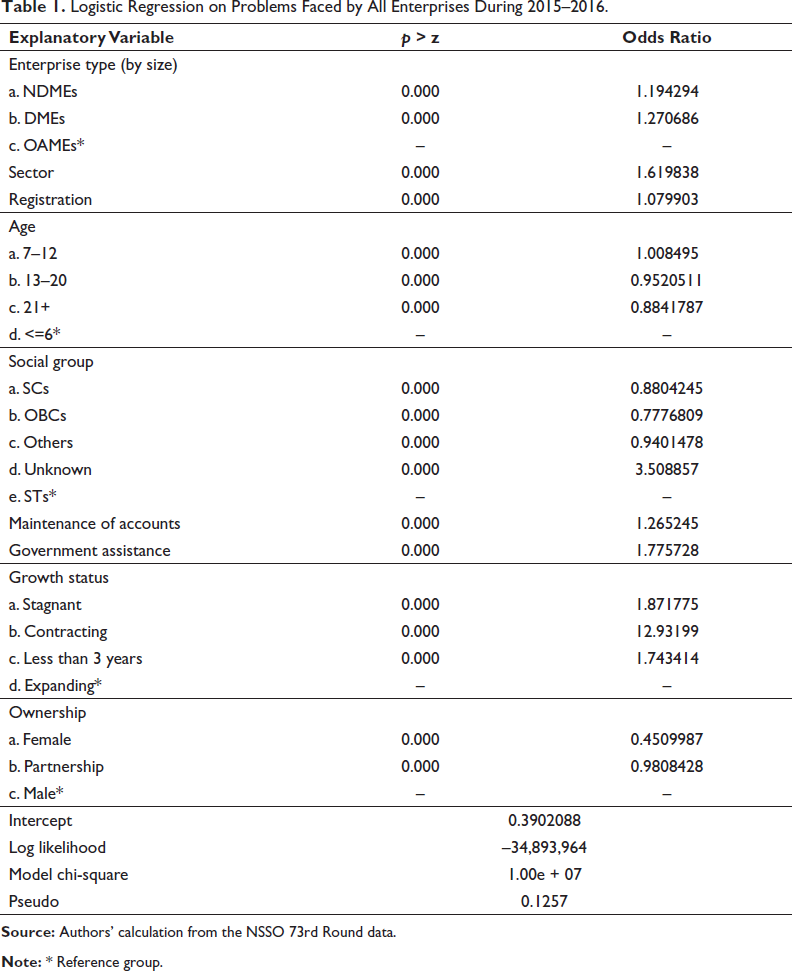
In Table 1, the outcomes, shown in terms of odds ratios, have been found to be statistically significant, with p values less than .05 for all explanatory variables. The odds of having problems are larger for NDMEs and DMEs than for OAMEs. The finding is justified since the DMEs and NDMEs have a sizable existence in the midst of dominating OAMEs in the urban sector and that the share of the rural enterprises is declining more especially among the OAMEs (Chadha & Sahu, 2006). It could also be that the methods of operations of the establishments are more dependent on availability of power and capital compared to the OAMEs. Hence, with the increasing proportion of the NDMEs and DMEs, we can also expect chances of occurrence of problems such as power cuts and shortage of capital. The odds ratio for the rural sector enterprises is greater than one implying that rural sector enterprises are more likely to face problems compared to urban sector enterprises. This result is corroborated by the fact that such enterprises would probably face infrastructural bottlenecks at a larger extent compared to urban sector enterprises. Further, registered enterprises have a higher likelihood of facing problems than unregistered enterprises, as the odds ratio is greater than one. Registration status may help an enterprise to have better financial accessibility (Bhavani & Bhanumurthy, 2014) but does not help them mitigate other problems such as accessibility of raw materials, power cuts and labour problems, which enterprises typically face. It is also more likely that the registered enterprises are larger enterprises which are more prone to having problems.
Based on social groups of owners, the enterprises owned by SCs, OBCs and Others are having lower risk of problems than those owned by STs. Further, problems are more likely to prevail among enterprises that have maintained accounts than among those not maintaining. Thus, unlike the previous findings (Bhavani & Bhanumurthy, 2014; Sasidharan & Raj, 2014), maintaining of accounts does not ascertain lesser chances of problems at large. Those which have obtained government assistance (where odds ratio is greater than one) are also more likely to face problems. Getting government assistance could lower the risk of marketing and skill problems (Sasidharan & Raj, 2014) but not the other problem(s). Considering expanding enterprises as the base group, the odds of facing problems is more liable among the other enterprises, that is, stagnant, contracting and operating less than three years. The contracting enterprises also have the highest odds ratio of 12.9, indicating that such enterprises are 13 times more likely to face problems than the expanding enterprises. In fact, this is a possible expectation for contracting enterprises.
Logistic Regression on Problems Faced by All Enterprises During 2015–2016.
Conclusion
This study investigating the type of enterprises in UMS more prone to problems has revealed certain useful information. Our findings from the logistic regression analysis have enlightened about the effects of certain characteristics of an enterprise, that is, type (by size), location/sector, registration, social group, maintenance of accounts, government assistance, growth status of enterprise, ownership and age on problems that UMS have faced in the recent years. The study has observed that establishments, rural sector enterprises, male-owned enterprises, contracting enterprises, enterprises with accounts maintained and enterprises with government assistance are those where the existence of problems is more likely to happen.
Registration with government agencies apart from the Factory Act, and maintaining of accounts, does not guarantee removal of problems, especially when an enterprise faces problems other than financial access. Such enterprises may be in need of equipment, training, access to raw materials and promotion of their products in wider platforms such as access to online markets to be more competitive. Younger enterprises are more prone to problems and are to be supported and encouraged to foster growth and productivity. Larger enterprises, DMEs and NDMEs, have to be specifically addressed through suitable policy measures to help them formalise and encourage them to be part of the organised sector. The ST-owned enterprises are clearly more disadvantaged than the enterprises belonging to other social groups; therefore, a blanket policy targeting minority-owned enterprises is not expected to effectively help them overcome their problems.
Better infrastructural development in the rural areas can help enterprises to avail proper connectivity, endure lower transportation costs and have access to basic education, health and services. Incentives to enterprises should also be based upon the social groups of owners. Besides, other government assistance (apart from marketing and training) should be considered for lowering the incidence of problems in the UMS.
The study has enlightened on the enterprises in the UMS which are more likely to face problems based on their characteristics in recent years. The results of the study reveal that tailor-made policy measures designed and targeted on enterprises with specific characteristics are the need of the hour for improving the productivity and growth prospects of enterprises under UMS. It may be argued that the growth of UMS should be discouraged as it entails ineffective use of resources, a drag on the organised sector and loss of tax resources to the state: The fact remains that the unorganised sector will persist and undeniably continue to be an important source of economic activity in India in the near future. UMS should be supported to strengthen the complementarity it provides to the organised sector.
Footnotes
Declaration of Conflicting Interests
The authors declared no potential conflicts of interest with respect to the research, authorship and/or publication of this article.
Funding
The authors received no financial support for the research, authorship and/or publication of this article.
