



Abstract
The necessity for understanding workplace competencies and personal effectiveness has arisen as a result of the rising pressure on employees to adapt to the changing nature of work and enterprises to remain competitive in the marketplace. In this context, employers need to identify the factors impacting work performance to achieve organisational effectiveness. Organisational effectiveness is one of the most significant organisational goals practically for all firms in every industry. Organisations create several strategies to compete with rivals and to improve organisational performance in order to achieve business success. No organisation can advance or be successful unless and until its employees are competent to complete duties and achieve goals. Therefore, the current study makes an effort to comprehend the significance of workplace competencies and personal effectiveness on organisational effectiveness in the micro, small and medium enterprises of Manipur. This study finds that workplace competencies have a significant effect on the organisational effectiveness and also ascertains that personal effectiveness acts as a positive mediator in the workplace.
Keywords
Introduction
The twenty-first century is known for its dynamic business environment. This environment is now characterised by increased globalisation, the integration of digital technologies and a global workforce. The goal of globalisation is to create a single market where people can transact businesses (Tallman, 2022), but the dynamic interactions between human behaviour and organisational effectiveness have been generally neglected (Katz & Kahn, 1966). Therefore, organisations require a variety of abilities for a variety of job perspectives, and each competency calls for a variety of layers of knowledge to be integrated with the specific tasks that are given to each employee in the organisation (Sharma, 2017). The survival of enterprises is threatened in the business climate of the twenty-first century despite their size, technology or market emphasis on businesses today due to intense competition. Consequently, the focus on competency studies has grown rapidly (Qiao & Wang, 2009). A strong and supportive workplace should be established and upheld between employees and their organisations in order to overcome these challenges. In order for the workers to meet organisational expectations under difficult circumstances, it is crucial that they recognise workplace competencies and personal effectiveness for organisational sustainability.
Objectives of the Study
The primary purpose of the study is to examine workplace competencies and how they relate to personal effectiveness in achieving organisational effectiveness in the MSME sector of Manipur. This study addresses the following research objectives:
To ascertain the relationship among workplace competencies, personal effectiveness and organisational effectiveness.
To determine the effect of workplace competencies on organisational effectiveness.
To explore the mediating effect of personal effectiveness.
To conduct structure equation modelling (SEM) of the causal model.
In order to fulfil the objectives of the study, the researchers formed the following hypotheses:
H1: Workplace competencies and personal effectiveness have a positive relationship with organisational effectiveness.
H2: Workplace competencies have an effect on organisational effectiveness.
H3: Personal effectiveness mediates the effect of workplace competencies on organisational effectiveness.
Competency
According to Draganidis and Mentzas (2006), competence is a mix of implicit and explicit understanding, behaviour and abilities that increases a person’s capacity for effectiveness in job performance. A person’s potential to perform at a later time is represented by their acquired competencies (Boam & Sparrow, 1992; Page et al., 1993). In the highly competitive corporate climate of today, competence has become strategically important and is essential for organisational effectiveness (Dubois, 1998).
Workplace Competencies
They are a set of observable performance elements, such as unique knowledge, skills, attitudes and abilities, and make up a job-related competency and behaviours that are connected to high performance, as well as collaborative team, process and organisational skills that give the company a long-term competitive advantage (Athey & Orth, 1999). Workplace competencies, also known as work-ready competencies, are the knowledge, skills and practices that enable people to function in an organisational setting. Therefore, workplace competencies are simply the required job-related activities and behaviours to effectively do the job. These workplace competencies can be generally divided into technical and behavioural categories. Competency in the workplace is a collection of mental abilities (technical knowledge, expertise and abilities), and behavioural traits that are a result of a person’s personality, such as principles, attitudes, values and motivations (Hodges Burchell, 2003).
Personal Effectiveness
The capacity to influence people positively and energetically via the persuasive and effective communication of ideas and information is known as personal effectiveness. It entails organising and prioritising resources while utilising interpersonal abilities to create productive working connections with others and lessen stress on an individual basis (George & Jayan, 2012, p. 121). It alludes to a person’s capacity for effective job performance (Sutton & Ford, 1982). The task performance of particular employees or organisation members is highlighted by their personal effectiveness. Interpersonal effectiveness and group effectiveness are two ways that personal effectiveness appears at the organisational level. Personal effectiveness fosters happiness and well-being on an individual level (George & Jayan, 2012, p. 121). It is the way a person uses their abilities and how they do so to increase their overall success in the organisation.
Organisational Effectiveness
Organisational effectiveness is defined by Mott (1972) as ‘the capacity of an organisation to mobilise its centres of power for action, production, and adaptation’. The ability of a business to consistently achieve its strategic and operational goals over the long term is known as organisational effectiveness (Fallon & Brinkerhoff, 1996). Organisations that are effective tend to generate more and adjust to internal and external issues more readily than other organisations of a similar nature. The organisational effectiveness shows that the company accurately determines its objectives and then executes them with considerable skill and zeal (Beugre & Offodile, 2001). The traditional and modern approaches are the two main methods that Daft (2003) identified for measuring organisational effectiveness. The goal approach, system resource approach and internal process approach are some of the traditional methods. The outputs are what the goal approach to organisational effectiveness, which is taken into account in this study, is concerned with. It examines whether the organisation accomplishes its goals in terms of the level of output that it wants to produce (Strasser et al., 1981). In other words, this methodology determines and evaluates the output goals of the organisation. The four factors, viz., resource acquisition, efficiency, goal attainment and customer satisfaction, can be used to assess an organisation’s effectiveness (Kushner & Poole, 1996). Economic and technological efficiency, as well as the ability to evolve with the outside world, are all characteristics of an effective organisation (Carnall, 2007).
Research Methodology
It is an empirical study based on both primary and secondary data. The primary data are collected from MSME workers belonging to eight districts of Manipur, and secondary data are retrieved from Google Scholar. A random sampling technique is used for collecting the primary data using a structured close-ended questionnaire. A 5-point Likert scale of 1 (strongly disagree) to 5 (strongly agree) was used to measure the responses. Items for the constructs of work competency, personal effectiveness and organisational effectiveness are measured using multiple competency assessment surveys (HR Survey, 2020), assessment of entrepreneurial potential (Baltic Sea Academy, n. d.) and NJOD Holistic Organizational Effectiveness Survey (Quantisoft, 2012). Statistical tools such as Cronbach’s alpha, factor analysis and Pearson correlation tests were used for the analysis of the data using SPSS version 23, and SEM was applied using AMOS version 24 for the test of hypotheses and model fitness.
Data Analysis and Results
A total of 656 sample size was considered for the study collected from eight districts operating MSMEs in Manipur. The demographic details of the respondents are given below.
Gender.

Gender.
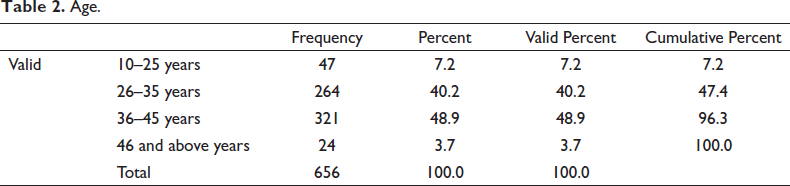
Age.
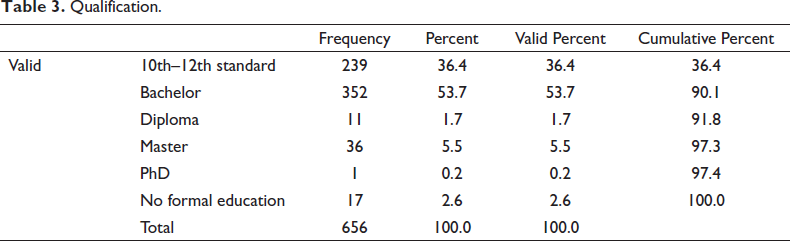
Qualification.
Place of the Enterprises.
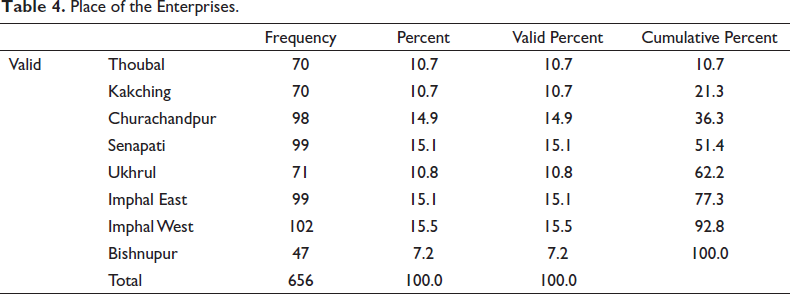
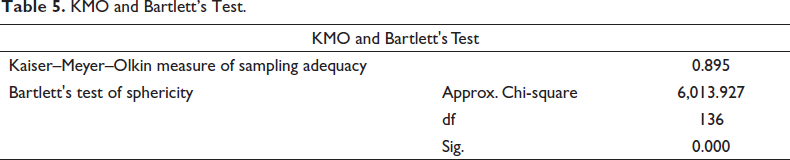
The study’s sample size is 656, which is sufficient to carry out exploratory factor analysis (EFA). The participants’s gender, age, qualifications and places of enterprises are given in the Tables 1 to 4. The overall sample adequacy test of KMO and Bartlett’s test is 0.895 (Table 5) which is greater than the cut-off points of 0.7. The results of the EFA using the principal component method, varimax rotation and suppressing loading below 0.7 produces three factors representing organisational effectiveness, workplace competencies and personal effectiveness (see Table 6).
KMO and Bartlett’s Test.
Exploratory Factor Analysis.
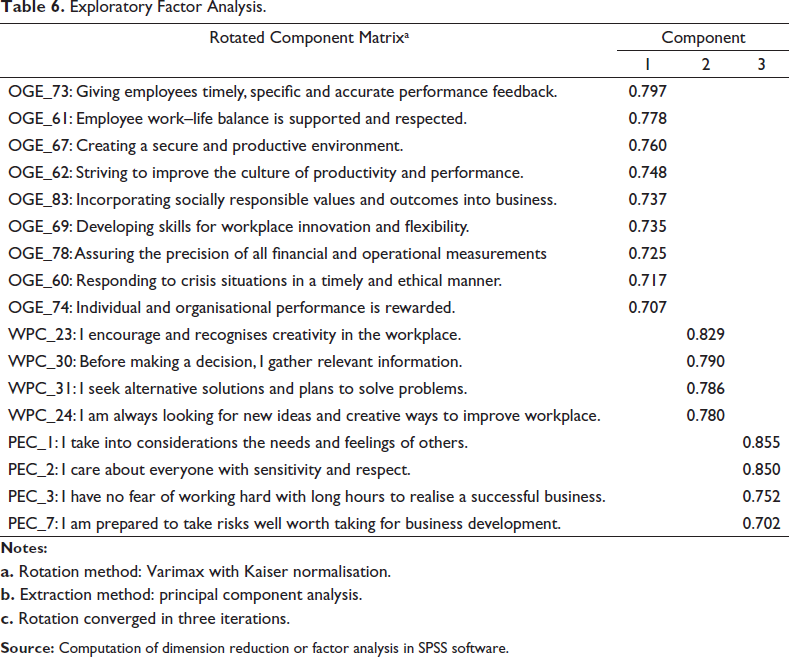
The overall Cronbach’s alpha of the three factors, that is, organisational effectiveness, workplace competencies and personal effectiveness competencies, is 0.903 which is above the threshold value of 0.7. The reliability scores of each construct are 0.910, 0.853 and 0.0.838 as shown in Table 7.
Scores of Cronbach’s Alpha.
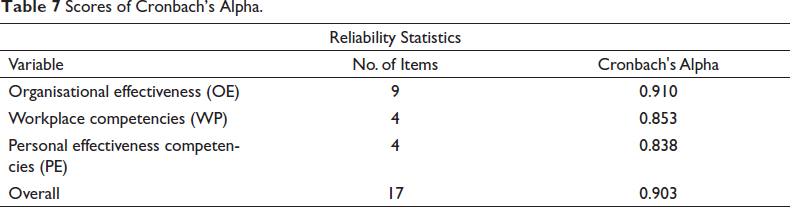
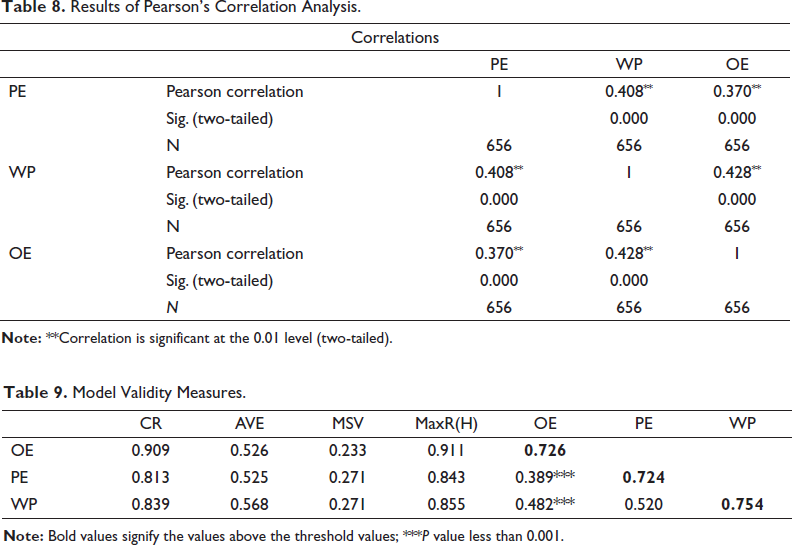
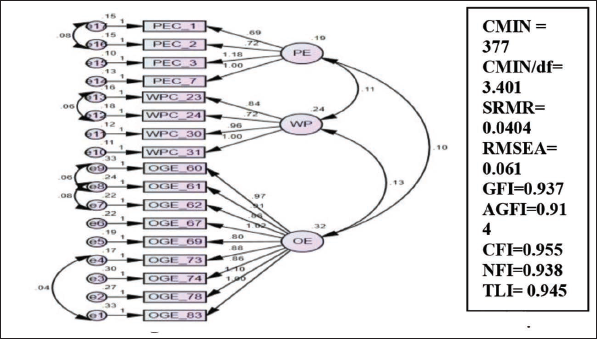
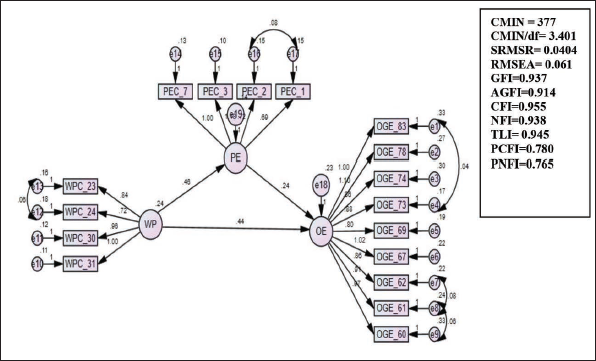
Table 8 shows that the p value is less than 0.05; therefore, personal effectiveness competencies and workplace and organisational effectiveness have a significant positive relationship among them. The confirmatory factor analysis (CFA) was executed to test the fit indices of the measurement model of the study using AMOS 24. The acceptable range for CMIN/df (≤ 5 recommended by Bentler, 1990), GFI/AGFI (cut-off > 0.9 as suggested by Schumacker & Lomax, 2004), RMSEA (cut-off value of 0.08, as recommended by Bagozzi & Yi, 1988), SRMR (<0.08 as recommended by Schumacker & Lomax, 2004), CFI, NFI and TFI (cut-off value of 0.9, as recommended by Hair et al., 2006), PCFI and PNFI (the cut-off value of 0.5, as recommended by Hair et al., 2006) have been used determine the goodness of fit of the model. The fit indices of the CFA model obtained are within the acceptable limit after model modification as given in Figure 1. In the SEM of the causal model, the p value is significant, which means that there is a significant effect of workplace competencies on organisational effectiveness, and personal effectiveness acts as the mediator (see estimates and regressions weight in Table 10). Additionally, the goodness of fit indices fold within the acceptable values, which indicates that the causal model fits the data well and is considered to be a good fit (CMIN = 377, CMIN/df = 3.401, p < 0.001, SRMR = 0.0404, RMSEA = 0.061, GFI = 0.937, AGFI = 0.914, CFI = 0.955, NFI = 0.938, TLI = 0.945, PCFI = 0.780 and PNFI = 0.765) as shown in Figure 2 and Table 10.
Results of Pearson’s Correlation Analysis.
CFA of the Measurement Model.
SEM Causal Model.
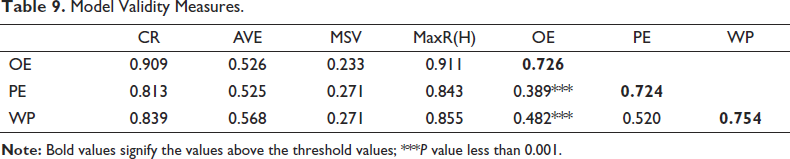
Model Validity Measures.
Estimates of the SEM Model.
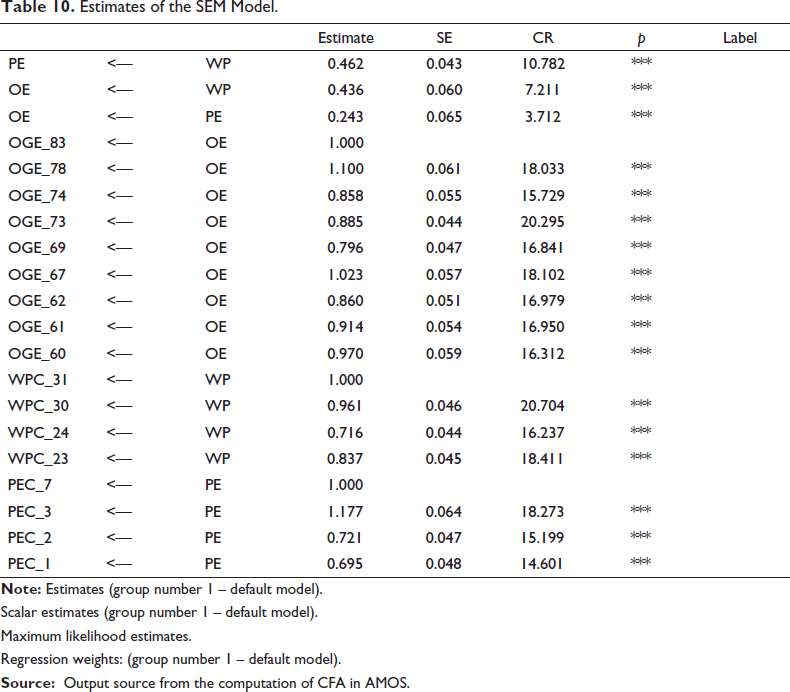
Scalar estimates (group number 1 – default model).
Maximum likelihood estimates.
Regression weights: (group number 1 – default model).
The validity of the constructs has no issues as the scores are above the threshold values recommended by Hu and Bentler (1999) using the Gaskin and Lim (2016), ‘master validity tool’, AMOS Plugin (source: Gaskination’s StatWiki).
This study confirms that workplace competencies have a significant positive effect on organisational effectiveness, and personal effectiveness acts as the mediator. The findings, therefore, suggest that to achieve organisational effectiveness, it is critical to understand employers’ perspectives on workplace competencies and employees must acquire the necessary workplace competencies to compete in the competitive marketplace. Further, this study enhances the body of empirical research on personal effectiveness and its importance in mediating effect on the organisational effectiveness in the workplace.
Footnotes
Declaration of Conflict of Interests
The authors declared no potential conflicts of interest with respect to the research, authorship and/or publication of this article.
Funding
This paper is a part of post-doctoral research work funded by the Indian Council of Social Science Research (ICSSR).
