



Abstract
Economic development is significantly influenced by the entrepreneurial process. Economic growth is fuelled by entrepreneurial activity; thus, academic institutions are under more pressure than ever to encourage students to think like entrepreneurs. This study tries to focus on analysing how entrepreneurship education is affecting the development of entrepreneurial intent among female students of Odisha. The study analysed the impact of entrepreneurship education in terms of perception of entrepreneurship education, perceived relevance and adequacy of curriculum and perceived competence of the lecturing team on student entrepreneurial intention. Our study showed a positive and significant association between entrepreneurship education and female entrepreneurial intention. It was also evident from the study that entrepreneurship education has a positive significant impact on female entrepreneurial intention. Therefore, it is imperative to reform and revolutionise the educational system for educated youth to stop seeking employment and start creating it instead.
Introduction
Without actively including women in all facets of life, economic progress cannot be realised. Scholars generally agree that women can play a significant part in the entrepreneurial phenomenon. The percentage of women’s contribution to economic and social growth depends on the institutional support for gender equality and its promotion. Through creative destruction, entrepreneurs support economic growth, job creation and other aspects of well-being (Sarfaraz et al., 2014). Economic development is significantly influenced by the entrepreneurial process, and entrepreneurs are essential to economic expansion. Promotion of entrepreneurship is seen by all nations as an essential strategy for long-term job growth and innovation in products, production processes and organisations. If women entrepreneurs have equal opportunities and access to resources, they can play significant roles in the process of economic development. It takes knowledge and understanding of women’s entrepreneurship and its relationship to economic growth to recognise the elements affecting female entrepreneurship. Even though women make up nearly half of the population of working age, they are underrepresented in the workforce across numerous industries, including entrepreneurship (Strawser et al., 2021).
State governments and policymakers, along with academic institutions and representatives from the business sector, are working to encourage women to launch and expand their firms because they are aware of the positive effects that female entrepreneurship can have on the economy (Islam et al., 2018). Incorporating entrepreneurship education into formal education could inspire and empower women to launch their own businesses. Economic growth is fuelled by entrepreneurial activity; thus, academic institutions are under more pressure than ever to encourage students to think like entrepreneurs. Exposing students to entrepreneurship education may inspire them to launch their own enterprises as university education has an undeniable influence on students’ job choices (Zhang et al., 2014). Understanding intention is crucial in determining the mindset of the young generation, especially students, about job choice and entrepreneurship education plays a significant role in the formation of entrepreneurial intention (Hassan et al., 2021). Entrepreneurship education is a crucial predictor of students’ entrepreneurial intention and behaviours (Soomro et al., 2021). According to a recent analysis by India Today, 33% of trained and employable millennials remain unemployed. The report expresses concern about the current formal education and training system, which is widening the gap between what employers desire and the skills that educated youth need to be provided (India Today, 2019).
As a discipline, entrepreneurship has been a long-standing part of the academic curriculum of Odisha. The commerce students are taught this subject from the moment they step into higher education. The number of students, particularly females, who undertake entrepreneurship is negligible. Therefore, it is imperative to reform and revolutionise the educational system for educated youth to stop seeking employment and start creating it instead. Against this backdrop, this study tries to focus on the entrepreneurial intentions of female commerce students of Odisha to find out how entrepreneurship education is helpful or affecting the development of entrepreneurial intent among female students and what improvements are required in this respect.
Review of Literature
The nexus between entrepreneurship orientation (in terms of innovativeness, need for achievements, opportunity recognition, risk-taking propensities and entrepreneurship education) and entrepreneurial intention has been explored. The study concluded that the entrepreneurship orientation of the students positively affects their intention to become entrepreneurs (Adhikari & Ghosh, 2023; Akhtar et al., 2022). A similar study conducted by Astiana et al. (2022) showed a positive and significant association between entrepreneurship education and entrepreneurial intention. Interestingly, in this study, along with entrepreneurship education and other variables such as perceived desirability and feasibility, the propensity to act also showed a positive association with entrepreneurial intention. Among Bangladeshi university students, a study by Akhter et al. (2022) was conducted to see how creativity and innovativeness affect the intention of the students to take digital entrepreneurship as a career. They concluded that there was a positive relationship between the variables. The impact of entrepreneurial attitude, perceived behaviour control and subjective norms on entrepreneurial intentions was studied. The entrepreneurial intention was explained by the theory of planned behaviour (TPB) (Ashari et al., 2021; Bian et al., 2021; Boubker et al., 2022; Imm Song et al., 2021; Lv et al., 2021; Singh & Mpanme, 2023). The SEM results showed a positive direct relationship between the former variables on entrepreneurial intention. Among all the variables, personal attitude shared the most significant relationship with entrepreneurial intentions. A similar study was conducted by Boubker et al. (2021) where only entrepreneurial education and attitude affected the entrepreneurial intention significantly which was inconsistent with the previous study.
Another study conducted by Bouk et al. (2022) also adopted the TPB model to study the impact of TPB along with experienced discrimination on entrepreneurial intention among Moroccan and Turkish Dutch immigrant students in the Netherlands. The study found that while experienced discrimination and perceived behaviour control affected entrepreneurial intention, the attitude towards behaviour and subjective norms had no impact on entrepreneurial intentions. Anggraeni (2022) added the family support variable as a moderator to the TPB to study its impact on entrepreneurial intention. The study found that family support cannot moderate the influence of TPB towards entrepreneurial intention. In contrast, Qazi et al. (2022) showed family support successfully moderating the relationship between the TPB variables and entrepreneurial intention among the women of Karachi, Pakistan. Samala et al. (2022) found a positive significant impact of entrepreneurship education and family support on the entrepreneurial intention of engineering students.
Colombelli et al. (2022) conducted a comparative study on the pre- and post-impact of challenge-based programmes on the entrepreneurial skills of university students. The study found a discernible positive impact of the programme on the entrepreneurial skills measured in terms of financial literacy, creativity and planning among the students. The perception of women about being self-employed through entrepreneurial education was studied (Dutta, 2022). The study found a substantial significant impact of academic qualifications on their intention to become an entrepreneur and awareness about different government schemes. Gebera et al. (2022) studied gender as a determining factor to become an entrepreneur among undergraduate students belonging to the National University, San Agustin. They found no significant difference among the gender groups affecting their intention to become an entrepreneur. Hassan et al. (2021) studied the impact of entrepreneurial orientation and entrepreneurship education on the intention to become an entrepreneur while entrepreneurship motivation was taken as a mediator. They found that entrepreneurship education affects both entrepreneurial orientation and motivation and has a significant positive nexus with entrepreneurial intention. The study also confirmed that entrepreneurship motivation significantly mediated the relationship between entrepreneurial orientation and entrepreneurship intention and entrepreneurship education and entrepreneurial intention.
Iwu et al. (2021) found a strong significant impact of entrepreneurship education and lecturer teams’ competency on the entrepreneurial intention of South African students. Similarly, Mukhtar et al. (2021) analysed the influence of entrepreneurship education and culture on entrepreneurial intention where the entrepreneurial mindset was taken as a moderator. The results revealed that the entrepreneurial mindset moderated the relationship between other variables. Entrepreneurship culture had a significant impact on entrepreneurial intention and education while entrepreneurship education do not affect entrepreneurial intention. An analysis of the entrepreneurial intention of Mexican students was done by López-Leyva et al. (2022) for short, medium and long terms. The result suggested that among all the multiple intelligence factors, linguistic–verbal intelligence, intrapersonal intelligence and interpersonal intelligence are the only intelligence types that affect entrepreneurial intention strongly. A comparative study was undertaken to analyse the association between entrepreneurship qualification and entrepreneurial intention among the private and government universities of Odisha. The result of the study showed that private university students surpassed government university students in terms of the quality and exposure to entrepreneurship education as well as their entrepreneurial intention (Maharana & Chaudhury, 2022). The study further added the inclination of the commerce and management discipline students towards entrepreneurship as compared to other disciplines. Moreover, self-employed parents, extra co-curricular activities and exposure to entrepreneurship education were significant determinants of entrepreneurial intention while academic qualification and socio-economic status of the students had a significant relationship with the entrepreneurial intention. The liaison between entrepreneurial self-efficacy, entrepreneurial intention and entrepreneurship education was studied (Maluda & Alias, 2022; Setiawan & Lestari, 2021). The study found that the curriculum and support of the university shared a significant positive association with entrepreneurial self-efficacy and entrepreneurial intention while the teaching methodology shared no relationship with both.
In Portugal’s context, Mónico et al. (2021) tried to analyse the perception of the students regarding the level of education of higher education institutions and their impact on students’ motivation and intention to become an entrepreneur. The level of education of higher education institutions shared a positive significant relationship with their entrepreneurship motivation but shared no such discernible association with their entrepreneurial intention. Shava (2022) found that entrepreneurship barriers can be determined by a non-entrepreneurship–oriented university and entrepreneurial intention can be determined by an entrepreneurship-oriented university. Further, the findings added that public infrastructure cannot mediate the relationship between a non-entrepreneurship–oriented university and entrepreneurship barriers and an entrepreneurship-oriented university and entrepreneurial intention. The efficacy of entrepreneurship education was analysed by Sherkat and Chenari (2022) in the Taherian context. The study found a strong significant nexus between entrepreneurship education and intention expressed in terms of goal intention, implementation intention and commitment of students. The various factors affecting the outcomes of entrepreneurship education which are entrepreneurial intention and creative self-efficacy were studied. It was found that entrepreneurship education had no say in changing the intention of the students to become an entrepreneur (Tantawy et al., 2021; Vuorio et al., 2022). In contrast, Wu et al. (2022) found that entrepreneurship education had a significantly positive impact on the intention and self-efficacy of the students in the Chinese context. Moreover, self-efficacy affected the intention to become an entrepreneur significantly. Zakari et al. (2022) analysed the impact of entrepreneurial passion on the social entrepreneurial intent while entrepreneurial self-efficacy is taken as a mediator. As per the results, entrepreneurial passion significantly affected entrepreneurial intention and self-efficacy. A study conducted on the performance of start-ups based in Uttarakhand showed there is a discernible contribution of entrepreneurial skills such as leadership skills, technical skills and marketing skills to the financial performance of the start-ups (Bahuguna & Dangwal, 2021).
The literature review showed many studies on student entrepreneurial intention (SEI), but very few studies focussed on women students’ entrepreneurial intention. Studies addressing women entrepreneurship in the state of Odisha are also very scarce. Considering this, the present study will fill the gap and address the research question: Does entrepreneurship education affect the entrepreneurial intention among female students? Female students of different universities and colleges located in Odisha are considered for the study.
Based on the objective, the following hypotheses are formed:
H01: The perception of entrepreneurship education (PEE) does not affect SEI.
H02: There is no significant impact of perceived relevance and adequacy of curriculum on the entrepreneurial intention of the student.
H03: Perceived relevance of the lecturing team has no impact on the SEI.
Research Methodology
This study is quantitative in nature and based on a primary source of data. Data were collected through a questionnaire served to the participants digitally via Google form. The respondents comprise intermediate, graduate and postgraduate students enrolled in various colleges and universities of Odisha. The sampling method used is purposive sampling. In order to maintain confidentiality, the students were asked not to mention their names in the Google form. A total of 1,063 questionnaires (in the form of Google form) were distributed, of which 441 forms were received, while 662 forms had no response. Out of 441 forms, 49 forms were rejected because of incomplete data. Hence, our final sample consists of 392 responses.
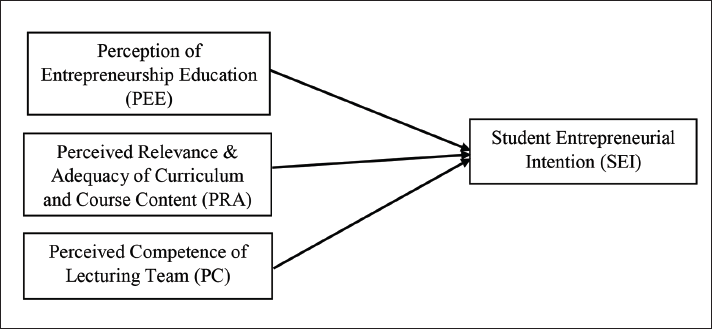
The conceptual framework (Figure 1) of the study has focussed on four variables: PEE, perceived relevance and adequacy of curriculum and course content, perceived competence of lecturing team and SEI. The questionnaire developed to measure these variables was adopted from Iwu et al. (2021). The items in the questionnaire served are in the form of statements complemented by a five-point Likert scale ranging from ‘1’ strongly disagree to ‘5’ strongly agree.
The conceptual model is presented in Figure 1.
Conceptual Model.
Results and Discussion
Descriptive Statistics
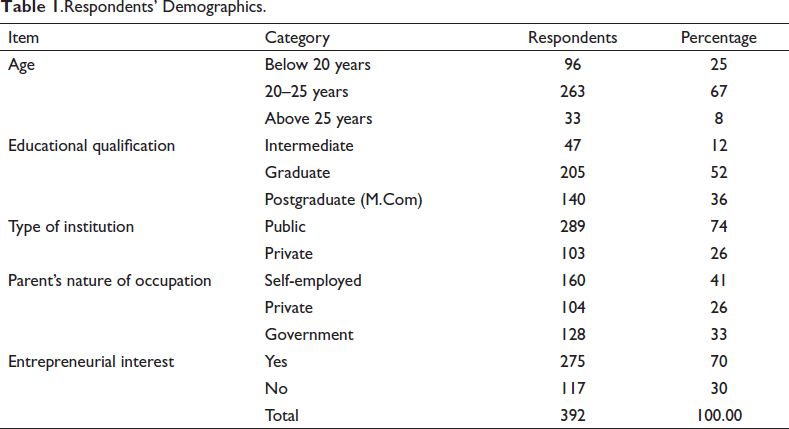
Table 1 represents the demographic profile of the respondents. Among the respondents, most of the females belong to the age group of 20–25 years. About 52% students are graduates followed by 36% postgraduates. 12% of the total respondents belong to +2 stream. Moreover, it is seen that 74% of the total female students are enrolled in government universities or colleges and not in private colleges or institutions. Almost 70% of female students have an interest in entrepreneurship while 30% of the students do not have any interest in being an entrepreneur. Out of 392 respondents, parents of about 41% respondents are self-employed, 33% are employed in government organisations while the rest 26% are employed in private organisations.
Respondents’ Demographics.
Sample Tests
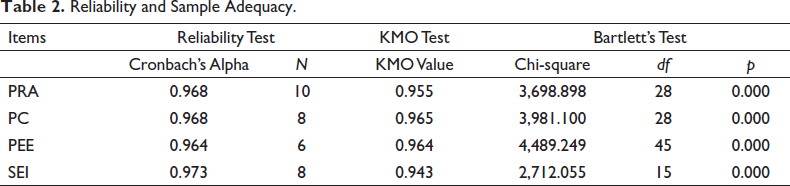
The reliability and sample adequacy test was conducted before analysing the data. The Cronbach’s alpha test was conducted to test the reliability, and the Kaiser–Meyer–Olkin (KMO) test and Bartlett’s test of sphericity were used to test the suitability of the data for further analysis. Table 2 shows the result of the reliability and suitability test. The Cronbach’s alpha value for each variable is greater than 0.9, which implies relatively high internal consistency of the variables. According to the KMO test, if the value is closer to 1, then the data are suitable for further analysis. In our study, each variable shows a KMO value almost near to one. Thus, all of them are suitable for further analysis. The p-value is significant for all variables at a 1% level of significance in Bartlett’s test that suggests all variables are related to each other as much as necessary for undertaking further analysis.
Reliability and Sample Adequacy.
After checking the suitability and reliability of the variables, correlation was calculated. Table 3 depicts the correlation results.
Correlation.
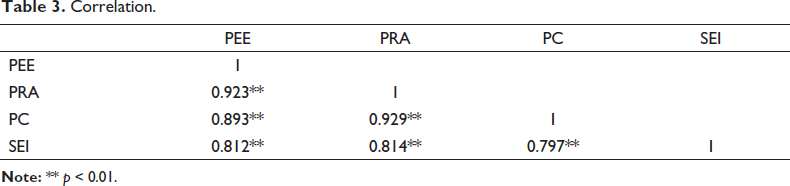
As evident from the correlation result depicted in Table 3, PEE, PRA and perceived competence of lecturing team show significant positive association with the SEI. This implies if there is an increase in any of the three former variables, then there will be a similar, direct proportional increase in the later variable, which is SEI.
To analyse the impact of PEE, PRA and PC of lecturing team on SEI, a regression test was conducted. The independent variables are the former three mentioned variables and the dependent variable is the later mentioned one. The regression results are depicted in Table 4 (model fit measures), Table 5 (ANOVA) and Table 6 (model coefficient).
Model Fit Measures.

ANOVA.

Model Coefficients.
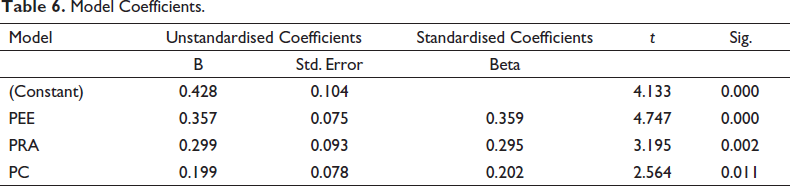
From Table 5, it is evident the regression model is significant at the 1% level of significance. In the case of all the independent variables, the p-value is less than 0.05, which implies that the null hypothesis should be rejected. This indicates that independent variables, PEE, PRA and PC (of lecturing team), significantly affect the dependent variable SEI in our study. This means if there is any change in the PEE, PRA and perceived competence of the lecturing team, it will bring a significant positive change in the entrepreneurial intention of the female students.
Conclusion
Education helps students in building their careers and evolving their intentions for different job choices. Our study has tried to analyse the impact of entrepreneurship education on the creation of entrepreneurial intention. This study has focussed only on the female students of Odisha. The study analysed the impact of entrepreneurship education in terms of PEE, PRA and PC of the lecturing team on SEI. Our study showed a positively significant association between entrepreneurship education and female entrepreneurial intention. Thus, the study infers that improving entrepreneurship education can add to building a greater number of female entrepreneurs in the context of Odisha. It was also evident from the study that entrepreneurship education has a positive significant impact on female entrepreneurial intention. This implies that by upgrading the entrepreneurship curriculum, recuperating the competence of the lecturing team and changing the perception for entrepreneurship education, the entrepreneurial intention of female students can be increased.
This study is not free from limitations. This study has focussed only on three facets of entrepreneurship education that can be expanded in further studies. Future research may study the awareness among female students about the policies of the government for women’s entrepreneurship. Moreover, a comparative analysis on female entrepreneurs can be done for different states.
Footnotes
Declaration of Conflicting Interests
The authors declared no potential conflicts of interest with respect to the research, authorship and/or publication of this article.
Funding
The authors received no financial support for the research, authorship and/or publication of this article.
