




Abstract
This study aims to investigate the socio-economic conditions of entrepreneurs that influence the growth of micro and small enterprises (MSEs) in the South Andaman District. In this study, a scheduled questionnaire-based survey research design was used, and a sample of 344 small business owners was collected for analysis. The data were processed using SPSS, and chi-squared test was applied for statistical analysis. The study’s findings revealed that factors such as entrepreneurs’ business experience, income levels, the number of working employees and ownership of house property significantly impact the growth of enterprises in the island region. However, factors like business location and sector of enterprises were found to be statistically insignificant in determining MSEs’ growth in the island region. The study suggests that policymakers and local administrations should enhance support for micro, small and medium-sized enterprises in island regions by implementing policies such as island capital investment subsidies and island transport subsidies for MSEs. As a result, small businesses play a pivotal role by contributing to local employment, production and investment opportunities in the island region.
Keywords
Introduction
Small enterprises are the hub of many economic activities in a lower-middle income country like India. Small- and medium-scale industries represent 80 per cent of the industrial base of most of the high income countries (Mathew, 1999, p. 23). Micro, small and medium-sized enterprises (MSMEs) are a major source of growth, innovation and jobs, and their potential impact on achieving many of the sustainable development goals is much greater than their size (ITC, 2019). Therefore, there is great interest among young people to start a business, and many of them are willing to undertake the risks and challenges of entrepreneurship (Papulová & Papula, 2015). Poverty eradication has been the major goal of small enterprise development in most lower-middle income countries. The General Assembly adopted resolution 71/221, which recognises the important contribution of entrepreneurship to sustainable development by creating jobs, driving economic growth and innovation, improving social conditions and addressing social and environmental challenges (UN, 2018). A globally recognised and developed nation is mainly focused on micro and small enterprises (MSEs) because of their small investment and great employment opportunities. A strong entrepreneurial small and medium enterprise (SME) sector significantly contributes to a country’s economy, adding to gross domestic product (GDP) by lowering the concentration of poverty and reducing the level of unemployment, and entrepreneurial SMEs play a vital role in developing a country (Bayati & Taghavi, 2007; Sarwar et al., 2021). SMEs are recognised globally, and their role is particularly important in developing economies (Karadag, 2016). According to Beck et al. (2005), one of the major roles played by entrepreneurial SMEs is a strategic approach that aims for balanced growth in both rural and urban areas. MSEs play a pivotal role in economic, social and development activities, contributing substantially to the GDP and improving the living standards of the general population. In recent years, MSMEs have adopted many new structural changes in response to global conditions.
This research will examine specifically the socio-economic aspects of entrepreneurs in MSMEs in the South Andaman Islands. This research focuses on the approach of business empowerment, emphasising the need to pay attention to the social and economic aspects in each region, considering that MSMEs directly grow from the community. It can be understood that the social and economic aspects of each region have differences, so this research remains interesting because it locates the different scope of areas and different problem-solving strategies as a result of different social and economic aspects (Musa & Hasan, 2018). MSMEs play a crucial role in the development of the islands, drawing upon numerous available resources. These include marine-based coastal industries, which hold immense potential for small businesses in the islands; forests covering 86 per cent of the geographical area; diverse flora and fauna; and tourism, offering significant opportunities for economic exploitation in the region.
India’s Population and Socio-economic Challenges
India, with over 1.4 billion people, holds the second-largest population globally. However, this massive population brings significant socio-economic challenges that affect both the micro and macro Indian economy. Several challenges exist, such as the majority of India’s population’s lower income group; unemployment, poverty and low investment are pressing issues that the country grapples with and social support in terms of education and health services, and many more.
The Role of MSME in India’s Economy
MSMEs play a crucial role in the Indian economy. MSMEs contribute to over 30 per cent of India’s GDP and nearly 50 per cent of its exports, making them key drivers of economic growth. The MSE sector primarily consists of small-scale, artisan-based businesses, often located in rural and semi-rural areas. These enterprises rely on local skills and resources to produce and sell their products within their communities. They typically require lower levels of investment in machinery, but they provide significant employment opportunities. Handlooms, khadi (handspun cotton cloth), sericulture (silk production), coir (coconut fibre), embroidery, knitting, woodcarving and other handicrafts are just some of the activities in which these small businesses engage. These MSEs also incorporate power-driven machines and some level of sophisticated technology to enhance their productivity. The range of products they offer includes ready-made garments, motor parts, electronics, sports goods, rubber goods and engineering goods. However, since the liberalisation, privatisation and globalisation (LPG) of India’s economy, the MSE sector has encountered several challenges. These challenges revolve around technology adoption, access to credit and equity capital, and intense competition in marketing. Overcoming these hurdles is crucial for the sustained growth and development of the MSE sector as a significant source of employment generation, production, investment and export.
Resilience in the Face of Challenges
In recent times, the MSME sector has faced additional challenges due to the impact of the COVID-19 pandemic. Small enterprises, in particular, have experienced significant revenue slowdowns, resulting in a shortage of working capital by around 30–40 per cent. Moreover, MSMEs have encountered difficulties in accessing credit and financing from banks. However, despite these obstacles, the MSME sector has displayed remarkable resilience. The Indian government has implemented various initiatives and schemes, such as ‘Make in India’, ‘Startup India’, ‘Digital India’ and ‘Skill India’ to support and uplift this vital sector.
Definition of MSMEs in India
In India, the definition of small-scale industries (SSIs) has undergone changes over the years in terms of investment limits. The main criterion for the definition is the investment and turnover level. Definitions of MSMEs vary quite widely from country to country and even within a country, depending on the business sector concerned. The Ministry of Agro and Rural Industries and the Ministry of Small Scale Industries have been merged into a single ministry, namely, the Ministry of Micro, Small and Medium Enterprises. Table 1 shows the periodical revision in defining SSIs in India.
Periodical revision of Investment Limits for Small-scale Industries in India.
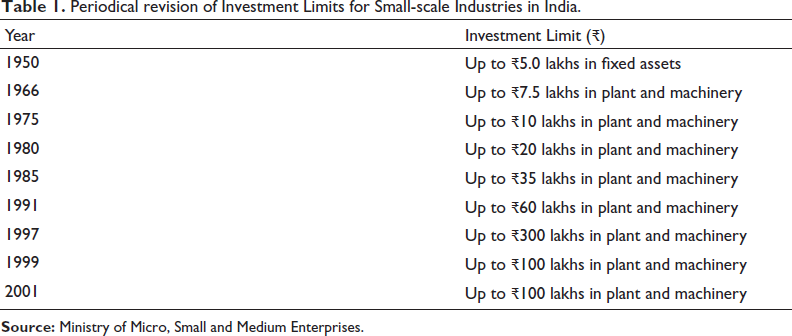
The SSIs have been renamed as micro, small and medium enterprises with the introduction of the Micro, Small and Medium Enterprises Development (MSMED) Act, 2006. Prior to the enactment of this Act, small industries in India comprised tiny, cottage, traditional, village and modern small enterprises. These enterprises were fragmented across various ministries and departments in India. Major sectors covered by MSEs in India include handloom, power looms, handicrafts, khadi, coir and other manufacturing and services-based enterprises. In order to correct these discrepancies and neglect, the MSMED Act was enacted on 16 June 2006. This Act provides the first-ever legal framework recognising the concept of an enterprise (comprising both enterprises and integrating the three tiers of these enterprises, namely micro, small and medium). A major change took place in 2006 with the enactment of the MSME Development Act, 2006. As per the provisions of the MSMED Act, 2006, MSMEs are classified into two categories, such as manufacturing and service enterprises, which are generally defined in terms of investment in the plant, machinery and/or equipment and annual turnover. The definition of MSMEs is given in Table 2.
Classification of Micro, Small and Medium Enterprises (MSME) Based on Investment and Turnover.
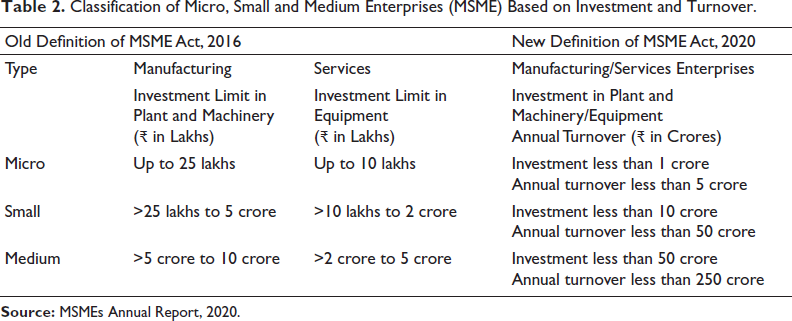
Table 2 shows the classification of MSMEs based on investment in plant and machinery. It is further broadly divided into two classes according to the provisions of the MSMED Act, 2006. They are as follows: (a) manufacturing enterprises engaged in the manufacturing or production of goods pertaining to any industry, defined in terms of investment in plant and machinery; (b) service enterprises engaged in providing or rendering services, defined in terms of investment in equipment. The changed definition was implemented through an amendment that aimed to further refine the business scenario for Indian enterprises. In 2020, the Union Cabinet approved the amendment to change the criteria for classifying MSMEs from ‘investment in plant and machinery’ to ‘annual turnover’. On 13 May 2020, the additional principle of turnover was added, along with the investment, with effect from 1 July 2020, across India.
Review of Literature
Aworemi et al. (2010) examined the impact of socio-economic characteristics on the performance of small enterprises in Osogbo, Osun State, Nigeria. Their study results show that gender, age and educational qualifications had a significant influence on business performance. Gender has a positive influence on the overall success and growth of MSEs. The paper suggested an integrated approach to developing individual entrepreneurial capacity and promoting sustainable small-scale enterprises.
Kassa (2021) investigated the socio-economic determinants that affect the growth of MSEs in North Wollo and Wag Hemra Zone-selected towns. 333 owners were selected as respondents, and STATA v-14 was used for applied binary logistic regression analysis. His findings revealed that the age of owners, access to finance, family business background and interest rates are most likely to affect the growth of the enterprises. On the contrary, entrepreneurship training, the experience of the owner, the inflation rate and competition are less likely to affect the growth of the enterprises at a statistically significant level.
Rajaiah (2016) studied the social status of entrepreneurs, types of activities, reasons for selecting the location of MSMEs and category-wise occupation of the family of entrepreneurs in the Nellore district. MSMEs always represented the model of socio-economic policies of the Government of India. The study on the social status of entrepreneurs, types of activity, nativity or location, reasons for selecting the location of MSMEs and category-wise occupation of the family of entrepreneurs in the Nellore district.
Khan (2014) studied the socio-economic factors, which are the major key factors influencing entrepreneurial behaviour and the operation of the business, thus necessitating the study and due influence. The impact of socio-economic factors in relevance to the entrepreneurship development of SMEs across Chennai, Tamil Nadu, India. The findings of socio-economic factors such as educational qualification background, religion, previous job experience, family type and legal status (ownership pattern) had a significant influence on the performance of the selected small-scale enterprises.
Semegn and Bishnoi (2021) examined the effect of microcredit on the performance of MSEs in the Amhara National Regional State, Ethiopia. A total of 340 MSEs were randomly selected, and a survey method was used. Their findings suggested that the majority of MSEs in Ethiopia were engaged in the manufacturing and urban agriculture sectors. They concluded that loan size, savings and entrepreneurship training had a significant positive effect on the performance of MSEs.
Musa and Hasan (2018) determined to analyse the influence of characteristics (social, economic and demographic) of MSME workers in Makassar on working hours and determine the strategy development. This research is quantitative with an econometric analysis tool. The results revealed that the economy (income and work experience) and demographics (age and gender) are very significant to the working hours of MSME workers. Additionally, income and age have a negative effect, while education, work experience and gender have a positive effect on working hours.
Methodology and Research Design
The research design, types and sources of data, profile of the study area and statistical tools were adopted for analysis. The research design proposed for this research work is based on a well-structured schedule for investigating the socio-economic conditions affecting small enterprises in South Andaman. Sample units were divided into micro and small units. The primary data were collected by the researcher using a scheduled questionnaire from micro and small businesses operating in various parts of the South Andaman district. The sample selection is based on a stratified proportionate random sample method, by which responses from 344 owners of small businesses were collected from the South Andaman District. The sample size was determined by Yamane (1967) by the following formula n = N/1 + N (e2), where, n = sample size, N = population (2,433) and e = standard error (i.e., 0.05). Substituting these values in the formula, we get, N = 344. Hence, the sample size of this study is 344 small businesses.
Profile of the Study Area
The Andaman and Nicobar Islands form a union territory situated in the Bay of Bengal, comprising three districts: South Andaman, North and Middle Andaman and Nicobar. Port Blair, located in the South Andaman district, serves as the capital of the territory. The Andaman and Nicobar Islands encompass a total of 527 islands, varying in size, with only 38 of them being inhabited.
Objective of the Study
The primary objective of this study is to investigate and understand the impact of socio-economic factors on MSEs operating in South Andaman, to identify and assess the selling patterns of MSEs in South Andaman Islands and to examine the market behaviour. Additionally, the study seeks to scrutinise various policy measures and initiatives implemented by the government to rejuvenate and support the MSMEs sector, particularly in the Andaman and Nicobar Islands.
Analysis and Discussion
Classification Based on Business Profile of the Enterprises
This section focuses on understanding the relationship between the business profile of the respondents and the type of business undertaking. For the purpose of this study, information is collected regarding the types of enterprise, types of ownership, number of employees working in the firms, location of the entrepreneurs and nativity of the entrepreneurs. The summarised information on the business profile of the enterprises, along with chi-squared test results, is presented in Table 3.
Classification Based on the Business Profile of the Enterprises.

Classification Based on Sector of Enterprises
The study aimed to know the sector in which the entrepreneur is involved, viz. manufacturing or services in which the respondents are involved in the study area. From the results presented in Table 3, it is observed that 222 (64.53 per cent) respondents are involved in the manufacturing sector and 122 (35.47 per cent) respondents are in the service sector. The chi-squared test result of the association between the sector and the type of enterprise revealed that there is no significant association (χ2 = 1.94, df = 1, N = 344, p value = .33) between the sector of enterprise and the type of enterprise. The results of the study reveal that the majority of the entrepreneurs are involved in manufacturing businesses, and the majority of the microenterprises are engaged in providing services, as it requires comparatively lesser investment.
Classification Based on Type of Ownership
For collecting information about the type of ownership of the business from the respondents, the businesses were categorised into four groups, viz. sole proprietor, partnership, joint family business and others. Table 3 clearly shows that 215 (62.50 per cent) respondents are sole proprietors, of which 155 (72.09 per cent) respondents are doing micro-level business and 60 (27.915 per cent) respondents are doing their business at a small level. Further, 73 (21.22 per cent) respondents are doing their business as a partnership firm, of which 40 (18.60 per cent) respondents are from micro-enterprises and 33 (45.21 per cent) respondents are from small enterprises. There are 30 (8.72 per cent) respondents engaged in joint family businesses, out of which 18 (8.37 per cent) respondents are from micro-enterprises and 12 (40.00 per cent) respondents are from small enterprises. The remaining 26 (7.56 per cent) respondents are other firms, of which 21 (9.77 per cent) respondents are involved in micro-enterprises and 5 (19.23 per cent) are in small enterprises. The chi-squared test result reveals that there is a significant association (χ2 = 10.34**, df = 3, N = 34, p value = .016) between the types of ownership and the types of enterprise. The study concluded that the majority of the respondents are sole proprietors in the study area.
Classification Based on Number of Employees Working in the Firm
Regarding the investigation of the number of employees working in the firm, Table 3 explains that 100 (29.07 per cent) entrepreneurs have less than 5 employees, 177 (51.45 per cent) entrepreneurs have 6–10 employees and the remaining 67 (19.48 per cent) respondents have more than 10 employees. The chi-squared test result for the association concluded that there is a significant association (χ2 = 12.41***, df = 2, N = 344, p value = .000) between the number of employees working and the type of enterprise.
Classification Based on Location of Enterprises
Regarding the enterprises’ location, Table 3 exhibits that there are 261 (75.87 per cent) businesses located in rural regions, and the remaining 83 (24.13 per cent) are located in urban regions. The chi-squared test found that there is no significant association (χ2 = 1.442, df = 2, N = 344, p value = .50) between the location of the enterprise and the type of enterprise. The findings clearly show that about 76 per cent of the enterprises are located in rural areas of the South Andaman district.
Classification of Respondents Based on Socio-economic Condition of Entrepreneurs
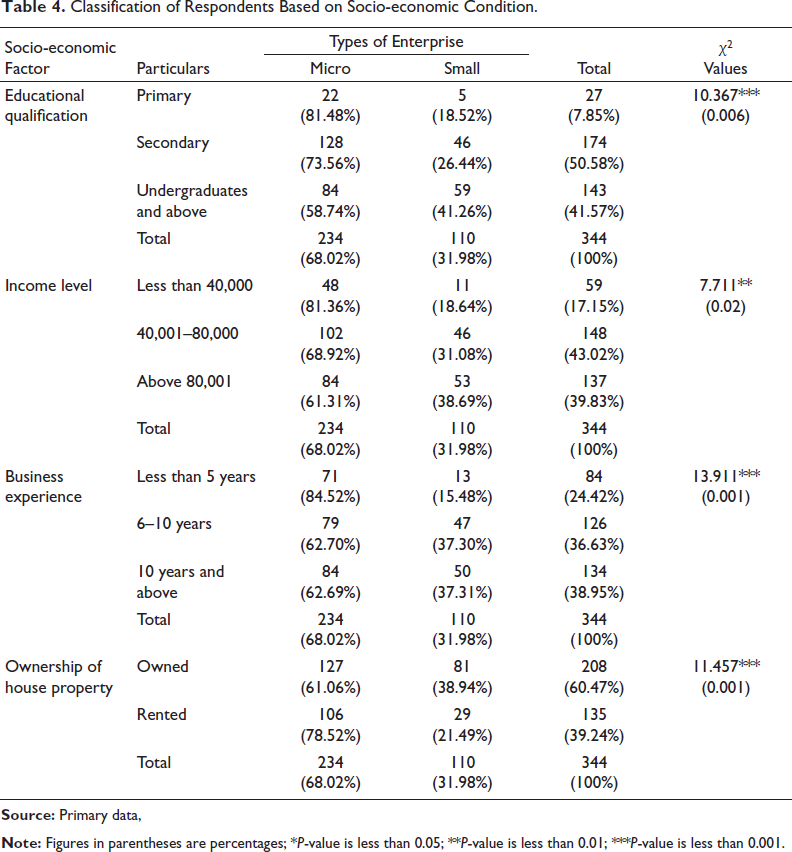
This section of the study presents details relating to the socio-economic status of the entrepreneurs. In order to understand the social and economic background of the entrepreneurs, variables like educational qualification, income level, business experience and house ownership of entrepreneurs were considered. The socio-economic status of the respondents, along with the results of the chi-squared test, is summarised and presented in Table 4.
Classification of Respondents Based on Socio-economic Condition.
Classification Based on Educational Qualification of the Entrepreneurs
Educational background plays a vital role in moulding the overall attitude and character of the respondents, as well as in the development of managerial capability to run the business. The level of education is measured through three categories, namely primary education, secondary education and undergraduate. From Table 4, it is clear that 27 (7.85 per cent) respondents have primary schooling, 174 (50.58 per cent) respondents have secondary education and 143 (41.57 per cent) respondents are undergraduates. The chi-squared test result clearly found that there is a significant association (χ2 = 10.367***, df = 2, N = 344, p value = .006) between the education of the entrepreneurs and the type of enterprises they owned. The findings showed that the majority of respondents (174) have up to secondary education.
Classification Based on Income Level of the Entrepreneurs
Income level is another important parameter to understand the economic background of the respondents, which is earned through their businesses. From Table 4, it is observed that 59 (17.15 per cent) respondents have a monthly income of less than ₹40,000, 148 (43.02 per cent) respondents earn income between ₹40,001 and ₹80,000 and 137 (39.83 per cent) respondents generate income of more than ₹80,000. It is further found that by using the chi-squared test, there is a significant association (χ2 = 7.711**, df = 2, N = 344, p value = .02) between the income level and the type of enterprise.
Classification Based on Business Experience of Entrepreneurs
To find out the impact of past business experience on the success of the present business operation, information relating to business experience is collected in three categories, viz. less than 5 years, 6–10 years and above 10 years. The results of Table 4 show that 84 (24.42 per cent) respondents have less than 5 years of experience, of which 71 (84.52 per cent) are from micro-enterprises and 13 (15.48 per cent) are from small enterprises. 126 (36.3 per cent) respondents have business experience between 6 and 10 years, of which 79 (62.70 per cent) are from micro-enterprises and 47 (37.30 per cent) are from small enterprises. 134 (38.95 per cent) respondents have more than 10 years of experience, of which 84 (62.69 per cent) are from micro-enterprises and 50 (37.31 per cent) are from small enterprises. The chi-squared test shows that there is a significant association (χ2 = 13.911***, df = 2, N = 344, p value= .001) between business experience and types of enterprises. The results of the study show that the majority of the entrepreneurs have business experience of more than 10 years.
Classification Based on Owning House Property
The study made an attempt to understand the economic condition of the MSE businessmen and the type of business activity by assessing whether they own their house property. From Table 4, it is observed that 208 (60.47 per cent) respondents had their own houses, of which 127 (61.06 per cent) are micro-entrepreneurs and 81 (38.94 per cent) are small entrepreneurs. The results further revealed that 135 (39.24 per cent) are living in rented houses, among whom 106 (78.52 per cent) respondents are micro-entrepreneurs and 29 (21.48 per cent) are small entrepreneurs. The chi-squared test result clearly revealed that there is a significant association (χ2 = 11.457***, df = 1, N = 344, p value = .001) between ownership of house property and types of business undertakings. The results of the study show that the majority of the entrepreneurs have own house property.
Classification Based on Workers’ Nativity
As far as the island is concerned, the availability of labourers, both casual and trained, is always a major issue for business establishments. Labourers are an important input for the continuous workflow, and they are required for the successful survival of any business. In order to identify the sources of recruitment of labourers, three categories were used, namely local workers, other island workers and mainland workers. The results are summarised in Table 5.
Classification Based on Workers’ Nativity.
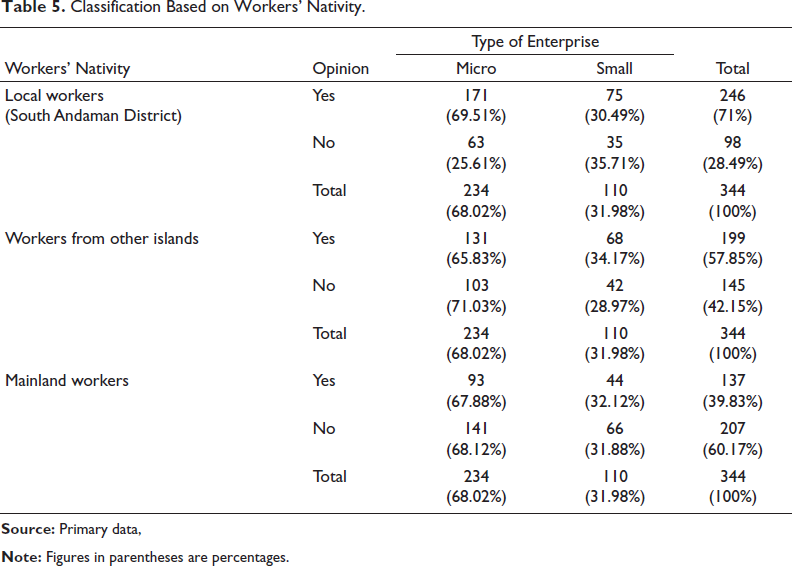
It is clear from Table 5 that 246 (71.00 per cent) respondents preferred local workers and 98 (28.49 per cent) of them did not prefer local workers. About 199 (57.85 per cent) respondents preferred to choose workers from other islands and 145 (42.15 per cent) respondents did not prefer other local workers. It is further observed that 137 (39.83 per cent) respondents preferred workers from the mainland and 207 (60.17 per cent) did not prefer mainland workers. The findings reveal that the majority of the employers recruit their workers from the local areas of the South Andaman district. This study also indicates that, due to the non-availability of workers, entrepreneurs also prefer to recruit workers from other islands and mainland India. The results of the study reveal that the majority of the entrepreneurs are hiring native (local) workers.
Classification Based on Selling Pattern
This section of the study attempts to identify the place of sale of the products and services offered by small and micro-entrepreneurs in South Andaman. The respondents’ opinions were assessed based on the following categories: from their own enterprise, through other local enterprises, through sale in other islands, through sale in the mainland and through government depots. This classification is required to understand the reach of the products and services of MSEs of South Andaman. The collected information is processed and presented in Table 6.
Classification based on Selling Pattern.
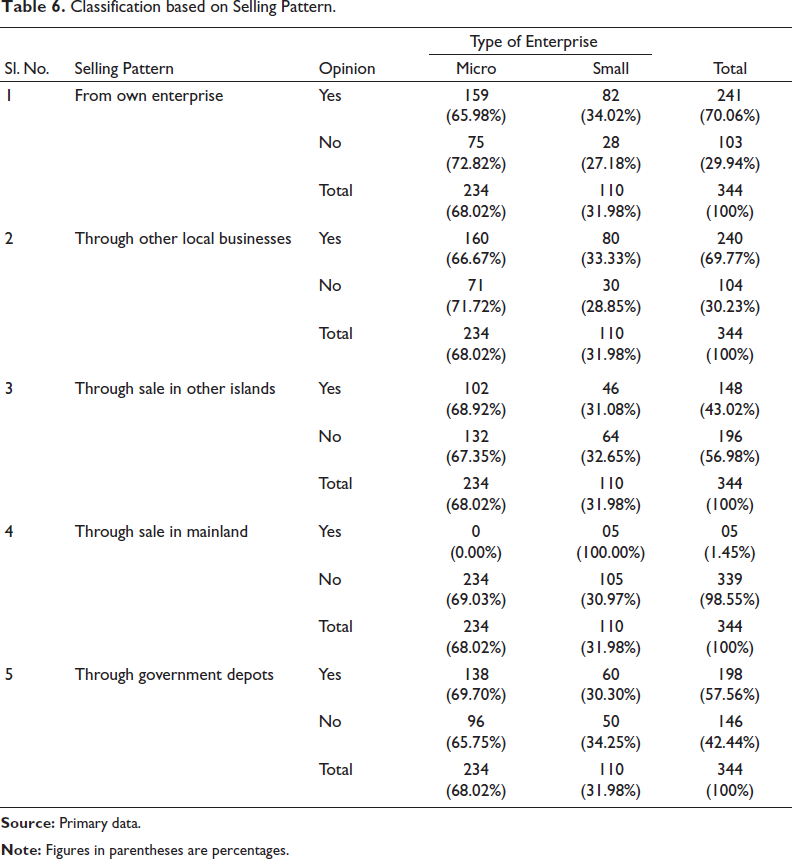
From Table 6, it is clear that in the multiple-response question posted to them, 241 (70.06 per cent) respondents preferred to sell their products through their own enterprise, 240 (60.77 per cent) respondents were ready to sell through other local businesses, and 148 (43.02 per cent) respondents preferred to sell their products via a firm in other islands. Only 5 (1.45 per cent) respondents preferred to sell their products in the mainland, followed by 192 (57.56 per cent) respondents who were interested in selling their products through/in government depots. Hence, it is found that only a few respondents show interest in selling their products in the mainland, and the majority of the respondents are interested only in catering to South Andaman customers.
Conclusion
This study identified critical factors influencing the business failure of MSEs in islands, primarily rooted in the socio-economic conditions of entrepreneurs. MSE development is intricately linked to factors such as the number of working employees, the business experience of the entrepreneur, income levels and ownership of house property in the island region. These factors have been established as significant contributors to the growth of MSEs. The research findings highlight a prevalent trend, with the majority of employers sourcing their workforce from the local areas within the South Andaman district. Entrepreneurs usually sell their products at their own businesses and other local enterprises in South Andaman. In light of these findings, it is recommended that the island administration consider providing subsidies for the acquisition of machinery, power generators and transportation facilities. Such measures can significantly promote and support the growth of MSMEs in the island region. Moreover, it is suggested that the District Industry Centre and Directorate of Industries of Andaman and Nicobar Islands actively promote and support small businesses through initiatives such as the Islands Transport Subsidy for Micro and Small Enterprises scheme and the Islands Capital Investment Subsidy for Micro and Small Enterprises scheme. These proactive steps can enhance the overall resilience and sustainability of MSEs in the islands, fostering economic development and local empowerment in the islands.
Footnotes
Declaration of Conflict of Interests
The author declared no potential conflicts of interest with respect to the research, authorship and/or publication of this article.
Funding
The author received no financial support for the research, authorship and/or publication of this article.
