




Abstract
The dramatic increase of intercultural encounters that have resulted from international migration and globalisation has presented challenges for societies, their institutions and their residents. The assumption is usually made that most culturally plural societies and their members seek to engage in positive encounters, rather than having conflictual ones. There are many factors (political, economic and historical) that can promote or limit the attainment of this goal of positive intercultural relations. Beyond these societal-level factors, another set of factors are psychological; these are based on the presence of some shared underlying psychological processes that enable mutual understanding and acceptance. For over 50 years, I have searched for some of these shared psychological principles, guided by some assertions contained in the Canadian policy of multiculturalism. These assertions are the promotion of: feelings of security in a group’s and a person’s place in the society; the presence of social contacts that are mutually respectful; and the existence of multiple identities and ways of living in the diverse population. This article reviews the evidence for these principles, using data from Canadian and international studies. I conclude that this psychological research has provided support for these general principles that are derived from public policy. As a result, they are ripe for possible use in many plural societies now seeking ways to manage and improve their intercultural relations. The journey has been from policy to research, and back to policy formulation and implementation.
Keywords
Introduction
Growing up in a society that had many languages and cultures, I came to realise that individuals and their behaviours were substantially influenced by their diverse cultural experiences. After high school, I worked on merchant ships, travelling to Africa, Asia and the Arctic, further exposing me to cultural diversity. When I eventually started university, I was armed with these two sets of diverse cultural influences, through which to view and challenge the psychology that was being taught. I knew that there was a serious problem with the discipline and practice of psychology: culture was not being considered, being both culture-bound and culture-blind.
The discipline and practice of psychology have long histories in only a few countries of the world. Initially developed in Europe, then further in the USA, it has close ties to the cultural traditions of those particular societies. Although more and more taught, studied and practiced in other parts of the world, as noted above, psychology remains largely culture-bound, being limited in its origins, concepts and empirical findings to only a small portion of the world. The discipline has also been culture-blind, largely ignoring the influence of the role of culture in shaping the development and display of human behaviour. These two limitations were the motivation for the development of the field of cross-cultural psychology, including the writing of textbooks and reviews (Berry et al., 1992, 2011, 2022).
As a result of these limitations, missing from the field are the insights, and the knowledge of psychology from the largest, most complex and in many ways the earliest-developed societies of the world. In particular, the psychological insights and contributions from Africa, India, China, and the Arab world are largely unknown to Western psychology. Similarly missing are those from the Indigenous Peoples in North and South America, and the Pacific region. This issue has been the focus of Psychology and Developing Societies over these past 35 years.
My career goal has been to develop a psychology that is global, or universal in validity and applicability (Berry, 2013). The core meaning of the concept of universal is rooted in the claim that since all human beings are members of the same species, they share all basic psychological processes and capacities. On the basis of these underlying psychological features, cultural experiences shape the development and expression on them into highly variable behaviours.
Conceptualisation and Theory Development
The ways in which these cultural experiences come to influence the behaviours of individuals have been captured in two frameworks: The Ecocultural (Berry, 1976–2018), and the Acculturation (Berry, 1980–2019). Both these frameworks provide maps of the key variables that start with background contexts (the roots), flow through the ways that these cultural features become incorporated (the routes) into the behaviours of individual.
The first framework considers two background contexts that provide the broad setting within which human development tales place: the ecological and the sociopolitical (Berry, 2018). The ecological context is a set of physical features of the habitat of a population that provide constraints and supports for the development of adaptive social and cultural institutions and practices. The sociopolitical context is a set of influences that impinge from outside bringing a new set of constraints and supports.
The second framework lies is within the field of intercultural or acculturation psychology (Sam & Berry, 2016). It is an expansion of the sociopolitical aspect of the ecocultural framework, and deals with the new experiences that arrive with contact with outside cultures, to which the existing cultures and individuals need to adapt.
In this article, I focus on the second framework and examine how individuals change following intercultural contact. The basic flow of concepts is from contact between two or more cultural groups, to the changes in both cultures, to the processes and the outcomes of psychological acculturation (see Figure 1).

One consequence of intercultural contact is the emergence of culturally-plural societies, in which people of many diverse cultural backgrounds attempt to live together. These societies provide new contexts to which individuals need to adapt. These societies are essentially multicultural and exhibit three inter-related phenomena. First, they are demographically diverse, with many groups having many languages, religions and sets of values. Second, they develop policies that attempt to manage the relationships among these diverse groups and individuals. Third, people develop various attitudes and ideologies that incorporate their beliefs and attitudes towards this diversity and its policy management.
These policies and ideologies may be closely-related: what a society (government policy) seeks to achieve is sometimes aligned with the interests of individuals in the diverse groups (their ideologies). Many such ideologies and policies have been promoted over the years, including assimilation into a melting pot, multiculturalism, polyculturalism and colour blindness. Grigoryev and Berry (2021) have produced a taxonomy of these various approaches, based on their similarities and difference on two dimensions: attitudes towards the value of diversity; and forms of inclusion.
Over the course of work in this area, I developed a general framework to guide my research on acculturation and intercultural relations (Berry, 2003, 2017). This framework conceptualises the core concepts and variables that are important in the related domains of acculturation and intercultural relations and is shown in Figure 1.
This framework identifies the main concepts and variables, and suggests their inter-relationships. Figure 1 is divided into two main parts: the cultural context on the left and the psychological processes and outcomes on the right. This framework displays and links these cultural-level and psychological-level phenomena in the two (or more) groups in contact. It serves as a kind of map of those phenomena that need to be conceptualised and measured during acculturation and intercultural relations research.
On the left are the characteristics of the two or more cultural groups prior to contact; the nature of the contact them; and the cultural changes that are taking place in both groups. In the middle are the psychological changes experienced by individuals in both groups in contact. And on the right are the longer-term adaptations that may, or may not, be achieved.
In more detail, at the cultural level (on the left) we need to understand key features of the two (or more) original cultural groups (A, B and so on) prior to their major contact; what do they bring with them to the intercultural arena? Second, we need to examine the nature of their initial and continuing contact relationships; what are the goals and ways in which the contact takes place, such as colonialism, domination, exclusion? Third, we must understand the resulting cultural changes as they emerge as ethnocultural groups in the larger society; have the structures and practices of the groups been substantially altered? The gathering of this cultural-level information requires extensive archival, and ethnographic community-level work.
At the individual level, we need to consider the psychological acculturation that individuals in all groups in contact undergo. Identifying these changes requires sampling individuals in a population and studying those who are variably involved in the process. There are three kinds of change that have been identified: behavioural changes; stress reactions; and strategies used in intercultural encounters.
First, behavioural changes can be a set of rather easily accomplished behavioral changes (e.g., in ways of speaking, dressing, and eating habits) or they can be more difficult to accomplish (e.g., changes in identities, self-concept and values). Second are changes that are challenging, even problematic, in which acculturative stress becomes manifest. This concept was introduced (Berry, 1970) to reconceptualise the commonly used notion of ‘culture shock’ (Ward et al., 2001). This new term was developed to address two problems with the notion of culture shock. First, shock is usually a negative experience, whereas stress can either be positive (eustress) or negative (distress). Following contact, intercultural experiences of individuals alert them to challenges, which may provide new opportunities (positive) or diminish them (negative). Second, the term ‘culture’ suggests that the source of the challenge lies in a culture; however, the source is really in the intersection between two or more cultures that encounter each other. Hence the term ‘acculturative’ is preferred over the term ‘culture’. In essence, the negative side of acculturative stress is often manifested by uncertainty, anxiety, and depression. Third, individuals also develop and engage in acculturation strategies and expectations as their preferred way to acculturate and relate to each other (see next section). Acculturation strategies and expectations are a major focus of current research. They have both attitudinal and behavioural components.
Finally, there are three kinds of adaptation. The first two of these were identified by Ward (1996), who distinguished between psychological adaptation and sociocultural adaptation. The first refers to adaptations that are primarily internal or psychological (e.g., sense of personal well-being and self-esteem; it is sometimes called ‘feeling well’). The second are sociocultural, and are sometimes called ‘doing well’. This form of adaptation is manifested by competence in carrying out the activities of daily intercultural living. A third form of adaptation was proposed by Berry (2003). This is the concept of intercultural adaptation, which refers to the extent to which individuals are able to establish harmonious intercultural relations, with low levels of prejudice and discrimination.
Embedded in this general framework is am acculturation and intercultural strategies framework that proposes a way to understand how individuals and groups attempt to acculturate and to relate to each other in plural societies; these are the strategies shown in the middle of Figure 1. The framework in Figure 2 was first proposed by Berry (1980) and further developed by Berry (2003). These various strategies combine two preferences: the value of maintaining an individual’s and group’s cultures and identities over a single life time and across generations; and the value of engaging in intercultural contact in order to share their cultures.
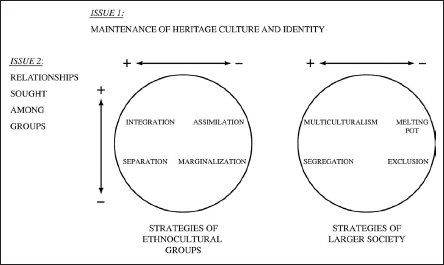
Individuals hold preferences for the degree to which they wish to be engaged with their heritage culture, and with the larger society; these two preferences are termed orientations. When these two orientations are crossed and allowed to intersect, the views held by the non-dominant peoples are called their strategies. Parallel views are held by the dominant group about how all ethnocultural groups should relate to each other and are termed their expectations. These strategies and expectations represent differing views that are rooted in orientations to the two underlying issues.
For non-dominant ethnocultural groups (on the left), the orientations to these issues intersect to define the four strategies: Assimilation, by giving up heritage culture and joining the larger society; Separation, by maintaining the heritage culture, and avoiding participation; Marginalisation, by losing the heritage culture and not participating; and Integration, by maintaining the heritage culture and participating in the larger society.
From the point of view of the larger society (on the right) parallel concepts are often used. These are the expectations that the dominant society has for how all ethnocultural groups should relate: Assimilation when sought by the dominant group is termed Melting Pot where individuals and groups should melt into the larger society; when Separation is forced by the dominant group it is called Segregation, where people should remain in separate communities; Marginalisation, when imposed by the dominant group is called Exclusion, where people should have little remaining of their heritage group and stay outside the larger society; and Integration, when diversity and inclusion are widely valued features of the society, including by all the various ethnocultural groups and the larger society, it is called Multiculturalism. These expectations also represent various ideologies and policies that are employed by the larger society.
Note that the terms integration and multiculturalism have very specific meanings within this strategies framework. They do not refer to any kind of incorporation of ethnocultural groups into the larger society, but specifically to double engagement. They are clearly different from assimilation and melting pot, because they involve substantial cultural maintenance. They are also clearly different from separation and segregation because they involve substantial contact and participation. And, they are clearly different from marginalisation and exclusion because they promote both the cultural maintenance and social participation of all into an inclusive larger society.
Empirical Research
My empirical work on these issues began in the 1960s in Australia (Berry, 1970), and came to fruition in the 1970s in Canada (Berry et al., 1977; Berry, 1984, 1991). In 1971, the Federal Government of Canada announced a policy of multiculturalism. The main statements of the policy approach were (italics added):
A policy of multiculturalism within a bilingual framework … (is) the most suitable means of assuring the cultural freedom of all Canadians. Such a policy should help to break down discriminatory attitudes and cultural jealousies. National unity, if it is to mean anything in the deeply personal sense, must be founded on confidence on one’s own individual identity; out of this can grow respect for that of others, and a willingness to share ideas, attitudes and assumptions. The Government will support and encourage the various cultural and ethnic groups that give structure and vitality to our society. They will be encouraged to share their cultural expression and values with other Canadians and so contribute to a richer life for all. (Government of Canada, 1971)
Following this announcement, we wrote to the Prime Minister’s office suggesting that this policy goal of improving the quality of intercultural relations was very important for all of Canadian society, but should be examined through conceptual analysis and empirical research. We proposed carrying out a national survey to discover the knowledge, beliefs and attitudes of Canadians regarding such a policy and its various components, assumptions and possible outcomes. We received a major grant to carry out this project and published our main findings in a book (Berry et al., 1977). This project created and employed some new concepts and scales that have continued in use up until the present time (e.g., Berry, 2017). In this project, we examined knowledge about the policy, acceptance of it, and beliefs about the consequences if the policy and programmes were to be implemented. We also examined attitudes and stereotypes with respect to many specific ethnocultural groups and immigrants.
A decade later, I was asked by the (then) Ministry of Multiculturalism to examine the conceptual basis, the theoretical assumptions and the empirical findings related to the policy from a psychological perspective. In an analysis (Berry, 1984), I developed a framework that showed the main components of the policy, and some possible links among them (see Figure 3).
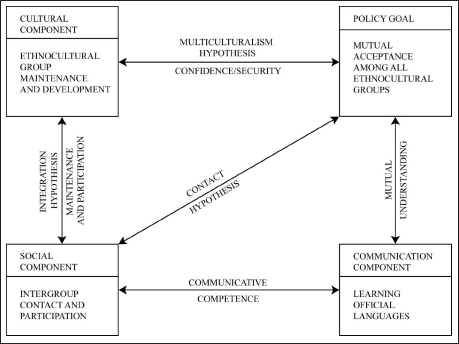
The main goal (shown on the upper right) of the 1971 multiculturalism policy was to promote the mutual acceptance of all ethnocultural groups through the reduction of prejudice and discrimination (‘break down discriminatory attitudes and cultural jealousies’). This goal was to be achieved through the three main initiatives of:
Promoting cultural maintenance over generations, by those who so wished (‘support and encourage the various cultural and ethnic groups’); this is the cultural component (upper left). Encouraging social contact and sharing among groups through their participation in the larger society (‘encouraged to share their cultural expression and values’); this is the social component (lower left). Promoting the learning of Official Languages (‘a policy of Multiculturalism within a bilingual framework’). This is the language component (lower right).
The framework identified some possible relationships that serve to link these four components; these may be called assumptions or hypotheses:
The multiculturalism hypothesis (along the top from left to right) is that a sense of confidence or security in one’s identity and place in the larger society will be a psychological precondition for the acceptance of those who are culturally different. Conversely, when one’s identity is threatened or undermined, people will reject others. The contact hypothesis (from lower left to upper right) is that social contact and sharing will promote mutual acceptance under certain conditions, especially when contact is voluntary and of relatively equal status. The integration hypothesis (between upper and lower left) is that individuals who maintain their heritage cultures and identities (cultural component), and who also engage with the larger society (social component), are likely to be more successful in their intercultural living than those who pursue only one of these identities. The language hypothesis (between lower and upper right) is that by knowing the official languages, social interactions and understanding become possible, leading to greater mutual acceptance.
We now examine each hypothesis in more detail.
The multiculturalism hypothesis stems from a statement in the policy that asserts that when individuals are confident in their cultural identity and their place in society, this will lead to the acceptance of others who differ from themselves. That is, the maintenance of heritage culture and identity by individuals and groups serves to provide a secure place from which to accept others in the larger society. This link was identified by Berry et al. (1977, p. 192), as a route to achieve mutual accommodation. In contrast, when the cultural place of a person or group in society is challenged or threatened (for example by discrimination or exclusion), then negative attitudes are likely to result (cf., intergroup threat theory, Stephan & Stephan, 2018). The concept of security has been expanded over the years (Berry, 2017), and involves three phenomena: cultural, economic and personal security. The first concerns issues such as language and identity; the second includes a person’s status in society such as employment and income; the third examines individuals’ sense of safety to move around in their neighbourhood and society. In sum, the multiculturalism hypothesis proposes that having a sense of security is a necessary basis for the acceptance of those of other backgrounds whom individuals encounter in the daily life of their plural society.
The contact hypothesis is one of the most enduring ideas in the field of intergroup relation (Dovidio et al., 2017). This hypothesis derives from the second link in the policy framework, which proposes that intercultural contact and sharing will promote mutual acceptance. The contact hypothesis was advanced by Allport (1954), who asserted that contact between members of minority and majority groups would reduce prejudice between them. However, this was likely to be the case only in some circumstances: when the groups are of social and economic equal status; when contact is voluntary; and when there are norms in the society that promote intergroup contact. Much research has been carried out over the years that provides support for the positive effects of contact (see review by Pauluck et al., 2019). In sum, the contact hypothesis proposes that under certain conditions, more intercultural contact will be associated with more mutual acceptance. Specifically, more contact will predict higher acceptance of a multicultural ideology and lower levels of prejudice.
The integration hypothesis proposes that when individuals and groups are doubly or multiply engaged in both their heritage cultures and with other groups in the larger society, they will be more successful in achieving a higher level of personal and intercultural adaptation than if they engage only one or the other of the cultural groups. This hypothesis derives from the intersection between the two planks of the policy (cultural maintenance and social participation). Based on a review of numerous studies, Berry (1997) made the generalisation that this double engagement (termed ‘integration’) was the most successful strategy for both psychological well-being and sociocultural adaptation. Since then, much research has demonstrated that the integration strategy is usually associated with better psychological well-being (e.g., Berry & Hou, 2016; Berry et al., 2006, 2022). This generalisation has been examined in a meta-analysis by Nguyen and Benet-Martínez (2013) who concluded that integration (‘biculturalism’ in their terms) was associated with the most positive outcomes for migrants’ well-being. An updated meta-analysis also supported the findings (see Stogianni et al., 2023); however, Kunst (2021) has questioned this conclusion. In sum, the integration hypothesis proposes that when individuals prefer the integration strategy (i.e., when they are doubly or multiply engaged), they will achieve higher levels of adaptation to living interculturally.
The language hypothesis is that those who acquire and use the two official languages will be better able to participate in the life of the larger society, leading to greater mutual knowledge and acceptance. Substantial research has been carried out in Canada showing the benefits of learning and using a second language and being bilingual (Edwards, 1998). Bilingualism increases the opportunities for intercultural contact, and higher levels of mutual knowledge and intercultural acceptance (Bialystok, 2011). Research in this area generally supports this hypothesis, particularly work carried out within the framework of language immersion education programmes in Canada (e.g., Bourhis et al., 2007; Lambert, 1967; Noels & Clément, 1996). In sum, the language and communication component of the multiculturalism policy proposes that knowing more than one language will lead to greater participation in the daily life of the larger society, and to greater mutual acceptance.
Research in Canada followed over many decades, with a second national survey (Berry & Kalin, 1995), and many specific studies of immigrant youth and ethnocultural groups (e.g., Berry & Sabatier, 2010; Berry et al., 2006). Here I will outline two recent research projects in Canada.
Immigrant Acculturation
With such a high level of immigration, Canada is an excellent society in which to examine the adaptation of immigrants and their descendants. Using data from the Statistics Canada General Social Survey (2013), we examined the acculturation strategies and psychological adaptation of the first and second generation of immigrants to Canada (Berry & Hou, 2016, 2017). Samples were immigrants to Canada, and Canadian-born individuals with at least one immigrant parent. There were over 8,000, made up of almost 5,000 first-generation immigrants, and second generation, including those with immigrant parents, and immigrants who arrived at age 12 or under.
We examined their acculturation strategies through the lens of sense of belonging, using two questions: ‘How would you describe your sense of belonging to Canada?’, and ‘What about (your sense of belonging) to your country of origin/ ethnic group?’ We found a high percentage of strong sense of belonging to both groups (ranging from 64% to 71%), with relatively few having no strong belonging to any group (1% or less). The four acculturation strategies (integration, assimilation, separation and marginalisation) were derived by crossing responses to these two questions. For example, those high on both dimensions were considered to have a preference for the integration strategy.
To assess psychological adaptation, we used two measures: Life Satisfaction and Positive Mental Health. The question inevitably arises about the differences in life satisfaction and mental health between the two immigrant samples (first and second generation in Canada) and those who are not considered to be immigrants (third + generation). We found that for psychological adaptation, there are significant differences across these three samples: first-generation immigrants have higher life satisfaction and mental health than the second generation, or those who have been in Canada for more generations. Thus, for both measures of well-being, the length of residence in Canada matters. These findings serve to question the view that immigrants may have poorer well-being than those born in the country.
Beyond these differences between generations, we evaluated the integration hypothesis by comparing the psychological adaptation of those in the four acculturation strategy groups. For both Life Satisfaction and Mental Health, the overall difference across the four groups was significant. There were specific mean differences between integration and the other three groups, and between marginalisation and the other groups. The assimilation and separation groups had similar levels of life satisfaction to each other; both groups had lower levels than the integration group, and higher levels of life satisfaction than the marginalisation group, thus supporting the integration hypothesis.
Intercultural Relations
Environics Institute regularly examines social issues in Canada and makes their data available to researchers. In 2019, they published their report on race relations in Canada that provided a descriptive over view of their findings. We requested their raw data for further multivariate analysis to examine the multiculturalism and contact hypotheses. We used the core variables that had been used by Environics, and created some new variables that represent components of the framework in Figure 2.
This study (Berry & Grigoryev, 2022) focused on four main classes of phenomena within the framework: intergroup contacts among individuals of differing cultural backgrounds; the experience of discrimination, for both individuals and their group; intergroup attitudes; and psychological and intercultural adaptation. We asked the question: does the quantity and quality of intergroup contact (positive contact) and their experience of discrimination (negative contact) impact individuals’ well-being (their psychological adaptation) and their attitudes towards others (their intercultural adaptation)?
We expected that positive contact and negative contact would be two distinct aspects of intergroup contact, and that they would be associated with both psychological and intercultural adaptation. We considered that positive contact provides a sense of security, while negative contact, such as discrimination, undermines this sense of security. Since the multiculturalism hypothesis proposes that a sense of security will promote better adaptation, positive contact should predict higher levels of both intercultural and psychological adaptation. In contrast, negative contact will be associated with lower psychological and intercultural adaptation. The contact hypothesis makes the same predictions as the multiculturalism hypothesis.
The Environics survey sampled the population of Canada (over 18 years of age) online in 2019. The total sample was over 3,000 respondents, with oversamples of the largest racialised groups in the country: Blacks, Chinese, South Asians and Indigenous Peoples. The main variables assessed were: contact (by three variables: frequency; quality; and the number of friends); discrimination (with questions for both individuals and groups); psychological adaptation (Life Satisfaction and Personal Health); intercultural adaptation (by statements of negative attitudes, and acceptance of the multicultural ideology.
We found that the three positive contact variables (frequency, quality, friends) were positively correlated among themselves, and were used to create a single positive contact variable. Two of the contact measures (poor quality and discrimination) were negatively correlated and were used to create a negative contact variable. The correlation between the two measures of psychological adaptation (Life Satisfaction and Personal Health) was also positive and significant as expected. And the two measures of intercultural adaptation (negative attitudes and multicultural ideology) were negatively and significantly correlated as expected.
To obtain an overall picture of how all these variables are related, we produced a structural model with a combined positive contact variable (made up of three constituent variables of frequency, quality, and friends) and a combined negative contact variable (made up of poor quality of contact and discrimination). These were used to predict the latent variables of psychological adaptation (made up of Life Satisfaction and Personal Health) and intercultural adaptation (made up of negative attitudes and multicultural ideology). The core findings of the model are the significant relationships between the two contact variables and the two adaptation latent variables: positive contact predicted both positive psychological and intercultural adaptation (.64 and .35, respectively), while negative contact predicted them in the opposite way (–.39 and –.41, respectively).
This main finding, that positive contact supports and promotes both forms of adaptation in the Canadian population, means that not only majority group members could possibly aid the well-being of minority groups by seeking contact with them, but contact with minority group members could aid majority group members as well. This finding supports the mutual benefits of contact, and corresponds with the international findings of Berry et al. (2017, 2022) in their examination of mutual intercultural relations. That is, intercultural contact is not a zero-sum game, but a win-win opportunity for all groups. This benefit of contact for both forms of adaptation, means that ‘relating well’ and ‘feeling well’ are linked to positive contact in the same way.
International Research
These issues have also been addressed by my research internationally. Two projects can be used to illustrate this work: the International Comparative Study of Ethnocultural Youth; and the study Mutual Intercultural Relations in Plural Societies (MIRIPS; Berry et al., 2022,; Berry, 2017).
Immigrant Youth Acculturation
The ICSEY project examined the processes of acculturation, intercultural relations and adaptation of immigrant youth from 26 different cultural backgrounds, who had settled in 13 countries. It was guided by the frameworks in Figures 1 and 2. In each country, we sampled over 5,000 immigrant youth and over 2,500 national youth, aged 13 to 18. We assessed their acculturation strategies (preferences for assimilation, integration, separation, and marginalisation in five life domains: cultural traditions, language, marriage, social activities, and friends. We also assessed their cultural identities, peer contacts and language preferences, regarding their ethnic and national groups, and their experience of discrimination. For outcomes, we examined their psychological adaptation (Life Satisfaction, Self-esteem, and Psychological Problems) and sociocultural adaptation (school adjustment and behaviour problems in the community).
Cluster analysis using all the acculturation variables yielded four clusters or profiles: ethnic (separation, 22.5% of the sample); national (assimilation, 18.7%); integration (36.4%); and diffuse (marginalisation, 22.4%). These constituent variables showed that youth in the ethnic profile had a clear orientation towards their own ethnic group and little involvement with the larger society; those in the national profile showed a strong orientation towards the new society, and little towards their ethnic heritage group; and those in the integration profile included those who indicated a relatively high involvement in both their ethnic and national cultures. We termed the fourth (marginalisation) profile ‘diffuse’, for youth who are uncertain about their place in society, with limited attachment to either culture.
The profiles were analysed for differences in relation to length of residence in order to reveal differences over time since immigration. The profiles showed a clear pattern of differences across the three length-of-residence categories. The integration and national profiles were more frequent among those with longer residence. In contrast, the diffuse profile was much less frequent in those with longer residence. With respect to the experience of discrimination, these encounters were negatively related to adolescents’ involvement in the larger society, being less frequent in the national and integration profiles, than in the separation and marginalisation profiles.
Of particular importance to understanding the acculturation and adaptation of ethnocultural youth is the issue of whether youth in the different acculturation profiles adapt psychologically and socioculturally to different degrees. The answer is ‘yes’: immigrant youth in the integration profile have both adaptation scores that are above the grand mean of the sample, while those with the diffuse profile are below the grand mean. Being in the ethnic profile contributed positively to psychological adaptation (but not to sociocultural adaptation), and a national orientation was related positively to sociocultural adaptation (but not to psychological adaptation). In further analyses of these data (Abu-Rayya & Sam, 2017; Abu-Rayya et al., 2023), using some statistical controls and different analytical methods, these findings were generally supported. In sum, this study has shown that immigrant youth do vary in their preferred ways of acculturating, and that these different acculturation strategies impact their psychological and sociocultural adaptation.
Mutual Intercultural Relations
The Mutual Intercultural Relations in Plural Societies (MIRIPS) project (Berry et al., 2022; Berry, 2017) was carried out in 21 culturally plural societies in 17 countries: 2 in Asia, 13 in Europe, and in Australia and Canada. As with the ICSEY project, it was guided by the frameworks in Figures 2 and 3. One issue addressed was the frequent bias that exists in the focus of research in these two domains. In the intercultural relations domain, studies have usually examined the views and behaviours of the dominant group towards the non-dominant group, with little examination of the attitudes of the non-dominant groups towards the dominant group. In the acculturation domain, the usual interest has been in the ways that non-dominant groups acculturate following contact, with almost no interest in the changes taking place among the dominant group. That is, in both domains, there has been a ‘one-way’ examination of these phenomena, with almost no examination of the mutual relationships, thereby providing an incomplete view of the complexity of these intercultural phenomena. To remedy this bias, the MIRIPS study examined the views of both kinds of groups in contact, using the same concepts and measures with both dominant and non-dominant groups.
The MIRIPS project included samples from societies that were migrant-receiving (both long-standing and more recently), those with established ethnocultural groups, and those with such groups that have resulted from their incorporation into larger nation-states. The samples are also diverse, including adults and youth, community groups, online forums, and both snowball and random samples. The total numbers of participants were nearly 7,000 individuals in the dominant groups and over 7,000 individuals in the various non-dominant ethnocultural groups.
We employed most of the same variables that had been used in the ICSEY study, but added a security variable (made up of three forms of security: cultural, economic and personal) and two intercultural adaptation outcomes (Multicultural Ideology and Tolerance). Each MIRIPS team used the basic research instrument, and chose to collect and analyse their data in a way that met their particular requirements, by selecting and operationalising the variables in culturally-appropriate ways, and taking into account their local research issues.
Using the .05 confidence level, we found support was found in 92%, 85% and 86% of these evaluations for the multiculturalism, contact and integration hypotheses, respectively (Berry, 2017). We carried out a further analysis of the MIRIPS data (Berry et al., 2022) using internal multilevel meta-analysis to evaluate the three hypotheses. This approach goes beyond the evaluation of the hypotheses that were based on the .05 level of probability. The results for the three hypotheses based on the meta-analysis show that all three hypotheses were supported: Multiculturalism (k = 20), r = .18 [.13, .23]; Contact (k = 19), r = .12 [.09, .16]; Integration (k = 18), r = .15 [.11, .18]. Taken together the two analyses suggest that there is sufficient support for the three hypotheses across cultures to conclude that they may qualify as basic principles of intercultural relations.
Applications for Policy Development
Psychological research has the possibility of making a difference in the lives of individual and societies. However, sometimes these potential applications are left under-examined, and are not presented to possible users. In my own work, I have sought to direct our findings to those in applied fields, especially to an international applied psychology audience. This is has led to my publishing much of this work in Applied Psychology: An International Review (Berry & Grigoryev, 2022; Berry et al., 1989, 2006, 2022; Berry, 1997). I have also engaged policy makers and government officials in a number of countries in order to ‘translate’ my findings into policy-relevant findings for their possible use.
Global Perspective
I conclude from the various studies in Canada and internationally that there is general support for the main ideas regarding how to improve the outcomes for acculturating individuals and for improving the quality of intercultural relations globally. I make this assertion on the basis of the widespread support for the three hypotheses examined in these studies. Given this level of support, we venture to suggest that these findings may provide a basis for claiming them as universal principles of acculturation and intercultural relations. To be clear, in cross-cultural psychology, the term ‘universal’ does not mean that a phenomenon is invariant across cultures. Rather, the term means that the underlying processes are shared psychological attributes by all human populations, while they are developed and manifested in variable ways under different cultural conditions. We also venture to propose that support for these psychological principles are sufficient to provide suggestions to policy-makers, ethnocultural groups and their members regarding how to engage each other following intercultural contact and the process of acculturation (Berry et al., 2022).
These concepts and empirical findings may be used to suggest the path forward to achieving well-being and positive intercultural relations for both immigrants and members of the larger society during the process of acculturation. We have found that integration (that is, double engagement in both a heritage cultural community and in the larger society) is not only possible, but also attainable and frequent. There appears to be no contradiction, and no need to choose, between different cultural identities and practices. Not only is the integration strategy the most preferred, in most studies, it is associated with the most desirable outcomes: greater personal well-being and positive social and intercultural relations. However, all this is possible only when societies, and their members accept that diversity and equitable participation by everyone should be promoted and can be achieved (Berry & Kalin, 2000).
This view corresponds well with the ‘multiculturalism vision’ that has been articulated by Abella (2019) based on the experience in Canada:
Where for others pluralism and diversity are fragmenting magnets, for Canada they are unifying. Where for others assimilation is the social goal, for us it represents the inequitable obliteration of the identities that define us. Where for others treating everyone the same is the dominant governing principle, for us it takes its place alongside the principle that treating everyone the same can result in ignoring the differences that need to be respected if we are to be a truly inclusive society. Integration based on difference, equality based on inclusion despite difference and compassion based on respect and fairness: These are the principles that now form the moral core of Canadian national values, the values that have made us the most successful practitioners of multiculturalism in the world.
Given the advantages of the integration/ multicultural approach shown in these studies, is it possible to emulate this transition to multiculturalism in other plural societies? The lesson here is that changes in acculturation an intercultural relations policy are possible; if this has been the case in some societies, why not in others?
What conditions may be required in other societies in order to move towards this more pluralist vision? One possible answer is that the kind of evidence provided by these studies may be useful to persuade other culturally diverse societies to move away from strict assimilation policies that are designed to achieve a culturally homogeneous society, or policies that exclude those people that are different, towards a more multicultural one. With these concepts, frameworks and findings, it should be possible to develop policy-relevant research and practice in many culturally plural societies.
Applications to health, education, justice and labour may be attempted through the use of findings linked to these three principles:
Provide a culturally, economically and personally secure place for all individuals and groups in the society (multiculturalism) Support the contact and engagement of diverse individuals and groups within countries (contact) Advocate for the development of multiple and integrated identities, rather than one single national or ethnic identity (integration).
In our view, policies that are evidence-based are more likely to be successful than those based only on pre-conceptions or political expediency, such as those based on fear and prejudice. However, evidence alone (such as that provided in these studies) is unlikely to shift public policy towards more pluralist ways of living together. Other factors are also important, particularly public opinion, political leadership, and the availability of resources. Public education about the benefits of multiculturalism, articulating the claim that life for everyone is enriched personally, culturally and economically in multicultural societies.
Footnotes
Declaration of Conflicting Interests
The author declared no potential conflicts of interest with respect to the research, authorship and/or publication of this article.
Funding
The author received no financial support for the research, authorship and/or publication of this article.