



Abstract
Building on expectancy theory, we study why entrepreneurs form positive beliefs about, and subsequent commitments to, entrepreneurial actions despite the negative mean outcome observed in the history of entrepreneurial efforts. We test our model using structural equation modelling on a sample of 1,185 entrepreneurs derived from the Panel Study of Entrepreneurial Dynamics II (PSED II) database. We find that the perceived gap between the value of an opportunity and opportunity cost positively influences both entrepreneurial expectancy and entrepreneurial intensity. Further, we find that the strength of these relationships is contingent upon uncertainty preference. Together, these findings contribute to literature on expectancy theory, increase our understanding of the role of uncertainty in entrepreneurial cognition and suggest that entrepreneurs’ cognition may be more rational than surface level appearances suggest.
Keywords
People do that which they believe is in their best interest to do. Specifically, expectancy theory assumes that human action can be explained by beliefs that one’s actions will lead to successful outcomes (Olson, Roese, & Zanna, 1996). Expectancy theory is popular in entrepreneurship literature because of its underlying assumption that human behaviour is determined, in part, by the perceived consequences of those actions (Miller & Grush, 1988). Following the logic of this theory, entrepreneurship scholars posit that entrepreneurs expend effort in venture creation activities because of their perception that it will lead to some desired outcome (Manolova, Brush, & Edelman, 2008). However, we know that the mean outcome of entrepreneurial effort is negative, suggesting that entrepreneurs may be behaving irrationally (Arend, 2015; Davidsson, 2004; Delmar & Shane, 2004).
Although the assumptions of expectancy theory are rational, it is unclear why individuals perceive desirable consequences from entrepreneurial endeavours given the high failure rate, and indeed, negative mean outcome for new ventures (Davidsson, 2004; Delmar & Shane, 2004). That is, expending effort towards desirable outcomes is rational; however, why entrepreneurs perceive desirable outcomes from actions that more often than not lead to negative outcomes is puzzling. Specifically, if the average outcome of some action is negative, then we would expect that on average individuals would seek to avoid that action, perceiving its outcomes as negative. However, we observe the opposite in entrepreneurship.
We seek to address why some individuals develop high entrepreneurial expectancy and intensity for new venture creation despite the negative mean outcome observed in the history of entrepreneurial efforts. Scholars have tried to examine this issue by explaining that entrepreneurs are overconfident through the use of hubris theory (Hayward, Shepherd, & Griffin, 2006; Stewart & Roth, 2001). Even if hubris theory does explain some of the variance, it does not clearly articulate what exactly entrepreneurs have with regard to hubris. Rather than explaining why entrepreneurs think irrationally by perceiving desirable outcomes, we try to understand how entrepreneurs’ perceptions may be rational after all. We use a measure of the gap between the perceived value of an opportunity and the entrepreneurs’ opportunity costs to explain their perception of desirable outcomes, that is, perceived desirability is relative to one’s outside options. Further, uncertainty has been conceptualised as a key construct driving entrepreneurial action as it can alter entrepreneurs’ perceptions (McMullen & Shepherd, 2006). Because uncertainty can affect how entrepreneurs perceive the outcomes of entrepreneurship, we examine whether it would have a moderating effect on the issue of rational perception of the outcomes of entrepreneurship studied in this article. The measure we use to capture uncertainty is entrepreneurs’ uncertainty preference (Matthews & Human, 2004).
The rest of the article proceeds as follows. First, we develop testable hypotheses. Then, we explicate the sample and methods used to test the hypotheses. Next, we report the results of the tests. Finally, we offer conclusions and implications that stem from the results.
Perceptions as Relative
We assume that two primary inputs aggregate to influence human perception regarding the desirability of outcomes from acting on an entrepreneurial opportunity, namely, the perceived value of an opportunity itself and the opportunity costs of the actor that perceives the desirability of the outcomes associated with a given opportunity. We assume that both of these inputs are relative and differ across individuals.
Here, entrepreneurial opportunities are assumed to exist in the environment available for discovery, evaluation and exploitation (Shane & Venkataraman, 2000). The first input is related to the evaluation of discovered opportunities. Here, an entrepreneur acts on an opportunity only after they discover and positively evaluate it. This boundary condition may not include the universe of entrepreneurial action; however, it is important to state this boundary condition because the predictions made herein may not apply to entrepreneurial behaviours that fall outside the discovery, evaluation and exploitation type of entrepreneurial behaviour (Alvarez & Barney, 2007). The evaluation of an opportunity cannot be separated from the awareness of one’s opportunity costs and, therefore, one’s perception of the value of an opportunity is relative to their opportunity costs. For example, imagine a hypothetical opportunity that two individuals discover and independently evaluate. Entrepreneur ‘A’ perceives the value of the opportunity, when ignoring who exploits the opportunity, to be 100; although unlikely, it is possible that entrepreneur ‘B’ independently comes up with the same valuation. Even if these two entrepreneurs valued the opportunity equally, that does not necessarily imply that entrepreneurs ‘A’ and ‘B’ will agree if the opportunity has a desirable outcome; whether they will perceive the opportunity as desirable depends on their outside options or their opportunity costs. In other words, it depends on what each entrepreneur will have to forgo in order to pursue the opportunity. If entrepreneur ‘A’ forgoes another opportunity that they are aware of valued at 120, then the perceived desirability of the reference opportunity should be negative, which may not be the case for entrepreneur ‘B’.
The gap between the perceived, independent valuation of an opportunity and an actor’s opportunity costs will drive their overall perception of whether an opportunity will have desirable outcomes or not. This may help resolve the irrationality associated with entrepreneurs perceiving desirable outcomes from actions that more often than not lead to negative outcomes, that is, what may be a negative outcome for others is not necessarily a negative outcome for everyone.
If an actor perceives an outcome as desirable, the emergent question is whether one’s actions will lead to that outcome; this is referred to as entrepreneurial expectancy, that is, entrepreneurial expectancy refers to the belief that a particular outcome will follow a particular action (Gatewood, Shaver, Powers, & Gartner, 2002). We assume that if entrepreneurs perceive that they have discovered an opportunity and positively evaluated it based on the gap between the perceived value of the opportunity and their particular opportunity costs, then they will believe not only that its outcome is desirable but also that by proceeding to the exploitation stage—expending actual entrepreneurial effort—they will realise the desired outcome. Therefore, we hypothesise that the gap between perceived value and opportunity costs will positively influence entrepreneurial expectancy.
H1: The perceived gap between the value of an opportunity and an entrepreneur’s opportunity costs will positively influence entrepreneurial expectancy.
Entrepreneurial expectancy only helps us understand how entrepreneurs form beliefs about outcomes following actions; perhaps, more important to understand is what drives entrepreneurs to be committed to a particular set of actions. Entrepreneurial intensity refers to the level of commitment and focus that an entrepreneur has to actions associated with starting a new venture (Liao & Welsch, 2004). When entrepreneurs perceive an opportunity’s outcomes as desirable, relative to the opportunity’s value less the opportunity costs, they will be more committed and focused towards creating the new venture to exploit the opportunity. It follows that the more committed someone is to some cause or goal, the more likely they are to exert effort in a manner that they perceive as directed at that goal (Locke & Latham, 1990). Therefore, we hypothesise that the gap between perceived value and opportunity costs will positively influence entrepreneurial intensity and subsequent effort.
H2: The perceived gap between the value of an opportunity and an entrepreneur’s opportunity costs will positively influence entrepreneurial intensity.
Uncertainty as a Moderator
It is well established in entrepreneurship literature that engaging in entrepreneurial activities requires bearing uncertainty—it is impossible to know the true value or probability of success for a given opportunity ex-ante (Matthews & Human, 2004). Further, extant research has established that uncertainty can be detrimental to entrepreneurial action because it leads to indecisiveness, hesitancy and procrastination (Casson, 1982). Therefore, entrepreneurs’ uncertainty preference could have an effect on entrepreneurial expectancy and entrepreneurial intensity because it affects the mindset and perceptions of entrepreneurs. As a result, we include uncertainty preference in our model in an attempt to study whether the relationships proposed in the hypotheses proposed so far persist in the face of uncertainty.
As we are interested in the role that uncertainty plays in preventing people from acting entrepreneurially, we conceptualise uncertainty similar to Lipshitz and Strauss (1997) as the sense of doubt that could prohibit entrepreneurial action. Here, one of the most relevant elements of uncertainty is entrepreneurs’ assessment of the gap between an opportunity’s value and their own opportunity costs, that is, it is impossible for an entrepreneur to actually know the value of an opportunity ex-ante (Shepherd et al., 2007) and difficult to accurately assess one’s opportunity costs. However, we assume that if entrepreneurs have a high uncertainty preference, then they will be more likely to proceed with their entrepreneurial endeavours despite the reality that their assessment of the gap between the value of an opportunity and opportunity costs is itself uncertain, that is, it is only a guess. Therefore, we hypothesise that uncertainty preference will positively influence both the relationship between the value of an opportunity and an entrepreneur’s opportunity costs and entrepreneurial expectancy and the relationship between the value of an opportunity and an entrepreneur’s opportunity costs and entrepreneurial intensity. The entire hypothesized theoretical model is shown in Figure 1.

H3: The positive relationship between the perceived gap between the value of an opportunity and an entrepreneur’s opportunity costs and entrepreneurial expectancy is strengthened for entrepreneurs who have a high uncertainty preference.
H4: The positive relationship between the perceived gap between the value of an opportunity and an entrepreneur’s opportunity costs and entrepreneurial intensity is strengthened for entrepreneurs who have a high uncertainty preference.
Methods
Sample
To test the proposed relationships, we use data from the Panel Study of Entrepreneurial Dynamics II (for brevity, hereafter PSED II). This data set is a representative sample of the adult population in the United States with screening beginning between 2005 and 2006. The screening process was aimed at identifying individuals who were actively involved as nascent entrepreneurs. The sample began with a representative sample of 31,845 adults, among which a cohort of 1,214 nascent entrepreneurs were identified and surveyed in three phases. The first phase was used primarily as a screening process to determine if they were indeed involved in a nascent venture, the stage of the venture creation process and demographic information about the entrepreneur and venture. The second phase covers a wide range of topics, including start-up activities, the nature of the venture, financial information, motivations, perspectives and other descriptive information about the entrepreneurs and the ventures. The third phase follows up on whether the venture is still active or not, new activities and changes in the start-up team or financial structure.
As an aside, we limited our investigation to only the first two waves of PSED II data. One of the PSED II limitations is that only those respondents that responded as ‘still trying’ to found a firm were captured at time two. This was changed for the collection of data at time three, and so we limited our investigation to the first two periods. In short, our hypotheses are related to expectations and intensity for entrepreneurs engaged in founding firms with particular interest in why they decide to take initial actions towards venture creation despite the negative mean outcome for entrepreneurial efforts, not necessarily whether those firms survived for certain durations. As such, we do not make normative claims about the antecedents of firm survival. As previously discussed, the sampling frame for the study consisted of 1,214 respondents. Of those, 29 cases were removed due to missing data (2.3 per cent of sampling frame). This brought the final sample for the study to 1,185 respondents.
Dependent Variables
As indicated by the research question, this study ultimately seeks to explain variance in entrepreneurial expectancy and entrepreneurial intensity for individuals engaged in founding a firm. Entrepreneurial expectancy refers to the belief that a particular outcome will follow particular action(s) and entrepreneurial intensity refers to the level of commitment and focus that an entrepreneur has to a new venture (Gatewood et al., 2002; Liao & Welsch, 2004). Each of these variables is measured by three items assessed using a five-point Likert scale. For more details on the measure, refer to Table 1.
Descriptions of Variables

Independent Variables
The primary antecedent that this study is interested in is the gap between the perceived value of an opportunity and the opportunity costs, or outside options, for the focal entrepreneur. This variable is assessed using a five-point Likert scale item that inquires about the perceived value of an opportunity compared to other options each particular entrepreneur has available to them as shown in Table 1 (Davis & Shaver, 2009).
In addition to the gap between opportunities’ value and the focal entrepreneurs’ opportunity costs, a model of expectations and intensity would be incomplete without including an uncertainty measure. Specifically, it is well established in entrepreneurship literature that engaging in entrepreneurial firm founding activities requires bearing some uncertainty (Matthews & Human, 2004). Therefore, we include a moderating variable that measures the entrepreneur’s preference for uncertainty. This variable is assessed using a five-point Likert scale item that requires respondents to agree/disagree to the following question: ‘I enjoy the uncertainty of going into a new situation without knowing what might happen?’
Control Variables
We used six control variables that extant research identifies as potentially affecting entrepreneurial action—age, education, gender, employment, race and firm ownership. More specific detail on each of the control variables is included in Table 1.
Statistical Analysis
To analyse the theorised model, we used structural equation modelling which is particularly effective in testing models that contain latent variables. We followed Bollen (1989) two-step rule. First, we made minor respecifications to the measurement model, such as correlating errors between individual items within a latent construct, based on the wording of questions within those latent constructs. For example, we correlated two of the errors on indicators of entrepreneurial intensity as well as two of the errors on indicators of entrepreneurial expectancy. First, entrepreneurial intensity is measured by three indicators which try to get at a subject’s expected willingness to give effort. After re-reading the questionnaire, we noticed that two of the three questions refer to expected willingness to give maximum effort, whereas the other refers to expected willingness to give sufficient effort. Therefore, we correlated the errors of the first two. Second, entrepreneurial expectancy is measured using three indicators which try to get at a subject’s expected degree of success. Re-reading the questionnaire brought to our attention the fact that two of the three questions include sources of success expectations that are from the past, knowledge, skills, ability and experience, whereas the third indicator does not. Therefore, we correlated the errors of the first two. After we were satisfied that subsequent, potential-inadequate fit indices would not be due to a poor measurement model, we tested the theorised structural model. Table 2 contains the means, standard deviations and correlations of the variables included in our theorised model.
Means, Standard Deviations and Correlations

Results
The structural equation model is of adequate fit and all hypothesised paths in the structural model are significant in the direction predicted. Although the chi-square of 278.110 with 50 degrees of freedom was significant below the 0.001 level, the other fit indices were similar to those used in published entrepreneurship literature (cf. Patel & Fiet, 2009). In addition, we are not concerned whether the chi-square is significant, given the large sample size of 1,185 individuals. The other indices that demonstrate good fit include: CFI: 0.934, TLI: 0.820, and RMSEA: 0.062 (0.055–0.069 interval) as shown in Table 3. In addition to the structural model having a good fit, the hypothesised direct paths and moderation paths are all significant with signs in the directions predicted. Therefore, these results generally support the notion that the gap between the perceived value of an opportunity and an entrepreneur’s unique opportunity costs positively influences their beliefs about and commitment to an opportunity and that their beliefs and commitment are somewhat contingent upon individual preferences for uncertainty. We outline the results for each of the hypothesised paths below.
Recall that H1 predicted that the gap between perceived opportunity value and individuals’ opportunity costs would positively influence entrepreneurial expectancy. The structural model supports this hypothesis as evidenced by the positive and significant path (standardised regression weight = 0.442, p < 0.001) as shown in Table 4.
H2 predicted that the gap between perceived opportunity value and individuals’ opportunity costs would positively influence entrepreneurial intensity. The structural model supports this hypothesis as evidenced by the positive and significant path (standardised regression weight = 0.239, p < 0.001) as shown in Table 4.
Fit Indices for Structural Model

Structural Equation Model Results

H3 predicted that the positive influence the gap between perceived value and opportunity costs has on entrepreneurial expectancy would be strengthened for those individuals with higher uncertainty preference. The structural model supports this moderation hypothesis as evidenced by the positive and significant path (standardised regression weight = 0.183, p < 0.01) as shown in Table 4.
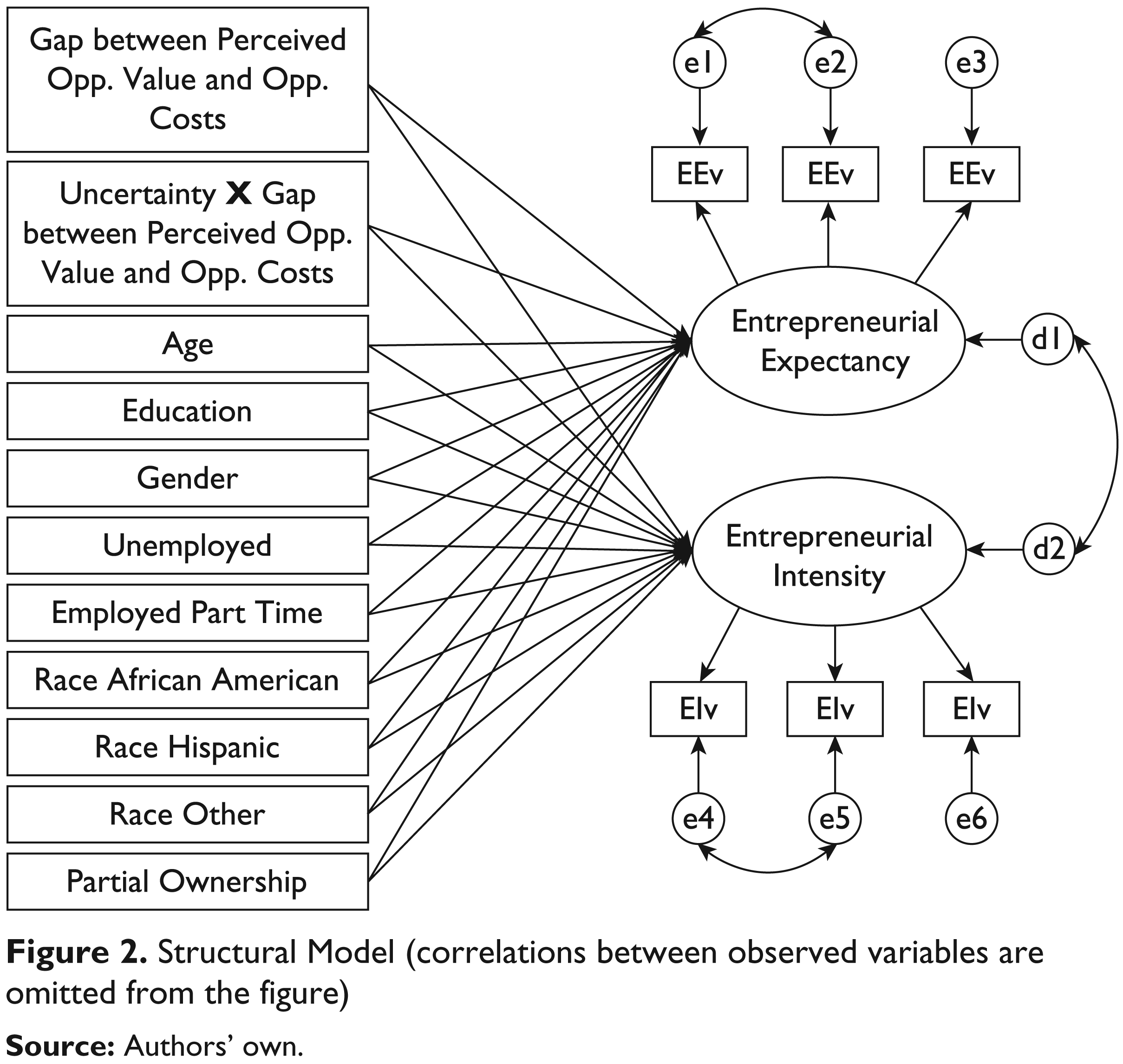
H4 predicted that the positive influence the gap between perceived value and opportunity costs has on entrepreneurial expectancy would be strengthened for those individuals with higher uncertainty preference. The structural model supports this moderation hypothesis as evidenced by the positive and significant path (standardised regression weight = 0.208, p < 0.001) as shown in Table 4. The structural model is shown in Figure 2.
Discussion
At the onset of this study, we set out to understand how entrepreneurs’ perceptions about opportunity value versus their specific opportunity costs might provide a basis for high levels of entrepreneurial expectancy and intensity which otherwise might seem irrational, given the high failure rate of entrepreneurial firms. In short, we were interested in what drives entrepreneurs to have such positive beliefs about and commitments to actions directed at entrepreneurial opportunities, which are inherently uncertain. Relying on expectancy theory’s assumption that perceived consequences drive expectancy and intensity, we predicted that individuals who perceived opportunities as more valuable compared to their outside options would exhibit higher levels of expectancy and intensity. Consistent with expectancy theory, this study supports the idea that individuals have higher beliefs about (expectancy) and commitments to (intensity) actions that they perceive as having positive outcomes relative to other actions (outside options) they could pursue instead.
Our second research question focused on the degree to which individuals’ preferences for uncertainty might enhance the influence that perceived gaps between opportunity value and opportunity costs have on entrepreneurial expectancy and entrepreneurial intensity. Our finding that uncertainty preference indeed positively moderates the influence that such a perceived gap has on expectancy and intensity sheds further light on why entrepreneurs might be perceived as having hubris and, more specifically, what specifically they have hubris about. The present study provides evidence that those entrepreneurs with high uncertainty preference either have more confidence about the accuracy of their perceptions of opportunity value and/or their own opportunities costs or simply are okay with being wrong and proceed anyway. Specifically, those entrepreneurs with higher uncertainty preferences relied more on their perceptions about the gap between value and opportunity costs when forming positive beliefs about, and subsequent commitments to, courses of actions. This is an important distinction between entrepreneurs with higher uncertainty preference and those with lower uncertainty preference because it influences subsequent beliefs related to entrepreneurial action.
Implications
Recently, entrepreneurship scholars examined how seemingly irrational entrepreneurial decisions—namely, pursuing start-up actions despite the negative expected outcomes of those actions—may be based on rationalisations that arise during early cognitive search stages of entrepreneurial decision making (Chwolka & Raith, 2012). We contribute to this literature by offering one of the likely targets of such search; specifically, we provide evidence that entrepreneurs’ identification of a perceived gap between opportunity value and opportunity costs can influence their expectations and subsequent intensity. This implies that future research on expectancy and intensity needs to explicitly consider entrepreneurs’ perceptions about their outside options prior to their exploitation of an opportunity.
Although there is evidence that entrepreneurs may be optimists, recent work provides evidence that entrepreneurs’ beliefs may merely appear optimistic but be justified on the basis ‘that entrepreneurs are more educated’ with regard to their beliefs about the future (Bengtsson & Ekeblom, 2014, p. 1). The present research contributes to this by articulating what it is that entrepreneurs may be educated about. Specifically, we provide evidence that entrepreneurs are educated about their own opportunity costs and use that information to inform their expectancy beliefs and related entrepreneurial intensity. Recent research highlights the importance of learning in new ventures (Aldrich & Tang, 2014); however, findings in the present research imply that we cannot ignore the importance of learning that happens prior to the existence of new ventures, specifically learning about the potential value of a focal opportunity and an individual or set of individuals’ aggregate opportunity costs.
A recent review of discovery-based entrepreneurship literature found that although new research within the discovery view of entrepreneurship is sophisticated, it is inadequate in its theorising about how uncertainty is involved in exploitation decisions (Ramoglou, 2011). In the present research, we theorised and empirically tested how uncertainty might be involved in decisions related to the eventual exploitation of entrepreneurial opportunities. An important implication of this research, then, is that entrepreneurs’ preference for uncertainty needs to be included in theoretical models aimed at explaining constructs related to entrepreneurial exploitation, such as expectancy and intensity.
Although the primary theme of the present study is to identify relationships between value–cost and expectancy/intensity, suggesting that entrepreneurs’ cognition may be more rational than surface level appearances suggest, we offer these findings with caution. Specifically, one of the core components of expectancy theory is the concept of escalation of commitment. Indeed, our dependent variables both have strong correlations with commitment (Yang, Liu, Zhang, Chen, & Niu, 2015). For example, the Chinese PSED provides evidence that in technology contexts, entrepreneurs are particularly susceptible to escalation of commitment bias. Therefore, it is important to emphasise that our independent variable is one of perception, that is, it is important for researchers, and practitioners especially, to note that we are not offering a justification of the escalation of resource commitment to ventures that appear to have negative expected outcomes on the surface; rather, we are providing evidence that suggests entrepreneurs’ decisions to pursue exploitation of opportunities which appear to have negative expected outcomes may be based on rational cognitive processes because the entrepreneurs believe (possibly incorrectly) that a focal opportunity has a greater value than the entrepreneur’s outside options appear to avail.
Limitations
An important limitation of this study is the lack of consideration for how many other entrepreneurial opportunities an individual is invested in. Real options theory suggests that entrepreneurs invest just enough into multiple opportunities to secure the right to invest more, should a particular opportunity continue to produce positive results (McGrath, 1999), that is, it might be that the entrepreneurs in this sample are investing in an opportunity with an options frame of mind, where their efforts to start the focal venture secure the right, but not the obligation, to continue to pursue that opportunity in the future. However, this is beyond the scope of this article, but may be a fruitful research agenda for the future.
A related limitation is the short time span. Specifically, we do not have data to indicate whether the dependent variables of interest, entrepreneurial expectancy and entrepreneurial intensity persist in future periods. Future research should set out to explore these issues using longitudinal data.