



Abstract
Strategic entrepreneurship (SE) emphasises the complementary roles played by entrepreneurship and strategic management in promoting firm growth. This article adopts two dominant concepts from each field—entrepreneurial orientation (EO) and dynamic capabilities (DCs)—to investigate their interaction effects on firm performance (FP). It further examines three contingencies—firm, market and product innovation—that significantly affect the levels of EO and DCs that firms pursue. This study analyses the influence of EO and DCs on performance using hierarchical regression models. Interaction effects of EO and DCs on FP demonstrate a positive relationship. This study found that DCs are more critical for incumbent firms than for small firms. Both EO and DCs enhance performance in dynamic markets. The EO increases performance under radical product innovation, while DCs show no effects. This study provides important and unique implications for the complementary roles of entrepreneurship and strategic management.
Keywords
Although entrepreneurship and strategic management evolved independently (Hitt, Ireland, Camp, & Sexton, 2001), both aim to grow firms and create wealth (Hitt, Ireland, Sirmon, & Trahms, 2011; Ireland, Hitt, & Sirmon, 2003; Kuratko & Audretsch, 2009). The notion underlying strategic entrepreneurship (SE) is to connect the entrepreneurial mindset with strategic thinking regardless of the firm’s size, environment and resources. It is difficult for any firm to grow and remain competitive while focusing on only one discipline (Ireland et al., 2003; Kraus, Kauranen, & Henning Reschke, 2011). From the SE perspective, both young and entrepreneurial firms that possess the strategic management skills (i.e., advantage seeking) necessary to manage resources well and handle the market environment adeptly as well as established firms that consistently identify and exploit entrepreneurial opportunities efficiently (i.e., opportunity seeking) will stay competitive in the market (Hitt et al., 2001; Ireland et al., 2003). A key limitation of the SE perspective is that it suffers from a lack of empirical evidence regarding the balance between opportunity-seeking and advantage-seeking activities and the absence of a concrete SE model to be applied in empirical studies (Foss & Lyngsie, 2011; Klein, Barney, & Foss, 2012; Luke, Kearins, & Verreynne, 2011). Moreover, contingency-based research has provided insufficient evidence of SE effects on firm performance (FP) (Schindehutte & Morris, 2009).
As SE is an umbrella perspective that covers broad aspects of entrepreneurship and strategic management (Klein et al., 2012), it is necessary to specify the concepts adopted from each discipline. Foss and Lyngsie (2011) supported the notion that the adaptation of entrepreneurial orientation (EO) and dynamic capabilities (DCs) in firm-level studies of SE is of great importance. Further, Klein et al. (2012) advised that ‘SE scholars use constructs, theories, and methods well-established in the two fields, For example, among the antecedents of value creation and capture are established variables like entrepreneurial orientation and dynamic capabilities’ (p. 3). The EO is a well-established concept in the study of firm-level entrepreneurship (Rauch, Wiklund, Lumpkin, & Frese, 2009), and the inclusion of DCs in the development of conceptual frameworks of SE has been increasingly highlighted in recent studies (Alavi & Leidner, 2001; Kyrgidou & Hughes, 2010). However, current literature has yet to fill this void, and the relationship between SE and performance remains largely ambiguous (Sirén, Kohtamäki, & Kuckertz, 2012). The primary aim of this study was to address some of these shortcomings by examining the effects of two theoretical frameworks—EO and DCs adopted from each discipline (i.e., entrepreneurship and strategic management)—on FP.
Scholars have suggested that EO and DCs are vital to create wealth in fast-changing environments, which are predominantly found in contemporary business (Teece, 2007; Teece, Pisano, & Shuen, 1997). The EO has received considerable scholarly attention from researchers seeking to understand firm-level entrepreneurship (Covin & Slevin, 1991; Kraus, Rigtering, Hughes, & Hosman, 2012; Low & MacMillan, 1988; Miller, 1983). Over the last decade, DCs have received enormous attention from field researchers and have become a pivotal issue in strategic management due to their ability to explain performance differentials among intra-industry groups possessing similar resource profiles (Foss & Lyngsie, 2011; Zott, 2003). However, there is limited understanding of how the joint effect of EO and DCs (i.e., the SE perspective) can influence FP. More specifically, whether the interaction of EO and DCs has a positive effect on FP remains largely unknown.
The SE scholars have suggested that the focus of entrepreneurship and strategic management varies according to firm size (Meyer, Neck, & Meeks, 2002). To some extent, small start-ups are relatively skilled at finding entrepreneurial opportunities, while incumbent firms are better at sustaining and developing a competitive advantage (Ireland et al., 2003). The market environment also affects the levels of entrepreneurship and strategic management that are required. Dynamic environments provide fertile ground for greater entrepreneurial activities but also demand that firms become equipped with better strategic management skills (e.g., DCs) (Teece, 2007). Entrepreneurial activities are centred on developing innovative products that are not merely incremental improvements on existing products (Miller, 1983). Accumulating capabilities through the effective practice of strategic management skills (e.g., networking, learning, and resource and knowledge management) can help entrepreneurial firms develop more innovative products. The authors argue that these three contingency factors—firm, market and product innovation—can affect the level of SE (i.e., EO and DCs) pursued by firms and that their subsequent effects on FP can vary.
This study makes three contributions to the literature on SE. First, we employ two dominant concepts from entrepreneurship and strategic management to validate their interaction effects on FP. Second, we explore how EO–FP and DC–FP can vary according to firms’ characteristics (e.g., size), market conditions and product innovation. Finally, this study provides an avenue for prospective empirical studies of SE; the approach applied in this work can be used for further development of this field. For example, subsequent studies can investigate how to identify the optimal point of practising SE by examining leading firms (e.g., Kraus et al., 2011). This article is organised as follows. To begin, three theories—SE, EO and DCs—are reviewed and linked to FP. Hypotheses are formed based on the interaction effects of EO and DCs on FP and influential contingency factors. This is followed by an explanation of the research context, data and methodology. The next section presents the results of empirical studies of Korean manufacturing small and medium enterprises (SMEs). Finally, the last section contains concluding comments and suggests directions for future studies.
Literature Review
Strategic Entrepreneurship
The SE is a relatively new perspective (Foss & Lyngsie, 2011) that has received increasing attention from researchers because firms need to possess both skills (i.e., entrepreneurship and strategic management) to maximise wealth (Kraus et al., 2011). The SE is defined as ‘the integration of entrepreneurial (i.e., opportunity-seeking behavior) and strategic (advantage-seeking behavior) perspectives in developing and taking actions designed to create wealth’ (Hitt et al., 2001, p. 481). The theoretical foundation of SE is rooted in balancing opportunity- and advantage-seeking activities that are composed of the entrepreneurial mindset, culture, leadership, strategic resource management and creative innovation activities (Ireland et al., 2003, p. 967). In addition, Kraus et al. (2011) proposed six elements that are incorporated into and interact in the model of SE: resources, strategy, environment, entrepreneurial leadership, organisational structure and capabilities (p. 64). Firm-level entrepreneurship research predominantly focuses on the early stages of organisations, such as small businesses, start-ups and new ventures. In contrast, strategic management research primarily focuses on medium- and large-sized enterprises (Foss & Lyngsie, 2011; Meyer et al., 2002). Firm growth and development are difficult to realise by focusing on opportunity-seeking or advantage-seeking behaviours alone. The intended purpose of the SE perspective is to provide a framework for creating wealth regardless of firm size, resources and environment (Hitt et al., 2011; Ireland et al., 2003; Kraus et al., 2011; Kuratko & Audretsch, 2009; Schindehutte & Morris, 2009). The challenge for the SE perspective lies in achieving the proper balance between entrepreneurial and strategic activities (Ireland & Webb, 2007); however, there exists a paucity of studies addressing this issue. For a clear understanding of the SE perspective in terms of firm growth, we illustrate a conceptual framework of the link between SE and FP adopted from both entrepreneurship and strategic management disciplines, which forms a basis for the hypothesis development shown in Figure 1.

Entrepreneurial Orientation
Entrepreneurship research has broadened its focus, especially in the studies of strategic management and entrepreneurship at the firm level (Boling, Pieper, & Covin, 2016; Covin & Slevin, 1991; Hisrich & Kearney, 2012; Low & MacMillan, 1988; Miller, 1983; Wiklund, 1999). The seminal work of Miller (1983), which has increased interest in firm-level entrepreneurship, identified three dimensions of entrepreneurship, that is, ‘innovativeness’, ‘risk taking’ and ‘reactiveness’. Firms with a high EO demonstrate strategy-making behaviours that initiate more innovative, proactive and risk-taking activities (Lumpkin & Dess, 1996; Miller, 1983; Moreno & Casillas, 2008). Prior empirical research has provided clear evidence of the positive effects of EO on FP (Kraus et al., 2012; Lee, Lee, & Pennings, 2001; Stam & Elfring, 2008; Wiklund & Shepherd, 2005; Zahra & Garvis, 2000). In a meta-analysis of the EO–FP relationship based on 51 empirical studies, Rauch et al. (2009) confirmed that EO and FP are positively correlated (r = 0.242) and that this relationship is robust under different contexts and contingencies. However, recent studies have also reported positive but non-linear effects of EO on FP (i.e., an inverted U-shaped relationship) (Su, Xie, & Li, 2011; Tang, Tang, Marino, Zhang, & Li, 2008). Due to the risk of focusing too strongly on EO, researchers emphasise the bounded effects of EO on FP. For example, Tang et al. (2008) found an inverted U-shaped relationship between EO and FP. They explained a lack of institutional support, venture-backed financial market, network accessibility and role formalisation as causes of this relationship. Similar results were observed in a study by Zahra and Garvis (2000), who found that the relationship between international entrepreneurship and performance showed an inverted U-shape and attributed this to difficulty in managing diverse corporate ventures and innovation activities in foreign markets. Su et al. (2011) also explored this relationship in the context of Chinese new ventures and established firms and found a curvilinear effect (inverted U-shape) of EO on new venture performance.
Dynamic Capabilities
Under the DC perspective, firms are considered to be heterogeneous in their utilisation of resources and capabilities. The DCs have been viewed as idiosyncratic and firm-specific routines and capabilities (Alvarez & Busenitz, 2001; Barreto, 2010; Zott, 2003). Based on an evolutionary economic perspective (Nelson & Winter, 1982) and a resource-based view (Barney, 1991), with shortened product life cycles, fierce competition and technological changes, which often characterise fast-changing environments, firms need extraordinary skills, that is, ‘DCs’, to reconfigure and transform their current asset bases, market positions and internal processes (Teece, 2007; Teece et al., 1997). The ability to reconfigure and transform current assets (and resources) and processes into dynamic paths (i.e., strategic alternatives) provides firms with better sensing and seizing abilities regarding new opportunities (Teece, 2007).
A few studies have found a positive relationship between DCs and FP (e.g., Drnevich & Kriauciunas, 2011; Pavlou & El Sawy, 2011; Wu, 2007). Pavlou and El Sawy (2011) found that DCs improve new product development (NPD) performance in a turbulent environment by enhancing operating capabilities. Drnevich and Kriauciunas (2011) claimed that in a dynamic environment, FP is increased only by DCs, not by ordinary (or operating) capabilities. In terms of the DC–FP relationship, there seem to be two differing views (Helfat & Peteraf, 2009; Wang & Ahmed, 2007). One view suggests a positive direct effect of DCs on FP (Teece et al., 1997; Zollo & Winter, 2002), while others contend that this relationship is indirect through the improvement of process and resource reconfiguration (Eisenhardt & Martin, 2000), the enhancement of substantive capabilities and organisational knowledge (Zahra, Sapienza, & Davidsson, 2006) and the repositioning of the asset base (Teece, 2007). Whether the effect is direct or indirect, strategic management researchers generally maintain that enhanced DCs have a positive impact on FP.
Several scholars have argued that DCs impose costly activities that are linked to acquiring, modifying and transferring assets, knowledge, resources and capabilities (Barreto, 2010; Zahra et al., 2006; Zott, 2003). Makadok (2010) and Zahra et al. (2006) noted that a firm’s profits may decrease in situations where cultivated DCs are not connected to the profit mechanism. In addition, Arend and Bromiley (2009) criticised extant studies for rarely accounting for the cost of creating DCs, resulting in an overestimation of the positive effects of DCs on performance. The excessive use of DCs may result in diminishing returns, mainly because the cost of investing in the creation of new capabilities outweighs the benefits, and these capabilities may not be linked to profit mechanism. Others have criticised the lack of theoretical coherence and consistency in the measurement of DCs and the positive direct effects of DCs on FP (Arend & Bromiley, 2009; Barreto, 2010; Eisenhardt & Martin, 2000; Williamson, 1999; Zahra et al., 2006; Zott, 2003). However, the growing interest in DCs is noteworthy since modern business tactics and practices must account for fast-changing environments for firms to sense, seize and exploit new business opportunities, which often may not be possible with their current operating capabilities. Such innovative products require greater knowledge management (Alavi & Leidner, 2001), inter-firm collaboration (Chesbrough, 2003), absorptive capacity (Cohen & Levinthal, 1990) and organisational learning skills (March, 1991), which together are referred to as innovation capabilities.
Hypotheses
In this section, we develop hypotheses that draw upon the argument for a joint effect of EO and DCs on FP and their comparative effects on FP based on three factors identified as influential.
Interaction Effect of Entrepreneurial Orientation and Dynamic Capabilities on Firm Performance
Entrepreneurs develop their knowledge, skills and capabilities through a recursive process of trial and error, strategic decision-making, benchmarking and cognitive skills training. Entrepreneurs can be more innovative, act more proactively and take greater risks (collectively described as EO) when they possess greater capabilities essential to solving problems and overcoming hurdles in identifying, developing and exploiting their entrepreneurial opportunities. Teece (2007) asserted that sensing, seizing and understanding entrepreneurial opportunities represent primarily non-routine activities that involve ‘recognizing problems and trends, directing (and redirecting) resources, and reshaping organizational structures and systems so that they create and address technological opportunities while staying in alignment with customer needs’ (p. 1347). Zahra et al. (2006) also contended that the evolution of DCs is strongly associated with entrepreneurial activities. Jantunen, Puumalainen, Saarenketo and Kyläheiko (2005) found that EO coupled with DCs increases the level of international performance based on a sample of 217 Finnish firms. Wiklund and Shepherd (2003) reported that EO enhances the relationship between knowledge-based resources and performance. However, Telussa, Stam and Gibcus (2006) found no evidence that entrepreneurial characteristics, such as human (e.g., education, work experience and gender) and social capital (e.g., networks and business partners), improve performance through building DCs. Firms that possess more DCs are likely to find better entrepreneurial opportunities and to exploit those opportunities with stronger EO with greater confidence, especially in highly turbulent environments. Some researchers have suggested that firm-specific capabilities (i.e., DCs) may increase EO and positively moderate the EO–FP relationship and vice versa (Covin & Miller, 2014; Edmond & Wiklund, 2010; Miller, 2011[1983]). Covin and Lumpkin (2011) noted that ‘dynamic capabilities can be understood as key means for linking EO to firm opportunity exploitation and subsequent performance’ (p. 861). Although there have been a number of empirical investigations of the direct effects of EO and DCs on FP, there has not been sufficient consideration of the joint effects of EO and DCs. Based on the extant arguments of positive effects of EO and DCs on FP, we expect that a positive interaction effect of EO and DCs on FP will be observed.
Hypothesis 1: The interaction effect of entrepreneurial orientation and dynamic capabilities on firm performance will be positive.
Moderating Effect of Firm Size
The SE emphasises the complementary roles of entrepreneurship and strategic management to promote firm growth, regardless of firm size (Ireland et al., 2003; Ketchen, Ireland, & Snow, 2007). However, it is presumed that the levels of competence and focus on each discipline may vary relative to firm size. Ireland et al. (2003) asserted that ‘small, entrepreneurial ventures are effective in identifying opportunities but are less successful in developing competitive advantages. In contrast, large, established firms often are relatively more effective in establishing competitive advantages but are less able to identify new opportunities’ (p. 963). Ketchen et al. (2007) maintained that new ventures possess ‘open-minded optimism’ for pursuing entrepreneurial opportunities, but this mindset becomes weaker as firms grow and become encumbered by bureaucracy, complex procedures and rigid culture.
Small firms are short on resources, experience, processes, networks and knowledge (Hitt et al., 2001; Ketchen et al., 2007; Zahra et al., 2006). Because they do not possess considerable resources, the survival of small firms often depends on how strongly they are committed to achieving their entrepreneurial goals. The EO is essential to the ability of start-ups to introduce new and innovative products to the market (Stam & Elfring, 2008) and overcome the ‘liability of newness and smallness’ (Freeman, Carroll, & Hannan, 1983). Early entrance into the market and more innovative products imply more risks and the pursuit of greater resources. By contrast, large and incumbent firms enjoy most of the current market share; thus, they are not as desperate as small firms to take the same amount of risk, lead product innovation and disrupt the current market. Therefore, stronger EO is required for small firms to overcome their shortcomings and the obstacles to bringing new innovations to the market, which can lead to higher FP (Miller, 1983; Rauch et al., 2009).
Hypothesis 2a: The impact of entrepreneurial orientation on firm performance will decrease as firm size increases.
The DCs are developed through previous experience and knowledge in developing new products, benchmarking best practices (Eisenhardt & Martin, 2000), trial and error (Nelson & Winter, 2002; Zahra et al., 2006), sharing information (Macher & Mowery, 2009) and similar factors. Kraus et al. (2011) argued that ‘in the growth process, external uncertainty decreases, which requires decreasing levels of exploration and planning … at the same time, internal complexity increases and adaptability decreases, which sets increasingly higher demands on the implementation side of strategic management’ (p. 63). As firms grow, they are more likely to possess resources, processes and networks, which are often called ‘routines’ (Nelson & Winter, 1982). Incumbent and large firms are likely to possess more routines (Nelson & Winter, 2002), which can provide them with a greater ability to cope with a changing environment (Eisenhardt & Martin, 2000) and thus lead to better performance.
Hypothesis 2b: The impact of dynamic capabilities on firm performance will increase as firm size increases.
Moderating Effect of Market Dynamism
In dynamic environments, a stronger entrepreneurial mindset is required to overcome external challenges caused by the volatility and uncertainty of markets and technologies. Scholars assert that firms can benefit more from pursuing EO and DCs in highly dynamic environments (Barreto, 2010; Deeds, Decarolis, & Coombs, 2000; Kraus et al., 2012; Li, Huang, & Tsai, 2009; Lumpkin & Dess, 2001; Pavlou & El Sawy, 2011; Teece, 2007; Zahra et al., 2006). Rapidly changing customer needs and technologies characterise the business conditions of dynamic markets. Miller and Friesen (1983) defined market dynamism (MD) as ‘the amount and unpredictability of changes in customer tastes, production or service technologies, and the modes of competition in the firm’s principal industries’ (p. 233). Based on a meta-analysis of 53 empirical studies of the EO–FP relationship and internal/external moderators, such as firm size, industrial dynamism and culture, Rauch et al. (2009) found that MD positively moderates the relationship between EO and FP. Survival under dynamic market conditions largely depends on whether a firm can introduce innovative products more quickly than its competitors, bear high risks and enter the market in the early stage of the product’s life cycle (Covin & Slevin, 1991; Lumpkin & Dess, 1996, 2001; Lyon, Lumpkin, & Dess, 2000).
Hypothesis 3a: The impact of entrepreneurial orientation on firm performance will increase as the degree of market dynamism grows.
Teece (2007) argued that DCs can play a key role in increasing performance in dynamic environments (p. 1320) and further explained that the effect of DCs on performance can be influenced by rapid changes in technologies, customer needs and fast globalisation, which characterise a dynamic market environment. Firms must match their DCs to such an environment to gain a competitive advantage and thus generate better performance (Barreto, 2010). Therefore, MD dictates the level of DCs required in competitive markets for firm survival and better performance (Teece, 2007). Zahra et al. (2006) argued this point by stating that ‘if the environment is highly volatile, frequently and unpredictably necessitating changes in substantive capabilities, the potential value of dynamic capabilities can be quite high’ (p. 942). Firm resources and a turbulent external environment constitute necessary conditions for firms to develop DCs (Helfat & Peteraf, 2009; Jantunen et al., 2005; Macher & Mowery, 2009; Wang & Ahmed, 2007; Wu, 2007; Zollo & Winter, 2002). For example, Song, Droge, Hanvanich and Calantone (2005) found that market and technological capabilities are significant only in highly dynamic environments. Drnevich and Kriauciunas (2011) compared the effects of ordinary capabilities and DCs on performance and found that ordinary capabilities have negative effects on performance, whereas DCs have positive effects in highly dynamic markets. Pavlou and El Sawy (2011) contended that DCs positively influence the performance of NPD in highly volatile market environments.
Hypothesis 3b: The impact of dynamic capabilities on firm performance will increase as the degree of market dynamism grows.
Moderating Effect of Product Innovation
It is apparent that innovation is an essential intermediary to achieve the performance goals of most firms emphasised by the domains of entrepreneurship and strategic management (Schindehutte & Morris, 2009). Numerous scholars have asserted that the primary activity of entrepreneurship is to create innovative products and services (Ahuja & Lampert, 2001; Drucker, 1985; Lumpkin & Dess, 1996; Schindehutte & Morris, 2009). A number of scholars have broadly classified innovation into two types: incremental and radical (Christensen, 1997; Ettlie, Bridges, & O’Keefe, 1984; Gatignon, Tushman, Smith, & Anderson, 2002). Incremental innovation arises from improvements in current products, services and processes to gain a cost advantage; increases production efficiency; adds more features to existing products/services; and is often generated from solving user (customer) complaints, collaborating with suppliers, conducting applied research and increasing production yield. Radical innovation arises from the development of new products/services that have not been introduced to the market or that provide completely different, previously non-existent functions that are valued by users; radical innovation is often generated from the novel discovery of technologies, ideas and basic research to fulfil customers’ unmet needs. According to Gatignon et al. (2002), ‘incremental innovations are those that improve price/performance advance at a rate consistent with the existing technical trajectory, Radical innovations advance the price/performance frontier by much more than the existing rate of progress’ (p. 1107).
Radical innovation requires more novel innovation, greater risk and proactive strategies because of the nature of genuine originality and creativity. Because entrepreneurial firms are regarded as innovators that take significant risk and act proactively in the market, they are likely to develop radical products/services, rather than to copy others (Bessant & Tidd, 2007). Further, to overcome the ‘liability of smallness’ often faced by new ventures (Freeman et al., 1983) and to cope with turbulent environments, these firms often cannot merely pursue fast-follower or copycat strategies. Miller (1983) contended that firms cannot be regarded as entrepreneurial if they pursue only incremental innovation and merely attempt to improve their current products and business efficiency. Ireland et al. (2003) further emphasised that ‘wealth-creating goals to be pursued by using an entrepreneurial mindset are more than incremental in nature’ (p. 969).
Hypothesis 4a: The impact of entrepreneurial orientation on firm performance will increase as the degree of product innovation becomes more radical.
Radical innovation also requires the reconfiguration and transformation of existing resources and capabilities, and DCs can play a critical role in a firm’s ability to develop new products/services that are novel, complex and innovative. Zahra et al. (2006) noted that DCs are strongly required in the context of radical changes in technologies and market segments, implying that DCs are more likely linked to radical innovation than to incremental innovation. Because DCs characterise a firm’s ability to transform and reconfigure current assets, more novel knowledge, enhanced processes, higher commitment and greater resource manipulation are needed when developing more radical products/services (Avlonitis & Salavou, 2007; Teece, 2007; Wang & Ahmed, 2007). Therefore, firms possessing more DCs are likely to produce more radically innovative products (Ireland et al., 2003).
Hypothesis 4b: The impact of dynamic capabilities on firm performance will increase as the degree of product innovation becomes more radical.
Research Methodology
Sample
The sample in the present study was gathered from a Korean manufacturing SME database provided by the Small and Medium Business Administration (SMBA), Republic of Korea. The manufacturing industry was selected as the focus of our study because the manufacturing industry is a major industry for innovative activities (e.g., R&D) in Korea (OECD, 2016). Korea’s SMBA defines manufacturing SMEs as firms with either less than 8 billion Korean won in total capital or fewer than 300 employees. We randomly selected 1,391 firms with fewer than 300 employees from the SME database and administered a survey questionnaire to capture data on all the variables considered in this study. The questionnaire was translated from English to Korean and then back-translated into English by an independent translator to ensure its validity. We then pilot-tested the face validity of the survey with 14 executives, who expressed no major concerns that the questionnaire was ambiguous or misleading. Excluding the firms included in the pilot study, we then conducted the main survey from September 2015 to November 2015. We first contacted all the sampled firms by telephone and inquired about their willingness to participate in the survey. We then sent an email survey to the entrepreneurs and executives who agreed to participate in the study. This study obtained a final usable sample of 252 firms. This two-step method significantly improved the response rate, which was 18 per cent. Among the participating firms, the average number of employees was 59, and the average firm age was 29.1 years. The sample firms ranged from high-tech industries to general manufacturing industries, such as IT, BT, chemicals, electronics, machinery and ship-building firms, among others. We assessed non-response bias using a chi-squared test of the differences between the respondents and non-respondents. We compared characteristics such as firm size, total number of employees and revenue. The results of one-way ANOVA showed that there were no significant differences between the respondents and non-respondents in any of these characteristics (F = 1.914, p > 0.10; F = 1.290, p > 0.10; F = 2.375, p > 0.10, respectively). We measured all items using simple surveys. Self-reporting by a common source can cause concerns about common method bias (Podsakoff, MacKenzie, Lee, & Podsakoff, 2003). We evaluated the possibility of common method bias using Harman’s (1976) single-factor test. If common method bias exists in data, one general factor that accounts for the majority of variance would result from a factor analysis of the data. We performed a factor analysis including all the variables, and the results indicated that the largest proportion of variance was 28.6 per cent. Therefore, common method bias was not a problem in this study.
Measures
Dependent Variable: Firm Performance
The FP was measured using four measurement items adopted from Tang et al. (2008). FP was measured as the firm’s relative performance compared to that of its competitors. All items were anchored on a 7-point Likert-type scale (refer to Table 1).
Validity and Reliability of the Measurement Model


Independent Variables: Entrepreneurial Orientation
Many researchers have treated EO as a one-dimensional construct of firm-level entrepreneurship that incorporates ‘innovativeness’, ‘risk taking’ and ‘reactiveness’ (Rauch et al., 2009). Miller (1983) asserted that entrepreneurship can be viewed as a ‘composite weighting’ of these three dimensions (p. 771). We followed this convention and measured EO using questions derived from Covin and Slevin (1991), who used nine items on 7-point Likert-type scale to measure EO as a single construct (refer to Table 1).
Dynamic Capabilities
The measurement of DCs has been vigorously criticised by many scholars (Arend & Bromiley, 2009; Williamson, 1999). In fact, there is no universal instrument to measure DCs (Barreto, 2010; Pavlou & El Sawy, 2011). We argue that transformation and reconfiguration capabilities capture the most unique features of DCs (Jantunen et al., 2005). Therefore, this study used seven items to measure DCs that were derived from Jantunen et al. (2005), who focused on the transformation and reconfiguration of DCs. All items were anchored on a 7-point Likert-type scale (refer to Table 1).
Control
As discussed earlier, the levels of EO and DCs pursued can be influenced by the size and age of the firm. Dynamic market conditions also favour the development of EO and DCs. Similarly, the degree of radicalness of new and/or existing products under development can be associated with the pursuit of EO and DCs. Therefore, this study included four control variables: firm age, firm size, MD and product innovation radicalness (PIR). To control for firm age and size, we measured the number of years the responding firms had been in operation and their number of employees. These values were logarithmically transformed to represent age and size, respectively. The MD was measured using three items presented by Miller and Friesen (1983) on a 7-point Likert-type scale. For measuring PIR, this study adapted items from Gatignon et al. (2002), who developed four items on a 7-point Likert-type scale to measure the radicalness of new and existing product development (refer to Table 1).
Analysis
To establish study validity, we performed an exploratory factor analysis using a principal component analysis to extract factors and varimax as the rotation method. According to Rauch et al. (2009), many EO researchers view EO as a unidimensional concept (refer to Covin, Slevin, & Schultz, 1994; Dimitratos, Lioukas, & Carter, 2004; Zahra & Garvis, 2000); however, a significant number of researchers have also found multidimensional aspects of this concept (e.g., Kraus et al., 2012; Kreiser, Marino, & Weaver, 2002). Therefore, we performed an exploratory factor analysis to determine whether EO (and other variables in this study) is a multidimensional or unidimensional construct. The results revealed that 62.28 per cent of the variance of the items could be explained by the factors extracted, supporting the significance of the factors (Hair, Sarstedt, Ringle, & Mena, 2012). As shown in Table 1, five factors were produced with eigenvalues greater than 1 (Kaiser, 1960) and factor loadings greater than 0.4 (Hair, Black, Babin, Anderson, & Tatham, 2006). We found that EO was a unidimensional construct in this study. The results indicated that all items loaded significantly on their respective constructs. Overall, these results lend support to strong construct validity. We assessed the internal consistency of items using Cronbach’s alpha. The results revealed Cronbach’s alpha values above 0.70 for all constructs except MD (0.66). We considered a Cronbach’s alpha value above 0.60 as acceptable following the recommendation of a minimal acceptance level of reliability by Hair et al. (2006) and Nunnally (1967). Finally, Fornell and Larcker (1981) suggested the use of average variance extracted (AVE) to assess discriminant validity. As suggested, we compared the highest shared variance (i.e., the square of the correlation) with the lowest AVE value and found that the lowest AVE value was greater than any of the shared variance between all variables, indicating a satisfactory discriminant validity of our constructs (Fornell & Larcker, 1981; Hair et al., 2006). We used a hierarchical moderated regression analysis to test our hypotheses. Hierarchical moderated regression analysis allows the comparison of alternative models with and without the interaction terms (Jaccard & Turrisi, 2003). As recommended by Aiken, West and Reno (1991), we mean-centred the independent variables before creating interaction terms. We examined multicollinearity issues by assessing the variance inflation factors (VIFs) for the variables. The results showed that the VIFs ranged from 1.2 to 2.7, which was well below the cut-off value of 10, indicating that there were no issues with multicollinearity.
Results
Table 2 presents the descriptive statistics and correlation matrix for all the variables. There was a strong positive correlation between EO and FP (r = 0.635, p < 0.01) and between DCs and FP (r = 0.534, p < 0.01). There was a significant negative correlation between firm age and FP (r = −0.258, p < 0.05). In our study, MD and PIR had no significant direct correlation with FP.
Descriptive Statistics and Correlations (N = 252)

Table 3 presents the results of the hierarchical regression analyses. In the first model, control variables were entered. In the second model, control variables and main effects of EO and DCs were entered, which together explained a significant share of the variance in FP (adjusted R2 = 0.226, p < 0.01). In the third model, the interaction term of EO and DCs was entered to test its effect on FP. The interaction model significantly improved the overall model, as indicated by the significance of the F-test. The results indicate that the interaction effect of EO and DCs had a significant positive impact on FP ( β = 0.203, p < 0.05). To further interpret the interaction effect between EO and DCs on FP, we plotted the interaction results for high and low values (mean plus one standard deviation and mean minus one standard deviation), as suggested by Aiken et al. (1991) (refer to Figure 2). The plot clearly shows that firms possessing higher EO coupled with higher DCs had better performance than vice versa (refer to Figure 2a). Thus, Hypothesis 1 received support.
Moderated Regression Results: Standardised Beta Coefficients


In the fourth model, the moderating effects of firm size on the contribution of EO and DCs to FP were assessed (Hypotheses 2a and 2b, respectively). The results did not support our prediction that firm size would have a negative effect on the relationship between EO and FP ( β = −0.125, p = n.s.), thus failing to provide evidence for Hypothesis 2a. The moderating effect of firm size on the relationship between DCs and FP showed a significant positive effect ( β = 0.126, p < 0.05). Figure 2b shows that DCs had a greater contribution to FP as firms became bigger. Thus, Hypothesis 2b was supported.
The interactions between MD and EO (Hypothesis 3a) and between MD and DCs (Hypothesis 3b) were significant and positive ( β = 0.479, p < 0.01; β = 0.199, p < 0.05, respectively). The plots for these interactions clearly indicate positive effects (refer to Figures 2c and d). These results are consistent with the suggestion by many scholars that EO and DCs become stronger in fast-changing external environments (e.g., Covin & Slevin, 1991; Lumpkin & Dess, 1996; Teece, 2007; Teece et al., 1997). Thus, Hypotheses 3 and 4 were supported.
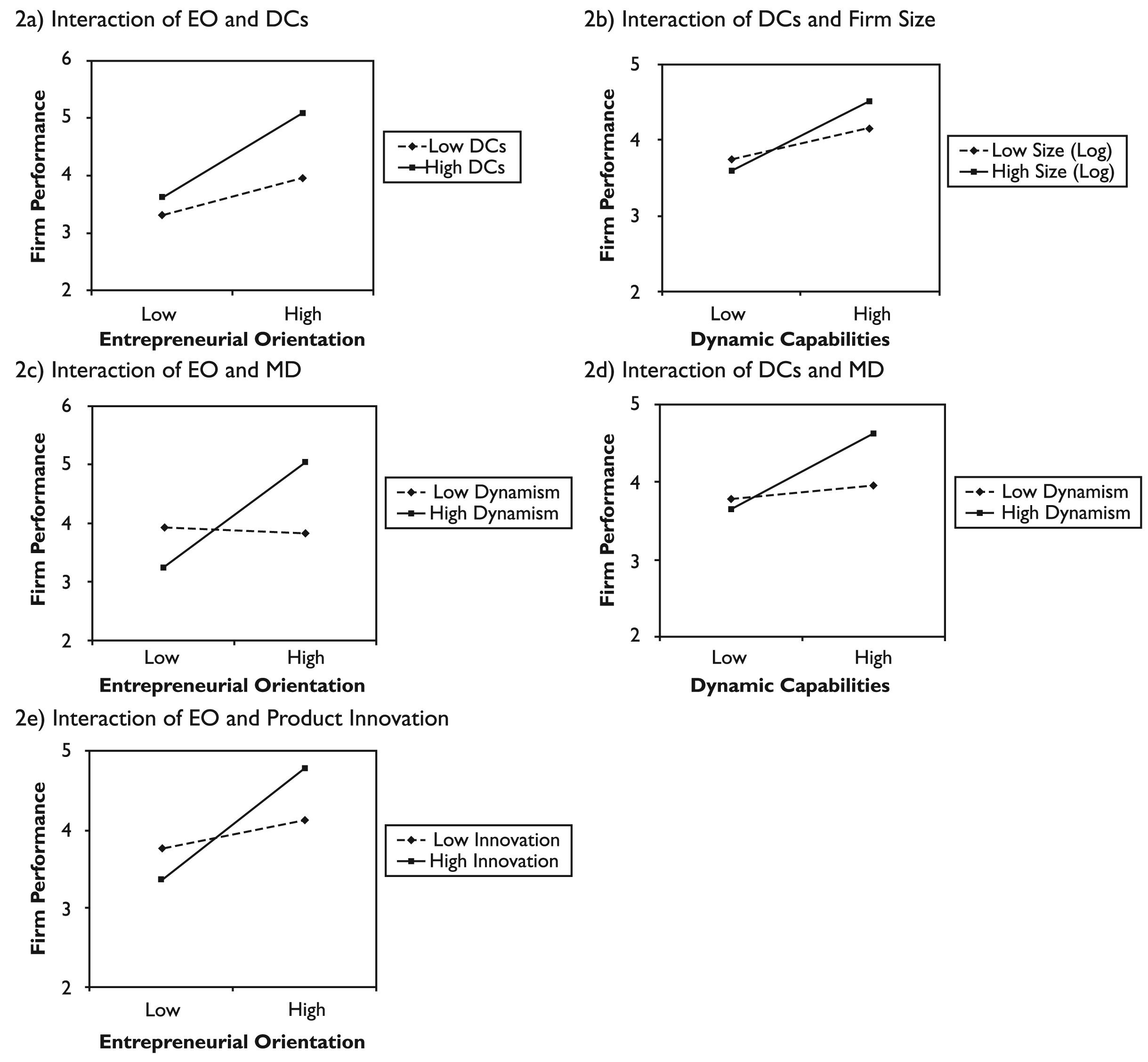
Regarding Hypothesis 4a, the radicalness of product innovation had a marginally significant positive effect on the relationship between EO and FP ( β = 0.265, p < 0.1). As shown in Figure 2e, a high level of EO improved FP by developing and commercialising more radical products with leading-edge, state-of-the-art technology and unique features, thus supporting Hypothesis 4a. This study found that DCs had no effect on FP ( β = −0.153, p = n.s.), thus rejecting Hypothesis 4b. This result may be due to the possibility that cultivating DCs requires long-term investments, such as learning, which may not be linked to profit mechanism (Zahra et al., 2006). Moreover, the reconfiguration and transformation of resources, capabilities and processes to develop more radical products can be time-consuming, which also may not improve short-term performance.
Discussion
Several scholars have called for research to integrate and reconcile the complementary roles of entrepreneurship and strategic management (i.e., SE) (Ireland et al., 2003; Ketchen et al., 2007; Kuratko & Audretsch, 2009). Barringer and Bluedorn (1999) demonstrated a direct link between strategic management and entrepreneurship by analysing US manufacturing firms. They found that three strategic management dimensions—environmental scanning, planning flexibility and locus of planning—had positive effects on the intensity of corporate entrepreneurship in the established firm context. The need for reconciliation of EO and DCs (i.e., SE) was explained by Teece (1998) as follows: ‘the ability to create additional wealth accrues to firms and individuals with superior skills (i.e., DCs; added by the author) in sensing and seizing entrepreneurial opportunities’ (quoted from Ireland et al., 2003, p. 965). In the present study, we expanded contingency-based SE research on the contributions of EO and DCs to FP.
First, this study found that the interaction effect of EO and DCs on FP is significantly positive, providing evidence that taking an SE perspective fosters firm growth. While each individual concept, EO and DCs, has a direct positive effect on FP, the combination of EO and DCs also provides a synergetic advantage that improves FP. Second, based on firm, market and product innovation characteristics, three contingencies that were identified as influential (i.e., firm size, MD and PIR in this study) were explored to determine their ability to moderate the effects of the EO–FP and DC–FP relationships.
From a firm characteristic perspective, this study found that the size of a firm does not affect the relationship between EO and performance. By contrast, DCs have a stronger positive effect on performance as firms become larger. These findings imply that, in the later stage of firm evolution, strategic management is crucial. The DCs are stratified in firm processes, individuals and routines, such as codified knowledge, structured manual, slack resources, networks and experience from trial and error and NPD. Cultivating DCs requires a period of time and investment (Wang & Ahmed, 2007). Therefore, large firms are likely to possess more DCs, which can lead to higher performance compared with small firms.
From a market perspective, both EO and DCs were found to increase FP in dynamic markets. In a dynamic market environment, firms are exposed to ample business opportunities, fierce competition and unpredictable changes in customers, markets and technologies (Miller, 1983). The EO and DCs promote the development of new and innovative products more quickly than the competition, which is a very important strategy in coping with dynamic market environments (Suarez & Lanzolla, 2007). In dynamic environments, firms may lag behind their competitors if they do not act more entrepreneurially and possess DCs that can sense, seize and exploit business opportunities caused by changing trends in technologies and markets.
From a product innovation perspective, this study found that EO has a significant positive effect on performance in innovative product development. This finding is not surprising, as innovation is a key feature in the pursuit of EO. Moreover, it is commonly understood that, compared with less entrepreneurial firms, highly entrepreneurial firms are more likely to pursue innovative activities to introduce new products to the market, rather than incrementally improving existing products (Miller, 1983). However, this study found no evidence that DCs have a positive effect on performance in the case of radical innovation. Radical innovation requires a longer period of time to develop than incremental innovation, and DCs require large amounts of investment, time, learning and commitment (Helfat & Peteraf, 2009; Zahra et al., 2006), which cannot be achieved instantly and may cause negative effects on short-term performance.
Conclusion
There has been growing interest in the integration of entrepreneurship and strategic management (i.e., the SE perspective) in recent years. However, there is little evidence regarding how SE is linked to performance under various contingencies. This study adopted two crucial theories from entrepreneurship and strategic management to demonstrate how the joint effects of EO and DCs (i.e., SE) affect FP and how these effects vary under various contingencies in Korean manufacturing SMEs. There is widespread acknowledgement that implementing EO and DCs is critical for firm survival in a competitive environment. As a result, we were able to identify three contingencies under which EO and/or DCs may play a critical role in FP. The consideration of complementary roles for EO and DCs in firm growth while addressing the market environment and product development can provide insights for managers to focus on short- and/or long-term strategies and human resource and technology development. This study contributes to the SE literature by extending the possible empirical connection and reconciliation of two important theories, EO and DCs, for increasing FP. The prospective goal of this study was to increase attention directed towards finding an optimal point for practising SE (i.e., opportunity- and advantage-seeking activities) to generate maximum wealth creation (Kraus et al., 2011). In summary, it is important to note that entrepreneurship and strategic management should be viewed as complementary, rather than separate, disciplines.
This study has several limitations that warrant future research. First, this study focused on Korean manufacturing SMEs. However, contextual differences among nations, cultures and institutions can affect the implementation of EO and DCs; thus, caution should be exercised in generalising our findings. Second, our study focused on general manufacturing industries. The implementation of EO and DCs can vary depending on the sector. Hence, future studies would benefit from focusing on specific industries. Third, cross-sectional data were utilised in this study. However, the effects of EO and DCs are not easy to observe with cross-sectional data. Longitudinal research would increase the robustness of our results concerning the effects of EO and DCs on FP. In particular, longitudinal data would allow investigations of how evolving DCs contribute to the development of new products. Fourth, this study focused on the characteristics of firms (here, firm size), market environment (here, dynamism) and product innovation (here, radicalness). However, there are many other characteristics of firms (e.g., culture, structure and system), markets (e.g., constrained/open markets and local/global markets) and innovation (e.g., competence enhancing/destroying, core/peripheral and architectural/generational innovation). Including these characteristics in future studies to reconcile the effects of EO and DCs on performance would allow researchers to provide more insightful implications for business practitioners. Finally, there is a lack of consistency in the measurement of DCs. This lack of consistency is a serious drawback for the application of DCs in practice and for academic research on this important topic. Williamson (1999) criticised the legitimacy of DCs in academic fields by stating that ‘a feasible criterion for judging dynamic efficiency is never proposed’ (p. 1098). Researchers need to develop clear, understandable and accountable DC measures for this field to gain greater legitimacy and robustness.
Declaration of Conflicting Interests
The author declared no potential conflicts of interest with respect to the research, authorship and/or publication of this article.
Funding
The author disclosed receipt of the following financial support for the research, authorship and/or publication of this article: this work was supported by the National Research Foundation of Korea Grant funded by the Korean Government (NRF-2014S1A5B8061859).