



Abstract
The development of theories to explain and predict the phenomena of entrepreneurship is essential to various stakeholders. Recent entrepreneurship literature has suggested that values motivate entrepreneurial intention, and entrepreneurship is contextual. This study examines contextual motivations of business undergraduates’ entrepreneurial intention across selected emerging Asian economies. The research methodology is quantitative. The measurement instrument consists of items from Portrait Values Questionnaire and Entrepreneurial Intent Scale to collect data from 378 matched business undergraduates from Malaysia, Indonesia and China. Structural equation modelling technique tested the hypotheses for overall sample, and measurement invariance was checked prior to multi-group analysis. The results suggest that the openness-to-change values shape Malaysian and Indonesian undergraduates’ entrepreneurial intentions, whereas achievement values shape Chinese undergraduates’ entrepreneurial intentions. The findings add to existing theory and evidence that argue for the importance of contextual motivations. It also enriches understanding of entrepreneurship in emerging Asian economies. Practical implications for entrepreneurship education and entrepreneurship development programmes are discussed.
Keywords
Entrepreneurship has long been recognised for its pivotal role in spearheading innovation, promoting diversity, increasing competitiveness, creating employment opportunities and generating economic growth (Bruton, Ahlstrom, & Obloj, 2008; Global Entrepreneurship Monitor Global Report 2017/18, 2018; Low & MacMillan, 1988). To put it differently, entrepreneurship creates a better world (Wiklund, Davidsson, Audretsch, & Karlsson, 2011). Given the touted benefits of entrepreneurship, the development of stronger theories to explain and predict (Bacharach, 1989) the phenomena of entrepreneurship is essential to scholars, policy makers and other stakeholders. At the same time, entrepreneurship is an interdisciplinary subject (e.g., management, finance, psychology, sociology, economics, political science, geography, etc.) (Amit, Glosten, & Muller, 1993; Audretsch, Thurik, Verheul, & Wennekers, 2002). Thus, it is essential to integrate different disciplines for a more productive entrepreneurship research (Zachary & Mishra, 2011).
Government entrepreneurship programmes are an important component in Global Entrepreneurship Monitor (GEM) Entrepreneurial Framework Conditions (Global Entrepreneurship Monitor Global Report 2017/18, 2018). In Malaysia, the National Blue Ocean Strategy focusses on fostering an entrepreneurial spirit among youths. A rigorous and theoretically grounded research provides informed insights to policy makers to formulate effective plans to nurture, support and harvest entrepreneurial activities to improve society’s quality of life (Zahra, 2007). However, public policy to promote entrepreneurship should take cognisance that individuals from different national contexts (the geography aspect of entrepreneurship) may be differently motivated for self-employment (Dana, 1997). Thus, it is imperative to identify best practices and develop entrepreneurship programmes suitable for different contexts (Terjesen, Hessels, & Li, 2016).
Recently, GEM has reported that two-thirds of the adult population surveyed in efficiency-driven economies perceived that starting a business is a good career choice (Global Entrepreneurship Monitor Global Report 2017/18, 2018). Empirical evidence suggests that young people are more likely to create a new venture (Global Entrepreneurship Monitor Global Report 2017/18, 2018; Levesque & Minniti, 2006). Undergraduates will face important career decision in the near future (i.e., making a career choice). Thus, it is desirable to attract undergraduates to choose entrepreneurship as a career (i.e., opportunity-driven or choice entrepreneurship) to take advantage of their formal education (O’Connor & Reed, 2015), stated differently, intellectual entrepreneurs. Entrepreneurship is teachable (Sexton, 1982) and fostering entrepreneurship through the education system is critical as evidenced in GEM Entrepreneurial Framework Conditions (Global Entrepreneurship Monitor Global Report 2017/18, 2018). The teaching and learning of entrepreneurship—entrepreneurship education—develops students’ mind-set, skills set and practice necessary for new venture creation (Neck & Corbett, 2018).
Entrepreneurship researchers have persistently endeavoured to understand motivational differences between entrepreneurs and non-entrepreneurs, with respect to their decision to become entrepreneurs (Baum, Frese, Baron, & Katz, 2007; Naffziger, Hornsby, & Kuratko, 1994; Sarasvathy, 2004). Additionally, to foster a culture conducive to entrepreneurship, it is theoretically and practically important to understand the emergence of entrepreneurial behaviour prior to the commencement of any observable action (Kautonen, Van Gelderen, & Tornikoski, 2013).
In sum, the issues of how to identify potential entrepreneurs prior to their emergence (Kautonen et al., 2013) and the limited applicability of theory to particular contexts (Cuervo-Cazurra, Andersson, Brannen, Nielsen, & Reuber, 2016) prompted this article to ask whether the same values predict entrepreneurial intention across different countries. Therefore, the purpose of this study is to examine contextual motivations of business undergraduates’ entrepreneurial intention in selected emerging Asian economies. This study begins with a review of relevant theories and previous research on values, career choice, new venture creation, entrepreneurial intention and contexts to formulate falsifiable hypotheses. Next, this study describes the research methodology, first to identify dimensions of values that relate to entrepreneurial intention in the overall sample, second to test for cross-country similarities and differences. This study then presents results, discussion, limitations and possible future research directions. This study ends with conclusion.
Review of Literature
Values, Career Choice and New Venture Creation
The socialisation hypothesis postulates that one’s values are a reflection of his/her environment of growing up (Hessels, van Gelderen, & Thurik, 2008). Entrepreneurship scholars have argued that cultural and social factors produce a set of values that impact entrepreneurial perception of desirability and feasibility (Anderson, 2000; Global Entrepreneurship Monitor Global Report 2017/18, 2018; Shapero & Sokol, 1982). In other words, values are a parsimonious theory or surrogate for a range of antecedent variables for new venture creation (Anderson, 2000). Because entrepreneurs are motivated by values, a new venture creation process model should include the entrepreneur’s goals or values set (Herron & Sapienza, 1992; Naffziger et al., 1994). It has been suggested that entrepreneurial organisation is a reflection of the founder’s values (Anderson, 2000; Hambrick & Mason, 1984; Hofstede, 1991).
New venture creation is the core of entrepreneurship (Davidsson, 2005; Gartner, 1988; Shook, Priem, & McGee, 2003). The enterprising individual is inseparable from new venture creation (Carland, Hoy, & Carland, 1988; Learned, 1992; Shook et al., 2003), consistent with the psychological perspective on new venture creation (Begley, Tan, & Schoch, 2005; Shaver & Scott, 1991). Entrepreneurial career decisions research address people’s decision for self-employment and new venture creation (Shepherd & Patzelt, 2017). Entrepreneurship scholars hypothesise that latent entrepreneurs possess an entrepreneurial anchor (or values, see Schein 1978, p. 127) that motivates them to choose an entrepreneurial career (Dyer Jr, 1994; Katz, 1994). Because values shape entrepreneurial action (Anderson, 2000; Welter & Smallbone, 2011), the values can predict entrepreneurial career choice (i.e., opportunity-driven or choice entrepreneurship) (Holt, 1997). Motivation for choosing entrepreneurship as a career still needs more study (Carsrud & Brännback, 2011) because there are insufficient investigations on how an individual’s personal values—especially using a comprehensive and parsimonious values model—influence the intention for new venture creation.
Values are broad motivational goals (Schwartz, 2015) and guide the selection of plans and behaviours to achieve goals (Carsrud, Brännback, Elfving, & Brandt, 2009; Feather, 1995; Rohan, 2000). Schwartz defines values as desirable, trans-situational goals, varying in importance, which serve as guiding principles in people’s lives (Schwartz, 1994, 2007, 2015). The set of goals or values for new venture creation can be productively investigated with Schwartz’s values theory, which is a comprehensive yet parsimonious model developed from a strong theoretical basis (Leung & Bond, 2004), researched empirically (Davidov, Schmidt, & Schwartz, 2008) and extensively validated across different cultures (Knoppen & Saris, 2009). This theory facilitates generation of systematic, integrated and coherent hypotheses relating values to other variables across many nations (Cieciuch, Schwartz, & Davidov, 2015; Schwartz, 1994; Schwartz & Bardi, 2001).
Do particular values motivate similar entrepreneurial behaviours across nations or cultural groups? Extant literature highlights the intellectual disagreements and mixed findings. The first school of thought suggests universality of entrepreneurial values. For example, Holt (1997) and Looi and Kamarulzaman (2015) found that the fundamental entrepreneurial values transcend national borders. Bruton et al. (2008) noted that many entrepreneurship studies assume that entrepreneurs think and act similarly irrespective of cultural and institutional contexts of different countries. The second school of thought posits heterogeneity of entrepreneurial values. For example, McGrath and MacMillan (1992) showed that entrepreneurial values varied significantly across countries they studied. Several authors have suggested culturally embedded values for entrepreneurial ventures (Morris & Schindehutte, 2005; Welter & Smallbone, 2011). Essentially, this school argues that there are no universal values consistently associated with new business formation in different nations (Bruton, Ahlstrom, & Li, 2010; Shane, Kolvereid, & Westhead, 1991). Moreover, values are multi-dimensional and as such it is imperative to develop a more nuanced view whether different values may be meaningfully influential at the intention stage of the entrepreneurial process in different countries.
Social psychologists assume that attitudes, beliefs, expectations and values vary by culture, underlining the importance of research that acknowledges similarities and differences in individual’s value priorities from different cultures or ethnic groups (Ajzen, 2011; Lonner & Adamopoulos, 1997; Roccas, Sagiv, Schwartz, & Knafo, 2002; Yeh, 1988). However, the study of entrepreneurship using the social psychological approach is an under-examined area in emerging economies (Bruton et al., 2008).
New Venture Creation Process, Entrepreneurial Intention and Context
A new venture creation involves a series of activities; in other words, it is a process (Global Entrepreneurship Monitor Global Report 2017/18, 2018; Kelley, Singer, & Herrington, 2012; Shepherd & Patzelt, 2017; van der Zwan, Thurik, & Grilo, 2010). Shook et al. (2003) identify four steps of new venture creation process: (a) entrepreneurial intent, (b) opportunity search and discovery, (c) the decision to exploit by new venture creation and (d) opportunity exploitation activities. Bird and Jelinek (1988, p. 21) define intentionality as ‘a state of mind, directing attention, experience and action toward a specific object (goal) or pathway to its achievement (means)’.
New venture creation is an intentional act (Levesque & Minniti, 2006) and an increasing number of studies have examined entrepreneurial intent (Schlaegel & Koenig, 2014). Multiple studies still regard entrepreneurial intention as one of the crucial antecedents of entrepreneurial behaviours (Global Entrepreneurship Monitor Global Report 2017/18, 2018; Krueger, Reilly, & Carsrud, 2000; Lee, Wong, Foo, & Leung, 2011) and recent research supported the predictive validity of intention on subsequent entrepreneurial behaviours (Bae, Qian, Miao, & Fiet, 2014; Kautonen, Van Gelderen, & Fink, 2015). As such, intention is a useful concept to understand entrepreneurship prior to the emergence of any observable entrepreneurial action (Kautonen et al., 2013). Carsrud and Brännback (2011) noted that although entrepreneurial motivation is essential in entrepreneurial intention, motivation is frequently assumed in entrepreneurial intention scholarship. Recent entrepreneurship literature suggests that values motivate entrepreneurial intention (Bae et al., 2014; Bird, 2015; Liñán & Fayolle, 2015). Although Bird (2015) developed an intention formation model based on values, to date, no study has empirically validated this model.
However, there is competing theory or alternative explanation (Cuervo-Cazurra et al., 2016; Terjesen et al., 2016; Zahra, 2007) of entrepreneurial intention. Prior studies found that the following demographic variables influenced entrepreneurial intention: (a) gender (Arenius & Minniti, 2005; Crant, 1996; Katz, 1992; Looi & Khoo-Lattimore, 2015; Matthews & Moser, 1996; Naffziger et al., 1994; Shook et al., 2003; Terjesen et al., 2016; Wennekers, Uhlaner, & Thurik, 2002; Wilson, Kickul, & Marlino, 2007); (b) family business background (Arenius & Minniti, 2005; Audretsch et al., 2002; Crant, 1996; Dubard-Barbosa, 2014; Katz, 1992; Kolvereid, 1996; Looi & Khoo-Lattimore, 2015; Matthews & Moser, 1996; Naffziger et al., 1994; Terjesen et al., 2016); and (c) education (Shook et al., 2003) or entrepreneurship education (Bae et al., 2014). These three variables are labelled as demographic control variables hereinafter. In this study, other demographic variables such as ethnicity, age, educational level and major, prior working experience and employment status are held constant and rendered uncorrelated with entrepreneurial intention (Davidsson, 2005).
Entrepreneurship research often applies established theory from developed economies without regard to context (Bruton et al., 2008; Morris & Schindehutte, 2005). Several studies have emphasised that entrepreneurs and entrepreneurship are embedded in their context (Anderson, 2000; Baker, Gedajlovic, & Lubatkin, 2005; Morris & Schindehutte, 2005; Welter & Smallbone, 2011). Unique contexts present different entrepreneurial opportunities and challenges (Baker et al., 2005; Krueger, Liñán, & Nabi, 2013; Wright, 2001) such that the impact of certain factors on entrepreneurs will vary according to context (Sexton, 1982; Shook et al., 2003). For example, a country’s cultural context may impact all four steps of the venture creation process (Shook et al., 2003), and entrepreneurs may follow different processes in different contexts (Bird & Jelinek, 1988). Contextualisation approach may be considered similar to emic research tradition in cross-cultural psychology. Due to limited applicability of theory to particular contexts (Cuervo-Cazurra et al., 2016), it is necessary to investigate the extent to which Western literature applies to the rest of the world (Wright, 2001). Theory should be adapted according to contexts, and future research should investigate the extent of culturally bounded entrepreneurial behaviour (Bruton et al., 2008). More research is needed to better comprehend the impact of context on entrepreneurial motivations and intentions (Carsrud & Brännback, 2011).
There is a need to develop an understanding of entrepreneurship in emerging economies to expand scientific community’s theoretical understanding of entrepreneurship in general (Bruton et al., 2008; Terjesen et al., 2016). In addition to a need for a deeper investigation of individual emerging economies, it is also necessary to scrutinise multiple emerging economies (Bruton et al., 2008). A major and growing area of international entrepreneurship research focusses on comparing entrepreneurial motivation for new venture creation across contexts (Aldrich & Waldinger, 1990; Baker et al., 2005; Brush et al., 2003; Coviello, McDougall, & Oviatt, 2011; Thomas & Mueller, 2000). Cross-national comparisons research is able to identify similarities and differences across countries (Terjesen et al., 2016), in terms of salient values that motivate undergraduates’ entrepreneurial intention in this study.
Hypotheses Development
Building upon Shook et al.’s (2003) model and synthesising related research (Carsrud et al., 2009; Hayton & Cacciotti, 2014; Shaver & Scott, 1991), this study integrates individual’s values and entrepreneurial intention while controlling for demographic characteristics to understand business undergraduates’ motivation for entrepreneurial intention.
Cieciuch et al. (2015) theorise that values influence behaviour via planning. Thompson (2009) defines entrepreneurial intention as conscious planning to set up a new business venture in the future. Synthesising these two ideas means that values influence entrepreneurial intention, which, in turn, influence entrepreneurial behaviour. Prior research has identified a set of common and core entrepreneurial values that drive entrepreneurial behaviour across national cultures or boundaries (Holt, 1997; Looi & Kamarulzaman, 2015; McGrath & MacMillan, 1992). Specifically, individualistic values are consistently associated with entrepreneurship and new venture creation (Hechavarria & Reynolds, 2009; Holt, 1997; Jaén, Moriano, & Liñán, 2013; Licht, 2010; Looi & Kamarulzaman, 2015; McGrath & MacMillan, 1992; McGrath, MacMillan, & Scheinberg, 1992; Mitchell, Smith, Seawright, & Morse, 2000; Noseleit, 2010; Schwartz, 2015; Thomas & Mueller, 2000; Tiessen, 1997). Values theory classifies values into personal focus (i.e., individualistic values, such as self-direction, stimulation, hedonism, achievement and power) and social focus (i.e., collectivistic values) (Cieciuch et al., 2015; Schwartz, 2015).
Previous studies suggested that preference for independence (also known as autonomy or freedom) is significantly related to higher intention for self-employment and new venture creation (Basu & Altinay, 2002; Birley & Westhead, 1994; Cassar, 2007; Croson & Minniti, 2012; Douglas & Shepherd, 2002; Dubini, 1989; Holt, 1997; Hornaday & Aboud, 1971; Looi, 2018; Morris & Schindehutte, 2005; Reynolds, Hay, & Camp, 1999; Shapero & Sokol, 1982; Tiessen, 1997; Van Gelderen & Jansen, 2006). Preference for independence is matched with Schwartz’s (2015) self-direction, defined as independent thought and action-choosing, creating and exploring. A higher level of self-direction will lead to a higher stated intention to be an entrepreneur. Thus, this study conjectures that:
H1: Self-direction positively affects entrepreneurial intention (when holding ethnicity, age, educational level and major, prior working experience and employment status constant)
(Note: please refer to sub-heading Control Variables)
Creativity and innovation in generating innovative, novel and useful ideas for new business ventures are important tasks of an entrepreneur (Amabile, 1997; Schumpeter, 1959; Ward, 2004). However, the business world is littered with failures, making self-employment and new venture creation risky (Brockhaus, 1982; Brockhaus & Horwitz, 1986; Douglas & Shepherd, 2002; McGrath et al., 1992; Shapero & Sokol, 1982), especially in relation to traditional employment at the initial stage of new venture (Croson & Minniti, 2012). Fear of failure is negatively associated with the choice to become an entrepreneur (Global Entrepreneurship Monitor Global Report 2017/18, 2018; Morgan & Sisak, 2016). As such, a person with greater capacity to tolerate risk is more likely to choose self-employment, other things being equal (Douglas & Shepherd, 2002; Levesque & Minniti, 2006; McGrath et al., 1992; Sexton & Bowman, 1985). Creativity, innovation and risk-taking are matched with Schwartz’s (2015) stimulation, defined as excitement, novelty, and challenge in life. A higher level of stimulation will lead to a higher stated intention for new venture creation (Tiessen, 1997). Thus, this study conjectures that:
H2: Stimulation positively affects entrepreneurial intention (when holding ethnicity, age, educational level and major, prior working experience and employment status constant).
Prior studies found that entrepreneurs work longer hours and harder (Bhide, 1996; Blanchflower, 2004; Chay, 1993; Eden, 1973; Hamermesh, 1990; Hofer, 1976; Levesque & Minniti, 2006; Van Ness & Seifert, 2016). Hedonism is defined as pleasure and sensuous gratification for oneself (Schwartz, 2015), which is the opposite of high level of work effort associated with entrepreneurship (Looi, 2017). People with higher level of tolerance for work effort will have a higher stated entrepreneurial intention (Douglas & Shepherd, 2002). Thus, this study hypothesises that:
H3: Hedonism negatively affects entrepreneurial intention (when holding ethnicity, age, educational level and major, prior working experience and employment status constant).
Prior research found a fairly consistent relationship between achievement motivation and entrepreneurship (Brockhaus, 1982; Brockhaus & Horwitz, 1986; Holt, 1997; Hornaday & Aboud, 1971; Jaén et al., 2013; Johnson, 1990; Licht, 2010; McClelland, 1961; Noseleit, 2010) as well as new venture creation (Dubini, 1989; Gatewood, Shaver, & Gartner, 1995; Morris & Schindehutte, 2005; Tiessen, 1997). A higher level of achievement will lead to a higher stated intention for new venture creation. Thus, this study hypothesises that:
H4: Achievement positively affects entrepreneurial intention (when holding ethnicity, age, educational level and major, prior working experience and employment status constant).
The economic motive for entrepreneurship suggests financial success and social status as motivations for self-employment and new venture creation (i.e., income-leisure choice model) (Basu & Altinay, 2002; Baumol, 1996; Begley & Tan, 2001; Cassar, 2007; Morris & Schindehutte, 2005; Schwartz, 2015; Tiessen, 1997). Financial success and social status are matched with Schwartz’s (2015) power, defined as social status and prestige, control or dominance over people and resources. The potential for power is a significant reason for starting a new venture (Carter, Gartner, Shaver, & Gatewood, 2003; Sarasvathy & Venkataraman, 2011). Therefore:
H5: Power positively affects entrepreneurial intention (when holding ethnicity, age, educational level and major, prior working experience and employment status constant).
The five theoretically derived hypotheses start with abstract and trans-situational values (antecedents) and funnel into specific intention for new venture creation (outcome). Collectively, these five hypotheses constitute a process-oriented cognitive model to predict business undergraduates’ entrepreneurial intentions. Hayton, George and Zahra (2002) suggest using a common model to identify both the similarities and differences among entrepreneurs from different contexts.
Research Methodology
Research Design
Empirical studies serve to develop a finer-grained view of various aspects of the phenomenon (Busenitz et al., 2003). This study is quantitative and comparative across different countries (Johns, 2006) using sample equivalence and data collection equivalence techniques (Delmar & Davidsson, 2000; Terjesen et al., 2016).
Variables and Measurement Instruments
To reduce common method variance, this study applied several ex ante procedural remedies in the design and administration of the questionnaire (Chang, Van Witteloostuijn, & Eden, 2010), such as assurance of anonymity and confidentiality of responses, that there are no correct or in correct answers, to answer as honestly as possible, instruments with different scale endpoints and formats. The questionnaire is in English as the medium of instruction for these undergraduates is English (the questionnaire is available upon request). Before ending, the questionnaire seeks participants’ permission to follow up on their new venture creation activities in the future. To explain and predict the phenomena of interest, this study identified three types of variables.
Independent Variables and Dependent Variable
This study utilised a consistent definition of entrepreneurial intention (Shook et al., 2003), which is a conscious planning to set up a new business venture in the future (Thompson, 2009). Part One of the questionnaire adopted Thompson’s (2009) entrepreneurial intention scale with six items to measure the dependent variable of interest. The anchor point ranges from ‘very untrue’ (1) to ‘very true’ (6). This scale has been tested for cross-national stability and its psychometric properties in relation to value construct has been established in a prior study (Looi, 2018). To increase the commitment to perform the specified behaviour (i.e., implementation intention) (Gollwitzer & Brandstätter, 1997), a timing element was added—within the next 5 years or so after graduation—to the entrepreneurial intention scale. Part Two of the questionnaire adopted Portrait Values Questionnaire with 40 items (PVQ 40) developed and empirically validated by Schwartz et al. (2001) as the focal independent variables. The anchor point ranges from ‘not like me at all’ (1) to ‘very much like me’ (6).
Control Variables
Control variables are extraneous variables not related to the theories and hypotheses being examined—they are not focal variables (Atinc, Simmering, & Kroll, 2012; Carlson & Wu, 2012; Spector & Brannick, 2011). This study endeavours to follow best practices concerning the use and reporting of control variables (Bernerth & Aguinis, 2016; Carlson & Wu, 2012).
Research methodology literature suggests that there are two techniques to address confounding variables in a study: (a) experimental and quasi-experimental designs, and (b) statistical control (Becker, 2005; Bernerth & Aguinis, 2016). This study utilised both techniques to eliminate the effects of confounding variables. Using the first control technique, some variables (such as ethnicity, age, educational level and major, prior working experience and employment status) are held constant across samples (Atinc et al., 2012; Becker, 2005; Bernerth & Aguinis, 2016). The second control technique involves measuring and analysing theoretically relevant control variables (Becker, 2005; Bernerth & Aguinis, 2016). Previous research suggests relationships between several demographic variables and entrepreneurial intention (see sub-heading New Venture Creation Process, Entrepreneurial Intention and Context). Given these relationships, it is possible that values relate to entrepreneurial intention not as this study theorises, but may be due to demographic variables. Therefore, Part Three of the questionnaire collects data on three demographic control variables: gender, family business background and whether participants have studied the subject of entrepreneurship before. Other factors such as ethnicity, age, educational level and major, prior working experience and employment status (Katz, 1992; Naffziger et al., 1994; Shook et al., 2003; Terjesen et al., 2016) are held constant to eliminate alternative explanation of entrepreneurial intention when empirically testing the five hypotheses formulated (Atinc et al., 2012; Becker, 2005; Bernerth & Aguinis, 2016).
Sampling
It is important to study entrepreneurial phenomena before their emergence (Hansemark, 2003; Kautonen et al., 2013; Krueger et al., 2000; MacMillan & Katz, 1992). Therefore, this is a prospective study (Carter et al., 2003) about business undergraduates’ intention for new venture creation prior to the emergence of any observable entrepreneurial behaviour. Moreover, in order to differentiate between groups, it is essential to include non-entrepreneurially intended subjects (Krueger & Carsrud, 1993).
This multi-country study allows scientific community to have greater confidence that the impact of entrepreneurial values on entrepreneurial intention has relevance in multiple countries (Bruton et al., 2010). This study selected matched or equivalent samples across countries (i.e., ethnic Chinese business undergraduates from Malaysia, Indonesia and China) (Becker, 2005; Cavana, Delahaye, & Sekaran, 2001; Hofstede, 1998) to facilitate meaningful comparison of findings across national borders and contribute to the extension of theoretical frameworks (Terjesen et al., 2016). GEM classifies Malaysia, Indonesia and China as efficiency-driven economies (Global Entrepreneurship Monitor Global Report 2017/18, 2018).
Data Collection Procedures
This study adopted data collection equivalence procedures, meaning the consistency of data collection process in terms of classroom setting, standardised briefing and instructions and participants were given approximately 10 minutes response time (Delmar & Davidsson, 2000; Terjesen et al., 2016). A total of 378 responses were collected independently of undergraduates from the three countries.
Data Analysis
Data analysis consists of preliminary stage using Statistical Package for the Social Sciences (SPSS) and main stage using structural equation modelling (SEM). The preliminary analysis: (a) examined normality assumption; (b) exploratory factor analysis (EFA) checked the factor structure of the dataset and tested common method bias for variance attributable to the measurement instrument; (c) checked constructs’ reliability and validity; and (d) determined whether the observed relationships were confounded by control variables.
To eliminate alternative explanations and to demonstrate the unique relationship between values and entrepreneurial intention, it is important to parse out the variance between demographic control variables and the focal independent variables. However, to be consistent with the theory being tested (Breaugh, 2008) and to match the analyses to the hypotheses, demographic control variables are not included in the hypotheses (Carlson & Wu, 2012; Cuervo-Cazurra et al., 2016; Spector & Brannick, 2011). Using multiple hierarchical regression to control the effects of confounding variables, demographic control variables are entered first and focal independent variables are entered next (Atinc et al., 2012; Bernerth & Aguinis, 2016; Breaugh, 2008; Spector & Brannick, 2011). The increment to R2 added by focal independent variables is the unconfounded effect (Breaugh, 2008), that is, the percentage of variance explained by focal independent variables beyond the effect of the demographic control variables (Atinc et al., 2012; Breaugh, 2008). Carlson and Wu (2012) asserted that incremental variance explained beyond all controls is a strong indication that focal independent variables have predictive utility.
In the main analysis, this study implemented a two-stage confirmatory factor analysis (CFA) (Anderson & Gerbing, 1988) using Analysis of Moment Structures (AMOS), that is, CFA for all the measurement models initially, followed by CFA for the structural model. To achieve model fit in CFA, it may be necessary to re-specify the measurement models and structural model justified by theory. Prior to conducting multiple group analysis across different countries, it is crucial that measurement of all constructs is invariant across nations (Cheung & Rensvold, 2002). The reporting of results for main analysis included the minimal requirements and optional additions (Gefen, Straub, & Rigdon, 2011).
Results
Preliminary Analysis
Q-Q plots revealed no serious violation of normality assumption, thus justified the use of maximum likelihood estimation method in AMOS (Gefen et al., 2011; Johns, 2006). Sample characteristics are depicted in Table 1.
Sample Characteristics
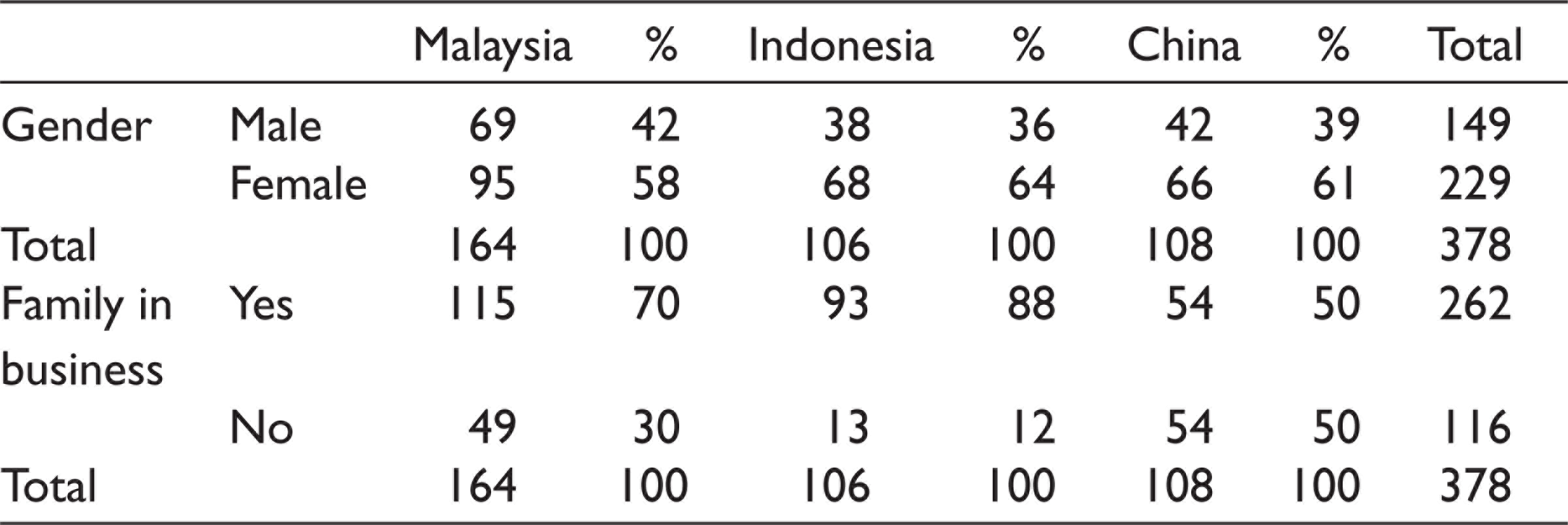
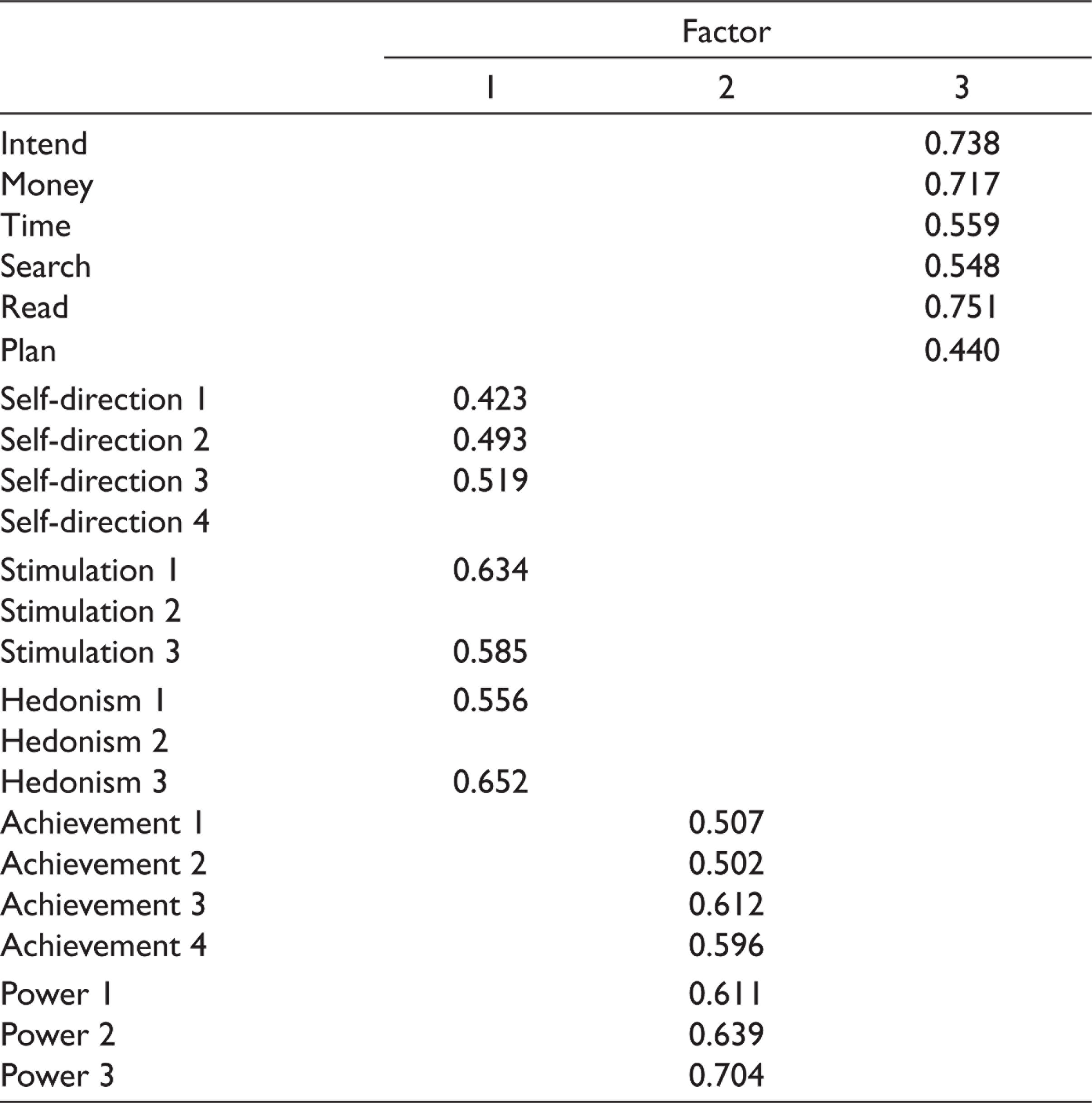
In factor analysis, the Kaiser–Meyer–Olkin (KMO) measure of sampling adequacy is above 0.5 and Bartlett’s test of sphericity is significant. Principal axis factoring (to identify the underlying dimensions) and varimax rotation method extracted three factors (Appendix). The first factor is intention; the second factor consists of self-direction, stimulation and hedonism, which corresponds to openness to change in Figure 1; the third factor consists of achievement and power, which corresponds to self-enhancement in Figure 1. The statistical remedy of Harman’s single factor test (Chang et al., 2010; Podsakoff, MacKenzie, Lee, & Podsakoff, 2003) indicates the absence of common method bias.

Because the items in the Portrait Values Questionnaire cover different conceptual components of each value, Schwartz (2013) contends that reliability of 0.4 or higher for value construct is reasonable. Additionally, the acceptable level of reliability should consider the context of measurement (Guide & Ketokivi, 2015; Nunnally & Bernstein, 1994). Thus, the construct reliability reported in Table 2 is acceptable. In Table 2, each construct’s square root of average variance extracted (AVE) is higher than its correlation with any other construct, suggesting discriminant validity for all constructs (Fornell & Larcker, 1981). The means, standard deviations and correlations for all constructs are tabulated in Table 2.
Construct Reliability, Means, Standard Deviations, Correlations and Square Roots of AVEs

** − significant at the 0.01 level (2-tailed); * − significant at the 0.05 level (2-tailed)
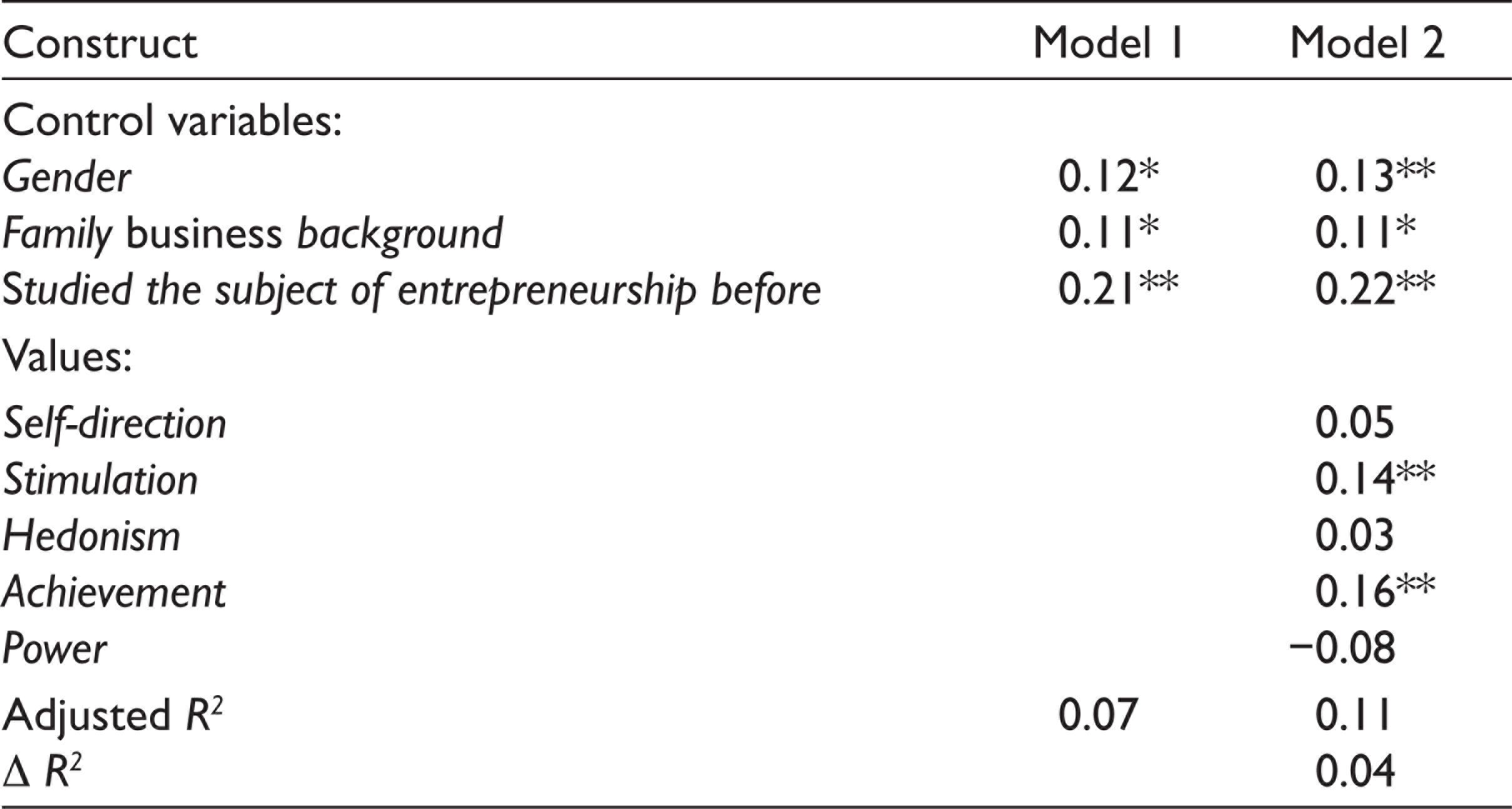
The results from multiple hierarchical regression (Table 3) show that demographic control variables (Model 1) and demographic control variables plus values (Model 2) accounted for 7 per cent and 11 per cent of the variance explained for entrepreneurial intention, respectively. Thus, the impact of alternative explanation of control variables on entrepreneurial intention is parsed out. Furthermore, the incremental prediction beyond all recognised controls is evidence that the focal independent variables (i.e., values) have utility (Carlson & Wu, 2012).
Multiple Hierarchical Regression
Main Analysis Using Aggregate Sample
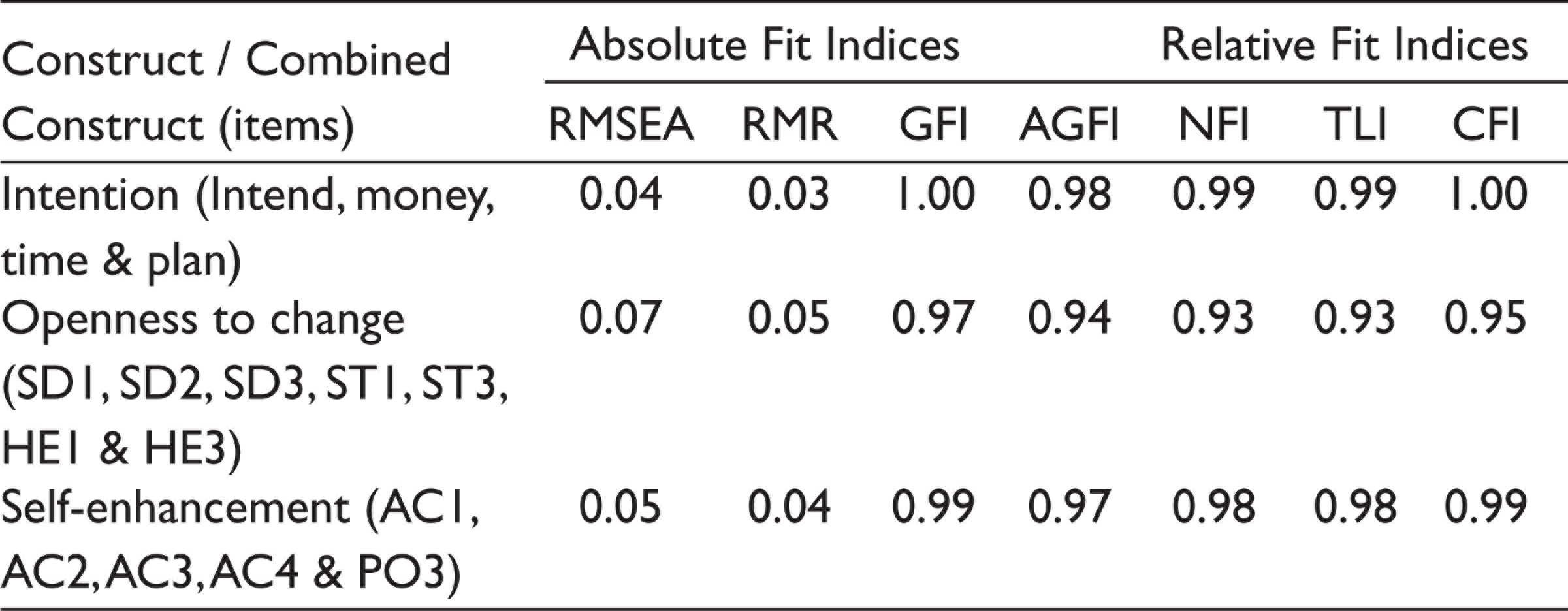
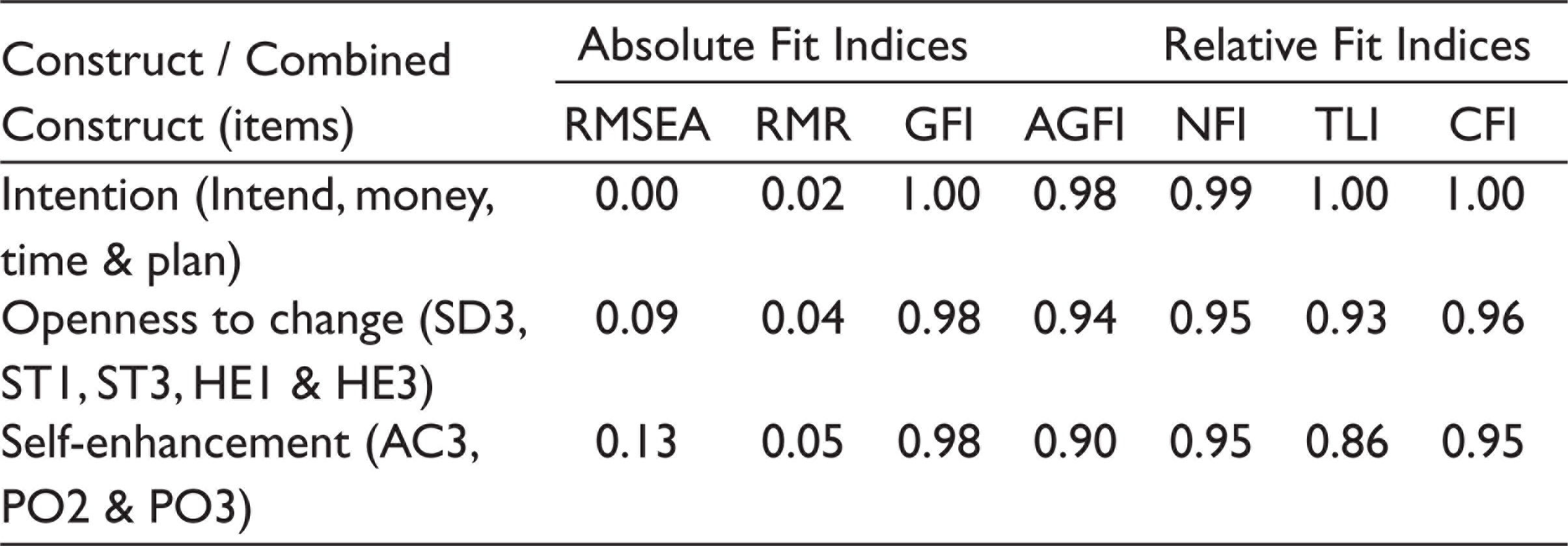
In empirical studies, values from adjacent locations may intermix instead of emerge in clearly distinctive locations, that is, the dimensions of value are not mutually independent (Schwartz, 1994). The practice of combining adjacent values based on the values theory to improve model fit (Schwartz & Boehnke, 2004) is consistent with model re-specification practice supported by theory in SEM (Anderson & Gerbing, 1988; Hair, Anderson, Tatham, & Black, 1998; McDonald & Ho, 2002). Individually, the five dimensions of values do not possess a satisfactory model fit. Consequently, based on theory and EFA results, self-direction, stimulation and hedonism are combined to become the higher order dimension of openness to change (see Figure 1). Accordingly, the first three hypotheses are combined to become Hopenness to change. Achievement and power are combined to become the higher order dimension of self-enhancement (see Figure 1). Accordingly, the last two hypotheses are combined to become Hself-enhancement. A variety of indices are reported (Hair, Black, Babin, & Anderson, 2010) as different fit indices reflect different aspects of model fit. After model re-specifications, all absolute fit and relative fit indices are above the recommended cut-off criteria (Hair et al., 2010) (Table 4).
Summary of Goodness-of-fit Indices for Measurement Models
CFA was performed on the re-specified structural model. The goodness-of-fit indices indicated that the final structural model only retained self-enhancement to entrepreneurial intention (Table 5). The standardised regression weight from self-enhancement to entrepreneurial intention is 0.39 ( p < 0.01), meaning a squared multiple correlation for entrepreneurial intention of 0.15.
Summary of Goodness-of-fit Indices for Structural Model

Prior to conducting multi-group analysis (MGA), measurement invariance tests using nested multi-group confirmatory factor analysis (MG-CFA) were carried out. The results do not support metric invariance in the aggregate sample. However, this study found evidence for configural invariance and partial metric invariance for Malaysian and Indonesian sub-sample. Therefore, it is only legitimate to compare the structural relationship between constructs for Malaysian and Indonesian undergraduates (Hair et al., 2010; Steenkamp & Baumgartner, 1998). Consequently, separate analysis will be conducted for Malaysian and Indonesian undergraduates as one sub-group and China undergraduates as another sub-group.
Sub-Sample Analysis
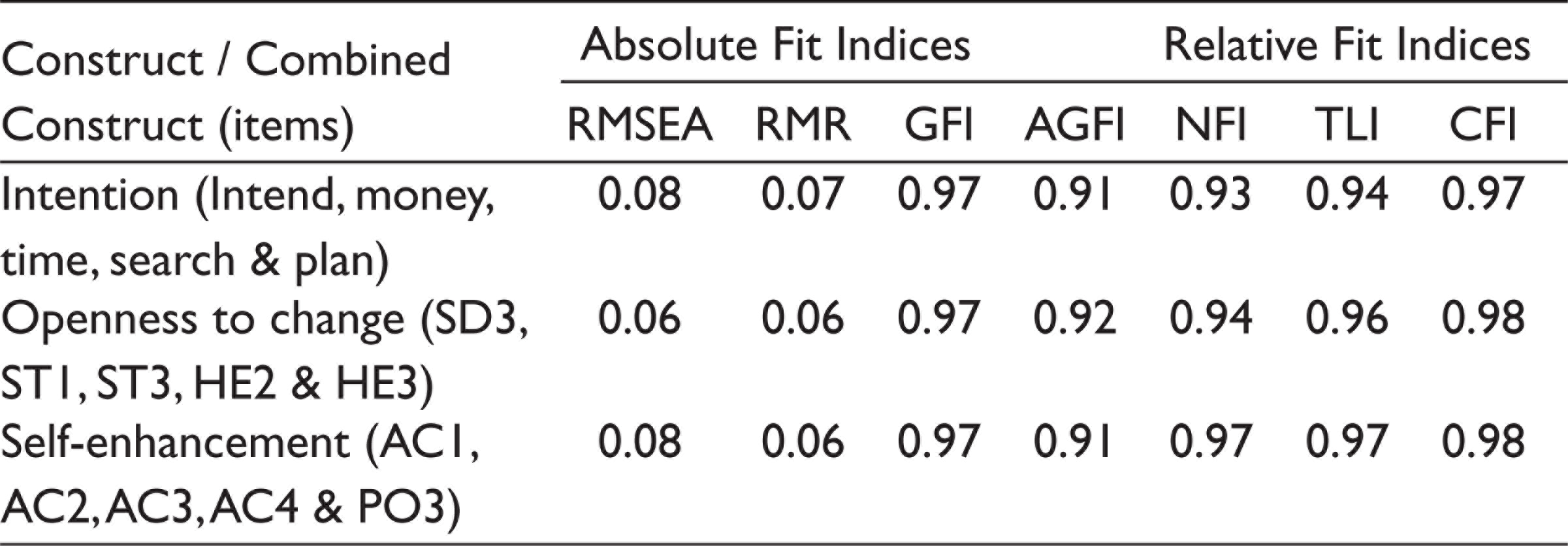
The fit indices for measurement models of China sub-sample are reported in Table 6. The final structural model consists of self-enhancement driving entrepreneurial intention (Table 7). The standardised regression weight is 0.38 ( p < 0.01) and the squared multiple correlation is 0.14.
Summary of Goodness-of-fit Indices for Measurement Models (China sub-sample)
Summary of Goodness-of-fit Indices for Structural Model (China sub-sample)
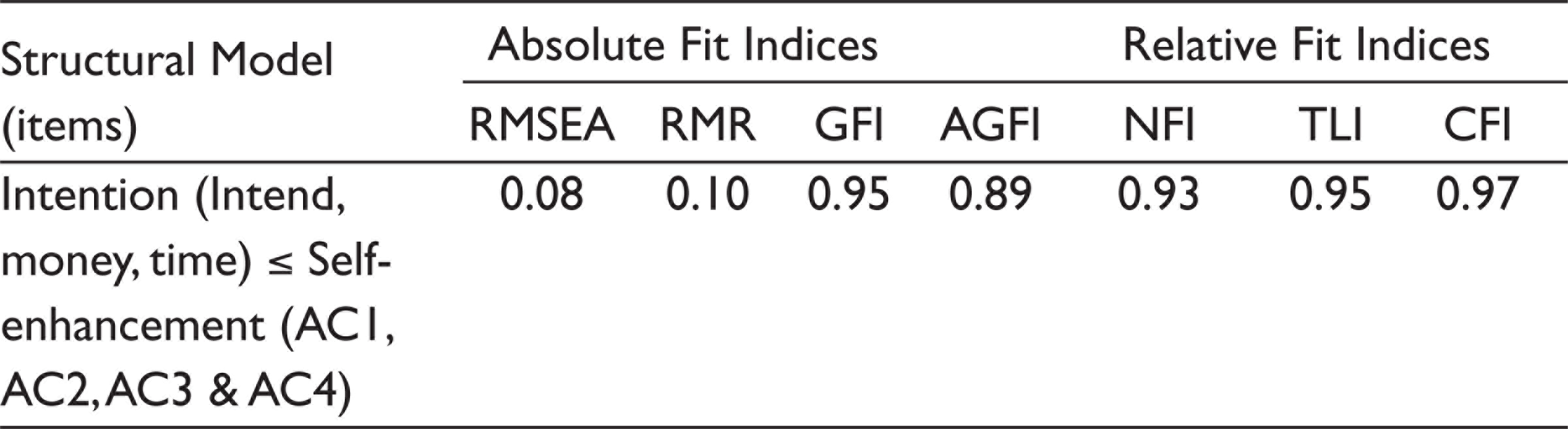
The fit indices for measurement models of combined Malaysian and Indonesian sub-sample are reported in Table 8. Because not all fit indices for self-enhancement are satisfactory, as such, self-enhancement will be excluded from the structural model analysis. The final structural model shows that openness to change drives entrepreneurial intention (Table 9). The standardised regression weight is 0.29 ( p < 0.01) and the squared multiple correlation is 0.08.
Summary of Goodness-of-fit Indices for Measurement Models (Malaysian and Indonesian sub-sample)
Summary of Goodness-of-fit Indices for Structural Model (Malaysian and Indonesian sub-sample)

Partial metric invariance allows comparison of the structural relationships between constructs for Malaysian and Indonesian undergraduates. Using MGA in AMOS, the model is acceptable at conventional significance level (Table 10). This implies that there is no significant difference in the structural relationship from openness to change to entrepreneurial intention across the two groups of undergraduates.
Multi-group Analysis

Discussion of Findings
New venture creation is likely to be a young man’s game (Levesque & Minniti, 2006); therefore, it is imperative to understand young latent entrepreneurs’ motivations for new venture creation. Comparative international entrepreneurship examines how and why business processes vary across different national contexts and its implications (Baker et al., 2005). This article sets out to examine contextual motivations of busi-ness undergraduates’ entrepreneurial intentions for new venture creation in three emerging Asian economies. The results suggest different motivational models to explain and predict entrepreneurial intentions across different national contexts. Openness to change values (i.e., self-direction, stimulation and hedonism) shapes Malaysian and Indonesian business undergraduates’ entrepreneurial intentions whereas achievement values shapes China business undergraduates’ entrepreneurial intentions, reflecting the prevalent cultural norms and values of ethnic Chinese in these three emerging Asian economies.
Alternatively, it could be argued that business undergraduates choose a career in entrepreneurship to maximise different types of utility. For Malaysian and Indonesian business undergraduates, entrepreneurship is to maximise utility of openness to change, such as independence of thought, action, feelings, readiness for change and choosing jobs with opportunities for initiative (Schwartz, 2015). For China business undergraduates, entrepreneurship is to maximise utility of achievement, such as choosing a high income job (Schwartz, 2015). The results for Malaysian and Indonesian business undergraduates seem to be consistent with a number of previous studies on the influence of self-direction on entrepreneurial intention (Looi, 2017, 2018), whereas the findings on China business undergraduates corroborate with Holt’s (1997) observation about the lack of emphasis on self-determination in the context of entrepreneurship in China. Thus, this article contends that Malaysian and Indonesian business undergraduates pursue entrepreneurial activities as an end in themselves, whereas China business undergraduates are externally motivated to obtain wealth and status (Carsrud & Brännback, 2011; Sarasvathy & Venkataraman, 2011).
‘The primary goal of a theory is to answer the questions of how, when and why’ (Bacharach, 1989, p. 498). Bacharach (1989, p. 501) proposes two criteria for the evaluation of theories: falsifiability and utility. Falsifiability refers to disproving theories. Utility refers to the ability of theory to both explain (‘establishes the substantive meaning of constructs, variables and their linkages’) and predict (‘tests that substantive meaning by comparing it to empirical evidence’). Based on the existing theoretical and empirical literature, this article generated five hypotheses (which were subsequently combined into two hypotheses with higher levels of abstraction) to be falsified. Subsequently, these linkages were tested against data. This article meets these two criteria of theoretical contribution and integrates process and context into its research design. It extends entrepreneurial intention research in emerging Asian economies by empirically attesting that although entrepreneurial intention is a function of values—validating Bird’s (2015) values-intention model—but different dimensions of values may be salient in different national contexts. Thus, the intellectual disagreements and mixed findings in extant literature regarding homogeneity or heterogeneity of entrepreneurial values can be reconciled via the lens of contextual motivations. Contrary to popular belief, wealth may motivate entrepreneurship in certain contexts only.
From a subsequent qualitative study conducted with some of the China business undergraduates, it appears that achievement values may be both individualistic and collectivistic in the context of China, which is in contrast to McClelland’s and Schwartz’s individualistic nature of achievement motivation. Consequently, entrepreneurship research in the context of China may need to consider that achievement motivation is not unidimensional as in the Western contexts. In view of the pervasive achievement motivation in the context of China, this study suggests the notion of ‘The achieving society of China’. Nevertheless, several China business undergraduates highlighted the graduate shift towards openness to change values. Thus, future similar studies on China may find openness to change values playing a bigger motivational role for new venture creation.
Understanding latent opportunity-driven entrepreneurship in certain segments of the population prior to the commencement of any observable action is of considerable relevance to policy (Kautonen et al., 2013). The findings from this study suggest that the design of public policy aimed at encouraging opportunity-driven entrepreneurship as an occupational choice for youth may target Malaysian and Indonesian business undergraduates with high levels of openness to change values and China business undergraduates with high levels of achievement values, resulting in greater efficiency and effectiveness. The valuable insights also enable various stakeholders to devise newer and improved measures and approaches to promote entrepreneurial career among business undergraduates in the countries under scrutiny, for example, entrepreneurship education and development programmes (Global Entrepreneurship Monitor Global Report 2017/18, 2018) can be designed to shape or increase contextually salient values for entrepreneurial intention among business undergraduates.
Limitations and Avenue for Future Research
There are several limitations inherent in the present study. First, in examining the contextual motivations for entrepreneurial intention, this study relied on samples drawn from three emerging Asian economies. Extensive research is still needed to better comprehend context-embedded motivation for entrepreneurial intention in other emerging economies. Second, the cross-sectional design of this study focussing on the psychological precursors to new venture creation limits its causality. Third, predicting who might be more likely to start a business is only a partial view of the process of entrepreneurship (Naffziger et al., 1994). A fruitful area for future research is to move beyond early stages of new venture development into examining subsequent new venture creation steps (i.e., opportunity search, discovery and exploitation activities). This study has obtained participants’ consent and email addresses for a follow-up study using the process, context and outcomes framework (Low & MacMillan, 1988) with intention as the independent variable (Bird, 2015) and new venture creation as the dependent variable (Aldrich & Martinez, 2001; Bae et al., 2014).
Conclusion
This study adopts a social psychology approach to explore an important aspect of entrepreneurship research—a career in entrepreneurship.uilding on the notion that context influences an entrepreneur’s behaviours, this study endeavours to empirically identify salient values driving business undergraduates’ entrepreneurial intentions across three emerging Asian economies. The empirical evidence suggests that different salient values motivate business undergraduates’ entrepreneurial intentions in different national contexts.
The findings here provide useful insights into similarities and differences in motivations for entrepreneurial intention in different national contexts, therefore, contributing to existing theory and evidence that argue for the importance of contextual motivations. Understanding values as contextual motivations for an entrepreneurial career contributes to our understanding the interaction between process and context to avoid the problem of overgeneralise results across heterogeneous settings within and across studies (Welter, 2011).
A precondition to training latent entrepreneurs is to understand their cultural values, historical experience and mind-set (Dana, 2015). Consequently, it is imperative to understand contextual motivations (psychological or economic) in different countries for various stakeholders to design research-informed opportunity-driven entrepreneurship policy, education and training programmes. By appealing to business undergraduates’ salient values, various stakeholders can develop business undergraduates’ entrepreneurial mind-sets and influence their career choice for an opportunity-driven entrepreneurship to create a better world (Wiklund et al., 2011) for themselves and society.
Footnotes
Declaration of Conflicting Interests
The author declared no potential conflicts of interest with respect to the research, authorship and/or publication of this article.
Funding
The author received no financial support for the research, authorship and/or publication of this article.
Rotated Factor Matrix
| Factor |
|||
| 1 | 2 | 3 | |
| Intend | 0.738 | ||
| Money | 0.717 | ||
| Time | 0.559 | ||
| Search | 0.548 | ||
| Read | 0.751 | ||
| Plan | 0.440 | ||
| Self-direction 1 | 0.423 | ||
| Self-direction 2 | 0.493 | ||
| Self-direction 3 | 0.519 | ||
| Self-direction 4 | |||
| Stimulation 1 | 0.634 | ||
| Stimulation 2 | |||
| Stimulation 3 | 0.585 | ||
| Hedonism 1 | 0.556 | ||
| Hedonism 2 | |||
| Hedonism 3 | 0.652 | ||
| Achievement 1 | 0.507 | ||
| Achievement 2 | 0.502 | ||
| Achievement 3 | 0.612 | ||
| Achievement 4 | 0.596 | ||
| Power 1 | 0.611 | ||
| Power 2 | 0.639 | ||
| Power 3 | 0.704 | ||