



Abstract
The objective of this article is to analyse the effect of entrepreneurial competence and planning guidance on the relations between university students’ entrepreneurial attitude and entrepreneurial intention. In this correlational study, the empirical model was tested through Structural Equation Modeling on a sample of 2,771 university students via an online survey at a federal higher education institution in northeastern Brazil. The results point to the moderation effect only of entrepreneurial competence on the relation between entrepreneurial attitude and intention, with this relationship being stronger in students who perceive themselves as more competent. We conclude that self-perception of entrepreneurial skills strengthens the effects of positive attitudes on entrepreneurial career intention, which adds to other evidence of the importance of context and entrepreneurial education for engaging in that career.
Keywords
The students’ entrepreneurial career intention (ECI) involves several individual and contextual predictors (Liñán & Fayolle, 2015). Psychological factors and personality traits, such as risk propensity and locus of control (internal or external), creativity, emotional intelligence, values, motivations, and, above all, attitudes stand as individual predictors of ECI (Baluku et al., 2018; Sancho et al., 2018; Sieger et al., 2014; Watchravesringkan et al., 2013). Entrepreneurial education (EE), a set of actions aimed at the development of entrepreneurial competencies (ECs), is one of the main contextual predictors of students’ ECI (Samo & Mahar, 2017), alongside family influence and network of friends. Those competencies mainly refer to a set of skills for identifying and exploring entrepreneurial opportunities (Albuquerque et al., 2016; Tittel & Terzidis, 2020).
Different Centres for Entrepreneurship seek to expose university students to an entrepreneurial culture, besides promoting the development of ECs, in order to sensitise them to an entrepreneurial career. Although varied activities related to entrepreneurship in those new initiatives absorb only one third of the time of teachers working in Brazilian centres, a much shorter time than that found in developed countries (Hashimoto, 2013). Other institutions also play an important role in the development of culture and ECs, such as Brazilian Micro and Small Business Support Service (SEBRAE) and National Association of Studies in Entrepreneurship and Small Business Management (ANEGEPE).
Despite all those initiatives by higher education institutions (HEIs) and organisations specific to the field of entrepreneurship, studies point to the incipience of entrepreneurship training in Brazil and the world, and the institutions that do so usually make use of training in business planning and teach entrepreneurship in an ultra-neoliberal perspective (Ferreira & Pinheiro, 2018; Zawadzki, 2020). A more holistic view on the training of entrepreneurs and, consequently, their contributions to the development of the country is needed (Albuquerque et al., 2016), to provide students with an opportunity to experience first hand the reality of organisational processes and problems in the creation of new businesses (Zawadzki, 2020).
While we face these institutional shortcomings, the field of knowledge in entrepreneurship is rapidly advancing. For example, the understanding that entrepreneurial attitudes (EA) have a direct effect on ECI is consensual and the existing models on entrepreneurial intention reaffirm this, with the predominance of predictor variables-attitude, perceived behavioural control and subjective norm (Paiva et al., 2020). However, the combination of individual and contextual factors seems to produce different effects from those arising from the effect of each isolated factor related to the ECI of university students (Paço et al., 2015; Samo & Mahar, 2017).
In this study, we chose to test the role of two moderating variables that seem to have important effects on ECI. One of them is the planning guidance (PG), which refers to a person’s tendency to think and base their current actions on reasons, objectives and consequences they intend to achieve in the future (Horváth & Nováky, 2016; Sekti et al., 2019). Thinking about the future has become a more widespread orientation and expectations about the future have improved considerably, although there is a tendency of not-so-optimistic scenarios (Kompas, 2018). The assumption is that students, who invest in prospecting their future tend to strengthen their positive attitudes towards entrepreneurship (Armstrong, 2014; Beal, 2011). Self-concept training, for example, is considered one of the effective ways to improve the future orientation of those students (Sekti et al., 2019), because knowledge about their future professional choices is believed to tend to minimise failures. Having PG requires, among other aspects, to think strategically about positive and negative aspects before making a decision and sacrificing the present to achieve what one wants in one’s future (Beal, 2011).
The other variable to be tested as a moderator of the relation between EA and ECI of students is entrepreneurial competence (EC), defined as the articulation among knowledge, skills and attitudes to create and develop business (Mitchelmore & Rowley, 2010; Tittel & Terzidis, 2020). EC starts to receive qualifications from organisations and groups, being more than the sum of individual skills (Takahashi, 2017; Vygotsky, 1979). The EC is constituted by a repertoire already acquired by individuals (experiences) and by a potential repertoire derived from the influence of the most immediate environment in which social interactions and group belongingness are included, mainly during university socialisation and throughout the creation and maintenance of new businesses (Behling & Lenzi, 2019; Paço et al., 2015). Specifically, regarding university education, the development of ECs through specific subjects of the curricula of each course and extracurricular activities related to entrepreneurship tend to make students perceive themselves as more capable and more confident when choosing to be entrepreneurs (Ahmed et al., 2018; Samo & Mahar, 2017). In addition, there is evidence that the development of EC strengthens the relationship between EE and the performance of companies such as spin-offs and start-ups (Rasmussen & Wright, 2015).
As already mentioned at the beginning of this introduction, attitude predicts the ECI of university students (Liñán & Fayolle, 2015; Ngan & Khoi, 2020; Sancho et al., 2018; Sieger et al., 2014), but little is known about the effect of variables, such as PG and perception of mastery of EC, that are considered important for business success in the literature (Botha & Robertson, 2014; Frese & Gielnik, 2014; Mokhtar, 2017; Tehseen & Ramayah, 2015). Therefore, the purpose of this study was to test the moderation effect of EC and PG on the relations between EA and ECI in a group of university students from an educational institution (EI) in northeastern Brazil, through Structural Equation Modeling (SEM).
The testing of the aforementioned relation in the present study seeks to go beyond the existing models, since it presupposes that, in the presence of those moderating variables, the intensity of the relation between EA and ECI undergoes changes. Additionally, the study aligns with the suggestion of Ali et al. (2018) for using SEM in the empirical testing of the relations among antecedent variables, moderating variables and criteria.
Literature Review
Entrepreneurial Attitude and Entrepreneurial Career Intention
EA refers to the positive or negative affective evaluation that individuals make of the entrepreneurial career that contributes to the attraction towards or distance from the target, that is, the creation of a business or the development of innovative ideas and projects (Ajzen, 1991; Ngan & Khoi, 2020; Sancho et al., 2018). ECI is a state of mind, in which one’s attention is directed to the creation of a business. Liñan and Fayolle (2015) stated that ECI is a person’s set of efforts to carry out entrepreneurial behaviour.
Attitude is a key element in the theory of planned behaviour—TPB (Ajzen, 1991), widely used in ECI studies (Paiva et al., 2020; Vamvaka et al., 2020). Alongside subjective norms (influence of classmates, family, university) and perception of behaviour control (self-efficacy), attitudes function as strong antecedents of behavioural intention. Attitudes favourable to entrepreneurship are related to positive expectations about business creation. Mahmood et al. (2020) identified personality traits that influence EA, such as innovation, internal locus of control, need for achievement and proactivity. Vamvaka et al. (2020) found that instrumental attitudes (e.g., being an entrepreneur implies more advantages than disadvantages) and affective ones (e.g., being an entrepreneur will bring satisfaction) lead to ECI. Ngan and Khoi (2020) showed that innovation and personal control impact EA. Mahfud et al. (2020) reported that psychological capital (i.e., self-efficacy, optimism, hope and resilience) mediates the relation between EA and ECI and that social capital (close trust relationships) did not have a direct effect on ECI. Furthermore, Baluku et al. (2018) pointed to a positive effect of internal locus of control on EA, and, consequently, on ECI, in contexts in which culture is more individualistic.
Furthermore, negative attitudes towards entrepreneurship are related to barriers on the individual level, perception of lack of skills and risk aversion and, on the contextual level, they are related to the absence of financial, material, technological and organisational support and limited social networks (Kebaili et al., 2015; Kazmi, 2020).
Entrepreneurial Competencies: Importance of Self-perception and Learning Environment
Designing a business and exploring it require conceptual and specific EC skills, such as identification and exploration of opportunities, creativity, problem solving, construction and maintenance of networks (Liñán, 2008; Tittel & Terzidis, 2020). People who recognise themselves as holders of those ECs feel more prepared to formulate and implement business development and growth strategies (Ahmed et al., 2018), and they also adapt to contextual changes in their entrepreneurial careers (Mcmullan & Kenworthy, 2014).
A review by Tittel and Terzidis (2020) shows that ECs are acquired in learning processes in specific contexts. Such learning involves acquisition/retention, generalisation, articulation and application of knowledge, skills and attitudes, and may occur through educational training courses (Samo & Mahar, 2017) or personal, social and professional experience (Albuquerque et al., 2016). To train an entrepreneur, it is not enough to focus only on learning in the cognitive domain, but also on the affective, behavioural and contextual domains, since some of those ECs are acquired only through critical reflection on the practical experience of success and failure and through emotional engagement in change and reorientation of behaviours (Parreira et al., 2015).
Emphasis on learning ECs in practice does not lead to an undermining of the importance of theory for the formation of those competencies. Theories are important pillars of the formation of entrepreneurs. Theoretical knowledge adds to the development of an entrepreneur’s cognitive skills for decision-making (Albuquerque et al., 2016). Albuquerque et al. (2016) reported that entrepreneurial pedagogy must go beyond economic functionality and include training and education for citizenship and for the exercise of substantial and responsible freedom.
Few scholars, such as Gielnik et al. (2015) and Tehseen and Ramayah (2015), reaffirm the importance of contexts in students’ learning processes of ECs, such as participation in courses, internship and laboratory experiences during the course of university training and relationships with customers and suppliers. The proximal context of those students, which includes social support to overcome challenges and uncertainties, influences the positive self-perception of EC (Newman et al., 2019). In the absence of such support, students tend to perceive themselves as less capable (Setiawan, 2014). When they see themselves as more competent, such students present more positive attitudes towards entrepreneurship and perceive themselves as better able to conduct future business, explore opportunities, lead and organise, in addition to interacting with others (Fernández-Pérez et al., 2017; Watchravesringkan et al., 2013).
Studies that test the effect of attitude on ECI, moderated by self-perception of EC and PG in university students are scarce (Liñán & Fayolle, 2015; Sekti et al., 2019; Tittel and Terzidis, 2020). However, other moderating effects of EC have been investigated. Watchravesringkan et al. (2013) concluded that knowledge and EC of university students strengthen the relationship between personal values and EA. Further, Liñán (2008) documented a positive effect of self-perception of EC of university students on attitudes, subjective norms and perception of behaviour control. Entrialgo and Iglesias (2016) observed a moderating effect of EE on the relationship between EA and subjective norms. Another study revealed that family background and gender strengthen the relationship between EE and entrepreneurial orientation (Marques et al., 2018). Tehseen and Ramayah (2015) identified the relationship with customers and suppliers as a reinforcer of the relation between EC and business performance.
The feeling of being able, tied to university actions that are aimed at EE enhances the perception of entrepreneurial performance (Samo & Mahar, 2017) and guides one’s career. Based on what was presented, the following hypothesis was formulated:
Planning Guidance
PG refers to a mental willingness to establish plans that enable the achievement of a future goal (Horváth & Nováky, 2016). It is a modus operandi that is based on expectations and plans for future realisation and the choice of behaviours congruent with such plans and expectations (Beal, 2011). People with high orientation to the future pursue their goals and engage in daily planning of their activities. Sekti et al (2019) concluded that students’ future orientation could be improved through self-concept training offered by schools and universities. They also showed that if the training occurs before the student enters the undergraduate course, course evasion and unemployment tend to be minimised, due to previous knowledge and awareness about professional choices.
Students who engage in daily planning endeavours tend to increase their perception of viability in business creation as a future career such as their propensity to act (Armstrong, 2014, Horváth & Nováky, 2016). They are more likely to engage in entrepreneurial behaviour when they have confidence in their skills to accomplish it, and planning plays an active role in that process. Empirical studies confirm the importance of planning in the process of formulating, creating and performing the business activity (Botha & Robertson, 2014; Frese & Gielnik, 2014). Unwanted situations, such as business mortality in a short period, can be anticipated and prevention measures activated (Sekti et al., 2019). Few studies also indicate that the importance of planning depends on the cultural context in which one resides. Planning can be more valued in cultures in which there is a concern to reduce the uncertainties of the future, while in others uncertainty is tolerated, opening up more possibilities for flexibility, experimentation and improvisation of solutions (Schmitt & Pierre-André, 2020).
Associated with the cultural context of socialisation, two perspectives guide planning (Sarasvathy, 2001). The first one is causation, best suited to predict the future of a business through systematic plans, in which students are guided by their goals. The second one is effectuation, in which the student’s focus is on the client/market and the partners involved in actions (e.g., suppliers and stakeholders). In this case, experimentation, flexibility and losses are acceptable rather than exclusively the expected returns. Three questions guide the effectual perspective: who am I? What do I know? How to do it? Who do I know? The effectuation logic reverses traditional principles, predictive rational logic and causal nexus, although it is market-driven flexibility. The entrepreneurial activity requires dealing with both previous PG (causation) and planning according to the presented circumstances (effectuation) (Barzotto & Nassif, 2019; Schmitt & Pierre-André, 2020).
The level of PG may be higher or lower depending upon the mastery of the business, the intended goals, the emergency and economic factors, and the cultural and individual aspects. Planning adjusts depending on the demands of the environment. In dynamic environments, for instance, there is a need for constant redefinition of actions and strategies that keep up with socioeconomic changes, which reaffirms the proposition that plans are not static (Sarasvathy, 2001).
Brazilian universities, which, in their curricula, contemplate entrepreneurship, usually offer business plan subjects (Hashimoto, 2013) to help students describe each stage of the enterprise succinctly and objectively. But besides learning how to make a business plan, entrepreneurship teaching can include the dynamic model of effectuation (Salusse & Andreassi, 2016), stimulating the diversification of ideas, reflection on the practice, flexibility and development of EC through real challenges. Moreover, it can use a less neoliberal perspective, emphasising that entrepreneurship goes beyond purely economic aspects and that it can bring social benefits (Zawadzki, 2020).
Ultimately, the importance of planning as a future orientation in the process of formulation, creation and performance of the business is quite clear. Students of higher PG have higher ECI (Armstrong, 2014; Beal, 2011). The second hypothesis was formulated as follows:
Method
Participants
The present study included 2,771 students from different courses in a public HEI in the Northeast region of Brazil. Of all the respondents, 18% studied Medicine and Health Sciences; 16% Engineering and Architectural Design; 10% Social Sciences; 6% Law; 5% Arts; 5% Business Administration and Management but 40% of respondents did not specify their cources. With a mean age of 25 (SD 6.11; 17−40), 31% of respondents qualified their academic performance well above average, 35% above average, and 27.4% below the average. Out of the total number of students, 73.2% were single, 24.2% married or living together, 2.5% divorced; 40.2% of them were male. Regarding the experiences related to entrepreneurship, 77% never had any contact with entrepreneurship subjects, 23% did at least one subject, 40% had at least one parent or some other family member performing entrepreneurial activities, while 32% stated that none of their parents had their own business. A significant percentage (47%) of respondents stated they work on average 31.98 hours per week (SD = 12.11).
Instrument
The goal of the entrepreneurship research project GUESSS (Global University Entrepreneurial Spirit Students’ Survey) is to monitor perceptual indicators of individual and contextual level variables of the university environment related to entrepreneurship among higher education students. GUESSS has reached more than 30 countries, including Brazil. Its research tool has 12 questions blocks: (a) personal data; (b) student profile (training area, course etc.); (c) career choice intentions (being your own employer, being employed, succeeding family businesses); (d) EA (attractive career, career satisfaction), (e) reasons for career choice (power and achievement); (f) EI (general learning environment and specific entrepreneurial learning); (g) entrepreneurial profile of the student; (h) family experiences; (i) characteristics of the socialisation process in the country; (j) business PG (motivations, goals, planning for the future etc.); (k) general information about the business (filter—when applicable); (l) information on family business (filter—where applicable); (m) specific issues of each country where the study is applied (e.g., parents’ education, family income and personal traits of the student).
For purposes of analysis, four variables were selected, namely EA, EC, PG and ECI, as shown in Table 1.
Variables Used in the Study
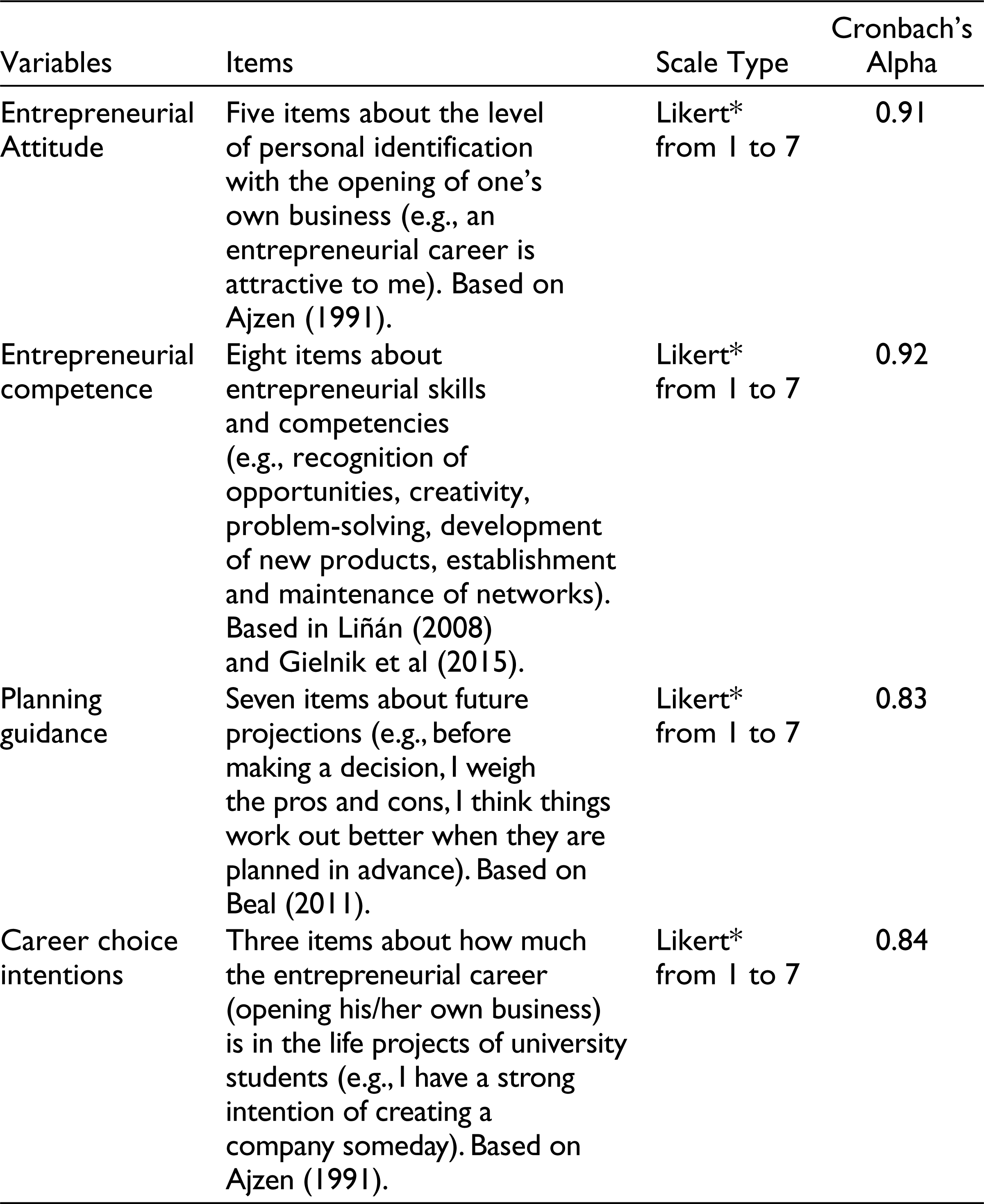
Since there is still no evidence on the validity of the items to measure those variables in the national context, the factorial validity of the selected items was performed to measure the four variables: ECI, EA, EC and PG. For this purpose, a model formed by the respective latent variables correlated with each other was specified, measured by each of their items. The adequacy of the proposed model was evaluated based on confirmatory factor analysis (CFA) results, using the maximum likelihood (ML) method for the estimation of parameters (Figure 1). The model presents good adjustment indexes, which represents evidence of factorial validity of the items: χ2(gl = 293; N = 2991) = 4988.24, p < 0.001; comparative fit index (CFI) = 0.92; Tucker–Lewis index (TLI) = 0.91; root mean square error of approximation (RMSEA) = 0.073 (RMSEA confidence interval: 0.071–0.075); Bayesian information criterion (BIC) = 230614.381.

AE, Entrepreneurial attitude; CE, entrepreneurial competence; ICE, entrepreneurial career intention; OP, planning guidance; Q1 to Q8, items.
Additionally, the composite reliability (CC) was determined for each factor whose results showed that the items used are highly reliable to measure the latent variables of the model: ECI (CC = 0.95); attitude (CC = 0.95); EC (CC = 0.92); PG (CC = 0.84). That set of results shows that the items used adequately measure the four factors and the hypothesised relations with high precision.
Data Collection Procedures
The questionnaire was sent by a link to 23,000 students enrolled in Northeastern Brazil HEI by the information technology sector of that institution, and the invitation link was shared twice again. Participation in the research was voluntary and the HEI only supported the initiative.
Data Analysis Procedures
Residues distribution’s normality assumption tests indicated no univariate and multivariate atypical values (Mahalanobis squared distance—D2, p <0.01). The asymmetry coefficients (Sk) and curtose (Ku) are within the expected limits for normal residues distribution (Maroco, 2014). Measures of central tendency (mean and SD) were extracted. The proposed moderation model was tested by SEM with latent variables (SEM; AMOS 19—Analysis of Moment Structures), following guidelines from Maroco (2014). The ML was the chosen estimation method. The adjustment indicators of the models were: RMSEA with better adjustments for values close to 0.06 and 0.08; parsimony comparative fit index (PCFI), reference value >0.80; and goodness-of-fit index (GFI), reference value >0.09.
For testing the proposed hypotheses and due to the high number of instrument items (23), it was necessary to use the procedure defined as parcelling in the specification of the indicators of latent variables. Measurement technique used in multivariate approaches, parcelling is characterised by aggregating manifest variables in parcels (Little et al., 2002). One of the advantages of parcelling is to consider the explained variance of all items, allowing us to control the measurement error of latent variables as if the items were isolated, but in a more parsimonious model. For each predictor variable, two parcels were constructed. Grouping was done by aggregating ≥2 items into each of the variables. The selection of items to form each parcel was made randomly.
Following equation specifies the moderation model proposed here:

where y denotes FCI, the dependent variable; b0, the intercept; b1, the weight of the independent variable EA; b2, the weight of the variable moderator EC; b3, the weight of the moderating variable PG; b4, interaction A × C; and b5, interaction A × P.
Results
Strength of the Link Among Entrepreneurial Career Intention, Entrepreneurial Competence and Planning Guidance
Table 2 shows the associations among the antecedent variables of the study (EA, EC and PG) with ECI.
Correlations Among the Variables of the Study
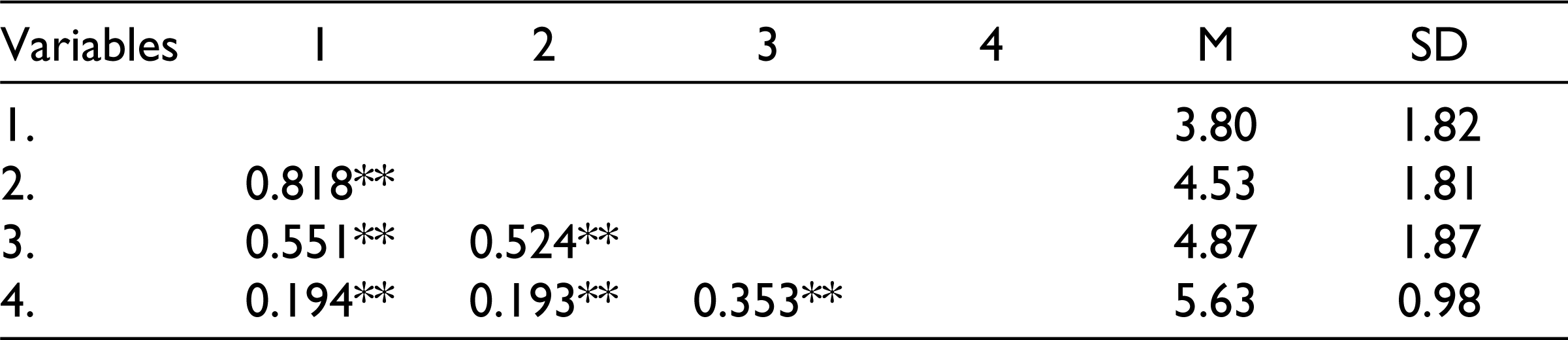
EA has a higher association (r = 0.818; p < 0.01) with ECI, followed by EC (r= 0.551; p < 0.01). PG also relates (r = 0.194; p <0.01) with ECI, but with much lower strength. There is no multi-linearity in the data.
Effects of PG and ECs on the Relation Between AE and ECI
Figure 2 illustrates the standardised estimates of the parameters of both the measurement model (weighting factor) and the structural moderation model. The model variables explain 70% of the variance of ECI (R2 = 0.70). The proposed model presents a good adjustment to the data: χ2(gl = 0.50; N = 2,771) = 550.827 p < 0.001; χ2/gl = 11.0; GFI = 0.971; CFI = 0.981; PCFI = 0.629 and RMSEA (90% CI) = 0.060 (0.056–0.065).

We also found that, when considered individually, only EC (β = 0.175, SE = 0.015, p < 0.001) and EA (β = 0.521, SE = 0.014, p < 0.001) have a direct effect on the surveyed university students’ ECI. PG was not shown to be a predictor of ECI (β = −0.047, SE = 0.018, p > 0.001).
Regarding the interaction or moderation effect, we observed interaction only between EC and EA (β = 0.043, SE = 0.06, p < 0.001), which did not occur between PG and EA (β = −0.004, p = 0.682).
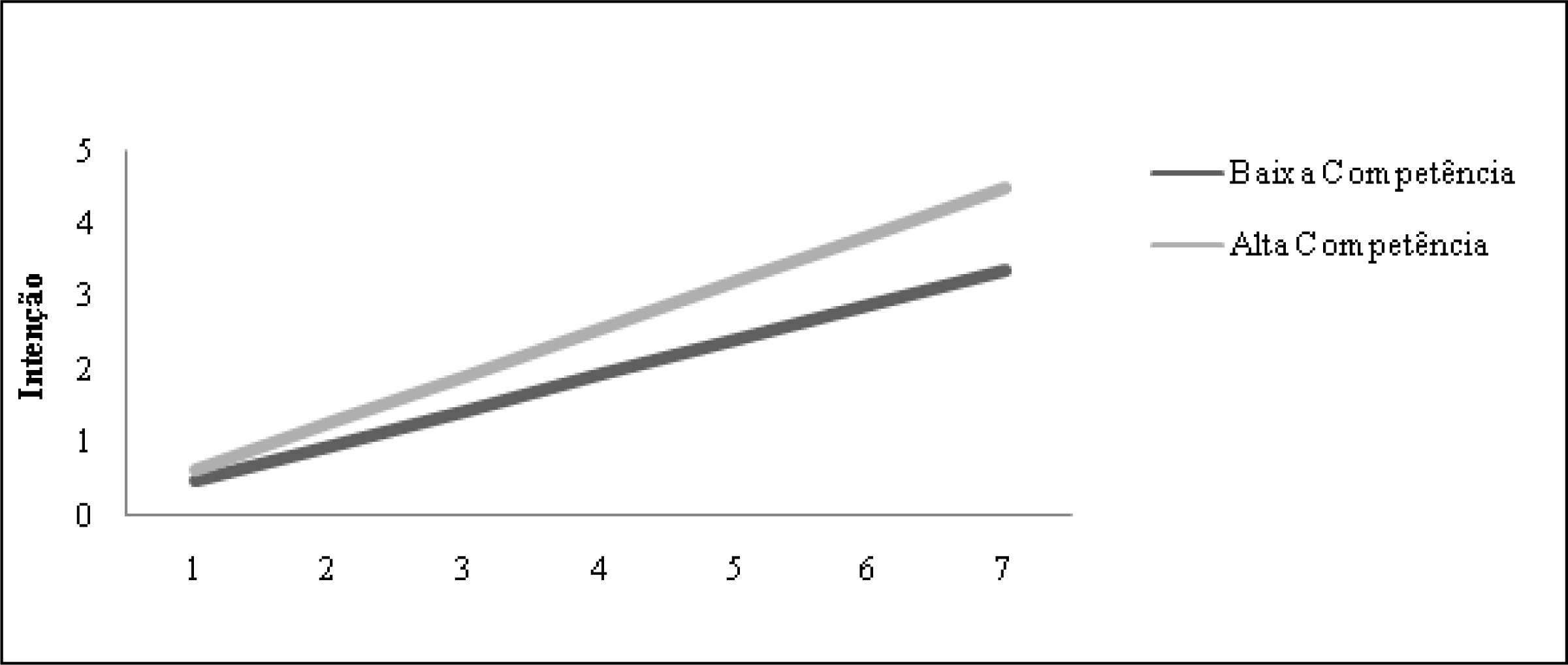
Since only EC moderated the relationship between EA and ECI, the effect of EA on ECI was tested in individuals with high competence (SD above average) and low competence (SD below average). It is observed that for both groups (high or low competence) the stronger the EA, the higher the ECI (Figure 3). This relation, however, is stronger in students who declare themselves more competent, corroborating hypothesis 1, according to which the relation between EA and ECI would be stronger among university students who perceive themselves as more competent.
Regarding hypothesis 2, which predicted that there was the moderation of PG so that among university students who declared themselves more organised the relation between EA and ECI would be stronger, the results indicate no significant interaction between EA and PG. There, this hypothesis is refuted.
Discussion of Results
The correlations and the model test reaffirmed the power of prediction of positive EAs and competencies over students’ career intentions, corroborating what has already been reported in previous studies (Ajzen, 1991; Liñán, 2008; Ngan and Khoi, 2020; Paço et al., 2015; Sancho et al., 2018). The desire of those young people for self-employment has increased worldwide, as pointed out by GUESSS (Sieger et al., 2014), and also due to social influences. Positive attitudes can reinforce the insertion of students in an EE project, either via subjects, through which apprentices have the opportunity to learn theories, to deal with tools and to develop expertise through real cases, whether through internships and consulting (e.g., start-ups; Samo & Mahar, 2017). Negative attitudes, however, derive from barriers to business creation, such as excessive bureaucracy, high tax burden, competition and perception of lack of skills (Kebaili et al., 2015).
Returning to the role of education, it is highlighted that such a role not only develops and strengthens positive attitudes towards entrepreneurship but also passes on related theoretical and practical knowledge because as is well known starting a business requires more effort and dedication to overcome challenges than to be hired by an organisation that already maintains established structure and dynamics (Watchravesringkan et al, 2013). That does not mean disregarding, as pointed out by Parreira et al. (2015), that some skills are acquired in day-to-day experience, by the history of successes and failures of each one, observation of other entrepreneurs and through other sources of relationship, in addition to the formal education received.
The model test also revealed that students who perceive themselves as more competent display a higher attitudinal disposition to engage with entrepreneurship than those who perceive themselves as less competent. This is because students who believe more in their abilities have support in their proximal context and successful experiences (Armstrong, 2014, Horváth & Nováky, 2016; Tittel & Terzidis, 2020). Those who consider themselves less competent tend to avoid unexpected situations in business and engage in tasks that can put their skills to the test. They also tend to avoid situations of uncertainty, as well as stressful, conflictual and pressure situations (Setiawan, 2014). However, those aspects that weaken the entrepreneurial profile of the latter group of students can be minimised or overcome if institutions take into account psychological aspects in their teaching and student support strategies, in addition to technical knowledge. Some ways of doing that would be providing them with learning how to deal with stress, assigning them tasks with a progressive degree of difficulty and reducing the use of teaching strategies that promote social comparison; all of that can help them learn how to deal with difficult and unexpected changes and challenges that often happen in entrepreneurial life (Newman et al., 2019; Samo & Mahar, 2017; Setiawan, 2014; Sekti et al., 2019).
The competencies that the students of this study believe have been associated with cognitive (e.g., identifying new business opportunities and applying personal creativity) and behavioural aspects (e.g., setting up a network of professional relationships, being a leader and communicator), showing that those competencies can be learned (Samo & Mahar, 2017; Vygotsky, 1979). They are also influenced by affective, motivational and attitudinal factors (Tittel & Terzidis, 2020). Although the literature shows that students may have unrealistic self-perceptions about their own ECs (Setiawan, 2014) and that the real competency test is taken in action, it is recognised that believing in their abilities contributes to the understanding of entrepreneurial performance (Mokhtar, 2017).
Another aspect highlighted in the current study is that some students perceive themselves as competent even in the face of an incipient scenario of EE in the country. This reaffirms the importance of formulating and adopting more holistic entrepreneurship teaching strategies, supported by successful worldwide field researches, theories and learnings. Entrepreneurial teaching could also use education for citizenship and for the exercise of substantive and responsible freedom that would strengthen the profile of more socially engaged entrepreneurial actions (Albuquerque et al., 2019; Zawadzki, 2020).
In this study, PG, as it was measured (e.g., ‘I like to plan every step of the things I do’; ‘I think things work out better when they are planned in advance’) was not a predictor of students’ entrepreneurial intention as was the case with attitudes and competences and did not moderate the relationship between EA and ECI. Nevertheless, other empirical evidence (Armstrong, 2014; Botha & Robertson, 2014; Ferreira & Pinheiro, 2018) shows that planning mitigates risks. In the current Brazilian context, our results suggest that planned actions need to be continuously reviewed, avoiding not-so-productive investments in static future projections. This finding converges with the study by Horváth and Nováky (2016), whose results indicate that in dynamic and uncertain contexts, future planning requires flexibility and adaptability to change, using experimentation and quick solutions.
The results also highlight the planning based on effectual logic more than the one on causal logic, as described by Sarasvathy (2001), considering that the latter depends more on a stable environment in which one can analyse the information in detail and predict the future more safely. Effectual logic is based more on contingency and short-term factors and Brazil’s institutional instability increases the uncertainty surrounding new businesses and decreases the capacity to predict the future. The results also support the propositions of Schmitt and Pierre-André (2020) and Barzotto and Nassif (2019), in respect of the combination of prior planning with experimentation with better results in mitigating risks to the business, especially small businesses in which structural simplicity and lack of formal strategies predominate Sekti et al. (2019) for whom training aimed at developing future guidance can help young people make more assertive and planned professional choices.
EE projects based on skill development, future guidance and preparation of young people to deal with uncertainties contribute substantially to increasing the positive attitude towards entrepreneurship. However, it is appropriate to point out that any EE or simply the offer of a business plan subject does not fulfil such a complex role. There is a need for a new paradigm shift in EE in which teachers use experiential and dynamic approaches more widely and propose activities that challenge students with the use of simulations, laboratories, practices and tests (Salusse & Andreassi, 2016), besides providing a learning experience to tackle conflictual and stressful situations that are present in business management (Setiawan, 2014). A cooperative-based EE relating to the persons, their motivations, their entrepreneurial competencies and their environment (school, groups, work and community) was also proposed by Albuquerque et al. (2019) and Zawadzki (2020).
Conclusions and Future Directions
This study evaluated the effect of EC and PG on the relations between EA and ECI in a sample of university students from an EI in northeastern Brazil. The study shows that entrepreneurial skills strengthen the effects of positive attitudes on entrepreneurial intention, adding to the importance of context in the development of capacities that make the entrepreneurial career more attractive. PG seems to depend on more stable environments and may also lead to training that is aimed at developing future guidance.
EE plays an important role in the process of business creation and one of the current challenges is to empower teachers to act as trainers of EAs and competencies. Some students show interest in entrepreneurship, have creative potential and many ideas about what could or should be done, but they do not have the relevant knowledge and skillset necessary to make their business viable. Teachers can contribute to this process by helping them realise their potential and guiding them on how to put it into practice.
Finally, this study has a few limitations. One of them relates to the scope of the measures. The PG and EC constructs are measured only in some of their aspects. PG has used the concept of future career orientation and causal perspective in which the detailed formulation of plans is prioritised. Such measure of PG neglects, for example, aspects related to the effectual perspective, in which dynamic and redefined plans are taken into account based on the contexts. Entrepreneurial competencies are measured considering technical and innovation issues, neglecting other aspects such as leadership.
Despite the limitations, the results of the current study contribute to the formulation of educational policies that create a favourable climate for the development of ECs, supporting training programmes for future entrepreneurs and promoting reflection on current academic curricula, as well as on teachers’ skills and teaching pedagogies.
Overall, future studies can test the effectiveness of EE programmes by comparing the career intentions of undergraduate students before and after participation in such programmes, and also when such intentions are realised in an entrepreneurial career through the creation of new businesses.
Footnotes
Declaration of Conflicting Interests
The authors declared no potential conflicts of interest with respect to the research, authorship and/or publication of this article.
Funding
The authors received the following financial support for the research, authorship and/or publication of this article: This research was aided by a scholarship received by the author from the Coordination of Superior Level Staff Improvement (CAPES).