



Abstract
Social entrepreneurship as a prosocial phenomenon focuses on the upliftment of the vulnerable and marginalised through entrepreneurship. Social enterprises are mission-oriented often suffering from mission-related challenges that accompany duality in its form. This in turn raises concern over sustainability for social enterprises as they begin to focus more on the economic objectives rather than the social value they originally intended to create. The objective of the study is not only to carry out a systematic literature review of the mission of a social enterprise but to also come out with drivers of mission engagement that contribute to social enterprise sustainability. Drawing upon past literature covering vast databases like Scopus and Proquest, and our understanding from reputed ABDC listed journal articles, we propose a conceptual framework of mission engagement for social enterprise sustainability that offers a fresh perspective on mission duality. We make a three-fold contribution to social entrepreneurship literature with a categorisation of literature for better conceptual clarity on mission-related concepts in social entrepreneurship, four constituents of mission engagement in social enterprises and three drivers to creating a sustainable social enterprise through mission engagement. We propose the notion of ‘sustainable social enterprises’, which derives maximum benefit from cross-sectoral collaboration, active engagement in building strong social networks and building on social capital to bring about transformative societal change.
Social enterprises are regarded as sustainability-oriented enterprises with the social mission remaining central (Ketprapakorn & Kantabutra, 2019). One of the strands of literature in social entrepreneurship research examines how social entrepreneurs tackle the issue of mission duality, the tensions that arise from competing logics, conflicting objectives and divergent multi-stakeholder expectations (Manning & Haigh, 2018). Sengupta et al. (2020) describe social enterprises as ‘mission-driven’, however, the extent to which a social enterprise pursues its primary social mission is a matter of discretion (Dacin et al., 2011). Sometimes, when social enterprises try to fulfil their dual mission, they fail to overcome challenges in terms of strategy, people and capital (Huggett, 2010). First, a social enterprise has a strategic challenge in meeting double or triple bottom lines while remaining true to the primary social mission. Second, social enterprises face challenges in hiring people with the necessary skills, capabilities and approaches relevant to the exact work they do on the ground (Lewis et al., 2021). Third, social enterprises face challenges in acquiring capital, be it in the form of philanthropy, equity or debt (Huggett, 2010). These challenges give rise to organisational and managerial tension (Lewis et al., 2021), internal clashes and external pressure that can compromise the social mission (Raynor, 1998). Though there have been numerous studies carried out on the mission of a social enterprise from various perspectives, however, the knowledge remains scattered and fragmented. This motivated us to explore past literature with an intent to sort out the literature into more comprehensive constituents of missions and also address the two review questions: How do social enterprises ensure their sustainability? What drives their mission and how do they engage with their mission for the sustainability of the enterprise? As a first, we attempt to bring more clarity to mission-related concepts and how they at times lead, overlap and intersect each other. Such a review that brings out the constituents and drivers of mission engagement will help in developing a more lucid understanding of how social enterprises can work towards sustainability.
Review Methodology
Mission deviation or the challenges in engaging with the mission causes mission drift. Although a reasonable body of literature has addressed the different ways in which social enterprises address mission drift (Smith et al., 2013; Ramus & Vaccaro, 2014), it still seems that as a research community we do not yet fully understand when (and why) does mission drift begin to appear in social enterprises. What is commonly known is that a social enterprise achieves its economic mission of generating revenue for financial sustainability (Battilana et al., 2015) while it strives to fulfil its primary social mission. The social enterprise creates social value for the local community and the environment (Dacin et al., 2010). But even despite this clarity in purpose and mission, the paradoxical nature of the enterprise is such that it gives into its inherent vulnerability at some point, causing havoc to the mission of the enterprise. With a six-stage systematic review of the literature (Figure 1), we first try to understand the various forms of mission concepts that still have a lot of ambiguity around them and then draw learnings on how mission engagement contributes to the sustainability of social enterprises.

We searched the Scopus database for documents with ‘*MISSION’ and ‘*SOCIAL ENTERPRISE’ as keywords in title, abstract and keywords. The database was first accessed around the month of October 2020 and then we periodically kept revisiting it. This brought us a total of 763 articles. From these, we removed articles that made a passing mention of the mission of social enterprise and focused on other aspects of enquiry in social entrepreneurship research. This brought us to 671 articles. These articles were from all disciplines including etc. Further, we removed results from disciplines other than management and economic sciences, such as engineering, life sciences, nursing, energy, mathematics and pharmacy, which did not relate to mission as understood in the social enterprise context. This number was hence reduced to 207 articles (Figure 2).

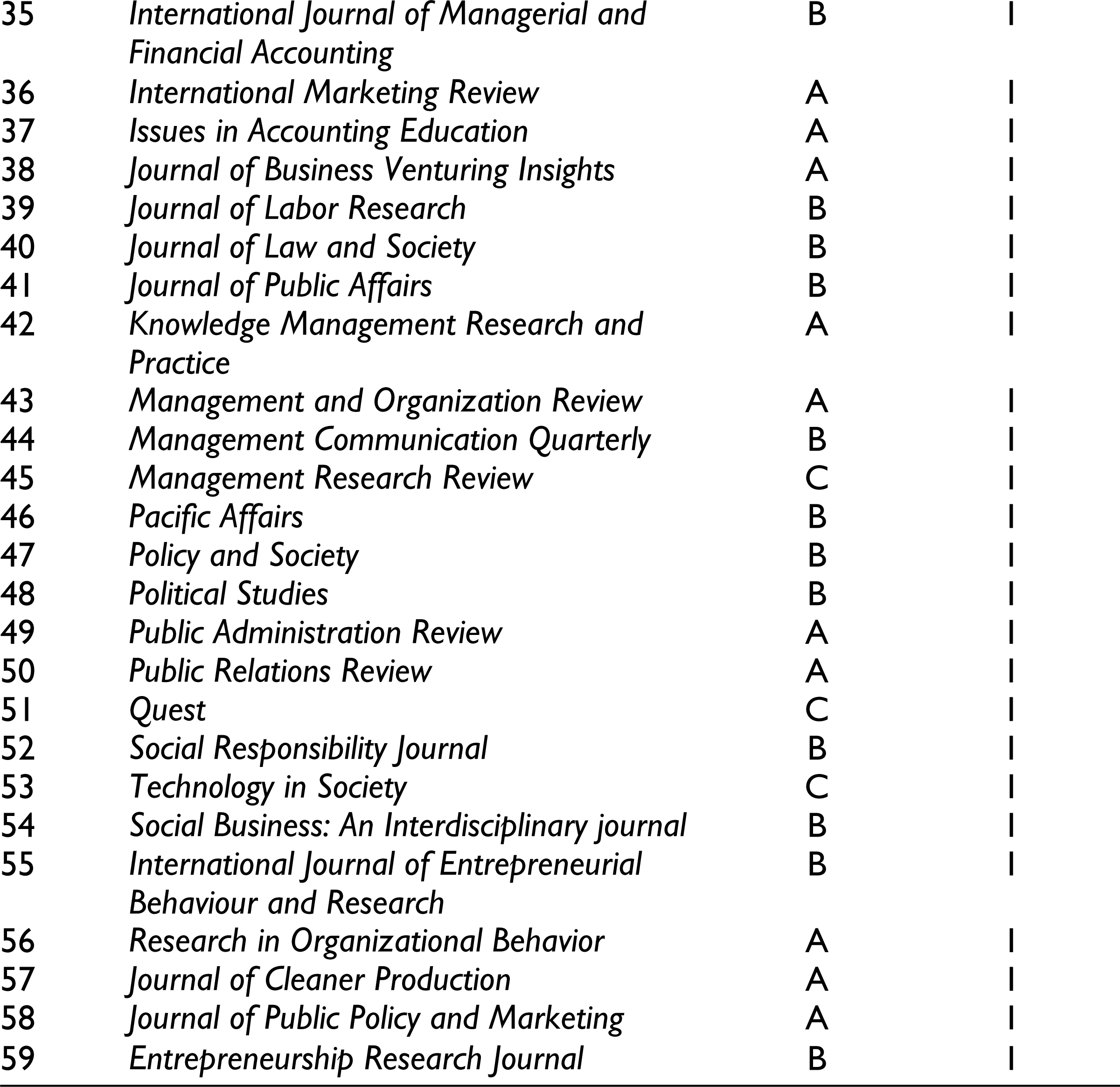
At this point, we decided inclusion of journal articles and book chapters only in English and excluded conference papers, proceedings and book reviews, which brought the list to 144 articles. On reading the abstracts, we found that some articles suffered from a lack of quality and rigor. As an indicator of quality, we selected articles only from ABDC ranked journals, which led to a shortlist of 96 articles (Table 1). At each stage, the articles were being reviewed and screened by three reviewers so that no important study was left out and every aspect, concept and perspective related to the mission of social enterprise was being covered. The selection process and the databases were tallied with each other to check and maintain the accuracy and rigor of the selection process of articles. The reviewers worked independently on the review process of articles. In order to remove bias from the study pertaining to the selection of studies, the reviewers did not interact with each other while undertaking the selection process. It was only when the process was complete, they tallied their findings.
Stage 6 of the Review Process: List of ABDC Journals Containing 96 Mission Related Articles

Though these 96 articles talked about mission in one way or the other, only a few of them informed researchers on how studying mission could contribute to deepening our knowledge on the sustainability of a social enterprise. Hence, a final stage of shortlisting and accumulating literature relevant to our research (review) question led to a set of 21 studies. A careful and deep reading of the selected literature led to important findings on the duality-centric mission-related concepts in social entrepreneurship and the drivers of mission engagement as a strategy for sustainability of a social enterprise. To articulate the findings, we make a three-fold contribution to social entrepreneurship literature. First, we make a conceptual categorisation of literature for better conceptual clarity on mission-related concepts in social entrepreneurship: (a) understanding duality of mission in social enterprises, (b) balancing duality of mission, (c) mishandling duality: mission drift and (d) keeping duality intact: avoiding mission drift. Second, we elaborate on the four constituents of mission engagement in social enterprises: (a) organisational identity, (b) multi-stakeholder engagement, (c) value creation and (d) resources. Finally, we identify three drivers to creating a sustainable social enterprise: (a) role of engagement, (b) cross-sectoral collaborations and (c) social capital and social networks.
Duality-Centric Mission in Social Entrepreneurship
Understanding Duality of Mission in Social Enterprises
Lumpkin et al. (2001) in their social entrepreneurship process framework established mission as one of the antecedents to social entrepreneurship process and the basis for any entrepreneurial action. Mission in the field of research comes as a ‘higher-order multidimensional construct’ that has many dimensions. While the economic mission refers to creating value for private gains (Austin et al., 2006), the social mission refers to creating value for the benefit of public. According to Stevens et al. (2015), the social and the economic missions are ‘higher order’ constructs and have their dimensions as ‘values’, ‘identity’ and ‘attention to goals’. While the social mission brings out normative organisational identity, the economic brings out the utilitarian identity. While the social value is at the core of a ‘socially’ mission-driven enterprise, for ‘economically’ inclined enterprises, it is the creation of economic value.
For social enterprises focusing on achieving both social and economic goals, ‘duality’ in mission engagement is the biggest challenge. Social missions are focused on the fulfilment of long-ignored problems of the society that need to be addressed, whereas economic mission stresses more on what the consumer wants. Brooks (2009) postulated five guiding thoughts for the alignment of the social mission of the enterprise in times when they have to make do for the economic mission: actions of the entrepreneur, uniqueness of offering, perceived meaning of value and the measurement of value vis-a-vis success. Researchers have been trying to explore how a social enterprise balances the two missions (duality) pursuing economic growth and social prosperity without sacrificing one at the cost of another (Doherty et al., 2014).
Balancing Duality of Mission
Social enterprises personify dual functioning with motivations and goals that are non-complimentary to each other (Battilana & Lee, 2014). Social Enterprises are a battleground for dilemmas and conflicting interests, and this often results in tension regarding prioritising objectives, purpose and strategies (Pache & Santos, 2013). Previous research work emphasises balancing both the social and economic missions (Certo & Miller, 2008) through bricolage (Di Domenico et al., 2010), organisational form and identity formation (Townsend & Hart, 2008). A social enterprise is able to balance its dual mission if it has command over its organisational design (Binder, 2007) so that the enterprise’s human resources management practices and its accounting tools foster social culture and promote multi-stakeholder engagement. For this purpose, Seibold et al. (2019) introduced the concept of mission spill over and its effects for managing dual mission, achieving organisational growth and creating social impact. Bojica et al. (2018) suggest that it is important to understand how social ventures select, connect and intermix their dual mission.
Research also shows that for some sustainability-oriented enterprises, the social and the market logics can actually converge into a unified approach in what social enterprises do on the field in local, remote and rural settings (Sengupta et al., 2020). Their social-market convergence has a three-stage process consisting of: (a) involved searching, (b) dialogic localising and (c) engaged implementing. They find out that social enterprises generate insights through involved interactions to identify problems in challenging contexts such as rural communities as markets themselves or communities producing goods for other markets. They engage dialogically with locals for shared insights and solutions to address local community and market problems. The implementation of solutions needs honest convincing, genuineness and mutual trust in engagement with local communities and markets. This brings in a new contribution to the problematisation in the literature on social enterprises drifting from the original objective and finding challenges in realignment (Mair et al., 2012).
Mishandling Duality: Mission Drift
In principle, the combination of socio-economic value creation leads to profits getting reinvested in the social mission. Actually speaking, combining both can sometimes become a constant point of tussle. When the social enterprises start favouring profit over social cause, there is mission drift (Ebrahim et al., 2014). Internal conflict and tension with stakeholders due to mission drift poses challenges for the legitimacy and survival of the enterprise. Though this drift makes the social enterprise more revenue-generating, it comes at a cost of the social mission due to increasing focus on the economic orientation. Mission drift and the resulting pitfalls are certain when an organisation moves away from its fundamental goals (Ebrahim et al., 2014). It can happen in the absence of proper integrative structures, poor coordination or scaling (Kickul et al., 2018). As the organisation sways from its originally intended social mission, the new structure is not yet fully in place and so this inappropriate integration and lack of coordination in the new form of organisation causes mission imbalance and drift. Similarly, while scaling also, the same phenomenon can be seen due to the organisational functioning still being in a luminal state of existence. Mission drift also occurs when highly resourceful enterprises become insensitive to external pressures and go adrift. Concurrently, there were also social enterprises that proactively work on preventing mission drift and find ways to integrate the social and economic aspects (Sengupta et al., 2020).
Keeping Duality Intact: Avoiding Mission Drift
Ometto et al. (2019) suggest that social enterprises need ‘spaces of negotiation,’ and ‘herding spaces’ to draw a connect between an enterprise and its larger institutional context. Spaces of negotiation are spaces that facilitate the formation of collective identities generating commitment to a social purpose (Polletta, 2002). Kellogg (2009) shows that in a similar entrepreneurial context, people can use ‘relational spaces’ which are more informal in nature and mobilise a critical mass for change within an organisation. By relational spaces, it means the value of informal relationships with people often comes to aid and helps in fulfilling the desired goal. Spaces of negotiation provide opportunities for understanding the multiple objectives of an organisation and a permissible balancing of dual goals for avoiding mission drift (Haug, 2013; Ometto et al. 2019). Other ways to avoid mission drift include ‘selective coupling’ (Pache & Santos, 2013), ‘compartmentalisation’ (Binder, 2007), ‘deliberation structures’ (Canales, 2014) and enhancing ‘collective identification’ through socialisation (Battilana & Dorado, 2010). Selective coupling shows how some organisations survive and thrive when faced with pluralistic institutional environments. Pache and Santos (2013) revealed in their study that instead of decoupling or compromising, some organisations selectively coupled some of the elements prescribed by each logic (social/economic). Compartmentalisation means when an organisation chooses to maintain all current identities and does not seek any synergy amongst them. Deliberation structures made of committees or quality circles and the like create a respectful space for disagreement that helps create positive tension to maintain a good balance between organisational standards and contextual needs. Organisations opt for collective identification to remain sustainable and thus form a new hybrid organisation that represents an organisational identity that balances the two competing logics. But it is important to mention that these logics keep changing with time. In some cases, structural separation (Binder, 2007) or compartmentalisation (Battilana et al., 2017) also help in avoiding mission drift.
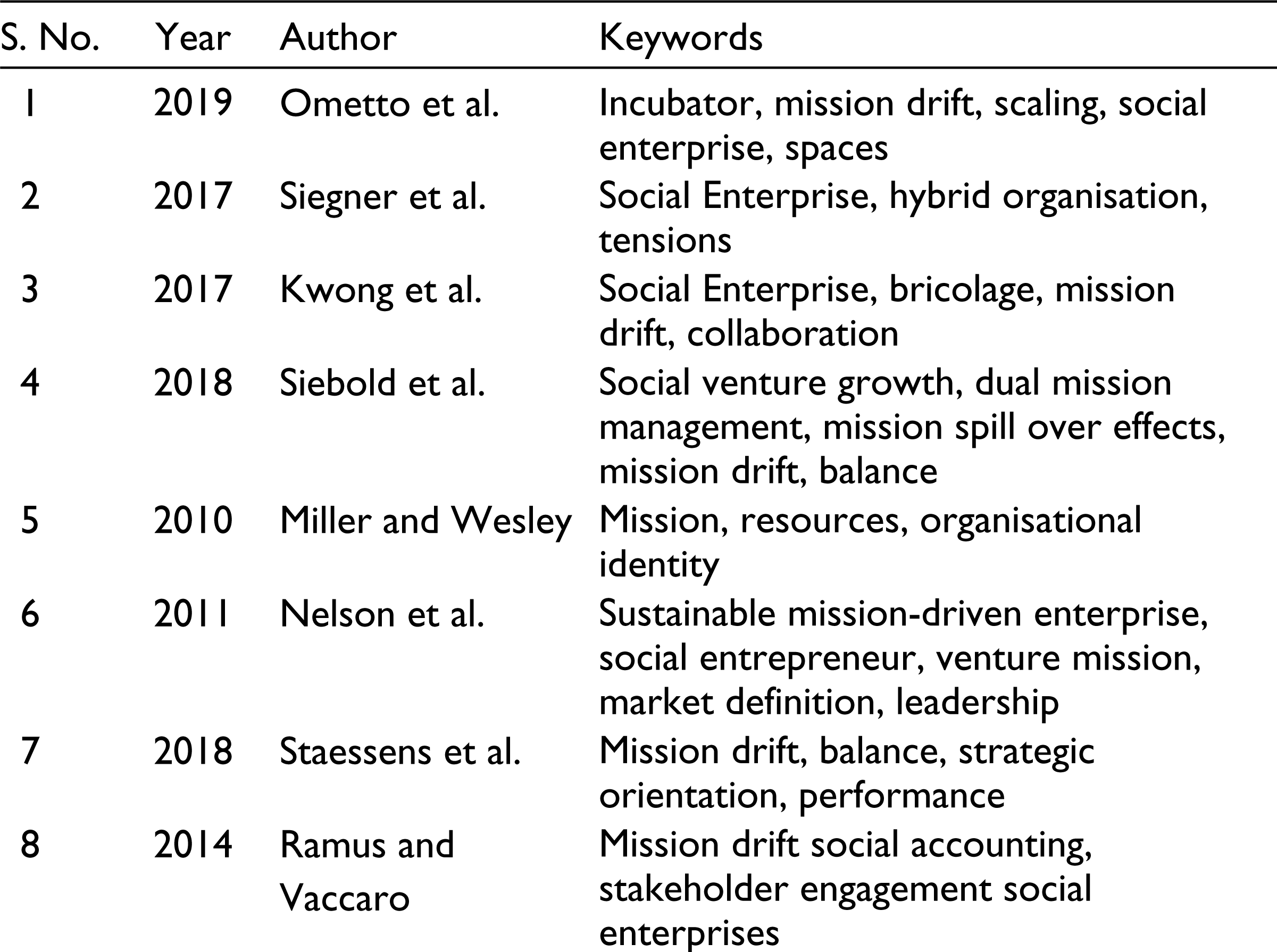
In the second part of the analysis of the literature, we identified four key drivers in the organising and managing of the mission-centric duality by social enterprises: (a) organisational identity), (b) stakeholder engagement), (c) value creation and (d) resources. In Table 2, we show the paper-wise key descriptive words that give an idea of the central theme of the 21 selected papers.
In-depth Study of 21 Articles and Its Key Descriptive Words

Constituents of Mission Engagement
Organisational Identity
Organisational identity renders a distinct image that characterises the organisation (Albert & Whetten, 1985). It is a collective representation of the members of the organisation and how they themselves view it (Gioia, 1998). Identity influences decision making (Dutton & Dukerich, 1991). It plays a key role in an organisation’s growth and success (Gioia et al., 2000). Our study also helped us in developing a better understanding of a social enterprise having multiple social and entrepreneurial identities (Austin et al., 2006) often in conflict (Hillman et al., 2008) with one another. Stevens et al., (2015) opine that social enterprises hold both utilitarian (economic) and normative (social) identities. They assume a utilitarian identity for cost reduction (Luke & Verreynne, 2006) and a normative identity in order to maximise revenues through different monetary activities that also serve a social purpose (Haugh, 2007). An organisation has a normative identity at the core of its mission when employees have a high commitment towards its enterprise (Albert & Whetten, 1985). Normative identities (Forman & Whetten, 2002) also include social relationships, community involvement and reputation. It is found that meeting the expectations and demands of one identity may have an adverse effect on the other identity (Glynn, 2000).
Multi-Stakeholder Engagement
Sakarya et al. (2012) observed that stakeholder engagement has come out as a strong force for achieving the dual mission. The stakeholders have various expectations from the social entrepreneurs with regard to the trade-off and balance between social and economic value creation (Kramer & Porter, 2011). Stakeholders provide the revenue and human resource necessary for the social enterprise to accomplish its mission. Littlewood and Holt (2018) state that the relationship of social enterprises with their stakeholders defines the focus of the enterprise mission. Some stakeholders become mission enablers or influencers and enhance the impact and achievement of social enterprise mission. In some cases, the influence may be negative, such as the emergence of new competition. Sengupta and Sahay (2017) posit that such dependency of a social enterprise on its stakeholders leads to including stakeholders in their mission statements (van Nimwegen et al., 2008).
Value Creation
Sengupta et al. (2020) find that a social enterprise creates social value while being market-oriented at the same time; finding out a way of doing things in ways that it hardly matters which part is ‘social’ and which part is ‘market’. Rather, it’s a process where social value creation and market orientation coexist and converge through involved searching, dialogic localising and engaged implementing. But more knowledge is needed on the convergence of these seemingly opposite logics in the social enterprise organisation. This reinforces the need for more research to understand that while a social mission is at the core of a social enterprise (Saebi et al., 2019), social entrepreneurship remains at large a cluster concept (Choi & Majumdar, 2014). Understanding value invites holism rather than particularisation, as value creation can simultaneously refer to content and process (Lepak et al., 2007).
Social value includes financial value, reputational and ethical value, among others (Auerswald, 2009). It is agreed upon that ‘value’ is subjective and ‘social value’ is complex (Young, 2006). Santos (2012) postulated a positive theory of social entrepreneurship, which offered a more holistic approach to value. He suggested that for social enterprises, there is always a choice and a dilemma of value creation versus value capture and that it is this distinction that sets them apart. Social value creation is a societal phenomenon, whereas value capture is more of an organisational economic activity. In early-stage social enterprises, value creation and value capture may be very close to each other in meaning and enactment. However, as enterprises scale up, there is an increasing tension in balancing social purposiveness and financial viability.
Social entrepreneurs are likely to sustain and grow in areas where there are strong positive externalities that create more opportunities for value creation. When successful, value capture comes along. Santos (2012) posits that ‘social entrepreneurs thrive where there is scope for strong positive externalities and severe market and government failures, where value capturing possibility is lower than value creation possibility because the benefits for society go much beyond the benefits accrued to the entrepreneurs’. Gupta et al. (2020) posit that hybridity of mission lends unique challenges in the attainment of values and goals of the social enterprise.
Resources
A social enterprise generates its own revenue and optimises its resources to maximise its potential. Since resources are scarce, the social entrepreneurs use their entrepreneurial abilities and innovative strategies to make skilful access and use of the same. Market orientation focuses on identifying opportunities and utilising all resources to create value-based products (Bjerke & Hultman, 2002). Considering the constraint of resources for a social enterprise, opportunity recognition, entrepreneurial orientation, entrepreneurial culture and building networks become even more significant (Domenico et al., 2010). As a response to scarce resources, there is an increased inclination for cross-sector partnerships (Moran et al., 2016). Social entrepreneurship is a process of an innovative combination of resources that catalyse social change and address social needs (Mair & Marti, 2006). Of all the theoretical approaches addressing the opportunity–resource nexus, bricolage is one of the most dominant forms of strategy used by social enterprises for resourcefulness, where they create something new by making do of available limited resources (Garud et al., 1998).
Discussion and Conceptualisation
The reason for mission drift is due to formalisation of procedures and practices (Donaldson, 2001) in a culture where such practices are not appreciated and rather alienates people who believe more in normative behaviour and practices (Ometto et al., 2019). Sustaining and scaling up of a social enterprise is part of enterprise success. However, sustainability of the social enterprise organisation is a neglected area of research and only a couple of attempts have been made to map a commercial sustainability model to a social enterprise, for example, a study by Ketprapakorn and Kantabutra (2019) in the Asian context. Lumpkin et al. (2011) state that the sustainability of entrepreneurial activities is a significant area of study for scholars as well as practitioners. The sustainability of a social enterprise is in terms of its activities from a resource perspective and applying the solution to bring about institution-level transformation. The resource perspective focuses more on long-term survival and is still being studied to determine how sustainability can be embedded into the operational processes of a social enterprise, creating social impact and generating revenue and establishing legitimacy as an enterprise. Such sustainable social enterprises fulfil the expectations of all stakeholders.
While some believe that the co-existing social and economic objectives are a constant source of tension for the social enterprise, others find it unique for a social enterprise to be able to converge these two objectives in ways that they work in tandem with each other. Some researchers do not focus on the conflict, challenges or tensions generated with two organisational goals, but on the capacity of those enterprises to balance and merge these supposedly opposite objectives. The tensions arise from the need to make attempts at maximising social impact and financial performance and there is a compulsion to prioritise one over another. This prioritisation has a bearing on its legitimacy also as an enterprise, so the decision-making becomes all the more critical.
This formed the basis for our conceptual framework that attempts to show different scenarios of duality in mission. Subsequently, we propose the drivers in social entrepreneurship literature for mission engagement as a strategy for social enterprise sustainability.
Scenario 1: Where the Social Mission is Greater than the Economic Mission
Scenario 1 (Figure 3) is mostly at the inception of the social enterprise, its venture creation stage. The nascent venture is more inclined to pursue the social mission for which it had been formed. The social objective outweighs the economic and there exists some amount of tension to keep it so. There is a strong push and pull arising out of organisational identity, multi-stakeholder engagement, value creation and resource acquisition.

Scenario 2: ‘Mission Drift’ where Economic Mission Becomes Bigger than the Social Mission
Scenario 2 (Figure 4) is the one where, as scaling begins to occur, the enterprise begins to lean more on multi-stakeholder engagement and as a result of the expectations arising out of various stakeholders, the nature of the push and pull becomes economic in nature as the stakeholders begin to impress upon revenue returns and profit. The tension causes an alteration in the identity of the enterprise. The social takes a backseat and the economic becomes the driving force.

Scenario 3: Achieving the Desired State—Becoming a Sustainable Social Enterprise
Scenario 3 (Figure 5) This is the stage where the social enterprise with an evolved understanding and having tested the waters and gained considerable experience realises that it is imperative to take along both sides of the mission in order to become sustainable. One cannot survive without the other. It is important to note here that the sustainable social enterprise acts like a clout over the social and economic objectives of a social enterprise and includes the characteristic feature of social networks and cross-sectoral collaborations. The proposed framework incorporates social networks, social capital and cross-sectoral collaborations into the socio-economic mission, for the sustainability of the social enterprise. Drawing upon past literature, we realise that some key drivers contributing to achieving this desired state are: (a) role of engagement, (b) cross-sectoral collaborations and (c) social capital and social networks.

Role of Engagement
When we looked for engagement in our extant literature review, we found insufficient research on mission engagement in social enterprises. In organisation studies, we find some studies on engagement in academics (Holland, 2005), or stakeholder engagement (Ruiz et al., 2021) as essential components of sustainability strategy. Borrowing the engagement concept from academic institutional literature, engagement is active involvement in sharing, co-learning and knowledge generation. Engagement offers collaborative relationships, and enhancing of identity and performance (Holland, 2005). Some common elements that came out of studies on engagement were interaction, exploration and relevancy (Parsons & Taylor, 2011).
This proposed framework of mission engagement for social enterprises implies that the social enterprise can be true to its mission when the push of the social mission via organisational identity, multi-stakeholder engagement and value creation is greater than the pull by the economic mission of resources. It also means that such forces have to be complemented with social networks, social capital and cross-sectoral collaborations to create a bigger social impact and sustain the enterprise. Social enterprises are hybrid organisations that have to maintain a fine balance between fulfilling their social and commercial objectives. They realise that in order to ensure the sustainability of dual mission, they have to incorporate approaches right from inception through sustainability-oriented engagement. Mission orientation is an important consideration since it impacts the kind of social activities it undertakes and allocates its resource for greater impact and performance (Scillitoe et al., 2018).
Cross-Sectoral Collaborations
Cross-sector collaboration is a response to scarce resources and resistance to conventional interventions (Barraket et al., 2016; Huybrechts & Nicholls 2013). It is a process where actors converge to share power and resources, leverage core capabilities and create structures to address social concerns and create and capture social value (Grudinschi et al., 2013). It helps in overcoming market failures and pursuing social opportunities (Bern & Branzei, 2010). It also facilitates in co-creation of shared social value that satisfies mutual interest, especially in cases where the problems are complex and require multi-sectoral and multi-organisational support. Porter and Kramer (2011) state that cross-sectoral partnerships in sync with core business and social issues can be particularly effective in creating shared value for the enterprise and its various stakeholders. Cross-sectoral partnerships in the case of social enterprises display resourceful behaviour (Shaw & de Bruin, 2013), a keen sense of opportunity recognition (Henry, 2015), affinity towards social exchange (Di Domenico et al., 2009) and a seeking for social alliances (Sakarya et al., 2012). That increases outreach to market and resources, as well as strengthens legitimacy (Henry, 2015). The ‘social value chain’ concept given by Barraket et al. (2016) explain the processes by which organisations seek to draw out social outcomes through a collaborative chain. It embeds and integrates value-creating collaborative activities and mechanisms into daily business processes, helping social enterprises scale up in their operations (Loosemore & Higgon, 2015). Collaborative and partnership form an enduring ethic of social entrepreneurship and social innovation (Bruin et al., 2014). Such collaborations help a social enterprise gain greater impact (Austin et al., 2006), more legitimacy (Huybrechts & Nicholls, 2013), better access to funds (Shaw & de Bruin, 2013) and creates a better mechanism for exchange of knowledge (Chalmers & Balan-Vnuk, 2013) including open sources and sharing pools of knowledge platforms (Ridley-Duff & Bull, 2015).
Social Capital and Social Networks
The social network builds social capital. As McCall and Livesey (2005) point out: ‘Social enterprise networks have to refrain from being too ideological diverse and still have shared values and a common vision to build social capital that sustains the network’. Social capital is about cooperation, trust and reciprocity that exists within and between communities. Social capital can be defined as exhibiting normative behaviour that encourages cooperation, trust and networks (Fukuyama, 1995). The type of interactions, relationships and behaviour that one has with others define its strength or weakness of social capital which in turn reflects how well the actions can be taken collectively.
Social entrepreneurship is a collaborative and collective activity, where multiple stakeholders take part (Ratten, 2014). These actors support social enterprises and provide access to resources, knowledge and information (Westerlund et al., 2017). A social network means strong and active relationships with other individuals that existed even before the creation of the enterprise (Lechner et al., 2006). Through these networks, entrepreneurship is either facilitated or hindered (Zimmer, 1986). Shaw (1999) proposed five characteristics of social networks: content, durability, intensity, frequency and direction. Trust plays an important role in building and maintaining a social network. To inspire confidence and trust in each other that ensures cooperation and support, it is imperative to think beyond the structural boundaries of network relationships so that together, one may accomplish the purpose and objective of establishing the network (Das & Teng, 1998). Trust is expecting a positive reaction from another party in an otherwise untrustworthy situation (Gambetta, 1988). It induces collective decision making, more information sharing and reduces self-centred behaviour (Das & Teng, 1998). Since no contract is sufficient in itself, trust compliments the contract by filling up the gaps and protecting the interest of partners (Larson, 1992). Trust is a ‘multidimensional’ concept that adopts social or economic dimensions by human emotions or rationality (Larson, 1992). While cognitive trust is more about having confidence in the competence and reliability of the other party (Mayer et al., 1995), affective trust is more about emotional attachment to the other party where both the parties genuinely care about each other’s welfare (McAllister, 1995). Trust acts as adhesive to network ties during any social or economic interaction or transaction.
The network ties can work differently in different enactment of relationships and structures. It means that the implications of these ties will be different in case the behavioural norms encourage supportive relationships and cooperative interactions stressing upon collective decision making, reciprocity and trust. The connotations of the same network ties will be altogether different if the structure promotes command and control (Sacchetti & Sugden, 2003). A social enterprise utilises different combinations at different stages to work through its entrepreneurial processes and create meaningful social value out of it. As the enterprise evolves, so do the networks and ties through which they engage with other sectors, which is often contingent in nature (Maurer & Ebers, 2006).
Though the review has been thorough and rigorous, and the reviewers have done the selection independently, however, as a limitation, it may have suffered from the subjectivity of the reviewer.
Linking SDG Goals with Sustainable Social Enterprises
Sustainable social entrepreneurs are expected to be self-sustaining change-makers who do not depend on external funds. However, although the purpose of this study was to understand the sustainability of the social enterprise organisation, another sustainability dimension is about the enterprise being sustainability-oriented. It means that the enterprise creates innovative solutions and brings changes for social and environmental sustainability. The social enterprises also ensure that the solutions are contextually effective. SDG goals echo their mission of not being profit-oriented but rather aiming to create social (and possibly environmental) impact. At a macro level of the functioning of these social enterprises, an endeavour should be made by these enterprises to align their activities around the 17 SDG Goals as laid down by the United Nations. Some social enterprises that stand as examples of entrepreneurship towards fulfilling SDG goals are:
SDG Goal 1 (no poverty): AfriKids is a child rights and community development organisation, operating in north Ghana. It works on eradicating child poverty. SDG Goal 4 (quality education): Story Pirates, USA. It gives after-school writing and drama programs to underserved schools. It also produces stage shows for the public. SDG Goal 3 (good health and wellbeing): SEKEM’s Pharma ATOS venture is a social enterprise that is contributing to the good health and wellbeing of people. GOAL 8 (decent work and economic growth): Goodwill Industries in the US is working on ‘job-preparedness’ and ‘work integration’ for people under challenging circumstances. GOAL 15 (life on land): Mumwa Crafts Association in Zambia, is working on sustainable use of natural resources.
Directions for Future Research
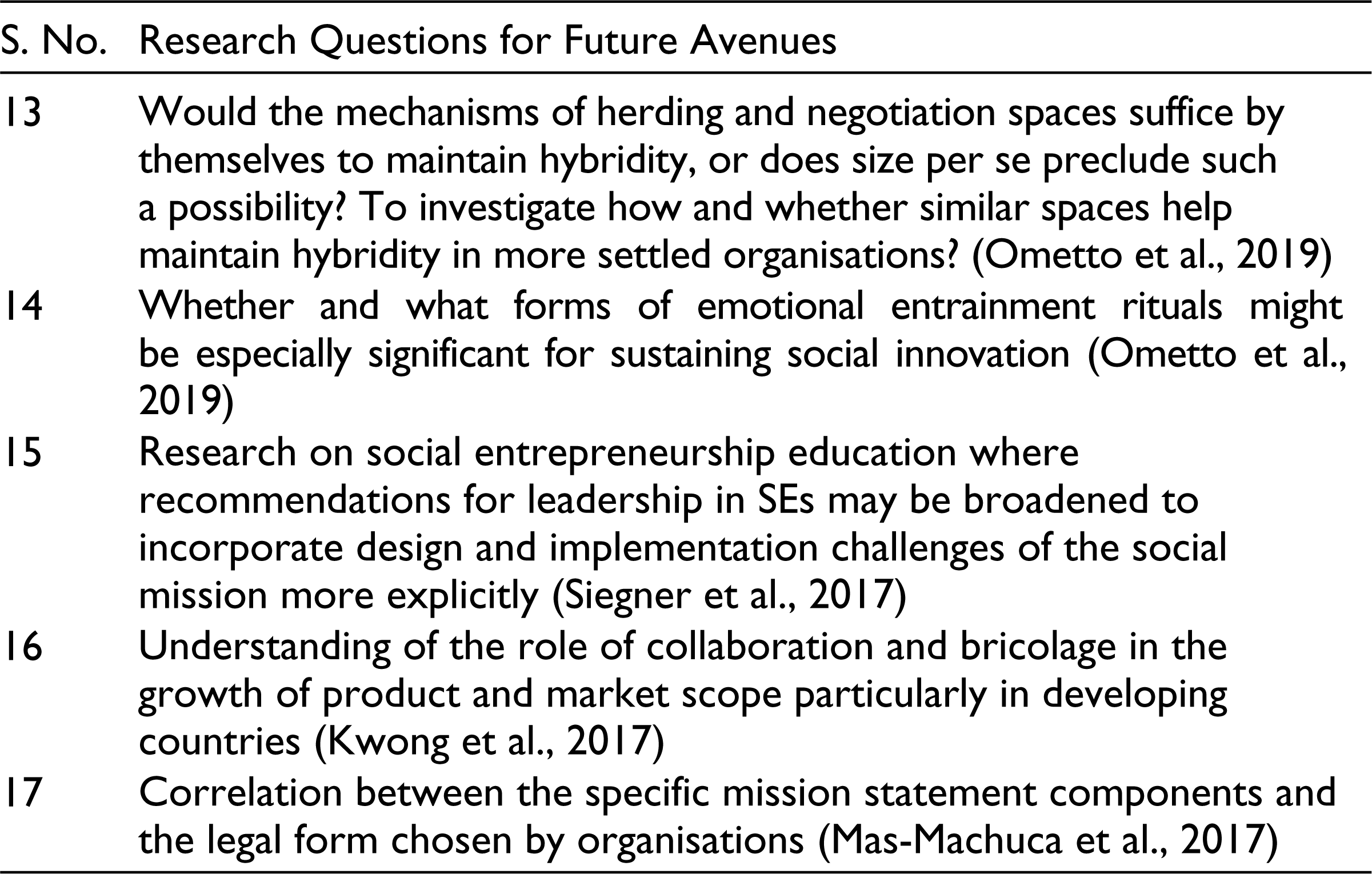
Our systematic literature review has led to the formation of some conceptual frameworks and theoretical categorisations. These can be further pursued empirically to compare the literature-derived knowledge with real-life experiences of social entrepreneurs and enterprises regarding mission-related challenges. Since the study could not find any study on the role of engagement of a social enterprise at the mission level, it could also be a possible area of study in the future. This study could help the practitioners in understanding the significance of the role of engagement in mission and social sustainability. It will also help them get a clear picture of what drives the mission of an enterprise and how they can work towards sustainability. At the policy level, the social enterprise can address these drivers and constituents in their vision and mission statement so that each employee is sensitised towards it and they all commonly aim to achieve it. Another area could be to explore the role of entrepreneurial skills and dynamic capabilities on mission engagement. For the limitation of the study, we could not include literature on the mission statement and explore the empirical findings of other studies. As a future area of research, understanding the significance of the mission statement in mission engagement for the sustainability of a social enterprise is certainly a necessary one. As such mission statement as a tool within the third sector remains underexplored (Lewis et al., 2021). The future avenues of research as listed by other authors are also summarised in Table 3.
Future Avenues for Research

Conclusions
Miller and Wesley (2010) opine that social entrepreneurship combines a traditional view of opportunity exploitation and social mission. But despite their best efforts to transform society, the social entrepreneurs face a constant struggle to fund their social ventures (Tracey & Jarvis, 2007). Thus, social entrepreneurs resort to means that cause them to deviate from their primary objective. And at times, they ‘mission drift’. Our contribution to the field of research is how social enterprises can achieve sustainability through mission engagement. We look at mission engagement as an effective design to balance, manage and sail through socio-economic mission tensions that occur at different stages of implementation and scaling. The study suggests that by employing different mission strategies along with offering structural support through social networks and emotional support through social capital, the social enterprise can strive to sustain itself. And, finally, the authors suggest that the more active the mission engagement, the more sustainable the social enterprise would be.
Footnotes
Declaration of Conflicting Interests
The authors declared no potential conflicts of interest with respect to the research, authorship and/or publication of this article.
Funding
The authors received no financial support for the research, authorship and/or publication of this article.