



Abstract
Entrepreneurial activity is generally considered to be an important tool for improving economic growth through innovation and employment. The objective of the study was to determine the relationship among economic growth (GDP), entrepreneurial intention (EI), total early-stage entrepreneurial activity (TEA), established business ownership (EBO) rate and high job creation expectation (HJCE) rate. The research design followed a quantitative approach to annual secondary data from 2014 to 2018 for the BRICS countries (Brazil, Russia, India, China and South Africa). The dynamic ordinary least squares model was used to test the relationship among variables. Results indicated that EI is a significant determinant for economic growth. The study added to the prior literature by confirming that EI drives economic growth which can be useful for the policymakers.
Entrepreneurship has always been a subject of discussion among scholars, policymakers and politicians around the world. The theoretical framework for the hypothesis that entrepreneurship enhanced economic growth was discussed at the beginning of the nineteenth century. It can be traced back to Schumpeter (1911) as referred by Dejardin (2000) and Galindo and Mendez-Picazo (2013). Based on the perception of Schumpeter, a large volume of empirical studies has established the relationship between economic growth and entrepreneurial activity (Hoselitz, 1952). Scholars used various methods and considered different variables and models to test Schumpeter’s perception of the positive relationship between entrepreneurship and economic growth. The existing literature reveals they have not given much attention to examining entrepreneurship factors for economic development at the beginning of the twentieth century. However, in the last decades, scholars gave importance to the relationship among entrepreneurship, economic growth and employment and reported diverse views. A brief review of these studies is presented here.
Entrepreneurship and Economic Growth
According to Wennekers and Thurik (1999), entrepreneurship had played a significant role in the European economy’s take-off stages and during Industry Revolution. At the same time, they reported that the economy declined as experienced in the late nineteenth and most of the twentieth century. It was also reported that due to uncertainty, Britain was not encouraging entrepreneurship. Baumol and Strom (2007) stated that entrepreneurs contribute immensely to economic growth, productivity and increased social welfare. Recent research studies indicate that some scholars examined the relationship with varied contexts and factors. For example, Valliere and Peterson (2009) and Sergi et al. (2019) examined the impact of entrepreneurship on the economic growth of developed and emerging economies. They found that integration processes in entrepreneurship contributed significantly to economic growth. Some scholars reviewed the literature on the said theme and stated their observation and research gaps. For example, Ahlstrom et al. (2019) presented an overview of the literature on the relationship between economic growth and entrepreneurship. They concluded that most research studies cited by the authors were from developing countries. They referred to the literature on various traditional growth factors and entrepreneurship. Stoica et al. (2020) analysed the extensive literature and reported that the relationship between entrepreneurship and the GDP per capita may be convex. It has been noticed that country-wise analysis of the relationship among income, employment and economic growth demonstrated an exciting picture.
Adusei (2016) reported that entrepreneurship positively explains the variation in growth, including in Africa. Michael et al. (2018) suggested that those regions demonstrating higher levels of entrepreneurship culture tend to have higher employment growth. Scholars used robustness checks for the confirmation of the findings. The population had also been an essential factor in increasing entrepreneurial activity, which positively affected growth in developing countries compared to developed countries. A minor increase in the entrepreneurship rate had a positive effect on growth (Prieger et al., 2016). However, few scholars focused on the emerging economy like China to examine entrepreneurship’s direct and indirect impact on economic growth. They had been the key driver of growth and economic development in China. Li et al. (2012) analysed China’s regional data and found that entrepreneurship contributed to economic growth positively. These entrepreneurs were the reason for the emergence of the private sector in China. In addition to country-specific studies, BRICS countries (Brazil, Russia, India, China and South Africa) also established a positive impact of entrepreneurship on economic growth. For instance, Coulibaly et al. (2017) reported that while using two econometric techniques, results reveal that globalization and entrepreneurship variables, including all other explanatory variables, are significant and positively affected economic development. The study suggests that they are sources of the rapid growth influencing the level of development in BRICS nations.
The relationship between entrepreneurship and employment is reported regionally and on time lag. Quite a few studies reported on economic and business indicators to measure the contribution of entrepreneurship to economic growth (Bosma et al., 2018; Chen, 2014; Meyer & Meyer, 2017; Stel et al., 2005; Wennekers & Thurik, 1999). Folester (2000) analysed the panel data of Swedish countries and suggested that self-employment may positively affect overall employment. It has been reported that new businesses create more jobs in the long term (Fritsch & Mueller, 2004). The nation-wise effect of entrepreneurship on employment in Romania, Hungary, Croatia and Latvia did not positively affect the labour market immediately but after a time lag of at least 3 years (Nitu & Feder, 2012). The effect of new business formation on employment varied in high and low productivity regions. For example, Fritsch and Mueller (2008) established its impact on employment change in German regions as negative in low productivity regions. The regional factors play a significant role in the overall employment effect. Another dimension of studies reveals that indirect supply-side effects of new firms are considered more vital than the direct effects on employment creation. The indirect effect may be because of competition, efficiency or innovation (Baptista et al., 2008). The relationship between entrepreneurship and unemployment was also reported to change in the results (Baptista & Thurik, 2007). The low level of graduate self-employment leads to graduate unemployment at 60% in Uganda (Ngoma & Dithan Ntale, 2016). New business formation in a specific sector indicates inconsistent results in different time lags. Arauzo Carod et al. (2008) demonstrated that the effects of new business formation from the perspective of manufacturing industries were positive in the short term, negative in the medium term and positive in the long term. Regional economic development changes in a share of productive high-growth entrepreneurship across different entrepreneurial ecosystems (Audretsch & Belitski, 2021). In a reverse relationship, entrepreneurial ecosystems also affected employment. For example, Content et al. (2020) applied a latent class model to examine the influence of entrepreneurial ecosystems on growth in European Union regions. They found that the results supported the perception. Scholars focused on student’s self-employment intentions (SEIs), entrepreneurship education (EE) and entrepreneurial self-efficacy (ESE) and reported a direct effect on employment (Abdullahi et al., 2017; Ebewo et al., 2017; Faloye & Olatunji, 2018). However, graduate’s intention to adopt self-employment was low in comparison to all graduates. The Uganda National Council for the higher education tracer study of 2018 shows only 18.2% of 2015 and 2016 who opted for self-employment (Babyetsiza, 2019).
Scholars considered various variables for investigating the impact of entrepreneurship on economic growth and employment. Urbano and Aparicio (2016) construct a panel of 43 countries from 2002 to 2012 and selected the total entrepreneurial activity (TEA) variable for establishing a positive effect on GDP. Scholars considered EI to an important variable in most studies. The latest literature on entrepreneurship has reported that values motivated EI, and entrepreneurship was contextual (Looi, 2020). However, higher entrepreneurial activity rates were having a positive correlation with economic growth and employment (Acs & Armington, 2004). It is an important driver of economic growth. For high growth, potential entrepreneurship significantly impacts economic growth (Wong et al., 2005). Analysis of the relationship between inequality and entrepreneurship indicates an interesting result at a different level of development. The inequality may be less harmful to entrepreneurial activities in less developed and developing economies than in advanced economies (Auguste, 2020). Scholars noted some problems in Schumpeter’s theoretical framework during the seventies. Leff (1979) re-visited the theoretical framework of entrepreneurship and economic development and reported that ‘public and private responses’ have become a crucial tool for the economic development in most of the LDCs that would increase the supply of entrepreneurs. Robbins et al. (2000) argued that institution influences entrepreneurship and cultural realities. In addition, the literature reported innovation as an important factor for economic growth. Innovation creation involves increasing diversity by initiating new knowledge in the economy (Rosenberg, 1992). Innovation creation, innovation diffusion and possible competition mechanism in entrepreneurship may lead to economic growth (Wennekers & Thurik, 1999). Few scholars defined the meaning of an entrepreneur as an innovator who has new skill sets which require to meet the new economic opportunities (Lazear, 2004). Galindo and Mendez-Picazo (2013) reported that entrepreneurship with innovation activity indirectly affected economic growth and achieved higher levels of employment and welfare. Innovative start-up activity contributes to economic growth significantly. A rise in this activity in West Germany was more effective than an increase in general entrepreneurship in accelerating economic growth (Mueller, 2007). After entrepreneurial activity and innovation, the authors considered an institutional factor for analysing the relationship among entrepreneurship, employment and economic growth. Aparicio et al. (2016) analysed Latin American countries’ data and considered an institutional factor as a major variable. They considered other sub-variables such as control of corruption and confidence in one’s skills for analysis purposes. They found that private coverage to obtain credit promotes a positive effect of opportunity entrepreneurship on economic growth. Policy on entrepreneurship has also been given importance, especially in the context of examining cross-country differences concerning their stages of development (Wennekers et al., 2005). The extent to which self-employment contributes to local economic growth is uncertain. For example, if entrepreneurs earn less than a salaried person, it means increased entrepreneurship may not be an efficient local economic strategy. Most entrepreneurs choose and stay in their respective businesses even though they have low earnings than in paid employment (Hamilton, 2000). Research studies further reported that it depends on various factors, that is, the individual and nature of the local economies and resource availability (Willis et al., 2019). Some scholars presented a reverse picture of this relationship, particularly in the context of emerging economies. For instance, Acs et al. (2004), Wennekers and Thurik (1999) and Mueller (2007) argued that entrepreneurship can contribute to economic growth significantly. There is little relevance to answering whether entrepreneurship has any significant impact on growth and development in emerging and developing countries (Naude, 2011). Acs (2010) reported that the impact of entrepreneurship might be negative and turns positive in the long run. Feki and Mnif (2016) analysed the impact of technological innovation on growth and reported similar results. Harbi et al. (2011) reported a unidirectional causality running from entrepreneurship to economic growth while analysing the data of 34 OECD countries from 1996 to 2007. The study suggests that an increase in self-employment promotes economic growth over the short term but reduces economic growth in the long term. Most literature reported the mixed results of economic growth on this aspect across the globe. Scholars excluded knowledge as a key variable that influences economic growth. But recent literature on the subject argued and suggested ‘additional mechanism such as entrepreneurial activities to be considered to transform the existing knowledge into economic knowledge’ (Nurmalia et al., 2020). Cross-national data on entrepreneurship and inequality show that entrepreneurship rates are significantly higher in less developed countries and emerging economies (where inequality is relatively high) than advanced economies (where inequality is relatively low). It can be partly attributed to the high unemployment rates in those countries that may be an alternative to unemployment (Auguste, 2020). Another dimension of research indicates that entrepreneur policy implemented by respective states has no conclusive effects on identified indicators of local economic and entrepreneurial activity (Figueroa-Armijos & Johnson, 2016). Doran et al. (2018) reported that the impact of different entrepreneurship variables on GDP was not uniform. It had a negative effect on growth in middle/low-income countries, whereas it positively affects GDP in high-income countries.
In addition to the aforementioned variables, scholars used different models and methodology to estimate the relationship between entrepreneurship (cross-country and panel data models) and GDP per capita growth (Bjornskov & Foss, 2016). Acs and Sanders (2013) developed an upstream model that considered consumers, producers, intermediate producers and new entrants. Acs and Szerb (2009) developed an integrated Global Entrepreneurship Index (GEI) and tested the model. The three SLS estimation model was also used to estimate a system of equations in which productive entrepreneurship is estimated (Urbano & Aparicio, 2016).
The previous literature analysis shows misperception of the relationship among entrepreneurship, economic growth and employment. Scholars used different variables, methodology and econometric models for analysis. To conclude, there is no consensus among them that entrepreneurial activity has a positive effect on economic performance and overall employment. Empirical evidence on the relationship between entrepreneurship and economic growth reveals inconsistent results. It may be due to the diverse nature of each country’s economy. Despite mixed results, scholars and policymakers have considered entrepreneurship a vital factor for economic growth, particularly in the present context because of the revolution of digital technology and social media. It has also been noticed that very few scholars attempted to analyse the relationship among entrepreneurship, economic growth and employment variables of BRICS countries, particularly at the time when most of the developed and developing economies across the globe became victims of COVID-19 crises. None of these studies examines the inverse relationship between GDP and employment, particularly from 2014 to 2018 for the future planning of BRICS countries once the COVID-19 crises are controlled. Urbano et al. (2019) analysed the 20 years (1992–2016) of research and suggested an integrated model, including institutions, entrepreneurship and economic growth that could be considered for advanced study. Towards this direction, an attempt has been made to analyse the relationship among entrepreneurship, employment and economic growth with more entrepreneurial activities with different models. Our analysis will attempt to empirically test these theoretical assumptions by using an unbalanced panel data set of the BRICS countries and recommend a future action plan. Based on the existing literature, we hypothesise the following relationship.
Objective of the Study
The objective of the study is to analyse the impact of entrepreneurial activity, that is, entrepreneurship intention (EI), established business ownership (EBO), total early-stage entrepreneurial activity (TEA) rate and high job creation expectation (HJCE) rate on economic growth of BRICS’s nation.
Methodology
A quantitative research methodology was used for the present study. The methodology consists of descriptive statistics and econometric panel data models. We used the Levin, Lin and Chu test and the PP-Fisher Chi-square test when we found that all variables are stationary at first difference. The panel unit root test was conducted to measure whether the variables are stationary or not and used the Levin, Lin and Chu test and the PP–Fisher chi-square test. When the variables are stationary at I(0), in that case, a normal panel vector auto regression analysis was conducted. If variables are stationary at I(1), then the Fisher Johnson panel co-integration test for a long-run relationship was conducted.
Data, Sample and Variables
For the current economic scenario of BRICS countries, data were compiled and analysed for 2019 from the World Bank and International Monetary Fund (IMF) databases. Most of the nations across the globe and also International Labour Organization and IMF defined economic growth as a prerequisite for increasing productive employment and chose this variable as an indicator for development. The World Bank also defined the annual percentage growth rate of GDP at market prices based on local currency. Aggregates are based on constant 2010 US$. GDP is the sum of gross value added by all resident producers in the economy plus any product taxes and minus subsidies not included in the value of products. It is calculated without making deduction for depreciation of fabricated assets or depletion and degradation of natural resources (
For entrepreneurship activities, data were compiled from Global Entrepreneurship Monitor (GEM) Reports of respective years. The time-series data of these countries from 2014 to 2018 were pooled in the panel, resulting in 175 observations. For a descriptive and present economic analysis of BRICS nations, data were compiled from OECD, World Bank, BRICS database and Joint Statistical Publication of BRICS nations. The study investigates the relationship between economic growth and employment, and economically active entrepreneurship variables. We have considered variables of the Global Entrepreneurship Monitor for our analysis. These are entrepreneurial intention (EI), total early entrepreneurial activity (TEA), EBO and HJCEs (Figure 1).

Total Early-stage Entrepreneurial Rate
TEA: Percentage of 18–64 years age group population who are either a nascent entrepreneur or owner-manager of a new business. Nascent entrepreneurs are those who have committed resources to start a business but have not yet paid salaries, or any payments, including to the founders(s) for 3 months or more. 1
Entrepreneurial Intention Rate
EI can be defined as most persons who are currently starting a business are also expecting to start their business within 3 years. It can be calculated as a percentage of the 18–64 population (individuals involved in any stage of entrepreneurial activity excluded) who are latent entrepreneurs and who intend to start a business within 3 years.
Established Business Ownership Rate
EBO can be defined as those who are running a business that has paid wages for 42 months or more are categorized as established business owners. The EBO rate can be calculated as a percentage of 18–64 population who are currently owner-manager of an established business, that is, owing and managing a running business with paid salaries, wages, or any other payments and being the owners for more than 42 months.
High Job Creation Expectation Rate
The HJCE rate can be calculated as a percentage of those involved in TEA who expect to create six or more jobs in 5 years.
Econometric Model
The model from the function is described in the following Equation

Where ɑn is constant, βn and λn are the coefficients, k is the number of lags, t is time series (2014–2018), j is for variables, and u1 and u2 are the stochastic error terms, which are also known as stocks in the model.
Profile of the BRICS Countries
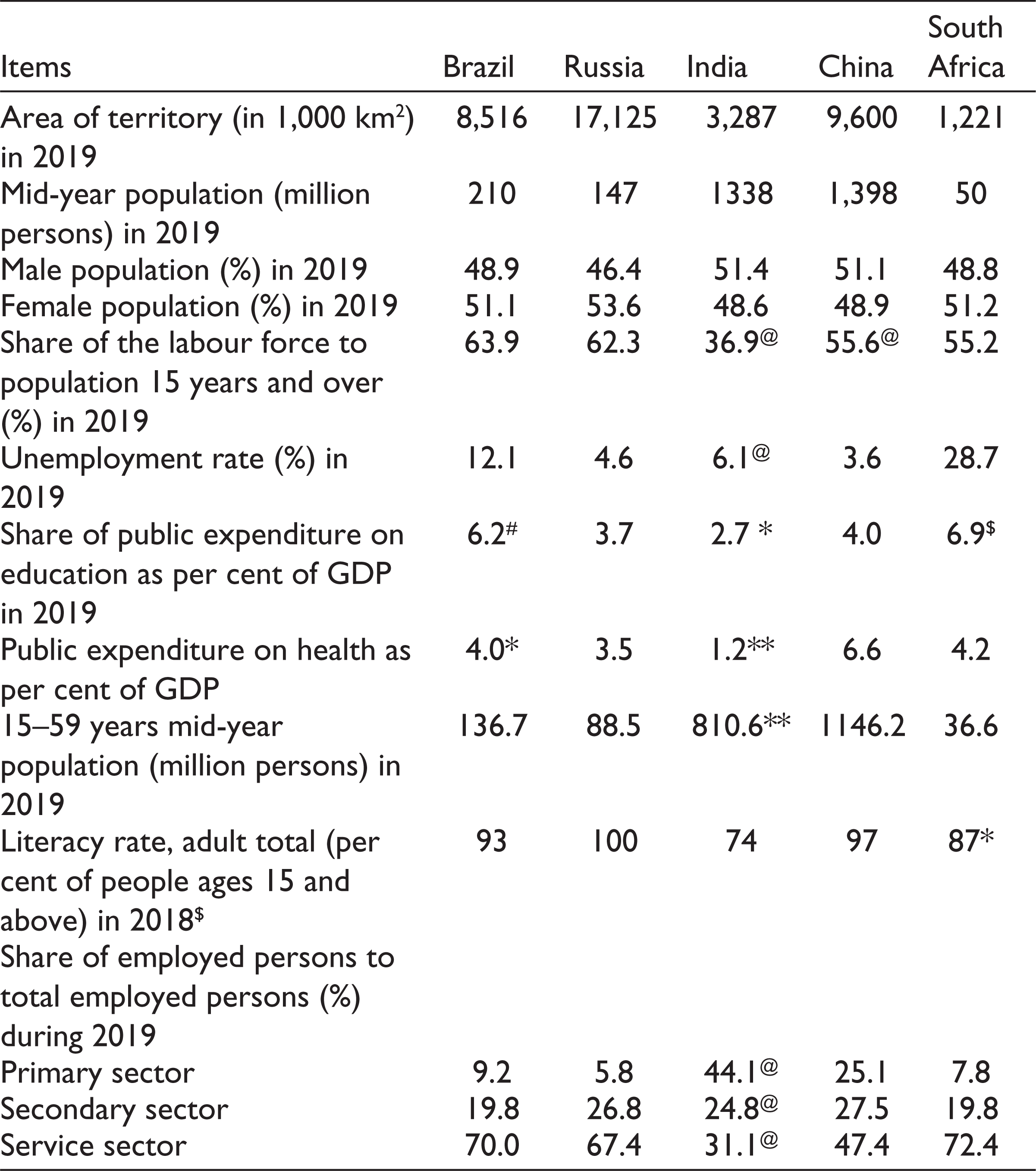
BRICS is the group constituted of five major emerging countries, that is, Brazil, Russia, India, China and South Africa. The nature of each country’s economy is unique as presented in Table 1. It represents about 41% of the population, 24% of GDP, 29.3% of the territory and 16% of the global trade. 2 BRICS countries have been the major contributors to global growth over the years. Finance and trade are key areas of cooperation among BRICS countries. An analysis of each country’s profile in the group during 2019 shows that South Africa has the lowest area of territory and population among all the BRICS countries. Eighty-seven per cent population of BRICS countries belongs to China and India. The share of the female population was higher in Brazil, Russia and South Africa than that of India and China. The share of India’s labour force to population 15 years and over was the lowest (36.9%) among all the BRICS countries. South Africa has the highest unemployment rate (28.7%) and the lowest in China (3.6%). India has the lowest share of public expenditure on education as a percentage of GDP (2.7%) and health (1.2%) and literacy rate (74%) among all BRICS countries. The largest share of employed person to total person of BRICS countries was higher in service sector except India in agriculture sector (Table 1). At the time of the BRICS summit on 14 November 2019, in Brasilia, each group’s economy experienced serious problems. India’s economy was a slowdown, Brazil and South Africa’s economies were growing by about 1%. Brazil had a high inflation and unemployment rate. China was suffering low economic growth.
Profile of BRICS Countries in 2019
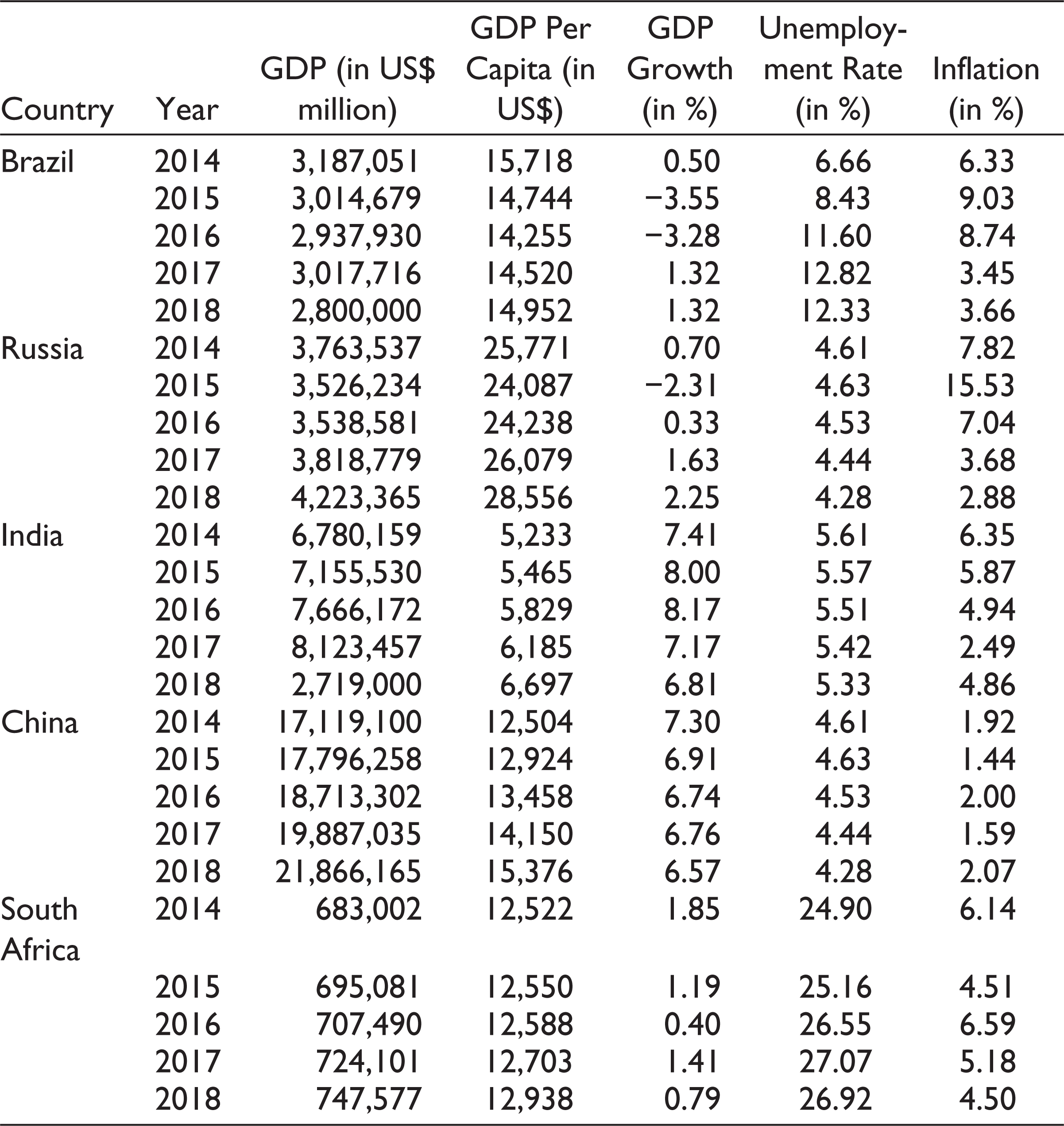
An analysis of the key indicators during the study period (2014–2018) shows that India and China’s GDP growth rates increased from 2014 to 2018 (Table 2). India’s growth rate was higher at 8.17% in 2016 among all the countries in the group followed by China at 7.30% in 2014. Brazil reported negative growth rates in 2015 and 2016 and Russia in 2015, indicating that these countries experienced an economic recession during the said duration. However, Russia’s economy recovered marginally with a higher growth rate in 2018. South Africa’s GDP growth rate remains fluctuating from 1.85% in 2014 to less than 1% in 2016 and 2018. Brazil and South Africa reported higher unemployment rates than other countries of BRICS. The inflation rates of all the countries were fluctuating during the period under study. However, Russia reported a higher inflation rate, that is, 15.53% in 2015 and China’s lowest rate 1.44% during the same year, indicating price instability in these countries.
Comparison of Economic Indicators of BRICS Countries from 2014 to 2018
Data Analysis and Discussion
Table 3 shows that the growth rate of Brazil and Russia has increased from 2014 to 2018 compared to India, China and South Africa during the same period. In general, the economies of the BRICS countries were not showing any significant growth reflected in the declining employment rate of most countries. Brazil, India and China have the highest intention rate (EI) towards entrepreneurship. Regarding the TEA rate, Brazil has the highest level of TEA rate at 17.88% in 2018. It is interesting to note here that the TEA and EBO rates have increased in all the BRICS countries over a period except China. Brazil has the highest EBO rate (20.25%), and South Africa had the lowest in 2018. In terms of perception towards the HJCE rate, South Africa has the highest rate (33.0%) of the rest of the BRICS countries.
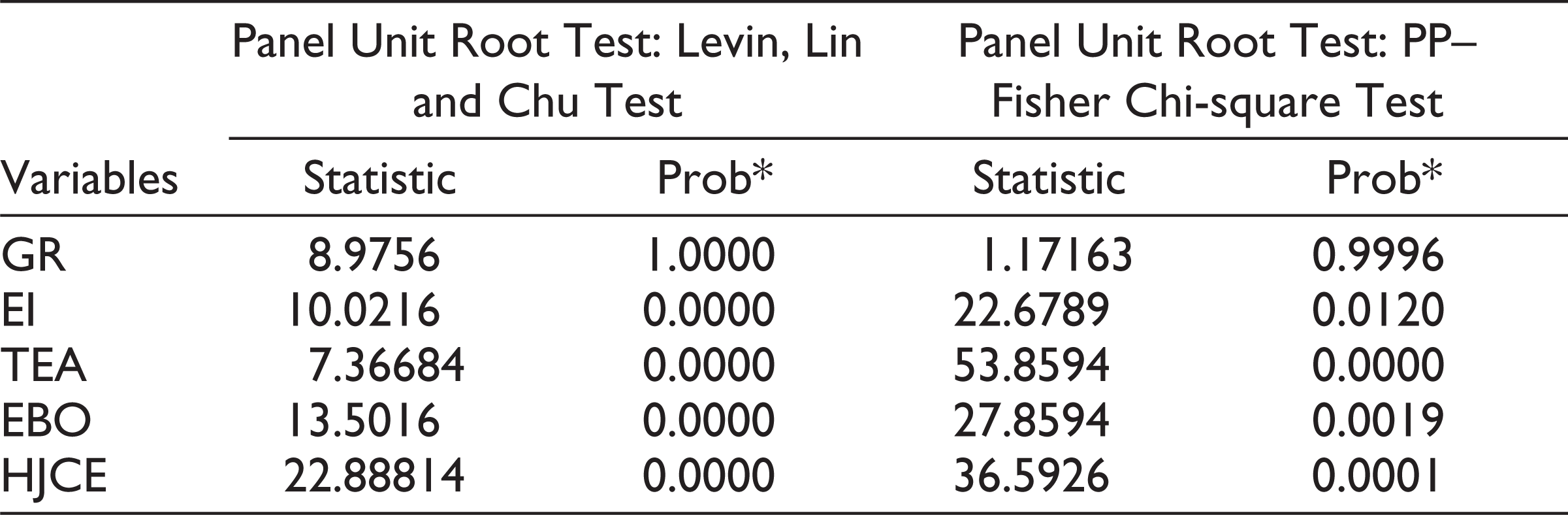
Table 4 indicates the correlation among the entrepreneurial activity variables with a p-value of 0.0005, which varies from variable to variable. To determine the direction of the relationship, we applied the Granger causality test. The correlation between growth rate and EI, TEA, EBO and HJCE is analysed; results show a positive correlation between HJCE (0.17) and EI (0.07). Table 5 presents the pairwise Granger casualty test results in the short-run for the selected variables. The results show mixed results on the relationship among variables EI, TEA, EBO and HJCE and economic growth at a 5% significance level. To know the relationship among the variables for the long run, panel unit root tests, Levin, Lin and Chu test and PP-Ch-Square test, were examined. First, we tested for the exitance of unit roots in panel data to know whether variables are stationary or not. The results indicate that all the variables are stationary at levels 1(0), and GR is stationary at levels 1 and 2 (Table 6).
Summary of Key Data for BRICS Countries (in %)

Correlation Analysis

Granger Causality
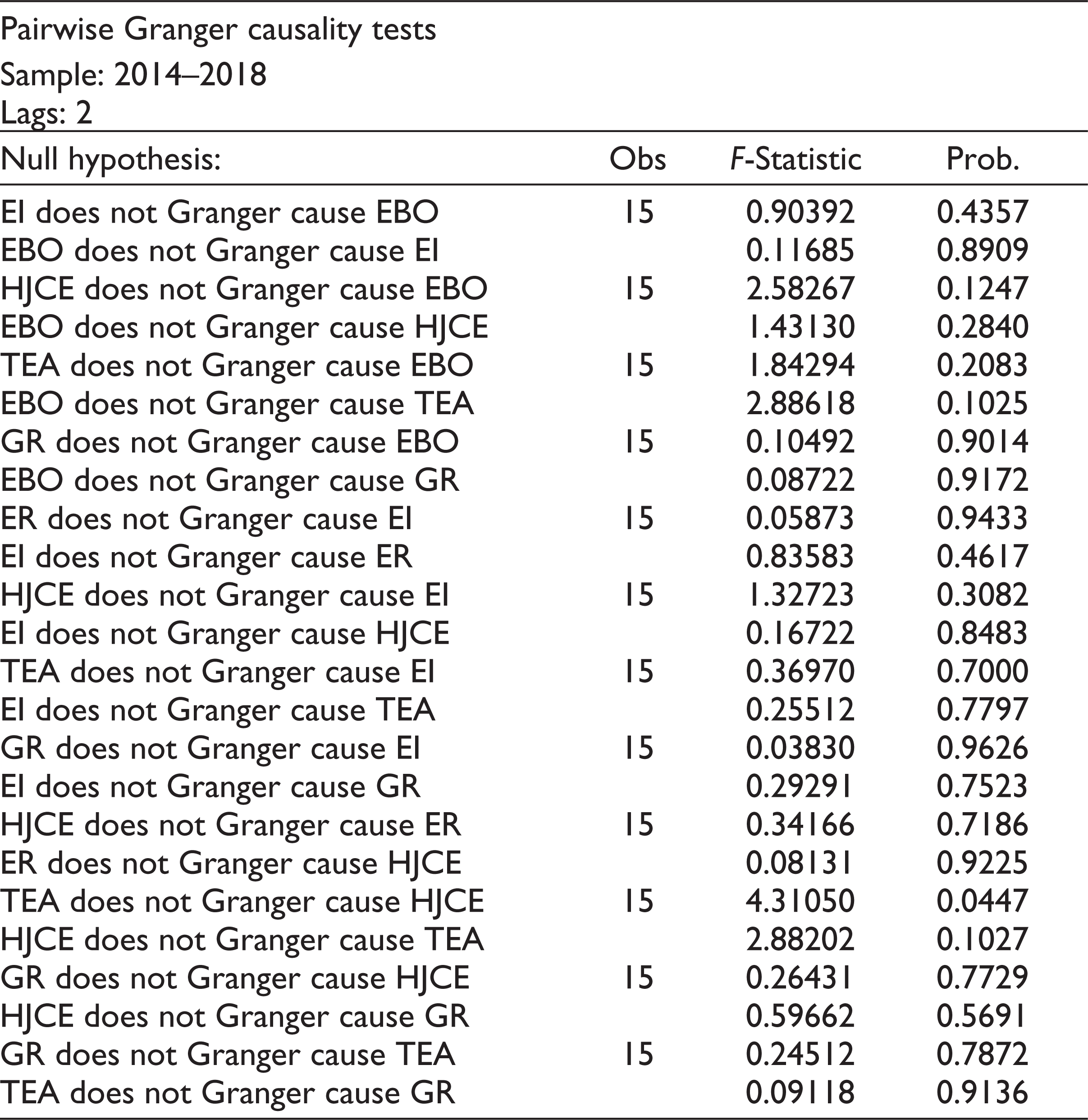
Panel Unit Root Test: Levin, Lin and Chu Test and PP–Fisher Chi-square Test
Null hypothesis: Unit root.
The Fisher Johansen panel cointegration test was also applied. The results show that there is a presence of co-integrated relationship among the variables from both the trace tests and eigenvalues at a 5% significant value (Table 7). It is concluded, therefore, that the results from the panel cointegration test point to a long-run equilibrium relationship among the variables. After the analysis confirms the long-run equilibrium among the variables in the study, the short-run impacts among the variables are estimated.
Fisher Johnsen Panel Cointegration Test ( GR, EBO,EI,TEA and HJCE as variables)
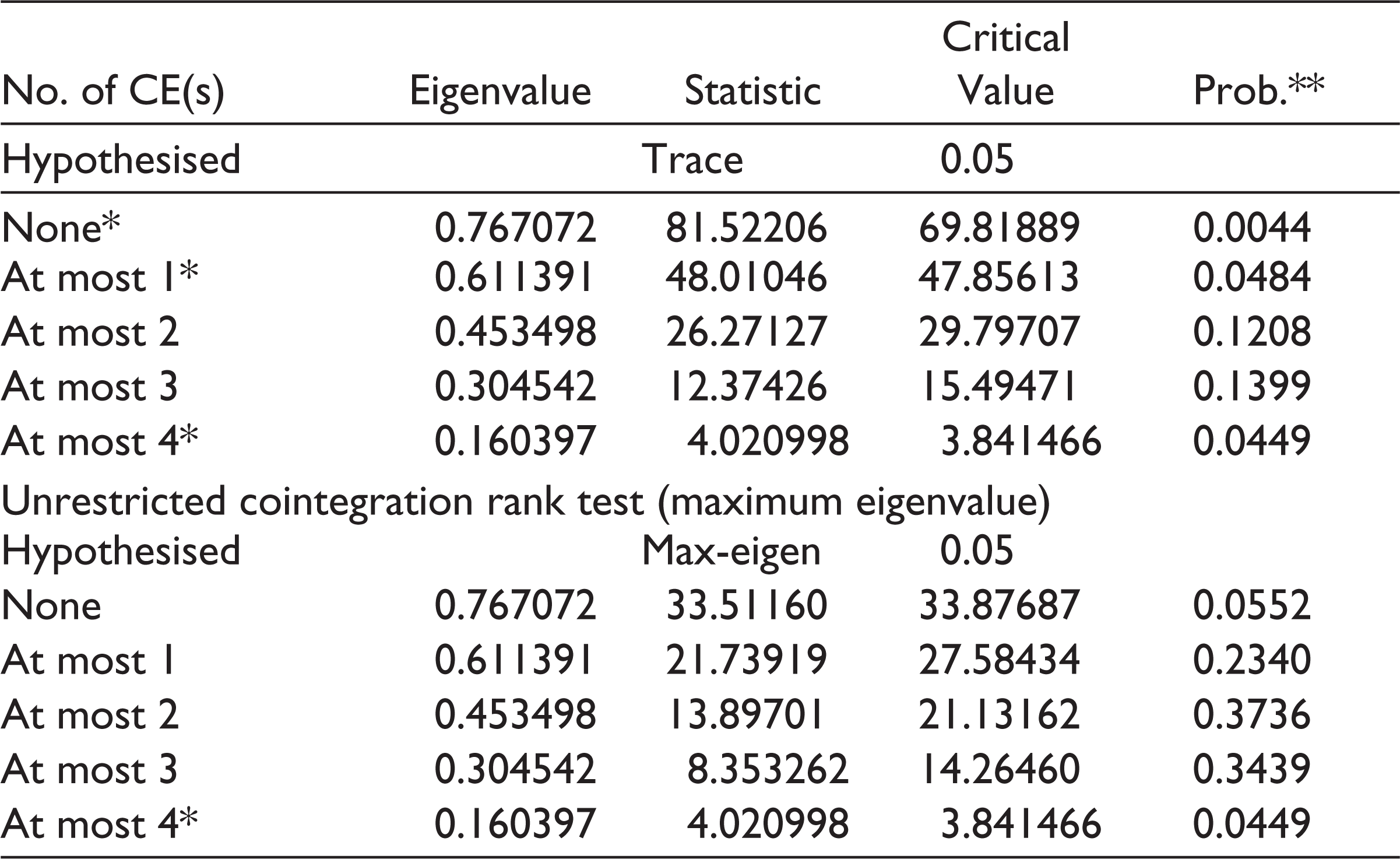
Max-eigenvalue test indicates no cointegration at the 0.05 level.
*Rejection of the hypothesis at the 0.05 level.
**MacKinnon-Haug-Michelis (1999) p-values.
We used the dynamic ordinary least squares model because it reduced bias better than the fully modified ordinary least square model (Kao & Chiang, 2000). The GR is the dependent variable, and EI, TEA and EBO are independent variables (Table 8).
Dynamic Ordinary Least Squares Results: Dependent and Independent Variables
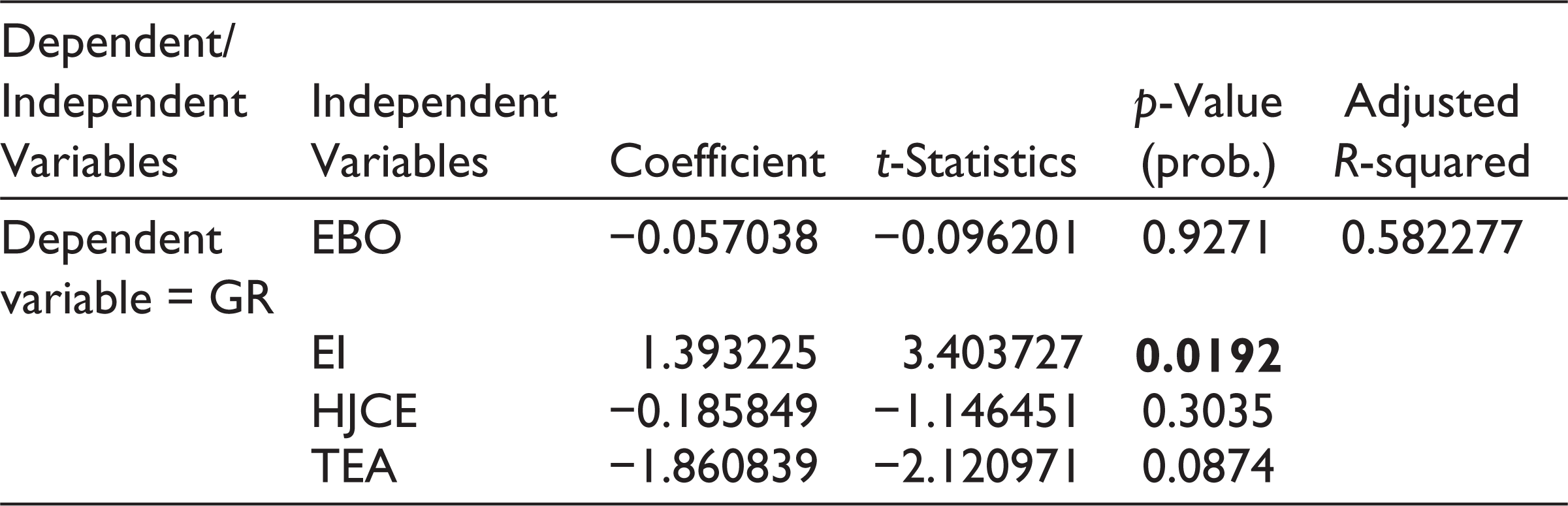
The results suggest that EI has a positive effect on GR. We can assume from Table 8 that 1% increase in EI leads to the rise of 1.39% increase in economic growth. Other variables have a negative relationship with economic growth and are nonsignificant. To conclude, the EI rate contributed significantly in comparison to other entrepreneurial activities.
Nevertheless, it is too early to analyse the impact of COVID-19 on the relationship between entrepreneurship and economic growth, and employment because the pandemic situation is still spreading, particularly in India. An analysis of data on BRICS countries reveals that the impact of COVID-19 on Brazil worsened, leading to low growth, high-income inequality and weak fiscal position. The present situation of COVID-19 will hit India’s economy seriously. The IMF projected 100% debt of GDP and continues to rise over the next 5 years. According to the World Bank, the Indian economy will slow down before the arrival of COVID-19. The implementation of the national lockdown on 24-03-2020 brought economic activity to a halt, and economic growth was negative during the first 6 months of the 2020–2021 financial year. The World Bank projected Russia’s economic growth at 4% in 2020 and 2.6 and 3.00% in 2021 and 2022. Instead, the Chinese economy is recovering very fast from the pandemic. Inflation is expected to remain under control. Like any other country in the BRICS group, South Africa’s economy is also seriously affected by COVID-19. It has been expected that South Africa’s economy will grow by 3% during this year.
It has been observed from the study that the relationship among entrepreneurship, economic growth and employment has generated mixed results. Although entrepreneurial activity has been considered an essential factor for any economy, its results contradict earlier studies. The limitation of the study is that time-series data were analyzed for a shorter period, that is, 2014–2018. We selected this phase to see its effect on the present economic situation and its impact on future planning once the pandemic situation is to be controlled. We used the GEM database, which is based on a selected sample. Once, the COVID-19 crisis is controlled, the global economy will enter a situation in which entrepreneurship will play a critical role in shifting the traditional economy to an online economy, that is, knowledge economy. Research suggests that social networks are important for new business activity emerging compared to developed economies (Danis et al., 2011). This type of entrepreneurship will depend on the skill and competencies of the entrepreneur in the respective sectors. There is a need for further research at the micro-level once the COVID-10 crises are controlled, particularly to examine the role of entrepreneurship in the health sector to recover economic growth. Their ability to absorb technological spillovers, resource coordination and innovation has created a positive impact of entrepreneurship on their growth and development (Acs et al., 2008; Ács & Armington, 2006; Baumo & Strom, 2007). Some issues and problems are common in BRICS countries, and the collective efforts of each member can solve them. We agree with Coulibaly et al. (2017) that ‘policymakers should concentrate on improving internal demand to match the supply of more innovative products from more technologically advanced countries to less advanced ones with the BRICS regional agreement’.
Our analysis reveals that the economic situation of BRICS countries is expected to slow down except for China. They will have a tough time bringing their economy back to its normal position. Hence, the role of entrepreneurship becomes crucial for achieving this high economic growth. The entrepreneurship activity can be decided as per the local needs of the economy. The priority of each member will be changed once the COVID-19 crises are controlled. The nature of the economy of this group may be re-shaped as a digital/online economy, and artificial intelligence requires re-skilling the existing manpower after the present crises are controlled.
Conclusion and Recommendation
Although the study’s findings showed mixed results, the relationship among entrepreneurship, economic growth and employment of BRICS nations cannot be ignored. There is a need for future research, which will focus on the region specific of each member of BRICS countries with large sample presentation and economic variables. The study recommends that (a) once the COVID-19 crises are controlled, each member should play an active role in encouraging entrepreneurship for the progress of sustainable development goals by 2025 to ensure affordable, quality services on health, education, water, sanitation and energy. The study results may help the policymakers formulate development agenda for the forthcoming meetings, (b) digital solutions will be essential for driving economic growth. Hence, there is a need to re-skilling the existing workforce once the present crises are controlled and (c) to invest more in health and education (vocational education and skill development).
Footnotes
Declaration of Conflicting Interests
The authors declared no potential conflicts of interest with respect to the research, authorship and/or publication of this article.
Funding
The authors received no financial support for the research, authorship and/or publication of this article.