



Abstract
The goal of this article is to investigate the influence of a family firm’s commitment to learning on open innovation. First, the research suggests that commitment to learning would allow the family firm to develop organisational knowledge useful to initiate and develop open innovations. Second, the conceptual model suggests that this relationship would be negatively moderated by the socio-emotional goal of family-to-the firm identification. Indeed, it is argued that a family firm’s identity preservation may inhibit open innovation because the firm may be reluctant to collaborate with other firms, or to license its intellectual property to others, for fear that this will erode its competitive advantage. While the first hypothesis is corroborated, unexpectedly the second is not, as the findings show that the stronger the identification, the stronger the influence that learning would have on open innovation.
Innovation is vital for firms’ performance because it allows firms to create new products, processes or services that can improve their efficiency or competitiveness. Innovation can also help firms to respond to changes in the environment or to new market opportunities, and help staying afloat during difficult times, by allowing it to reduce costs or find new ways to increase revenues. Particularly, smaller businesses may face different resource limitations and innovation initiatives, yet innovation is still important and essential to their competitiveness (Martinez-Conesa et al., 2017; Parida et al., 2012). Especially, open innovation can be critical for firms because it allows them to access new ideas and technologies from other firms, as well as from individual inventors and entrepreneurs, leading to better performance (Brunswicker & Vanhaverbeke, 2015). Like any other business, family firms must be able to embrace open innovation, as the need to be more agile and competitive requires a higher degree of openness to new ideas and approaches. Hall et al. (2001) showed how entrepreneurial families that decide to adopt explicit open cultures and double loop learning processes throughout the organisation have made it possible for family businesses to successfully face uncertainty and speed of change. Also, family firms are often passed down from one generation to the next, so they must innovate to stay competitive and survive. Since family businesses are generally long-term oriented, innovation is used as a survival strategy to preserve wealth, safeguard the company’s competitiveness and provide for expansion (Nieto et al., 2015; Zahra et al., 2007a, 2007b). Recent research indicates that family businesses develop more incremental than disruptive innovations and are less open to external sources in terms of their innovation process (Casprini et al., 2017; Chrisman & Patel, 2012). Yet, opening the innovation process takes on a specific importance for family firms (Pellegrini & Lazzarotti, 2019), as it could give admittance to resources that family businesses may not have for sustaining innovation and possibly achieving economic goals (Pellegrini & Lazzarotti, 2019).
This article aims at contributing to this research stream by integrating the influence of organisational learning into the theoretical and empirical debate. Organisational learning allows firms to maintain a sustainable competitive advantage and successfully overcome potential disruptions that may arise unexpectedly (Dickson, 1996). This can be achieved through the development of a meaningful innovation potential. Indeed, organisational learning allows for the development of organisational knowledge critical to innovation, particularly to open innovation (Drechsler & Natter, 2012). Surprisingly, few studies have focused on the relationship between organisational learning and open innovation in the context of family firms. Yet, family businesses are known for their introversion and low orientation towards external sources of knowledge (Cabrera-Suárez et al., 2001; Zahra et al., 2007a,b). For Duarte Alonso and Kok (2018), family firm management’s ability to gather, contextualise and synthesise knowledge, including tacit knowledge, is crucial to adapt to new challenges in their business environment. In the same vein, Zahra (2012) argued that learning allows a firm to be more flexible and to more easily adapt to changes in the marketplace and in the technology landscape through continuous innovation. It is therefore legitimate to investigate the role organisational learning can play in family firms’ open innovation. More precisely, this article will examine the influence of a family firm’s commitment to learning on open innovation. Notably, it is suggested that this relationship could be moderated by the search of the owning family to maintain a fit between its identity and the firm identity.
The next part of this article reviews the extant literature about family firm’s commitment to learning and its relationship with open innovation in family firms. It then explains the likely moderating effect played by family identity fit with the firm. The remaining parts of the article describe the research design, the findings and contributions as well as research limitations.
Theoretical Background
Because of the increasing global competition firms face and the need to be more agile in order to succeed, firms could no longer rely on internal R&D to be the sole source of new ideas and should instead look to external sources for inspiration and collaboration (Chesbrough, 2003a). Therefore, innovating in an open and collaborative way is vitally important today. However, there is a lack of research and also a debate in family firms’ literature about open innovation (Brinkerink et al., 2016; Pellegrini & Lazzarotti, 2019). On the one hand, family firms tend to be more long-term oriented than publicly traded firms (Lumpkin et al., 2010), which implies that they are more likely to invest in research and development and to take risks to generate new ideas (Schmid et al., 2014). For example, Kets de Vries et al. (2007) argued that family firms are more likely to be innovative and creative than non-family firms. On the other hand, there are several reasons why a family firm may be less likely to engage in open innovation activities. First, they may be more risk-averse than other types of firms (Hiebl, 2013; Kempers et al., 2019) which implies that they may be less likely to try new things or to invest in new technologies (Chrisman et al., 2015). Second, family firms may have a more traditional view of the role of innovation, believing that it should be done internally rather than externally (Claessens et al., 2002). Furthermore, these organisations may have attributes that inhibit innovation because of the close relationships among family members and their reluctance to share information with outsiders (Kotlar et al., 2020). Finally, small family firms may be less likely to have the resources (e.g., money, time, personnel) necessary to engage in open innovation activities (Parida et al., 2012). In this research, it is argued that the inclination of these firms towards open innovation depends on one key factor, namely, the commitment to organisational learning. However, the role of this key variable may be undermined by the fear of losing the firm’s family character. In fact, organisational identity—the organisation’s purpose, values, and beliefs, as well as its outward appearance—is crucial for family firms. Over time, organisational identity is constructed from a shared sense of purpose and values, shared experiences, and repeated interactions. Family business research showed that family identification leads the firm to adopt value creation goals that are specific to the family or non-financial goals (Cabrera-Suárez et al, 2014). Furthermore, for family firms, identity preservation and the family-to-firm identity fit shape various operational and strategic outcomes such as internationalisation, diversification or innovation (Basly, 2022). In this research, the effect of identification is considered as a moderating variable of the previous relationship.
Commitment to Learning and Open Innovation
While the traditional model of closed innovation has been criticised for generating risks of redundancy and autonomy (Chesbrough, 2003), the paradigm of open innovation—defined as the process of sourcing ideas and solutions from external sources rather than relying solely on internal R&D—is today important for firms because it allows them to tap into a larger pool of ideas and resources (Brunswicker & Vanhaverbeke, 2015; Chesbrough, 2003; Parida et al., 2012). Firms that innovate in an open innovation paradigm typically do so by partnering with other firms, academia and/or government institutions. For example, a firm may partner with a university to research and develop new technologies, or it may partner with another firm to jointly develop a new product. By collaborating with other organisations, firms in an open innovation paradigm can tap into a larger pool of resources and ideas, which can help them be more innovative (Chesbrough, 2003). Research has shown that SMEs that have open innovation relationships with various types of partners show the best innovation performance (Brunswicker & Vanhaverbeke, 2015) and that open innovation can give small firms easier and greater access to (inter)national markets (Fu, 2012). However, some firms may be hesitant to embrace open innovation because of a variety of internal and external factors, including organisational culture (Nakagaki et al., 2012) and lack of knowledge (Chaochotechuang et al., 2020; Drechsler & Natter, 2012; Padilla-Meléndez et al., 2013). For example, Drechsler and Natter (2012) argued that factors that prevent firms from opening up are lack of technological and market knowledge. Knowledge development and learning are therefore key factors so that firms embrace open innovation. Previous literature on learning and innovation has also found that organisations that are more innovative tend to also be more learning-oriented (Eisenhardt & Schoonhoven, 1996). Senge (1990) argued that organisational learning is essential for innovation because it allows organisations to create a ‘shared vision’—that is, a shared understanding of what they are trying to achieve. Without this shared understanding, it is difficult for organisations to generate new ideas and put them into practice. Furthermore, organisational learning allows a firm to have a flexible and responsive structure, allowing to respond to new challenges more quickly than competitors (Martinez-Costa & Jimenez-Jimenez, 2009).
This research suggests that a culture promoting a high commitment towards organisational learning will lead to more openness in a firm’s innovation activities. Previous research found that organisations that are more innovative are those which are more likely to encourage employees to experiment and take risks, provide opportunities for employees to learn from their mistakes, and encourage them to share knowledge and ideas (Manso, 2017). Research has also found that firms that have a learning mindset and have instilled this orientation in all members of the organisation achieve superior results (Sinkula et al., 2017), as they will be able to identify and incorporate new knowledge that enables them to act more quickly and reliably when decisions need to be made (De Geus, 1988). As an illustration of this rationale, Søndergaard and Burcharth (2011) identified employee unwillingness to share knowledge as a key organisational barrier to implementing open innovation strategies. Similarly, Burcharth et al. (2014) found that inbound and outbound open innovation practices are negatively influenced by the attitudes of employees towards the acquisition and sharing of knowledge. Therefore, ensuring high employee and organisational commitment towards organisational learning is critical to achieve open innovation (Van de Vrande et al., 2009). In fact, a learning environment within the firm, which encourages employees to share knowledge and ideas and to learn from each other is essential for innovation to occur.
As explained earlier, organisational learning leads to the development of new knowledge and skills within the organisation. Yet, innovation—and particularly open innovation—is a knowledge-based process leading to new products, services or processes (Chaochotechuang et al., 2020; Martín-de Castro et al., 2011; Quintane et al., 2011). For instance, Drechsler and Natter (2012) show that the lack of technological and market knowledge are the factors that prevent firms from opening up. Similarly, for Fu (2012), actively searching for complementary external knowledge significantly improves innovative output. In addition, a firm’s commitment to learning promotes open innovation by encouraging the organisation to experiment and learn from its mistakes and to improve its operations (Burcharth et al., 2017; Chaochotechuang et al., 2020). Importantly, a firm’s commitment towards organisational learning allows to be more open to new ideas and to be more willing to experiment with these new ideas. Particularly, organisational learning helps firms and organisations to innovate openly by involving stakeholders and other partners in the process of innovation (Laursen & Salter, 2006; Vanhaverbeke et al., 2012). Thereby, firms and organisations can benefit from their expertise and knowledge (Chaochotechuang et al., 2020) and can create a more open and collaborative environment in which innovation can flourish.
These arguments are, of course, equally applicable to family firms. For example, studying the significance of knowledge in family firms—from the perspective of the knowledge-based view of the firm—Duarte Alonso and Kok (2021) found the benefits of knowledge accumulation and sharing multiple, including through efficiencies and new product development. Also, Leal-Rodríguez et al. (2017) showed the significant positive effect of organisational unlearning on the firm’s innovation outcomes of family firms. Finally, for Pérez-Pérez and Hernández-Linares (2020), commitment to learning and knowledge management practices are the main undercurrent of strategic renewal of these firms. In light of these arguments, it is expected that commitment to learning promotes open innovation in family firms and suggest the first hypothesis of this research:
H1: A family firm’s commitment to learning positively influences open innovation.
The Moderating Influence of a Family-to-firm Identity Fit
A family firm is a business where ownership and management are controlled by members of one or several families. Family firms do not limit their goals to generating maximum value, since family members are heavily involved in the business (Sharma et al., 1997). While family owners may seek financial and non-financial objectives, family-centred and firm-oriented goals are common in these firms (Tagiuri & Davis, 1996). Above all, feelings and emotional involvement are hallmarks of family businesses (Hirigoyen & Basly, 2019). In fact, owning families wish to remain independent to preserve the non-monetary gains the firm provides them (Gomez-Mejía et al., 2007). These gains include the social and emotional benefits derived from the involvement in the business and especially meeting emotional needs, belonging and respect, enjoying influence, upholding family values and fulfilling obligations associated with having blood relatives—as family owners would act altruistically toward family—or to satisfy the need for empathy in the family business (Berrone et al., 2012; Gomez-Mejía et al., 2007). The seminal research by Gomez-Mejia et al. (2007) suggested that the preservation of this socio-emotional wealth (SEW) is essential to understanding family firms’ behaviour. Amongst the various social and emotional goals, identification with the firm is paramount, as in family firms there could be a strong fit between the shareholding family and the firm’s identities (Berrone et al., 2012; Zellweger et al., 2013). For Zellweger et al. (2013) family and organisational identities tend to overlap, creating a common under-standing of ‘who we are’ and ‘what we do’ in ‘our family business’. This creates a unique dynamic in which family members may have difficulty distinguishing between their personal and professional lives, leading to conflict, as well as a sense of loyalty and obligation that may override rational decision-making. Family business research found that a family business organisational identity is more likely to be based on values of trust, loyalty and cooperation than on values of competition and individualism (Chua et al., 1999; Sorenson, 1999; Sundaramurthy, 2008). Some other studies found that family firms are more likely to have a strong sense of community and social responsibility than non-family firms (Bingham et al., 2011; Cabrera-Suárez et al., 2014). Therefore, because a family firm’ organisational identity is shaped by the values, traditions and history of the owning family, the family will strive to preserve it and pass it on to future generations (Whetten et al., 2014; Wielsma & Brunninge, 2019; Zellweger et al., 2010).
Arguments suggested by extant research mostly explain that family influence, and particularly family-to-firm identity fit may play an inhibiting effect on open innovation (De Massis et al., 2015; Duran et al., 2016; Kotlar et al., 2013; Nieto et al., 2015). First, family firms’ emphasis on survival is likely to constrain autonomy and innovativeness (Dess et al., 2011). Besides, it may be difficult for a family firm to change products or services without compromising its identity (König et al., 2013). For Duran et al. (2016), the idea of SEW is one of the key reasons family businesses are less eager to invest in open innovation (Duran et al., 2016). Particularly, Nieto et al. (2015) argue that family firms are less prone to engage in technological collaboration to access external resources, suggesting that certain aspects of family influence may hinder opening up innovation. This reluctance may first be explained by the high commitment of family members to the business, as previous literature showed that a high level of commitment in family firms with a majority of family managers may make interactions among members more frequent and direct (Gupta et al., 2006) thereby promoting information exchange and learning from colleagues within the firm (Liu et al., 2015). Yet, this internally oriented learning may lead to knowledge redundancy and weak exploratory efforts on the part of family members and particularly family managers. In fact, as shown by Döring and Witt (2020), especially the CEOs of small and middle-sized family businesses who are family members often lack a clear knowledge management strategy and do too little to improve knowledge processes in their companies. Furthermore, the pursuit of non-economic goals can restrict the extent to which family firms share knowledge with non-family actors given the lack of trust and the risk of losing control (Su & Daspit, 2021). Conversely, Andersén (2015) has shown that family SMEs manifest a low internalisation of strategic knowledge compared to a non-family business. Indeed, family firms tend to be more insular and less likely to engage in external knowledge exchange given the economies created among kin with the internal transfer of tacit knowledge (Patel & Fiet, 2011). According to Zahra (2012), the domination of a single family in the control of the firm is likely to lead to strategic conservatism, as family members may dominate decision making and information flows by excluding non-family employees, thus reducing the variety of knowledge flows from external sources and hence learning opportunities (Zahra, 2012). In a similar reasoning, Serrano-Bedia et al. (2016) found that the family firm dimension tends to attenuate the positive effects of using various types of knowledge sources on innovation performance. Also, for de Massis et al. (2015), family firms might prefer to set up collaborations with partners (e.g., universities, research centres) that do not involve potential control losses. Conversely, external sources are only beneficial when they are ingrained in the company’s culture and preserve SEW in ways that lessen the family’s impression of losing control, such as with the aid of patent protection (De Massis et al., 2013). On another level, some authors related the reluctance of family firms towards open innovation to family management. For example, according to Kotlar et al. (2013), there is a negative relationship between technology acquisition and family management. The reason is that external acquisition of technology forces family managers to give up part of their discretionary control over innovation trajectories, which they do not want (Kotlar et al., 2013). Similarly, Lazzarotti and Pellegrini (2015) show that family firms managed by non-family managers are more likely to search for a broader set of external sources in embracing open innovation. A last argument may be due to the family owners’ reluctance to share their firm’s intellectual property with others (De Massis et al., 2015). The firm may be reluctant to collaborate with other firms, or to license its intellectual property to others, for fear that this will erode its competitive advantage (De Massis et al., 2015). In general, because of their firms’ specific goals—mainly family business continuity—family owner-managers have little tendency to externalise or codify organisational knowledge, which gives primacy to tacit knowledge within these organisations (Cabrera-Suárez et al., 2001). Seeking to protect their knowledge-base, family firms are weakly motivated to articulate and formalise organisational knowledge (Jaskiewicz et al., 2013) and family-owners thus maintain mechanisms that reinforce causal ambiguity (Jaskiewicz et al., 2013; Nelson & Winter, 1982). To summarise, family firms may be less likely to engage in open innovation activities, which could limit their ability to create new products or services. Accordingly, this research suggests that the effect of this variable should lessen the favourable influence of commitment to learning on open innovation. Therefore, the second hypothesis is the following:
H2: Pursuing the goal of family-to-firm identity fit negatively moderates the relationship between the family firm’s commitment to learning and open innovation.
Research Design and Method
Sample and Data Collection
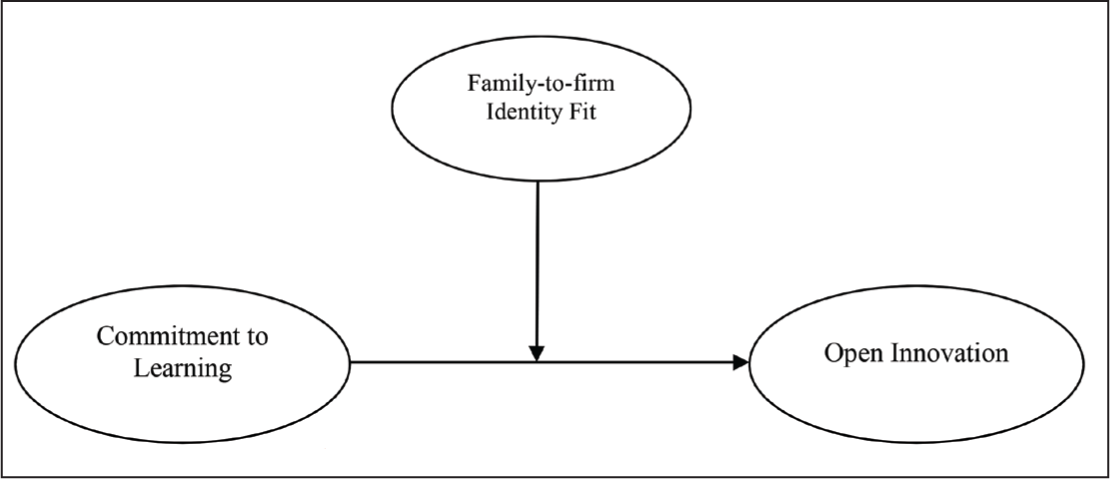
The research hypotheses were tested through a quantitative method based on a survey conducted among Tunisian family firms. Because of the lack of a family business database in Tunisia, a great difficulty was encountered during sampling, as in Tunisia there is no recognised legal status for the family business entity. A convenience non-probabilistic sample was collected through personal networks and also direct interactions and solicitations of business owners during various Tunisian business exhibition fairs. For a business to be considered a family business, the owning family (or multiple families) had to hold at least 50% of the firm’s capital if it was unquoted, 10% in the opposite case (Astrachan & Kolenko, 1994). 1 Therefore, the questionnaire data was directly collected from family business owner-managers. As explained below, the survey constructs were mainly based on established measures in the literature. Figure 1 shows the conceptual model of this research.
Conceptual Model.
One hundred and fifty questionnaires were given in person or sent by mail to respondents between November 2017 and February 2018 and a total of 101 responses were received until 30 May 2018. After excluding 10 unfilled questionnaires (respondents indicated that they were unwilling to participate in the survey) and 15 incomplete questionnaires, 76 questionnaires were complete and usable. The response rate is of 50.67%, which is a relatively favourable rate in comparison to rates of 25–35% typically found in survey research conducted with family businesses (Miller et al., 2008). Tables 1 and 2 provide descriptive statistics about the sample firms.
Descriptive Statistics.

Industries.

Statistical Choices
The models were tested through structural equation modelling with latent variables solved by the second-generation Partial Least Squares (PLS2) approach, which is rarely used in management sciences (Lacroux, 2011) and in particular to deal with the subject that interests us. The use of this kind of model is justified by the fact that it allows for testing complex causality models and incorporating several latent variables. Smart PLS 2.0 was used to estimate the model and test the significance of the PLS estimates via the bootstrap (5,000 bootstrap samples) method (Hair et al., 2012). Furthermore, individual sign changes in the bootstrap procedure were allowed for (Henseler et al., 2009).
Variable Measurement
In the present model, the variables were defined from previously validated constructs (cf. the Appendix) when possible, then translated into French to be included in the survey instrument. A pilot test was carried out in the form of interviews with one senior manager and one family business academic. These interviews allowed for refining the variables selection, examining consistency in understanding the survey items, improving items wording after translation and finally validating the survey instrument. All construct items were measured on Likert-type scales from 1 to 5. To assess measurement model quality, items’ reliability, internal consistency (Cronbach’s alpha) and constructs validity (convergent and discriminant validities) were evaluated. Convergent validity is ensured by examining the average validity extracted (AVE) which needs to be greater than 0.5 (Fornell & Larcker, 1981) (Table 3). To assess discriminant validity, the square root value of the AVE for each construct were compared to the correlation a given construct has with the others (Fornell & Larcker, 1981; Hair et al., 2021).
Measurement Quality (AVE, R2, Composite Reliability and Cronbach’s Alpha).

Commitment to Learning
This scale was used by Wang (2008) and was made up of five items. It represents the first dimension of the three-dimensional scale of learning orientation that was originally developed by Sinkula et al. (1997) and re-tested by Baker and Sinkula (1999) who found further support for its validity and reliability. Commitment to learning is measured through examining the extent to which firms place value on organisational learning and consider learning as an investment rather than expenses (Sinkula et al., 1997). Items 1, 2 and 3 were dropped because of weak communalities and the final scale was reliable, as Cronbach’s alpha was of 0.830 and composite reliability was of 0.922.
Open Innovation
Based on the work by Chesbrough and Brunswicker (2014), Naqshbandi et al. (2015) and Barham et al. (2020), this research suggested an original measure comprised of five items related to working with the firm’s partners, customers and suppliers to offer products, services and business solutions. For example: ‘my organisation’s employees work alongside partners to develop business solutions’; ‘In recent years, my organisation has improved the quality and design of its products and processes through its relationships with partners’, etc. After dropping items 1 and 2 because of weak loadings, the final scale made up of items 3, 4 and 5 has a Cronbach’s alpha of 0.744 and a composite reliability of 0.855.
Family-to-firm Identity Fit
The research used the family business identity subscale developed by Frank et al. (2017) which represents a decision premise that frames decisions regarding the self-conception as a family business (Frank et al., 2017). The original scale found support for its validity and reliability (Frank et al., 2017). In this analysis, the final construct was made up of 3 items (after dropping items 1, 2 and 5) and was reliable (Cronbach’s alpha of 0.785 and a composite reliability of 0.872).
A set of control variables which might have an impact on family firms’ open innovation was introduced in the research model. First, the extent of family involvement in decision-making and control (measured by the ratio of family executives by the total size of the top management team; and by the ratio of family directors within boards) and in operational management (measured by the ratio of family employees divided by the firm’s total workforce) were included. In addition, the generational involvement measured by the rank of the current controlling generation was taken into consideration. Finally, firms’ size and industries (trade, services or manufacturing) were included.
Findings and Discussion
The quality of a structural model, in the context of the PLS method, is assessed by observing the Stone–Geisser coefficient (Q²) and the coefficients of determination (R2). To test the hypotheses, the two-step procedure of moderated multiple regressions was used (Akremi, 2005). First, a model with control, independent and moderator variables was tested. The second step involved the product of independent and moderator variables representing nonlinear interaction effects. An increasing value of R2 confirms the moderation effect, which is complemented by checking the significance of the interaction effect to establish the moderation effect. Table 4 shows the correlations matrix. Collinearity analysis was performed on the independent variables. This resulted in all variance inflation coefficients below 5.0, indicating that the estimated path coefficients are well established in the model. The results are presented in Tables 5 and 6, showing the explained variance (R2) of the dependent variable and the model path coefficients. Bootstrapping (5,000 samples) was used to generate standard errors and t-statistics, consistent with Chin (1998).The results shown in Model 1 support the hypothesis that a firm’s commitment to learning positively influences open innovation in family firms. This finding is consistent with previous literature showing that organisational learning is essential for firms to be able to innovate because it allows them to develop new knowledge and skills, and to apply them to new situations. As argued by Laursen and Salter (2006) and Vanhaverbeke et al. (2012), organisational learning also helps firms and organisations to innovate openly by involving stakeholders and other partners in the process of innovation. Thus, commitment to learning pushes organisations to overcome barriers to external learning and to benefit from the knowledge and expertise of external partners (Chaochotechuang et al., 2020). In sum, commitment to learning allows firms to access a wider range of ideas and knowledge, which can lead to more innovative products and services. This finding is also consistent with previous family business research showing that commitment to learning allows firms to be more flexible and to more easily adapt to changes in the marketplace and in the technology landscape through continuous innovation (Duarte Alonso & Kok, 2021; Pérez-Pérez & Hernández-Linares, 2020; Zahra, 2012). Unexpectedly, it was also found that the pursuit of the goal of family-to-firm identity fit has a positive effect on the dependent variable. Similarly, the model incorporating moderating effects (cf. Table 6) shows a significant moderating effect played by a family-to-firm identity fit on the relationship between commitment to learning and open innovation. However, contrary to expectations, this effect is positive, suggesting that the family desire for an identity fit with the firm amplifies the positive impact of commitment to learning on a family firm’s open innovation. In other terms, the more the family seeks to maintain an identity fit with the firm, the more organisational learning would be beneficial towards open innovation.
Correlations Matrix.

Model 1 (Without Moderation)—R2 = 0.440.

Model 2 (With Moderation)—R2 = 0.512.

The unexpected results go against most mainstream theories and can be justified by a few rationales. First, it is plausible that as the owning family pursues the continuity of the family and firm identities fit over time, it will accept taking risks more easily otherwise the family business SEW will be threatened. As explained by Gómez-Mejia et al. (2007), in some situations, the loss aversion in terms of SEW may lead to risk taking. This could push the family to open up more easily to external partners and to accept disclosing knowledge to them and also to accept inbound knowledge flows. This idea is supported by Kellermanns and Eddelstone (2006) who argued that strong long-term thinking encourages participation in partnerships with outside parties for a lasting perspective and also motivates staff to look into potential innovations. Second, findings may be understood considering previous arguments showing that long-lasting and trustworthy connections are especially advantageous for coordination, knowledge generation and transfer (Pittz & Adler, 2016). Additionally, in family firms, social capital favourably influences absorptive capacity which is crucial for implementing open innovation (Lichtenthaler, 2011). As argued by Miller and Le Breton-Miller (2005), these factors assist family enterprises in establishing fruitful and consistent interactions with outside parties and taking part in open innovation activities. In the same vein, Lichtenthaler (2009) demonstrated that family businesses, with their long-term focus, high degree of social capital and absorptive capacity, also profit greatly from open innovation initiatives (Lichtenthaler, 2009). Furthermore, most investigations support the idea that strong identification produces a culture where employees are better able to connect their goals with those of the company, which improves individual productivity and job satisfaction and encourages the creation of new family business ideas (Carmeli et al., 2011; Judge et al., 2001). This rational may of course apply for firm’s employees belonging the owning family. Third, while identity preservation may favour internal organisational learning at the expense of external learning, internal learning need not to be neglected for innovative activities, especially for open innovation. Despite the risk of knowledge redundancy and stagnation, traditional founding knowledge underlying a firm’s competitive advantage is crucial for innovation in family businesses that need to build on their past achievements to succeed in their future endeavours (Erdogan et al, 2020). In some cases, the owning family may accept articulating the firm’s knowledge and know-how to share it with external innovation partners. For example, Kotlar et al. (2013) showed that family firms become more favourable to considering the adoption of an open approach to technology development when some protection mechanisms (specifically, the filing of patents on the firm’s proprietary technologies) increase the managers’ perceptions of control over the technology trajectory (Kotlar et al., 2013). Similarly, a secret family recipe might be protected by a patent before being shared—with all the required guarantees—with an external partner. Fourth, as explained by Aldrich and Cliff (2003), the embeddedness of the family business in its environment and its relationships with different stakeholders and within proximity networks mean that it often has privileged relationships with its customers and suppliers which are themselves a source of learning (Zahra, 2012). Similarly, Feranita et al. (2017) argued that family firms often have strong relationships with their customers and suppliers, which can lead to greater collaboration on innovation projects (Feranita et al., 2017). On a more general level, the owning family’s altruistic orientation towards contributing to the development of its immediate territory may explain the willingness to accept co-innovation and open innovation since it can benefit the surrounding community. It should also be remembered that contribution to the community may have a positive impact on the owning family’s reputation which is a desired goal for family firms. Finally, these findings may be explained by the reputational benefits an owning family derives from a firm’s ownership. Despite the risks that identity-fit with the firm may entail with respect to open innovation, it is likely that the owning family may consider open innovation as a means to develop reputation and prestige through the offering of new products or services. Particularly, when the firm is eponymous and when the products/services allow stakeholders identifying the owning family, it is reasonable that the family should be more openly innovative. For example, Sharma et al. (1997) argued that as a consequence of their involvement in the firm, family businesses seek to produce quality products or services. Therefore, developing a family firm’s eponymous brand, and the family’s reputation, may encourage family owner-managers to build partnerships allowing the firm developing new organisational knowledge useful for innovation. In other words, the business may become a vehicle for developing the owning family’s notoriety by establishing relationships with various stakeholders. As a consequence, the stronger the family’ identification with the firm, the stronger the influence that organisational learning would have on open innovation.
Contributions
This research intended to highlight the influence of commitment to learning on open innovation in family firms, while taking into account the moderating role of the owning family’s identification with the business. While the effect of commitment to learning was validated, the moderating effect of the moderating variable, that is, the family-to-firm identity fit was found to be significantly positive and not negative as hypothesised.
This study has several theoretical contributions. First, it contributes to the literature on organisational learning in family-owned enterprises (Tsang, 2020; Zahra, 2012) by showing that commitment to learning contributes to opening up the innovation process, potentially because it pushes owner-managers and organisational members to explore new opportunities and ideas outside the boundaries of the family business. In this respect, the relational capital of the owning family, and particularly that of the owner manager, plays a beneficial role in the integration of external knowledge and in the development of an organisational knowledge base. As described by Lambrechts et al. (2017), open innovation should be reflected in leadership style, and top management should set an example of how to use and pursue open innovation initiatives. By doing this, they can forge strong connections and thrive for new business opportunities and innovation in collaboration with outside sources. The study therefore highlights the role of commitment to learning in family-owned enterprises in shaping the behaviour of family owner-managers and, consequently, in critical strategic steps such as open innovation. This research argues that the commitment to learning supported by the firm’s management may create a counterweight to the likely strategic inertia that may be promoted by the shareholding family when seeking to preserve SEW.
Furthermore, this study adds to the literature on open innovation and dynamic capabilities in family firms, as it reveals the effect of certain determinants of open innovation in the family firm, among which is commitment to learning. In a dynamic capabilities approach, this factor has to be considered a driving force for developing the organisation’s capabilities and maintaining its competitive advantage through open innovation. As explained above, the desired organisational identity of the family business can explain the inclination of the owning family towards open innovation by seeking to develop external organisational learning. Indeed, the reputational capital of the family-owner can clearly benefit from the open innovation performed by the family business. Therefore, this study provides an illustration of how an owning family goals—and particularly inclination to pursue SEW goals such as identification—might interact with the firm’s organisational learning predispositions affecting open innovation. Contrary to many arguments found in the literature (De Massis et al., 2015; Duran et al., 2016; Nieto et al., 2015), this research shows that the search for identification with the firm can have a favourable effect on open innovation. Therefore, these results challenge—or even call into question—previous ideas defending an internally oriented closed innovation in family firms. More specifically, it is argued that the search for identification can play a driving role in opening up the innovation process in these firms.
Limitations and Future Research
This research is not without limitations. First, non-probabilistic sampling and its application to certain types of firms can be flawed. The results of this study need to be generalised with caution, as they are specific to the context of a developing country. Future studies therefore suggest that the research model could be tested using different samples in different situations. Since firm open innovation is also susceptible to external factors such as environmental complexity and uncertainty, the scope of this study can be extended to other explanatory and contingency factors.
Footnotes
Declaration of Conflicting Interests
The authors declared no potential conflicts of interest with respect to the research, authorship and/or publication of this article.
Funding
The authors have received no financial support for the research, authorship and/or publication of this article.