



Abstract
Despite their innovation practices, Latin American companies seem to show low levels of corporate entrepreneurship. More research on corporate practices directed at infusing an entrepreneurial climate in the region is needed. This study draws on a recent theory that brings together configuration theory with prior corporate entrepreneurship conceptualizations. With this study, the authors test whether innovation training programs increase the entrepreneurial climate of multinational corporations from Latin American emerging markets. The authors of this study collected data from a sample of 2,796 employees of a Colombian multinational, divided into two groups of trained and untrained staff. They hypothesise that the corporate entrepreneurship climate would be higher in the trained group. They specify and validate a series of multigroup structural equation models to test their hypothesis. The results of this study suggest that some dimensions of entrepreneurial climate are higher when companies implement innovation programs.
Keywords
After decades of research, entrepreneurship within companies is still the focus of researchers from different fields. Entrepreneurship is a complex topic, and scholars from disciplines ranging across economics to strategic management have studied the phenomenon through different lenses (Bruyat & Julien, 2001). Scholars from different regions currently recognise the importance of entrepreneurship as a means for corporate sustainability and wealth generation.
Although the trend is changing, so far, the most prolific authors in the Corporate Entrepreneurship (CE) field are Anglo-Saxon (Urbano et al., 2022). To date, only a small percentage of business studies in Latin America discuss entrepreneurial activity in the region (Gonzalez-Brambila et al., 2016). Given its role as a predecessor of corporate sustainability and wealth generation, studying what internal corporate practices foster CE in established companies is of utmost importance (Burger & Blažková, 2020).
A recent study involving employees from four Latin American countries suggests that although companies in the region incorporate innovation practices, they are not competitive in terms of innovative performance (Villasana & Lozano, 2020). As in the case of studies inquiring about entrepreneurial activity, research about CE in Latin America is still scarce and exploratory (e.g., Soares et al., 2021; Villasana & Lozano, 2020).
Low levels of CE indicate the need for staff training and development (Duane Ireland et al., 2006). A study conducted in five Latin American countries found that 60% of the surveyed firms had very low or non-existent levels of innovation (Fernandez, 2017). To the authors’ knowledge, no study has inquired about the effect of innovation training on entrepreneurial climate in Latin American companies.
Prior literature suggests that an entrepreneurial culture fosters innovation outcomes. In line with this empirical evidence, Arshi and Burns (2018) found that, as a dimension of entrepreneurial architecture, entrepreneurial culture affects innovation outputs such as improvements and modifications, and radical changes in products and services (incremental and radical innovation, respectively). While Arshi and Burns (2018) found that measures of entrepreneurial culture are similar to those of entrepreneurial climate, in this study the authors focus on the latter. Another differentiating aspect of this study is that it does not inquire about innovation as an output. Instead, this study analyses the effect of innovativeness, which is a component of the broader concept of CE (Kuratko, 2017), on entrepreneurial climate. To the authors’ knowledge, no study has investigated the effect of innovativeness in the form of employee training programs in innovation, on entrepreneurial climate.
Conceptually speaking, the Entrepreneurial Orientation (EO) of a company and its components (i.e., innovativeness) are firm behavioural patterns (Covin & Lumpkin, 2011). Prior studies have provided empirical evidence about the relationship between innovativeness and entrepreneurial climate. However, those studies were conducted in developed countries, and their authors used operationalizations of innovativeness whose dimensionality has been under debate (Hornsby et al., 2013; Rauch et al., 2009). Recently, Arshi et al. (2020) validated an EO scale and found support for an innovation orientation dimension. Although in terms of EO and innovativeness conceptualization and measurement, these results are promising, the authors indicate that their results are restricted to the Omani corporate sector. Furthermore, a more recent bibliometric analysis shows that while some studies provide evidence for EO as a unidimensional construct, other research results support a multidimensional structure (Wales et al., 2021).
In this study, the authors evaluate whether training programs in innovation, an actual firm behavioural pattern, change the entrepreneurial climate of an emerging market multinational. The implementation of CE is an important topic in the CE research field (Kuratko et al., 2015). The authors structure this article as follows: First, they present a brief review of the theory behind CE and academic literature related to the concept. Next, they summarise the methods used in this study. Finally, after reporting their results, they discuss them by emphasising the takeaways of their research for scholars and practitioners.
Corporate Entrepreneurship, Entrepreneurial Climate, and Innovation Training
The CE academic field consolidated in the 1990s (Kuratko, 2017). Although the concept of CE started to form in the 1970s, and several conceptualizations co-exist, the authors agree with the definition provided by Zahra (1991), according to which CE ‘may be formal or informal activities aimed at creating new businesses in established companies or entrepreneurial innovations through product, process, or market initiatives’ (Zahra, 1991, p. 262). Concerning these formal activities or practices, recent exploratory research suggests that training does in fact influence CE in the form of corporate entrepreneurs’ learning outcomes (Byrne et al., 2016).
CE manifests in companies in the form of corporate ventures or strategic entrepreneurship (Kuratko, 2017) and aims at improving the competitive advantage and financial performance of organizations (Zahra, 1991). In addition, CE requires a different way of carrying out organizational tasks and processes (Antoncic & Prodan, 2008).
Firms that want to foster successful CE need to be involved in strategy-making processes. Specifically, EO is related to strategy-making practices and fosters CE. Following Miller’s (1983) idea of entrepreneurial strategic posture, Covin and Slevin (1989) initially characterised EO as a strategic posture. In a more recent conceptualization, EO represents an entrepreneurial mentality mirrored in the corporate culture (Dess & Lumpkin, 2005). The concept of EO draws on a conception of strategy-making as patterns of action or decision-making styles (Dess & Lumpkin, 2005). Recently, Kreiser et al. (2021), examined the relationship between CES external fit (i.e., the match between the environment and internal elements of CES) and CES internal fit (i.e., the alignment between internal CES elements and the consistency with an ideal organizational profile), and the link between the latter and organizational performance. They suggested that the fit between the internal and external elements of CES is related to enhanced organizational performance. This study shed light on CES issues in companies from Latin America and other emerging markets. A recent exploratory study conducted in four Latin American countries concluded that firms wanting to elicit employee innovation and entrepreneurial behaviours in emerging markets should think of CE as a strategy (Villasana & Lozano, 2020).
Nowadays, the debate about the number and composition of CE dimensions continues (Kreiser et al., 2021). EO is conceived as a multi- and unidimensional construct (Rauch et al., 2009; Wales et al., 2011). Some scholars conceptualise CE drawing on the dimensionality of the EO construct (Kreiser et al., 2021). In one of the most popular multidimensional conceptualizations of EO, the construct has five different dimensions, namely: autonomy, innovativeness, proactiveness, risk-taking, and competitive aggressiveness. Autonomy is associated with independent actions directed to advance and carry out ideas. Innovativeness refers to organizational support for new ideas, creativity, and experimentation. Proactiveness is related to organizational opportunity seeking, competitive aggressiveness refers to the firm’s tendency to challenge competitors (Lumpkin & Dess, 1996), and risk-taking to its willingness to make risky commitments (Kreiser et al., 2021; Miller & Friesen, 1978). In Latin America, firms’ innovativeness seems to be considered a key EO dimension. Companies in the region often incorporate some innovation practices. Despite this, they do not seem to be performing innovatively (Villasana & Lozano, 2020).
As mentioned before, prior exploratory research suggests that formal practices, such as training, boost CE (Byrne et al., 2016), which is understood as EO in this study. In the case of the firm that the authors studied, the company directed its efforts into fostering innovativeness through a continuous program of innovation training. Considering the firm’s emphasis on innovativeness, the authors wanted to test whether the company’s support for new ideas, creativity, and experimentation in the form of formal training practices on innovation affected other aspects of the CES the company. The choice of studying a single dimension of EO also responded to the still open discussion about the EO construct dimensionality (Kreiser et al., 2021). Instead of using an existing operationalization of EO, the authors used an innovation training program to operationalise innovativeness. By measuring innovativeness in this way, they follow the recommendation of several authors claiming the use of alternative measurement techniques in EO measurement. The operationalization of EO dimensions with alternative methods grants measurement accuracy (Wales et al., 2021). Keeping these suggestions in mind, the authors of this study believe that this operationalization of innovativeness allowed them to focus on innovativeness as a firm behavioural pattern rather than a managerial perception.
In the view of Covin and Lumpkin (2011), it is hard to differentiate EO from other organizational attributes, yet EO is different from entrepreneurial climate or culture. While the former is a behavioural trait, aspects of the latter are intangible. EO and the intangibles such as entrepreneurial climate may be linked. Even though in the CES model of Kreiser et al. (2021) EO and entrepreneurial climate have a correlation, as in other previous studies (Hornsby et al., 2013), earlier CE literature suggests that one is the predecessor of the other. According to Covin and Lumpkin (2011), firms’ isolated entrepreneurial behaviours may not result in a firm being recognised as entrepreneurial. A company should make continuous efforts to be identified as entrepreneurial. Following this line of thought, the authors believe that when a company shows steady support for new ideas, creativity, and experimentation (i.e., innovativeness) by systematically training their employees in innovation, their perception of the entrepreneurial nature of the firm increases (i.e., entrepreneurial climate).
In the view of Kreiser et al. (2021), the entrepreneurial climate has several organizational antecedents and outcomes. While other internal elements of the CES such as EO are behaviour-related (e.g., innovativeness), the entrepreneurial climate of a firm is part of the entrepreneurial architecture of the CES. In this vein, its role is paramount in enhancing the innovation and entrepreneurship of companies. The entrepreneurial climate of a company is a reflection of the commitment of top management to foster entrepreneurial behaviours. The most common conceptualization of the entrepreneurial climate in the Corporate Entrepreneurship field portrays it as a four-dimensional construct (Kuratko, 2017). The first dimension of the entrepreneurial climate—top management support—represents the individual perception of managerial support, facilitation, and promotion of entrepreneurial behaviours. A second dimension—work discretion—refers to the perception of decision-making possibilities of its employees. The third dimension of the entrepreneurial climate is rewarded, which refers to the individuals’ perception of organizational systems rewarding entrepreneurial behaviours and success. The fourth dimension—time availability—represents the individual perception of time availability to undertake innovations (Hornsby et al., 2002; Kreiser et al., 2021; Kuratko et al., 1990, 2014).
The Corporate Entrepreneurship Assessment Instrument (CEAI) is the most popular operationalization of the entrepreneurial climate concept (Burger & Blažková, 2020; Hornsby et al., 2002; Kuratko et al., 1990, 2014). This scale has been used in studies conducted in several emerging countries. However, the results concerning the CEAI construct validity and reliability are different. When validating the CEAI, scholars have found different factor structures. For instance, in a study conducted in Romania, the authors found a ten-factor structure (Vizitiu et al., 2018) whereas two other studies with Indian and South African samples reported what may be considered as problems of validity and reliability for the time availability factor (Bhardwaj & Sushil, 2012; Villiers-Scheepers, 2012). Yet another study conducted in Ethiopia did not report the validity of the CEAI (Kassa & Raju, 2015).
Duane Ireland et al. (2006) suggest that the assessment of corporate entrepreneurship evaluations indicates that firms need to invest in innovation and entrepreneurship training. Following Covin and Lumpkin (2011), the authors of this study believe that corporate practices are necessary to raise the recognition of a company as having an entrepreneurial climate. Descriptions of some exemplary US and British entrepreneurial firms indicate that firms that support programs stimulating entrepreneurial activity boost entrepreneurial climates (Dess & Lumpkin, 2005). Climate literature supports the assertion that behaviour-related elements of the CES determine entrepreneurial climate. The definition of climate refers to employee perceptions of policies, practices, procedures and consequential behaviours that support innovation outcomes, and creativity, among others (Patterson et al., 2005). Climate literature also suggests that corporate practices (e.g., programs of innovation training) precede employees’ perceptions or climate, in this case, entrepreneurial climate. Following the CE and climate literature, the authors of the study posit that innovativeness in the form of a company’s commitment to training its employees in innovation—innovation training—leads to the recognition of the company as an entrepreneurial organization.
Following the CE and climate literature, the authors of this study posit that innovativeness in the form of a company’s commitment to training its employees in innovation—innovation training—leads to the recognition of the company as an entrepreneurial organization. In this way, this study problematises recent research theorizations and findings suggesting a mere correlation between CES internal elements (Kreiser et al., 2021). As stated below, the authors believe that some CES internal elements such as the company leaders’ support for training in innovation have a positive effect on the firms’ entrepreneurial climate.
H1: Innovation training increases corporate entrepreneurial climate.
Method
Participants and Procedures
The authors collected data from 2,796 employees from ten companies which are part of a Colombian multinational conglomerate in the manufacturing sector. The participants of the study signed an informed consent. The company has presence in more than 10 countries, located mainly in North, Central and South America. All the innovation policies regarding the facilitation of the entrepreneurial climate are designed at the conglomerate’s holding company and then implemented at each company under their own guidance. The company aimed the innovation training program at implementing an innovation strategy, structuring a governance model, identifying new technologies, and building a new portfolio of innovation projects. Table 1 shows the number of responses collected from each company to complete the 2,796-strong sample.
Responses Collected From a Colombian Multinational Conglomerate.

The sample of employees was nearly homogeneously distributed in terms of gender: 55.54% of the respondents were females, and 44.46% were males. Concerning the age of the participants, 5.58% ranged from 18 to 25 years, 31.62% from 26 to 35, 37.70% from 36 to 45, and 11.62% 46 or older. The respondents held positions at different organizational levels: 2.18% of respondents made part of the conglomerate’s top management, 4.15% were area managers, 32.90% were team managers and 60.77% were employees without staff under supervision. The participants also had different educational levels: 7.30% of respondents held a high school degree, 25.61% a technical degree, 19.28% an undergraduate degree, 47.39% a graduate degree and 0.43% of respondents held a doctorate.
The multigroup factor analyses are sensitive to substantial differences in group sizes (Yoon & Lai, 2018). The authors of this study avoided those issues by collecting almost balanced sub-samples. 59.97% (NTraining = 1677) of the participants received innovation training before the data collection process. The participants voluntarily participated in this study and the innovation training for a maximum of 120 hours during one year. Hence, they were not randomly assigned to the training and control groups. The authors discuss this limitation below in the discussion section. They employed several procedural measures to tackle some of the sources of common method bias (Podsakoff et al., 2003). Specifically, they protected the anonymity of the respondents and methodologically separated the measures by using distinct types of measures (multiple and single item) and response formats (i.e., Likert and dichotomous).
Measures
The authors of this study selected Hornsby et al. (2013) CEAI scale to assess the entrepreneurial climate in this sample. The CEAI was developed by Kuratko et al. (1990) and has passed through different revisions afterwards (Hornsby et al., 2002, 2009, 2013). The CEAI has shown content and structural validity in samples of US professionals. A similar measure of entrepreneurial climate was recently used in Latin America by Villasana and Lozano (2020). In the method section of their study, these authors indicate that they selected the CEAI instrument validated by Morris et al. (2010). The authors of this study used the 18-item shortened version of the scale initially validated by Hornsby et al. (2013). The eighteen items assess four different but related factors, namely: Work Discretion (WD; 5 items), Time Availability (TA; 5 items), Management Support (MS; 5 items), and rewards/reinforcement (RR; 3 items). Examples of the items are: ‘I have the freedom to decide what I do on my job’; ‘I have just the right amount of time and workload to do everything well’; ‘People are often encouraged to take calculated risks with ideas around here’; ‘My supervisor will give me special recognition if my work performance is especially good’. Like in Hornsby et al. study (2013), the participants of this study tapped their responses using a 7-point Likert scale ranging from 1 = strongly disagree to 7 = strongly agree. In their validation of the CEAI, Hornsby et al. (2013) found acceptable reliability for the four factors with Cronbach alphas ranging from 0.63 to 0.89 in exploratory analysis and from 0.73 to 0.87 after confirmatory analysis (Hornsby et al., 2013). To account for the language adaptation of the CEAI, the authors of this study utilised the translation to Spanish of the original CEAI scale (Hornsby et al., 2002; Kuratko et al., 1990) published by Moriano et al. (2009).
Analysis
The authors selected the multigroup approach for two reasons: On the one hand, entrepreneurial climate refers to collective perceptions (aggregated perceptions), regularly measured with multiple-item measures (i.e., CEIA). On the other hand, they wanted to compare groups of employees who received innovation training and those who did not. They analysed the quantitative data with the Mplus statistical package (v.8.6; Muthén & Muthén, 2017). Because of its advantages over confirmatory analysis (Marsh et al., 2014), they selected the Exploratory Structural Equation Modelling (ESEM) technique. ESEM and the multigroup approach are preferable to analyses of variance used in prior studies using the CEIA for comparisons among groups (e.g., Hornsby et al., 2002), as they correct for measurement errors (Marsh et al., 2014). Besides allowing a comparison between the levels of latent variables, the multigroup analysis helps test the extent to which the measurement scales are useful for comparisons between groups. The multigroup approach implies testing different degrees of scale invariance. The simplest degree of invariance, configural invariance, implies replicating the same factor structure across groups under comparison. Once the configural invariance model is accepted, it is possible to test more constringent metric invariance models. The low invariance models specify the same factor structure and, in addition, equal factor loadings across groups. If a low invariance model is accepted, it is possible to compare item scores or even test more restrictive models with item intercepts constrained to equality. These models, known as strong metric invariance models, are useful when the objective is to compare groups in terms of the means of the latent variables (Kline, 2011). The authors of this study expected to validate the strong invariance model to be able to compare the different dimensions of corporate entrepreneurship between the groups of employees who received training and those who did not.
To cope with small deviations from the norm, the authors selected the MLR estimator. They used the Oblimin rotation since the factors of corporate entrepreneurship are theoretically related. They screened the factor loadings and cross-loadings keeping in mind the critical value of 0.35 (Hair et al., 2010). Finally, they assessed each invariance model fit using the χ2, CFI, and RMSEA coefficients. A non-significant χ2, values close to 0.95 and close to 0.06 for RMSEA, suggest a good fit between the models and the data (Hu & Bentler, 1999). Concerning the comparisons between the models, the authors of this study inspected whether the more restrictive models implied an important loss of model fit. using the ΔCFI and ΔRMSEA coefficients. Values greater than 0.01 in these coefficients indicate that the fit has deteriorated and that the more constrained model should be rejected (Cheung & Rensvold, 2002).
Results
An initial model including the RR factor showed a negative residual variance for one of the three items. With only two items remaining and considering that at least three items are recommended for each factor (Robinson, 2018), the authors of this study omitted the RR factor from further analysis. The general fit of the configural invariance model was satisfactory, except for the χ2 value (see Table 2). The authors inspected the residual correlations and detected a residual correlation higher than 0.10. between items 4 and 5 of the WD factor. Residual correlations higher than 0.10 suggest model-data misfit (Kline, 2011). After analysing the factor loadings of both items, the authors proceeded to delete the item with the lower factor loading (wd5). Although the χ2 value of the configural and other invariance models continued to be significant, the authors of this study did not detect other sources of misfit in the residual correlations. As portrayed in Table 2, all the models obtained satisfactory results of fit in the rest of the coefficients. Therefore, they continued with the comparison of the invariance models.
Goodness of Fit and Difference Tests.
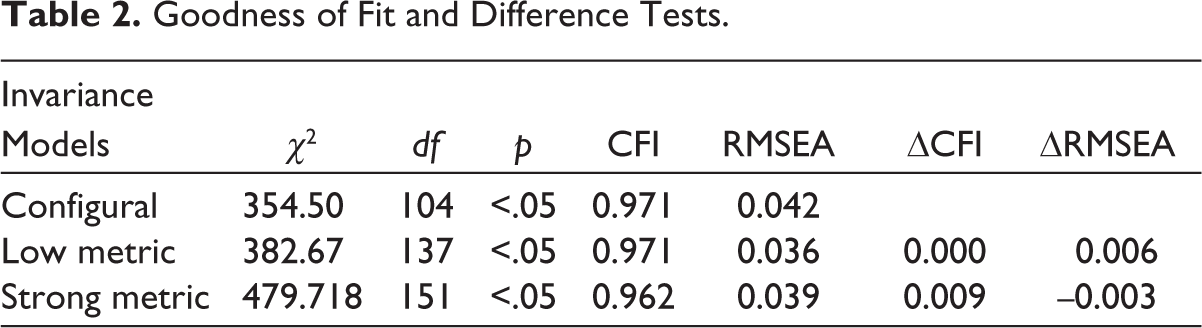
The results of the comparison between the configural invariance and the low metric invariance model indicate that no significant reduction of fit resulted by adding additional constrictions. After that, the authors of this study compared the low and strong invariance models. Constraining the indicators’ intercepts to equality across the groups did not worsen the fit. Thus, they retained the strong invariance model, which allowed them to make comparisons at the latent variable level. They also computed the reliability of the sub-scales with Jamovi (v. 1.6.23.0). The Cronbach alphas were satisfactory (αwd = 0.80; αta= 0.72; αTs = 0.77). The specific standardised results of the model are depicted in Figure 1. The model shows that the three resulting factors were positively related. The items loaded in their theoretical factors and the cross-loadings were below the critical value.
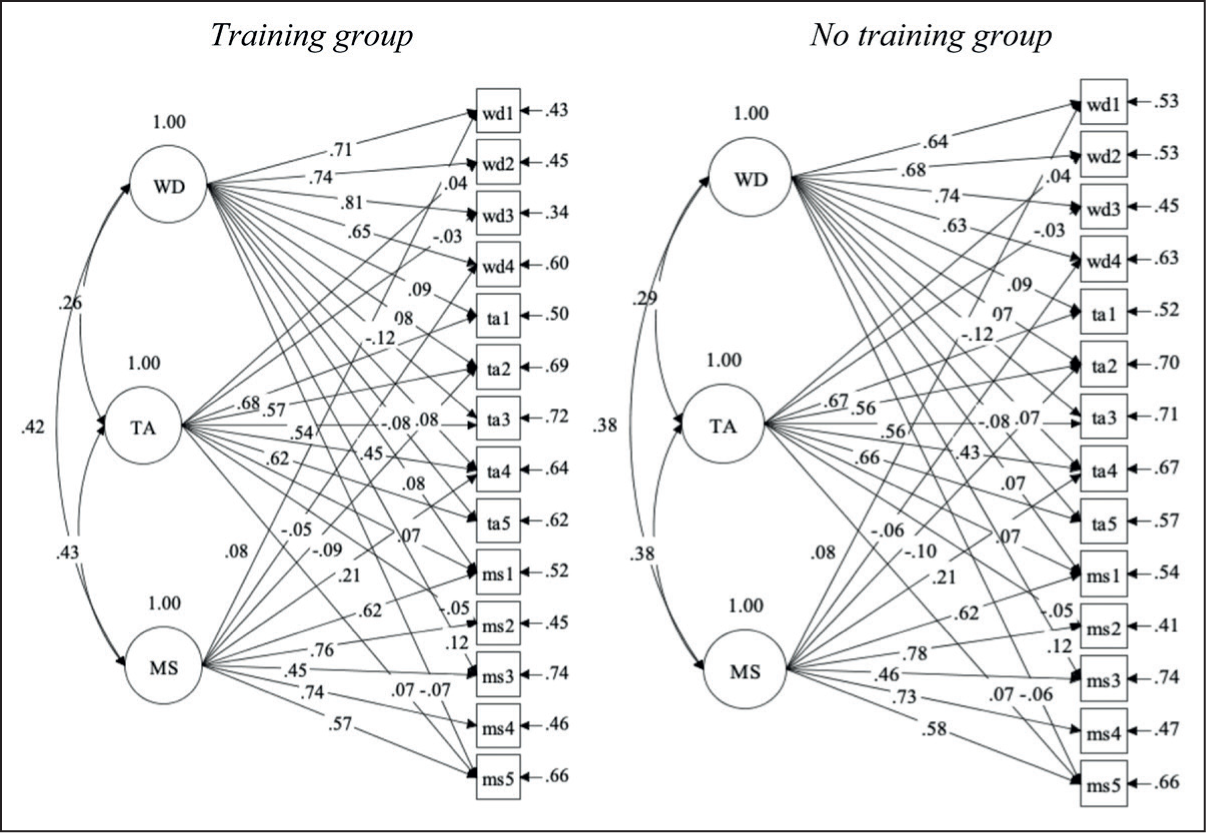
In multigroup modelling, the latent means of one group are set by default to 0. The authors constrained the latent means of the training group and noted that the estimated means of the WD and MS factors were lower for the no-training group (M = –0.22, p < .01 and M = –0.28, p < .01, respectively). They did not find differences between groups in terms of TA. With these results, they found partial support for the hypothesis of a higher corporate Entrepreneurship climate according to the employees who received training in innovation.
Discussion
The alignment of CES elements such as EO and entrepreneurial climate is of utmost importance for firm performance (Kreiser et al., 2021). Based on prior CE research and climate literature, the authors hypothesised in this study that some elements of EO, namely innovativeness, precede and impact entrepreneurial climate. The results suggest that innovation training increases the levels of two entrepreneurial climate dimensions, namely, WD and MS. These results support Covin and Lumpkin’s (2011) assertion of a need for continuous EO practices to boost recognition/perception of the firm as entrepreneurial.
Given the importance of the entrepreneurial climate for firm sustainability and performance, companies should continue to develop this corporate asset. Companies in emerging markets show a notable disparity in their capacity to create an entrepreneurial climate, leading to entrepreneurial activities. Recent studies indicate that the role of Latin American top managers may inhibit entrepreneurial behaviours, suggesting the importance of their support of the entrepreneurial activity of employees (Villasana & Lozano, 2020). The results suggest that innovation training programs are key for developing an entrepreneurial climate in Latin American companies.
In this study, the authors did not find differences in TA. Compared to the view of employees who did not participate in the innovation program, the perceptions of employees with training in innovation about time availability were not different. This finding suggests that regardless of the investment in innovation training, more efforts should be invested in TA for employees to be able to dedicate working hours to entrepreneurial activities within the organization. However, comparatively speaking, Latin American companies need to invest more in innovation and entrepreneurship. Prior research showed that employees of companies in Latin America, including Colombian firms, perceive a lack of organizational resources and incentives to foster entrepreneurial behaviours (Villasana & Lozano, 2020). Following these research results, it is plausible to think that this perception, pervasive in the region and country, would prevent employees participating in the innovation program from changing their perceptions about the TA entrepreneurial climate dimension.
In line with Hornsby et al. (2013), who used the innovativeness subscale of EO and the CEAI, the authors of this study did not find a significant correlation between TA and innovativeness. They confirm the absence of a relationship between TA and innovativeness following recommendations for alternative EO measurement techniques. They believe that future studies inquiring about the effect of innovativeness or other EO dimensions on entrepreneurial climate should adopt different operationalizations of innovativeness.
Although prior research on entrepreneurial climate has consistently used the CEAI in different emerging countries and economic sectors (Bhardwaj & Sushil, 2012; Johanna de Villiers-Scheepers, 2012; Kassa & Raju, 2015; Vizitiu et al., 2018), the authors did not find support for the RR sub-scale in this sample. They cannot contrast this result with the construct validity of the CEAI instrument in Latin America, since there is little evidence about the psychometric properties of the CEAI scale in Latin American samples. Villasana and Lozano (2020) measured and analysed the entrepreneurial climate of several Latin American companies, using a possibly different scale, the CECI scale by Morris et al. (2010). The authors did not find a reference to Morris et al. (2010) in the version of the article sent to them by one of the authors or in the Scopus citations list of Villasana and Lozano’s (2020) work. Using a principal component analysis, they found support for a five-factor structure with similar factors to those measured by the CEAI instrument. The authors report extremely high correlations (up to 0.93) between the items of the subscale evaluating rewards and reinforcement, which may suggest problems of item redundancy. The authors of this study did not find results concerning the residual variances of their items. This would have helped them to compare their results with the findings of the RR dimension of the entrepreneurial climate. The authors of this study also detected problems with the RR dimension (i.e., a negative residual variance and only two items remaining) of the CEAI in the sample and decided to continue their analysis without considering that factor. They believe that more research should be conducted about the psychometric properties of the CEAI in Latin America. Using suitable research designs and analytic techniques, other scholars would be able to cross-validate the CEAI in Latin American countries. The multigroup technique that the authors used in this study is arguably more adequate to this end than first-generation techniques. So far, studies comparing the entrepreneurial climate in organizations from different Latin American countries have used the latter (Villasana & Lozano, 2020). Employing SEM techniques would pose challenges given the relatively large sample sizes that this analytical approach requires.
Given the focus of the company’s program in innovation training, the authors of this study only studied innovativeness. Comparing trained and untrained staff in innovation allowed them to avoid existing EO sub-scales, whose dimensionality is still discussed (Wales et al., 2021). Measuring both innovativeness and entrepreneurial climates with two similar scales would have added further limitations to this study. However, since the authors only measured innovativeness, they cannot rule out that other EO practices may affect the entrepreneurial climate of the company. Studying the effect of different training programs aimed at all the EO theoretical dimensions would have helped to test this assumption. However, finding a company where all the EO dimensions are tapped with training programs can be difficult. A field experiment where distinct groups of employees are randomly assigned to training in different EO dimensions, to test the effect of each EO factor on entrepreneurial climate would be the ideal research scenario. Yet, collecting data to achieve this research design is very unlikely, and this difficulty arises in Latin American companies. The authors discuss this challenge in the following section of the article.
Limitations and Future Studies
The authors of this study used self-reported measures to assess the entrepreneurial climate and participation in innovation training of more than 2,000 employees from an emerging market multinational. Prior studies using the CEIA also used self-reported ratings (Hornsby et al., 2002, 2009, 2013; Kreiser et al., 2021). Entrepreneurial climate is best captured by self-reported measures (Hornsby et al., 2013), but the authors cannot ignore the fact that the exclusive use of self-reported measures can lead to common method bias issues (Podsakoff et al., 2003). Even though they used procedural remedies to ease common method bias such as protection of the anonymity of the participants and diverse types of measures and response scales, their results should be read with care.
Future studies using data collected from various sources (e.g., actual/objective participation in innovation programs) and in different organizations (e.g., secondary data) can confirm these findings. Studies using randomised samples can confirm the results of this attempt to compare entrepreneurial climate as perceived by employees who received innovation training and those who did not. However, conducting field experiments within firms can be particularly challenging. Conducting business research in Latin America has shown to be a challenging task. Prior analyses show that only a small percentage of business studies discuss entrepreneurial activity in the region and their result’s applications to business and industry. At least in part, this issue is due to the disconnection between academic institutions and businesses (Gonzalez-Brambila et al., 2016). The authors hope that this study encourages other scholars to conduct more surveys or field studies on entrepreneurship in Latin America. Although there do not seem to be differences in perceptions of entrepreneurial climate between Anglo-Saxon countries (Hornsby et al., 1999), given the many differences among Latin American countries (e.g., languages), future research should test these differences and international validity of the CEAI.
The authors did not collect data about the date and time the participants spend on training programs. The information about these covariates would have been useful to inquire about the necessary exposure to training in innovation to affect employee perceptions about preparedness for corporate entrepreneurship. Finally, training programs were not simultaneous, and the participants were not randomly selected and assigned to the groups. In this sense, the authors hope that field experiments corroborate the findings of their study. They believe, however, that conducting field experiments with sample sizes such as theirs can prove to be challenging in emerging countries. For this reason, they suggest a combination of observational and experimental data to further study the effect of participation in innovation programs on OPCE.
Footnotes
Acknowledgements
The authors would like to thank Santiago Arias Yepes for his participation in the data collection process.
Declaration of Conflicting Interests
The authors declared no potential conflicts of interest with respect to the research, authorship and/or publication of this article.
Funding
The authors received no financial support for the research, authorship and/or publication of this article.