




Abstract
The process of globalisation has unleashed substantial changes in the employment sector. One of the common features of this process has been discussed through the concept of the ‘feminisation of labour’. In India, most scholars have questioned this thesis given the ongoing low work participation rates among women. In this article two sites of labour—one in the traditional sector and the other in the emerging new labour context—are compared to explain the gendered structures of the new labour paradigm. In the handloom sector, male workers are leaving while women continue to work, whereas the special economic zone emerges with young women-centred jobs. The article argues that at the micro level, especially in the context of Kerala’s male labour history, a variation on the feminisation thesis is relevant. The micro spaces of these women workers must be explored in order to understand labour and its nuances in contemporary Kerala, with possible lessons for other spaces as well.
Introduction
This article explores the possibility of highlighting gender as a critical factor for conceptualisations of labour and the informal sector in the era of globalisation. It illustrates new organisational and micro-existential strategies initiated by women through their agency as workers in the changing labour scenario.
I attempt to explain the dynamic linkages between gender and globalisation, looking at the informal sector of Kerala with special reference to the handloom sector and the special economic zone. These locations of informal labour, one in the traditional sector and the other in an emerging sector, provide scope for understanding shifts in gendered labour practices in the era of globalisation. The main proposition here is that gender, restructuring of the economy and the informal sector are three significant realms that current debates on labour could focus on. This approach helps to locate the gendered shifts in labour practices by opening up a space for new interpretations of labour in the emerging terrain.
This article is based on a study conducted in the handloom sector and special economic zone located in the south Indian state of Kerala. Information was collected from 200 workers through questionnaires and 40 in-depth interviews in both sites. The management, male workers, cooperative societies, trade union leaders and government officials were other sources of information.
Understanding Labour and the Transition to the New Labour Scenario
Labour cannot be understood at the level of a particular individual’s necessity or capability but rather through the socio-political determinants that lead people in a particular position to particular jobs. Factors like caste, race, gender and so on are involved in shaping labour spaces and practices.
The very nature of work and the production process have been undergoing major changes across the world. While the term ‘work’ can apply to all kinds of activity, much of which is not paid, ‘employment’ refers more precisely to activity that is paid. Hannah Arendt had noted how the industrial revolution replaced all workmanship with labour, with the result that the things of the modern world have become labour products whose natural fate is to be consumed, instead of being work products which are to be used (Arendt, 1958, p. 124). In the modern work process the division of labour appropriates and transforms the labouring process. Mass production would be impossible without the replacement of specialised workmen through the division of labour. The ‘right to work’ was interpreted in the late 1940s as the ‘right to employment for a reasonable wage’, primarily for men in households with dependent women and children (Pahl, 1984). The classical labour model imagined a free, male wageworker working in the modern factory who was also a member of a trade union (Linden and Mohapatra, 2009).
Through the International Division of Labour (IDL) 1 which was formed in the aftermath of the Second World War, a capitalist economy has been extending its control over the production process. Production aimed only for profit led to the maximisation of profit through the maximisation of production (Hoogvelt, 1997; Munck, 2002). One of the early features of the IDL was that raw materials produced by cheap labour were imported from the colonies or ex-colonies (Mies, 1986).
Locating the Informal
The new IDL associated with the present era of global restructuring has had a profound effect on evolving labour relations. David Harvey (1990) has discussed this in terms of a general shift in the global economy from Fordism 2 to flexible accumulation. 3 Munck has added a further dimension by conceiving of labour flexibility simultaneously as a social process and a discourse. This makes it possible to open up the space to critically examine and deconstruct the dominant discourses of work in the present era (Munck, 2002, p. 73).
The prior typical masculine framework of the ‘worker’ has been destabilised by the projection of women who are seen to be better able to adjust to the new conditions of work. The gendering (and racialisation) of labour has created new kinds of working classes which need to be acknowledged and require more detailed analysis. This restructuring has created an imbalance within existing labour hierarchies because much of this new labour is located at lower levels within the production process. Informalisation is the common terminology that has been used to define this process which is often invisible even though it plays a very significant role in the labour market.
Informal activity in the developing world consists primarily of unregulated but productive activity, a means of survival for the poor in the economy (Sudarshan and Unni, 2003). Anthony Giddens has explained it in terms of the transactions outside the sphere of regular employment, involving the direct exchange of goods and services and sometimes exchange of cash for the services provided (Giddens, 2006, p. 741). The development of new technologies has further redefined employer–employee relationships where informal contracts and invisible employers characterise the situation. Multiple work assignments and multiple tasks are essential features in this new phase. Employers try to find maximum ways to reduce their fixed costs by contracting out wherever possible. This results in flexibility of labour where casualisation and instability are rampant. 4
The Informal Sector in India
The structure of the Indian labour force has witnessed considerable change over the last 20 years. Labour in Indian society is mostly understood in the language of class but aspects of culture are relatively neglected (Parry, 1999). Bhattacharya and Lucassen (2005) have argued that in a less developed country like India, the normative status of the classical proletariat does not hold. Capital uses labour according to its needs in a very flexible manner, so that labour attains only a temporary status within certain sectors, showing a tendency to shift between the so-called formal and informal spheres. 5 The rare presence of trade unions in the informal sector highlights the lack of organised strength, thus only further emphasising the vulnerability implicit in such work, apart from its scattered and fragmented nature. Household production wherein all members in the home are involved is particularly vulnerable since the total wage earned is calculated as the wage of the male in the family, ignoring the labour provided by women and others. In families where the male breadwinner’s roles have declined, women are therefore not in a position to substitute for this role, becoming dependent on whatever work is available, often drifting in and out of jobs in the context of growing informalisation. Jan Breman terms this as occupational multiplicity (Parry, 1999).
Labour in Kerala
It is necessary now to look at the question of women and work in Kerala. The question of labour in the state of Kerala cannot be understood outside of the history of communism and its creation of a politics in favour of labour rights. The land reform movement and the social reform movement initiated in the state were integrated into the working class movement causing the working class to be the dominant political force in society (Kannan, 1998; Parayil, 2000).
The welfare and rights-based policies which the state of Kerala formulated to support different kinds of workers is still a model for the country as a whole. The politicisation and awareness generated among the workers (organised and unorganised) helped weather oppressive situations, to a certain extent sustained their jobs and raised levels of wages in some sectors such as agriculture. Moreover, such collective organising prompted the state to expand the provision of social services for basic necessities like food, education, health and housing (Heller, 1999; Justino, 2003; Kurien, 2000; Oommen, 1993; Prakash, 1994). Cooperativisation of labour-intensive industries has been a particularly exemplary state initiative to uphold the rights of workers. But this is not the whole story. These developments effectively excluded large sections of people—women, Dalits, tribals, fisher folk (Dreze and Sen, 1991; Kurien, 2000, Rammohan, 2000; Saradamoni, 1991). Moreover, women’s issues like rights over one’s own body, right to mobility, decision making, inheritance rights, right to work, etc., were not part of the model of development that was promoted. Social issues like dowry, sexual harassment, domestic and public violence have become quite visible within Kerala’s public sphere in different forms. Critical analysis of the land reforms further showed that women in landowning households were involved extensively in various aspects related to the management and cultivation of land, and yet in enumeration the work participation rates of women in Kerala are shown as being much lower than the national average (Kodoth, 2001; Kodoth and Eapen, 2002). This is because women, although involved in a wide range of work on the land, identified themselves as housewives. 6
Anna Lindberg, while studying the cashew workers of Kerala, has shown how women workers were directed towards the home through a range of strategies by state officials, employers and their own trade union representatives (Lindberg, 2001). Though statistics reveal the increase in women’s employment in Kerala’s ‘informal’ sector, this employment is in the nature of casual and irregular contractual labour. Moreover, though women’s earnings contribute substantially to the household, this is often devalued if not denigrated. Women, especially from the lower classes and castes, not only have to cope with physical hardships that affect their health but continue to be paid much lower wages than men in the same category (Eapen, 2001). A new phenomenon has emerged on this scene—women, especially young unmarried girls, are leaving their homes to work to earn their livelihood. Traditionally, it was the men who left in search of work, leaving their households to be sustained by women. This development has not received enough attention within academic research.
This article is based on micro studies within two sectors—the handloom industry and the new economic zones. While comparing the work experiences of women in the two sectors, we will have occasion to see what kind of transition is occurring in Kerala in the context of a long history of a largely male working class, and the changing structures within which these women are struggling to survive.
The Handloom Sector
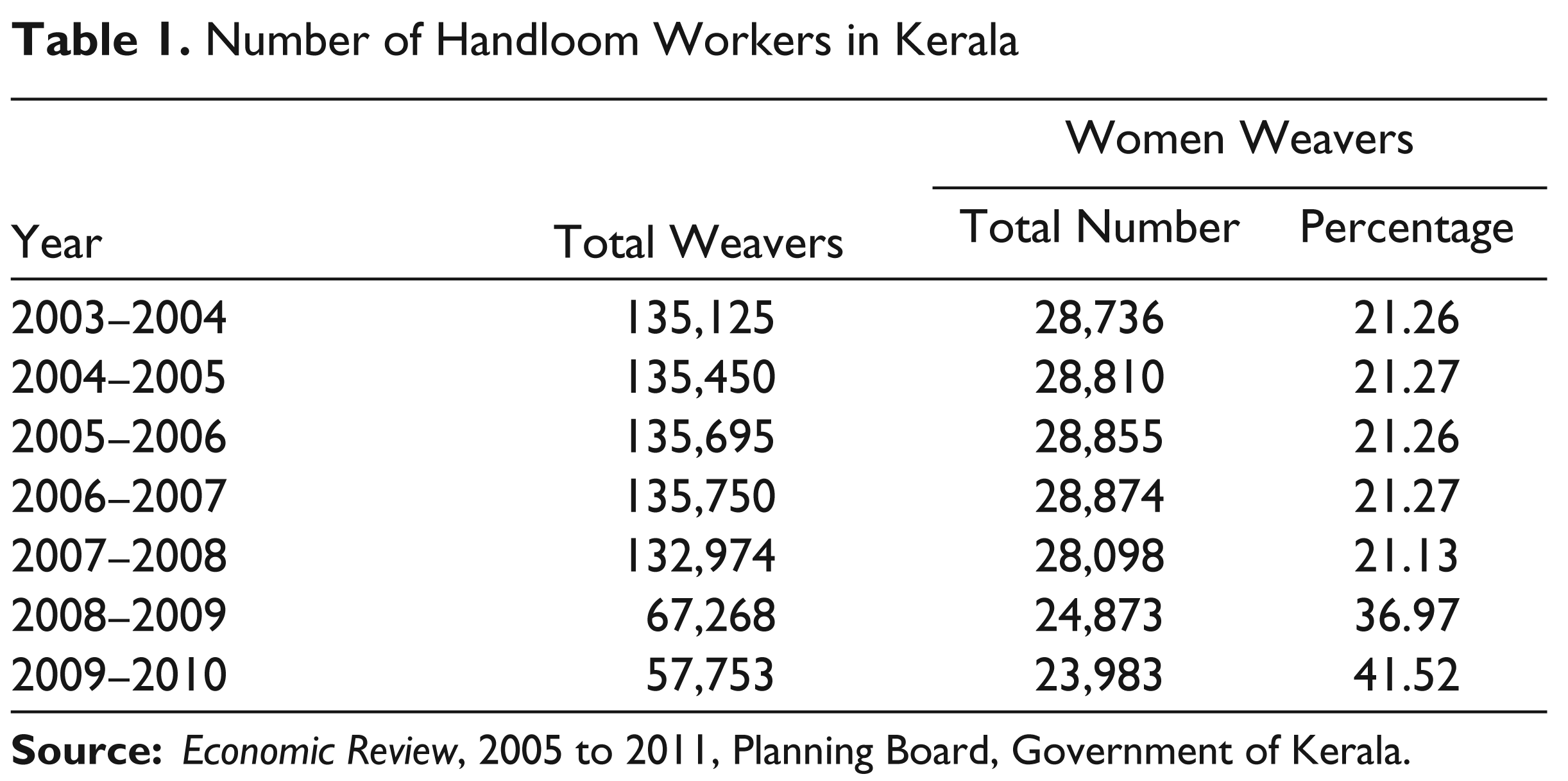
The handloom sector, one of the primary traditional sectors of Kerala, has played a significant part in the state’s history. Next to coir, handloom is the second most important traditional industry in Kerala, employing about 0.2 million persons. Though this industry is spread across the state, from its inception it has been mainly concentrated in two districts—Thiruvananthapuram and Kannur—where 75 per cent of the total number of weavers are in cooperatives, which were introduced as an explicit measure to protect the unorganised handloom weavers from exploitation by outside forces. They have been supported by government policy through various official channels and planning boards. The procurement and marketing of handloom fabrics in the state are undertaken by two state level organisations—Hantex and Hanveev (Eapen, 1991). And yet, in spite of these state initiatives the handloom industry is on the verge of a crisis as a result of which male workers are slowly disappearing and the industry increasingly depends on a female workforce (see Table 1).
Number of Handloom Workers in Kerala
The Special Economic Zone
Special economic zones (SEZs) are, as the name suggests, segregated zones or areas which house new forms of export-oriented production. The SEZ in Cochin was started in 1981 as an industrial township on 105 acres of land, 7 where garments and electronic centres are the major production units. At present there are 87 industries functioning in the zone, providing employment to about 12,000 workers, according to local sources. 8 However, official records claim that there are only 8,000 workers 9 in the zone. Exact figures are not available because of the nature of work practices there. Different units engage in a wide range of products including electronic hardware, software, ready-made garments, engineering products, plastic, rubber products, spices, marine products, coir products, tissue culture, gold, diamonds, ceramics, food products and sanitary ware. Of the total number of workers employed, 70 per cent are women, a large proportion of whom are unmarried and between the ages of 18 and 30 years. They are educated but from poor families living in neighbouring districts. 10 There are four categories of labour involved in the SEZ: permanent, temporary, casual and contract labour. Facilities like a canteen, accommodation, crèche, etc., do not exist. In certain industries, workers are appointed as apprentices or trainees, a practice which helps the employer to escape from labour laws. The minimum wage is not respected by the majority of companies, according to the labour enforcement officer (SEWA, 2001). Most of the companies do not come under the provision of the Minimum Wages Act, and most of their products are not notified.
Gender and Labour
Attempts to understand the gendered dimensions of globalisation compel us to reconsider some of the key issues in feminist methodology and research. In most literature on third world women’s participation in labour, there is a tendency to treat them as victims of class, racial and sexual ideologies instead of giving prominence to the social agency of women who are caught within contemporary forms of capitalist discipline. Therefore, there is a need for studies that try to understand them as agents who make choices, hold a critical position in their own situations and who raise symbolic forms of resistance (Mohanty, 2003, p. 72). Questions of gender, class and caste take a new turn when the ‘feminisation of labour’, 11 especially that of third world women, becomes a reality. In this context I would like to look at the different arguments that have been circulating around the issue of the ‘feminisation of labour’. The ‘feminisation’ thesis is one of the prominent forms that the restructuring of economies in the globalisation era have been taking, and is associated with the work of Guy Standing and others. Many scholars and activists have argued that the whole issue of feminisation requires much more scrutiny especially in the Indian context, given that our labour markets and women’s working patterns have been significantly different from other countries. Nirmala Banerjee (1997/2008) by examining census data between 1981 and 1991 has argued, for instance, that increases in rural women’s work were mainly confined to agriculture. She has, therefore, sounded a note of caution and pointed out the limitations of Standing’s concept for generalising on the question of feminisation in India’s labour markets. Based on studies undertaken in Bombay, Nandita Shah, Sujatha Gothoskar, Nandita Gandhi and Amrita Chachchi (1994) have also looked critically at the argument that structural adjustment policies (SAP) will tend to lead to the feminisation of labour in the Indian context. They have argued that many micro studies have proved the contrary, with women in several industries being the first to lose their jobs. Varma and Neetha (2004), while undertaking a study of women workers in the SEZ of Noida (outside Delhi in the state of Uttar Pradesh), say that export-oriented production processes cannot simply be explained in terms of the feminisation of labour. Feminisation, they argue, is only visible under specific conditions, such as, highly exploitative working patterns and very low wages.
My argument is that while it may be true that there are no large trends favouring women as workers in the contemporary economic landscape, this does not mean that the notion of feminisation cannot be a useful one. In the context of Kerala that I have briefly outlined earlier, which saw the emergence of a small mostly male working class with some labour rights and comparatively better conditions of work than in the rest of the country, the current transformations and restructuring underway also include increasing numbers of women workers. I would suggest that they represent a variation on the feminisation thesis, one that is therefore peculiarly applicable in a state like Kerala, if not elsewhere in the country. The two sectors I am exploring, one old and the other new, give some strength to the kind of relations between gender and labour that I believe are emerging in this state. Beyond the usual indicators of social development and economic status, I would also suggest that women’s labour practices are extremely significant determinants in the micro politics of daily life and for women’s sense of self.
The Handloom Sector and the Special Economic Zone—Spaces for Comparison
While interpreting the emerging shifts in labour it would be illuminating to compare the two sectors. Labour practices which are economically and culturally diverse are unique to each sector. Handloom, being an old industry, has seen enormous changes and shifts in recent times. Precisely because it is undergoing considerable informalisation, against a history where the handloom weaver was overwhelmingly male, the question arises as to who is able to adjust and manage as the industry is transformed. Marianne Marchand says that for women to enter an environment associated with hegemonic masculinity is difficult because they are likely to face obstacles or barriers to their work resulting from the implicit notion that these women are ‘out of place’ (Marchand, 2006, p. 266). In the handloom sector, my research has shown that women were not considered as workers at any point. The working arrangements and the facilities available make this quite explicit. This is the context in which women weavers are becoming the prominent workforce as men continue to leave this form of employment. Feminisation is happening here because men are going away while the women stay on.
In considerable contrast, the SEZ is a recently developed industrial area with specific amounts of space allotted to each industry. It is intended to be a female-dominated workspace which is completely based on production outputs. What needs special attention is that here ‘feminisation’ is taking the form that occurs generally in other parts of the world, that is, the new globalised workplace is creating work explicitly for women and not for men. It is associated with all the features of women’s work, such as, low pay, docility, dexterity and no signs of unionisation. The managements in the special zone were very reluctant to say anything about their industrial spaces and the conditions of work there.
Shifts in Labour Practices—Remaining and Emerging as Workers
In the handloom sector, the identity and representation of the workers associated with it, the skills they possess, the symbolic interactions the workspace offers, and so on, maintain this sector within its traditional confines. 12 To begin with, the women here represent themselves as skilled workers, as women who had hitherto played supporting roles, winding the thread for example, have now had to acquire the skills of a weaver.
Sanita
13
who works in a private cooperative society talks about herself:
I am from a weaving family. From 13 years onward I started doing the tharuchuttu (winding). After marriage I went to the [cooperative] society to learn weaving. There I learnt to weave sarees and mundus (dhothis). I work from 10 am to 5 pm in the society and can finish a saree within one and a half days.
Ponnamma who is a home-based worker shares a similar background:
My parents were traditional weavers. From my childhood itself I was given the task of noolu chuttu (winding) to help them. My parents used to make dhothis and sarees. But I learned weaving only when I grew up and then I got married into a weaving family, where I continued with my work.
Padmini from Balaramapuram is a weaver at a private cooperative society. She says:
My parents were weavers and I learnt winding when I was 14 years old. I used to help my parents in weaving until I got married at the age of 17. I have two daughters. When I was 30 my husband absconded from home, I had to take over full responsibility for the family. Then I was determined to learn weaving for which I got training from the society where I was working. Now I know how to weave dhothis, shirt materials, etc. and earn Rs 50–60 a day.
Employees in the economic zone are young girls who leave home in search of jobs after a high school education (Class 10 to pre-university), migrating to a different social and geographical destination which could offer them some space for themselves. This new attitude towards work on the part of a young woman just out of school should be seen in relation to the changes happening in capitalistic society. The shift from a predominantly agricultural society to an industrial one has raised multidimensional issues in this process of transformation. The concept of work itself has changed, with the kind of social status associated with it. The present pattern of education fails to impart skills by which the young could be expected to live. Young women coming in search of work in the SEZ are not trained in skills, and are unaware of their choices and rights. This was reflected in their selection of work, wages and attitudes. Away from home, they are ready to do any kind of work, and are easily exploited.
Sini comments:
I saw the newspaper advertisement of jobs [available] in Leela Lace [the company]. My home situation was so pathetic that without a second thought I came in search of that job. I didn’t ask about the salary or the benefits I am entitled to, nor did I have any idea about a minimum wage either. When I started work, I got Rs. 1000 which seemed a reasonable amount on which I could live.
Janitha from Idukki has been working in the SEZ for the last seven years. She says:
I lost my parents. My father was a watchman on an estate. We had to sell our land for Mother’s treatment. I have three elder sisters. We are living in the estate quarters in our father’s friend’s house. The pathetic situation in the house prompted me to search for a job and I finally came here.
Rekha says:
I have a mother, sister and two brothers. One brother got married and the other is physically disabled. My father abandoned us when we were young. He used to torture my mother a lot. My sister never went to work. I was determined to work and looked at many sources of employment. First, I worked in the fish processing industry in Eroor. Then I heard about the Cochin SEZ in 2001 and through a contractor I joined here.
Many of the girls in the SEZ have had similar experiences. Their narratives illustrate the complexities of their urge to work and find a means of livelihood, and the factors that push them towards the means of survival. While in the handloom sector it was the family situation that prompted them to acquire weaving skills, in the SEZ precarious family circumstances, age and status combine to shape workers’ attitudes and hopes.
In the mid-1970s the handloom sector acquired the status of an organised sector following modifications in its structure of work with the formation of cooperative societies, primary societies and apex societies. But recent events have created havoc in the sector with the state completely losing control over the export market. The multi-fibre agreement that came into existence in 1992 was a real setback. According to official statistics the number of workers is much reduced in this sector which is currently visibly unorganised. The introduction of power-looms and mill cloth which is cheaper than handloom cloth had led to the gradual decline of the handloom industry and male workers could not survive long in this sector. Now women have stepped in to fill their places at the looms. While discussing this shift it is important to consider the issues of skill, the status associated with weaving, 14 the family situation and the oscillating trajectory of the industry.
According to Gherardi (1995, p. 138),
The realm of work is completely masculine. As men assume the labour as work, for women labour is reproduction. This is a symbolic construct common to all cultures; and the celebration of the symbolic order of gender places work and its organisations in ‘reliable’ male hands.
Such a gendering of labour is applicable to the handloom industry in Kerala. Women entering the workforce are fitted into a framework where the norms and rules have been formulated with a clear male bias, thus directly affecting their behaviour in the workspace. Identifying the spatial dimensions of marginality could help challenge the traditional male dominated frame of work. Most of the women start their work only at 9 or 10 in the morning. Very few begin work before 8 am, since they adjust their work timings according to needs at home. When men weave, they work for 10–12 hours a day, while women can only work a maximum of 8 hours. Thus, working class women’s experiences are significantly different from men’s. Family has been the important responsibility of women as they move in and out of the workforce according to family need (Morgan, 1992).
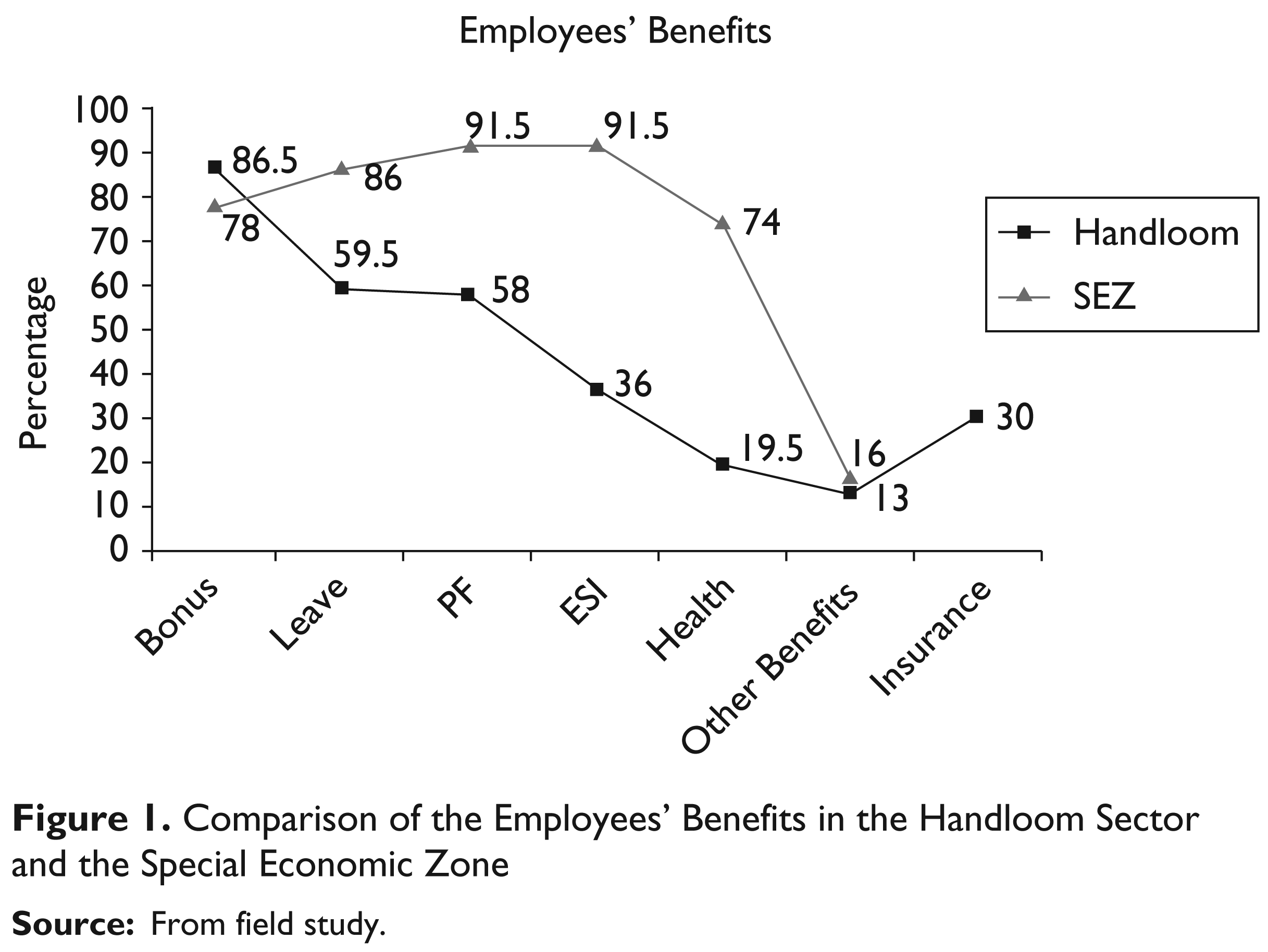
The work narratives of women workers in the SEZ reflect a different reality. In the newly developed industrial zones, although facilities like breaks, ESI, provident fund and bonus are available for workers, the worker is controlled in ways that lead to a different set of human rights violations. In the SEZ, work timings are very strictly followed with 8–12 hour shifts; overtime is paid only when the daily target is reached and workers have finished the prescribed extra work. Officially, there are breaks with facilities for the workers but they are not able to take them because of the overburden of the targets they have to meet. Sometimes permission is denied even to go to the toilet. Many of the workers revealed the extreme difficulties they experienced during menstruation. The fear of losing the attendance bonus forces them to work without breaks despite great physical discomfort (see Figure 1).
Leela Lace is a famous garment company, where Rani has been working for the last six years.
In the beginning there were more than 1500 workers, now reduced to 500. If we work for 26 days we get Rs. 100 as attendance bonus. There is a punching system. The target is 50 pieces per hour but the most we can do is 35. Every day there is pressure [on us] to increase [the target] and there are threats of shifting us out if it is not increased. Rs. 16 per hour is paid for overtime. Nobody will remain there permanently.
Siji has been working in the SEZ for the last eight years. In between she got married to a worker there and she now lives with her family in one room in the extension of a house where other workers also live. She narrates her experience like this:
They took my pass and pressed me to do overtime. Pointing out some mistake in my stitching, the supervisor banged my head on the machine. Blood started coming out and nobody bothered to take me to the hospital. That was my last day in Leela Lace. After a break I joined a gloves company, Primus. I had to check the gloves before packing. One day’s target was 12,000 pieces. They never allowed us to drink water in between or even to go to the toilet. I suffered urinary infection many times. If we go to the toilet and get delayed by even one minute the supervisor will shout at us. My second pregnancy got aborted. The atmosphere is full of dust. I have severe throat infection as a result.
In the SEZ, workers have to work for the prescribed amount of time and no interactions are possible during this period. Rajani describes the situation as follows:
Once we enter the premises of the company we are totally different persons. There won’t be any communication between us and we are not treated like human beings. We are not allowed to have any contact with the outer world and even if there is some serious information for us we are not informed till the target is reached. If we go to the toilet and are late by even one minute, they shout at us as if we don’t have any basic rights.
Without looking into the multiple roles that women take on in the course of their lives it is difficult to come to the right kind of analysis of the work situation, including the kind of ‘feminine habitus’ that they occupy, where the nature of work traverses both private and public domains (Adkins, 2004). Considering women as subjects of labour could make new interpretations possible. In my interviews with them, the women in the handloom industry have emphasised their family situations and responsibilities. Their labour identity is influenced by a strong sense of familial responsibility that sustains them throughout their lives. When husbands moved away from the traditional industry, died or were alcoholics, women were pushed into a position of sole responsibility. Many women work with multiple responsibilities within the home, in the workplace and in their social sphere.
Sheela (42), a weaver, recounts her responsibilities:
My husband died two and a half years ago and I have two children. I used to work for daily wages. My husband never took responsibility for the family and was a habitual drinker. After my daughter attained puberty I stopped going to work outside the home. I took a loan and put two looms in my house.
Anitha from Kannur works in a private factory:
I am 42. Six years ago my husband passed away. I have three girls. My parents were weavers. I learned weaving from the Khadi Society [where] I worked for ten years and in another factory for seven years. I am now weaving furnishing items for export here for the last four years and can weave 50 metres per week which gives me an average of Rs. 500 a week. We have to reach at 8.10 a.m. sharp in the morning to get our token. If we are late we will get only three fourths of our DA [Dearness Allowance]. I used to be regular at work; otherwise my family will be in trouble. If there is any mistake [in weaving] we have to deal with it ourselves …otherwise there will be a salary cut. We used to get bonus for festivals and also PF, leave, ESI and gratuity. But we are under pressure to reach the [daily] target.
Many workers in the SEZ shared similar stories. The girls maintained minimum living standards. Early in the morning they would cook some rice and a curry made out of potato, tomato and onions. They ate the same food at all meal times on any given day, trying to save as much money as possible.
Sunita, who was married, had this to say:
I have two children. Our family has undergone a severe economic crisis. We now owe more than Rs. 1,50,000 to someone. This has created much tension. I came to the SEZ in search of work as we couldn’t find any other way to pay off our debts and I used to do overtime too to earn more. Out of [my wage of] Rs. 2500 I spend only Rs. 500 on living expenses and the rest I send home. Out of Rs. 500 I spend Rs. 300 on rent alone, for the space I live in.
The burdens of social reproduction remain utterly invisible and devalued within these labour situations and conditions of overwork and paltry entitlements. Prospects in the handloom sector are dismal. The buildings where weavers work have no facilities such as toilets and rest rooms and are full of dust and cobwebs. No maintenance work is carried out in the places where the looms are installed; most of the workers suffer from breathing problems. The members of one famous cooperative society which was once owned by a private owner spoke of their plight:
Everyone is saying that the government provides benefits, but we don’t know about it. We used to get all the benefits. We have been here since the owner’s time. Now we don’t come here regularly and for our survival we are forced to do other work, like domestic work or coolie work. Our P.F. has not been paid for the last eight years. Now attendance is not registered and we do not have passes, which means we are not entitled to any benefits. Five months’ wages are pending. We used to get a medical allowance of Rs. 150, but now even that has been stopped. There used to be a strong trade union presence on the premises, but now there are no unions at all. Out of 117 looms, only 15 are functioning now.
A worker from one of the oldest and biggest cooperatives in Thiruvananthapuram commented, ‘We have not been paid for many months now. The buildings are in a very pathetic condition. Bathrooms are not usable. We continue to come here hoping that when we retire we will get some benefits.’
Both these different work situations raise questions in relation to women workers where new issues are arising in the workplace. Facilities in the SEZ were makeshift on the assumption that such arrangements were temporary. The strategy of the management was to retain flexibility of movement so that units could be shifted at any time to locations that would attract cheap labour.
Skill and Output
It is evident from the existing literature on the new economy that it is the market that is increasingly determining work, the conditions of work and the kind of worker required. Women in both the sectors have no control over production or the market. Their role appears to be only that of reaching targets in order to earn subsistence income. It is difficult to make a cost–benefit analysis in such a context.
In modern times, skilled manual workers have been getting deskilled. When they shift from traditional to other sectors, definitions of ‘skill’ change (Bolton, 2004). Women are rarely exposed to opportunities for developing modern skills. Women continue to work in traditional economic activities like weaving work long hours alongside their domestic household work. Such activity has the value of being an important source of their identity and agency. They are proud of their perfectionism in their traditional skills. Vijayan is a private entrepreneur who procures finished quality-tested goods, and supplies them to leading textile shops in Thiruvananthapuram. Shobana, one of Vijayan’s suppliers, says:
I always come up here to supply my products (dhothi). The muthalali (owner) is so pleased with the quality of my work that I get a good price for it. I won’t compromise on quality and both of us are satisfied with our deal. I get Rs. 180 for a finished mundu which is higher than the local price.
Rani is a worker now in the Safe Shield Gloves Company. She is a temporary worker, and started working in the SEZ in 2001.
I first came to work in Leela Lace through a friend and met a contractor to whom I had to give Rs. 5 from the 50 rupees I got. I worked there for some days and then joined the AVT tissue culture company. Later, I had to work only on alternate days. Then I joined Primus, a company producing gloves where I worked for four months. I checked gloves before they were packed for which I was paid 500 per week. Because of the dust I couldn’t continue there and went back home and worked in the paddy fields. After some time, I came back and joined the Safe Shield glove company, where I am working now. When I joined it I used to get Rs. 50, with an increment of Rs. 5 every six months. On Sunday, I get Rs. 120 and since this is not a permanent appointment there are no other benefits. Sometimes I have to work on night shifts too for which I get paid Rs. 10 per hour with meals.
Conditions of work in export processing zones are precarious and this is so also in the Cochin SEZ. While workers are categorised as permanent, temporary and contract, most of the companies do not keep any permanent rolls of workers. Workers are provided with a ‘gate pass’ and a ‘photo pass’ for identification before gaining entry into the company premises. Temporary workers only get a pass for 3–6 months and have to renew it periodically. Without continuous work for the year, they have to put up with layoffs and wait for the next call, or they will be sent away permanently. Supervisors of some companies are very rude and the management would never compromise on any inability on the part of the worker. Only permanent workers can avail of benefits like ESI, Provident Fund and gratuity. Contractors supply workers to the companies and charge brokerage fees from workers.
Sunitha is a contract worker in the Sandrea Gloves Company. She says, ‘Now I get ₹3100. But it is on contract and it is the contractor who pays us. We don’t have any idea about how much the contractor takes. We cannot go on leave. Deductions are made for our PF and ESI contributions.’
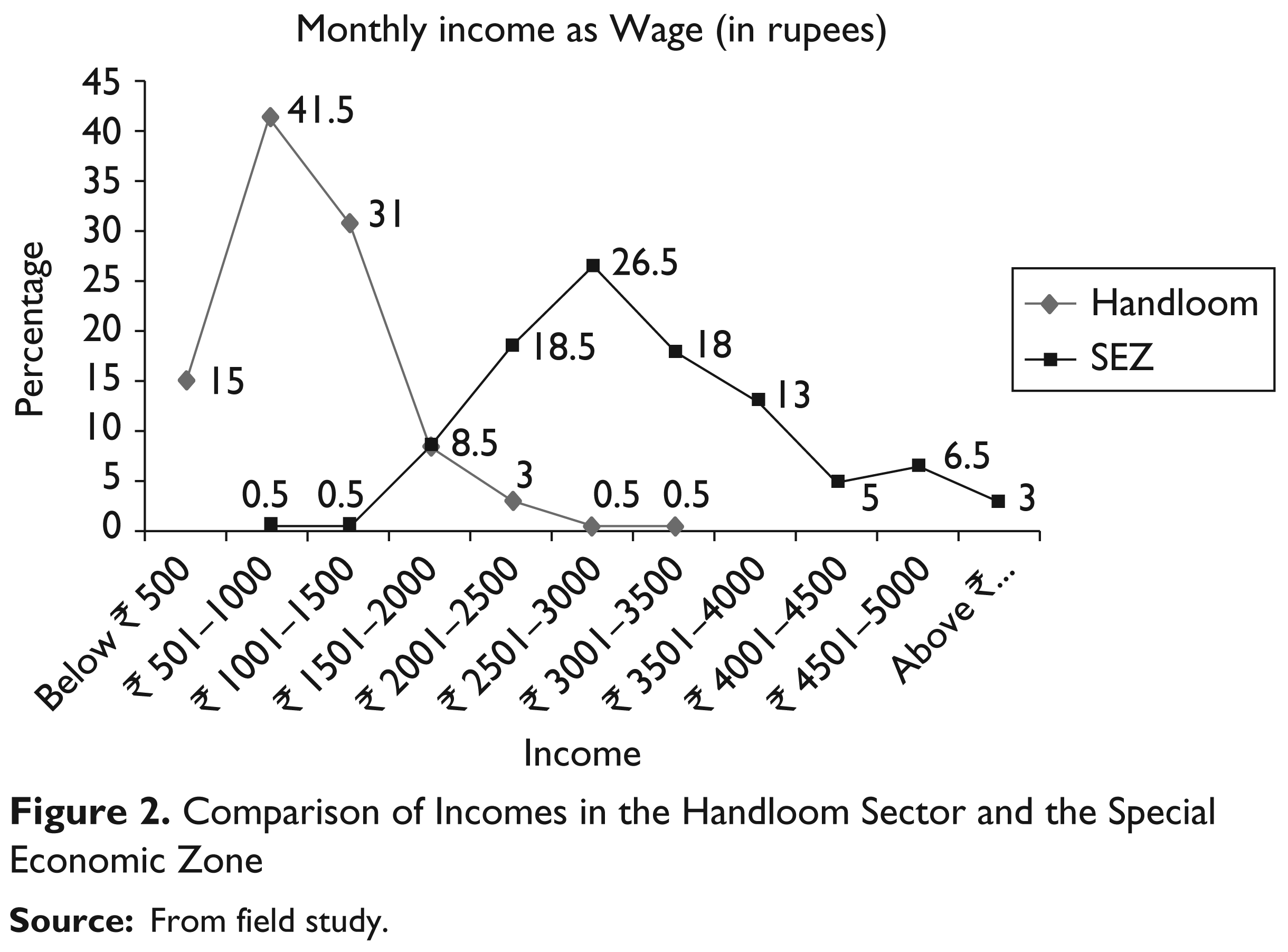
The two sectors exhibit different wage patterns. Women in the SEZ are paid more than women in the handloom sector where the wage is determined by the number of pieces each worker turns out. This, as discussed earlier, is again related to the time and responsibilities of a particular worker. Without considering the time that has been spent for social reproduction, it is difficult to compute the wages of a woman worker who earns an average monthly income which is as low as ₹1,000–2,000.
In the SEZ, workers are paid an average of around ₹2,000–3,000 (Figure 2). But considering their work and experience, they are not drawing even the minimum wages prescribed and of which they are not even aware. Targets at work are much higher than any normal person can hope to complete. However, within a short time they get adjusted to the demand for maximum productivity. Boys working alongside the women earn more than them.
Age, Work and Identity
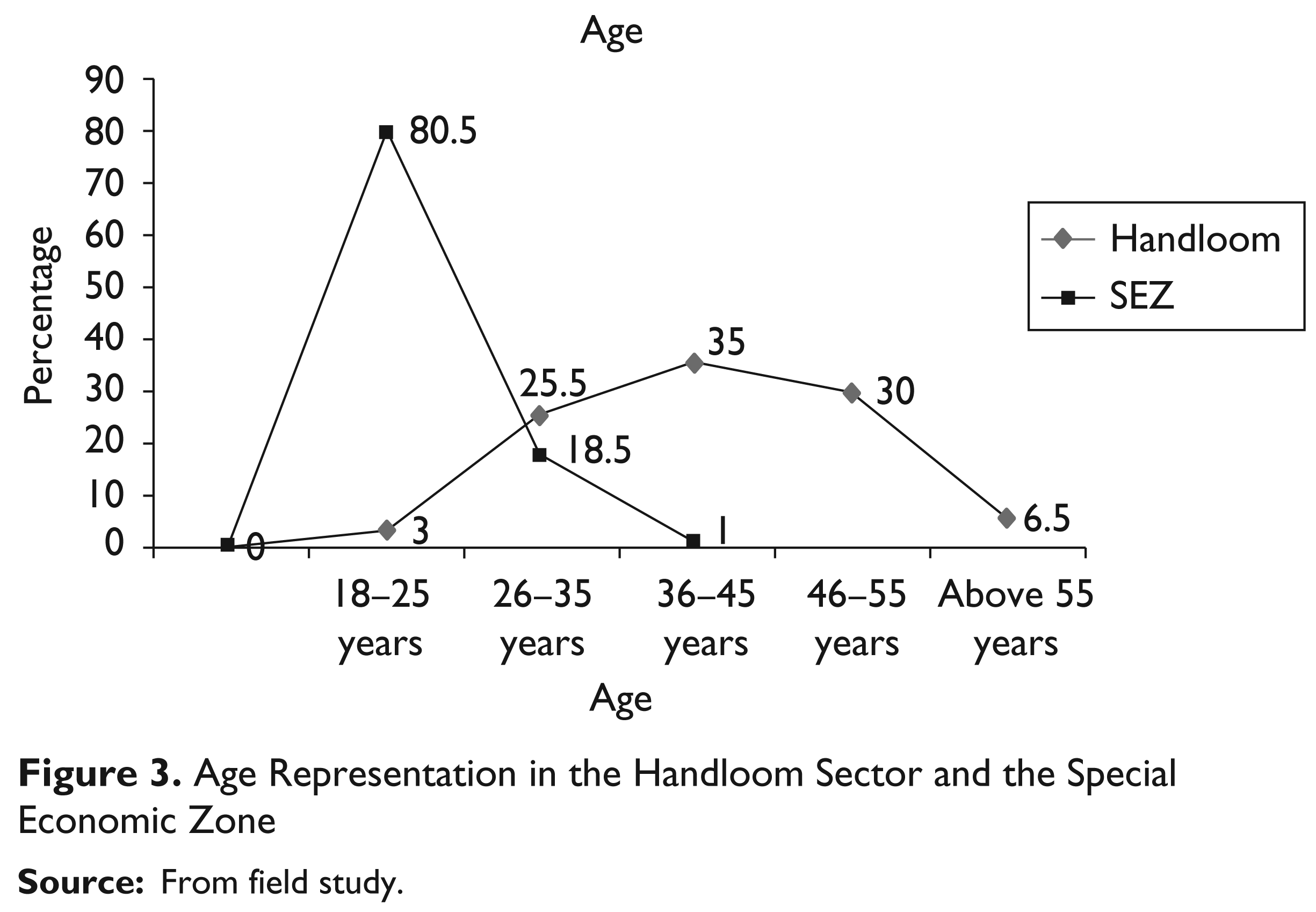
In the handloom sector the majority are middle-aged women. Very rarely do young women come into the industry. Most of them emphasised that they would not like to encourage their children to enter the industry. Anitha, a weaver, says, ‘I work very hard to earn my living. My family situation never allowed me to continue my studies. But I am very particular that my children should get maximum education and secure jobs. I work only for that.’
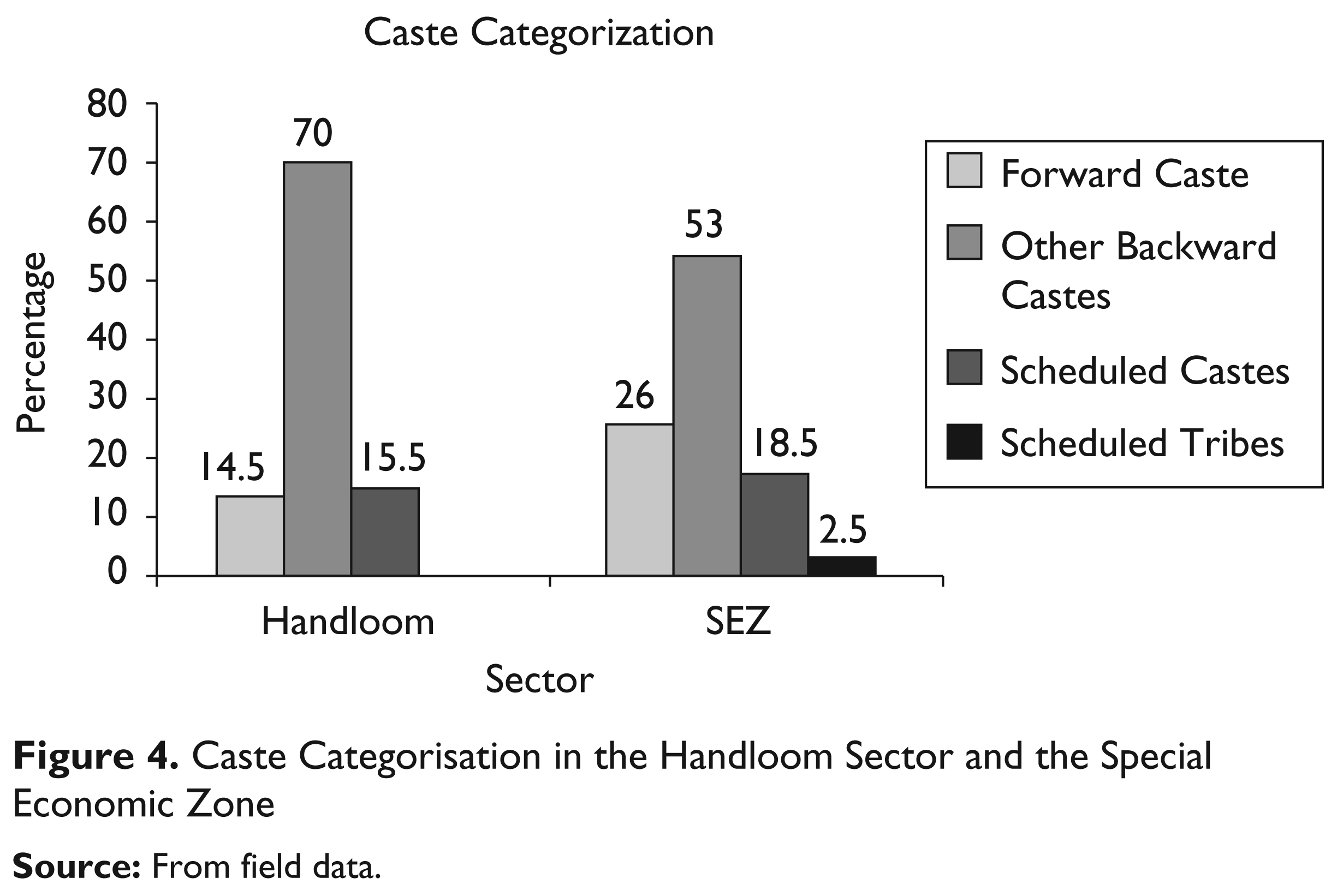
In the SEZ, as the statistics clearly show, the majority are young women who come from different socio-cultural backgrounds. They leave the workplace after a few years of work which is precisely what the work structure intends and perpetuates. (Figure 3 shows age of workers and Figure 4 indicates caste representations.)
The very question of employer responsibility in these sectors is becoming less significant, particularly since women are willingly becoming entrepreneurs, finding and managing their own work. Home-based work is becoming a more accepted and flexible form of work, where the worker is considered to be ‘self-employed’. Krithika and Thanima are two new projects simultaneously designed for north Kerala and south Kerala by the Handloom Development Corporation (HDC) to support home-based looms. This initiative gives women access to certain spaces in their homes where they can function according to their own requirements. Here entrepreneurship replaces labourer status and the rights associated with it.
While in the cooperativised sector women wait for the day when they will get benefits, women working independently on their own looms hope for better prices so that they can stand on their own feet. The middle-aged women weavers express the thrill that their skill gives them and want to progress higher in the labour market with improved skills. Although these women are now playing a larger role in the labour market, neither the state as ‘protection providers’, 15 nor employer, family or society appear prepared to make any changes to accommodate the changes workers desire.
Rathi, a 49-year-old single woman, spoke of her life:
I am living with my sisters. Because of financial difficulties, I couldn’t marry. I used to worry about that, but now I have overcome that. One of my sisters is also not married. The family property (15 cents) is in both our names. We live by our hard work. My parents were from this tradition—Father wove and Mother did the winding. I have learned the skill of winding from my mother. At first I used to go out on coolie work. But for the last 13 years I have been a weaver. Sometimes there is no work. If there is regular work I get Rs. 250–300 per week. I have decision making power in my family. I have taken a loan for the house and am repaying it only through these earnings. I would like to work as long as my health permits.
The male breadwinner role may have altered and suffered in this transition, but the responsibilities of social reproduction continue to be with women. Moreover, in the case of lower caste women, caste hierarchies force them into situations of subservience in the wider society. At the same time, young women have to work to earn a ‘dowry’ for their future.
Raji from Idukki said of her plight:
I come from an agricultural family. We have one acre of land on which rubber and pepper are grown. I have studied till the 10th class and my brothers are drivers. I wanted to study more but to go to school I had to walk eight km each way and that made it quite difficult. We couldn’t live on the yield of our land and when the situation became worse I started searching for a job. My parents are really concerned about the dowry they have to find for my marriage. It is difficult for us to find work in our own area. I saw an advertisement in the newspaper put out by a garment company four years ago and came here. I thought that I could at least take care of myself and save some money towards my marriage.
There are continuous conflicts between the women’s work within the realms of production and social reproduction. Saskia Sassen (2004) has found a systematic link between the growing presence of women in diverse circuits and the rise of unemployment, shrinking male employment opportunities, debt and falling government revenues. Bringing all this together she calls it a ‘feminisation of survival’.
Most of the SEZ workers have expressed their unwillingness to work after marriage. Discussions about work in the future held little enthusiasm. Nonetheless in their present workplace they nurture aspirations. Years of work experience have given many of the workers the ability to recognise the exploitation they suffer, and to understand and address it at various levels as workers.
Consciousness and Organising
Both these sectors vividly demonstrate the failure of class organising and class consciousness. This was clear from the case studies and the questionnaires. Preference for women’s labour is rampant as it is considered cheap, flexible and scattered without a chance for organisation. In the handloom sector, traditional trade unions are very weak, visibly unable to address the real issues. Trade unions organised by men only seem to look at the issues from their perspective. In an industrialised society work and workers’ rights are typically placed in a fixed frame where the trade unions stand for the rights of only workers who are male.
When women replaced the male workforce, their invisibility continued, without proper representation of women as workers. This phenomenon points to the deficiencies in existing labour organising practices and is clearly manifested in the handloom sector. Meena is working in a Dalit cooperative society in Kannur, and articulates this problem:
When I started working there were 70 people who used to come to work regularly. There were seven men in the society but none of them are there now. When they were there union activities were very strong. But when they dropped out, the union came to a standstill and we women never got together or showed enough interest to sustain the union. We now really feel the absence of the union. We always feel that there is no one to represent us and nobody is willing to come forward either [to do so].
The restriction on organising is one of the main issues discussed in the SEZ debates (Chhachhi and Pittin, 1996; Edgren, 1982; Lee, 1984). Export-led growth distorted labour relations instead; new strategies and reshuffles took place in defining ‘labour’. The rights of unions to organise and bargain collectively have been reduced significantly since the 1960s, export processing zones emerging as industrial spaces promoting the passivity of workers (Edgren, 1982).
Raji, who is working in Tata Ceramics, mentioned her disappointment:
I am a temporary worker. We have many complaints about our salary and working conditions. We don’t have a space to present our issues. Permanent workers have a union. Some of the temporary workers who joined the union have been thrown out by the management. We are really afraid now, we cannot even support them. I would like to be part of union activities but now I don’t have an option.
The anti-women nature of the trade unions failed to accommodate specific gender issues or to rise to the occasion in the face of infringements of regulations. ‘Hire and fire’ 16 is a common phenomenon within the economic zone, where there can be no voice of resistance. Unionising is not permitted inside the premises. The majority of the women did not feel the need for a union. Only a few worked for and in the unions. The reality of women’s indifference to unions and the advantage capitalist industrial settings gain from this raise new questions concerning labour in today’s context.
New Meanings in Conceptualising Labour
These cases have revealed some of the ways in which the global economy acts through its multiple locations whether they be in traditional or newly created sectors, here visible through the links one can make between economies and the survival strategies of women. This type of transformation creates a new labour culture and practices. In the specific context of Kerala where gendered transformations in labour are taking place, workers are denied work, or benefits, or the sector itself is disintegrating. In some situations women workers end up as individual entrepreneurs with some support offered by the state. The suitability of women for repetitive and tedious jobs, with no chances of organising because of their submissive nature, is projected as an advantage. A symbolic feminisation of the economy is constructed at the level of both the workplace and the state (Marchand, 2004).
Kathy Weeks refers to labour collectively as the variable practices that are constitutive of ever-changing forms of existence and modes of subjectivity. By challenging the traditional gender division of labour, she locates labour as an immanent and creative force of social production and historical change (Weeks, 2004, pp. 184–185). Women’s work sites can be a place for the construction of alternatives which enable the subjectivities engaged in it.
These workers’ realities force us to rethink existing conditions of labour. An older working class definition of labour is no longer relevant to these informal workers. What is needed is a better understanding of the inter-linkages between the contexts that women are coming from, the kinds of work they are involved in and the new identities they develop in the process. In the socio-political situation of Kerala these potentially subversive practices need spatial and temporal mapping in order to develop a new work culture. The case studies have proved that the pro-labour attitudes of the state could not address these new practices of work, for example, taking female labour for granted and to whom labour rules are not applicable, promoting invisibility and a devaluing of women’s labour.
On the brink of very subsistence and survival, unable to envisage their own rights and their future lives as workers, new interpretations of women’s work are needed to understand the world of women’s labour today. It is not enough to describe women’s labour as sites of oppression and exploitation. By highlighting the immanent, creative and strategic dimensions of women’s life we can hope to get away from a mechanistic logic of determinism. How can women’s labour at specific points of history create new models of work, how can we strategise to formalise it? Giving specific attention to visibility, temporalities and so on are crucial in these processes. This is a challenge even to mainstream organising of the working class. The point is to create sites of contestation over the social construction of specific practices where we can raise questions about what we can do and who we can become. Highlighting women’s contribution to the economy, the new labour practices they develop at work sites and new forms of assertion could be the means of doing this.