



Abstract
The study was intended to examine whether gender differences exist with regard to equity sensitivity between Korean female and male workers. Employing equity sensitivity theory to represent gender and individual differences in a collectivistic country such as Korea may allow internationally located organisations and their managers to understand and accommodate different behaviours of individuals in a different culture. Understanding individual and gender differences in a particular culture can enable organisations and managers to design equitable reward systems. A total of 400 survey packets were mailed to two regional universities in Korea. A total of 380 survey packages were returned, and 374 surveys were useable for data analysis. The results of the study illustrated that gender differences in equity sensitivity exist in Korea. Korean workers felt more entitled than did workers from other countries in earlier studies. The significant finding was that Korean female students felt more entitled than did Korean male participants and their behaviours as ‘entitleds’ was consistent with the dimensions of equity sensitivity theory.
Introduction
The rapid expansion of globalisation, continuously and greatly, affects the world economy and business environment. One of the significant effects of globalisation is that many domestic organisations now operate in foreign markets. More business organisations are following the trend to explore untapped foreign markets, share potential profits and exceed projected market growth. Another major global trend is the increased number of female workers in the workplace. A substantial number of research studies and theories are available for organisations and managers operating in foreign countries to help understand and learn about cultural differences (for example, Bond, 1986; Ferraro, 1994; and Hofstede, 1980, 1983, 1997) and the relationship between different cultural values, workplace attitudes and behaviours and different organisational outcomes (see Kirkman, Lowe and Gibson, 2006).
However, there is a limited amount of data concerning gender differences and the behaviour of women in an organisational setting. Carr-Ruffino (2003) suggested that there is a significant distinction between male and female behaviour within all cultures and organisations. Among many gender-associated issues in an organisational environment, pay inequity between male and female employees is the most significant, persistent and endemic problem throughout the world. According to Fortin (2005), Pettit and Hook (2005) and Srinivas (2007), women’s employment rates and participation in the labour force are steadily increasing throughout the world; however, the pay disparity between male and female workers is not closing significantly.
Changes in labour market selectivity, job performance, education, attitudes towards women workers and women’s preferences for part-time jobs are some of the reasons that explain the phenomenon of pay disparity and women’s labour force participation rates (Blau and Kahn, 1997; O’Neill, 2003).
Despite the difference in gender, the main concern for employees is fair and equitable treatment (Sheppard, Lewicki and Minton, 1992). A primary objective of most foreign organisations and managers is to develop equitable and fair reward systems to promote gender diversity and to form positive organisational justice perceptions. Equity theory (Adams, 1963, 1965) is the most popular theory for researchers to use to analyse and develop equitable reward systems within an organisational setting, but the theory is deficient in incorporating individual differences. On the other hand, equity sensitivity (Huseman, Hatfield and Miles, 1985, 1987) is a psychological construct that delineates individual differences and incorporates them into equity theory. However, a great deal of research based on equity theory and equity sensitivity, especially cross-cultural studies, does not explicate the specific nature of gender differences.
The purpose of the current study was to examine both gender and individual differences using the equity sensitivity construct in two types of under-rewarded situations within a collectivistic culture, South Korea. The research was twofold. First, it was designed to analyse individual differences by separating samples into two groups, male and female, and dividing them into three different classifications of individuals posited in equity sensitivity theory: entitleds, equity sensitives and benevolents. Second, the research then analysed the different responses of each gender to two types of under-rewarded situations. Identifying and understanding individual and gender differences in a particular culture can enable further research and help organisations and managers to design equitable reward systems.
Relevant Literature
The historical overview of the equity sensitivity construct is necessary because the construct is still viewed as a relatively new paradigm. Since equity sensitivity theory is an extension of Adams’s (1963, 1965) equity theory, this section begins with a brief overview of equity theory. Furthermore, previous studies are examined that explore and illustrate organisational equitable and fair reward systems based on the following characteristics: (i) within and between different cultures; (ii) focused on gender-based differences; (iii) using the equity sensitivity construct; and (iv) using under-reward situations (for example, Allen, Takeda and White, 2005; Allen and White, 2002; Chhokar, Zhuplev, Fok and Hartman, 2001; Mueller and Clarke, 1998; and Wheeler, 2002). Research based on these elements can not only increase the value of equity sensitivity theory but can also make the theory applicable to different cultures and systems. Equity theory has been popular with scholars and practitioners over the last four decades.
Equity Theory
Adams (1963, 1965) stated that equity exists when an individual perceives the ratio of output (for example, compensation) to input (for example, work performance) is equivalent compared to a cognitively chosen referent (for example, co-worker). On the other hand, inequity exists if the perceived output to input ratio is less than or greater than that of a comparison referent; consequently, the tension from inequity motivates an individual to take action to restore equity. Based on equity theory, the perception of pay inequity negatively affects behaviours of individual workers. Individual workers may take various actions, including quitting their jobs or lowering their performance to reduce or eliminate inequity. Many researchers have suggested that equitable treatment of pay affects other organisational variables, such as job satisfaction (Berkowitz, Fraser, Treasure and Cochran, 1987; Farr, 1976; Jenkins and Lawler, 1981; Pritchard, Dunnette and Jorgenson, 1972); absenteeism (Carrell and Dittrich, 1976); productivity (Adams and Rosenbaum, 1962); quantity and quality of work output (Andrews, 1967; Goodman and Friedman, 1968; Lawler and O’Gara, 1967; Valenzi and Andrews, 1971); and job performance (Greenberg, 1982).
Equity theory was highly popular with researchers until the beginning of the 1980s. The theory was recognised as one of the most useful middle-range organisational behaviour theories (Weick, 1966). However, the major limitation of equity theory that eventually came under increasing criticism in the early 1980s was its inability to explain and incorporate individual behaviours to include gender differences in equity theory prediction (for example, Huseman et al., 1985, 1987; King, Miles and Day, 1993; Major and Deaux, 1982; Miner, 1980; and Mowday, 1991), and equity theory diminished in popularity due to its major limitation.
Equity Sensitivity Theory
Equity sensitivity, originating from equity theory, fills a gap in equity theory by exploring individual differences and explaining individuals’ different reactions to perceived inequity (Huseman et al., 1985, 1987; King et al., 1993). Huseman et al. (1985, 1987) found the construct was directly related to equity theory and argued that individuals react consistently but in different ways to equity and inequity because individual preferences for equity are different. The notion of individually different reactions to and preferences for equity and inequity is the cornerstone of breaking a tradition of presuming the universal norm of equity originally suggested by equity theory (see Carrell and Dittrich, 1976). As mentioned earlier, equity sensitivity includes three categories of individuals, according to the degrees of sensitivity to equity: entitleds, equity sensitives and benevolents. Entitleds are more dissatisfied when they are under-rewarded but satisfied when over-rewarded. Equity sensitives express their dissonance when they are over and under-rewarded. Benevolents are more tolerant of under-rewarded situations (Huseman et al., 1985).
Culture, Gender and Equity Sensitivity
The importance of cross-cultural differences has been a major topic for international organisations and their managers since the movement of globalisation. Understanding and learning the culture of a specific foreign country significantly affects the success and failure of international business organisations. The publication of Hofstede’s (1980) book, Culture’s Consequences: International Differences in Work-related Values, is conceivably the most prominent study to inspire many empirical studies on different cultural values (see Kirkman et al., 2006). Hofstede classified four dimensions of national culture in order to enhance understanding of the behaviours of individuals in different countries: power distance; individualism–collectivism; uncertainty avoidance; and masculinity. These dimensions are critical in identifying and describing the values of different societies.
Hofstede’s cultural dimensions can provide general ideas of national culture (that is, individualism or collectivism) and are useful to measure how the cultural dimensions influence individual behaviours. However, developing a reward system in a particular country based entirely on Hofstede’s cultural dimensions may not bring about the success of international organisations. The cultural dimensions are too vague to identify precisely, and explain why individuals view equity and fairness in reward allocation differently (Fadil, Williams, Limpaphayom and Smatt, 2005). Carefully examining cultural dimensions and gender differences in relation to equity sensitivity may provide accurate information to international managers to design a fair and equitable reward system.
Although research on cultural dimensions and gender differences in relation to equity sensitivity is quite limited, there has been relatively extensive research on collectivism versus individualism in relation to equity and reward allocations (for example, Chen, Meindl and Hunt, 1998 and Hui, Triandis and Yee, 1991). In terms of cross-cultural research in relation to equity sensitivity, Mueller and Clarke (1998) investigated and found differences in perceptions of the fairness of reward allocation between the United States (US) and Central and Eastern Europe. They found that men in general, both in the US and Central and Eastern European countries, exhibited more entitled behaviour than did women. The national culture of Central and Eastern European countries has been characterised as more collectivistic than that of the US (Smith, Dugan and Trompenaars, 1996).
Chhokar et al. (2001) examined the relationships among equity, equity sensitivity and organisational citizenship behaviour in five different countries: Great Britain, France, India, Russia and the US. The British and French respondents were found to be the most entitled-oriented; the Indian, American and Russian subjects were more benevolence-oriented; and the Indian sample exhibited the highest benevolent behaviour. The expectation was that the American sample, with the highest individualistic culture, would show more entitled behaviour than the other countries. No significant findings on gender differences were found in this study.
Wheeler (2002) also examined cultural values in relation to equity sensitivity. The purpose of the study was to determine the relationships of Hofstede’s (1980, 1983, 1997) four dimensions of cultural values and equity sensitivity. The study found significantly positive correlation coefficients between equity sensitivity and selected cultural values. The findings indicated that those subjects with more collectivist, femininity, power distance and uncertainty-avoidance orientations tended to be benevolents and those with more individualistic orientations tended to be entitleds. Wheeler’s (2002) study indicated that gender, used as a control variable, was significantly related to equity sensitivity: female samples tended to be benevolents and males tended to be entitleds.
Allen et al. (2005) expanded the study to examine the cross-cultural differences between the US and Japan with regard to equity sensitivity and found that the sample of Japanese was significantly more entitled than was the American sample. Results indicated that Japanese were more likely than Americans to take overt actions to reduce feelings of perceived inequity. Results of the study supported the notion of cultural differences, especially between Japanese and Americans, with regard to equity sensitivity and how these two samples responded to under-reward situations. The study suggested gender had no effect on cultural differences between American and Japanese samples. However, the researchers found that female subjects of both countries, when they are under-rewarded, were more likely to justify cognitively their own or their referent’s pay. Allen et al. (2005) suggested further research into equity sensitivity differences between other cultures and gender differences to generalise consistency across nationality lines.
Lyness and Kropf (2005) found the appropriate roles of women and men are different in many countries. In some countries, the major role for males is being breadwinners, and for females, homemakers or caregivers, whereas the roles of men and women overlap or are similar in other countries. However, women are still not considered equal to men in the increasingly diverse corporate culture. Naqvi (2011) explored the perceptions of Indian women managers in the public sector, and many respondents suggested that they still face gender inequity in their workplace. When Anderson and Shinew (2001, 2003) examined gender equity in the leisure service field, many respondents indicated that they perceived gender inequity in their jobs. In terms of the relationship between gender and job satisfaction, Hulin and Smith (1964) found that female manufacturing workers were less satisfied with their jobs than their male co-workers. Coh and Koh (1991) also found that male Singaporean accountants were more satisfied with their jobs than were their female colleagues. Lumpkin and Tudor (1990) indicated that male managers were actually paid more and were more satisfied with their pay than were female workers. Okpara (2006) found that female bank managers of Nigeria were less satisfied with their salary than were their male colleagues. In terms of pay inequity and gender, Rosenfeld and Kalleberg (1991) discovered the gender gap in earnings varied but women earned less than men in all nine industrialised countries they examined. Zhang, Han, Liu and Zhao (2008) found that the average of the gender earnings gap had widened in urban China over the period 1988–2004. Alkadry and Tower (2006) claimed that pay disparity between male and female workers persisted in the US despite strong attempts to rectify gender pay inequity.
Korea and Gender Equity
Hofstede (1980) suggested that Korea is particularly collectivistic and the US is the most individualistic country. Consequently, Korean subjects should have followed the equality rule more closely, in that everyone should receive the same amount of reward, and American subjects should have followed the equity rule, with rewards based on individual effort.
Several reasons to select Korea for the study included: Korean culture is significantly different from American culture; Korea is one of the important host countries for international organisations investing overseas; and the Korean female workforce is rapidly increasing while pay inequity persists. The culture of Korea is heavily associated with Confucianism, a philosophy of human nature. Confucianism has governed the daily activities of Koreans since 1392, and it has become the most influential factor in Korean culture.
During the last three decades, Korea has achieved remarkable economic growth. According to Lee (2007), increases in the number of working women is the most dramatic change in the labour market in Korea over the years, and this trend will continue as female educational levels increase to support the knowledge-based economy of Korea. However, Korea is still a male-dominated society, and women regularly experience inequity in the workplace (Chang, 1989). Korean women have been characterised as belonging within the domestic sphere and women’s subordination within marriage and family has been the typical role of Korean women for decades (Moon, 2002). In the organisational environment, female workers were paid only 60 per cent of male workers’ earnings in 1999. Although pay discrimination against women is diminishing as women’s labour force participation rate and educational level increase, many believe that pay discrimination will exist as long as men dominate Korean culture (Yoo, 2003). Tuten and August (2004) posited that many educated Korean women seek employment in foreign companies because these potential workers believe that foreign companies will provide them with a better working environment than Korean companies.
In summary, a great deal of research based on equity theory, equity sensitivity, cross-cultural studies and gender studies does not explicate the specific nature of gender differences in relation to culture. Equity sensitivity theory is a paradigm that focuses primarily on individual differences in equity or inequity situations. Specific research that focuses on pay inequity between male and female workers within a specific culture adds value to both theoretical and practical knowledge. This type of research may help to demonstrate the efficacy of equity sensitivity theory as well as to effectively and efficiently manage workforce diversity through equitable reward systems.
Methodology
This research used the equity sensitivity instrument (ESI) and two types of under-reward scenarios to examine how male and female Korean workers would respond to pay inequity. The two types of under-reward situations are: (i) individuals doing the same amount of work for less pay than their referents; and (ii) individuals doing greater amounts of work for the same pay as their referents. Research on the equity sensitivity construct using an ESI with either cultural dimensions or under-reward scenarios in different cultures has shown the usefulness of developing an appropriate reward system (Allen et al., 2005; Wheeler, 2002). Using survey questionnaires, selecting a sample, collecting and analysing data and testing hypotheses were congruent with the majority of existing equity sensitivity studies. The finalised questionnaires were mailed to two regional universities in Korea and administered to a total of 380 male and female students studying business-related fields. SPSS statistical software was used to analyse the collected quantitative data. Independent t tests were used to test the hypotheses.
The ESI determines three classes of individuals: benevolents, equity sensitives and entitleds. The ESI includes five questions with a five-item scale, and each question includes two choices. Participants are free to distribute a total of 10 points between two choices in each question. The possible score range on the ESI is 0 to 50. Two options for each question are designed to represent entitled and benevolent, and the ESI score is obtained by adding the scores of all five benevolent options. ESI scores above one half of a standard deviation from the mean are characterised as benevolent, those below one half of a standard deviation from the mean are classified as entitled, and equity sensitive individuals are those people between the two groups (Huseman et al., 1985). Previous research studies using the ESI have indicated reliability coefficients (α) ranging from 0.77 to 0.88 (Allen et al., 2005; Allen and White, 2002; Huseman et al., 1985; King and Miles, 1994; King et al., 1993; Miles, Hatfield and Huseman, 1989; Patrick and Jackson, 1991).
Two under-reward scenarios position the participants in hypothetical under-reward situations in which they pose as student workers coding questionnaires for their professor. In the first scenario, a student is coding the same amount of questionnaires per hour and the quality of work is the same, but she discovers that she is being paid less than her referent. In the second scenario, used only by Allen et al. (2005) and Allen and White (2002), a student receives the same amount of hourly rate as her referent, but she is coding more questionnaires for her professor. After reading each scenario, respondents are asked to complete nine Likert-type questions on a seven-point scale.
Hypotheses
The study used and tested the following hypotheses based on the results of previous research to support the purpose of the current study:
H1: There are significant gender differences in equity orientation. H2: There are significant gender differences when individuals choose to reduce their inputs in under-reward situations. H3: There are significant gender differences when individuals choose to increase their pay in under-reward situations. H4: There are significant gender differences when individuals choose to increase the inputs of their referent other in under-reward situations. H5: There are significant gender differences when individuals choose to decrease the outcome of their referent other in under-reward situations. H6: There are significant gender differences when individuals choose to justify why they are being under-rewarded in under-reward situations. H7: There are significant gender differences when individuals choose to justify why their referent other is being over-rewarded in under-reward situations. H8: There are significant gender differences when individuals choose to change their referent other in under-reward situations. H9: There are significant gender differences when individuals choose to transfer to another part of the organisation in under-reward situations. H10: There are significant gender differences when individuals choose to quit or leave their organisations in under-reward situations.
Data Analysis and Findings
After carefully examining the returned surveys, six surveys were found unusable because two surveys had unsigned consent forms and four surveys had one or more questions unanswered. Therefore, a total of 374 surveys were useable to analyse the data, representing a 94 per cent response rate. Any response rate above 55 per cent would accomplish the purpose of the research.
Of the 374 responding to the survey, 191 were male students (51.1 per cent) and 183 were female students (48.9 per cent); the largest percentage of respondents were between 23–27 years old (53.5 per cent); the majority of the respondents were third year college students; and only 6.2 per cent reported having no work experience. Prior to analysing the hypotheses, reliability analysis was performed for equity sensitivity (five items) and the two types of the under-reward scenarios (18 items). The reliability analysis of all five items of equity sensitivity had a reliability coefficient (Cronbach’s α) of 0.844, while the reliability analysis of the two types of the under-reward scenarios (each scenario includes nine Likert-type questions with a 7-point scale) had a reliability coefficient of 0.804.
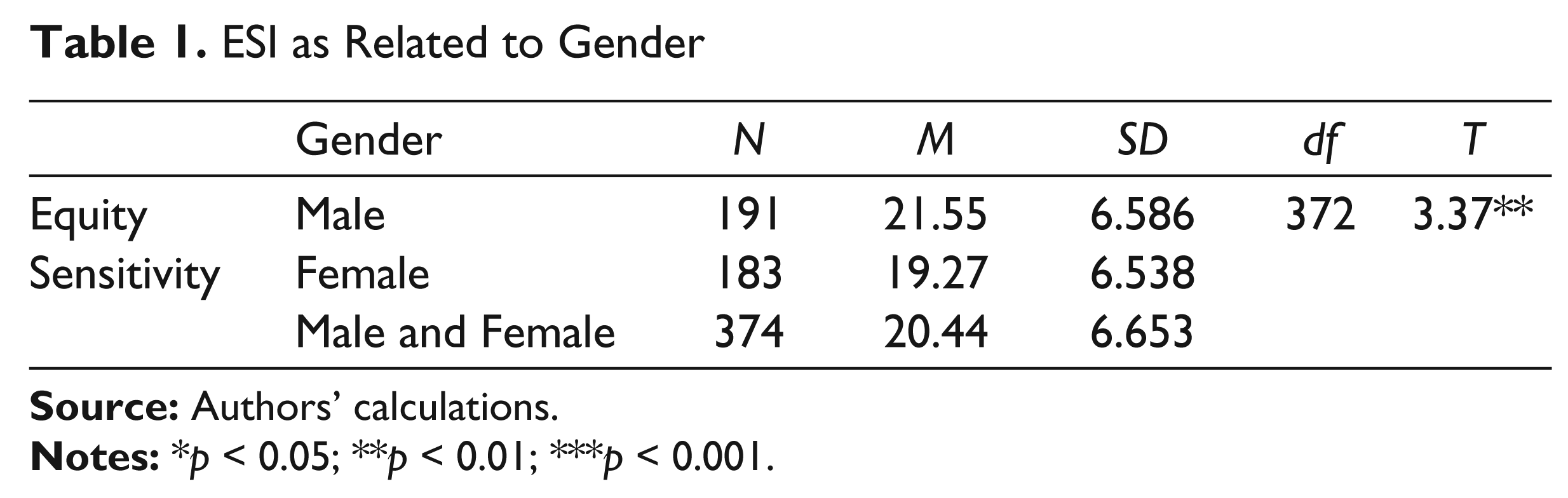
The first research question of the study was used to identify gender differences in individuals’ equity orientation. An independent sample t test was computed to detect if there was a significant difference in equity orientation between the male and female participants.
The test output shown in Table 1 indicates a significant difference in the mean equity sensitivity scores (T = 3.369, df = 372, p < 0.01) between the male and female participants.
ESI as Related to Gender
Using the ESI decision rule, ±one half of a standard deviation from the mean, the sample was divided into 95 benevolents, 159 equity sensitives and 120 entitleds (see Table 2).
Equity Orientation (Groups)

The remaining research questions and hypotheses of this study were designed to examine gender differences in response to two hypothetical scenarios of inequity. All nine responses were associated with the possible reactions that respondents would most likely have to each type of under-reward situation. The responses were the same for both scenarios. Table 3 depicts the results of independent sample t tests for both under-reward scenarios. The test results supported rejecting null hypotheses 2, 5, 6, 7, 8, 9, and 10 in scenario 1, and null hypotheses 6, 7, 8, and 9 in scenario 2. All of the hypotheses were tested based on a significance level of 0.5 or greater.
Hypotheses Tests: Scenarios 1 and 2

Discussion
The result indicated that the mean equity sensitivity score of both male and female Korean participants was significantly lower than the mean scores of earlier studies. For instance, the mean equity sensitivity score of the Central and Eastern European sample was 27.31 in 1996 (Mueller and Clarke, 1998) and the mean equity sensitivity score of the US sample was 29.14 (Allen and White, 2002). The mean equity sensitivity scores of the American and Japanese samples were 28.95 and 23.95 (Allen et al., 2005). This score indicates that Korean workers clearly depict entitled behaviour, and can be explained in terms of differences in culture. Allen et al. (2005) suggested that group harmony is the focal point of organisational and managerial objectives to manage their employees in a collectivist culture. Workers in a collectivist culture generally take necessary, sometimes blatant, actions to minimise perceived inequity within the group. The results of the present study and Allen et al. (2005) counter the results of Wheeler’s study in 2002. Wheeler (2002) found that collectivists tend to exhibit benevolent behaviours and individualists tend to show entitled behaviours.
The t test result of the first hypothesis to determine gender differences in equity sensitivity was the major finding of this study. The result indicated that Korean female workers were more entitled than the male workers. This significant gender difference contradicts the previous findings of male workers being more entitled than female workers. Prior to this study, Mueller and Clarke (1998) suggested that male participants, in general, had a higher propensity to an entitled response than female participants. It appears that the under-reward scenario 1, pay inequity, produced more significant gender differences than the scenario 2, workload inequity.
Because both male and female participants in Korea were entitleds and reacted strongly to scenario 1, pay inequity, the concepts of the equity sensitivity theory were supported. The test results indicated that only two hypotheses, hypothesis 3 and hypothesis 4, did not produce significant gender differences in both under-reward scenarios. Participants could indicate that they would increase their own pay, hypothesis 3, and make others work harder, hypothesis 4.
The test results showed that three hypotheses produced significant gender differences in scenario 1 but not in scenario 2; these were hypotheses 2, 5 and 10. Participants could indicate that they would reduce their effort, hypothesis 2, reduce other’s pay, hypothesis 5, and quit their jobs, hypothesis 10. The mean scores of female participants of all three hypotheses were higher than the mean scores of male participants in both scenarios. These results are consistent with the dimensions of equity sensitivity theory: ‘Entitleds tend to place more importance on tangible outcome’ (Allen and White, 2002, p. 446). The results of this study indicated that Korean participants were highly entitled, and the female participants felt significantly entitled than the male participants. Therefore, significant gender differences could be found more in the pay inequity scenario than in the workload inequity scenario.
The results of independent t tests showed significant gender differences in four hypotheses, 6, 7, 8 and 9, in both scenarios. The important aspect of these results was that the mean scores of hypotheses 6, 7 and 8 of male participants were higher than the mean scores of female participants in both scenarios, but the mean scores of hypothesis 9 of female participants were higher than the mean scores of male participants in both scenarios. The result of hypothesis 9 (transferring to another department in response to inequity) could be explained by the dimensions of equity sensitivity theory. Korean female participants, as highly entitleds, were significantly more likely to request transfer to another part of the organisation in response to inequity.
However, the results of hypothesis 6 (justify own pay), hypothesis 7 (justify other’s pay) and hypothesis 8 (change referent other) were highly significant. Allen et al. (2005) reported that hypothesis 6 and hypothesis 7 were the only two hypotheses that had significant gender differences, and the female participants of the Allen study were more likely to justify their own and other’s pay in response to inequitable situations than were the male participants. Allen et al. (2005) also suggested that Japanese women view gender-based inequities as a natural part of their lives. Comparing the results of this study and the study of Allen et al. (2005) revealed that Japanese and Korean women are highly collectivist, but Korean women are more entitled than are Japanese women. Consequently, the results of hypothesis 6 and hypothesis 7 are consistent with Korean women being highly entitled. The higher mean scores of male participants on hypothesis 8 could be explained by understanding that changing the referent other is one of the cognitive processes used to justify or rationalise inequity. Therefore, the lower mean scores of hypothesis 8 of Korean female participants, as highly entitleds, were consistent with the equity sensitivity theory.
Conclusion
Based on empirical evidence, the present study illustrates that gender differences in equity sensitivity exist between Korean males and females. Both Korean women and men were more entitled than women and men from other countries who had been included in earlier studies. The significant finding was that Korean female students were more entitled than Korean male participants and their behaviours as entitleds were consistent with the dimensions of equity sensitivity theory. The results of the present study support these propositions and provide strong evidence that gender and cultural differences are directly associated with the categories of equity sensitivity. Korean participants, as highly collectivist, were more oriented towards entitleds and would react strongly to pay inequity. Korean female participants were more entitled than the male participants and would more likely take overt actions to minimise dissonance created by pay inequity.
The findings imply that each organisation, especially those companies operating in foreign countries, needs to design an equitable and fair reward system carefully taking into consideration individual, gender and cultural differences and behaviours of employees. The findings of this study are significant not only to international managers but also to managers in cultures that are similar to Korea. However, the results of the present study and previous studies of this nature were exploratory and therefore limited in the ability to derive generalised conclusions. The most important result of the present study, that is, Korean female participants being more entitled than the male participants, may represent only a segment of the entire female working population, especially as the older and more experienced female working population is not as well educated as the participants of this study. The significant findings and limitations of this study merit further research to validate and resolve the issues. Future studies in different cultures based on gender differences, including a real working population as a sample and developing and using more realistic under-reward scenarios, are necessary to resolve the limitations of this study and to validate the present results.
Footnotes
Acknowledgements
Funding for this paper was provided by Namseoul University, South Korea.